bookmark_borderExtreme Rainfall–surge Hazard Risks

by Daniel Brouse

Most climate change models forecast rising sea levels as the predominant threat of a warming climate to flood risks. Though sea level rise is of great concern, so should be extreme rainfall.

Both the sea and air temperatures are rising. Warm air can hold more moisture than cool air. Warmer sea temperatures result in more evaporation. Warmer air can hold more moisture. The increased moisture in the air moves over land causing inland deluges.

Hurricane Ida in the summer of 2021 is a good example. Because of the 85 degrees Fahrenheit Gulf of Mexico ocean temperature, Ida rapidly gained strength right before it made landfall jumping from a Category 1 to a Category 4 storm. The warm air allowed more moisture to be carried as rain. The storm was so large that it was able to pick up more moisture from the Atlantic Ocean. The ocean moisture was carried inland and dumped over places like Pennsylvania and New York. Ida caused record flood damage in parts of Pennsylvania. The Philadelphia Inquirer reported, “The remnants of Hurricane Ida destroyed or damaged hundreds of homes in Southeastern Pennsylvania and caused more than $100 million in public infrastructure damage across the state.” There were more deaths in the Northeastern USA than where the storm made landfall in Louisiana. The New York Times reported, “The remnants of Hurricane Ida caused flash flooding and a number of deaths and disrupted transit across parts of New York and New Jersey. The storm killed at least 43 people in New York, New Jersey, Pennsylvania and Connecticut and left more than 150,000 homes without power.”

The Journal Nature published the study Tropical cyclone climatology change greatly exacerbates US extreme rainfall–surge hazard examining how current models underestimate the risk of Rainfall–surge Hazard. “Tropical cyclones (TCs) are drivers of extreme rainfall and surge, but the current and future TC rainfall–surge joint hazard has not been well quantified. Using a physics-based approach to simulate TC rainfall and storm tides, we show drastic increases in the joint hazard from historical to projected future (SSP5–8.5) conditions. The frequency of joint extreme events (exceeding both hazards’ historical 100-year levels) may increase by 7–36-fold in the southern US and 30–195-fold in the Northeast by 2100. This increase in joint hazard is induced by sea-level rise and TC climatology change; the relative contribution of TC climatology change is higher than that of sea-level rise for 96% of the coast, largely due to rainfall increases. Increasing storm intensity and decreasing translation speed are the main TC change factors that cause higher rainfall and storm tides and up to 25% increase in their dependence.”

From the article Rising Temperatures Bringing Bigger Floods published in the Journal Science, “CO2 emissions have boosted risk of intense precipitation and consequent flooding. To determine how rising temperatures have altered flood risk, atmospheric scientist Pardeep Pall of the University of Oxford in the United Kingdom and his colleagues ran thousands of climate simulations. In roughly half of them, they reduced atmospheric concentrations of carbon dioxide to levels measured in the year 1900, and they adjusted ocean temperatures and the amount of Arctic sea ice—which affects high-latitude weather patterns—accordingly. In the other simulations, they modeled modern conditions. Then they compared the rainfall amounts generated in both types of simulations. Finally, they fed the rainfall values into a model that assesses the potential for flooding. In 90% of the simulations, results suggested that the flood risk in England and Wales in autumn 2000 was at least 20% higher than it would have been in 1900.”

As the Earth warms, the air will hold more moisture. More moisture-laden air moves over land and creates atmospheric rivers (Pineapple Express). The Journal EOS in the article Atmospheric Rivers Spur High-Tide Floods on U.S. West Coast said, “Atmospheric rivers are narrow bands of moisture that travel across the lower troposphere, generally at the leading edges of massive low-pressure systems. At their peak, they can carry as much water through the sky as the Amazon River does on land. They unleash intense winds and heavy rain as they surge across the Pacific Ocean, eventually making landfall on the U.S. West Coast, contributing to many high-tide flooding events.”

The atmospheric rivers also bring heavy rainfall inland causing extreme flooding. In October of 2021 NOAA said, “a convergence of storms brought more than half a foot of rain to parts of the Bay area in addition to strong winds, flash floods, and mud/landslides. They also bring the potential for heavy snow to higher elevations in the Sierra Nevada mountain range.” (Atmospheric River Hits the West Coast)

More articles on Flood Insurance, Extreme Weather Events, Rising Sea Levels and Global Warming

bookmark_border26% Increase in US Flood Risk by 2050 Due to Climate Change

A study published in the Journal Nature, Inequitable patterns of US flood risk in the Anthropocene, models a 26.4% (24.1–29.1%) increase in US flood risk by 2050 due to climate change.

Flood Risk % Increase

“Our national depiction of comprehensive and high-resolution flood risk estimates in the United States indicates current average annual losses of US$32.1 billion (US$30.5–33.8 billion) in 2020’s climate, which are borne disproportionately by poorer communities with a proportionally larger White population. The future increase in risk will disproportionately impact Black communities, while remaining concentrated on the Atlantic and Gulf coasts. Furthermore, projected population change (SSP2) could cause flood risk increases that outweigh the impact of climate change fourfold. These results make clear the need for adaptation to flood and emergent climate risks in the United States, with mitigation required to prevent the acceleration of these risks.”

This study/model shows the heaviest impact on the Atlantic and Gulf coasts; however, as the Earth warms, the air will hold more moisture.
More moisture-laden air moves over land and creates atmospheric rivers (Pineapple Express). The Journal EOS in the article Atmospheric Rivers Spur High-Tide Floods on U.S. West Coast said, “Atmospheric rivers are narrow bands of moisture that travel across the lower troposphere, generally at the leading edges of massive low-pressure systems. At their peak, they can carry as much water through the sky as the Amazon River does on land. They unleash intense winds and heavy rain as they surge across the Pacific Ocean, eventually making landfall on the U.S. West Coast, contributing to many high-tide flooding events.”

The atmospheric rivers also bring heavy rainfall inland causing extreme flooding. In October of 2021 NOAA said, “a convergence of storms brought more than half a foot of rain to parts of the Bay area in addition to strong winds, flash floods, and mud/landslides. They also bring the potential for heavy snow to higher elevations in the Sierra Nevada mountain range.” (Atmospheric River Hits the West Coast)

More articles on Flood Insurance, Rising Sea Levels and Global Warming.

bookmark_border25% of Critical Infrastructure at Risk of Flooding

The First Street Foundation, a nonprofit research and technology group that assesses the threat posed by flooding across the country, released a report that found one-forth of critical infrastructure in the USA is at risk of flooding including: police and fire stations, hospitals, airports and wastewater treatment facilities.

“With an increasing number of flooding 1events making U.S. headlines, there is a greater awareness of the economic and human cost that
flood-damaged infrastructure can produce. For instance, Hurricane Sandy flooded hospitals, crippled electrical substations, overwhelmed waste water treatment centers, and shut down power and water to tens of millions of people (U.S. Senate Committee on Commerce, Science, and Transportation, 2012). More recently, the impact of Hurricane Ida stretched across the country crippling the electrical grid in southern Louisiana, flooding the transportation infrastructure in the NYC metro area, and killing nearly 100 people. It is clear, now more than ever, that the ways and places in which we live are likely to continue to be impacted by our changing environment. One of the most important implications in this development is the vulnerability of our national infrastructure.”

About 1/4 (2 million miles) of roads are already at risk of becoming impassable due to flooding.

“And as global warming melts ice sheets, raises sea levels and tilts the odds in favor of more extreme rainfall events, the risk will grow in many more communities, the First Street report found. Over the next 30 years, the number of residential properties at risk of flooding is expected to grow from 12.4 million today to 13.6 million by 2051, the report says. For critical infrastructure and commercial properties, the number of vulnerable facilities are projected to grow by 6% and 7% respectively over the next three decades,” said Drew Kann and Ella Nilsen.

Infrastructure Flood Risk

More articles on Flood Insurance, Rising Sea Levels and Global Warming.

bookmark_borderBiodiversity: Humanity Faces Catastrophic Losses of Aquatic Species and Habitats

by 570 Experts

More than 570 Experts from 97 Countries Urge United Nations to Strengthen Freshwater Biodiversity Protections

Humanity Faces Catastrophic Losses of Aquatic Species and Habitats
World leaders must prioritize urgent and targeted actions to protect and restore freshwater ecosystems and respect the rights of indigenous and marginalised communities disproportionately affected by these losses

It is often said that water is life. Our rivers, streams, lakes, and wetlands are teeming with an amazing array of aquatic life. Covering less than 1% of the Earth’s surface, freshwater ecosystems are home to more than 10% of all species, and they are also vital to terrestrial and ocean life. However, we have managed freshwater systems primarily to provide for human needs, resulting in highly manipulated and degraded aquatic systems. We have dammed and diverted rivers, filled and converted wetlands, eroded shorelines, polluted water, over-harvested freshwater fish and waterfowl, and introduced invasive species.

bookmark_borderThe Cost of Flood Insurance

An article in the New York Times entitled The Cost of Insuring Expensive Waterfront Homes Is About to Skyrocket states, “Federal officials say the goal is fairness — and also getting homeowners to understand the extent of the risk they face, and perhaps move to safer ground, reducing the human and financial toll of disasters.”

“Subsidized insurance has been critical for supporting coastal real estate markets,” said Benjamin Keys, a professor at the University of Pennsylvania’s Wharton School. Removing that subsidy, he said, is likely to affect where Americans build houses and how much people will pay for them. “It’s going to require a major rethink about coastal living.”

In 2019, FEMA said it would instead price flood insurance based on the particular risks facing each individual property, a change the agency called “Risk Rating 2.0.”

“With a rapidly escalating threat of natural disasters, Risk Rating 2.0 is a much needed and timely change,” said Laura Lightbody of Pew Charitable Trusts, which has pushed governments to better respond to climate threats. Higher insurance costs, she said, were “a reflection of our new, wet reality.”

“For the first time, our policyholder premiums will be based on their individual risk,” said David Maurstad, who runs the flood insurance program at FEMA. “We pledge to continue to evaluate and make adjustments where and when it’s warranted.”

But the growing threat of climate change may make that kind of intervention less successful, said Roy Wright, who ran the flood insurance program until 2018 and now runs the Insurance Institute for Business & Home Safety.

“We cannot hide the truth of this increasing risk,” Mr. Wright said. “We shouldn’t hide it. Tell people the truth.”

More articles on Flood Insurance, Rising Sea Levels and Global Warming.

bookmark_borderClimate Change: Code Red for Humanity

The UN’s IPCC (Intergovernmental Panel on Climate Control) release their latest report that has been compiled and peer-reviewed over the last 8 years.

U.N. Secretary-General, António Guterres described the report as “a code red for humanity.”

“The alarm bells are deafening, and the evidence is irrefutable: greenhouse gas emissions from fossil fuel burning and deforestation are choking our planet and putting billions of people at immediate risk,” said Mr. Guterres.

Some of the changes already set in motion will be “irreversible” for centuries to come.

A press release from the IPCC states:

The report provides new estimates of the chances of crossing the global warming level of 1.5°C in the next decades, and finds that unless there are immediate, rapid and large-scale reductions in greenhouse gas emissions, limiting warming to close to 1.5°C or even 2°C will be beyond reach.

The report shows that emissions of greenhouse gases from human activities are responsible for approximately 1.1°C of warming since 1850-1900, and finds that averaged over the next 20 years, global temperature is expected to reach or exceed 1.5°C of warming. This assessment is based on improved observational datasets to assess historical warming, as well progress in scientific understanding of the response of the climate system to human-caused greenhouse gas emissions.

“This report is a reality check,” said IPCC Working Group I Co-Chair Valérie Masson-Delmotte. “We now have a much clearer picture of the past, present and future climate, which is essential for understanding where we are headed, what can be done, and how we can prepare.”

Every region facing increasing changes

Many characteristics of climate change directly depend on the level of global warming, but what people experience is often very different to the global average. For example, warming over land is larger than the global average, and it is more than twice as high in the Arctic.

“Climate change is already affecting every region on Earth, in multiple ways. The changes we experience will increase with additional warming,” said IPCC Working Group I Co-Chair Panmao Zhai.

The report projects that in the coming decades climate changes will increase in all regions. For 1.5°C of global warming, there will be increasing heat waves, longer warm seasons and shorter cold seasons. At 2°C of global warming, heat extremes would more often reach critical tolerance thresholds for agriculture and health, the report shows.

But it is not just about temperature. Climate change is bringing multiple different changes in different regions – which will all increase with further warming. These include changes to wetness and dryness, to winds, snow and ice, coastal areas and oceans. For example:

* Climate change is intensifying the water cycle. This brings more intense rainfall and associated flooding, as well as more intense drought in many regions.
* Climate change is affecting rainfall patterns. In high latitudes, precipitation is likely to increase, while it is projected to decrease over large parts of the subtropics. Changes to monsoon precipitation are expected, which will vary by region.
* Coastal areas will see continued sea level rise throughout the 21st century, contributing to more frequent and severe coastal flooding in low-lying areas and coastal erosion. Extreme sea level events that previously occurred once in 100 years could happen every year by the end of this century.
* Further warming will amplify permafrost thawing, and the loss of seasonal snow cover, melting of glaciers and ice sheets, and loss of summer Arctic sea ice.
* Changes to the ocean, including warming, more frequent marine heatwaves, ocean acidification, and reduced oxygen levels have been clearly linked to human influence. These changes affect both ocean ecosystems and the people that rely on them, and they will continue throughout at least the rest of this century.
* For cities, some aspects of climate change may be amplified, including heat (since urban areas are usually warmer than their surroundings), flooding from heavy precipitation events and sea level rise in coastal cities.

For the first time, the Sixth Assessment Report provides a more detailed regional assessment of climate change, including a focus on useful information that can inform risk assessment, adaptation, and other decision-making, and a new framework that helps translate physical changes in the climate – heat, cold, rain, drought, snow, wind, coastal flooding and more – into what they mean for society and ecosystems.

This regional information can be explored in detail in the newly developed Interactive Atlas interactive-atlas.ipcc.ch as well as regional fact sheets, the technical summary, and underlying report.

Human influence on the past and future climate

“It has been clear for decades that the Earth’s climate is changing, and the role of human influence on the climate system is undisputed,” said Masson-Delmotte. Yet the new report also reflects major advances in the science of attribution – understanding the role of climate change in intensifying specific weather and climate events such as extreme heat waves and heavy rainfall events.

The report also shows that human actions still have the potential to determine the future course of climate. The evidence is clear that carbon dioxide (CO2) is the main driver of climate change, even as other greenhouse gases and air pollutants also affect the climate.

“Stabilizing the climate will require strong, rapid, and sustained reductions in greenhouse gas emissions, and reaching net zero CO2 emissions. Limiting other greenhouse gases and air pollutants, especially methane, could have benefits both for health and the climate,” said Zhai.

More on The Human Induced Climate Change Experiment

bookmark_borderClimate Change: Past the Tipping Point

A group of scientists known as Polarstern team spent the last year drifting through the arctic. “The disappearance of summer sea ice in the Arctic is one of the first landmines in this minefield, one of the tipping points that we set off first when we push warming too far,” Markus Rex (one of the 300 scientists from 20 countries) said. “And one can essentially ask if we haven’t already stepped on this mine and already set off the beginning of the explosion. Arctic Ocean ice had retreated faster in the spring of 2020 than since the beginning of records. The spread of the sea ice in the summer was only half as large as decades ago. Only evaluation in the coming years will allow us to determine if we can still save the year-round Arctic sea ice through forceful climate protection or whether we have already passed this important tipping point in the climate system.”

Al Jazeera reports, “Stefanie Arndt, who specialises in sea ice physics, said it was ‘painful to know that we are possibly the last generation who can experience an Arctic which still has a sea ice cover in the summer.”‘

More on Climate Change

bookmark_borderRising Sea Level Turning New Jersey Cedars into Ghost Forests

The New Jersey Department of Environmental Protection released the “New Jersey’s Coastal Community Vulnerability Assessment” ccvamp-final

The sea level is rising faster than forecast. Saltwater intrusion is a current and severe problem. The United States Geological Survey reports, “Saltwater intrusion has occurred to some degree in many of the coastal aquifers of the United States. Since saltwater cannot be used to irrigate crops or be consumed by people, saltwater intrusion can be very problematic to coastal communities that rely on fresh groundwater supplies for the livelihood.”

In New Jersey, saltwater intrusion is killing thousands of Atlantic White Cedar trees and turning the acreage into “ghost forests”.

Ghost Forest / Photo credit: Frank Kummer

The Human Induced Climate Change Experiment

bookmark_borderCoastal Real Estate Financial Crisis

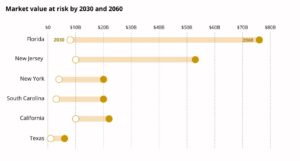
The rising sea level is putting a trillion dollars of real estate at high risk.

“The question is no longer if rising seas will erode coastal home values, but who will get stuck with the devalued assets when the markets turn,” reported Dee Gill.

“Alarmingly, more than half of that (at-risk property) exposure is estimated to lie outside FEMA flood zones. That means those properties are at higher risk of being underinsured, and, therefore, the loans attached to them are at higher risk of impairment, with increased risk for the value of the related CMBS (securities).” —CFTC

Market Value at Risk of Flooding

“Fannie and Freddie carry about $5.6 trillion in assets, mainly home mortgages and related securities. Ultimately, taxpayers backstop the payments on loans under the agencies’ control, UCLA’s Yu explains. Their regulator, the Federal Housing Finance Agency, issued a request for information in January, in part to assess flood risks. The entities require flood insurance that might mitigate their losses only on properties inside FEMA’s poorly drawn flood zones. Coverage limits imposed by NFIP — $250,000 for the structure and $100,000 for personal property — mean many coastal homes that have coverage are grossly underinsured.” — UCLA / Is the $1 Trillion Coastal Housing Market a Future Financial Crisis?

BlackRock, the G20-backed Financial Stability Board and the U.S. Commodity Futures Trading Commission are voicing concerns about unflagged flood risks squirreled away in mortgage-backed securities, bond markets and other real estate-backed investments. Common themes: The exact size of exposure is elusive but big; markets don’t currently price for it; these assets pose a threat to the stability of the global financial system.

More on Flood Insurance and Real Estate Risk

bookmark_borderCOVID-19: A Survivor’s Story

by Daniel Brouse

(Also see the update: 3 Years of Living With It)

I am a scientist and journalist publishing articles and papers since 1994. As part of a collective of scientists, we have been working on the greatest threat to humankind — humans. Much of my effort has been spent on Anthropogenic Climate Change. In addition, I have specialized in pollution, diseases, health and wellness.

In late December 2019 and early January 2020, I started studying a novel coronavirus discovered in Wuhan, China. My first paper on the subject was published in March 2020 entitled “COVID-19 and Air Pollution”.

In late January of 2020, I had been very ill with an upper respiratory illness. The same illness killed my father. At the time, COVID-19 had not been known in the USA. Since there was no test for COVID, the doctors could not diagnose the specific virus that caused my father’s death. It wasn’t until my recurring symptoms were diagnosed as “COVID Long Haulers” in May of 2020 that I knew I was suffering the aftermath of COVID-19.

The recurring symptoms were so concerning that I devoted all of my resources to studying COVID-long and searching for a cure. Every couple of weeks I went through a wave of symptoms. Though not as severe as the original illness, the symptoms still would render me useless. The symptoms did not come on all at the same time, rather they would cycle through over two weeks (not necessarily in the same order) and then repeat. Exercise and exertion would cause the symptoms to be more severe. The symptoms included:

* difficulty breathing (feeling like you’re not taking in enough oxygen)
* congestion / mild cough
* stomach issues / diarrhea
* loss of taste, smell, and appetite
* temperature regulation / night sweats
* nightmares / vivid dreams
* dizziness / the spins / foggy thinking
* headaches / body aches / soreness
* fatigue
* ear aches
* peripheral neuropathy (tingling of the hands and feet)

My concerns were several. Would the symptoms go away over time? As the months went on, the answer was no. Would the long term recurrence of systems cause a permanent disability? The answer is probably yes. My organs were sustaining progressive damage. Respiratory, circulatory, neurological, and renal damage, as well as, blood clots, thinning and leaky blood vessels in the brain tissue, and death have all been attributed to COVID and COVID-long.

In my pursuit of answers, I found another long hauler scientist, Dr. Ade Wentzel. Ade proved to me that my hypothesis of “COVID-19 Long Haulers: autoimmune response due to inactive particles of the virus” was incorrect. Rather, he demonstrated that sars-cov-2 causes COVID-19 Induced Secondary Pellagra (CISP).

The main culprit is believed to be COVID’s genetic change to our production and utilization of NAD+ (nicotinamide adenine dinucleotide). NAD+ is involved in cell creation, maintenance, metabolism, and regulating cell processes. COVID can chronically increase the breakdown of NAD+ and simultaneously decrease the production of NAD+.

Ade added, “The biggest function of NAD+ is as a cofactor for energy(atp) production via the citric acid cycle. NAD+ is essential for carbohydrate metabolism. The brain being highly dependent on carbs.”

NAD+ and the Citric Acid Cycle

Ade introduced me to one of the co-authors of his research, Robert Miller. In October of 2020, Ade and Robert started me on “the stack”. The vitamin stack helps correct the NAD+ malady by treating COVID-19 Induced Secondary Pellagra. Finding the correct form and dosage of Niacin was the most challenging part.

Within days of starting the stack, my COVID-long symptoms dissipated. Since that time, I have remained relatively symptom free EXCEPT when I tried reducing the Niacin dosage. On three separate occasions, I experimented with reducing the dosage of Niacin. All three times my symptoms returned; therefore, I would call the stack a treatment not a cure.

Since that time, I have successfully helped thousands of other COVID-long victims with the stack.

At the end of April, I received my first dose of the Moderna vaccine. Loss of taste and muscle soreness symptoms returned for 24 hours and then disappeared. My overall wellness appears to have improved. Now, I’m experimenting with reducing my Niacin dosage again to see if the vaccine helped my body recover its ability to produce and retain NAD+.

After several days of reduced Niacin (nicotinic acid dosage was reduced from 300-500mg/day down to 0-30mg day), symptoms returned: neuropathy, fatigue, brain fog, muscle soreness, difficulty breathing, GI track / stomach issues, ear aches, and allergy-like symptoms. The most notable symptom to return — headaches. Prior to COVID, I did not experience headaches. Within days of decreasing the dosage, a chronic headache returned. I increased the Niacin dosage back to 500mg/day and supplemented the stack with resveratrol. Symptoms immediately dissipated.

After the second shot, side-effects were slightly worse. The metallic taste returned within a couple hours. For the 12-24 hours post-vaccination, there was dizziness, nausea, and fatigue. Then, all the side-effects disappeared. Three months after being fully vaccinated all of my presenting symptoms dissipated. Other “silent” post COVID conditions have persisted since the initial infection.

See the update: 3 Years of Living With It

CISP and The Stack

MORE ON COVID: COVID-19 / SARS-CoV-2 / Novel Coronavirus