bookmark_borderNational Flood Insurance Program Increasing Rates

FEMA is updating the National Flood Insurance Program’s (NFIP) risk rating methodology through the implementation of a new pricing methodology called Risk Rating 2.0. The methodology leverages industry best practices and cutting-edge technology to enable FEMA to deliver rates that are actuarily sound, equitable, easier to understand and better reflect a property’s flood risk.

The Bradenton Herald reports, “More than a million Floridians will see their flood insurance premium rise next year, FEMA said Thursday.

The good news is, most will see increases of less than $120 a year. The bad news is that homeowners will likely see annual rate hikes like that for the foreseeable future.

The new strategy is meant to help pull the program out of its $20 billion debt and encourage people to live in safer, less flood-prone homes.

The new program will stop charging flood insurance premiums based solely on whether a home is within or outside of a flood zone and instead consider a range of factors like distance from the ocean, rainfall flooding and the cost to rebuild a home.

Starting April 2022, this pricing revamp will lead to higher prices for a majority of Florida’s 1.7 million policyholders — the most of any state — as well as a decrease for about 20% of policies, more than 340,000 policyholders.

“It allows us to set accurately sound rates and communicate flood risk better than we ever have before,” David Maurstad, senior executive of FEMA’s National Flood Insurance Program.

More articles on Flood Insurance, Rising Sea Levels and Global Warming.
bookmark_borderIncreasing Cost and Risk of Flood Insurance

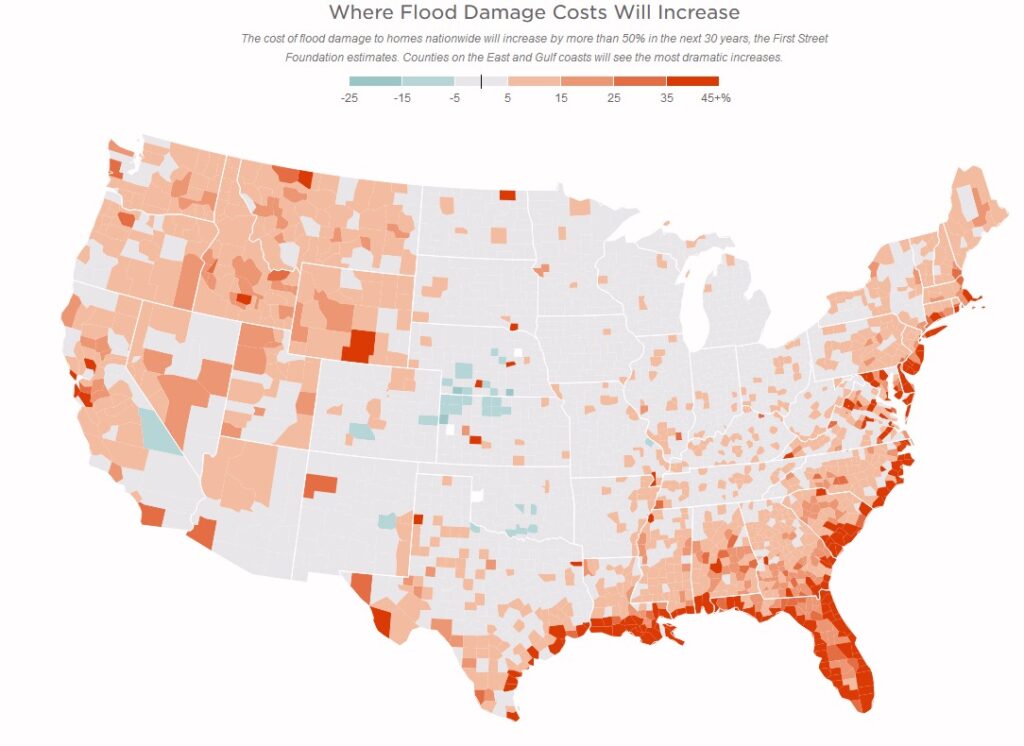
The cost of flood damage to homes nationwide will increase by more than 50% in the next 30 years, the First Street Foundation estimates.

Flood Insurance Forecast

A report by NPR radio, A Looming Disaster: New Data Reveal Where Flood Damage Is An Existential Threat, found:
The federal government provides the vast majority of residential flood insurance in the U.S. Most policies are underpriced relative to the actual cost of flood damage.

The new data show that flood insurance rates would need to more than quadruple to keep up with the costs of climate-driven flooding. The Federal Emergency Management Agency is already preparing to raise insurance premiums in many places later this year in an effort to save the National Flood Insurance Program, which has accrued more than $36 billion in debt.

FEMA warns that the First Street Foundation’s analysis is only an estimate and that FEMA didn’t provide the research group with details about the new flood insurance pricing plan, known as Risk Rating 2.0.

“Any entity claiming that they can provide insight or comparison to the Risk Rating 2.0 initiative, including premium amounts, is misinformed and setting public expectations that are not based in fact,” writes David Maurstad, the senior executive of the National Flood Insurance Program, in an email to NPR. “While entities are free to suggest or estimate their opinion of what flood insurance premiums should be, they are offering exactly that — an opinion — and they do not have insight into the Risk Rating 2.0 initiative.”

For homeowners who are currently underpaying for flood insurance, FEMA says it plans to raise rates by up to 18% each year until the price is accurate, according to a January report by the Congressional Research Service. The agency will begin rolling out the new pricing in October.

As the cost of insurance goes up, many people who need flood insurance will likely be unable to afford it, leaving them to face lasting damage. Research has found that disasters can erode family stability and exacerbate mental and physical ailments when people don’t have the money they need to repair their homes.

“If you don’t have the finances you need to recover, then families have to make really difficult trade-offs, like maybe forgo spending on medical expenses because otherwise you don’t have a safe home,” says Carolyn Kousky, the executive director of the Wharton Risk Management and Decision Processes Center at the University of Pennsylvania.

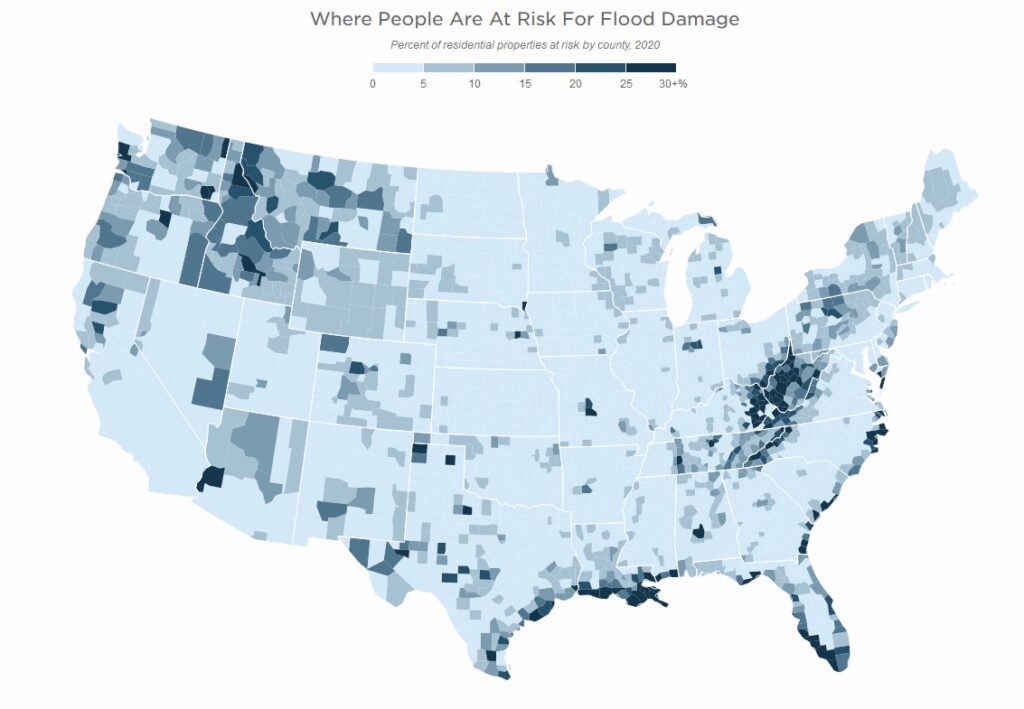
Flood Damage Risk
Flood Damage Risk
Flood Damage Cost
Flood Damage Cost

More articles on Flood Insurance, Rising Sea Levels and Global Warming.
bookmark_borderIncreasing Cost of Flood Insurance

“Increased awareness of flood risk and rising future insurance costs impact perceptions of value, which will impact real estate markets,” said Matthew Eby, founder and executive director of First Street Foundation.

First Street Foundation published a report that concludes: “Rising sea levels and extreme weather could cause $20 billion of flood damage to at-risk U.S. homes this year, rising to $32 billion (per year) by 2051.”

First Street Foundation Flood Insurance Forecast

“Roughly 4.3 million homes – concentrated in Florida, California, South Carolina and Texas – have a substantial risk of sustaining economic damage from flooding this year, the report shows. The majority are not required by the U.S. government to have flood insurance. Were all of them to buy federal insurance, National Flood Insurance Program (NFIP) rates would need to increase 4.5 times to cover the risk, according to the report. The current average NFIP premium for these 4.3 million homes is $981,” reports Kate Duguid of Reuters.

More articles on Flood Insurance, Rising Sea Levels and Global Warming.

bookmark_borderThe Cumulative Costs of Climate Change

“The crisis carries a profound warning. As climate change brings more frequent and intense storms, floods, heat waves, wildfires and other extreme events, it is placing growing stress on the foundations of the country’s economy: Its network of roads and railways, drinking-water systems, power plants, electrical grids, industrial waste sites and even homes. Failures in just one sector can set off a domino effect of breakdowns in hard-to-predict ways,” as reported by The New York Times in the article Texas Blackouts Point to Coast-to-Coast Crises Waiting to Happen.

“We are colliding with a future of extremes,” said Alice Hill, who oversaw planning for climate risks on the National Security Council during the Obama administration. “We base all our choices about risk management on what’s occurred in the past, and that is no longer a safe guide.”

“Sewer systems are overflowing more often as powerful rainstorms exceed their design capacity. Coastal homes and highways are collapsing as intensified runoff erodes cliffs. Coal ash, the toxic residue produced by coal-burning plants, is spilling into rivers as floods overwhelm barriers meant to hold it back. Homes once beyond the reach of wildfires are burning in blazes they were never designed to withstand.”

“I am extremely concerned by the lack of emergency-management expertise reflected in Biden’s climate team,” said Samantha Montano, an assistant professor at the Massachusetts Maritime Academy who focuses on disaster policy. “There’s an urgency here that still is not being reflected.”

A White House spokesman, Vedant Patel, said in a statement, “Building resilient and sustainable infrastructure that can withstand extreme weather and a changing climate will play an integral role in creating millions of good paying, union jobs” while cutting greenhouse gas emissions.

“All these issues are converging,” said Robert D. Bullard, a professor at Texas Southern University who studies wealth and racial disparities related to the environment. “And there’s simply no place in this country that’s not going to have to deal with climate change.”

bookmark_borderFlood Factor: Estimate Flood Insurance Risk by Address

Flood Factor allows you to enter a property address to determine the future risk of severe flooding.

Access data calculated by a team of more than 80 world-renowned experts using decades of peer-reviewed research.

Over 142 million properties, neighborhoods, and cities analyzed
View any home’s Flood Factor and understand what can be done to protect it from flooding.

>FEMA Current Flood Maps by Address
Whether you are in a high risk zone or not, you may need flood insurance because most homeowners insurance doesn’t cover flood damage. If you live in an area with low or moderate flood risk, you are 5 times more likely to experience flood than a fire in your home over the next 30 years. For many, a National Flood Insurance Program’s flood insurance policy could cost less than $400 per year. Call your insurance agent today and protect what you’ve built.

More articles on Flood Insurance, Rising Sea Levels and Global Warming.

bookmark_borderDaniel Brouse: About the Author

Q: Any background on membrane .com?

A: In 1994, I started a publishing company with another scientist (low temperature physicist and co-builder of the Ohio States supercomputer). The name of the publishing company is The Philadelphia Spirit Experiment. As the name suggests, it is a scientific experiment in the publishing of arts and science. At the time, domain names were free and the world wide web was 6 months old. We wanted a name that both rhymed and made a good scientific pun — everything passes through the Membrane Domain. The KingArthur.com anti-IQ test launched in 1995.

We were the first record company, fine arts, science, technology, math, and engineering publisher on the web. As such, we were the first to analize web traffic. Our monthly audience is over 300 million. Innovations include: the clickable button on a webpage, MP3 distribution, pay-per-download, free streaming music, the web-based video… and interactive games to save the planet (including a $1,000,000 prize to solve the Anthropogenic Global Warming problem.

My areas of expertise include: musicology, geology, meteorology, anthropology, biology, health & wellness, sociology, security, climate change, physics, finance, economics, statistics, computer science, data science, chaos theory, political science, publishing, logic, and philosophy. In general, my aptitude is in science, technology, engineering, and math.

— Daniel Brouse

bookmark_borderDroughts and Rising Sea Levels

“There has been a 500% increase in the US drought area,” said Al Roker of the Today show while reporting on 2020 being tied for the hottest year.

The Washington Post reports, “Drought is the sleeper weather story you’ll hear more about in 2021.” [1}

“The impact of desertification is intensifying due to climate change, which is reducing the availability of freshwater, fertile soil, and forest and vegetation. As the degraded land loses value, investments in agriculture and rural development decline even more.” — Ban Ki-moonUnited Nations Secretary-General [2}

This doesn’t have to do with drought episodes. It has to do with areas prone to having droughts. As the area of land that is prone to flooding is increasing exponentially, so too is the land prone to severe, long term drought. We make it even worse by pumping ground water out for agriculture. This depletes the aquifers. The result is sinking land and rising sea levels. The depleted fresh water is then intruded by salt water. Salt water intrusion has a severe impact on the world food supply.

So, you have rising seas above and below the land. Compounding the problem — water expands when it gets warmer. About 1/3 of the rise in sea level is due to thermal expansion of water. [Volumetric Thermal Expansion] The warmer sea water also melts sea ice. The ocean doesn’t reflect the energy the way ice does. In fact just he opposite, the ocean absorbs the heat… making the water warmer… melting more sea ice…. and warming the planet. Which melts the land ice, which raises the sea level. A vicious feedback cycle of fresh water depletion and sea level rise has been created.

Climate change is making weather events more extreme and more frequent. More severe droughts, more severe floods, etc. Energy is being added to the system. “Climate change increases the odds of worsening drought in many parts of the United States and the world in the decades ahead. A changing climate can also alter atmospheric rivers (narrow streams of moisture transported in the atmosphere), which can especially disrupt precipitation patterns in the Western United States. Droughts can persist through a “positive feedback,” where very dry soils and diminished plant cover can further suppress rainfall in an already dry area.” [3]

“Risks from desertification are projected to increase due to climate change (high confidence). The combination of pressures coming from climate variability, anthropogenic climate change and desertification will contribute to poverty, food insecurity, and increased disease burden (high confidence).” [4]

1. Drought is the sleeper weather story you’ll hear more about in 2021. (The Washington Post)
2. DESERTIFICaTION (United Nations)
3. Drought and Climate Change (Center for Energy and Climate Solutions)
4. SPECIAL REPORT: Climate Change and Land Desertification (International Panel on Climate Change)

bookmark_borderYou Can Not Fight the Rising Tide

aA “Built atop spongy marsh and old tidal creeks filled with sawdust”
A report by Yale School of the Environment found cities are going to lose the costly battle to hold back the sea.

“It’s a nightmare,” says Ana Zimmerman, who moved her family to higher ground after her James Island home flooded twice.

“wall-off the historic downtown with an 8-mile-long seawall that would cost nearly $2 billion. ”

“In Miami, the Army Corps is studying a 13-foot-high flood wall … Most of the estimated $8 billion price tag would be covered by federal taxpayers … ”

“In Galveston, Texas, the Corps has proposed placing a massive Dutch-style surge gate … estimated cost has ballooned from $2 billion to $37 billion ”

“In New Jersey, the Corps last year published a preliminary plan … Cost estimates range from several billion dollars up to $15 billion.”

“In New York, the Corps proposed building a huge seawall across Lower Manhattan … somewhere between $62 billion and $119 billion”

“In America, we have yet to come to terms with the fact that climate change tells us there are some places where growth is no longer possible.”

“a big wall of distraction”

“Miamians seem to have this horrible concept of permanence of place, even though Miami has only been around a hundred years ”

” the National Flood Insurance Program, which is $20 billion in debt”

“Americans keep flocking to the coast, and builders keep accommodating them. ”

“We’re continuing with more building on a peninsula that’s sinking”

More articles on Flood Insurance, Rising Sea Levels and Global Warming.

bookmark_borderSea Level Rise and Real Estate

In the research paper, Sea level rise and coastal flooding threaten affordable housing, the authors explain how vast sections of real estate will become uninhabitable in the near future.

Sea Level Rise Impact on Housing

About Flood Insurance

Do I Need Flood Insurance?
Flood Risks Across the USA Seriously Underestimated
Climate Change: Suspension Of Belief
Climate Denial and Climate Change Change
Underwater: Sea Level Rise
Disaster on the Horizon: The Price Effect of Sea Level Rise
Climate Change And Credit
Real Estate and the Rising Sea Level


bookmark_borderResidential Real Estate Flood Risk Information

Do you know if you need flood insurance? Do you know if you have flood insurance? What happens when your house gets flooded?

Flood risk information has not been readily available to the average consumer. Climate change is making your flood risk drastically increase.

Now, one of the major real estate databases (Realtor.com) is making flood information available to the public.

In the NPR story, Major Real Estate Website Now Shows Flood Risk. Should They All?, experts explain the trend.

“People are buying property with little knowledge of whether it’s going to flood or not,” says Harriet Festing, co-founder of the advocacy group Higher Ground, which connects people across the country who have survived floods. “It ruins lives.”

Millions of buyers risk overpaying for homes likely to be hit with a natural disaster over the course of a 30-year mortgage. But representatives for other realty sites say home sellers are reluctant to publish flood risk information, since it could decrease their home’s value.

What you need to know about flood insurance and your home.