bookmark_borderThe United States and the 1.5°C Climate Tipping Point Crisis

by Daniel Brouse and Sidd Mukherjee

Overview

The United States bears an oversized responsibility for the climate crisis through its enormous historical contribution to greenhouse gas emissions. Yet U.S. climate policy is moving backward while Earth’s interconnected climate systems are destabilizing.

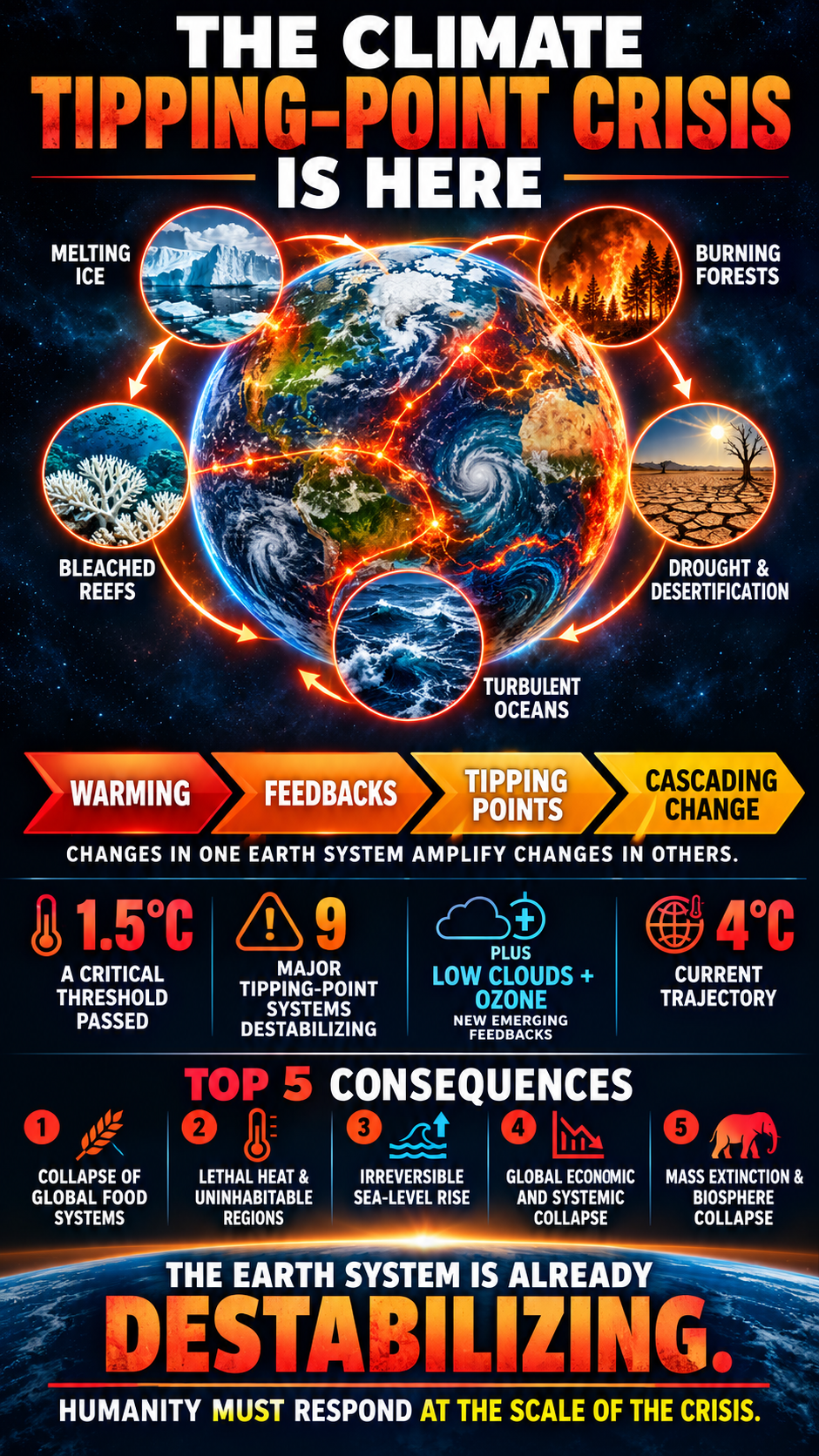
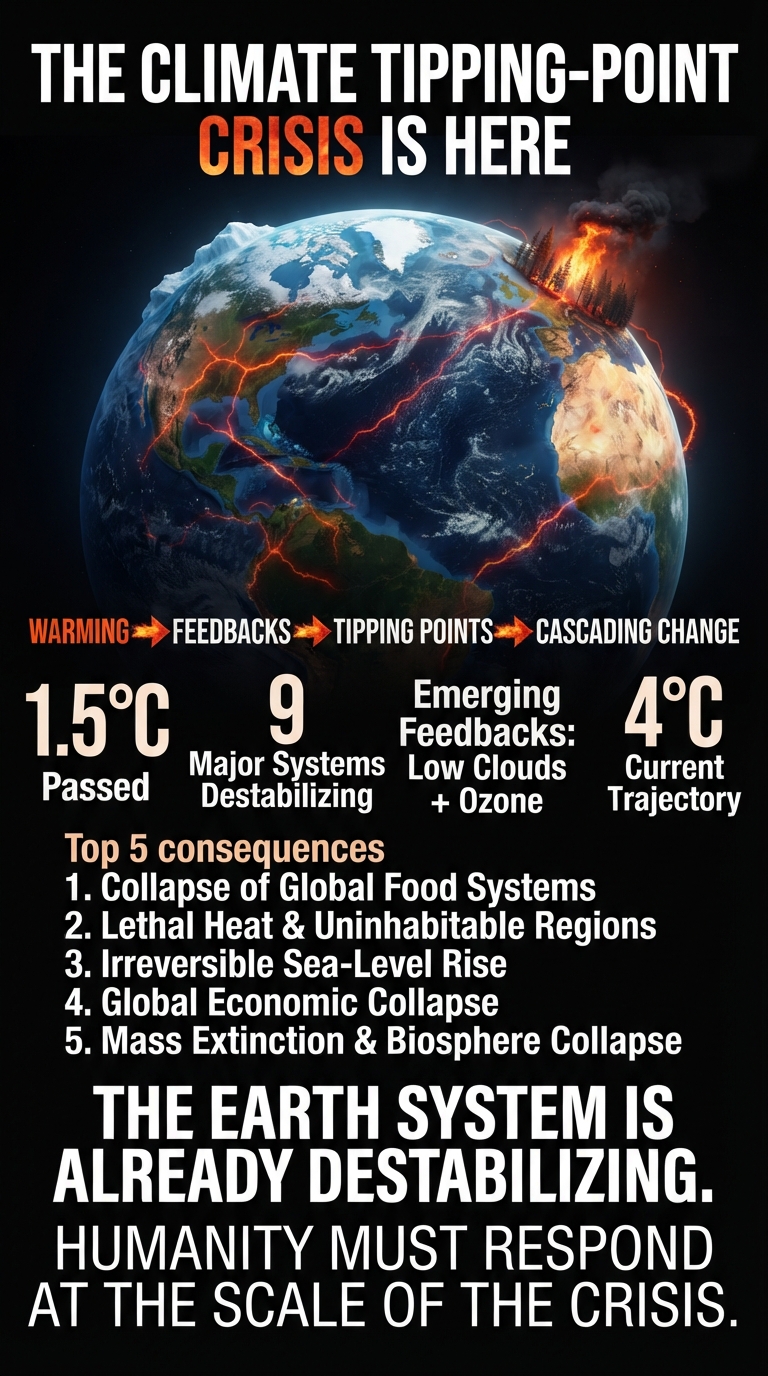
THE CLIMATE TIPPING-POINT CRISIS IS HERE.

Warming is no longer just a matter of rising temperatures. It is activating feedbacks that amplify changes across interconnected Earth systems, accelerating a climate domino effect.

WARMING → FEEDBACKS → TIPPING POINTS → CASCADING CHANGE

When one system destabilizes, it changes the conditions affecting others. Melting ice reduces Earth’s reflectivity. Thawing permafrost releases greenhouse gases. Forest degradation weakens natural carbon sinks. Declining low-level clouds and tropospheric ozone add further warming pressure.

THE KEY FACTS

  • 1.5°C — A critical climate threshold already crossed in individual years.
  • 9 major climate tipping-point systems — Already exhibiting destabilization.
  • LOW CLOUDS + OZONE — Emerging feedbacks intensifying the climate challenge.
  • 4°C — The severe warming trajectory examined in this analysis for this century.

THE TOP FIVE CONSEQUENCES

  1. Collapse of Global Food Systems
  2. Lethal Heat and Uninhabitable Regions
  3. Irreversible Sea-Level Rise
  4. Global Economic and Systemic Collapse
  5. Mass Extinction and Biosphere Collapse

These are interconnected threats. Food insecurity, extreme heat, coastal inundation, economic disruption, and ecological collapse reinforce one another, placing human civilization and natural ecosystems under mounting pressure.

THE EARTH SYSTEM IS ALREADY DESTABILIZING.

The climate crisis is not simply a future problem. Observed changes are already underway, and interconnected feedbacks threaten to amplify their consequences. Political delay and continued emissions deepen the challenge.

HUMANITY MUST RESPOND AT THE SCALE OF THE CRISIS.

Read the full paper for the scientific framework, emerging feedbacks, climate tipping points, and consequences of a high-warming trajectory.

#ClimateChange #ClimateTippingPoints #GlobalWarming #ClimateScience #ClimateAction

Crossing 1.5°C: The Tipping Points Are Already Activating

The significance of crossing the 1.5°C global warming threshold extends far beyond a numerical temperature target. This threshold marks a critical boundary for the activation of major climate tipping points. At least nine major tipping-point systems are already exhibiting destabilization, with activation beginning below 1.5°C of global warming.

Other major tipping points associated with warming between 1.5°C and 2°C are also experiencing periods of activation. These observations demonstrate that the climate system is already undergoing fundamental changes as interconnected feedback processes intensify.

According to the UN Environment Programme (UNEP) and the Copernicus Climate Change Service, the long-term global average surface temperature has risen approximately 1.4°C above pre-industrial levels (1850–1900). Understanding this figure requires distinguishing sustained warming from individual annual temperature records.

1. Long-Term Warming: Approximately 1.4°C

To assess the Paris Agreement’s 1.5°C threshold, scientists examine long-term temperature averages rather than treating a single unusually warm year as proof of a sustained breach. A 20-year average smooths temporary fluctuations associated with natural climate variability, including El Niño.

By this long-term measure, global warming stands at approximately 1.4°C. The world is approaching the threshold associated with increasingly widespread and consequential climate tipping-point activation.

2. Annual Temperature Records: 1.55°C

Individual calendar years have already exceeded 1.5°C of warming.

In 2024, the global average surface temperature reached approximately 1.55°C above the pre-industrial baseline, making it the hottest year in the instrumental record. Human-caused greenhouse gas emissions, combined with natural climate variability, contributed to this record.

The 1.5°C threshold is therefore no longer merely a distant benchmark. Annual global temperatures have already crossed it, while long-term warming continues to approach the same boundary.

Once tipping points activate, self-reinforcing feedback processes intensify changes within the climate system. These processes connect warming to additional warming, accelerating the redistribution of energy throughout the atmosphere, oceans, cryosphere, and biosphere.

Nine Major Climate Tipping-Point Systems Undergoing Destabilization

A landmark synthesis published in Nature by leading international scientists identifies nine major climate tipping-point systems exhibiting destabilization. These systems have moved beyond abstract future concerns: measurable changes are occurring across interconnected components of the Earth system.

The Cryosphere: Ice Masses and Frozen Ground

Greenland Ice Sheet: Accelerating surface melting threatens the long-term stability of the ice sheet. Crossing its tipping threshold commits the planet to eventual, irreversible sea-level rise of approximately seven meters.

West Antarctic Ice Sheet: Marine ice-sheet instability is intensifying as warming ocean waters melt glaciers from below, undermining the structural stability of the ice sheet.

Parts of East Antarctica: Major subglacial basins are showing signs of accelerated ice loss, challenging earlier assumptions about the stability of these regions.

Arctic Sea Ice: Arctic sea ice is rapidly declining in extent and thickness. This loss reduces Earth’s albedo, or reflectivity, allowing the ocean to absorb more incoming solar energy and amplifying regional and global warming.

Permafrost: Abrupt thaw is occurring across northern latitudes. Decomposition of previously frozen organic material releases carbon dioxide and methane, adding greenhouse gases to the atmosphere and strengthening warming feedbacks.

Ocean and Atmospheric Circulation

Atlantic Meridional Overturning Circulation (AMOC): This major system of Atlantic Ocean currents, which includes the Gulf Stream, is experiencing substantial disruption. Freshwater entering the North Atlantic from melting Arctic and Greenland ice alters ocean density and threatens the circulation system’s stability.

Changes in ocean circulation affect heat transport, regional climate patterns, marine ecosystems, and the distribution of energy throughout the climate system.

The Biosphere: Forests and Marine Ecosystems

Amazon Rainforest: Deforestation and rising temperatures are intensifying drought stress across the Amazon. Increasingly dry conditions, forest degradation, and fire interact to push parts of the rainforest toward a degraded, fire-prone savannah state.

Boreal Forests: Extensive tree mortality and increasingly destructive wildfire cycles are disrupting forest regeneration across northern latitudes. These changes threaten the long-term stability of major forest ecosystems and their role in carbon storage.

Warm-Water Coral Reefs: Marine heatwaves have repeatedly exceeded critical thermal thresholds, producing widespread and severe coral bleaching. Repeated bleaching and ecological degradation threaten reef survival and accelerate transitions toward algae-dominated ecosystems.

These tipping-point systems do not operate independently. Destabilization in one part of the Earth system changes conditions in others, creating interconnected feedbacks and increasing the risk of cascading failures. The resulting domino effect makes the combined behavior of the climate system more consequential than any single tipping point considered in isolation.

The United States: A Major Setback in Global Climate Action

The United States’ climate policy direction represents a major setback in the international response to global warming.

According to the 2026 UN Environment Programme Emissions Gap Report: The Point of Return, the United States was identified as the only major economy experiencing a dramatic annual increase in greenhouse gas emissions. The reported increase of 133 million metric tons of carbon dioxide equivalent represents a substantial reversal in U.S. emissions performance.

The reported surge reflects the interaction of energy demand, fossil-fuel dependence, and federal policy changes. While other G20 economies reduced or stabilized their emissions, the United States moved in the opposite direction.

Policy Reversal: Withdrawal from the Paris Agreement

Following his second inauguration in January 2025, President Donald Trump signed an executive order initiating a second U.S. withdrawal from the 2015 Paris Climate Agreement. The withdrawal became official on January 27, 2026.

The administration defended the decision as a means of protecting American energy independence and resisting international regulations it characterized as unfair to domestic workers.

At the same time, federal policy reversed or weakened multiple climate measures. These changes targeted vehicle fuel-efficiency standards, halted tax credits supporting wind and solar development, and imposed requirements intended to keep aging fossil-fuel power plants operating.

Together, these policies weakened federal support for emissions reductions and reinforced the role of conventional fossil fuels in the U.S. energy system.

Coal, Electricity Demand, and Artificial Intelligence

The reported 133-million-metric-ton emissions increase coincided with rising electricity demand and renewed reliance on carbon-intensive power generation.

Coal resurgence: Increased coal-fired generation helped meet electricity demand while older power plants remained operational. Extending the operation of these plants reversed a longstanding downward trend in U.S. power-sector emissions.

Artificial intelligence and data centers: Rapid expansion of AI infrastructure created substantial new electricity demand. Data-center growth increased pressure on existing power grids, while the deployment of new energy infrastructure struggled to keep pace. Utilities consequently relied heavily on existing coal and natural-gas generation.

The interaction of rising electricity demand, fossil-fuel generation, and policy changes demonstrates how technological expansion without corresponding clean-energy deployment increases emissions.

Global Consequences

The UNEP report projects that current global climate policies and emissions trajectories will produce warming of approximately 2.6°C to 2.8°C by the end of the century. This trajectory represents a substantial overshoot of the Paris Agreement’s 1.5°C objective.

The United States’ retreat from climate commitments deepens the international leadership gap. The European Union, China, India, Brazil, and South Africa are among the major actors pursuing international climate cooperation outside the framework of U.S. participation.

The central problem is not simply that one country has changed its policies. It is that the world’s largest historical contributor to greenhouse gas emissions is weakening its climate response while the Earth system is already showing signs of destabilization.

The Deeper Problem: Climate Change Is Accelerating Beyond Historical Human Experience

The difficulty of predicting future climate conditions lies in the unprecedented speed and complexity of the changes now underway.

Humanity has never experienced human-driven climate change at the present rate of acceleration. As one scientific assessment explains, the current speed of human-induced carbon dioxide change and warming is nearly without precedent in the geological record, with the instantaneous meteorite impact associated with the extinction of non-avian dinosaurs 66 million years ago representing the principal known exception.

Past climate records provide essential evidence about Earth’s sensitivity and behavior. However, those records do not provide a direct historical precedent for a technologically advanced civilization deliberately transforming the atmosphere at the current rate while simultaneously confronting interconnected climate tipping points.

Humanity understands the mechanisms behind many individual climate feedbacks. The unprecedented challenge is determining how these mechanisms interact when multiple thresholds are crossed and destabilization spreads across interconnected systems.

A reasonable expectation is that a society confronting its greatest existential environmental threat would respond decisively. The U.S. policy reversal demonstrates that political and economic behavior does not necessarily follow that expectation, even as climate risks intensify.

From Individual Tipping Points to Cascading Feedbacks

The activation of nine major tipping-point systems raises a fundamental issue: the climate system is interconnected, and its response to multiple simultaneous disturbances is not equivalent to the sum of isolated changes.

As ice melts, albedo declines. As oceans absorb additional energy, marine heatwaves intensify. As forests deteriorate, carbon storage and ecosystem resilience decline. As permafrost thaws, greenhouse gases enter the atmosphere. These processes interact, reinforcing the original warming and altering the conditions under which other feedbacks operate.

This is the climate domino effect: warming activates feedbacks, feedbacks amplify warming, and interconnected systems move toward additional thresholds. The resulting cascade changes the trajectory of the entire Earth system.

The problem is compounded by emerging feedback mechanisms whose combined influence is not adequately represented in conventional climate projections.

Two Emerging Feedbacks: Low-Level Clouds and Tropospheric Ozone

Declining low-level clouds represent a major emerging climate feedback. Low clouds reflect incoming solar radiation back into space. A sustained decline in their coverage reduces this cooling influence and increases the energy retained by the Earth system.

Tropospheric ozone is another major climate-forcing agent. In addition to contributing to atmospheric warming, ozone damages vegetation, reduces photosynthetic performance, and impairs the ability of forests and other ecosystems to absorb carbon dioxide. These ecological effects weaken natural carbon sinks while adding to the climate system’s existing greenhouse forcing.

The significance of these feedbacks extends beyond their individual contributions. Their interaction with established feedbacks changes the overall balance of energy entering, leaving, and being redistributed throughout the climate system.

Previous probabilistic projections placed end-of-century warming on a trajectory approaching 2.8°C. Accounting for the combined influence of declining low-level clouds and tropospheric ozone supports a substantially more severe assessment, with warming of approximately 4°C this century representing the trajectory advanced in this analysis.

A 4°C outcome is not simply a more intense version of today’s climate. It represents a fundamental transformation of the conditions supporting human civilization and natural ecosystems.

The Consequences of a 4°C World

Warming of 4°C above pre-industrial levels would impose extraordinary stresses on food production, human habitability, coastlines, global economic systems, and biodiversity. The following risks describe the consequences associated with such a high-warming trajectory.

1. Collapse of Global Food Systems

Extreme heat, prolonged drought, and shifting precipitation patterns threaten agricultural productivity across the world’s major food-producing regions.

  • Simultaneous crop failures: Concurrent failures of wheat, maize, rice, and soybean harvests across multiple continents threaten global food supplies and destabilize international markets.
  • Tropical agricultural losses: Agricultural productivity in tropical and subtropical regions faces declines of up to 50%, undermining food security across major agricultural zones.
  • Marine food-system disruption: Marine heatwaves and ocean acidification damage fisheries and marine ecosystems, threatening a major source of protein for billions of people.

The convergence of agricultural losses and declining marine productivity places global food security under severe systemic pressure.

2. Lethal Heat and Uninhabitable Regions

Extreme heat and humidity threaten human survival across increasingly large areas of the planet.

  • Wet-bulb temperature extremes: Parts of the Middle East, South Asia, Central Africa, and the Amazon face dangerous combinations of heat and humidity. A sustained wet-bulb temperature of 35°C approaches the theoretical upper limit of human heat tolerance under the conditions used to define that threshold.
  • Mass displacement: A large share of the global population faces living conditions outside the historical human climate envelope, driving displacement on a scale involving hundreds of millions of people.

The consequences extend beyond direct heat mortality. Extreme temperatures undermine outdoor labor, public health, infrastructure, water availability, and the viability of entire communities.

3. Irreversible Sea-Level Rise and Coastal Inundation

A 4°C warming trajectory places the major ice sheets under extreme long-term stress and commits the planet to substantial, persistent sea-level rise.

  • Long-term inundation: Sea-level rise of approximately one to two meters by 2100 represents a severe coastal risk under high-warming scenarios. Continued ice-sheet loss commits the planet to much greater sea-level rise over subsequent centuries, with estimates of 10 to 20 meters associated with the most severe long-term outcomes.
  • Threats to major cities: Tokyo, New York, Shanghai, Mumbai, and Lagos, together with low-lying island nations, face escalating coastal inundation, infrastructure destruction, and displacement as sea levels rise.

The long response time of major ice sheets means that the consequences of sustained warming extend far beyond the end of this century.

4. Global Economic and Systemic Collapse

Climate disasters occurring simultaneously across regions place interconnected financial, economic, and political systems under extraordinary strain.

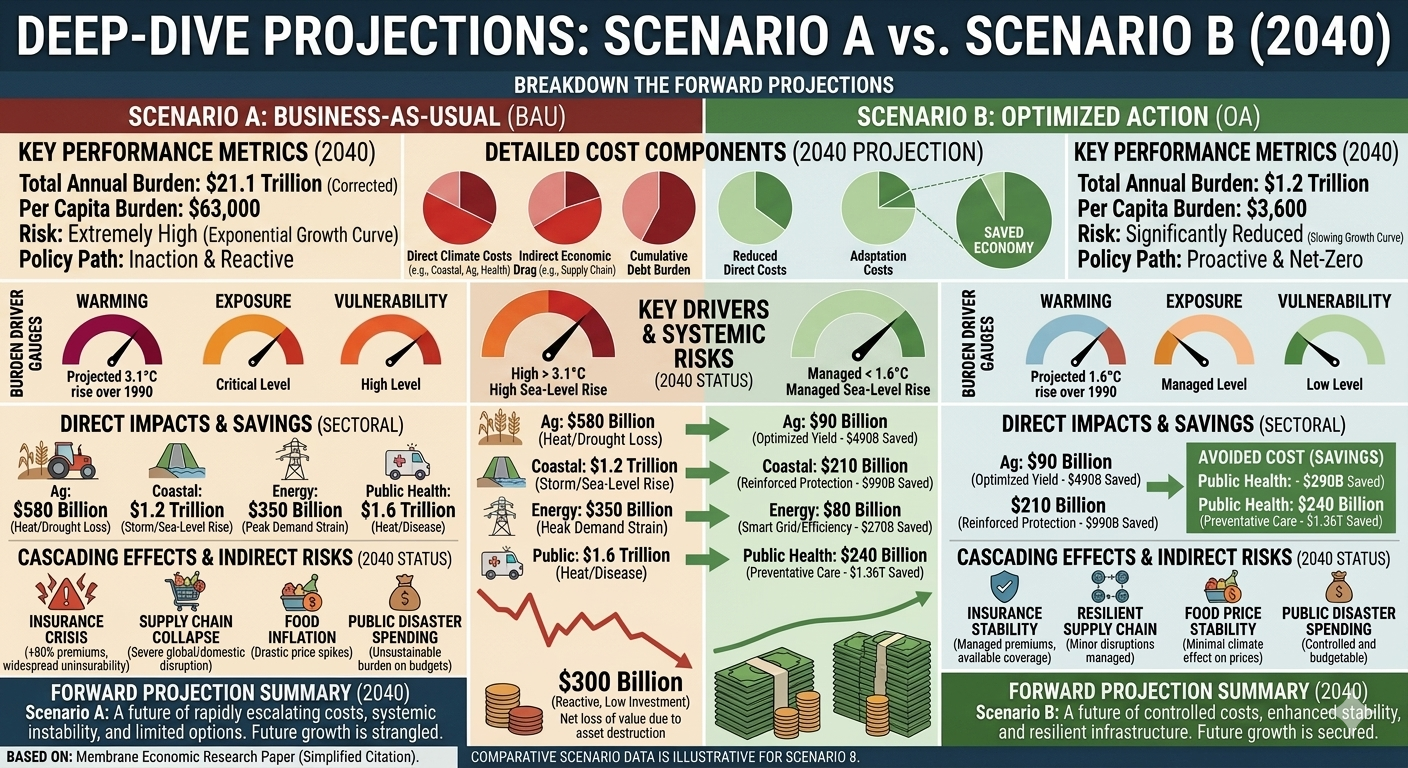
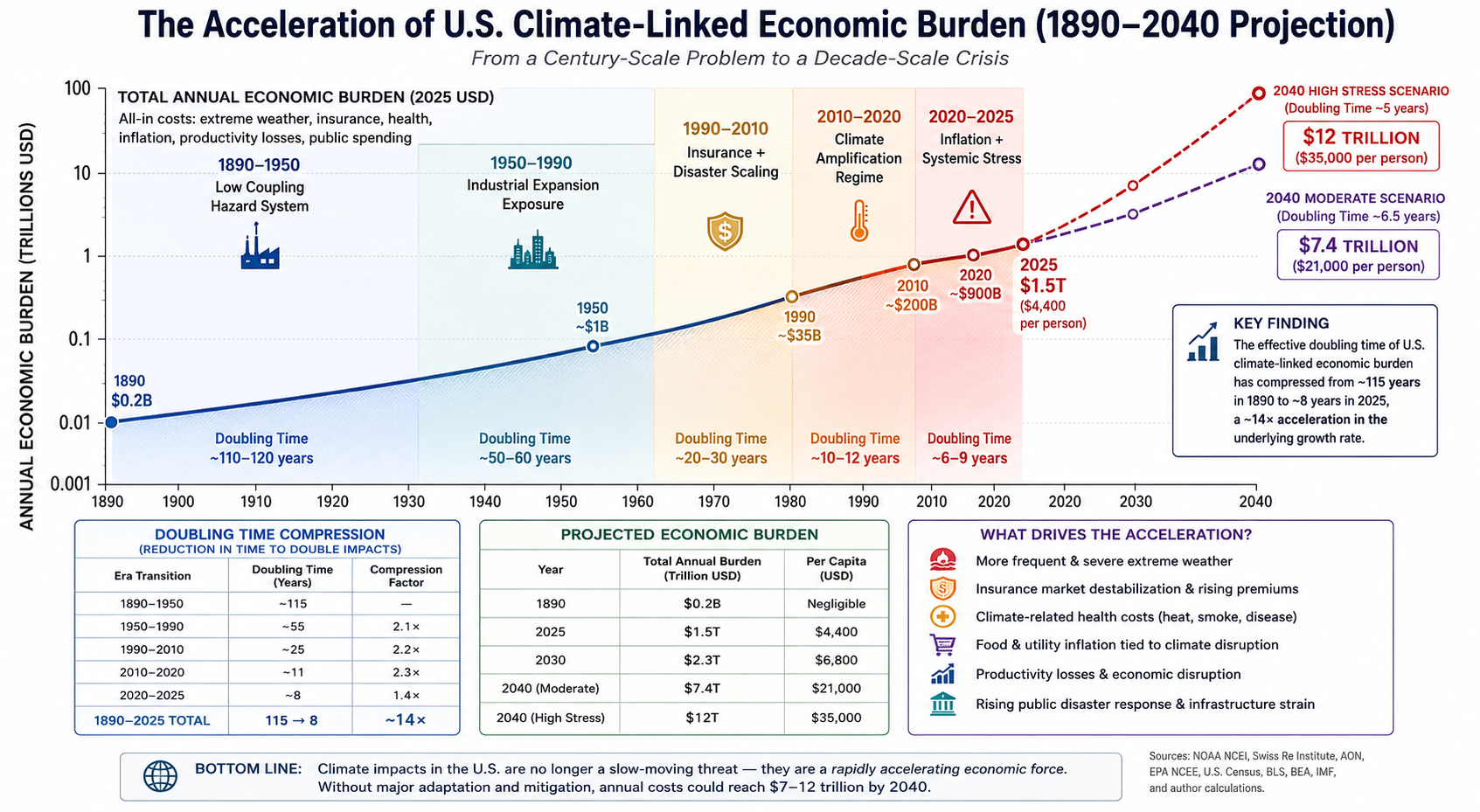
  • Severe economic contraction: High-warming assessments include scenarios involving global economic losses on the order of 30% to 50% by 2100. Losses of this magnitude would exceed the economic disruption associated with the Great Depression.
  • Resource conflicts: Competition over freshwater, fertile land, and other essential resources intensifies as drought expands and mountain glaciers diminish. These pressures increase the risks of geopolitical conflict, displacement, and state failure.

Insurance markets, public infrastructure, food distribution, financial systems, and government budgets face overlapping losses. The scale and interdependence of these impacts threaten the stability of the global economy.

5. Mass Extinction and Biosphere Collapse

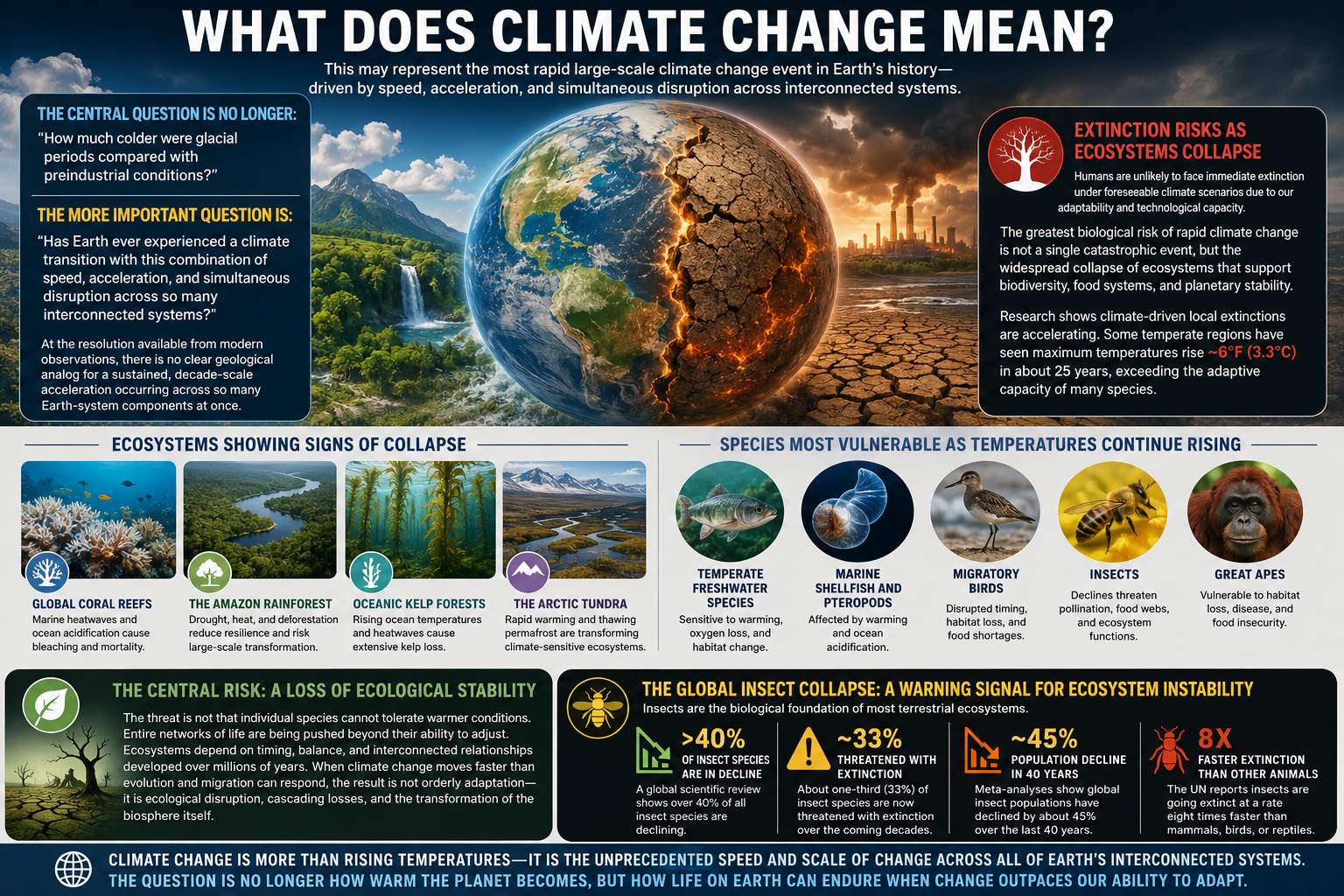
Rapid climate disruption forces ecosystems to change faster than many species can adapt or migrate. Habitat loss, extreme heat, drought, wildfire, and ocean warming compound existing pressures on biodiversity.

  • Accelerating extinction risk: Under severe warming, a substantial share of plant and animal species faces extinction risk as habitats disappear or undergo fundamental transformation.
  • Amazon forest dieback: Continued warming, drought, deforestation, and fire intensify the risk of large-scale Amazon forest degradation and transition toward savannah-like ecosystems. The release of stored carbon would reinforce atmospheric warming and further destabilize the climate system.

Biosphere collapse is not an isolated ecological concern. Forests, soils, wetlands, and marine ecosystems regulate carbon storage, water cycles, regional climates, and food webs. Their deterioration weakens the natural systems on which human societies depend.

Conclusion: The Climate Tipping-Point Crisis Is Already Underway

The 1.5°C threshold represents a critical boundary in a climate system already undergoing measurable destabilization. Major ice sheets, Arctic sea ice, permafrost, ocean circulation, forests, and coral reefs are experiencing changes that interact through reinforcing feedbacks.

The danger lies in the coupling of these processes. Individual changes alter the conditions governing other components of the Earth system, creating a cascading response that conventional assessments of isolated climate risks fail to capture fully.

The United States’ retreat from climate commitments adds a major political and economic obstacle to the global response. Rising fossil-fuel emissions, expanding electricity demand, and the weakening of climate safeguards deepen the gap between the scale of the threat and the scale of the response.

Declining low-level clouds and tropospheric ozone further complicate the climate outlook by strengthening warming and undermining natural cooling and carbon-absorption processes. Their combined influence demands serious consideration when evaluating the trajectory toward 4°C of warming this century.

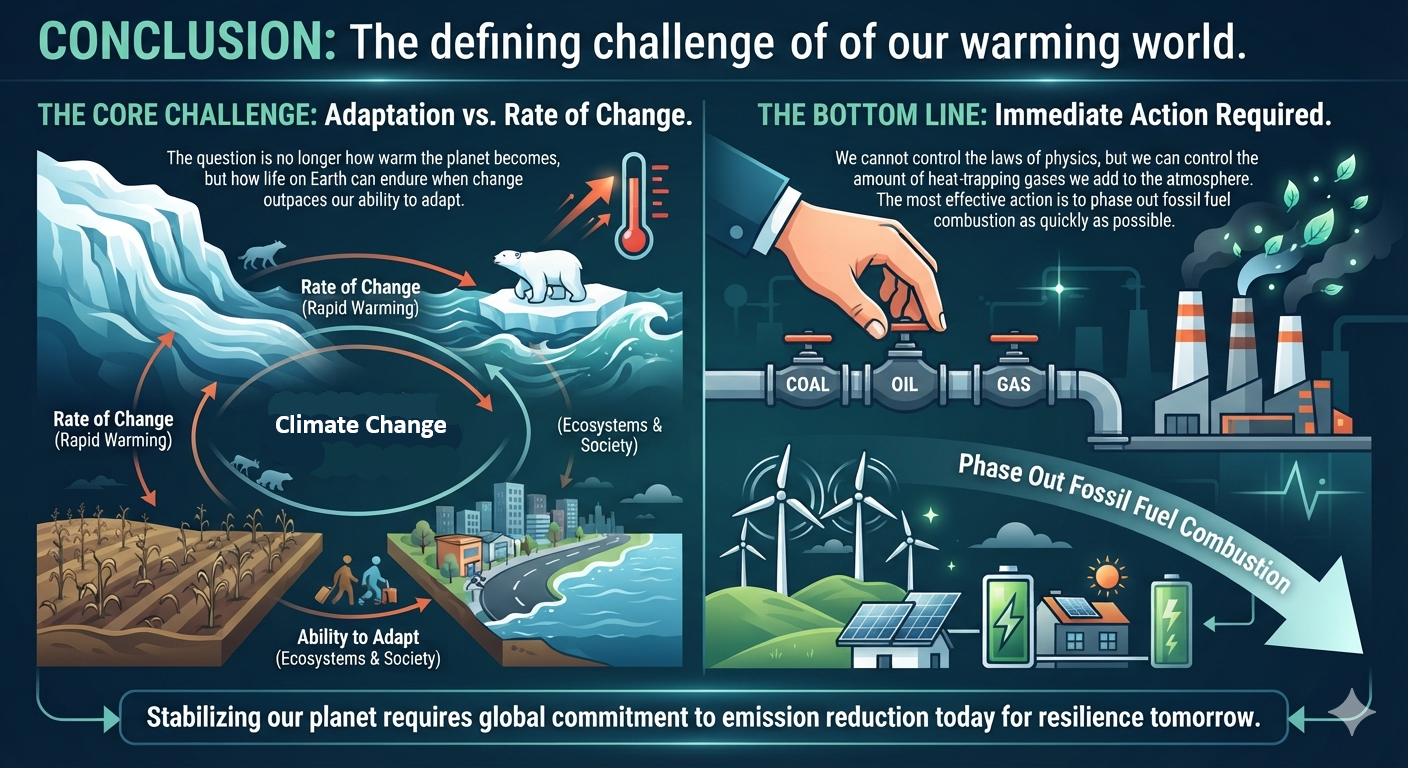
The central conclusion is clear: climate change is not merely a future problem defined by a temperature target. It is an accelerating Earth-system crisis involving interconnected feedbacks, tipping points, ecological disruption, and profound risks to human civilization.

The question is no longer whether climate change is destabilizing the Earth system. The observed evidence establishes that it is. The defining challenge is whether humanity will respond to the scale and speed of that destabilization before cascading consequences become substantially more severe.
bookmark_borderThe Great Deceiver: Donald Trump, Christian Nationalism, the End Times, and the Moral Responsibility to Protect Humanity

By Daniel Brouse

Introduction: Faith, Science, and Political Accountability

I’m a fiscally conservative Republican economist who has been registered Republican since 1980. I also hold a degree in philosophy, with a concentration in morals and ethics, and have studied Christianity extensively, including reading the Bible in depth multiple times.

My family lineage can be traced to the Tribe of Judah and the family of Jesus. I’ve spent decades studying eschatology, particularly the biblical significance of my given name, Daniel, and the subject of the End Times. I’ve also conducted an extensive examination of the Book of Revelation.

Although I generally keep my religious beliefs separate from my scientific work, I’ve been analyzing Donald Trump’s conduct since the 1990s. My conclusions are informed by decades of economic analysis, moral philosophy, scientific research, and biblical study.

This paper brings those perspectives together to examine a question that extends beyond ordinary partisan politics: What happens when political power, religious certainty, deception, and disregard for human consequences converge?

My argument is that Trump’s conduct deserves serious scrutiny not because he is necessarily the literal Antichrist described in biblical prophecy, but because his political actions, public statements, and alliances raise profound moral questions about deception, authoritarianism, environmental destruction, Christian nationalism, and the treatment of vulnerable human beings.

1. My First Moral and Ethical Assessment of Trump

During the 1990s, I conducted a moral and ethical experiment involving Trump’s publicly traded business interests in the context of a widows-and-orphans fund.

Of all the businesses examined in that study, Trump’s was the only one in which I concluded that funds intended for widows and orphans had been stolen.

That experience left a lasting impression on my assessment of his character. It also established a personal foundation for my subsequent examination of Trump’s business practices, public conduct, and political career.

The conclusion was not based on whether I liked his personality, agreed with his politics, or approved of his business ambitions. It arose from an assessment of conduct against a moral standard: how people and institutions behave when entrusted with resources that affect others, particularly vulnerable people.

That distinction remains fundamental. Wealth, power, popularity, and claims of religious conviction do not exempt anyone from moral accountability.

2. The Great Deceiver: A Decade of Dangerous Consequences

Over the past decade, I’ve watched Trump develop into what I consider the Great Deceiver: a politician whose repeated falsehoods have undermined public trust, public health, and public safety.

His conduct during COVID-19, his rejection of climate science, and his decisions affecting foreign aid have contributed to consequences that, in my assessment, include millions of needless deaths. These actions belong in any serious examination of large-scale human suffering and crimes against humanity.

The term “Great Deceiver” is my moral and political characterization of Trump’s conduct. I use it deliberately because deception is not merely a personal failing when practiced by someone wielding enormous political power. It can shape public behavior, distort the understanding of reality, undermine institutions, and influence decisions affecting millions of lives.

During a public health emergency, misinformation can interfere with efforts to protect people. When a political leader repeatedly dismisses established scientific evidence, the consequences can extend beyond rhetoric into policy and public behavior. When decisions affect humanitarian assistance, the consequences can reach people who have little control over the political decisions that determine whether they receive help.

Climate change presents an equally serious moral problem. Rejecting established climate science and obstructing effective responses can increase risks to public health, food security, infrastructure, ecosystems, and future generations.

On September 23, 2025, Trump addressed the United Nations General Assembly and called climate change “the greatest con job ever perpetrated on the world.” This was a public and unmistakable expression of his rejection of mainstream climate science and international climate action. Source: Reuters, September 23, 2025.

These are not simply disagreements over the details of environmental policy. They concern the consequences of dismissing an extensive body of scientific evidence while exercising power over decisions that affect the lives of others.

The moral question is straightforward: When a political leader’s statements and decisions contribute to preventable suffering, what responsibility does that leader bear?

That question deserves examination regardless of party affiliation.

3. Is Trump the Antichrist?

Regarding the Antichrist, I agree with one part of the argument made by those who believe the figure described in biblical prophecy will be difficult to recognize: I don’t believe Trump is literally the Antichrist described in Scripture.

But that conclusion does not eliminate my concerns about his conduct or the movements he supports.

The concern is that Trump is helping advance political and religious movements that could bring about catastrophic consequences under the banner of Christianity. I see a dangerous convergence of Christian Zionism, white nationalism, and authoritarian politics, alongside an alarming relationship between elements of the Trump political network and the broader Epstein scandal.

The distinction matters. One can reject the claim that a political leader is literally the Antichrist while still examining whether that leader’s actions embody forms of deception, hypocrisy, cruelty, or destructive ambition that religious teachings warn against.

Biblical discernment should not be reduced to identifying a single individual who matches a prophetic description. It should also involve examining conduct, motives, consequences, and the treatment of other people.

A person can invoke God, Scripture, and Christian identity while pursuing policies that contradict the ethical principles those beliefs are supposed to uphold.

The question is not simply whether Trump fits a particular interpretation of Revelation. It is whether Christians are applying their moral teachings consistently when evaluating him.

4. Christian Zionism, Biblical Prophecy, and the War With Iran

The connection between Christian Zionism and Trump’s foreign policy deserves particular scrutiny.

Support for Israel among evangelical Christians is not exclusively theological; it also reflects strategic, cultural, historical, and political considerations. However, for some Christian Zionist constituencies, support for Israel is tied to specific interpretations of biblical prophecy and the End Times.

When prophetic expectations become intertwined with decisions about war, the consequences can extend far beyond theology.

The concern is that religious interpretations of history and prophecy can become entangled with political calculations in ways that make military escalation appear divinely justified or historically inevitable. When that happens, the ordinary requirements of foreign policy—evidence, strategic judgment, proportionality, diplomacy, and consideration of human consequences—risk being subordinated to a narrative of prophetic destiny.

The Trump administration’s confrontation with Iran in 2026 has intensified these concerns. The United States and Israel launched strikes against Iran in February 2026, and the conflict subsequently developed into a prolonged confrontation. The administration’s handling of the war has raised questions about its strategic objectives, its exit strategy, and the economic and human costs. Source: Reuters, October 8, 2026.

The relationship among the Trump administration, Christian Zionist organizations, and the war raises serious questions about the relative influence of American national interests, military strategy, religious prophecy, and domestic political pressures.

There is also a political contradiction within Trump’s coalition. An America First constituency has opposed prolonged foreign entanglements, while influential evangelical constituencies support policies toward Israel that some understand through a biblical, prophetic framework.

These positions are not necessarily irreconcilable, and Christian Zionists do not all share one interpretation of prophecy or one position on military action. Nevertheless, the tension deserves examination.

The concern is that the language of Christianity can be used to justify political decisions whose consequences include war, suffering, displacement, and death. A policy does not become morally defensible simply because its supporters attach religious meaning to it.

If religious conviction is influencing decisions about war, then those convictions must be examined alongside the evidence, strategic objectives, and human consequences of the decisions themselves.

5. The Epstein Scandal and the Ideology of Human Worth

The Epstein scandal raises additional questions about the ideological environment surrounding powerful political, financial, and social networks.

Publicly released statements attributed to Jeffrey Epstein include arguments that increased atmospheric carbon dioxide benefits plants and that climate change could serve as a mechanism for reducing overpopulation. Other statements attributed to him express disturbing views about executing elderly and infirm people and make racist claims about African music and learning.

These statements, if accurately represented in their original context, reveal a worldview in which human lives can be evaluated according to their perceived usefulness, with some people effectively treated as expendable.

That is the kind of thinking that raises concerns about eugenics, ecofascism, and a grotesque version of survival of the fittest.

The issue is not simply whether someone disputes climate policy or believes that population growth creates environmental pressures. It is the moral distinction between addressing environmental problems in ways that protect human dignity and treating human suffering or death as a desirable means of achieving an ideological objective.

Recognizing that distinction is essential.

The term “ecofascism” refers to the danger of combining authoritarian power, hierarchical judgments about human worth, and environmental or population arguments that rationalize unequal human survival. It is a warning about an ideological pattern, not a claim that every person skeptical of climate policy subscribes to that worldview.

Similarly, statements attributed to Epstein do not, by themselves, establish that Trump personally shares every belief expressed in them. My concern is the broader environment in which extreme wealth, political influence, racial hierarchy, authoritarianism, and disregard for environmental threats can intersect.

The questions are legitimate and serious: What values are being promoted? Whose lives are being treated as expendable? And what happens when people with immense resources and influence begin to regard some populations as less deserving of protection than others?

These questions belong in any serious examination of the moral consequences of concentrated power.

6. Deception, Political Loyalty, and the Surrender of Moral Judgment

This is why term “Great Deceiver” relevant.

Deception does not have to look like a mysterious biblical figure who charms everyone. It can also operate through political loyalty, religious certainty, propaganda, and the conviction that one’s own side is incapable of wrongdoing.

A leader need not persuade everyone. It may be enough to maintain the loyalty of a sufficiently committed group that interprets every criticism as persecution, every contradiction as a conspiracy, and every failure as someone else’s fault.

Under those conditions, evidence can lose its ability to change minds. Political identity becomes more important than independent judgment, and loyalty becomes a substitute for evaluating facts.

This creates a serious moral danger within religious communities. When a political leader claims to represent Christian values, supporters may be tempted to defend the leader rather than assess whether the leader’s conduct actually reflects those values.

But Scripture demands more than declarations of faith. It calls for discernment about character, conduct, hypocrisy, truthfulness, compassion, justice, and the treatment of the vulnerable.

Merely claiming Christian values does not demonstrate that a person practices them.

The fundamental problem with Trump’s most devoted followers is when they appear unwilling to apply the same moral standards to their political leader that they would apply to anyone else. When evidence conflicts with political loyalty, the evidence is dismissed and loyalty becomes a substitute for judgment.

That is not faith. It is the surrender of independent moral reasoning.

A meaningful moral standard must be applied consistently. If dishonesty is wrong when practiced by political opponents, it is also wrong when practiced by a political ally. If cruelty is unacceptable when directed at people we care about, it does not become acceptable when directed at people we dislike. If Scripture is a source of moral authority, it cannot be invoked selectively to excuse the behavior of a favored leader.

The test of conviction is not how fiercely we defend our own side. It is whether we remain willing to recognize wrongdoing when doing so is uncomfortable.

7. Beyond Trump: The Larger Crisis of Human Responsibility

The problem is much deeper than Trump or any political party.

Political corruption, institutional failure, disinformation, environmental destruction, and the exploitation of vulnerable people cannot be explained by one individual alone. They emerge from broader systems of incentives, beliefs, power, and social behavior.

But recognizing the larger problem does not absolve individuals of responsibility for their own conduct.

Trump’s influence matters precisely because political leaders can amplify existing problems, normalize behavior that was once considered unacceptable, and use institutional power to make harmful decisions consequential on a much larger scale.

The same principle applies to religious institutions, corporations, governments, and individuals. No institution should be exempt from scrutiny because it claims a noble purpose. No political movement should be immune from criticism because it presents itself as the defender of a particular faith or national identity.

The challenge is to develop standards of accountability that do not depend on political affiliation, religious identity, wealth, or social status.

That requires a willingness to examine evidence, challenge deception, protect the vulnerable, and recognize the consequences of our choices.

It also requires resisting the temptation to turn every disagreement into a battle between absolute good and absolute evil. Serious moral analysis demands both conviction and intellectual honesty. Strong conclusions should be accompanied by evidence, and evidence should not be dismissed merely because it threatens a cherished belief.

The objective is not to replace one form of blind allegiance with another. It is to restore the capacity for independent moral judgment.

8. The Covenant of Balance: An Interfaith Alternative

The following paper takes a constructive approach to these problems:

The Covenant of Balance: An Interfaith Synthesis of Ecological Ethics, Economics, Climate Science, Earth’s Energy Imbalance, and Integrated Climate Stewardship

https://www.kingarthur.com/global_warming/Covenant-of-Balance.html

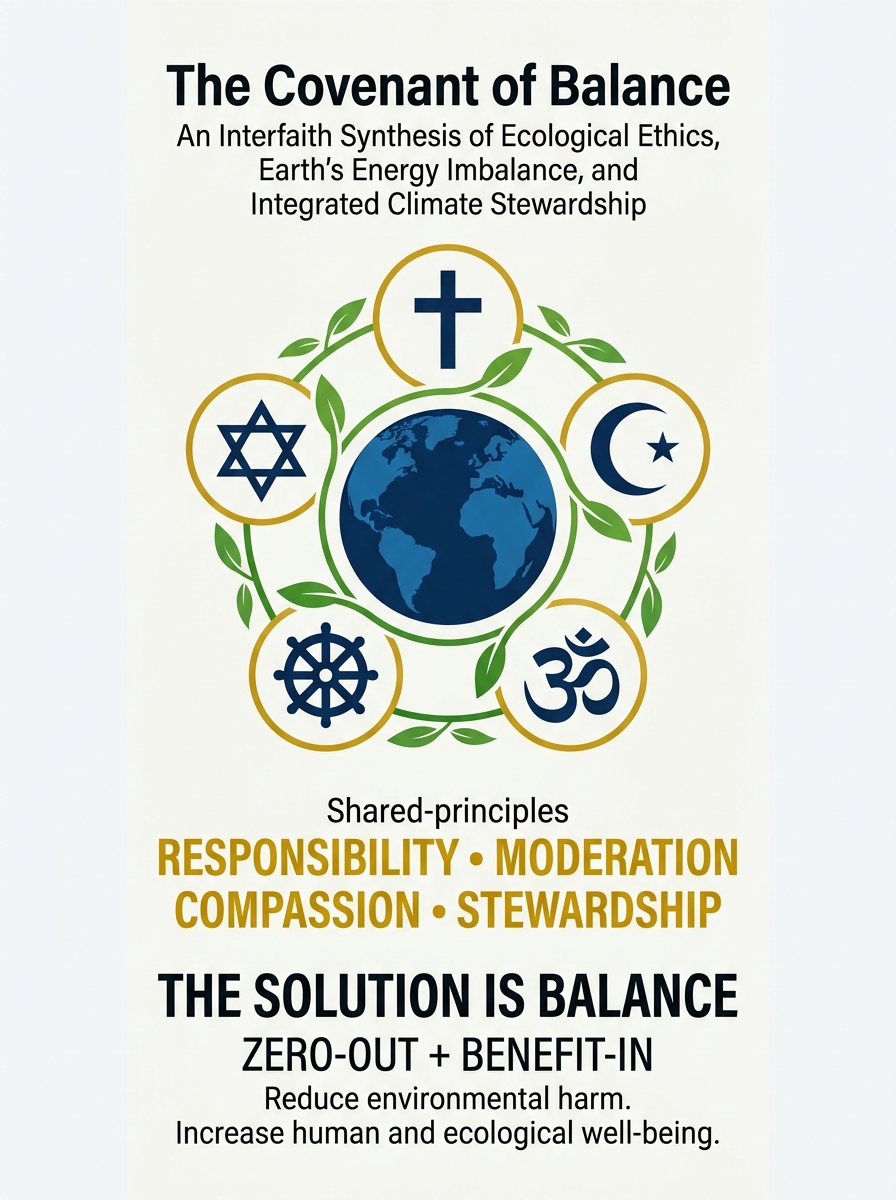
The paper examines Christianity, Islam, Judaism, Buddhism, and Hinduism, identifying shared ethical principles of responsibility, compassion, moderation, stewardship, and avoiding needless harm. It connects those principles with climate science, economic accountability, and practical action.

The premise is simple: We do not need to share one religion, one political philosophy, or one interpretation of Scripture to recognize that our actions have consequences for other people and the living world.

Christianity offers teachings on creation care, stewardship, and love of neighbor. Islam emphasizes Mīzān, or balance, and responsible trusteeship. Judaism includes bal tashchit, the principle of avoiding needless destruction and waste. Buddhism highlights interdependence, compassion, and mindful consumption. Hinduism offers ethical resources through dharma, responsibility, and minimizing harm.

These traditions are distinct, and their adherents do not agree on every environmental or political question. Yet they offer meaningful grounds for cooperation around the protection of human life, the reduction of suffering, responsible resource use, and the preservation of the conditions that sustain future generations.

The paper also connects these ethical principles to Earth’s physical energy imbalance and the consequences of climate change.

Its practical framework is Integrated Climate Stewardship:

ZERO-OUT + BENEFIT-IN

ZERO-OUT means reducing actual sources of environmental harm. BENEFIT-IN means creating tangible improvements in affordability, efficiency, resilience, comfort, and quality of life while protecting the ecological systems on which we depend.

This approach seeks to unite moral responsibility with measurable results. It recognizes that environmental stewardship must extend beyond declarations of concern to practical decisions by households, businesses, institutions, and governments.

The same principle applies to political and religious life. Good intentions and declarations of faith are not sufficient. Our conduct must be evaluated according to its consequences for other people and the world we share.

The Covenant of Balance is an invitation to move beyond divisions that prevent cooperation. We can disagree about theology while working together to reduce suffering. We can hold different political beliefs while insisting on truthfulness and accountability. We can approach the natural world through different ethical traditions while recognizing our common dependence on its physical and ecological systems.

My objective is to find common ground among people of different faiths and beliefs so we can work together for the common good.

9. The Moral Test: Separating the Sheep From the Goats

If we’re going to talk about separating the sheep from the goats, perhaps we should begin by applying the same standards of truth, morality, compassion, and accountability to our own political leaders that we claim to find in Scripture.

Religious language should not function as a shield against scrutiny. Claims of divine purpose should not exempt political decisions from moral examination. And the authority of Scripture should not be used selectively to condemn opponents while excusing the conduct of political allies.

The deeper question is whether our beliefs make us more willing to confront wrongdoing or more determined to defend it when it comes from our own side.

A genuine commitment to truth requires the courage to examine uncomfortable evidence. A genuine commitment to morality requires consistency. A genuine commitment to compassion requires concern for people beyond our immediate community. And a genuine commitment to stewardship requires responsibility for the consequences of our actions.

These standards should apply to everyone, including presidents, religious leaders, corporations, political movements, and ordinary citizens.

Identifying the literal Antichrist is not the most urgent task facing humanity. The more immediate responsibility is to recognize deception, resist the misuse of religious authority, challenge destructive ideologies, protect vulnerable people, and hold those in power accountable for their conduct.

The danger is not confined to one political party, one religion, or one individual. It lies in the human capacity to rationalize wrongdoing when it serves our interests, confirms our beliefs, or strengthens our allegiance to a leader.

That is why the work of moral discernment matters.

Conclusion: Faith Should Sharpen Our Judgment

This perspective comes from decades of studying economics, moral philosophy, Christianity, eschatology, and the physical systems that sustain life. Although I generally keep my religious beliefs separate from my scientific work, I see no contradiction in examining the moral consequences of political decisions through both ethical and scientific frameworks.

I do not believe Trump is literally the Antichrist described in biblical prophecy. Nevertheless, I believe his conduct, his rejection of climate science, his approach to public health and foreign policy, and his relationship with political and religious movements raise profound questions about deception, responsibility, and the consequences of concentrated power.

My assessment of Trump as the Great Deceiver reflects my judgment of his conduct and its consequences. It is not a substitute for examining the evidence, and it should not be treated as a claim that every legal or historical question surrounding his actions has already been resolved.

But neither should the seriousness of those questions be diminished by political loyalty or religious identification.

If we are concerned about deception, we must examine the behavior of those who claim to defend the truth. If we are concerned about the End Times, we must not neglect the suffering and dangers unfolding in the present. If we claim to follow Christian values, we must evaluate our conduct and our leaders against the moral responsibilities those values entail.

And if we recognize that humanity faces threats extending beyond politics—including climate change, ecological disruption, and the consequences of destructive economic systems—we must be willing to cooperate across religious and ideological boundaries.

We do not have to agree on every theological question to agree that human life matters, deception should be challenged, vulnerable people deserve protection, and the Earth must be preserved for future generations.

My hope is that people of different faiths and beliefs can find common ground in these responsibilities and act together for the common good.

The ultimate test is not whether we can convincingly claim to stand on the side of God, country, or a particular political movement. It is whether our actions reflect truth, justice, compassion, and responsibility.

Faith should sharpen our moral judgment, not blind us to reality.

bookmark_borderThe Covenant of Balance

An Interfaith Synthesis of Ecological Ethics, Earth’s Energy Imbalance, and Integrated Climate Stewardship

By Daniel Brouse

Overview

THE COVENANT OF BALANCE
An Interfaith Synthesis of Ecological Ethics, Earth’s Energy Imbalance, and Integrated Climate Stewardship

What do Christianity, Islam, Judaism, Buddhism, and Hinduism have in common when it comes to protecting our planet?

Although these five religious traditions differ in their beliefs and practices, each offers ethical principles that can help guide humanity toward a more responsible relationship with the Earth.

Christianity emphasizes creation care and stewardship.
Islam teaches Mīzān—balance—and responsible trusteeship.
Judaism emphasizes bal tashchit—avoiding needless destruction and waste.
Buddhism highlights interdependence, compassion, and mindful consumption.
Hinduism emphasizes dharma, responsibility, and minimizing harm.

Different traditions. Different teachings. A shared recognition that our actions have consequences.

THE SCIENCE: Earth’s energy imbalance is driving climate change. Greenhouse gases trap additional energy in the Earth system, warming the oceans, atmosphere, and land while contributing to ice loss, rising seas, and ecological disruption. Interacting climate feedbacks can amplify these changes.

THE ETHICS: Our responsibility extends beyond ourselves—to other people, vulnerable communities, future generations, and the living systems that sustain us.

THE SOLUTION: BALANCE.

My paper connects these five religious traditions with two complementary frameworks:

Humanity’s Greatest Threat Is Humanity: Energy Imbalance → Climate Change → The Solution = Balance

Integrated Climate Stewardship: ZERO-OUT + BENEFIT-IN

ZERO-OUT means reducing actual sources of environmental harm. BENEFIT-IN means improving affordability, efficiency, resilience, comfort, and quality of life while protecting the natural systems on which we depend.

This is not a claim that all religions teach the same thing or agree on every environmental issue. It is an invitation to identify common ethical ground and turn shared concerns into practical, measurable action.

We do not need to share one religion to share responsibility for the Earth.

Five traditions. One interconnected planet. A common responsibility.

THE SOLUTION IS BALANCE.

Read the paper:

The Covenant of Balance: An Interfaith Synthesis of Ecological Ethics, Earth’s Energy Imbalance, and Integrated Climate Stewardship

Introduction

Humanity faces a profound ecological challenge: our economic systems, patterns of consumption, and exploitation of natural resources are disrupting the balance of Earth’s interconnected systems. Climate change is a central expression of this disruption, driven primarily by the accumulation of greenhouse gases that trap additional energy within the Earth system. Addressing this crisis requires scientific understanding, economic transformation, practical action, and an ethical framework capable of motivating change across cultures and societies.

This paper synthesizes five major religious traditions—Christianity, Islam, Judaism, Buddhism, and Hinduism—with two complementary frameworks: “Humanity’s Greatest Threat Is Humanity: Energy Imbalance → Climate Change → The Solution = Balance” and “Integrated Climate Stewardship.” Christianity is considered broadly across its Catholic, Orthodox, Protestant, evangelical, and other traditions. Pope Francis’s Laudato si’ and Laudate Deum are examined as influential Catholic contributions within the wider Christian conversation, alongside broader Christian teachings and initiatives concerning creation care.

Despite their theological differences, these traditions offer overlapping principles of responsibility, restraint, compassion, justice, and care for the living world. Their ethical insights can be connected with climate science and translated into practical action through Integrated Climate Stewardship: ZERO-OUT + BENEFIT-IN. This approach emphasizes eliminating or substantially reducing actual sources of environmental harm while bringing tangible benefits into daily life through lower costs, improved resource efficiency, greater resilience, and healthier communities.

The central proposition is that a sustainable future requires balance at multiple levels: physical, ecological, economic, social, and ethical. Religious traditions can help articulate why that balance matters; science can explain the physical processes involved; and practical stewardship can help translate shared values into measurable action.

1. Introduction: A Shared Responsibility for Our Common Home

Humanity is part of an interconnected living system. The atmosphere, oceans, forests, soils, freshwater systems, and countless forms of life interact through physical, chemical, and biological processes. Human societies depend on these systems for food, water, energy, shelter, health, and economic activity.

Yet many prevailing economic practices treat the natural world as an effectively unlimited source of materials and an unlimited destination for waste. The resulting pressures include climate change, biodiversity loss, deforestation, pollution, soil degradation, freshwater stress, and the depletion of natural resources.

Climate change makes the consequences of this imbalance particularly visible. Greenhouse gas emissions alter Earth’s energy balance, while interacting feedbacks and ecological changes can amplify the resulting impacts. The consequences extend beyond temperature: they include changes in precipitation, ice loss, sea-level rise, ecosystem disruption, agricultural stress, and risks to human health and economic stability.

The problem is scientific, but it is also ethical. Science can measure changing conditions and investigate their causes. It cannot, by itself, determine the full moral responsibilities of individuals, institutions, governments, or economic systems.

Religious and philosophical traditions have long explored questions of responsibility, restraint, justice, compassion, and humanity’s relationship with the natural world. Although their beliefs and practices differ, they offer resources for examining the values that shape human behavior.

This paper brings five traditions into conversation:

  • Christianity, including Catholic, Orthodox, Protestant, evangelical, and other Christian perspectives.
  • Islam, particularly the principles of Mīzān and Khilāfah.
  • Judaism, including the principle of bal tashchit.
  • Buddhism, including interdependence, compassion, and mindful consumption.
  • Hinduism, including dharma, ahimsa, and reverence for the Earth.

The purpose is not to suggest that these traditions are identical or that their followers agree on every environmental question. It is to identify meaningful areas of convergence and connect them to a practical framework for ecological responsibility.

2. Christianity: Creation Care, Stewardship, and Love of Neighbor

Christian environmental ethics draws on a broad range of biblical teachings and theological traditions. Across Catholic, Orthodox, Protestant, evangelical, and other Christian communities, creation care has been understood through concepts such as stewardship, responsibility, humility, justice, and love of neighbor. Interpretations differ, and environmental responsibility is not expressed uniformly across all denominations.

Several biblical passages are particularly relevant.

Genesis 2:15 describes humanity’s placement in the garden of Eden to work it and keep it. This passage supports an understanding of human responsibility that includes both productive use and protection of the natural world.

Psalm 24:1 declares that the Earth belongs to the Lord. This can be understood as a challenge to the assumption that human ownership confers unlimited moral permission to destroy or exhaust the resources on which other life depends.

Romans 8:19–23 portrays creation as groaning and awaiting liberation. Christian environmental thinkers have drawn on this passage to reflect on ecological suffering and the relationship between human redemption and the wider creation.

Christian traditions also emphasize love of neighbor. Environmental degradation disproportionately affects people with limited resources, including communities exposed to extreme heat, flooding, drought, pollution, food insecurity, and displacement. Climate responsibility can therefore be understood as an expression of concern for vulnerable people, future generations, and the conditions necessary for human flourishing.

Christian contributions to ecological responsibility

Several major initiatives illustrate the breadth of Christian environmental engagement.

Pope Francis’s Laudato si’: On Care for Our Common Home (2015) presents an influential Catholic account of ecological responsibility, linking environmental degradation with social inequality, consumerism, economic priorities, and the need for an integrated response. Laudate Deum (2023) further emphasizes the urgency of the climate crisis and the inadequacy of responses that fail to match the scale of the problem.

These documents are important contributions to Christian environmental thought, but they do not represent every Christian denomination or establish a single environmental doctrine binding on all Christians.

Other examples include the World Council of Churches’ work on climate justice and ecological sustainability, the Lausanne Movement’s Cape Town Commitment and its wider evangelical discussions of creation care, and environmental initiatives within evangelical Christianity, including the Evangelical Environmental Network.

Together, these efforts demonstrate that ecological responsibility is discussed across multiple Christian traditions, even where theological interpretations, political priorities, and preferred policy responses differ.

The broader Christian contribution to an interfaith framework can be expressed through three connected principles:

  1. Creation care: The natural world is not merely a disposable storehouse of resources.
  2. Responsible stewardship: Human power over nature entails obligations, not unlimited permission to exploit.
  3. Love of neighbor: Environmental decisions should consider their consequences for other people, especially vulnerable communities and future generations.

These principles connect naturally with the concept of balance: humanity’s use of the Earth should sustain the conditions that make life possible rather than progressively undermine them.

3. Islam: Mīzān, Khilāfah, Tawḥīd, and Iqtisād

Islamic environmental ethics provides a particularly direct vocabulary for connecting ecological responsibility with balance.

Mīzān refers to balance, measure, and equilibrium. In the Qur’anic context, it conveys an order that should not be violated through excess or injustice. Applied to environmental responsibility, it encourages human beings to respect the limits, relationships, and conditions that sustain the natural world.

Khilāfah expresses humanity’s role as steward or trustee. Human beings exercise influence over the Earth, but that responsibility can be understood as an obligation to protect and manage creation rather than a license for unlimited exploitation.

Tawḥīd, the oneness of God, provides a theological foundation for understanding creation as an interconnected whole. Although the natural world contains immense diversity, its components exist within relationships that human activity can disrupt.

Iqtisād emphasizes moderation, economy, and avoiding excess. It challenges wasteful consumption and encourages responsible use of resources.

These principles are reflected in Al-Mizan: A Covenant for the Earth, launched in 2024 through an initiative associated with the United Nations Environment Programme’s Faith for Earth work. The document presents an Islamic framework for ecological responsibility, connecting spiritual principles with conservation, sustainability, and collective action.

Its contribution to this synthesis is the explicit connection between balance, trusteeship, moderation, and responsibility for the natural world.

4. Judaism: Bal Tashchit and Responsibility for Creation

Jewish environmental ethics includes the principle of bal tashchit, commonly understood as a prohibition against needless destruction or waste.

The principle is traditionally associated with Deuteronomy 20:19–20, which restricts the destruction of fruit-bearing trees during a siege. Its interpretation has extended into broader discussions of waste, resource conservation, and unnecessary harm.

Jewish teachings also draw on the creation narratives of Genesis, including the responsibilities associated with humanity’s place in the garden. As in Christianity, interpretations of dominion and human authority over nature vary, but Jewish environmental thought offers substantial resources for understanding human power as carrying moral obligations.

The Rabbinical Assembly’s The Green Covenant: A Jewish Pledge Toward Carbon Neutrality illustrates an effort to translate Jewish environmental values into institutional and practical commitments.

The relevance of bal tashchit extends beyond recycling or avoiding the waste of individual objects. It invites a broader question: when human activities needlessly damage ecosystems, squander resources, or impose preventable costs on future generations, what responsibility follows?

In the context of climate change, this principle supports reducing avoidable emissions, conserving energy and materials, preventing pollution, and questioning economic practices that generate unnecessary environmental damage.

5. Buddhism: Interdependence, Compassion, and Mindful Consumption

Buddhist teachings offer an ethical perspective centered on the interconnected nature of existence, the reduction of suffering, compassion, and awareness of the consequences of one’s actions.

Interdependence challenges the idea that human well-being can be separated from the well-being of other living systems. Food, water, climate, health, and economic stability depend on relationships among people, ecosystems, and physical processes.

Compassion extends ethical concern beyond the self. Environmental damage becomes relevant not only because it affects human comfort or prosperity, but also because it can cause suffering among vulnerable people and other living beings.

Mindful consumption encourages reflection on desire, attachment, and the consequences of acquiring and using material goods. It does not necessarily require rejecting technology or material comfort. Rather, it questions patterns of consumption that create harm without corresponding benefits to well-being.

The Time to Act Is Now: A Buddhist Declaration on Climate Change represents a Buddhist contribution to the climate discussion, emphasizing the relationship between climate responsibility, ethical conduct, and the need for action.

From this perspective, stewardship requires more than technical efficiency. It also involves examining the motivations and social arrangements that drive waste, excessive consumption, and disregard for the consequences of human behavior.

6. Hinduism: Dharma, Ahimsa, and Reverence for the Earth

Hindu traditions encompass a wide range of philosophies, practices, and interpretations. Environmental ethics within these traditions can draw on dharma, ahimsa, and reverence for the Earth.

Dharma can refer to duty, right conduct, and the responsibilities that sustain personal and social order. Environmental responsibility can be understood as part of fulfilling obligations to other living beings, communities, and the conditions that support life.

Ahimsa, commonly understood as nonviolence or the avoidance of harm, provides a basis for considering how human actions affect living beings and ecological systems. Its application to environmental issues varies across traditions, but it encourages attention to avoidable injury and destruction.

Hindu traditions also include forms of reverence for rivers, mountains, forests, animals, and the Earth itself. Bhūmi Devi, the Earth goddess, is one expression of the spiritual significance attributed to the Earth in Hindu traditions.

The Hindu Declaration on Climate Change, associated with the 2015 interfaith climate initiatives, articulates a Hindu contribution to the moral case for climate action and ecological responsibility.

These ideas connect environmental stewardship with duty, restraint, and respect for the living world. They encourage a view of human prosperity that does not depend on treating nature as morally irrelevant or endlessly expendable.

7. A Shared Ethical Framework Across Five Traditions

The five traditions differ in theology, scripture, spiritual practice, and their understanding of humanity’s place in creation. They should not be collapsed into a single religious doctrine. Nevertheless, their environmental teachings reveal several important areas of convergence.

TraditionRelevant principlesEnvironmental implication
ChristianityCreation care, stewardship, love of neighborProtect creation and consider the consequences for vulnerable people and future generations
IslamMīzān, Khilāfah, Tawḥīd, IqtisādRespect balance, exercise responsible trusteeship, recognize interconnection, and avoid excess
JudaismBal tashchit, responsibility for creationPrevent needless destruction and waste
BuddhismInterdependence, compassion, mindful consumptionReduce avoidable harm and reconsider excessive consumption
HinduismDharma, ahimsa, reverence for the EarthFulfill responsibilities and minimize harm to living systems

These parallels are meaningful, but they are not exact equivalences. Mīzān, for example, has a specific Qur’anic and Islamic context; bal tashchit has a distinct Jewish history; and Buddhist interdependence does not simply mean the same thing as Christian stewardship or Hindu dharma.

The common ground is more practical than doctrinal: human decisions affect interconnected systems, and ethical responsibility requires attention to the consequences of those decisions.

An interfaith environmental framework can therefore rest on several shared commitments:

  • Reduce avoidable harm.
  • Use resources responsibly.
  • Avoid unnecessary waste and excess.
  • Protect the conditions that sustain life.
  • Consider the needs of vulnerable communities.
  • Recognize obligations to future generations.
  • Translate ethical commitments into measurable action.

This is the foundation for connecting religious ethics with the scientific and practical framework developed in the two papers considered here.

8. The Scientific Foundation: Energy Imbalance and Climate Change

Religious ethics can motivate responsibility, but climate science must establish the physical processes and evidence involved.

Earth receives energy from the Sun and returns energy to space. Over time, the amount entering and leaving the Earth system determines whether the planet gains or loses energy.

Human-caused greenhouse gas emissions have altered this balance by reducing the rate at which Earth loses energy to space. The result is a positive energy imbalance: more energy accumulates within the Earth system than leaves it.

The oceans absorb the great majority of the excess heat accumulating in the climate system. Energy is also taken up by the atmosphere, land, and cryosphere. The consequences include rising temperatures, ocean warming, melting land ice, sea-level rise, and changes in the behavior of ecosystems and atmospheric circulation.

The central distinction is that climate change is not simply a problem of elevated surface temperature. Temperature is one indicator of a wider physical process involving energy storage, redistribution, and changes across interconnected systems.

From imbalance to interacting feedbacks

Climate systems contain feedback processes that can amplify or moderate an initial change. Examples include:

  • Ice and snow loss, which reduces reflectivity and allows more solar energy to be absorbed.
  • Changes in atmospheric water vapor, which affect the greenhouse effect.
  • Changes in clouds, which can alter both incoming solar radiation and outgoing infrared radiation.
  • Changes in ecosystems and vegetation, which can influence carbon storage, surface reflectivity, moisture, and local climate.
  • Ocean circulation changes, which redistribute heat and influence regional climate patterns.

These processes do not all operate in the same direction or with the same strength. Their effects depend on location, timescale, and the interactions among physical and biological systems.

The broader scientific concern is that feedbacks can interact. Multiple changes may reinforce one another, increase stress on ecosystems, and make the consequences of continued warming more severe.

The distinction between an ethical principle and a physical measurement is essential. Religious concepts of balance can help explain why disruption is morally significant, but they are not substitutes for observations, measurements, and scientific models. Conversely, climate science can describe physical changes without independently determining every ethical obligation arising from them.

The synthesis proposed here uses each framework for its appropriate purpose: ethics clarifies responsibility, science investigates the physical problem, and stewardship translates both into action.

9. Humanity’s Greatest Threat Is Humanity: Energy Imbalance → Climate Change → The Solution = Balance

The paper Humanity’s Greatest Threat Is Humanity: Energy Imbalance → Climate Change → The Solution = Balance presents balance as a central organizing principle for understanding the climate crisis and responding to it.

The sequence begins with human activities that alter Earth’s energy balance. These activities include greenhouse gas emissions from fossil fuels, land-use changes, and other human-caused influences on the climate system.

The resulting energy imbalance drives warming and contributes to changes in oceans, ice, weather patterns, ecosystems, and the distribution of heat and moisture.

The effects then interact with human systems. Agricultural disruption can affect food prices and availability. Environmental damage can increase economic losses and displacement. Resource stress can intensify existing inequalities and political pressures.

This sequence does not mean that every climate impact follows one inevitable pathway, or that every feedback leads to collapse. It means that environmental, economic, and social risks are connected and should not be evaluated as isolated problems.

Balance is the proposed solution in the sense of restoring conditions that support long-term stability and human flourishing. Physically, that requires reducing greenhouse gas emissions and ultimately bringing the climate system toward a sustainable energy balance. Ecologically, it requires protecting and restoring the systems that support life. Economically, it requires reconsidering practices that depend on unlimited material throughput and the externalization of environmental costs.

Ethically, balance means recognizing that short-term gains for some can impose lasting costs on others.

The religious traditions examined here provide different reasons for accepting these responsibilities. Their shared contribution is not a claim that the Earth must remain static or that all change is harmful. Rather, they support the principle that human power should be exercised with regard for consequences, limits, and obligations to others.

10. Integrated Climate Stewardship: ZERO-OUT + BENEFIT-IN

Integrated Climate Stewardship translates environmental responsibility into a practical framework for everyday life, businesses, institutions, and public policy.

Its central formula is:

ZERO-OUT + BENEFIT-IN

ZERO-OUT means eliminating or substantially reducing actual sources of environmental harm wherever practical. This includes reducing unnecessary energy use, fossil fuel consumption, waste, pollution, and resource-intensive activities.

BENEFIT-IN means choosing changes that also produce tangible benefits: lower utility bills, reduced operating costs, greater resilience, improved comfort, healthier living conditions, and more efficient use of resources.

The framework is intended to make climate stewardship a practical part of ordinary life rather than an obligation dependent entirely on sacrifice, charitable contributions, or distant technological promises.

Examples include:

  • Improving building efficiency and reducing unnecessary heating and cooling.
  • Using targeted heating and cooling rather than conditioning unused spaces.
  • Reducing electricity and hot-water demand.
  • Repairing, reusing, and maintaining products to extend their useful lives.
  • Reducing food waste and choosing efficient food-storage and preparation practices.
  • Using durable, efficient equipment when the total costs and environmental benefits justify it.
  • Protecting trees, soil, water, and vegetation where they provide measurable ecological benefits.
  • Improving household and community resilience to heat, storms, flooding, and power interruptions.

Not every action will be appropriate for every household or region. Costs, safety, building conditions, local climate, access to technology, and the environmental impacts of equipment all matter. The goal is to identify measures that produce real net benefits rather than simply shifting environmental costs from one place to another.

Why benefits matter

Climate communication often emphasizes costs, restrictions, and sacrifices. These are sometimes unavoidable, particularly when major structural changes are necessary. But stewardship can also produce immediate personal and social benefits.

Lower energy demand can reduce bills. Durable products can reduce replacement costs. Improved building performance can increase comfort. Better preparedness can limit losses during disruptions. Reducing waste can save money while reducing pressure on natural resources.

These benefits can make climate action more accessible to people who might otherwise see it as financially burdensome or disconnected from their daily lives.

The approach also helps distinguish genuine emissions reductions from accounting exercises. Offsets do not automatically eliminate the underlying source of pollution, and their quality varies. ZERO-OUT prioritizes direct reductions; BENEFIT-IN encourages additional improvements that support ecological and human well-being.

The framework does not imply that individual household measures alone can solve climate change. Electricity generation, industrial production, transportation, agriculture, infrastructure, and public policy remain essential. Individual action is most effective when supported by changes in the larger systems that shape available choices.

11. Economic Balance: Prosperity Without Ecological Destruction

Economic systems are human institutions, not independent forces beyond human responsibility. Their incentives, rules, and measures of success influence how resources are extracted, distributed, consumed, and discarded.

Traditional measures of economic activity can rise while natural capital declines. Gross domestic product, for example, does not by itself distinguish between productive investment, resource depletion, environmental restoration, and expenditures required to repair damage.

An economy can therefore report growth while imposing costs on ecosystems, public health, future generations, or communities that lack the power to avoid those costs.

A more integrated understanding of prosperity considers not only the production of goods and services but also the durability of the ecological systems on which economic activity depends.

This does not require rejecting markets, innovation, or economic growth in every form. It requires evaluating economic activity according to its full consequences rather than treating environmental costs as someone else’s problem.

A practical stewardship framework asks:

  • Does this activity meet a genuine need or produce a meaningful benefit?
  • Can the same benefit be achieved with less energy or fewer materials?
  • Are environmental costs being imposed on other people or future generations?
  • Does the activity strengthen or undermine long-term resilience?
  • Can waste be prevented at the source rather than managed after it occurs?
  • Do the financial incentives reward conservation and efficiency, or excessive extraction and disposal?

These questions connect the religious principle of moderation with economic accountability. They also connect scientific knowledge about finite ecological capacities with the practical task of designing better incentives and institutions.

The aim is not balance for its own sake as an abstract slogan. It is an economic system that can support human well-being without progressively undermining the natural systems that make prosperity possible.

12. Justice, Vulnerability, and Future Generations

Environmental damage is not distributed evenly. Communities differ in their exposure to hazards, their access to resources, their capacity to recover, and their historical contribution to environmental pressures.

Low-income households may have fewer options for improving inefficient housing or recovering from extreme weather. Coastal communities may face growing flood and erosion risks. Agricultural communities may be exposed to changing rainfall patterns, heat, and crop stress. People with limited access to healthcare, reliable infrastructure, or financial reserves may suffer disproportionately from environmental disruption.

These inequalities make climate stewardship a question of justice as well as physical science.

Christian teachings on love of neighbor, Islamic concepts of trusteeship and justice, Jewish obligations against needless destruction, Buddhist compassion, and Hindu principles of duty and minimizing harm can all contribute to discussions of how environmental costs and responsibilities should be shared.

The traditions do not necessarily prescribe identical policies. Nevertheless, their ethical resources support asking who benefits from environmentally damaging activities, who bears the costs, and whose needs are excluded from decision-making.

Future generations are particularly important because they cannot participate directly in current decisions, even though they may inherit the consequences. Stewardship therefore requires a time horizon longer than an election cycle, quarterly earnings report, or individual consumer decision.

A balanced approach must consider the rights and needs of people who have little influence over the choices that shape their future.

13. Indigenous Knowledge and Local Stewardship

Indigenous peoples and local communities hold diverse traditions of environmental knowledge, place-based observation, and resource management. These traditions are not uniform, and they should not be romanticized as though every community has identical practices or perspectives.

In many places, however, Indigenous knowledge contributes valuable understanding of ecosystems, seasonal changes, species relationships, fire management, water, soils, and long-term landscape stewardship.

Such knowledge can complement scientific research when collaboration respects community authority, cultural context, and rights over traditional knowledge. It should not be appropriated without consent or treated as a substitute for the participation of the people who hold it.

The interfaith framework developed here reinforces the importance of humility: no single institution, discipline, or tradition possesses every insight required to address complex environmental problems.

Effective stewardship draws on scientific evidence, local experience, ethical reflection, and the participation of communities directly affected by environmental decisions.

14. From Shared Values to Measurable Action

An interfaith agreement on environmental responsibility becomes meaningful when it leads to action. Broad ethical commitments can be translated into a practical program for households, congregations, schools, businesses, communities, and governments.

Individuals and households

  • Measure energy and resource use before choosing improvements.
  • Reduce avoidable consumption and waste.
  • Prioritize practical efficiency measures with favorable costs and benefits.
  • Protect and restore local ecosystems where feasible.
  • Prepare for climate-related hazards.
  • Evaluate actions according to actual outcomes rather than appearances.

Faith communities

  • Incorporate creation care and environmental responsibility into education and community service.
  • Improve the efficiency of buildings and facilities.
  • Reduce food, water, energy, and material waste.
  • Support vulnerable households facing environmental hazards.
  • Encourage cooperation among religious traditions without erasing their differences.
  • Publish measurable goals and report progress honestly.

Businesses and institutions

  • Identify environmental costs throughout operations and supply chains.
  • Reduce emissions and waste at their sources.
  • Evaluate investments using long-term costs and risks.
  • Improve product durability, repairability, and resource efficiency.
  • Avoid presenting symbolic commitments as substitutes for measurable reductions.

Governments and public institutions

  • Align infrastructure and energy decisions with credible climate science.
  • Support efficiency improvements and practical emissions reductions.
  • Protect public health and communities exposed to environmental hazards.
  • Incorporate environmental costs into economic decision-making.
  • Encourage innovation while evaluating its full environmental consequences.
  • Provide transparent data so progress can be independently assessed.

A common standard of accountability

Regardless of the religious, philosophical, or secular motivation behind an action, its environmental performance should be evaluated using evidence.

Relevant measures include energy consumption, greenhouse gas emissions, waste generation, water use, ecosystem condition, financial cost, resilience, and health outcomes.

Ethical intention matters, but good intentions alone do not establish that a practice is environmentally effective. Similarly, a measurable improvement does not eliminate the need to consider justice, consent, or other ethical questions.

The combination of moral purpose and measurable results provides a stronger basis for lasting stewardship.

15. An Interfaith Covenant of Balance

The traditions examined in this paper can contribute to a common commitment without requiring agreement on every theological question.

Such a covenant might be expressed through the following principles:

Respect the conditions that sustain life. Recognize that human prosperity depends on interconnected physical, ecological, and social systems.

Exercise power responsibly. Treat technological, economic, and political influence as carrying obligations to other people and the natural world.

Reduce needless harm. Avoid waste, pollution, and destructive practices when effective alternatives are available.

Practice moderation without rejecting well-being. Distinguish genuine human needs and benefits from unnecessary consumption that imposes disproportionate costs.

Protect the vulnerable. Consider the people and communities most exposed to environmental harm and least able to recover.

Preserve opportunities for future generations. Avoid decisions that create preventable, long-lasting damage for people who cannot participate in current choices.

Turn values into action. Establish practical goals, measure results, and revise ineffective approaches.

Cooperate across differences. Work with people of different religions, philosophies, and scientific disciplines while respecting their distinct beliefs and perspectives.

This covenant is a proposed synthesis, not an official declaration adopted by the five religious traditions. Its purpose is to identify a shared practical direction that can support cooperation without pretending that important differences do not exist.

16. Conclusion: The Solution Is Balance

Climate change is a physical consequence of a disrupted Earth energy balance, but the decisions that contribute to it are made within human economic, political, cultural, and ethical systems.

The scientific challenge is to understand the changes occurring across the Earth system, reduce the human causes of warming, and protect the ecological systems that sustain life. The ethical challenge is to recognize responsibility for the consequences of human choices. The practical challenge is to translate that responsibility into effective, affordable, and measurable action.

Christianity, Islam, Judaism, Buddhism, and Hinduism approach these questions through distinct teachings and traditions. Their concepts should not be treated as interchangeable, and their followers do not hold a single universal position on every environmental issue. Yet each tradition offers resources for considering responsibility, restraint, compassion, justice, or humanity’s relationship with the living world.

Christian creation care, Islamic Mīzān, Jewish bal tashchit, Buddhist interdependence, and Hindu dharma provide different ethical paths toward examining the consequences of human behavior. These paths can converge in practical commitments to reduce harm, conserve resources, protect vulnerable communities, and preserve the conditions necessary for future life.

The two complementary frameworks considered here connect these commitments with scientific understanding and everyday practice.

“Humanity’s Greatest Threat Is Humanity: Energy Imbalance → Climate Change → The Solution = Balance” identifies the disruption of Earth’s energy balance as a central physical dimension of the climate crisis and presents balance as a guiding principle for the response.

“Integrated Climate Stewardship” translates that principle into the practical formula ZERO-OUT + BENEFIT-IN: reduce actual sources of environmental harm while creating tangible benefits through efficiency, affordability, resilience, and improved quality of life.

Balance does not mean keeping every natural system unchanged, returning humanity to a preindustrial past, or requiring every community to follow the same path. It means recognizing physical limits, respecting ecological relationships, accounting for the consequences of economic activity, and exercising human power responsibly.

Religious ethics can help explain why stewardship matters. Climate science can establish what is happening and evaluate possible responses. Economic analysis can help identify costs, incentives, and opportunities. Practical action can turn these insights into measurable improvements.

The ultimate goal is not simply to slow environmental damage. It is to build a way of living and organizing society that supports human well-being while preserving the natural systems on which that well-being depends.

Humanity does not need to share one religion to share responsibility for the Earth. Nor must every person agree on the same philosophical foundation before cooperating on practical solutions.

We can begin with a common recognition: our choices matter because we are part of the system we are changing.

The solution is balance—understood scientifically, pursued ethically, and practiced every day.

References and Further Reading

  1. Francis. Laudato si’: On Care for Our Common Home. Encyclical, June 18, 2015. Vatican.
  2. Francis. Laudate Deum: Apostolic Exhortation to All People of Good Will on the Climate Crisis. October 4, 2023. Vatican.
  3. United Nations Environment Programme, Faith for Earth. Al-Mizan: A Covenant for the Earth. Launched in 2024.
  4. The Rabbinical Assembly. The Green Covenant: A Jewish Pledge Toward Carbon Neutrality. 2011.
  5. The Time to Act Is Now: A Buddhist Declaration on Climate Change. Buddhist declaration and related climate-action materials.
  6. Hindu Declaration on Climate Change. 2015.
  7. World Council of Churches. Climate justice and ecological sustainability initiatives and resources.
  8. Lausanne Movement. The Cape Town Commitment. 2010.
  9. Evangelical Environmental Network. Resources on Christian environmental stewardship.
  10. United Nations. Interfaith and faith-based initiatives addressing climate change and environmental responsibility, including the 2016 interfaith statement presented at the United Nations General Assembly.
  11. Brouse, Daniel. Humanity’s Greatest Threat Is Humanity: Energy Imbalance → Climate Change → The Solution = Balance. https://www.kingarthur.com/global_warming/Climate-Solution-Is-Balance.html
  12. Brouse, Daniel. Integrated Climate Stewardship. https://www.kingarthur.com/global_warming/Climate-Change-What-Can-I-Do.html

bookmark_borderThe Good Ancestor

A poem by Daverick Leggett

Every day I walk a hundred years
to the hill where my great, great granddaughter sits.
I carry words of blessing
and reach to touch her back.

But feeling me near she turns,
sad-eyed and heavy with grief.

“What was it like?” she asks,
“when the great whales swam,
when the birds sang you awake,
when the rains came soft,
and the soil smelled sweet underfoot?”

And the blessings
catch in my throat.

On darker days she turns,
her famished face charred, and eyes
sunk in their bony orbits,
burn with curses.

And the blessings
froth at my mouth
with the poisonous
spume of betrayal.

On the darkest of all days
I walk the hundred years
and find no one there.

Let today be the bright day.
Let today be the bright day
I lay my hand upon her back.

And, feeling me near, she turns
and blesses me, saying,

“Your love was fierce enough,
sweet ancestor,
your love was fierce enough.”

bookmark_borderScience Is Science: Confronting Denialism and Ecofascism

About Denialism and Ecofascism: Science Is Science

The Observation
Glad to know you’re watching out! At the same time, this divisiveness—when we desperately need everyone to pull together because it’s a CRISIS, right?—makes me somehow deeply sad.

That’s a big job right there… How do we reach those who seem furthest away from any kind of understanding? We need both a Winston Churchill and a Mahatma Gandhi in this endeavor…

The Response
Agreed. Both denialism and ecofascism are ideologies that ultimately defy logic. In very different ways, they can become a kind of combination of self-destruction and destruction of others.

I’ve spent years battling misinformation, propaganda, and rhetoric. To the best of my knowledge, neither Sidd nor I have successfully converted—or even educated—a single committed denier. Climate science has somehow been transformed into a “belief” system. But science has nothing to do with belief. 1 + 1 = 2. If someone refuses to “believe” that, what exactly can you do?

From the beginning, our work has been based on observations, data, mathematics, and the laws of physics. So yes, I think this is at the heart of the crisis. When we started this work, we genuinely believed humanity would eventually take action. We thought we had thousands, if not tens of thousands, of years to adapt. That was the one thing we got wrong.

A couple of years ago, after explaining my continuing attempts to reach climate deniers, I asked Sidd what we could possibly do. His response was essentially, “Dude, just tell them to look out their window.” It sounds simplistic, but there is profound truth in it. The consequences are becoming increasingly difficult to deny.

Since then, we’ve had to rebuild much of our modeling. A +4°C world within thousands of years is no longer the worst-case scenario we worry about. The possibility of 4–7°C of warming within a century has become a much more serious concern in our work.

And then there is the political dimension. The rise of white-nationalist and authoritarian governments in the U.S. and elsewhere has made an already difficult problem considerably harder. Paradoxically, though, history offers one small reason for hope: fascism ultimately fails. It is inherently self-destructive.

The “drill, baby, drill” mentality is economically and environmentally self-defeating. A severe economic contraction could, ironically, buy humanity some time for adaptation while drastically reducing emissions. That is hardly the future anyone should want, but history has repeatedly demonstrated that systems built on extremism and authoritarianism eventually consume themselves.

So yes—we desperately need both the Churchill and Gandhi dimensions: the willingness to confront reality without flinching, and the willingness to keep reaching for people rather than giving up on them. I’m just not sure humanity has ever faced a crisis where we needed both quite this badly.

bookmark_borderBeyond Temperature: What Climate Change Really Means

Climate change is often framed around a simple comparison:

How much colder were ice ages than the climate before the Industrial Revolution?

While historical temperature comparisons remain scientifically important, they no longer capture the most significant feature of modern climate change.

The more important question today is:

Has Earth ever experienced a climate transition with this combination of speed, acceleration, and simultaneous disruption across so many interconnected systems?

Based on modern observations, there is no clear geological example of a sustained, decade-scale acceleration occurring simultaneously across numerous components of the Earth system. Rising temperatures are occurring alongside accelerating changes in oceans, ice sheets, ecosystems, atmospheric moisture, and extreme weather patterns. It is this convergence of rapid changes—not temperature alone—that defines the modern climate era. This may represent the most rapid large-scale climate change event in Earth’s history, based on the rate and simultaneous disruption now being observed across multiple interconnected Earth systems.

The Growing Risk of Ecosystem Collapse

Humans are unlikely to face immediate extinction under foreseeable climate scenarios. Our species possesses technological capabilities, global communication networks, and a remarkable ability to adapt to changing conditions.

Many other species, however, do not have those advantages.

The greatest biological danger posed by rapid climate change is not a single catastrophic event. It is the gradual breakdown of ecosystems that support biodiversity, food production, and the stability of the biosphere itself.

Research increasingly shows that climate-driven local extinctions are accelerating. Some temperate regions have experienced unexpectedly high biodiversity losses associated with rapidly increasing temperature extremes. In certain areas, maximum temperatures have risen by approximately 6°F (3.3°C) in only about 25 years, creating environmental conditions that exceed the ability of many species to adapt or migrate.

Ecosystems Already Showing Signs of Stress

Several major ecosystems are exhibiting characteristics consistent with ecological disruption and increasing instability:

  • Global Coral Reefs: Marine heatwaves and ocean acidification are causing repeated mass bleaching events and widespread mortality.
  • The Amazon Rainforest: Increasing drought, heat, and deforestation are reducing resilience and raising concerns about large-scale ecosystem transformation.
  • Oceanic Kelp Forests: Rising ocean temperatures and marine heatwaves are causing extensive losses of kelp ecosystems that support diverse marine life.
  • The Arctic Tundra: Rapid warming, thawing permafrost, and shifting vegetation are fundamentally altering one of Earth’s most climate-sensitive regions.

Species Most Vulnerable to Continued Warming

Some groups of organisms appear particularly vulnerable because they occupy narrow ecological niches or depend on highly synchronized environmental conditions.

Among the most at-risk are:

  • Temperate freshwater species
  • Marine shellfish and pteropods
  • Migratory birds
  • Insects
  • Great apes

The loss of these organisms can have consequences far beyond individual extinctions because each species is connected to larger ecological networks.

The Real Threat: Losing Ecological Stability

The defining danger of rapid climate change is not simply that individual species cannot survive warmer temperatures.

The larger threat is that entire networks of life are being pushed beyond their capacity to adjust.

Ecosystems depend on timing, balance, and intricate relationships that evolved over millions of years. Plants flower at specific times to coincide with pollinators. Predators and prey maintain dynamic balances. Migratory species depend on seasonal cues that have remained relatively stable throughout human history.

When climate change occurs faster than evolution, migration, and adaptation can respond, ecosystems do not smoothly transition to new conditions. Instead, they experience disruption, cascading losses, and fundamental reorganization.

The result is not merely a warmer planet. It is the transformation of the biosphere itself.

The Global Insect Collapse: An Early Warning Signal

One of the clearest indicators of accelerating ecological disruption is the worldwide decline of insect populations.

Insects form the biological foundation of most terrestrial ecosystems. They pollinate crops and wild plants, decompose organic material, recycle nutrients, and provide food for countless birds, fish, amphibians, reptiles, and mammals.

Scientific studies paint a concerning picture:

  • More than 40% of known insect species are experiencing population declines.
  • Approximately one-third of insect species are considered threatened with extinction over the coming decades.
  • Long-term analyses suggest that global insect abundance has fallen by roughly 45% over the past 40 years.
  • The United Nations has reported that insects are disappearing at rates estimated to be eight times faster than mammals, birds, or reptiles.

Because insects support so many ecological processes, their decline serves as an early warning signal of broader ecosystem instability. Reduced pollination, disrupted food webs, and diminished nutrient cycling can trigger cascading effects that extend throughout the biosphere.

Climate Change Is About More Than Degrees

Climate change is often discussed in terms of global average temperature—1°C, 2°C, or 3°C of warming. But the defining characteristic of the modern climate system is not simply how warm the planet becomes.

It is the unprecedented pace of change and the simultaneous disruption occurring across interconnected physical and biological systems.

The central question of climate change is therefore no longer:

“How different is today’s temperature from the past?”

The more consequential question is:

“How do ecosystems and societies respond when multiple Earth systems begin changing faster than they can adapt?”

The answer to that question may determine not only the future of individual species, but the stability of the biosphere upon which human civilization ultimately depends.

Conclusion

The question is no longer how warm the planet becomes, but how life on Earth can endure when change outpaces our ability to adapt.

Bottom line: We cannot control the laws of physics, but we can control the amount of heat-trapping gases we add to the atmosphere. The most effective action is to phase out fossil fuel combustion as quickly as possible.

bookmark_borderBeyond Degrees: Why the Rate of Climate Change Matters More Than Historical Temperature Comparisons

by Daniel Brouse

Introduction

Climate change is often framed around a simple question: How much warmer is the planet compared with the past? While global temperature remains an important indicator, it does not fully capture the defining characteristic of the modern climate system.

The more fundamental shift is not only the magnitude of warming, but the rate, acceleration, and changing dynamics of the Earth system. If the Earth has not experienced a comparable rate of climate-system acceleration over millions of years, then historical records provide increasingly limited predictive value for the future. They tell us how the climate system responded under previous conditions, but they may not accurately describe how a rapidly accelerating, highly coupled system will behave under unprecedented rates of change.

At the same time, many of the climate indicators traditionally used for forecasting are exhibiting increasingly nonlinear and volatile behavior. Temperature anomalies, ocean heat content, sea-level rise, atmospheric moisture, ice loss, and extreme weather patterns are showing changes that are becoming more difficult to model using assumptions based primarily on historical variability.

The challenge is not that these indicators have lost their value—they remain essential observations of the Earth system. The challenge is that a climate regime undergoing rapid acceleration and increasing feedback coupling may behave differently from the relatively stable climate conditions on which many traditional predictive approaches were developed.

Historical climate records, including glacial cycles, provide essential context for understanding how the planet has responded to major changes in energy balance. However, their predictive power becomes increasingly limited when the current climate regime begins to operate outside the conditions and time scales represented in those records.

The defining feature of today’s climate change is not merely that the planet is warming. It is that the system is changing rapidly, with multiple interconnected components accelerating simultaneously.

The Limits of Historical Analogies

The geological record tells us that Earth’s climate has changed dramatically many times before. During glacial periods, global average temperatures were several degrees colder than preindustrial conditions, and transitions between climate states reshaped ice sheets, oceans, ecosystems, and atmospheric circulation.

Those records remain valuable for understanding climate sensitivity, feedback mechanisms, and long-term Earth-system behavior.

However, the question facing modern civilization is not simply whether Earth has been warmer or colder in the past. The more important question is whether previous transitions occurred at a comparable rate of change.

Many past climate transitions unfolded over centuries, thousands of years, or longer. The modern climate system is experiencing simultaneous changes across the atmosphere, oceans, cryosphere, and biosphere over time scales measured in decades.

This difference in timescale fundamentally changes the problem.

From Temperature Change to System Dynamics

Climate change is commonly described as an increase in average global temperature. While accurate, this description captures only one dimension of a much larger transformation.

The climate system is better understood as a complex, dynamic system whose behavior depends not only on its current state, but also on how quickly that state is changing.

The key question is no longer only:

How much has temperature increased?

It is also:

How quickly is the rate of change itself changing?

This introduces the importance of higher-order dynamics, including acceleration and the changing acceleration of climate variables. In physics, the third derivative of position is known as “jerk.” Applied conceptually to climate dynamics, it represents a system in which the acceleration of change is itself becoming nonlinear.

A system exhibiting increasing jerk is not simply moving toward a new state—it is moving toward that state at an increasingly rapid pace.

The Expanding Right Tail of Climate Extremes

The most visible consequence of this changing climate regime is not just a warmer average. It is a transformation of the entire probability distribution of climate events.

The temperature distribution is shifting toward warmer conditions while becoming increasingly right-skewed.

This means two things are happening simultaneously:

  • Average temperatures are increasing.
  • Extreme heat events are becoming disproportionately more common, intense, and persistent.

A simple shift of the entire distribution would produce a warmer climate. A growing right tail produces something more disruptive: a climate system increasingly capable of generating events beyond the historical range of experience.

The same principle applies beyond temperature.

As the distribution of climate states changes, the probability of extreme events shifts as well:

  • Extreme heat waves become more frequent and longer-lasting.
  • Marine heatwaves intensify.
  • Atmospheric rivers carry greater moisture loads.
  • Extreme precipitation events become more destructive.
  • Flash flooding increases.
  • Drought conditions intensify.
  • Wildfire conditions expand.
  • Tropical cyclones gain additional energy from warmer oceans.

These are not simply warmer versions of historical weather events. They are manifestations of a changing statistical regime.

From Individual Indicators to a Coupled Earth System

Early climate analysis often focused on individual indicators:

  • Global mean temperature
  • Sea level rise
  • Ocean heat content
  • Sea surface temperature
  • Ice loss
  • Atmospheric greenhouse gas concentrations

These measurements remain essential, but they are increasingly insufficient as standalone descriptions of system behavior.

The Earth system is not a collection of independent variables. It is a network of interacting components connected through feedback loops.

For example:

Polar amplification weakens equator-to-pole temperature gradients, affecting atmospheric circulation. Changes in circulation influence jet stream behavior and storm tracks. Altered weather patterns affect drought, flooding, agriculture, ecosystems, and human infrastructure. Ice loss changes freshwater distribution, ocean circulation, and planetary energy balance.

Each component influences the others.

As these connections strengthen, the behavior of the entire system becomes more important than any single measurement.

A New Framework for a Changing Climate Regime

The initial approach to understanding accelerating climate impacts focused on individual indicators and their changing growth rates, including the concept of shrinking effective doubling times.

The next step is moving beyond retrospective curve fitting toward a state-space view of Earth-system evolution.

This perspective asks:

  • How rapidly are climate variables changing?
  • Is the rate of change accelerating?
  • How are different components interacting?
  • Are feedbacks amplifying one another?

The objective is not merely to measure a warmer planet, but to characterize the evolving dynamics of a coupled Earth system.

The Climate Question Has Changed

The historical record tells us that Earth’s climate can change dramatically. It provides a foundation for understanding climate sensitivity and feedback processes.

But the modern challenge is different.

The central question is no longer:

“How much colder were glacial periods compared with preindustrial conditions?”

The more important question is:

“Has Earth ever experienced a climate transition with this combination of speed, acceleration, and simultaneous disruption across multiple interconnected systems?”

At the resolution available from modern observations, there is no clear geological analog for a sustained, decade-scale acceleration occurring across so many Earth-system components at once.

The past reveals what climate systems can do.

The present is revealing a system changing at a rate that may be outside the range experienced throughout human civilization and perhaps for millions of years.

Extinction Risks as Ecosystems Collapse

Although humans are unlikely to face immediate extinction under foreseeable climate scenarios due to our adaptability and technological capacity, the same cannot be said for many other species. The greatest biological risk of rapid climate change is not a single catastrophic event, but the widespread collapse of ecosystems that support biodiversity, food systems, and planetary stability.

The concept of “ecological whiplash” captures one of the defining dangers of climate change: the speed of environmental transformation. When climate conditions shift over decades rather than thousands of years, species are forced into a mismatch between the environments that shaped their evolution and the rapidly changing physical world around them. Instead of a gradual transition toward a new equilibrium, ecosystems can experience abrupt destabilization as food webs fracture, habitats disappear, and critical relationships between species break down.

Recent research indicates that climate-driven local extinctions are accelerating, with some temperate regions experiencing unexpectedly high biodiversity losses. These changes are strongly associated with rapid increases in temperature extremes, including a reported 6°F rise in maximum temperatures over roughly 25 years in some affected regions, creating conditions that exceed the adaptive capacity of many species.

Ecosystems Showing Signs of Collapse

Global Coral Reefs
Marine heatwaves are triggering widespread coral bleaching events across the planet. When ocean temperatures become too high, corals expel the symbiotic algae that provide most of their energy, leaving them weakened and vulnerable to mass mortality. Repeated bleaching events reduce recovery time and threaten the long-term survival of reef ecosystems.

The Amazon Rainforest
Rising temperatures, changing precipitation patterns, and increasing drought stress are pushing portions of the Amazon toward ecological fragmentation. As forests lose moisture and resilience, some regions risk transitioning from rainforest ecosystems into degraded savannah-like landscapes, reducing biodiversity and weakening one of Earth’s largest carbon sinks.

Oceanic Kelp Forests
Rapid ocean warming, combined with ecological disruptions such as predator loss, has caused widespread kelp forest declines. In some regions, once-thriving underwater forests have been replaced by barren “urchin barrens,” fundamentally altering marine ecosystems and eliminating habitat for countless species.

The Arctic Tundra
The Arctic is warming several times faster than the global average. Melting permafrost, landscape subsidence, vegetation shifts, and widespread “browning” events are transforming tundra ecosystems that evolved under stable frozen conditions.


Species Already Lost or Facing Severe Climate Pressure

The Bramble Cay Melomys
The Bramble Cay melomys is widely recognized as the first mammal considered to have gone extinct primarily because of human-caused climate change. Rising seas, storm surges, and habitat loss overwhelmed the species’ tiny coral island habitat.

The Arctic Bumblebee (Bombus polaris)
This highly specialized polar pollinator evolved thick insulating hair and behaviors adapted to extreme cold. Rapid Arctic warming threatens to push this species beyond its environmental limits as temperatures rise and seasonal patterns shift.

Alpine Butterflies
Many high-elevation butterfly species depend on narrow ecological conditions and specialized alpine plants. As mountain climates warm, these species face habitat loss because they cannot migrate upward indefinitely as suitable conditions disappear.

The Golden Toad
The golden toad, once found in Costa Rica’s cloud forests, disappeared after climate-driven changes disrupted the persistent mist and moisture conditions required for reproduction. Its loss became an early warning example of how climate shifts can destabilize specialized ecosystems.


Species Most Vulnerable as Temperatures Continue Rising

Temperate Freshwater Species
Freshwater ecosystems are among the most threatened environments on Earth. Changes in rainfall, rising temperatures, and wetland loss are increasing extinction risks for fish, amphibians, and aquatic invertebrates that depend on narrow environmental conditions.

Marine Shellfish and Pteropods
The ocean has absorbed a substantial portion of human carbon emissions, causing approximately a 30% increase in ocean acidity since the preindustrial era. Acidification makes it more difficult for organisms such as shellfish and pteropods to build and maintain calcium carbonate shells.

Migratory Birds
Climate disruption is altering migration timing and seasonal cycles. Earlier springs can create a dangerous mismatch between bird breeding periods and the availability of insect prey, reducing reproductive success and population stability.

Cold-Blooded (Ectothermic) Insects
Many insects rely on external temperatures to regulate their metabolism and survival. Rapid, unpredictable temperature swings can exceed their physiological limits, disrupting reproduction, migration, and population cycles.

Great Apes
Species such as orangutans and gorillas face compounding pressures from habitat destruction, drought, and climate-driven ecosystem changes. As forests become increasingly fragmented and stressed, remaining populations face shrinking ranges and declining resources.


The Central Risk: A Loss of Ecological Stability

The defining threat of rapid climate change is not simply that individual species cannot tolerate warmer conditions. It is that entire networks of life are being pushed beyond their ability to adjust. Ecosystems depend on timing, balance, and interconnected relationships developed over millions of years. When climate change moves faster than evolution and migration can respond, the result is not orderly adaptation—it is ecological disruption, cascading losses, and the transformation of the biosphere itself.


The Global Insect Collapse: A Warning Signal for Ecosystem Instability

Among the clearest indicators of accelerating ecological disruption is the widespread decline of insect populations worldwide. Insects represent the biological foundation of most terrestrial ecosystems, serving as pollinators, decomposers, nutrient recyclers, and a primary food source for countless birds, fish, reptiles, amphibians, and mammals.

Multiple long-term studies have documented substantial insect declines across regions, with losses observed in both abundance and diversity. A landmark analysis published in 2019 warned of a potential “insect apocalypse,” citing widespread declines driven by a combination of climate change, habitat destruction, pesticide exposure, invasive species, and pollution. While the magnitude of decline varies by location and species, the overall pattern is clear: many insect populations are experiencing unprecedented pressure.

Climate change is becoming an increasingly dominant driver because insects are highly sensitive to temperature changes. Unlike mammals and birds, most insects are ectothermic, meaning their body temperature and metabolic function depend on external environmental conditions. Rapid warming can push species beyond their thermal limits, disrupt reproductive cycles, alter migration patterns, and create mismatches between insects and the plants or animals that depend on them.

Key examples of insect decline include:

Butterflies and Moths
Long-term monitoring programs in Europe and North America have documented major declines in many butterfly and moth species. These insects are especially vulnerable because many have highly specialized relationships with particular plants, meaning climate-driven shifts in vegetation can eliminate their habitat faster than populations can adapt.

Pollinating Insects
Bees, butterflies, moths, and other pollinators are experiencing widespread stress from rising temperatures, changing flowering schedules, habitat loss, and chemical exposure. The disruption of pollinator populations threatens not only wild ecosystems but also agricultural systems that depend on insect pollination.

Aquatic Insects
Freshwater insects such as mayflies, stoneflies, and caddisflies are declining in many regions due to warming rivers, drought, pollution, and habitat degradation. These insects are critical indicators of freshwater ecosystem health and form the foundation of many aquatic food webs.

Tropical Insects
Tropical insects are particularly vulnerable because many already live near their upper thermal limits. Unlike temperate species, they often have little physiological capacity to tolerate additional warming. Even small increases in temperature can reduce survival, reproduction, and population stability.

Why Insect Loss Creates Cascading Ecological Effects

The decline of insects represents more than the loss of individual species—it threatens entire ecological networks. A reduction in insect abundance can trigger cascading effects:

  • Bird populations decline because many songbirds depend on insects to feed their young.
  • Freshwater ecosystems weaken as aquatic insects disappear from food chains.
  • Plant reproduction suffers when pollinator populations decline.
  • Soil systems degrade as decomposer insects become less abundant.
  • Food webs destabilize as the energy transfer from plants to higher organisms is disrupted.

The disappearance of insects is therefore a measurable sign of ecosystem stress. Because insects reproduce quickly and occupy nearly every terrestrial environment, their decline acts as an early warning indicator of broader biological instability.

A Planetary Threshold Indicator

The global insect decline illustrates the central danger of rapid climate change: ecosystems do not respond only to the amount of warming, but to the speed at which environmental conditions change. Species that evolved within relatively stable climate ranges can be overwhelmed when temperature, precipitation, and seasonal patterns shift faster than adaptation can occur.

The loss of insects may ultimately prove to be one of the most consequential ecological changes of the modern era—not because insects are individually dominant, but because they quietly support the biological systems upon which nearly all complex life depends.

Conclusion: Beyond Temperature—The Transformation of a Planetary System

Climate change is often measured in degrees, but degrees alone cannot describe the full magnitude of the transformation now underway. The defining feature of the modern climate system is not simply that Earth is warmer than it was in the past, but that multiple components of the Earth system are changing simultaneously at rates that challenge the ability of natural systems, ecosystems, and human societies to adapt.

Historical climate records remain essential for understanding how the planet responds to changes in energy balance. However, the current climate trajectory represents a fundamentally different challenge: a rapidly accelerating transition occurring across the atmosphere, oceans, cryosphere, and biosphere within decades rather than centuries or millennia. The question is no longer only how much the climate has changed, but how quickly the rate of change itself is increasing and how those changes interact through a highly connected planetary system.

The consequences of this accelerating transition are already visible. Rising ocean heat content, intensifying marine heatwaves, accelerating ice loss, changing precipitation patterns, increasing atmospheric moisture, and the expansion of extreme climate events are not isolated trends. They are interconnected signals of a climate system moving into a new and less predictable operating regime.

The biological consequences reveal the deeper significance of this transformation. Ecosystems evolved within relatively stable climatic boundaries, allowing species relationships to develop over thousands to millions of years. When environmental conditions shift faster than migration, adaptation, and evolution can respond, ecosystems do not simply relocate—they destabilize. Coral reefs decline, forests lose resilience, freshwater systems deteriorate, and species disappear as ecological relationships unravel.

The global decline of insects provides one of the clearest warnings of this instability. Because insects occupy nearly every terrestrial ecosystem and support pollination, decomposition, nutrient cycling, and food webs, their decline represents more than the loss of individual species. It signals disruption at the foundation of biological systems. When the smallest organisms that support complex ecosystems begin to disappear, the consequences propagate upward through the entire web of life.

The greatest risk posed by rapid climate change is therefore not a single catastrophic threshold, but a cascade of interacting disruptions. A warmer planet is not merely a hotter version of the world we know. It is a different climate regime with altered probabilities, intensified extremes, weakened ecological stability, and increasing uncertainty.

The central challenge of the twenty-first century is recognizing that climate change is not only a temperature problem—it is a systems problem. The future will be determined not just by the amount of additional warming that occurs, but by whether humanity can slow the rate of change before critical Earth-system processes move beyond the capacity of natural and human systems to respond.

The past demonstrates that Earth’s climate can change dramatically. The present demonstrates that it can change rapidly. The defining question before civilization is whether we can recognize the difference in time to influence the trajectory of the planet’s future.

bookmark_borderThe Acceleration of U.S. Climate-Linked Economic Burden (1890–2040 Projection)

by Daniel Brouse and Sidd Mukherjee

This paper estimates the long-run evolution of U.S. climate-related economic burdens and finds strong evidence of nonlinear acceleration. Using a reconstructed baseline in the late 19th century and an integrated 2025 estimate of approximately $1.5 trillion annually in climate-attributable economic losses, we estimate that the effective doubling time of climate-related economic burden has compressed from ~115 years (circa 1890) to ~8 years in the present regime. We project forward under continued compression dynamics to 2030 and 2040, showing that costs may enter multi-trillion-dollar annual regimes within the next two decades if current nonlinear amplification persists.

1. Economic Burden Definition

The total climate-linked economic burden is defined as:

I(t) = I_disasters + I_insurance + I_health + I_inflation + I_productivity + I_public_spending

  • Direct disaster losses (NOAA billion-dollar events)
  • Insurance premium inflation and coverage withdrawal
  • Climate-linked health costs
  • Food and utility price inflation
  • Productivity losses
  • Federal and state disaster response expenditures

2. Anchor Points

1890 baseline (reconstructed low-coupling system): $0.2 billion

2025 integrated estimate: $1.5 trillion

Total growth factor:

I_2025 / I_1890 ≈ 7,500×

3. Historical Doubling-Time Compression

I(t) = I₀ e^(kt), T_d = ln(2)/k
Era System Character Doubling Time
1890–1950 Low coupling hazard system ~110–120 years
1950–1990 Industrial expansion exposure ~50–60 years
1990–2010 Insurance + disaster scaling ~20–30 years
2010–2020 Climate amplification regime ~10–12 years
2020–2025 Inflation + systemic stress ~6–9 years

Total compression: ~14× reduction in doubling time (115 → ~8 years)

4. Present Growth Rate

T_d ≈ 8 years
k = ln(2)/8 ≈ 0.0866

5. Forward Projection Method

We assume continued compression with slowing rate:

  • 2025: ~8 years
  • 2030: ~6 years
  • 2040: ~5 years (stress scenario)

6. 2030 Projection

I_2030 = 1.5 × e^(0.0866 × 5) ≈ 2.31 trillion USD

Per capita (2030): ≈ $6,800

7. 2040 Projections

Scenario A: Moderate Compression

n = 15 / 6.5 ≈ 2.31 doublings
I_2040 ≈ 1.5 × 2^(2.31) ≈ 7.4 trillion USD

Per capita: ≈ $21,000

Scenario B: High Nonlinear Amplification

n = 15 / 5 = 3 doublings
I_2040 = 1.5 × 2^3 = 12 trillion USD

Per capita: ≈ $35,000

8. Summary Table

Year Total Economic Burden Per Capita
1890 $0.2B Negligible
2025 $1.5T $4,400
2030 $2.3T $6,800
2040 (moderate) $7.4T $21,000
2040 (high stress) $12T $35,000

9. Key Finding

Climate-linked economic burden in the United States exhibits a nonlinear acceleration regime characterized by a ~14× compression in doubling times since 1890, shifting from century-scale dynamics to decade-scale systemic amplification.

10. Conclusion

The United States climate-linked economic burden has transitioned from a low-coupling hazard system in the late 19th century to a highly nonlinear, inflation-amplified economic stress system in the 21st century. Using a 2025 estimate of $1.5 trillion annually, we find that doubling times have compressed from ~115 years to ~8 years, implying a ~14× acceleration in the growth rate of climate-attributable damages. Under continued compression, annual burdens may reach $7–12 trillion by 2040.

bookmark_borderThe Future: Feedback Loops and the Limits of Human Adaptation

Introduction: Bounded — But Potentially Extreme

Q: What is the most likely future climate scenario?

A: Accelerating climate disruption driven by interacting feedback loops.

The good news is that physics places limits on the absolute worst-case outcomes. Earth is not expected to undergo a runaway Venus-style greenhouse effect in which oceans boil away and the atmosphere becomes permanently uninhabitable.

The danger facing humanity is different — and arguably more immediate.

The true risk is rapid, nonlinear climate acceleration occurring within thermodynamic bounds: a trajectory capable of producing severe ecological disruption, widespread biodiversity collapse, destabilization of global food and water systems, large-scale migration, economic fragmentation, and profound stress on human civilization.

Current evidence increasingly suggests that warming is not progressing through simple linear relationships alone. Multiple climate feedback mechanisms are now interacting simultaneously, amplifying one another through what can best be described as a cascading “Domino Effect” of destabilized Earth systems.

While uncertainties remain, current research increasingly points toward two dominant warming pathways over the next century.


The Two Most Likely Climate Pathways

Current Policy Trajectory (~3–4°C Warming)

This pathway reflects scenarios in which emissions plateau or decline slowly without deep structural reductions in fossil-fuel dependence.

Even under this comparatively moderate scenario, the world would experience:

  • chronic extreme heat,
  • intensified droughts and flooding,
  • major agricultural disruption,
  • accelerating sea-level rise,
  • ecosystem destabilization,
  • and substantial economic stress.

Large portions of the subtropics and tropics would experience increasingly dangerous wet-bulb temperatures, while many coastal megacities would face escalating flooding risks and infrastructure instability.


High-Feedback / Tipping Cascade Scenario (~4–7°C Warming)

This increasingly likely high-risk pathway assumes that major climate feedback loops begin substantially amplifying warming beyond direct human emissions alone.

These feedbacks include:

  • weakening land carbon sinks,
  • accelerating boreal and Arctic wildfires,
  • permafrost thaw,
  • methane release,
  • forest dieback,
  • declining biosphere productivity,
  • ozone-driven reductions in photosynthesis,
  • altered atmospheric circulation,
  • and destabilization of polar ice systems.

Under this scenario, the climate system increasingly becomes self-reinforcing.

The central concern is no longer simply how much carbon humans emit directly, but how strongly Earth’s own feedback systems begin adding additional greenhouse gases while simultaneously weakening natural carbon removal systems.


The World at ~3–7°C Warming

A world experiencing 3–7°C of warming would be profoundly transformed environmentally, biologically, economically, and socially.

The resulting conditions would not represent merely a “warmer version” of today’s civilization. They would constitute a fundamentally different planetary operating environment.


Extreme Heat and Wet-Bulb Stress

Extreme heatwaves would become routine across much of the planet, especially in tropical, subtropical, and low-income regions.

Of particular concern are rising wet-bulb temperatures — combinations of heat and humidity at which the human body can no longer effectively cool itself through sweating.

Once wet-bulb temperatures approach critical physiological thresholds, even healthy individuals resting in the shade can experience:

  • heat exhaustion,
  • organ failure,
  • cardiovascular collapse,
  • and death after prolonged exposure.

This represents one of the clearest biological limits confronting human civilization under severe warming scenarios.


Rising Seas and Infrastructure Collapse

Sea-level rise would intensify coastal flooding, saltwater intrusion, erosion, and storm-surge damage.

Major urban centers, ports, industrial zones, and transportation networks would face escalating instability.

The economic consequences would extend far beyond coastlines, disrupting:

  • global trade,
  • insurance systems,
  • supply chains,
  • energy infrastructure,
  • and freshwater access.

Climate migration pressures would increase substantially as populations relocate away from increasingly uninhabitable regions.


Ecosystem Collapse and Biodiversity Loss

Warming at this scale would likely trigger widespread ecological restructuring.

Expected impacts include:

  • mass coral reef die-offs,
  • accelerating rainforest decline,
  • collapse of Arctic ecosystems,
  • expanding desertification,
  • and widespread species extinction.

Many ecosystems evolved within relatively stable climatic ranges and may not adapt quickly enough to the pace of modern warming.

As biodiversity declines, ecosystem resilience weakens further, increasing the likelihood of cascading ecological failures.


Agricultural Destabilization and Food Insecurity

Climate change threatens agriculture through multiple simultaneous stressors:

  • heat stress,
  • water scarcity,
  • ozone damage,
  • soil degradation,
  • shifting precipitation patterns,
  • and expanding pest and pathogen ranges.

Crop viability would progressively shift toward higher latitudes and elevations.

At the same time, many historically productive agricultural regions could become increasingly difficult to farm reliably.

This raises the risk of chronic food insecurity, volatile food prices, geopolitical instability, and humanitarian crises.


Crossing Climate Tipping Points

Perhaps most importantly, severe warming increases the probability of crossing major climate tipping elements.

Potential tipping systems include:

  • Greenland Ice Sheet collapse,
  • West Antarctic Ice Sheet destabilization,
  • Amazon rainforest dieback,
  • boreal forest collapse,
  • Atlantic circulation weakening,
  • and large-scale methane release from thawing permafrost.

Once critical thresholds are crossed, some processes may become partially self-sustaining over centuries or millennia.

This introduces the possibility of long-term warming amplification even if human emissions later decline.


Human Biology Under Climate Stress

Reproductive Stress and Fertility Decline

Climate change is increasingly emerging as a reproductive health issue.

Environmental stressors associated with warming — including extreme heat, pollution exposure, wildfire smoke, endocrine-disrupting chemicals, malnutrition, and chronic psychological stress — directly affect fertility and pregnancy outcomes.

Declining Fertility

High ambient temperatures impair spermatogenesis, contributing to:

  • lower sperm counts,
  • reduced motility,
  • altered morphology,
  • and hormonal disruption.

For women, heat stress may interfere with:

  • ovulation,
  • follicular development,
  • menstrual regularity,
  • and reproductive hormone balance.

Large-scale demographic studies have observed measurable declines in birth rates approximately nine months following major heatwaves.


Adverse Pregnancy Outcomes

Extreme heat and air pollution exposure — particularly fine particulate matter (PM2.5) and wildfire smoke — increase systemic inflammation and oxidative stress.

These conditions are associated with elevated risks of:

  • miscarriage,
  • stillbirth,
  • preterm birth,
  • low birth weight,
  • and developmental complications.

Epigenetics and Long-Term Biological Stress

A growing area of concern involves epigenetic changes — chemical modifications that influence how genes are expressed without altering the DNA sequence itself.

These changes function like biological switches, activating or silencing genetic pathways in response to environmental conditions.

Chronic exposure to:

  • pollution,
  • heat stress,
  • malnutrition,
  • environmental toxins,
  • psychological stress,
  • and sleep disruption

may contribute to harmful epigenetic changes associated with:

  • inflammation,
  • immune dysfunction,
  • metabolic disease,
  • neurological disorders,
  • accelerated aging,
  • and reduced resilience to future stressors.

Researchers are also investigating potential transgenerational effects, in which environmentally induced epigenetic stress in one generation may increase disease vulnerability in subsequent generations.


Pathogen Expansion Versus Immune Suppression

Perhaps even more concerning is the difference in adaptation timescales between humans and pathogens.

Viruses, bacteria, fungi, and parasites evolve rapidly over short timescales, while human biological adaptation occurs slowly across many generations.

As warming expands tropical and subtropical conditions into new regions:

  • mosquitoes,
  • ticks,
  • fungal pathogens,
  • and waterborne diseases

are expected to spread into populations with limited immunity and inadequate infrastructure preparedness.

At the same time, climate-related stressors — including heat exposure, pollution, malnutrition, dehydration, and chronic physiological stress — weaken immune system performance.

In effect, while human biological adaptation proceeds slowly, many pathogens and environmental stressors are accelerating rapidly under changing climate conditions.


Psychological and Social Stress

Climate instability also produces profound psychological consequences.

Increasing climate anxiety, displacement pressures, food insecurity, economic instability, and disaster exposure contribute to:

  • chronic stress,
  • depression,
  • trauma,
  • social fragmentation,
  • and declining long-term reproductive confidence.

Many individuals are already reporting declining “fertility aspirations” due to uncertainty surrounding future planetary habitability.


Evolutionary Lag and Maladaptation

Modern human civilization evolved during an unusually stable climatic period known as the Holocene.

Agriculture, cities, infrastructure, political systems, and global trade networks were all built around relatively predictable environmental conditions.

Rapid climate destabilization threatens to outpace the adaptive capacity of many biological and societal systems simultaneously.

When a species adapts too slowly to environmental change, this is known as an evolutionary lag.

If environmental disruption becomes severe enough that survival and reproduction can no longer be maintained effectively, the result becomes maladaptation — or an evolutionary trap.

Historically, such processes have contributed to mass extinction events throughout Earth’s history.


PART II

Extreme Energy Events: Immediate and Escalating Risks

While many long-term climate threats continue to develop over decades, some of the most dangerous impacts are already unfolding in real time through what can be described as extreme energy events — high-energy atmospheric events driven by excess heat accumulating within the Earth system.

These include:

  • deadly humid heat,
  • violent rainfall and flash flooding,
  • atmospheric instability,
  • wildfire outbreaks,
  • drought intensification,
  • and cascading public health emergencies.

Unlike slower-moving environmental changes, these events directly translate excess atmospheric energy into immediate human mortality, infrastructure failure, economic disruption, and declining quality of life.


A Growing Public Health Emergency

Health feedback loops, violent rain, and deadly humid heat are now contributing to a rapidly accelerating rise in climate-related illness and mortality.

This emerging lethal triad — disease, extreme heat, and extreme precipitation — demonstrates that climate change is no longer a distant environmental concern. It is increasingly becoming a systemic public health emergency.

These stressors do not operate independently. Instead, they interact and amplify one another through cascading feedback loops:

  • heat worsens ozone formation and air pollution,
  • pollution weakens respiratory and cardiovascular health,
  • flooding spreads pathogens and contaminates water systems,
  • infrastructure failures reduce emergency response capacity,
  • and chronic stress weakens immune resilience.

The result is a compounding system of interconnected risks.


Deadly Humid Heat

All 50 U.S. states — including Alaska — are already experiencing dangerous humid-heat conditions and recurring heat advisories.

Large regions of the United States and other parts of the world are becoming increasingly difficult to inhabit safely during portions of the year due to prolonged heat exposure and rising humidity.

Of particular concern are rising wet-bulb temperatures — a combined measure of heat and humidity that determines whether the human body can cool itself through sweating.

In some regions, wet-bulb temperatures are now approaching physiological danger thresholds where prolonged outdoor survival becomes impossible, even for healthy individuals with access to water and shade.

This represents one of the clearest biological limits confronting human civilization under accelerating warming scenarios.


Violent Rainfall and Atmospheric Instability

At the same time, violent rainfall events are increasing in frequency and intensity.

A warmer atmosphere holds substantially more moisture — approximately 7% more water vapor per degree Celsius of warming. This increases the likelihood of:

  • hyper-intense downpours,
  • atmospheric river events,
  • flash flooding,
  • stalled storm systems,
  • and destructive rainfall extremes.

These events already cause:

  • hundreds to thousands of deaths annually,
  • billions in infrastructure damage,
  • agricultural disruption,
  • water contamination,
  • and long-term economic instability.

In many regions, stormwater systems, drainage infrastructure, and emergency services were never designed for this new level of atmospheric energy.


1. Hot-Humid Heat Events: The Biology of Lethal Heat

In a warming climate, the combination of extreme heat and humidity may become the most immediate direct threat to human survival.

Mortality Risks

Heat Stroke and Multi-Organ Failure

When humidity becomes too high, sweating loses effectiveness as a cooling mechanism.

At sufficiently elevated wet-bulb temperatures, core body temperature begins rising uncontrollably, leading to:

  • heat stroke,
  • neurological dysfunction,
  • cellular breakdown,
  • cardiovascular collapse,
  • and multi-organ failure.

Even healthy individuals cannot survive prolonged exposure under these conditions without artificial cooling.


Cardiovascular and Renal Stress

Extreme heat forces the cardiovascular system to work far harder in order to move heat away from internal organs toward the skin.

This dramatically increases the risk of:

  • heart attacks,
  • strokes,
  • dehydration,
  • electrolyte imbalance,
  • and acute kidney injury.

Outdoor workers, elderly populations, children, and individuals without reliable cooling access face especially high risks.


Quality-of-Life Impacts

The Energy Poverty Trap

As heat intensifies, survival increasingly depends on continuous access to air conditioning.

This creates a dangerous dependency on electrical infrastructure precisely when energy systems are under maximum strain.

During major heatwaves:

  • power demand surges,
  • grids become unstable,
  • blackouts become more likely,
  • and indoor spaces can rapidly become lethal.

This disproportionately affects low-income communities already struggling with energy costs.


Loss of Labor Capacity

Extreme heat also reduces the number of safe outdoor working hours available each day.

Agriculture, construction, logistics, transportation, and emergency services become increasingly difficult to sustain safely during prolonged heatwaves.

Workers may face a choice between:

  • severe health risks,
  • reduced income,
  • or complete labor disruption.

Over time, this degrades household economic stability and broader economic productivity.


2. Violent Rain and Flash Flooding: The Chaos of Uncontrolled Water

As the atmosphere stores more heat and moisture, rainfall events become increasingly concentrated and destructive.

Instead of steady precipitation, warming favors shorter-duration but far more intense rainfall extremes.


Mortality Risks

Drowning and Physical Trauma

Flash floods can develop within minutes, overwhelming roads, vehicles, homes, and low-lying communities before evacuation is possible.

Floodwaters often contain:

  • debris,
  • collapsed infrastructure,
  • sewage,
  • chemicals,
  • and landslide material.

These conditions create high risks of:

  • drowning,
  • blunt-force trauma,
  • electrocution,
  • and building collapse.

Waterborne Disease Outbreaks

Extreme rainfall frequently overwhelms sewage and drainage systems, allowing contaminated water to mix with drinking supplies.

This increases the risk of:

  • cholera,
  • leptospirosis,
  • gastrointestinal infections,
  • mosquito-borne disease expansion,
  • and mold-related respiratory illness.

Stagnant floodwaters also create breeding grounds for mosquitoes and pathogens.


Quality-of-Life Impacts

Displacement and Housing Instability

Flooding destroys homes, transportation networks, and public infrastructure.

Even after floodwaters recede, chronic moisture intrusion and toxic mold growth can make buildings unsafe for long periods.

This contributes to:

  • displacement,
  • respiratory illness,
  • economic instability,
  • and long-term psychological stress.

Infrastructure and Supply Chain Breakdown

Violent rainfall events can:

  • collapse bridges,
  • wash out roads,
  • disable power systems,
  • disrupt hospitals,
  • and interrupt food and medical supply chains.

Communities may lose access to:

  • clean drinking water,
  • emergency services,
  • fuel,
  • communications,
  • and healthcare.

As these disruptions compound, societal resilience weakens further.


Intersecting Climate Impacts

Event TypePrimary Mortality DriversMajor Quality-of-Life Disruptions
Hot-Humid HeatHeat stroke, cardiovascular failure, kidney injuryBlackouts, labor loss, indoor confinement
Violent RainDrowning, trauma, waterborne diseaseDisplacement, mold exposure, infrastructure collapse

A System Under Increasing Stress

Extreme energy events illustrate how climate change transforms excess atmospheric heat into cascading human consequences.

The danger is not simply higher temperatures alone.

The danger emerges from interacting systems under stress:

  • biological limits,
  • energy infrastructure,
  • water systems,
  • agriculture,
  • healthcare,
  • labor capacity,
  • and economic stability.

When multiple systems fail simultaneously, the impacts become nonlinear.

Climate change is therefore not merely an environmental issue. It is increasingly a systemic risk multiplier capable of destabilizing the interconnected foundations of modern civilization.


Conclusion

If humanity continues accelerating climate change at the current pace, we are likely to face many of the same environmental stresses associated with ancient greenhouse worlds:

  • extreme heat,
  • expanding drought,
  • ecosystem disruption,
  • declining biosphere productivity,
  • atmospheric instability,
  • and increasing difficulty sustaining large-scale agriculture and stable civilizations.

Unlike ancient species, however, modern human civilization is deeply dependent upon highly interconnected infrastructure systems vulnerable to rapid environmental disruption.

The challenge is therefore not simply survival at the level of individual organisms, but maintaining the stability of the complex technological, agricultural, economic, and social systems upon which billions of people depend.

In essence, humanity is increasingly entering a planetary system operating under climatic conditions fundamentally hostile to modern human physiology and modern civilization simultaneously.

The greatest uncertainty is no longer whether climate change will occur.

The central question is how rapidly interacting climate feedback systems, ecological destabilization, and human maladaptation will accelerate once critical thresholds are crossed.

bookmark_borderThe Reality of Modern Climate Change

One of the most common arguments made by climate-change denialists is that rising atmospheric carbon dioxide (CO₂) is beneficial for the environment. Because plants use CO₂ during photosynthesis, denialists often claim that increasing concentrations will simply make Earth greener and more productive. Many also argue that the current warming trend is merely part of a natural climate cycle that has occurred repeatedly throughout Earth’s history.

While these claims contain fragments of truth in isolation, they become deeply misleading when removed from the broader scientific context of climate systems, atmospheric chemistry, evolutionary biology, ecology, and human physiology.

It is true that Earth experienced greenhouse periods long before humans evolved. During parts of the dinosaur era, atmospheric CO₂ concentrations were far higher than modern levels, and giant organisms such as Nagatitan chaiyaphumensis evolved within those ancient climates. However, those greenhouse transitions occurred gradually over millions of years, allowing ecosystems and species time to adapt through evolution and natural selection.

The modern climate crisis is fundamentally different.

Today’s warming is occurring at an extraordinarily rapid pace due primarily to fossil-fuel combustion, deforestation, industrial agriculture, and large-scale environmental disruption caused by human activity. In geological terms, humanity is injecting greenhouse gases into the atmosphere almost instantaneously.

Equally important, modern emissions are not composed of CO₂ alone. Fossil-fuel combustion also releases methane, ozone precursors, aerosols, particulate pollution, nitrogen compounds, and other chemical by-products that place additional stress on ecosystems and human health. Rising temperatures further amplify climate feedback loops involving drought, wildfire, permafrost thaw, ocean warming, biodiversity collapse, and desertification.

As a result, the simplistic idea that “more CO₂ is good for plants” ignores the destabilizing effects of extreme heat, water scarcity, soil degradation, ozone damage, wildfire smoke, flooding, ecosystem disruption, and rapidly shifting climate zones.

Perhaps most importantly, modern humans evolved during an unusually stable climatic window. Human civilization, agriculture, infrastructure, and global population growth all developed under environmental conditions far cooler and more stable than many ancient greenhouse worlds.

This paper examines the discovery of Nagatitan within the broader context of greenhouse Earth systems, evolutionary adaptation, predator-prey dynamics, human physiological limits, pathogen evolution, and the accelerating risks posed by modern climate change.

At its core, this paper explores a central question:

Could humans biologically adapt to a rapidly intensifying greenhouse world — or will the speed of modern climate change outpace human evolutionary capacity?