How Feedback Loops, Tipping Points, and the Climate Domino Effect Affect Our Future
An Integrated Climate and Economic Risk Framework
By Daniel Brouse and Sidd Mukherjee Membrane Institute November 14, 2026
1. Climate Change Is More Than Rising Temperatures
Climate change is often described as a gradual increase in Earth’s average temperature. But that description leaves out something important: the climate system is interconnected. Changes in one part of the system affect other parts, and those changes can reinforce one another.
The oceans absorb most of the excess heat trapped by greenhouse gases. That heat affects ocean circulation, sea ice, weather patterns, and marine ecosystems. Warming also changes the atmosphere, clouds, forests, soil moisture, and the amount of sunlight reflected back into space.
These processes do not operate independently. They interact.
The result is a climate system in which changes can accelerate, reinforce one another, and produce consequences that are much larger than any single change would suggest.
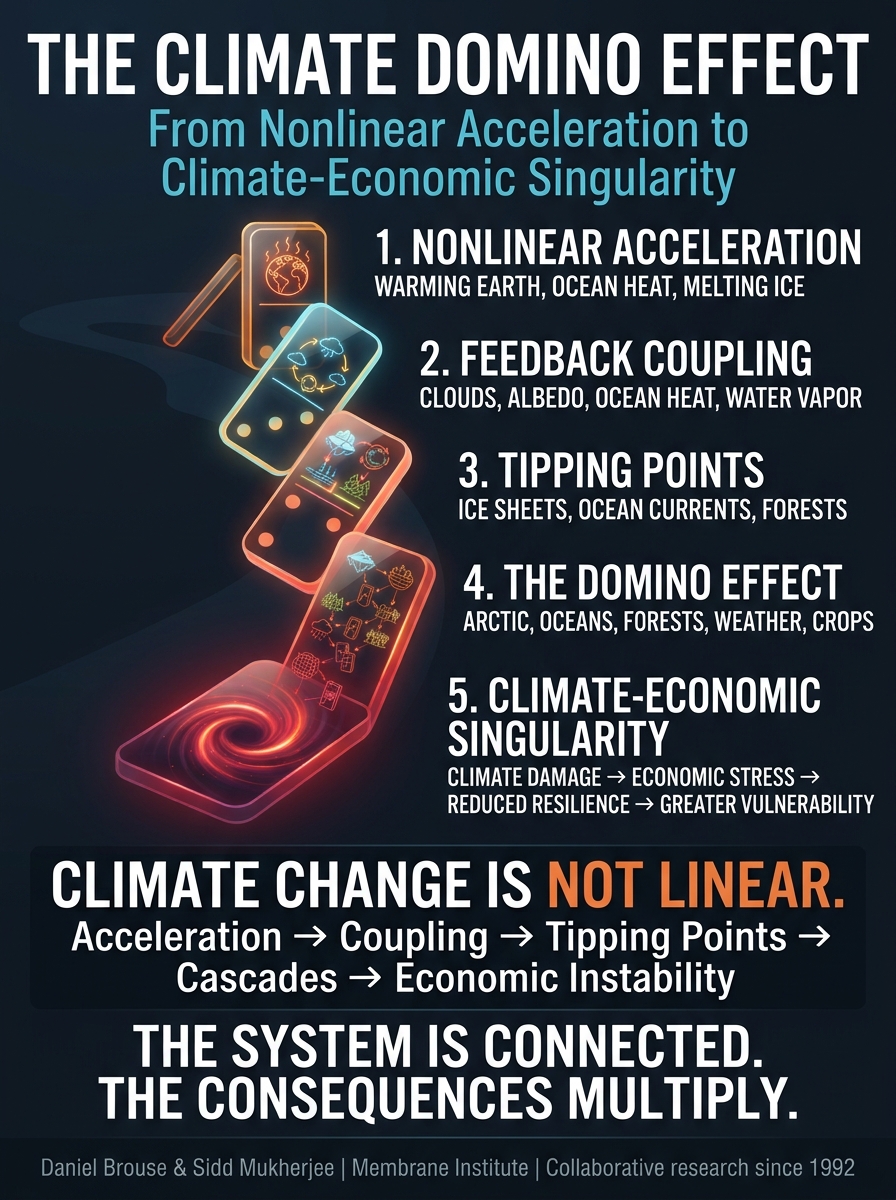
Our research brings together five related ideas:
Nonlinear Acceleration
Feedback Coupling
Climate Tipping Points
The Climate Domino Effect
Climate-Economic Singularity
Together, these ideas provide a framework for understanding how climate changes can spread through Earth’s natural systems and into the global economy.
2. Nonlinear Acceleration: Change Can Speed Up
A common assumption is that climate change will proceed at a relatively steady rate. But natural systems do not always change in straight lines.
A small change can produce a larger response. That response can then create conditions for even faster change.
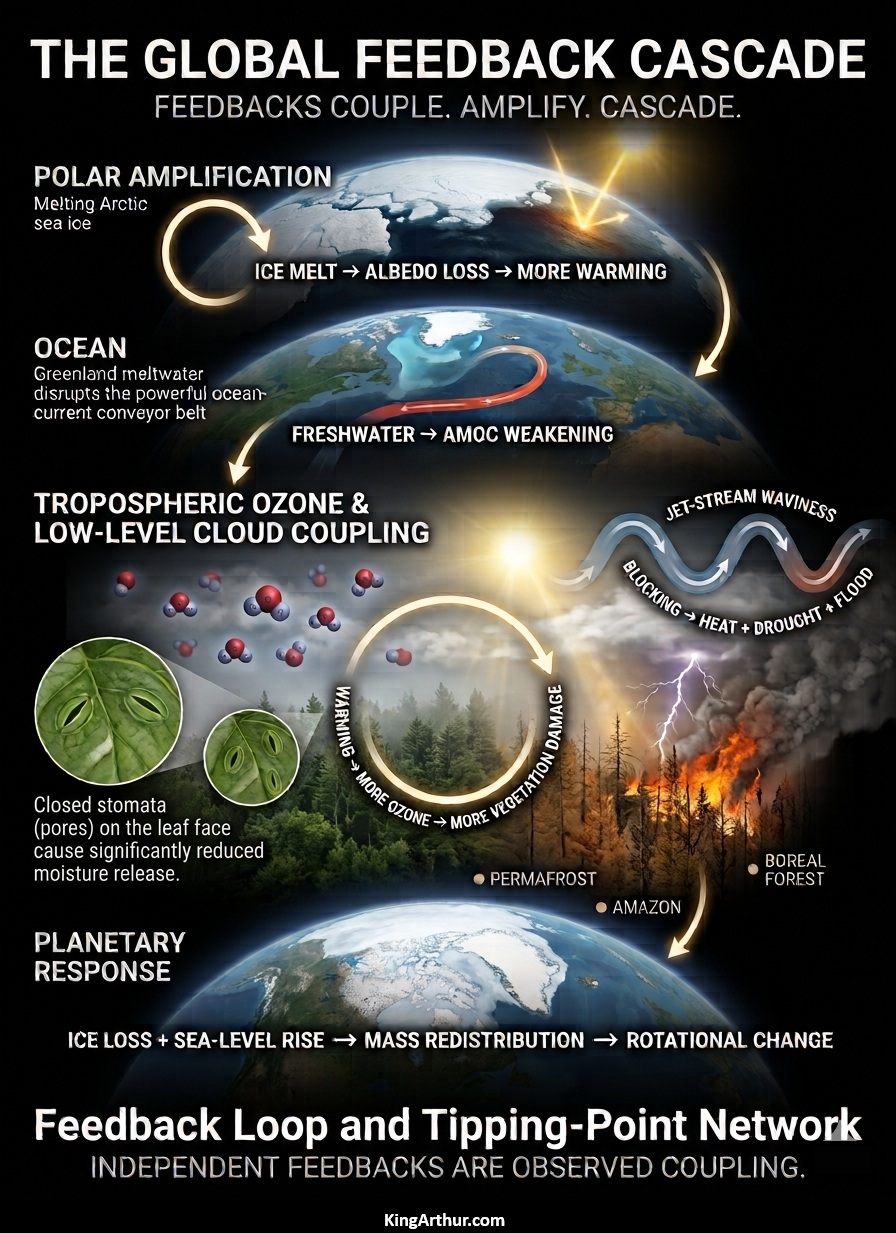
Consider Arctic sea ice. As temperatures rise, ice melts and exposes darker ocean water. Dark water absorbs more sunlight than reflective ice. The additional absorbed energy warms the ocean, contributing to further ice loss.
This is a feedback loop: an initial change creates conditions that reinforce the original change.
Our Nonlinear Acceleration Hypothesis examines how these processes can cause the rate of climate change itself to increase.
In simple terms:
Climate conditions change.
The rate of change increases.
Feedback processes reinforce that change.
Additional changes develop more quickly.
This means that looking only at average temperatures or long-term trends can miss important developments. We must also examine how quickly conditions are changing and whether that rate is increasing.
3. Feedback Coupling: Climate Changes Reinforce One Another
A feedback loop occurs when a change produces an effect that influences the original change.
Feedback coupling goes further. It describes what happens when multiple feedback processes interact.
For example:
Rising temperatures reduce reflective sea ice.
Reduced sea ice allows the ocean to absorb more solar energy.
Warmer ocean water contributes to atmospheric warming and changes in circulation.
Atmospheric changes influence clouds and precipitation.
Changes in vegetation and soil moisture affect how much heat and water move between the land and atmosphere.
Each process influences others.
The important point is that these interactions can amplify the overall response. The combined effect of several connected feedbacks can be greater than the effect of examining each one separately.
Our research examines these relationships through a proposed framework called the Coupled Climate Feedback Index. It is intended to help evaluate how interactions among indicators such as albedo, cloud cover, ocean heat content, sea ice, and temperature relate to changing climate conditions.
This approach emphasizes connections rather than treating each climate indicator as an isolated measurement.
4. Tipping Points: When Major Changes Become Difficult to Reverse
A climate tipping point is a threshold beyond which a system can undergo a major change that becomes difficult to stop or reverse.
Some changes happen gradually. Others can accelerate after a threshold is crossed.
Examples of climate systems receiving serious scientific attention include:
Greenland and Antarctic ice sheets
Arctic sea ice
Major ocean circulation systems
Tropical coral reef ecosystems
The Amazon rainforest
Permafrost regions
A tipping point does not necessarily mean that an entire system changes overnight. Some changes unfold over decades or centuries. But once the underlying processes become self-reinforcing, returning to earlier conditions can become increasingly difficult.
Tipping points are especially important because they can interact. A change in one part of the climate system can increase the pressure on another.
That brings us to the next concept.
5. The Climate Domino Effect: One Problem Can Lead to Another
The Climate Domino Effect describes how changes in one climate system can trigger or intensify changes in other systems.
Imagine a series of connected dominoes. The first falls, then affects the next, and the process continues.
In the climate system, the connections are more complicated, but the general idea is similar.
For example:
Warming contributes to ice loss.
Ice loss changes how much solar energy the Earth absorbs.
Additional warming affects ocean and atmospheric circulation.
Changes in circulation influence rainfall, drought, and regional weather.
These changes place additional stress on forests, agriculture, water supplies, and ecosystems.
The process can also work in the opposite direction. Damage to forests, for example, can reduce the ability of natural systems to absorb carbon dioxide and regulate water and energy flows.
The Domino Effect does not mean that every climate tipping point will automatically trigger every other one. It means that interconnected systems can transmit and amplify disturbances, increasing the risk of cascading changes.
Understanding these connections is essential to evaluating climate risk.
6. Climate Damage Becomes Economic Damage
Climate change is not simply an environmental problem. It is also an economic problem.
Extreme heat, flooding, drought, stronger storms, sea-level rise, and ecosystem damage affect the assets and resources on which communities and economies depend.
The economic consequences include:
Higher insurance premiums and reduced insurance availability
Damage to homes, businesses, roads, bridges, and utilities
Declining property values in vulnerable locations
Agricultural losses and food-price increases
Disruptions to transportation and supply chains
Higher costs for water, energy, and public infrastructure
Increased financial pressure on households, businesses, and governments
These costs are connected.
For example, a flood can damage a home, increase insurance costs, reduce property values, disrupt local businesses, and place additional financial pressure on a municipality.
When multiple climate-related events occur together or in rapid succession, the economic burden can compound.
This is why climate risk must be evaluated not only by measuring physical damage but also by examining how that damage spreads through financial systems and local economies.
7. Climate-Economic Singularity: When the Problems Feed Each Other
Our Climate-Economic Singularity framework examines the possibility that climate and economic stresses can become increasingly interconnected and mutually reinforcing.
Climate damage creates economic losses. Economic losses reduce the resources available for recovery, adaptation, and infrastructure protection. Financial stress can then increase vulnerability to subsequent climate events.
For example:
Repeated flooding damages homes and infrastructure.
Insurance costs rise, or coverage becomes unavailable.
Property values and local tax revenues decline.
Municipalities have fewer resources for repairs and protection.
Communities become more vulnerable to the next event.
The process can become a reinforcing cycle.
The same general pattern can occur at larger scales through food production, energy systems, international trade, public debt, and financial markets.
The term singularity is used here as a research framework for examining the possibility of increasingly rapid and interconnected climate-economic disruption. It does not imply that the global economy has already reached a single, precisely defined point of collapse.
The central concern is that climate and economic risks can become coupled, making each more difficult to manage independently.
8. How the Five Ideas Fit Together
The five concepts describe different parts of one connected process.
Nonlinear Acceleration: Climate change can increase in speed rather than proceeding at a constant rate.
Feedback Coupling: Interacting climate processes can reinforce and amplify one another.
Tipping Points: Some systems can cross thresholds that lead to major, difficult-to-reverse changes.
The Climate Domino Effect: Changes in one system can trigger or intensify changes in others.
Climate-Economic Singularity: Climate disruption and economic stress can become mutually reinforcing.
This is a framework for examining connected risks, not a claim that every stage must occur in the same order or at the same speed.
It emphasizes why climate change must be understood as a system-wide challenge rather than a collection of unrelated environmental problems.
9. What Can We Do? Integrated Climate Stewardship
Understanding climate risks is only part of the challenge. We must also reduce the forces driving climate change and strengthen the systems on which communities depend.
Our approach is called Integrated Climate Stewardship.
Its central principle is:
ZERO-OUT + BENEFIT-IN
This means reducing harmful environmental impacts as directly as possible while also creating measurable benefits.
The approach emphasizes:
Reducing greenhouse gas emissions at their source.
Improving energy efficiency and reducing unnecessary energy use.
Protecting forests, wetlands, soils, and other natural systems.
Improving water conservation and management.
Strengthening buildings and infrastructure against climate impacts.
Supporting resilient food and transportation systems.
Evaluating environmental and economic consequences together.
The objective is not simply to compensate for damage somewhere else. It is to reduce the damage being created and produce additional benefits wherever practical.
Individuals, households, businesses, and communities all have opportunities to contribute. Local decisions can reduce costs, improve resilience, and lessen the pressures placed on natural systems.
No single action will solve climate change. But coordinated action across many connected systems can make a meaningful difference.
10. Conclusion: Everything Is Connected
Climate change is not a collection of separate problems. It is a connected system of changes, and the consequences can multiply.
Rising temperatures affect oceans, ice, clouds, forests, and weather patterns. These changes interact through feedback loops. Some systems approach or cross tipping points. Changes can spread through the climate system and produce cascading environmental and economic consequences.
The challenge is not simply to understand how much the planet is warming. We must also understand how quickly conditions are changing, how different processes interact, and how physical changes translate into economic risks.
The five concepts presented in this paper provide a framework for examining that larger picture.
The future will depend on how effectively we recognize these connections, reduce the underlying causes, and prepare our communities for the changes already underway.
Climate change is a system-wide problem. Our response must be system-wide as well.
About the Authors
Daniel Brouse is an independent climate researcher and economist whose work focuses on nonlinear systems, climate feedbacks, economic risk, and the connections between environmental change and financial stability. His research and systems analysis extend across several decades.
Sidd Mukherjee is an independent physicist specializing in the membrane domain. He has collaborated with Daniel Brouse through the Membrane Institute since 1992, contributing physics-based analysis to their work on nonlinear climate behavior and interconnected systems.
An Integrated Earth-System and Economic Risk Framework
By Daniel Brouse¹ and Sidd Mukherjee² November 14, 2026
¹ Independent Climate Researcher and Economist, Membrane Institute, USA ² Independent Physicist, Membrane Institute, USA
Abstract
Climate change is transitioning beyond a predominantly emissions-driven process into an increasingly interconnected Earth-system disturbance characterized by nonlinear acceleration, reinforcing feedbacks, interacting tipping points, and cascading consequences. The implications extend beyond environmental change into the economic, financial, ecological, and institutional systems upon which civilization depends.
This paper integrates the collaborative research of Daniel Brouse and Sidd Mukherjee, building upon their Nonlinear Acceleration Hypothesis, developed in the late 1990s, and subsequent investigations into climate feedback coupling, third-derivative behavior, tipping-point networks, and climate-economic instability.
Five interconnected concepts form the foundation of this framework:
Nonlinear Acceleration Hypothesis: Climate impacts increase at changing rates, with the possibility that acceleration itself is increasing.
Climate Tipping Points: Critical thresholds alter the stability and behavior of individual Earth-system components.
The Domino Effect: Destabilization in one component propagates through interconnected physical, biological, ecological, and socioeconomic systems.
Climate-Economic Singularity: Climate and economic feedback systems increasingly interact, amplifying instability and undermining the capacity to recover from subsequent disturbances.
A central supporting contribution is the 2026 National Science Review paper, The Domino Effect of Climate Tipping Points: A Multidisciplinary Perspective on Global Risks. Its multidisciplinary treatment of interconnected tipping elements and cascading risks provides an important scientific foundation for understanding climate disruption as a network phenomenon rather than a collection of isolated environmental events.
This paper extends that perspective through the integration of nonlinear dynamics, climate feedback analysis, observational indicators, economic transmission mechanisms, and systemic risk.
The central argument is that climate disruption increasingly involves self-reinforcing interactions within the Earth system, while its consequences propagate into economic systems that depend on environmental stability. As these systems become more tightly coupled, historical linear assumptions, conventional risk assessments, and backward-looking climate baselines become progressively less reliable.
The defining challenge is no longer simply measuring how much the planet is warming. It is understanding how rapidly the interconnected systems supporting civilization are changing, how disturbances propagate between them, and whether economic and institutional resilience can keep pace.
1. Introduction: From Global Warming to Earth-System Destabilization
The conventional description of climate change emphasizes the relationship between greenhouse gas emissions, atmospheric concentrations, radiative forcing, and increasing global temperatures.
These relationships remain fundamental to understanding anthropogenic warming. However, they do not fully describe the increasingly complex interactions occurring throughout the Earth system.
The planet is not a collection of independent environmental components. Its atmosphere, oceans, cryosphere, land surface, biosphere, and geological systems exchange energy and matter through interconnected physical and biological processes.
Changes in one component alter the conditions experienced by others.
The resulting interactions can amplify initial disturbances, accelerate subsequent changes, and destabilize systems that previously absorbed environmental stress.
This is the central premise of our collaborative research.
Beginning with the Nonlinear Acceleration Hypothesis, our work has progressively examined the transition from individual climate feedbacks to interconnected feedback networks, tipping-point interactions, cascading disruption, and ultimately climate-economic coupling.
These processes are not necessarily sequential. They overlap, interact, and develop at different rates.
Nevertheless, the progression provides an integrated framework for examining the changing behavior of the Earth system.
2. The Nonlinear Acceleration Hypothesis
2.1 Origins and development
The Nonlinear Acceleration Hypothesis was developed by Brouse and Mukherjee in the late 1990s.
The original proposition was that climate impacts would not increase in a simple linear relationship with time. Instead, interactions among climate processes would produce increasingly consequential changes through reinforcing feedback mechanisms.
The hypothesis was subsequently developed through investigations into:
Nonlinear climate dynamics.
Chaos theory and complex adaptive systems.
Thermal energy redistribution.
Climate feedback mechanisms.
Cryosphere and ocean interactions.
Ecosystem degradation.
Accelerating climate-related economic losses.
The central distinction is between the rate at which climate change occurs and the rate at which that rate changes.
A system can experience increasing impacts without necessarily experiencing increasing acceleration. Likewise, a system can accelerate at a constant rate without experiencing increasing acceleration.
Our framework examines the higher-order dynamics.
2.2 First, second, and third derivatives
For a climate-impact indicator represented by I(t):
First derivative:
dI/dt = Rate of change.
Second derivative:
d²I/dt² = Acceleration.
Third derivative:
d³I/dt³ = Climate Jerk.
Climate Jerk describes the rate of change in acceleration.
When the third derivative is positive over an appropriately defined interval, acceleration is increasing.
This provides an additional dimension for investigating climate behavior beyond conventional trend analysis.
A positive third derivative does not establish that every climate indicator is accelerating, nor does it independently demonstrate that a tipping point has been crossed. The result depends on the indicator, measurement period, statistical treatment, and observational uncertainty.
Nevertheless, examining third-derivative behavior across multiple independent climate indicators offers a way to investigate whether the Earth system is entering a regime characterized by increasingly rapid changes.
2.3 Time compression
One of the most consequential implications of nonlinear acceleration is time compression.
Climate changes historically associated with longer timescales can produce increasingly rapid consequences as multiple processes interact.
Our research examines the compression of characteristic doubling times across climate-impact indicators, including extreme precipitation, heat extremes, wildfire behavior, ice loss, and economic damage.
The purpose is not to assume that every climate variable follows a single exponential trajectory. Different indicators have different physical constraints, statistical distributions, and response times.
Rather, the observed and proposed compression of characteristic timescales provides a framework for investigating whether climate disruption is becoming increasingly concentrated within shorter periods.
2.4 The failure of historical climate baselines
The traditional 30-year climate normal is useful for describing long-term climate conditions. However, rapidly changing climate distributions create an important limitation.
If temperatures, precipitation extremes, atmospheric moisture, and seasonal patterns change substantially within a decade, a 30-year average can increasingly describe conditions that no longer represent the current climate.
The faster the climate changes, the more a backward-looking baseline can lag behind actual conditions.
This has direct consequences for:
Weather forecasting.
Infrastructure engineering.
Agricultural planning.
Insurance underwriting.
Property valuation.
Municipal budgeting.
Financial risk assessment.
Our April 2026 paper, Climate Change Change: Third Derivatives, Time Compression, and the Collapse of the 30-Year Climate Baseline, develops this argument.
The central point is that institutions must increasingly evaluate the rate at which climate conditions change rather than relying exclusively on historical averages.
3. Feedback Coupling: From Individual Mechanisms to Interconnected Networks
3.1 The amplification mechanism
Climate feedbacks are processes through which an initial change produces an additional response. Positive feedbacks reinforce the original disturbance. Negative feedbacks counteract it.
The critical issue is that feedback mechanisms do not operate independently. They interact through shared energy flows, atmospheric circulation, ocean dynamics, biological processes, and changes in surface conditions.
Consequently, the combined behavior of interacting feedbacks can differ substantially from the behavior of individual mechanisms considered separately.
3.2 Major climate feedback mechanisms
Ice-albedo feedback
Declining snow and ice expose darker surfaces that absorb more incoming solar radiation. Additional energy absorption contributes to further warming and ice loss.
Ocean-cryosphere coupling
Increasing ocean heat contributes to basal ice-shelf melting, grounding-line retreat, and destabilization of marine-based ice sheets.
Water-vapor feedback
Warmer atmospheric conditions increase the capacity of the atmosphere to hold moisture. Increased water vapor amplifies the greenhouse effect.
Cloud feedback
Changes in cloud coverage, altitude, optical properties, and composition alter the balance between incoming solar radiation and outgoing terrestrial radiation.
Low-level cloud reductions are particularly important because these clouds reflect substantial incoming solar energy.
Biosphere-carbon feedback
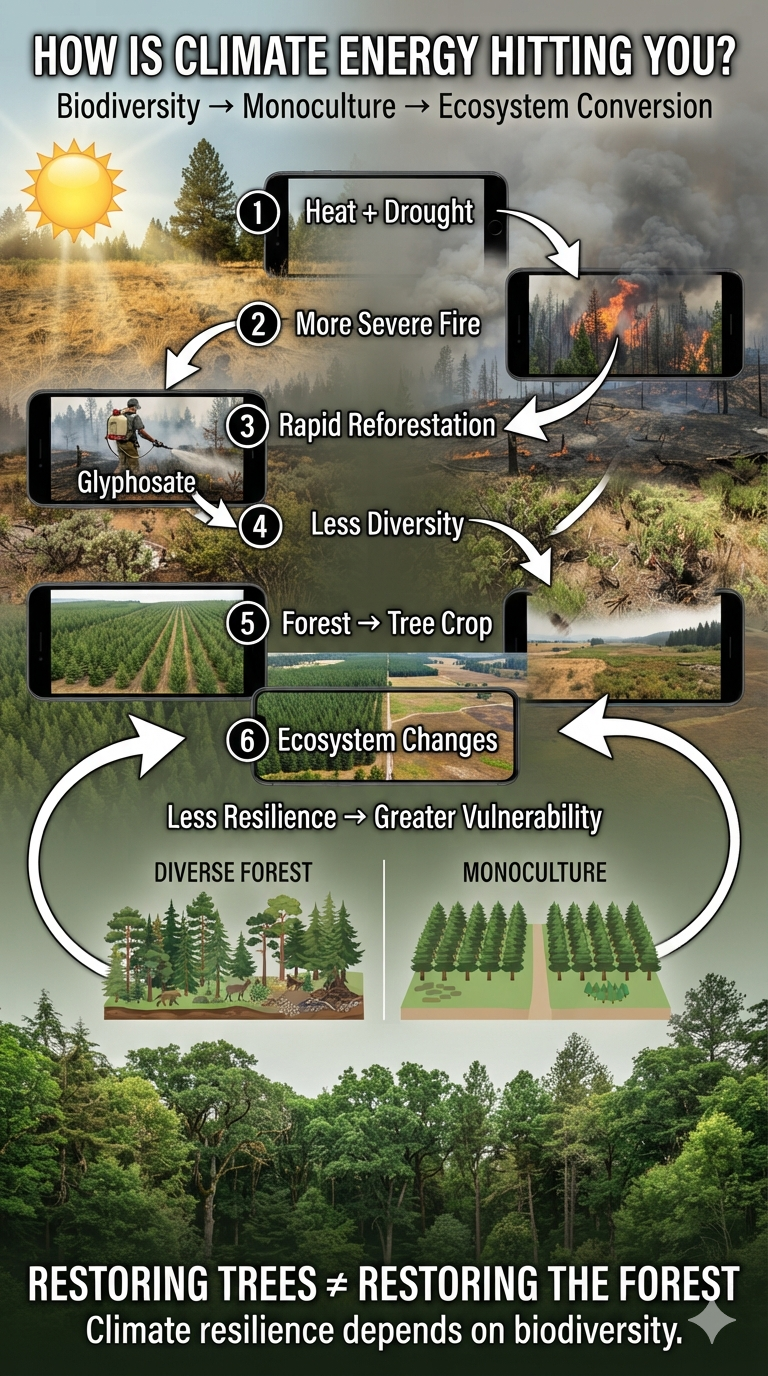
Heat, drought, wildfire, pests, and atmospheric pollutants stress vegetation, reduce photosynthetic activity, and weaken natural carbon sinks.
Permafrost feedback
Thawing permafrost releases previously frozen organic carbon through microbial decomposition, increasing atmospheric carbon dioxide and methane.
These mechanisms create multiple pathways through which disturbances propagate throughout the Earth system.
3.3 The Coupled Climate Feedback Index
Our Coupled Climate Feedback Index provides an analytical framework for investigating interactions among major climate indicators.
The framework incorporates:
Cloud cover.
Surface albedo.
Sea ice.
Ocean heat content.
Global surface temperature.
Atmospheric water vapor.
The analysis includes directional normalization, trend treatment, and pairwise and higher-order relationships.
Particular attention is given to the interaction among surface albedo, ocean heat content, and cloud behavior.
The proposed weighting framework identifies the following relationships:
Feedback interaction
Proposed relative weight
Albedo × Ocean Heat Content
14.3%
Cloud × Ocean Heat Content
13.2%
Albedo × Cloud
12.1%
Combined three-variable interaction
39.6%
These figures represent the proposed analytical weighting structure, not independently established percentages of global warming or causal attribution.
The purpose of the index is to investigate whether relationships among climate indicators are changing in ways consistent with increasing feedback coupling.
3.4 Feedback networks
Individual feedback loops can become components of larger networks.
For example:
Ocean Heat Accumulation ↓ Sea-Ice and Ice-Shelf Loss ↓ Reduced Surface Albedo and Increased Ocean Exposure ↓ Additional Solar Energy Absorption ↓ Further Ocean Warming ↓ Additional Cryosphere Destabilization
A second pathway involves the biosphere:
Increasing Heat and Drought ↓ Vegetation Stress and Wildfires ↓ Reduced Photosynthesis and Carbon Uptake ↓ Weakened Carbon Sinks ↓ Higher Atmospheric Greenhouse Gas Concentrations ↓ Additional Warming
The interaction between these pathways creates opportunities for cross-system amplification.
This is the distinction between individual feedbacks and feedback coupling.
Our research into emerging feedback networks examines how these relationships develop into interconnected systems capable of transmitting disturbances across multiple Earth-system components.
4. Climate Tipping Points: Thresholds and Loss of Resilience
4.1 Critical transitions
A climate tipping point occurs when an Earth-system component crosses a critical threshold beyond which a relatively small additional disturbance can produce a major transition.
Such transitions are associated with nonlinear dynamics, bifurcation theory, hysteresis, and changes in system stability.
Before a tipping point, a system may absorb disturbances and return toward its previous condition. As resilience declines, recovery can become slower or less complete. After a critical transition, the system may move toward a different state even if the original forcing is subsequently reduced.
This distinction is particularly important when evaluating the difference between preventing further destabilization and restoring an earlier environmental condition.
Changes in ocean overturning and regional circulation.
Marine ecosystem transitions.
Ocean deoxygenation.
Coral reef ecosystem degradation.
Disruption of marine biological carbon pumps.
Terrestrial ecosystems
Amazon rainforest dieback.
Boreal forest transitions.
Large-scale ecosystem degradation.
Loss of biodiversity and ecological resilience.
These systems are connected through heat redistribution, atmospheric circulation, ocean circulation, freshwater inputs, carbon exchange, and biological dependencies.
A disturbance in one system can therefore alter the stability of another.
4.3 Tipping points are not isolated events
The most important implication is that the stability of an individual tipping element cannot be evaluated entirely independently of its surrounding network.
The vulnerability of one system can increase as connected systems change.
For example, ocean warming affects ice shelves. Ice loss alters surface reflectivity and freshwater inputs. Freshwater changes can influence ocean circulation. Circulation changes can redistribute heat and nutrients, affecting marine ecosystems.
This creates a network of interacting vulnerabilities.
5. The Domino Effect: Cascading Tipping-Point Networks
5.1 The multidisciplinary perspective
The 2026 paper by Jun Meng and Deliang Chen, The Domino Effect of Climate Tipping Points: A Multidisciplinary Perspective on Global Risks, provides important supporting documentation for this framework. Published in National Science Review, the paper examines the broader consequences of interconnected tipping points and the potential for cascading transitions across multiple systems.
Its multidisciplinary perspective reinforces an important principle:
Climate tipping points are not simply individual thresholds. They are components of an interconnected network.
The use of network-based approaches, including multilayer connectivity and percolation concepts, provides a framework for investigating how local disturbances can propagate into larger systemic disruptions.
This complements our earlier work on feedback loops, tipping points, and the Domino Effect.
5.2 From dominoes to network cascades
The traditional domino analogy suggests that one event triggers another in a linear sequence.
The actual Earth system is more complex. One disturbance can affect several interconnected systems simultaneously. Those systems can then influence multiple additional components.
The resulting network contains overlapping pathways, feedback loops, thresholds, and dependencies.
Example 1: Arctic warming and cascading climate disruption
Arctic Warming ↓ Sea-Ice Loss ↓ Reduced Surface Albedo and Increased Solar Energy Absorption ↓ Changes in Ocean-Atmosphere Heat Exchange ↓ Changes in Atmospheric and Ocean Circulation ↓ Regional Temperature and Precipitation Changes ↓ Ecosystem Stress and Destabilization ↓ Agricultural Disruption and Economic Losses
This is an illustrative pathway, not a claim that every link occurs in a fixed sequence or that Arctic sea-ice loss alone necessarily triggers all subsequent changes.
Example 2: Ocean circulation and marine ecosystem disruption
Ocean Circulation Changes ↓ Altered Ocean Temperature and Nutrient Distribution ↓ Marine Deoxygenation and Ecosystem Stress ↓ Coral Reef Degradation and Fisheries Disruption ↓ Reduced Marine Food Production ↓ Food Security and Livelihood Pressures ↓ Economic Disruption in Coastal Communities
This pathway demonstrates how physical ocean disturbances can propagate into biological, ecological, and economic systems.
Example 3: Forest degradation and carbon-sink failure
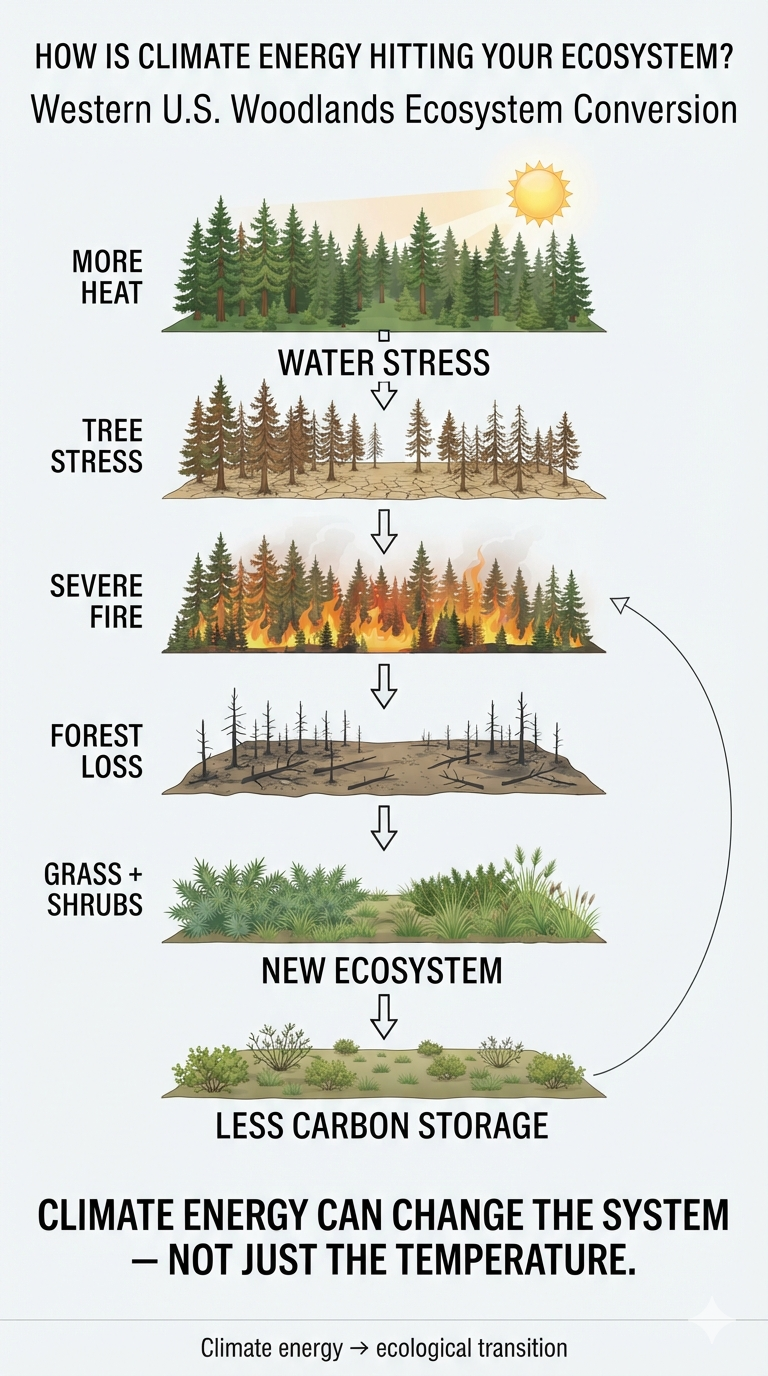
Increasing Heat and Drought ↓ Vegetation Stress and Wildfire ↓ Forest Degradation and Reduced Photosynthesis ↓ Declining Carbon Uptake ↓ Weakened Terrestrial Carbon Sinks ↓ Additional Atmospheric Greenhouse Gas Accumulation ↓ Further Climate Stress
The important feature is the reinforcing relationship between ecosystem degradation and climate change.
5.3 Percolation and interconnected risk
Percolation theory provides a mathematical framework for examining how disturbances spread through connected networks. As network connectivity or interaction strength increases, localized disruptions can propagate across larger portions of a system.
Applied to climate science, this raises an important question:
At what point do interactions among individual tipping elements become sufficiently strong that localized disturbances can generate widespread systemic transitions?
There is no single established planetary threshold answering this question. However, multilayer network analysis provides a useful framework for studying how physical, biological, ecological, and socioeconomic systems interact.
5.4 The importance of cascading effects
The Domino Effect changes the way climate risk must be evaluated.
A tipping element may appear geographically isolated, but its consequences can extend across the planet through atmospheric, oceanic, ecological, and economic connections.
The resulting risks cannot be adequately characterized by evaluating individual events in isolation.
The relevant question becomes how disturbances interact, how quickly they propagate, and whether the affected systems retain sufficient resilience to prevent additional transitions.
6. Climate-Economic Coupling: The Transmission of Physical Risk
6.1 The economy is embedded within the Earth system
The global economy depends on relatively stable environmental conditions. Agriculture requires productive soils, reliable water, and predictable growing conditions. Energy systems require functioning infrastructure and dependable resources. Transportation and international trade depend on ports, waterways, roads, railways, and shipping networks. Financial institutions depend on functioning businesses, insurable assets, reliable collateral, and stable economic activity.
These are not independent of environmental conditions.
The economy is embedded within the Earth system.
Consequently, environmental degradation creates economic consequences that extend far beyond the immediate cost of repairing physical damage.
6.2 Major economic transmission mechanisms
Agriculture and food security
Heat stress, drought, flooding, changing precipitation patterns, and ecosystem degradation affect crop production, livestock, fisheries, and food distribution.
Simultaneous disruptions across major agricultural regions increase the potential for global food-price instability.
Insurance withdrawal transfers additional exposure to homeowners, businesses, municipalities, lenders, and governments.
Infrastructure and public finances
Flooding, extreme precipitation, coastal erosion, extreme heat, and severe storms increase maintenance and replacement costs.
Governments face competing demands for emergency response, reconstruction, adaptation, public services, and debt servicing.
Energy and transportation
Extreme temperatures, water shortages, flooding, and severe weather threaten electricity generation, transmission infrastructure, transportation networks, and industrial operations.
International trade and supply chains
Disruptions in agricultural production, shipping, ports, energy supplies, and manufacturing propagate through international markets. These transmission mechanisms create an additional layer of cascading risk.
A climate disturbance initiates an economic disturbance, which can then increase vulnerability to subsequent climate disturbances.
6.3 Economic damage becomes endogenous
Conventional economic analysis frequently treats environmental damage as an external cost. This becomes increasingly inadequate when climate disruption begins changing the operating conditions of the economy itself.
The consequences extend beyond the original environmental event. Economic damage becomes an internal component of the climate-risk system.
This is the foundation of climate-economic coupling.
7. The Climate-Economic Singularity
7.1 Defining the singularity framework
The Climate-Economic Singularity is our proposed framework describing the convergence of nonlinear climate acceleration, reinforcing feedback networks, cascading tipping points, and increasingly interconnected economic instability.
The term singularity is used as a systems-level concept rather than a claim that a literal mathematical singularity or a single irreversible global economic collapse has been demonstrated.
In our March 2026 paper, Approaching Singularity: Third Derivatives, Nonlinear Collapse, and Coupled Climate-Economic Instability, we developed this concept through the examination of nonlinear dynamics, physical analogies, third-derivative behavior, and coupled climate-economic processes.
A singularity-like regime is characterized by:
Increasing sensitivity to relatively small disturbances.
Accelerating changes in system behavior.
Reinforcing feedback mechanisms.
Declining reliability of historical relationships.
ECONOMIC DAMAGE Agricultural losses, infrastructure destruction, insurance claims, property devaluation, supply-chain disruptions, and rising public expenditures.
↓
FINANCIAL AND INSTITUTIONAL STRESS Higher insurance costs, credit risk, municipal fiscal pressure, capital losses, market instability, and reduced investment capacity.
↓
REDUCED ADAPTIVE CAPACITY Less available capital for infrastructure protection, climate adaptation, ecosystem restoration, and economic resilience.
↓
GREATER CLIMATE VULNERABILITY More exposed infrastructure, vulnerable communities, fragile supply chains, and reduced capacity to absorb subsequent disturbances.
↓
ADDITIONAL ECONOMIC DAMAGE The cycle reinforces itself.
This is the critical distinction between conventional climate-economic risk and the singularity framework.
Climate disruption does not simply impose an increasing financial cost. It can undermine the economic capacity required to manage subsequent climate damage.
7.3 Third-derivative behavior
Our singularity framework examines the possibility that both climate and economic indicators exhibit increasing rates of acceleration.
The progression is:
dI/dt > 0 — Impacts are increasing.
d²I/dt² > 0 — Impacts are accelerating.
d³I/dt³ > 0 — Acceleration itself is increasing.
These relationships must be evaluated against specific indicators, observation periods, and statistical methods.
The important question is whether multiple independent climate and economic indicators increasingly exhibit this behavior.
Our research examines ocean heat content, sea-level rise, ice-sheet mass loss, atmospheric circulation, extreme weather losses, and economic exposure as components of this broader investigation.
7.4 Ocean Solvency and the Ocean Maelstrom
A particularly important extension of the Climate-Economic Singularity framework is our November 10, 2026 update, Ocean Maelstrom: Navigating the Climate Storm.
The report examines the systemic economic implications of ocean degradation, incorporating the Ocean Solvency framework developed in the November 2026 report by the Institute and Faculty of Actuaries, the University of Exeter, and The Ocean Race.
Ocean Solvency describes the continuing capacity of the ocean to provide the ecosystem services upon which human societies and economies depend.
These services include:
Global climate regulation and heat redistribution.
Marine food production and biodiversity.
Oxygen production and carbon absorption.
Global water cycles and weather patterns.
International commerce and maritime transportation.
Economic productivity and financial stability.
The Ocean Maelstrom scenario illustrates how multiple interacting ocean, climate, ecological, and geopolitical pressures can propagate through economic systems.
The sequence can be represented as:
Ocean Degradation ↓ Climate Disruption ↓ Food and Agricultural Instability ↓ Inflation and Supply-Chain Disruption ↓ Economic Contraction ↓ Financial and Sovereign Instability ↓ Reduced Adaptive Capacity ↓ Greater Vulnerability to Subsequent Disruptions
The scenario also examines exposure involving insurance markets, pension funds, investment portfolios, government finances, and retirement security.
Importantly, the scenario is a systemic-risk assessment, not a prediction of a specific economic contraction. Its significance is that ocean degradation can affect multiple components of economic stability simultaneously.
The ocean is not separate from the economy. It is foundational economic infrastructure.
7.5 From climate damage to economic amplification
The Climate-Economic Singularity framework extends the Domino Effect beyond the physical and ecological environment.
The interconnected system now includes:
Climate feedback networks.
Ecological and biological systems.
Agricultural and food systems.
Insurance and property markets.
Banking and financial institutions.
Infrastructure and energy networks.
Government budgets and sovereign finances.
International trade and supply chains.
As these systems become more tightly coupled, disruptions can propagate across multiple sectors. The resulting consequences can exceed the sum of individual losses.
This is the transition from environmental risk to systemic economic risk.
8. Integrating the Five Concepts: One Unified Framework
The five concepts developed throughout our research describe interconnected dimensions of the same evolving process.
Concept
Principal mechanism
Systemic consequence
Nonlinear Acceleration Hypothesis
Increasing rates of climate change and acceleration
Historical trends become inadequate
Feedback Coupling
Reinforcement among interacting climate processes
Greater amplification of disturbances
Climate Tipping Points
Critical thresholds and changes in system stability
Abrupt and potentially irreversible transitions
Domino Effect
Propagation across interconnected systems
Cascading environmental and ecological disruption
Climate-Economic Singularity
Coupling of climate and economic feedback systems
Systemic economic instability and declining resilience
This is a conceptual progression, not a fixed sequence of inevitable events. Individual processes can overlap, reinforce one another, and develop at different rates.
Nevertheless, the integrated framework provides a means of examining the transition from emissions-driven warming to increasingly interconnected Earth-system and economic instability.
9. Measuring and Monitoring an Interconnected System
9.1 Beyond global average temperature
Global average temperature remains an essential climate indicator, but it cannot independently characterize the stability of the entire Earth system.
A more comprehensive approach must examine:
Earth’s energy imbalance.
Ocean heat content.
Sea-ice extent and thickness.
Surface albedo.
Cloud properties.
Atmospheric water vapor.
Ocean circulation.
Ice-sheet mass and grounding-line behavior.
Ecosystem productivity.
Atmospheric and terrestrial carbon exchange.
Extreme precipitation and drought.
Agricultural productivity.
Climate-related economic losses.
The relationships among these indicators are as important as their individual trends.
9.2 Early-warning indicators
Systems approaching critical transitions can exhibit changes in their behavior before a major transition occurs.
Potential warning signals include:
Increasing variance.
Increasing autocorrelation.
Critical slowing down.
Changes in spatial correlations.
Increasing sensitivity to disturbances.
Altered recovery rates following perturbations.
These indicators can provide useful information about changing resilience. However, early-warning signals are not universal, and their absence does not establish that a system is stable.
The observational challenge is to identify changes in system behavior while distinguishing genuine shifts from natural variability, measurement limitations, and statistical artifacts.
9.3 Integrating physical and economic observations
The next generation of climate-risk analysis must connect Earth-system observations with economic and financial indicators.
A comprehensive monitoring framework integrates:
Physical climate observations.
Nonlinear dynamical analysis.
Climate feedback networks.
Multilayer tipping-point analysis.
Ecological and biogeochemical measurements.
Agricultural and infrastructure exposure.
Insurance and financial risk indicators.
Government fiscal exposure.
AI-assisted pattern recognition and early-warning systems.
This approach improves the ability to identify not only individual climate thresholds but also the interactions that increase the potential for cascading disruptions.
It also provides a more realistic assessment of how environmental changes propagate through the global economy.
10. Implications for Climate Policy and Economic Risk Management
The integrated framework has important implications for climate policy.
Emissions reductions remain essential because they limit additional external forcing and reduce the likelihood of further destabilization. However, climate policy must also address the internal dynamics of the Earth system and the growing economic consequences of interconnected climate disruption.
Five priorities
1. Protect climate-regulating systems
Prioritize the cryosphere, forests, wetlands, marine ecosystems, and other systems that contribute to planetary climate regulation.
2. Monitor coupled feedbacks
Develop integrated observational systems that identify changes in relationships among ocean heat, albedo, clouds, ice, atmospheric moisture, and biological carbon uptake.
3. Evaluate cascading risk
Assess infrastructure, food production, water security, insurance markets, and financial institutions against compound and interconnected climate hazards rather than isolated historical events.
4. Build economic resilience
Strengthen infrastructure, diversify supply chains, improve emergency preparedness, protect natural systems, and reduce financial exposure to correlated climate risks.
5. Integrate mitigation with measurable environmental benefits
Climate stewardship must extend beyond reducing emissions to include actions that improve the functioning of natural systems and reduce environmental stress.
Our Integrated Climate Stewardship framework expresses this through a straightforward principle:
ZERO-OUT + BENEFIT-IN.
Reduce environmental damage while actively contributing measurable benefits to the systems that sustain life and economic activity.
The objective is not merely to slow deterioration. It is to restore and strengthen resilience wherever possible.
11. Conclusion: The Transition to Systemic Climate-Economic Instability
The most important implication of our collaborative research is that climate change cannot be adequately evaluated as a linear response to greenhouse gas emissions.
The Earth system is interconnected, nonlinear, and capable of abrupt transitions.
The Nonlinear Acceleration Hypothesis identifies the increasing importance of acceleration in climate disruption.
Feedback Coupling explains how individual amplification mechanisms interact and form larger networks.
Climate Tipping Points identify critical thresholds beyond which major Earth-system transitions can occur.
The Domino Effect explains how those transitions propagate through interconnected physical, biological, ecological, and socioeconomic networks.
The Climate-Economic Singularity extends the analysis into the global economy, where climate damage increasingly affects the systems responsible for maintaining economic stability and financing recovery.
The 2026 analysis by Meng and Chen provides an important multidisciplinary foundation for understanding how tipping elements interact and how localized disturbances can generate cascading global risks.
Our collaborative work extends this perspective by integrating nonlinear acceleration, climate feedback coupling, third-derivative analysis, and economic transmission mechanisms into a unified framework.
The resulting picture is one of increasing interdependence.
Climate instability damages economic systems. Economic instability reduces the resources available for adaptation and resilience. Reduced resilience increases exposure to subsequent climate disturbances.
The cycle reinforces itself.
The consequences extend from the physical environment into property markets, insurance systems, agriculture, infrastructure, financial institutions, government budgets, and international commerce.
The global economy is operating within an Earth system whose stability it depends upon but whose destabilization it must increasingly absorb.
This creates a fundamental challenge for conventional economic analysis: the systems supporting economic production and financial stability are themselves exposed to the environmental deterioration driving the risks.
The central question is no longer simply how much additional warming the planet will experience. It is how rapidly the interconnected systems supporting civilization are losing resilience, how disturbances propagate between them, and whether economic institutions can adapt at a rate sufficient to keep pace.
Understanding this transition is essential to anticipating the next phase of climate risk.
The solution requires more than measuring change. It requires understanding the interactions driving change, recognizing the thresholds that alter system behavior, and protecting the environmental and economic foundations of civilization.
References and Supporting Research
A. Principal collaborative research by Brouse and Mukherjee
1. Nonlinear Acceleration of Climate Change (1999)
Brouse, D., & Mukherjee, S. (1999). Nonlinear Acceleration of Climate Change. Membrane Institute Working Paper Series.
Foundational development of the Nonlinear Acceleration Hypothesis.
2. Tipped Tipping Points and the Domino Effect: Accelerating Climate Collapse (2026)
Brouse, D., & Mukherjee, S. The Human Induced Climate Change Experiment and the Domino Effect.
Develops the Climate-Economic Singularity framework through nonlinear dynamics, third derivatives, physical analogies, and interconnected climate-economic feedback systems.
Daniel Brouse Independent Climate Researcher and Economist Co-founder, Membrane Institute Research interests: Nonlinear climate dynamics, climate-economic coupling, financial risk, climate feedback networks, and integrated climate stewardship.
Sidd Mukherjee, Ph.D. Independent Physicist Co-founder, Membrane Institute Research interests: Physics, nonlinear systems, energy dynamics, mathematical modeling, and climate-system interactions.
Membrane Institute / Membrane.com Collaborative independent research initiated in 1992.
This paper synthesizes the authors’ collaborative research and extends it through an integrated Earth-system and climate-economic risk framework. The proposed indices, acceleration metrics, and singularity framework are research constructs whose quantitative interpretations should be evaluated against observational evidence, statistical uncertainty, and established physical models.
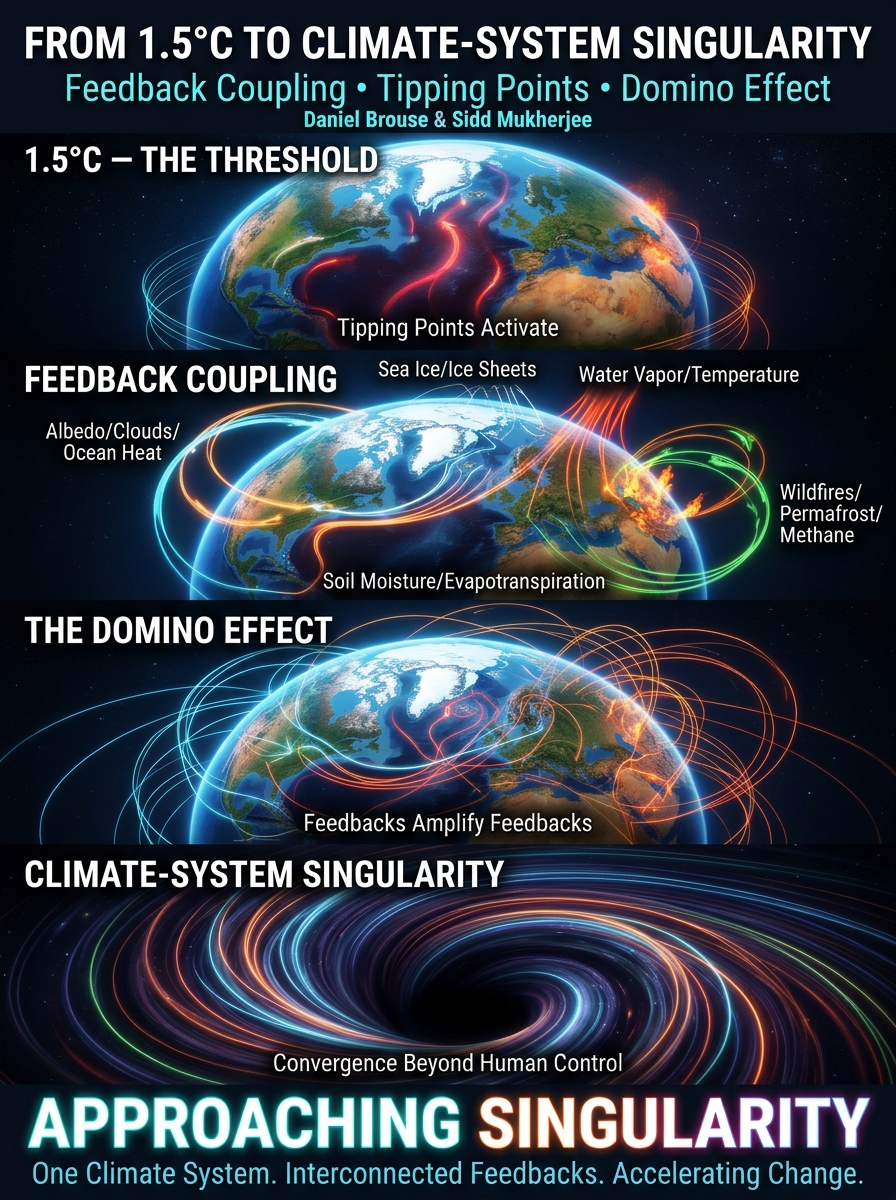
From 1.5°C Warming to Feedback Coupling, Tipping Points, and the Domino Effect
Earth’s climate system is entering a new phase. As global warming exceeds critical thresholds, climate feedbacks increasingly interact, reinforce one another, and trigger cascading changes across the planet.
The Emerging Progression
🌡️ 1.5°C Warming → Increasing pressure on planetary tipping points.
🔄 Feedback Coupling → Climate processes begin reinforcing one another.
🧊 Tipping Points → Ice sheets, oceans, forests, and other systems become increasingly unstable.
🌪️ Domino Effect → Interconnected feedbacks amplify changes across the Earth system.
Climate change is no longer just about rising temperatures. It is about an increasingly interconnected system in which one change amplifies another.
📖 Explore the paper, examine the emerging feedback connections, and discover the scientific sources and research behind this framework.
Feedback Coupling, Tipping Points, and the Domino Effect
1. The 1.5°C Threshold: Tipping Points Activate
The 2023–2026 four-year average is projected to surpass 1.5°C above preindustrial levels. This is no longer simply a projection of future warming. We are observing the consequences of an increasingly interconnected climate feedback system in real time.
3. Climate-System Singularity: Convergence of Feedback Networks
As individual feedbacks emerge, couple, and organize into self-reinforcing networks, those networks increasingly interact and converge toward a unified, interconnected climate system.
A climate-system singularity represents a critical tipping point where interacting feedbacks drive increasingly uncontrollable and irreversible planetary change. It is analogous to a gravitational singularity, such as a black hole, where converging forces produce a point beyond which conventional predictions and control break down. In the climate system, this represents a trajectory toward increasingly unpredictable, self-reinforcing change that becomes progressively decoupled from human policy intervention.
1. IPCC (2021) — Climate Change 2021: The Physical Science Basis, Chapter 7: Earth’s Energy Budget, Climate Feedbacks, and Climate Sensitivity. Covers water vapor, clouds, surface albedo, and interconnected climate feedback processes. IPCC Chapter 7
2. IPCC (2023) — Climate Change 2023: Synthesis Report. Documents increasing risks of abrupt and irreversible climate changes, including tipping-point risks between 1.5°C and 2.5°C. IPCC Synthesis Report
3. Global Tipping Points Report (2025). Comprehensive scientific assessment of interacting Earth-system tipping elements and cascading risks. 2025 Report and downloads
4. Nature Geoscience (2025) — Destabilization of Earth System Tipping Elements. Examines interactions among Greenland, Antarctic, AMOC, and Amazon tipping elements. Read scientific paper
5. IPCC (2021) — Chapter 5: Global Carbon and Other Biogeochemical Cycles and Feedbacks. Covers permafrost, vegetation, soil carbon, ocean carbon exchange, and greenhouse gas feedbacks. IPCC Chapter 5
6. WMO (2026) — Global Annual to Decadal Climate Update 2026–2035. Provides current temperature projections and the probability of temporarily exceeding 1.5°C. WMO Climate Update
Additional research and original work
7. Daniel Brouse and Sidd Mukherjee — Climate Feedback and Tipping-Point Network. Original research
8. Daniel Brouse and Sidd Mukherjee — Observable Climate Feedback Coupling. Original research
The United States bears an oversized responsibility for the climate crisis through its enormous historical contribution to greenhouse gas emissions. Yet U.S. climate policy is moving backward while Earth’s interconnected climate systems are destabilizing.
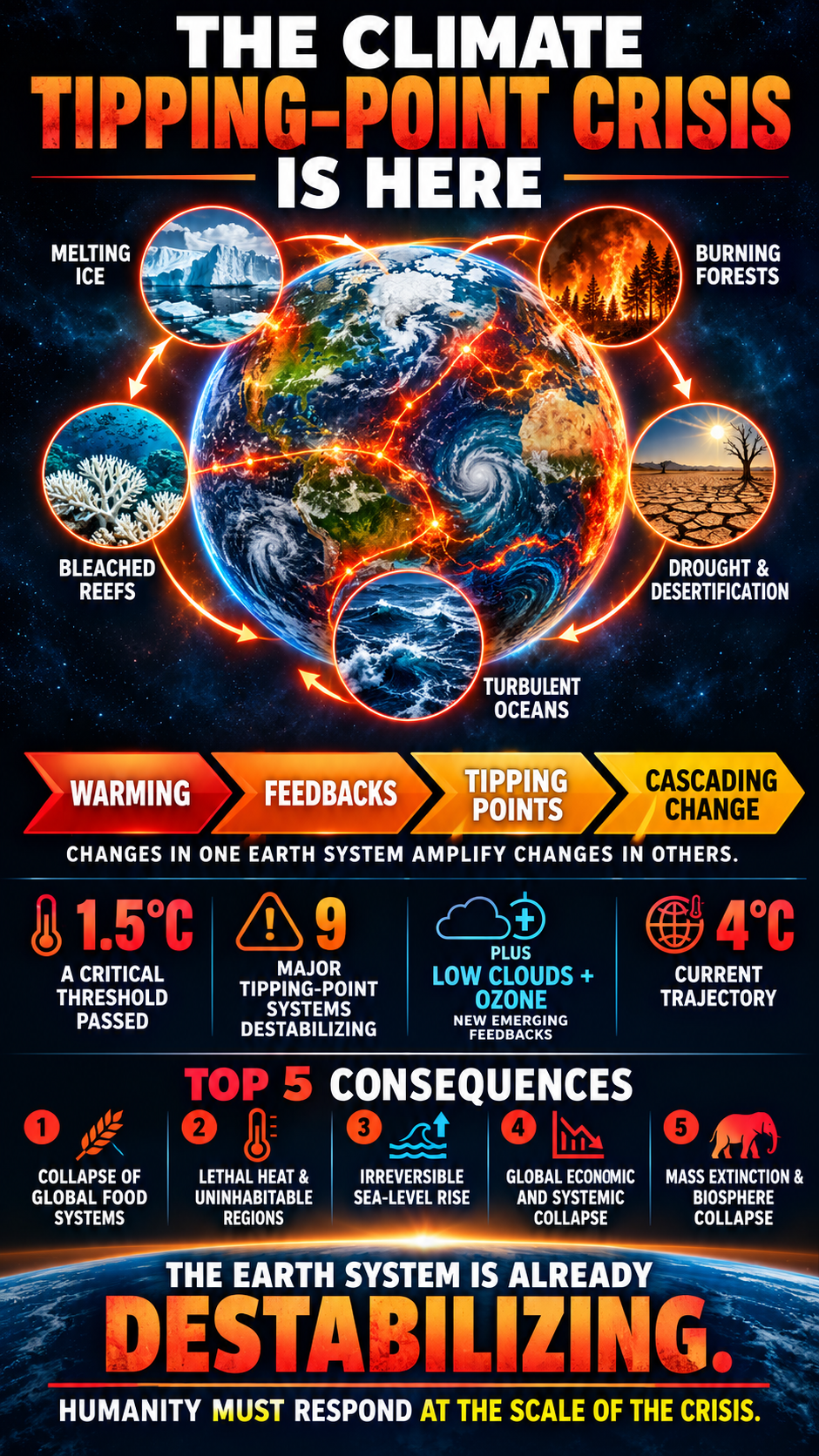
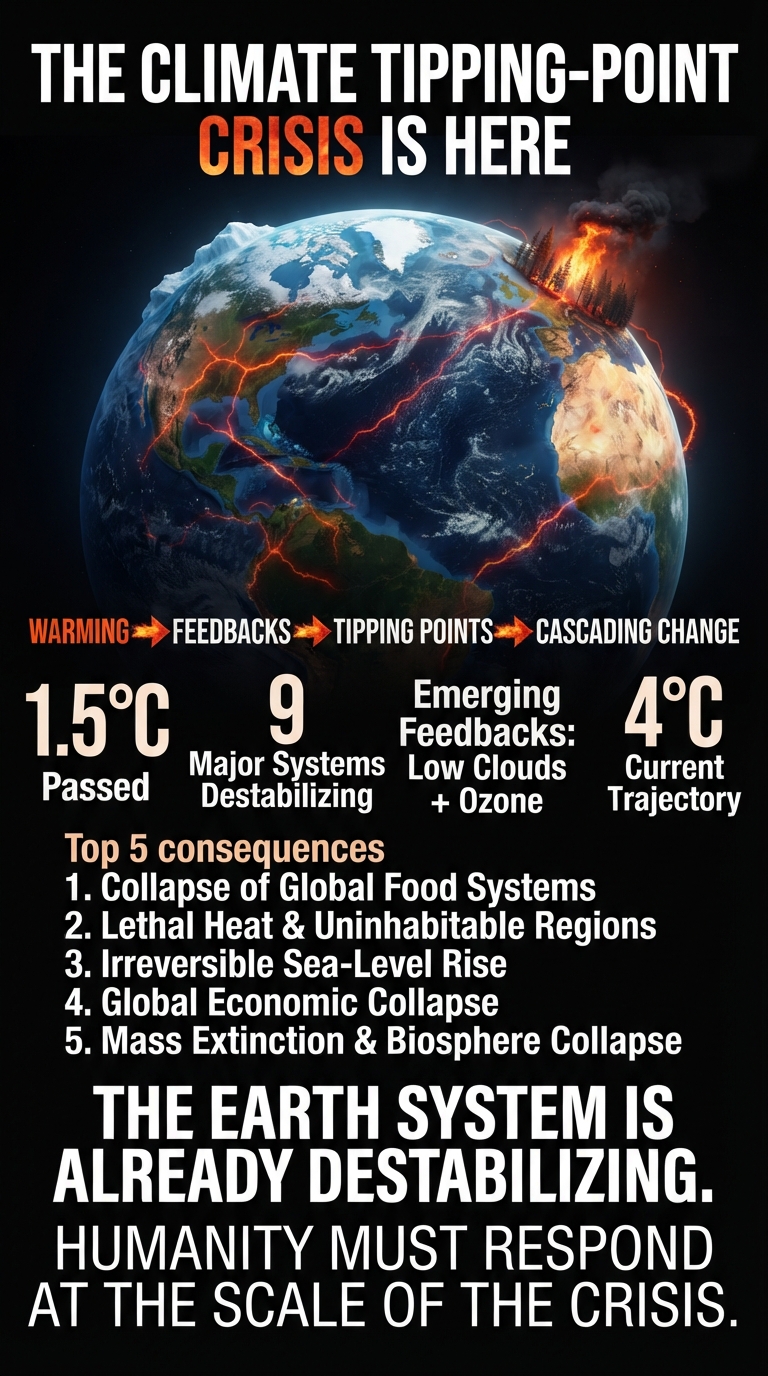
THE CLIMATE TIPPING-POINT CRISIS IS HERE.
Warming is no longer just a matter of rising temperatures. It is activating feedbacks that amplify changes across interconnected Earth systems, accelerating a climate domino effect.
4°C — The severe warming trajectory examined in this analysis for this century.
THE TOP FIVE CONSEQUENCES
Collapse of Global Food Systems
Lethal Heat and Uninhabitable Regions
Irreversible Sea-Level Rise
Global Economic and Systemic Collapse
Mass Extinction and Biosphere Collapse
These are interconnected threats. Food insecurity, extreme heat, coastal inundation, economic disruption, and ecological collapse reinforce one another, placing human civilization and natural ecosystems under mounting pressure.
THE EARTH SYSTEM IS ALREADY DESTABILIZING.
The climate crisis is not simply a future problem. Observed changes are already underway, and interconnected feedbacks threaten to amplify their consequences. Political delay and continued emissions deepen the challenge.
HUMANITY MUST RESPOND AT THE SCALE OF THE CRISIS.
Read the full paper for the scientific framework, emerging feedbacks, climate tipping points, and consequences of a high-warming trajectory.
Crossing 1.5°C: The Tipping Points Are Already Activating
The significance of crossing the 1.5°C global warming threshold extends far beyond a numerical temperature target. This threshold marks a critical boundary for the activation of major climate tipping points. At least nine major tipping-point systems are already exhibiting destabilization, with activation beginning below 1.5°C of global warming.
Other major tipping points associated with warming between 1.5°C and 2°C are also experiencing periods of activation. These observations demonstrate that the climate system is already undergoing fundamental changes as interconnected feedback processes intensify.
According to the UN Environment Programme (UNEP) and the Copernicus Climate Change Service, the long-term global average surface temperature has risen approximately 1.4°C above pre-industrial levels (1850–1900). Understanding this figure requires distinguishing sustained warming from individual annual temperature records.
1. Long-Term Warming: Approximately 1.4°C
To assess the Paris Agreement’s 1.5°C threshold, scientists examine long-term temperature averages rather than treating a single unusually warm year as proof of a sustained breach. A 20-year average smooths temporary fluctuations associated with natural climate variability, including El Niño.
By this long-term measure, global warming stands at approximately 1.4°C. The world is approaching the threshold associated with increasingly widespread and consequential climate tipping-point activation.
2. Annual Temperature Records: 1.55°C
Individual calendar years have already exceeded 1.5°C of warming.
In 2024, the global average surface temperature reached approximately 1.55°C above the pre-industrial baseline, making it the hottest year in the instrumental record. Human-caused greenhouse gas emissions, combined with natural climate variability, contributed to this record.
The 1.5°C threshold is therefore no longer merely a distant benchmark. Annual global temperatures have already crossed it, while long-term warming continues to approach the same boundary.
Once tipping points activate, self-reinforcing feedback processes intensify changes within the climate system. These processes connect warming to additional warming, accelerating the redistribution of energy throughout the atmosphere, oceans, cryosphere, and biosphere.
Nine Major Climate Tipping-Point Systems Undergoing Destabilization
A landmark synthesis published in Nature by leading international scientists identifies nine major climate tipping-point systems exhibiting destabilization. These systems have moved beyond abstract future concerns: measurable changes are occurring across interconnected components of the Earth system.
The Cryosphere: Ice Masses and Frozen Ground
Greenland Ice Sheet: Accelerating surface melting threatens the long-term stability of the ice sheet. Crossing its tipping threshold commits the planet to eventual, irreversible sea-level rise of approximately seven meters.
West Antarctic Ice Sheet: Marine ice-sheet instability is intensifying as warming ocean waters melt glaciers from below, undermining the structural stability of the ice sheet.
Parts of East Antarctica: Major subglacial basins are showing signs of accelerated ice loss, challenging earlier assumptions about the stability of these regions.
Arctic Sea Ice: Arctic sea ice is rapidly declining in extent and thickness. This loss reduces Earth’s albedo, or reflectivity, allowing the ocean to absorb more incoming solar energy and amplifying regional and global warming.
Permafrost: Abrupt thaw is occurring across northern latitudes. Decomposition of previously frozen organic material releases carbon dioxide and methane, adding greenhouse gases to the atmosphere and strengthening warming feedbacks.
Ocean and Atmospheric Circulation
Atlantic Meridional Overturning Circulation (AMOC): This major system of Atlantic Ocean currents, which includes the Gulf Stream, is experiencing substantial disruption. Freshwater entering the North Atlantic from melting Arctic and Greenland ice alters ocean density and threatens the circulation system’s stability.
Changes in ocean circulation affect heat transport, regional climate patterns, marine ecosystems, and the distribution of energy throughout the climate system.
The Biosphere: Forests and Marine Ecosystems
Amazon Rainforest: Deforestation and rising temperatures are intensifying drought stress across the Amazon. Increasingly dry conditions, forest degradation, and fire interact to push parts of the rainforest toward a degraded, fire-prone savannah state.
Boreal Forests: Extensive tree mortality and increasingly destructive wildfire cycles are disrupting forest regeneration across northern latitudes. These changes threaten the long-term stability of major forest ecosystems and their role in carbon storage.
Warm-Water Coral Reefs: Marine heatwaves have repeatedly exceeded critical thermal thresholds, producing widespread and severe coral bleaching. Repeated bleaching and ecological degradation threaten reef survival and accelerate transitions toward algae-dominated ecosystems.
These tipping-point systems do not operate independently. Destabilization in one part of the Earth system changes conditions in others, creating interconnected feedbacks and increasing the risk of cascading failures. The resulting domino effect makes the combined behavior of the climate system more consequential than any single tipping point considered in isolation.
The United States: A Major Setback in Global Climate Action
The United States’ climate policy direction represents a major setback in the international response to global warming.
According to the 2026 UN Environment Programme Emissions Gap Report: The Point of Return, the United States was identified as the only major economy experiencing a dramatic annual increase in greenhouse gas emissions. The reported increase of 133 million metric tons of carbon dioxide equivalent represents a substantial reversal in U.S. emissions performance.
The reported surge reflects the interaction of energy demand, fossil-fuel dependence, and federal policy changes. While other G20 economies reduced or stabilized their emissions, the United States moved in the opposite direction.
Policy Reversal: Withdrawal from the Paris Agreement
Following his second inauguration in January 2025, President Donald Trump signed an executive order initiating a second U.S. withdrawal from the 2015 Paris Climate Agreement. The withdrawal became official on January 27, 2026.
The administration defended the decision as a means of protecting American energy independence and resisting international regulations it characterized as unfair to domestic workers.
At the same time, federal policy reversed or weakened multiple climate measures. These changes targeted vehicle fuel-efficiency standards, halted tax credits supporting wind and solar development, and imposed requirements intended to keep aging fossil-fuel power plants operating.
Together, these policies weakened federal support for emissions reductions and reinforced the role of conventional fossil fuels in the U.S. energy system.
Coal, Electricity Demand, and Artificial Intelligence
The reported 133-million-metric-ton emissions increase coincided with rising electricity demand and renewed reliance on carbon-intensive power generation.
Coal resurgence: Increased coal-fired generation helped meet electricity demand while older power plants remained operational. Extending the operation of these plants reversed a longstanding downward trend in U.S. power-sector emissions.
Artificial intelligence and data centers: Rapid expansion of AI infrastructure created substantial new electricity demand. Data-center growth increased pressure on existing power grids, while the deployment of new energy infrastructure struggled to keep pace. Utilities consequently relied heavily on existing coal and natural-gas generation.
The interaction of rising electricity demand, fossil-fuel generation, and policy changes demonstrates how technological expansion without corresponding clean-energy deployment increases emissions.
Global Consequences
The UNEP report projects that current global climate policies and emissions trajectories will produce warming of approximately 2.6°C to 2.8°C by the end of the century. This trajectory represents a substantial overshoot of the Paris Agreement’s 1.5°C objective.
The United States’ retreat from climate commitments deepens the international leadership gap. The European Union, China, India, Brazil, and South Africa are among the major actors pursuing international climate cooperation outside the framework of U.S. participation.
The central problem is not simply that one country has changed its policies. It is that the world’s largest historical contributor to greenhouse gas emissions is weakening its climate response while the Earth system is already showing signs of destabilization.
The Deeper Problem: Climate Change Is Accelerating Beyond Historical Human Experience
The difficulty of predicting future climate conditions lies in the unprecedented speed and complexity of the changes now underway.
Humanity has never experienced human-driven climate change at the present rate of acceleration. As one scientific assessment explains, the current speed of human-induced carbon dioxide change and warming is nearly without precedent in the geological record, with the instantaneous meteorite impact associated with the extinction of non-avian dinosaurs 66 million years ago representing the principal known exception.
Past climate records provide essential evidence about Earth’s sensitivity and behavior. However, those records do not provide a direct historical precedent for a technologically advanced civilization deliberately transforming the atmosphere at the current rate while simultaneously confronting interconnected climate tipping points.
Humanity understands the mechanisms behind many individual climate feedbacks. The unprecedented challenge is determining how these mechanisms interact when multiple thresholds are crossed and destabilization spreads across interconnected systems.
A reasonable expectation is that a society confronting its greatest existential environmental threat would respond decisively. The U.S. policy reversal demonstrates that political and economic behavior does not necessarily follow that expectation, even as climate risks intensify.
From Individual Tipping Points to Cascading Feedbacks
The activation of nine major tipping-point systems raises a fundamental issue: the climate system is interconnected, and its response to multiple simultaneous disturbances is not equivalent to the sum of isolated changes.
As ice melts, albedo declines. As oceans absorb additional energy, marine heatwaves intensify. As forests deteriorate, carbon storage and ecosystem resilience decline. As permafrost thaws, greenhouse gases enter the atmosphere. These processes interact, reinforcing the original warming and altering the conditions under which other feedbacks operate.
This is the climate domino effect: warming activates feedbacks, feedbacks amplify warming, and interconnected systems move toward additional thresholds. The resulting cascade changes the trajectory of the entire Earth system.
The problem is compounded by emerging feedback mechanisms whose combined influence is not adequately represented in conventional climate projections.
Two Emerging Feedbacks: Low-Level Clouds and Tropospheric Ozone
Declining low-level clouds represent a major emerging climate feedback. Low clouds reflect incoming solar radiation back into space. A sustained decline in their coverage reduces this cooling influence and increases the energy retained by the Earth system.
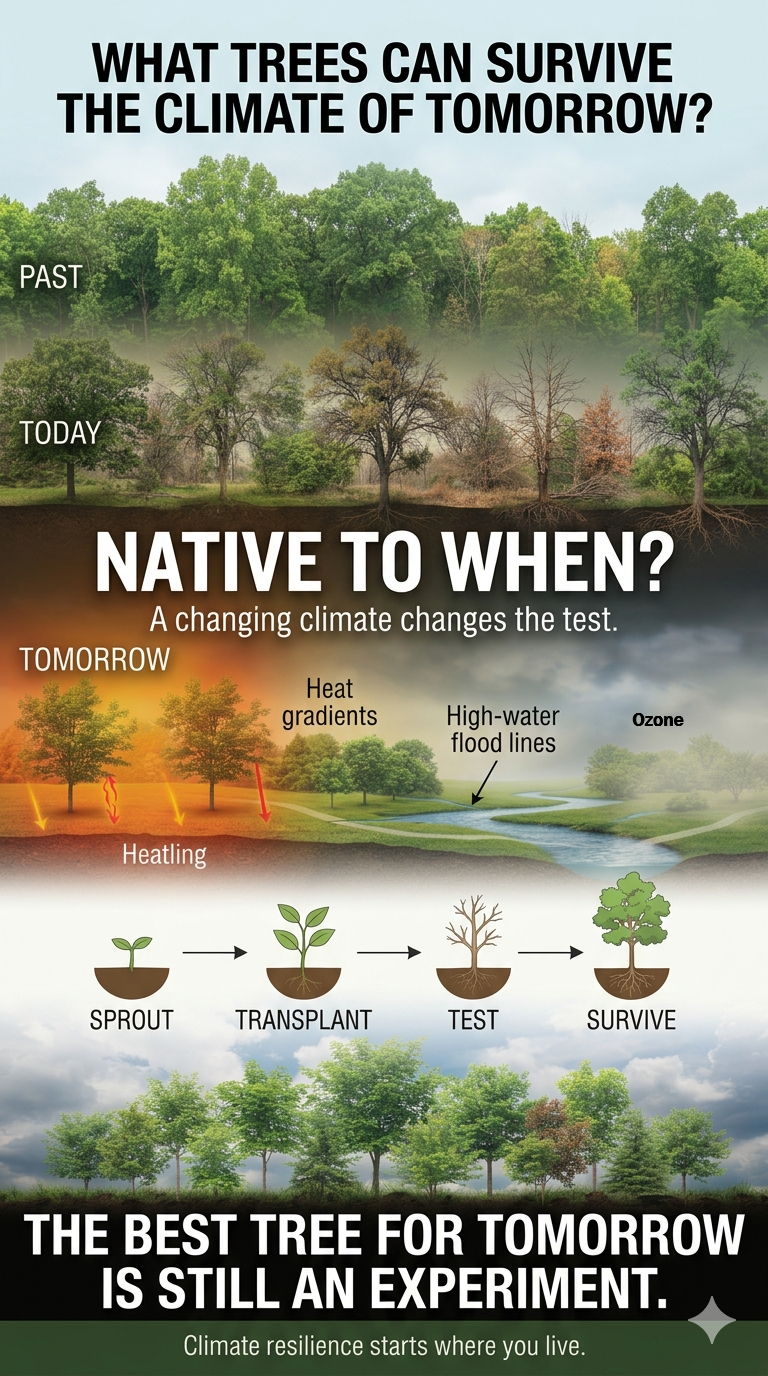
Tropospheric ozone is another major climate-forcing agent. In addition to contributing to atmospheric warming, ozone damages vegetation, reduces photosynthetic performance, and impairs the ability of forests and other ecosystems to absorb carbon dioxide. These ecological effects weaken natural carbon sinks while adding to the climate system’s existing greenhouse forcing.
The significance of these feedbacks extends beyond their individual contributions. Their interaction with established feedbacks changes the overall balance of energy entering, leaving, and being redistributed throughout the climate system.
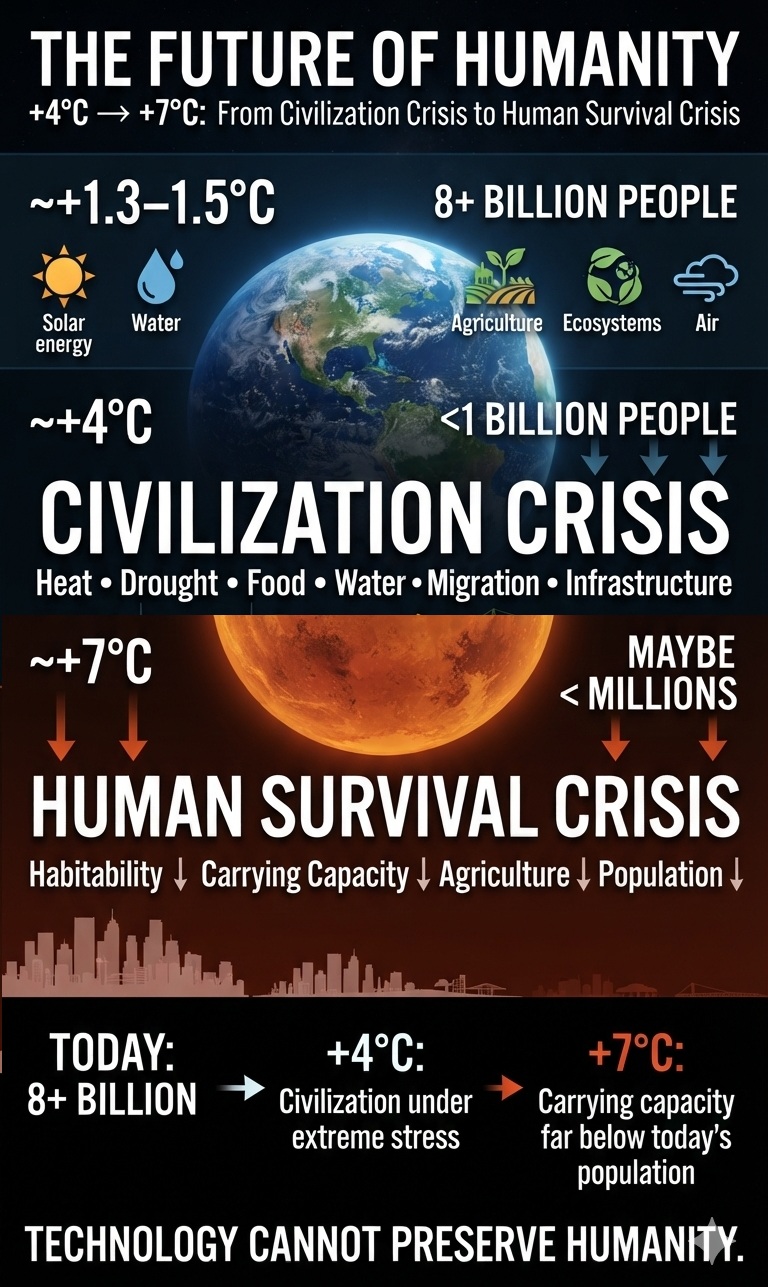
Previous probabilistic projections placed end-of-century warming on a trajectory approaching 2.8°C. Accounting for the combined influence of declining low-level clouds and tropospheric ozone supports a substantially more severe assessment, with warming of approximately 4°C this century representing the trajectory advanced in this analysis.
A 4°C outcome is not simply a more intense version of today’s climate. It represents a fundamental transformation of the conditions supporting human civilization and natural ecosystems.
The Consequences of a 4°C World
Warming of 4°C above pre-industrial levels would impose extraordinary stresses on food production, human habitability, coastlines, global economic systems, and biodiversity. The following risks describe the consequences associated with such a high-warming trajectory.
1. Collapse of Global Food Systems
Extreme heat, prolonged drought, and shifting precipitation patterns threaten agricultural productivity across the world’s major food-producing regions.
Simultaneous crop failures: Concurrent failures of wheat, maize, rice, and soybean harvests across multiple continents threaten global food supplies and destabilize international markets.
Tropical agricultural losses: Agricultural productivity in tropical and subtropical regions faces declines of up to 50%, undermining food security across major agricultural zones.
Marine food-system disruption: Marine heatwaves and ocean acidification damage fisheries and marine ecosystems, threatening a major source of protein for billions of people.
The convergence of agricultural losses and declining marine productivity places global food security under severe systemic pressure.
2. Lethal Heat and Uninhabitable Regions
Extreme heat and humidity threaten human survival across increasingly large areas of the planet.
Wet-bulb temperature extremes: Parts of the Middle East, South Asia, Central Africa, and the Amazon face dangerous combinations of heat and humidity. A sustained wet-bulb temperature of 35°C approaches the theoretical upper limit of human heat tolerance under the conditions used to define that threshold.
Mass displacement: A large share of the global population faces living conditions outside the historical human climate envelope, driving displacement on a scale involving hundreds of millions of people.
The consequences extend beyond direct heat mortality. Extreme temperatures undermine outdoor labor, public health, infrastructure, water availability, and the viability of entire communities.
3. Irreversible Sea-Level Rise and Coastal Inundation
A 4°C warming trajectory places the major ice sheets under extreme long-term stress and commits the planet to substantial, persistent sea-level rise.
Long-term inundation: Sea-level rise of approximately one to two meters by 2100 represents a severe coastal risk under high-warming scenarios. Continued ice-sheet loss commits the planet to much greater sea-level rise over subsequent centuries, with estimates of 10 to 20 meters associated with the most severe long-term outcomes.
Threats to major cities: Tokyo, New York, Shanghai, Mumbai, and Lagos, together with low-lying island nations, face escalating coastal inundation, infrastructure destruction, and displacement as sea levels rise.
The long response time of major ice sheets means that the consequences of sustained warming extend far beyond the end of this century.
4. Global Economic and Systemic Collapse
Climate disasters occurring simultaneously across regions place interconnected financial, economic, and political systems under extraordinary strain.
Severe economic contraction: High-warming assessments include scenarios involving global economic losses on the order of 30% to 50% by 2100. Losses of this magnitude would exceed the economic disruption associated with the Great Depression.
Resource conflicts: Competition over freshwater, fertile land, and other essential resources intensifies as drought expands and mountain glaciers diminish. These pressures increase the risks of geopolitical conflict, displacement, and state failure.
Insurance markets, public infrastructure, food distribution, financial systems, and government budgets face overlapping losses. The scale and interdependence of these impacts threaten the stability of the global economy.
5. Mass Extinction and Biosphere Collapse
Rapid climate disruption forces ecosystems to change faster than many species can adapt or migrate. Habitat loss, extreme heat, drought, wildfire, and ocean warming compound existing pressures on biodiversity.
Accelerating extinction risk: Under severe warming, a substantial share of plant and animal species faces extinction risk as habitats disappear or undergo fundamental transformation.
Amazon forest dieback: Continued warming, drought, deforestation, and fire intensify the risk of large-scale Amazon forest degradation and transition toward savannah-like ecosystems. The release of stored carbon would reinforce atmospheric warming and further destabilize the climate system.
Biosphere collapse is not an isolated ecological concern. Forests, soils, wetlands, and marine ecosystems regulate carbon storage, water cycles, regional climates, and food webs. Their deterioration weakens the natural systems on which human societies depend.
Conclusion: The Climate Tipping-Point Crisis Is Already Underway
The 1.5°C threshold represents a critical boundary in a climate system already undergoing measurable destabilization. Major ice sheets, Arctic sea ice, permafrost, ocean circulation, forests, and coral reefs are experiencing changes that interact through reinforcing feedbacks.
The danger lies in the coupling of these processes. Individual changes alter the conditions governing other components of the Earth system, creating a cascading response that conventional assessments of isolated climate risks fail to capture fully.
The United States’ retreat from climate commitments adds a major political and economic obstacle to the global response. Rising fossil-fuel emissions, expanding electricity demand, and the weakening of climate safeguards deepen the gap between the scale of the threat and the scale of the response.
Declining low-level clouds and tropospheric ozone further complicate the climate outlook by strengthening warming and undermining natural cooling and carbon-absorption processes. Their combined influence demands serious consideration when evaluating the trajectory toward 4°C of warming this century.
The central conclusion is clear: climate change is not merely a future problem defined by a temperature target. It is an accelerating Earth-system crisis involving interconnected feedbacks, tipping points, ecological disruption, and profound risks to human civilization.
The question is no longer whether climate change is destabilizing the Earth system. The observed evidence establishes that it is. The defining challenge is whether humanity will respond to the scale and speed of that destabilization before cascading consequences become substantially more severe.
Introduction: Faith, Science, and Political Accountability
I’m a fiscally conservative Republican economist who has been registered Republican since 1980. I also hold a degree in philosophy, with a concentration in morals and ethics, and have studied Christianity extensively, including reading the Bible in depth multiple times.
My family lineage can be traced to the Tribe of Judah and the family of Jesus. I’ve spent decades studying eschatology, particularly the biblical significance of my given name, Daniel, and the subject of the End Times. I’ve also conducted an extensive examination of the Book of Revelation.
Although I generally keep my religious beliefs separate from my scientific work, I’ve been analyzing Donald Trump’s conduct since the 1990s. My conclusions are informed by decades of economic analysis, moral philosophy, scientific research, and biblical study.
This paper brings those perspectives together to examine a question that extends beyond ordinary partisan politics: What happens when political power, religious certainty, deception, and disregard for human consequences converge?
My argument is that Trump’s conduct deserves serious scrutiny not because he is necessarily the literal Antichrist described in biblical prophecy, but because his political actions, public statements, and alliances raise profound moral questions about deception, authoritarianism, environmental destruction, Christian nationalism, and the treatment of vulnerable human beings.
1. My First Moral and Ethical Assessment of Trump
During the 1990s, I conducted a moral and ethical experiment involving Trump’s publicly traded business interests in the context of a widows-and-orphans fund.
Of all the businesses examined in that study, Trump’s was the only one in which I concluded that funds intended for widows and orphans had been stolen.
That experience left a lasting impression on my assessment of his character. It also established a personal foundation for my subsequent examination of Trump’s business practices, public conduct, and political career.
The conclusion was not based on whether I liked his personality, agreed with his politics, or approved of his business ambitions. It arose from an assessment of conduct against a moral standard: how people and institutions behave when entrusted with resources that affect others, particularly vulnerable people.
That distinction remains fundamental. Wealth, power, popularity, and claims of religious conviction do not exempt anyone from moral accountability.
2. The Great Deceiver: A Decade of Dangerous Consequences
Over the past decade, I’ve watched Trump develop into what I consider the Great Deceiver: a politician whose repeated falsehoods have undermined public trust, public health, and public safety.
His conduct during COVID-19, his rejection of climate science, and his decisions affecting foreign aid have contributed to consequences that, in my assessment, include millions of needless deaths. These actions belong in any serious examination of large-scale human suffering and crimes against humanity.
The term “Great Deceiver” is my moral and political characterization of Trump’s conduct. I use it deliberately because deception is not merely a personal failing when practiced by someone wielding enormous political power. It can shape public behavior, distort the understanding of reality, undermine institutions, and influence decisions affecting millions of lives.
During a public health emergency, misinformation can interfere with efforts to protect people. When a political leader repeatedly dismisses established scientific evidence, the consequences can extend beyond rhetoric into policy and public behavior. When decisions affect humanitarian assistance, the consequences can reach people who have little control over the political decisions that determine whether they receive help.
Climate change presents an equally serious moral problem. Rejecting established climate science and obstructing effective responses can increase risks to public health, food security, infrastructure, ecosystems, and future generations.
On September 23, 2025, Trump addressed the United Nations General Assembly and called climate change “the greatest con job ever perpetrated on the world.” This was a public and unmistakable expression of his rejection of mainstream climate science and international climate action. Source: Reuters, September 23, 2025.
These are not simply disagreements over the details of environmental policy. They concern the consequences of dismissing an extensive body of scientific evidence while exercising power over decisions that affect the lives of others.
The moral question is straightforward: When a political leader’s statements and decisions contribute to preventable suffering, what responsibility does that leader bear?
That question deserves examination regardless of party affiliation.
3. Is Trump the Antichrist?
Regarding the Antichrist, I agree with one part of the argument made by those who believe the figure described in biblical prophecy will be difficult to recognize: I don’t believe Trump is literally the Antichrist described in Scripture.
But that conclusion does not eliminate my concerns about his conduct or the movements he supports.
The concern is that Trump is helping advance political and religious movements that could bring about catastrophic consequences under the banner of Christianity. I see a dangerous convergence of Christian Zionism, white nationalism, and authoritarian politics, alongside an alarming relationship between elements of the Trump political network and the broader Epstein scandal.
The distinction matters. One can reject the claim that a political leader is literally the Antichrist while still examining whether that leader’s actions embody forms of deception, hypocrisy, cruelty, or destructive ambition that religious teachings warn against.
Biblical discernment should not be reduced to identifying a single individual who matches a prophetic description. It should also involve examining conduct, motives, consequences, and the treatment of other people.
A person can invoke God, Scripture, and Christian identity while pursuing policies that contradict the ethical principles those beliefs are supposed to uphold.
The question is not simply whether Trump fits a particular interpretation of Revelation. It is whether Christians are applying their moral teachings consistently when evaluating him.
4. Christian Zionism, Biblical Prophecy, and the War With Iran
The connection between Christian Zionism and Trump’s foreign policy deserves particular scrutiny.
Support for Israel among evangelical Christians is not exclusively theological; it also reflects strategic, cultural, historical, and political considerations. However, for some Christian Zionist constituencies, support for Israel is tied to specific interpretations of biblical prophecy and the End Times.
When prophetic expectations become intertwined with decisions about war, the consequences can extend far beyond theology.
The concern is that religious interpretations of history and prophecy can become entangled with political calculations in ways that make military escalation appear divinely justified or historically inevitable. When that happens, the ordinary requirements of foreign policy—evidence, strategic judgment, proportionality, diplomacy, and consideration of human consequences—risk being subordinated to a narrative of prophetic destiny.
The Trump administration’s confrontation with Iran in 2026 has intensified these concerns. The United States and Israel launched strikes against Iran in February 2026, and the conflict subsequently developed into a prolonged confrontation. The administration’s handling of the war has raised questions about its strategic objectives, its exit strategy, and the economic and human costs. Source: Reuters, October 8, 2026.
The relationship among the Trump administration, Christian Zionist organizations, and the war raises serious questions about the relative influence of American national interests, military strategy, religious prophecy, and domestic political pressures.
There is also a political contradiction within Trump’s coalition. An America First constituency has opposed prolonged foreign entanglements, while influential evangelical constituencies support policies toward Israel that some understand through a biblical, prophetic framework.
These positions are not necessarily irreconcilable, and Christian Zionists do not all share one interpretation of prophecy or one position on military action. Nevertheless, the tension deserves examination.
The concern is that the language of Christianity can be used to justify political decisions whose consequences include war, suffering, displacement, and death. A policy does not become morally defensible simply because its supporters attach religious meaning to it.
If religious conviction is influencing decisions about war, then those convictions must be examined alongside the evidence, strategic objectives, and human consequences of the decisions themselves.
5. The Epstein Scandal and the Ideology of Human Worth
The Epstein scandal raises additional questions about the ideological environment surrounding powerful political, financial, and social networks.
Publicly released statements attributed to Jeffrey Epstein include arguments that increased atmospheric carbon dioxide benefits plants and that climate change could serve as a mechanism for reducing overpopulation. Other statements attributed to him express disturbing views about executing elderly and infirm people and make racist claims about African music and learning.
These statements, if accurately represented in their original context, reveal a worldview in which human lives can be evaluated according to their perceived usefulness, with some people effectively treated as expendable.
That is the kind of thinking that raises concerns about eugenics, ecofascism, and a grotesque version of survival of the fittest.
The issue is not simply whether someone disputes climate policy or believes that population growth creates environmental pressures. It is the moral distinction between addressing environmental problems in ways that protect human dignity and treating human suffering or death as a desirable means of achieving an ideological objective.
Recognizing that distinction is essential.
The term “ecofascism” refers to the danger of combining authoritarian power, hierarchical judgments about human worth, and environmental or population arguments that rationalize unequal human survival. It is a warning about an ideological pattern, not a claim that every person skeptical of climate policy subscribes to that worldview.
Similarly, statements attributed to Epstein do not, by themselves, establish that Trump personally shares every belief expressed in them. My concern is the broader environment in which extreme wealth, political influence, racial hierarchy, authoritarianism, and disregard for environmental threats can intersect.
The questions are legitimate and serious: What values are being promoted? Whose lives are being treated as expendable? And what happens when people with immense resources and influence begin to regard some populations as less deserving of protection than others?
These questions belong in any serious examination of the moral consequences of concentrated power.
6. Deception, Political Loyalty, and the Surrender of Moral Judgment
This is why term “Great Deceiver” relevant.
Deception does not have to look like a mysterious biblical figure who charms everyone. It can also operate through political loyalty, religious certainty, propaganda, and the conviction that one’s own side is incapable of wrongdoing.
A leader need not persuade everyone. It may be enough to maintain the loyalty of a sufficiently committed group that interprets every criticism as persecution, every contradiction as a conspiracy, and every failure as someone else’s fault.
Under those conditions, evidence can lose its ability to change minds. Political identity becomes more important than independent judgment, and loyalty becomes a substitute for evaluating facts.
This creates a serious moral danger within religious communities. When a political leader claims to represent Christian values, supporters may be tempted to defend the leader rather than assess whether the leader’s conduct actually reflects those values.
But Scripture demands more than declarations of faith. It calls for discernment about character, conduct, hypocrisy, truthfulness, compassion, justice, and the treatment of the vulnerable.
Merely claiming Christian values does not demonstrate that a person practices them.
The fundamental problem with Trump’s most devoted followers is when they appear unwilling to apply the same moral standards to their political leader that they would apply to anyone else. When evidence conflicts with political loyalty, the evidence is dismissed and loyalty becomes a substitute for judgment.
That is not faith. It is the surrender of independent moral reasoning.
A meaningful moral standard must be applied consistently. If dishonesty is wrong when practiced by political opponents, it is also wrong when practiced by a political ally. If cruelty is unacceptable when directed at people we care about, it does not become acceptable when directed at people we dislike. If Scripture is a source of moral authority, it cannot be invoked selectively to excuse the behavior of a favored leader.
The test of conviction is not how fiercely we defend our own side. It is whether we remain willing to recognize wrongdoing when doing so is uncomfortable.
7. Beyond Trump: The Larger Crisis of Human Responsibility
The problem is much deeper than Trump or any political party.
Political corruption, institutional failure, disinformation, environmental destruction, and the exploitation of vulnerable people cannot be explained by one individual alone. They emerge from broader systems of incentives, beliefs, power, and social behavior.
But recognizing the larger problem does not absolve individuals of responsibility for their own conduct.
Trump’s influence matters precisely because political leaders can amplify existing problems, normalize behavior that was once considered unacceptable, and use institutional power to make harmful decisions consequential on a much larger scale.
The same principle applies to religious institutions, corporations, governments, and individuals. No institution should be exempt from scrutiny because it claims a noble purpose. No political movement should be immune from criticism because it presents itself as the defender of a particular faith or national identity.
The challenge is to develop standards of accountability that do not depend on political affiliation, religious identity, wealth, or social status.
That requires a willingness to examine evidence, challenge deception, protect the vulnerable, and recognize the consequences of our choices.
It also requires resisting the temptation to turn every disagreement into a battle between absolute good and absolute evil. Serious moral analysis demands both conviction and intellectual honesty. Strong conclusions should be accompanied by evidence, and evidence should not be dismissed merely because it threatens a cherished belief.
The objective is not to replace one form of blind allegiance with another. It is to restore the capacity for independent moral judgment.
8. The Covenant of Balance: An Interfaith Alternative
The following paper takes a constructive approach to these problems:
The Covenant of Balance: An Interfaith Synthesis of Ecological Ethics, Economics, Climate Science, Earth’s Energy Imbalance, and Integrated Climate Stewardship
The paper examines Christianity, Islam, Judaism, Buddhism, and Hinduism, identifying shared ethical principles of responsibility, compassion, moderation, stewardship, and avoiding needless harm. It connects those principles with climate science, economic accountability, and practical action.
The premise is simple: We do not need to share one religion, one political philosophy, or one interpretation of Scripture to recognize that our actions have consequences for other people and the living world.
Christianity offers teachings on creation care, stewardship, and love of neighbor. Islam emphasizes Mīzān, or balance, and responsible trusteeship. Judaism includes bal tashchit, the principle of avoiding needless destruction and waste. Buddhism highlights interdependence, compassion, and mindful consumption. Hinduism offers ethical resources through dharma, responsibility, and minimizing harm.
These traditions are distinct, and their adherents do not agree on every environmental or political question. Yet they offer meaningful grounds for cooperation around the protection of human life, the reduction of suffering, responsible resource use, and the preservation of the conditions that sustain future generations.
The paper also connects these ethical principles to Earth’s physical energy imbalance and the consequences of climate change.
Its practical framework is Integrated Climate Stewardship:
ZERO-OUT + BENEFIT-IN
ZERO-OUT means reducing actual sources of environmental harm. BENEFIT-IN means creating tangible improvements in affordability, efficiency, resilience, comfort, and quality of life while protecting the ecological systems on which we depend.
This approach seeks to unite moral responsibility with measurable results. It recognizes that environmental stewardship must extend beyond declarations of concern to practical decisions by households, businesses, institutions, and governments.
The same principle applies to political and religious life. Good intentions and declarations of faith are not sufficient. Our conduct must be evaluated according to its consequences for other people and the world we share.
The Covenant of Balance is an invitation to move beyond divisions that prevent cooperation. We can disagree about theology while working together to reduce suffering. We can hold different political beliefs while insisting on truthfulness and accountability. We can approach the natural world through different ethical traditions while recognizing our common dependence on its physical and ecological systems.
My objective is to find common ground among people of different faiths and beliefs so we can work together for the common good.
9. The Moral Test: Separating the Sheep From the Goats
If we’re going to talk about separating the sheep from the goats, perhaps we should begin by applying the same standards of truth, morality, compassion, and accountability to our own political leaders that we claim to find in Scripture.
Religious language should not function as a shield against scrutiny. Claims of divine purpose should not exempt political decisions from moral examination. And the authority of Scripture should not be used selectively to condemn opponents while excusing the conduct of political allies.
The deeper question is whether our beliefs make us more willing to confront wrongdoing or more determined to defend it when it comes from our own side.
A genuine commitment to truth requires the courage to examine uncomfortable evidence. A genuine commitment to morality requires consistency. A genuine commitment to compassion requires concern for people beyond our immediate community. And a genuine commitment to stewardship requires responsibility for the consequences of our actions.
These standards should apply to everyone, including presidents, religious leaders, corporations, political movements, and ordinary citizens.
Identifying the literal Antichrist is not the most urgent task facing humanity. The more immediate responsibility is to recognize deception, resist the misuse of religious authority, challenge destructive ideologies, protect vulnerable people, and hold those in power accountable for their conduct.
The danger is not confined to one political party, one religion, or one individual. It lies in the human capacity to rationalize wrongdoing when it serves our interests, confirms our beliefs, or strengthens our allegiance to a leader.
That is why the work of moral discernment matters.
Conclusion: Faith Should Sharpen Our Judgment
This perspective comes from decades of studying economics, moral philosophy, Christianity, eschatology, and the physical systems that sustain life. Although I generally keep my religious beliefs separate from my scientific work, I see no contradiction in examining the moral consequences of political decisions through both ethical and scientific frameworks.
I do not believe Trump is literally the Antichrist described in biblical prophecy. Nevertheless, I believe his conduct, his rejection of climate science, his approach to public health and foreign policy, and his relationship with political and religious movements raise profound questions about deception, responsibility, and the consequences of concentrated power.
My assessment of Trump as the Great Deceiver reflects my judgment of his conduct and its consequences. It is not a substitute for examining the evidence, and it should not be treated as a claim that every legal or historical question surrounding his actions has already been resolved.
But neither should the seriousness of those questions be diminished by political loyalty or religious identification.
If we are concerned about deception, we must examine the behavior of those who claim to defend the truth. If we are concerned about the End Times, we must not neglect the suffering and dangers unfolding in the present. If we claim to follow Christian values, we must evaluate our conduct and our leaders against the moral responsibilities those values entail.
And if we recognize that humanity faces threats extending beyond politics—including climate change, ecological disruption, and the consequences of destructive economic systems—we must be willing to cooperate across religious and ideological boundaries.
We do not have to agree on every theological question to agree that human life matters, deception should be challenged, vulnerable people deserve protection, and the Earth must be preserved for future generations.
My hope is that people of different faiths and beliefs can find common ground in these responsibilities and act together for the common good.
The ultimate test is not whether we can convincingly claim to stand on the side of God, country, or a particular political movement. It is whether our actions reflect truth, justice, compassion, and responsibility.
Faith should sharpen our moral judgment, not blind us to reality.
+4°C → +7°C: From Civilization Crisis to Human Survival Crisis
What happens to humanity if Earth doesn’t stop at +2°C or +3°C—but eventually reaches +4°C and then +7°C?
There is no scientifically established population number for a +7°C Earth.
But the physical constraints are becoming increasingly clear.
At approximately +4°C, humanity could face a civilization-scale crisis:
🔥 Extreme heat 💧 Water shortages 🌾 Agricultural disruption 🏙️ Infrastructure failures 🌍 Mass migration ⚡ Energy-system stress
Over the following centuries, continued warming toward +7°C could transform the question entirely.
The issue would no longer be simply:
How do we adapt civilization to a hotter planet?
It becomes:
How many humans can the planet physically support?
Technology could keep some people alive through underground facilities, controlled environments, hydroponic agriculture, protective equipment and advanced energy systems.
But there is an enormous difference between keeping thousands or millions of people alive in artificial environments and maintaining a civilization of 8+ billion people.
Today’s population depends upon the Earth providing enormous services essentially for free:
☀️ Solar energy 💧 Rainfall and freshwater 🌾 Productive soils 🌳 Ecosystems 🌬️ Breathable air 🌊 Functioning oceans 🌡️ Manageable temperatures 🌱 Outdoor agricultural space
At +7°C, humanity could increasingly have to manufacture artificially what the Earth currently provides naturally.
And that creates a fundamental problem:
Energy requires infrastructure. Infrastructure requires materials. Materials require mining and manufacturing. Manufacturing requires energy and water.
Technology can extend human habitability.
But technology cannot be assumed to recreate the Earth for eight billion people.
The path from +4°C to +7°C could therefore represent a transition from:
Fighting to preserve civilization
to
Fighting to preserve humanity itself.
The Future of Humanity: +4°-7°C
The most likely scenario is for the planet to warm approximately 4°C by 2150, with the potential for +7°C over the longer term.
That raises an unavoidable question:
How many humans could survive on a planet that is +7°C warmer than the preindustrial Earth?
There are no official, peer-reviewed demographic consensus figures projecting an exact human population at +7°C of global warming. A +7°C scenario lies far beyond the temperature range of conventional climate projections for this century, so mainstream climate models do not provide a precise population forecast for such a world.
That does not mean the consequences are unknowable.
Scientists can examine the physical limits of human habitability, agricultural production, water availability, ecosystem function, infrastructure, energy requirements, and planetary carrying capacity. Taken together, these factors point toward a potentially catastrophic contraction of human population.
1. Planetary Carrying Capacity Could Fall Below One Billion
Climate scientists have previously addressed the question of Earth’s carrying capacity under extreme warming.
Hans Joachim Schellnhuber, former director of the Potsdam Institute for Climate Impact Research, has stated that at approximately +4°C, Earth’s sustainable carrying capacity could fall below one billion people.
At +7°C, the situation would be vastly more hostile.
The implied carrying capacity could therefore be a small fraction of today’s eight billion people. Under extreme-risk scenarios, humanity could potentially be reduced to a few million survivors concentrated in the remaining habitable regions, including high-latitude areas and highly protected technological environments.
There is no peer-reviewed demographic model establishing a precise population at +7°C. The absence of such a number should not be confused with evidence that the current population could be maintained.
The fundamental issue is carrying capacity.
A planet capable of supporting more than eight billion people under today’s climatic conditions does not necessarily retain that capacity after the climate system has been pushed several additional degrees beyond the historical range.
2. Physical Limits of Human Habitability
The most fundamental constraint is not economics.
It is thermodynamics.
Sherwood and Huber’s 2010 study examined the physiological limits imposed by extreme combinations of temperature and humidity. Their work established the importance of the 35°C wet-bulb temperature threshold as an approximate upper limit for human heat dissipation under extreme conditions.
At a wet-bulb temperature of 35°C, the human body can no longer effectively shed metabolic heat to the surrounding environment.
Even a healthy, hydrated, unclothed person resting in the shade with adequate air movement eventually becomes unable to maintain a safe core temperature.
A global warming level approaching +7°C would create regions in which these extreme combinations of heat and humidity become increasingly common.
The regions affected would include large portions of the tropics and subtropics, the Middle East, parts of Asia, and other heavily populated regions. This is not simply a matter of discomfort. At sufficiently high heat and humidity, the human body physically loses the ability to cool itself. Protective technology can delay the problem. It cannot eliminate the underlying thermodynamic limit.
3. Abrupt Carrying-Capacity Collapse
Population collapse does not require every human being to suddenly reach a temperature at which survival becomes impossible. It can occur when the systems supporting civilization cross critical thresholds. Mathematical population models have examined what happens when environmental carrying capacity suddenly declines because of severe environmental crises.
One such study published in Chaos, Solitons & Fractals modeled a hypothetical situation in which Earth’s sustainable carrying capacity abruptly fell to approximately two billion people. When carrying capacity suddenly becomes lower than the existing population, the model produces an extremely rapid population decline.
The population can fall by half within only a few decades. This is important because climate change does not operate as a single-variable problem. A collapse in agricultural production can cause food shortages. Food shortages can produce price shocks and famine. Famine can produce migration. Migration can produce political instability. Political instability can disrupt energy production and transportation. Energy shortages can further reduce agricultural production.
The resulting system is nonlinear.
Once multiple critical systems begin failing simultaneously, population decline can accelerate dramatically.
Earth Today vs. Earth at +7°C
Metric
Current Era (~1.3–1.5°C)
Potential Earth at +7°C
Global population
~8.3 billion
Unquantified, but potentially reduced to hundreds of millions or less
Human climate niche
Most humans live within a relatively narrow range of climatic conditions
Large regions experience temperatures and humidity increasingly hostile to human survival
Agriculture
Globalized and heavily dependent on predictable climate, water, fertilizers and energy
Severe disruption of traditional outdoor agriculture, particularly in the tropics and mid-latitudes
Food production
Primarily solar-powered outdoor agriculture
Increasing dependence on artificial environments and technologically controlled agriculture
Water
Large-scale freshwater systems support cities and agriculture
Increasing drought, heat, evaporation and competition for water
Outdoor labor
Possible across most populated regions
Increasingly restricted by dangerous heat and humidity
Infrastructure
Designed around the historical climate
Increasingly stressed by extreme heat, storms, drought, flooding and water shortages
Primary mortality risks
Aging, disease, accidents and conventional disasters
Heatstroke, famine, water shortages, disease, conflict and systemic infrastructure failure
Civilization
Natural ecosystems provide enormous life-support services
Increasing portions of the natural life-support system must be artificially replaced
Ultimately, a +7°C world is not simply a difficult demographic scenario.
It represents an extreme threat to the carrying capacity of Earth and to the technological civilization that currently supports billions of people.
Why Couldn’t Humans Simply Adapt?
A reasonable question is:
Why couldn’t humans simply adapt?
Why not wear protective clothing or cooling suits?
Why not live underground?
Why not grow hydroponic food?
Why not build artificial environments and maintain the current population?
Humans are extraordinarily adaptable.
Technology already allows small populations to survive in environments that would otherwise be extremely hostile.
Humans live in Antarctica.
Humans operate submarines.
Humans live in deserts.
Astronauts survive in space.
The problem is not whether technology can keep some humans alive.
The problem is whether technology can sustain eight billion humans in artificial environments after the natural environment has become hostile to large-scale civilization.
That creates fundamental bottlenecks involving energy, materials, infrastructure, maintenance, food production and thermodynamics.
1. The Hydroponic Energy Paradox
To feed eight billion people entirely indoors, humanity would have to replace much of the free energy currently supplied by the Sun. Traditional agriculture obtains solar energy directly. Millions of square kilometers of agricultural land receive sunlight without humanity having to manufacture the photons.
Indoor agriculture changes the equation. Artificial lighting must be produced. Water must be pumped. Nutrients must be circulated. Temperature and humidity must be controlled. Carbon dioxide must be managed. Air must be circulated. Crops must be harvested. The systems must be maintained continuously.
The Scale
Feeding eight billion people entirely indoors would require an enormous quantity of electricity for lighting, climate control, pumping, ventilation, automation and food processing.
The energy requirement would be many times greater than the amount of energy currently available to the human race for ordinary food production and could approach or exceed the scale of the entire existing global energy system depending on the crops and technologies used.
And food is not merely calories.
Humanity requires carbohydrates, proteins, fats, vitamins, minerals, animal feed, oils and a tremendous diversity of agricultural products.
The Catch-22
If that additional energy comes from fossil fuels, the energy system accelerates climate warming.
If it comes from renewable energy, enormous quantities of solar panels, wind turbines, transmission lines, batteries and other infrastructure must be manufactured and maintained.
If it comes from nuclear energy, enormous quantities of reactors, fuel-cycle infrastructure, cooling systems, transmission systems and industrial capacity must be maintained.
In every case, the artificial food system becomes dependent upon an enormous industrial infrastructure.
And that infrastructure itself must survive a +7°C world.
2. Environmental Degradation of Critical Machinery
Humanity cannot run a global civilization strictly from underground. Resources must still be extracted from the surface. Minerals must be mined. Construction materials must be manufactured. Energy systems must be maintained. Transportation systems must operate. Food-production systems require machinery. Factories require workers. The coolant problem becomes increasingly important. Mechanical and industrial systems must ultimately reject waste heat. Power plants, industrial equipment, refrigeration systems, data centers and other large-scale machinery rely on heat-transfer systems.
As surrounding air and water become hotter, the temperature difference available for rejecting heat becomes smaller. Cooling therefore becomes increasingly difficult and energy intensive. The problem is not that every machine instantly stops working at +7°C.
The problem is that the amount of energy and infrastructure required to keep machines operating rises while the surrounding civilization is simultaneously being subjected to increasing environmental stress.
Protective Suits
Humans can wear cooled protective suits or specialized thermal equipment. Such equipment can allow people to work temporarily in environments that would otherwise be dangerous.
But the suits require:
electricity
cooling
air filtration
communications
maintenance
replacement parts
charging
trained personnel
A protective suit can keep an individual alive.
It cannot make the surface environment normal.
It cannot eliminate the need to mine resources, maintain roads, operate ports, manufacture machinery, repair electrical grids, produce food and maintain global supply chains.
A civilization in which workers can safely operate outdoors only for limited periods becomes fundamentally different from today’s civilization.
3. The Enormous Resource Footprint of Underground Civilization
Housing eight billion people underground would require the largest engineering project in human history. Thousands of subterranean cities would have to be constructed.
The required quantities of:
concrete
steel
copper
electrical equipment
ventilation equipment
pumps
elevators
water systems
sewage systems
air filtration
cooling systems
power generation
energy storage
communications
transportation
food-production equipment
would be enormous.
Excavating underground cities would itself require enormous quantities of energy and heavy machinery. Concrete production would add another major industrial burden. The systems would also require continuous maintenance.
Ventilation and Air
An underground population of billions would require enormous systems for:
supplying breathable air
removing carbon dioxide
controlling humidity
filtering pollutants
managing waste
maintaining pressure
controlling temperature
A single systemic failure in an underground city’s ventilation or power system could produce immediate mass casualties.
The larger and more interconnected the system becomes, the greater the consequences of systemic failure.
4. Underground Civilization Still Depends on the Surface
Moving underground does not eliminate dependence on the natural world.
An underground civilization would still need:
Energy.
Energy requires power plants and transmission systems.
Minerals.
Minerals require mining.
Food.
Food requires agriculture or industrial food-production systems.
Water.
Water must be obtained, transported and treated.
Machinery.
Machines require factories, raw materials and replacement parts.
Human labor.
Workers must maintain the systems.
Waste disposal.
Waste must be processed and ultimately incorporated into material cycles.
Therefore, an underground civilization would not actually be independent of the surface.
It would be more dependent on a functioning industrial system.
5. The Psychological and Biological Reality
Human beings are not genetically adapted to live permanently inside completely artificial environments.
Humans evolved within complex natural ecosystems under natural cycles of sunlight, darkness, temperature, seasons, atmospheric conditions, microbial exposure and biological diversity.
A completely artificial environment would impose enormous psychological and biological stresses.
Long-term confinement, artificial lighting, restricted environments, isolation and separation from natural ecosystems create substantial physiological and psychological challenges.
The problem extends beyond human psychology.
Natural ecosystems provide services that artificial systems would have to replace:
water purification
decomposition
nutrient cycling
pollination
soil formation
carbon storage
atmospheric regulation
biological pest control
The more completely humans isolate themselves from the natural environment, the more of these services must be replaced technologically.
Every replacement system requires energy and maintenance.
6. The Fundamental Problem: Scale
This is the central issue.
Technology could undoubtedly allow a sliver of humanity to survive conditions that would otherwise be fatal.
A few million highly organized people living in underground facilities, protected environments or high-latitude regions could potentially survive conditions under which conventional civilization could not.
The problem is maintaining eight billion people.
There is an enormous difference between:
keeping a few thousand people alive in Antarctica
and
maintaining billions of people inside an artificial global biosphere.
The first has already been demonstrated.
The second has not.
The eight-billion-person civilization exists because the planet provides enormous quantities of environmental services essentially for free. The Sun provides energy. Rain provides water. Soils grow crops. Oceans regulate heat. Forests and wetlands process water and carbon. Natural ecosystems recycle nutrients. The atmosphere provides breathable air. Outdoor agriculture converts sunlight into food without humanity having to construct the entire system artificially.
A +7°C Earth would place increasing portions of those services under extreme stress.
Humanity could replace some of them.
Replacing all of them, for eight billion people, indefinitely is a completely different problem.
The Catch-22 of Technological Survival
The technological solution creates its own dependency chain:
Climate warming
↓
Natural systems become less reliable
↓
Artificial systems replace natural services
↓
Artificial systems require enormous amounts of energy
↓
Energy systems require enormous industrial infrastructure
↓
Industrial infrastructure requires mining, water, transportation and stable ecosystems
↓
Those systems are themselves damaged by climate change
↓
Maintenance becomes increasingly difficult
↓
Artificial life-support systems become increasingly vulnerable
This is the fundamental problem.
Technology does not eliminate environmental carrying capacity.
It extends it by using energy and resources.
But the energy and resources required to extend carrying capacity become increasingly difficult to obtain as the planetary environment deteriorates.
The Real Question
The real question is therefore not:
“Can a human being survive +7°C?”
A human can survive an extraordinary range of environments with sufficient technology.
The real question is:
“Can eight billion humans maintain a technologically advanced global civilization on a planet that is +7°C warmer?”
That is an entirely different question.
The answer depends on whether enough food, water, energy, materials, infrastructure and habitable space remain available to support the enormous interconnected system required to maintain billions of people.
At +7°C, every one of those requirements becomes more difficult.
And the problems interact. Food shortages affect political stability. Political instability affects energy production. Energy shortages affect water systems. Water shortages affect agriculture. Agricultural failures affect food supplies. Infrastructure failures affect everything.
The result is a coupled nonlinear system in which multiple simultaneous stresses can produce consequences far larger than any individual stress alone.
Summary of the Collapse
The path to a +7°C world does not require humanity to suddenly jump from today’s climate into an uninhabitable planet.
It can happen progressively.
The first major threshold is approximately +4°C of global warming over the next century.
At +4°C, humanity would still exist in enormous numbers. Civilization would still operate. Technology would still function. Many regions would remain habitable. But the environmental conditions supporting today’s eight-billion-person civilization would be profoundly degraded. Agriculture would face increasing heat and drought. Freshwater supplies would become increasingly stressed. Extreme heat would restrict outdoor labor across large regions. Coastal regions would face accelerating sea-level rise.
Ecosystems would be increasingly disrupted. Food production, water systems, energy infrastructure and transportation would become increasingly vulnerable to compound climate extremes.
The result would not necessarily be the immediate collapse of civilization.
It would be the beginning of a progressive contraction in Earth’s effective carrying capacity. And +4°C would not necessarily be the end of the warming process.
If greenhouse-gas emissions, climate feedbacks and Earth-system changes continue to push the planet beyond +4°C, warming could continue over the following centuries toward +7°C or more.
That changes the problem fundamentally.
At +7°C, the issue is no longer simply whether humanity can adapt its agriculture, infrastructure and cities to a warmer climate. The issue becomes whether the Earth can continue to provide the environmental foundation required to support billions of people at all.
Technology would undoubtedly allow some portion of humanity to survive a +7°C world. Highly protected underground facilities, high-latitude settlements, artificial environments, hydroponic agriculture, protective equipment and advanced energy systems could preserve human life under conditions that would otherwise be lethal. But that does not demonstrate that eight billion people could be sustained.
The current population of approximately eight billion is supported by a planetary system that provides enormous services essentially for free:
solar energy
rainfall
productive soils
natural ecosystems
breathable air
functioning oceans
manageable temperatures
outdoor agricultural space
natural water cycles
global biological productivity
At +4°C, humanity would increasingly struggle to maintain those services.
At +7°C, humanity could increasingly be forced to manufacture them.
Air would have to be conditioned.
Water would have to be increasingly purified and transported.
Food would increasingly require controlled environments.
Temperature would have to be artificially regulated.
Nutrients would have to be recycled.
Natural ecosystem services would increasingly have to be replaced by industrial systems.
The resource and energy requirements would become enormous. And every artificial replacement creates another dependency.
Energy requires infrastructure.Infrastructure requires materials.Materials require mining and manufacturing.Manufacturing requires energy and water.Energy and water systems depend upon functioning infrastructure and ecosystems.
The result is a civilization increasingly dependent upon an industrial system that is itself operating under increasingly hostile environmental conditions.
This creates a fundamental progression:
Today → +4°C → +7°C
Stable planetary support → severely degraded planetary support → radically reduced planetary carrying capacity
At approximately +4°C, the central problem becomes maintaining civilization under extreme environmental stress.
At approximately +7°C, the central problem becomes maintaining humanity itself at anything approaching today’s population.
The transition would not necessarily be smooth. Climate systems, ecosystems, food systems and human societies are nonlinear. Carrying capacity can decline gradually for a time and then fall rapidly when multiple thresholds are crossed.
A decline in agricultural productivity can trigger food shortages. Food shortages can trigger migration. Migration can destabilize political systems. Political instability can disrupt energy and transportation systems. Energy failures can disrupt water and food production. Those failures can further reduce carrying capacity.
The process can therefore become a positive feedback loop of environmental degradation and societal contraction.
A +7°C world could produce a catastrophic contraction in human carrying capacity, potentially reducing the population by billions.
The exact surviving population cannot be known in advance.
It could be hundreds of millions.
It could be far lower.
Under extreme technological survival scenarios, only a small fraction of today’s population could remain. The critical point is not the precise number.
The critical point is that the carrying capacity of a +7°C Earth could be radically below the population that exists today.
And that creates an important distinction between the next century and the centuries that follow.
The +4°C world is a civilization-scale crisis.
The +7°C world could become a human-survival crisis.
Humanity does not merely inhabit the planet.
Human civilization is a product of the planet’s environmental stability.
The civilization supporting eight billion people was built within a remarkably narrow range of climatic conditions. Push the planet several degrees beyond that range and humanity must increasingly substitute technology for the natural systems that made civilization possible in the first place.
Technology can preserve pockets of humanity. Technology can extend human habitability.
Technology cannot be assumed to reproduce the entire Earth system for eight billion people.
The path from +4°C to +7°C therefore represents more than another three degrees of warming.
It represents a potential transition from adapting civilization to a changing planet to attempting to manufacture an artificial planet capable of sustaining humanity.
That is the ultimate carrying-capacity problem.
At +4°C, humanity may be fighting to preserve civilization.
At +7°C, humanity may be fighting to preserve humanity itself.
From Biodiversity to Monoculture: The Socio-Economic-Ecological Feedback Loop
Climate change is often described as a problem of rising temperatures, but temperature is only one expression of the additional energy entering the Earth system.
That energy moves through the atmosphere, hydrologic cycle, soils, vegetation, ecosystems, agriculture, forests, and human economies. As each system responds, it can alter the conditions experienced by the others.
This creates feedback loops.
A recent investigation by the Center for Investigative Reporting found that glyphosate is being sprayed in California forests at record levels. The U.S. Forest Service, timber companies, and other land managers use glyphosate after wildfire or timber harvest to suppress competing vegetation and improve the establishment of commercially valuable conifers.
At first glance, this may appear to be a straightforward forestry practice: kill competing plants, plant trees, and accelerate forest recovery.
But viewed through the lens of climate-system dynamics, it raises a much larger question:
What happens when our response to climate disruption further simplifies the ecosystems we depend upon for resilience?
Climate Energy Is Changing the Recovery Environment
Western forests are already experiencing a combination of higher temperatures, increasing atmospheric moisture demand, changing precipitation and snowpack, declining soil moisture, drought stress, and increasingly severe wildfire.
A forest can experience increasing stress for years without an obvious transformation. Then a threshold can be crossed.
Trees die.
Seed sources disappear.
Regeneration fails.
Shrubs and grasses occupy the landscape.
The ecosystem begins transitioning from one state to another.
As the paper explains, under moderate emissions scenarios, up to 40% of western conifer forests could convert to shrubland or grassland by 2100.
That is not simply forest damage.
It is ecosystem conversion.
And once we recognize that distinction, the economics of post-fire forest management look different.
The Economics of Reforestation
After a major wildfire, rapidly growing shrubs, grasses, ferns, and deciduous vegetation can compete with planted conifer seedlings for water, nutrients, and sunlight.
From a timber-production perspective, that competition is a problem.
Glyphosate provides an efficient way to remove it.
The Forest Service has used herbicide treatments as part of regeneration efforts because suppressing competing vegetation can improve the early survival and growth of desired seedlings. Forest research acknowledges that this is one reason herbicides have been used in reforestation.
The economic objective is therefore understandable:
But that is not necessarily the same objective as:
restore biodiversity → restore ecological function → increase climate resilience.
Those two objectives can overlap.
They can also conflict.
A Forest Is Not a Tree Farm
The distinction matters because a forest is not simply a collection of trees.
A functioning forest contains an enormous biological network:
multiple tree species
shrubs
grasses
flowering plants
fungi and mycorrhizal networks
insects and pollinators
birds
mammals
reptiles and amphibians
soil organisms
decomposers
streams and wetlands
genetic diversity
Each component participates in the functioning of the ecosystem.
When glyphosate is applied to eliminate “competing” vegetation, those plants are competitors only from the perspective of the desired crop.
From the perspective of the ecosystem, they may be food, shelter, habitat, soil cover, pollinator resources, firebreaks, nutrient sources, or participants in water and carbon cycling.
This creates a fundamental difference between restoration and production.
Production asks:
How efficiently can we produce the desired commodity?
Ecological restoration asks:
How effectively can we restore the biological relationships that make the ecosystem resilient?
Biodiversity Is Infrastructure
Biodiversity is often treated as an aesthetic or conservation issue.
It is much more than that.
Biodiversity is a form of ecological infrastructure.
Different species respond differently to drought, heat, insects, disease, fire, and changing precipitation. A diverse ecosystem therefore contains multiple biological responses to disturbance.
If one species performs poorly, another may survive.
If one food source disappears, another may remain.
If one plant cannot regenerate under new climatic conditions, another may occupy the available ecological niche.
This is one reason biological diversity can provide resilience.
A simplified ecosystem has fewer alternatives.
A diverse ecosystem has more.
That distinction becomes increasingly important as climate variability increases.
From Biodiversity to Monoculture
The problem becomes more obvious when forestry is compared with modern industrial agriculture.
Large-scale agriculture often relies on monocultures: enormous areas devoted to a single crop or a very small number of genetically similar crops. Monoculture creates economic efficiencies. Machines can plant, fertilize, spray, harvest, and transport a standardized product at enormous scale. But biological simplification creates vulnerabilities.
A pest that specializes in the crop has an enormous continuous food supply. A disease can spread rapidly through genetically similar plants. Soil nutrients can become depleted. Pollinator and insect diversity can decline. Herbicide and pesticide dependence can increase.
The economic system becomes increasingly dependent upon external inputs to maintain productivity.
The result can be a feedback loop:
biodiversity declines → ecological resistance declines → pests and disease become more consequential → chemical inputs increase → biodiversity declines further.
This is not an argument that all monoculture agriculture inevitably fails.
It is an argument that efficiency and resilience are not the same thing.
The same distinction applies to forestry.
The Forest Monoculture
When post-fire management suppresses naturally regenerating vegetation in order to establish commercially desirable conifers, the landscape can move toward a forest plantation rather than a naturally regenerating forest.
A plantation can contain thousands of trees and still possess considerably less biodiversity than the ecosystem it replaced.
This creates a dangerous semantic trap. We see trees. We call it a forest. But ecological function depends upon far more than tree cover.
A plantation of one or a few commercially valuable species can look green from above while functioning very differently from a diverse forest.
And in a warming climate, that distinction can become critical.
Ecosystem Conversion Versus Reforestation
This is where the concept of ecosystem conversion becomes important.
Suppose a severe wildfire destroys a mature conifer forest.
The original ecosystem does not necessarily return.
Under the warmer and drier conditions described in my Western U.S. Woodlands paper, grasses and shrubs may become better adapted to the post-fire environment than the trees that previously occupied it.
The second pathway is not simply allowing the ecosystem to respond to its new climate. It is imposing an economic land-use objective upon that response. That distinction should be explicit in public policy.
The Carbon Question
There is another important distinction. A green landscape is not necessarily equivalent to the forest that existed before. Grasslands and shrublands photosynthesize and absorb carbon.
So do plantations.
But carbon uptake is not the same thing as carbon storage.
A mature forest contains carbon in:
trunks
branches
roots
dead wood
forest soils
long-lived biomass
The Ecosystem Conversion paper makes this distinction explicitly:
carbon uptake ≠ carbon storage capacity
and
positive carbon flux ≠ preservation of the previous carbon stock.
A plantation may therefore satisfy a narrow definition of reforestation while failing to reproduce the carbon reservoir, biodiversity, hydrology, and ecological complexity of the original forest.
The Glyphosate Feedback
This brings us back to glyphosate. The current controversy is not simply about a herbicide. It is about the interaction between climate disruption, economic incentives, land management, biodiversity, and ecosystem resilience.
The emerging feedback looks something like this:
Climate warming
↓
Heat + drought + atmospheric moisture demand
↓
More severe wildfire
↓
Loss of mature forest
↓
Economic pressure to recover timber production
↓
Herbicide use to suppress competing vegetation
↓
Reduced vegetation diversity
↓
Simplified forest structure
↓
Greater dependence on managed inputs
↓
Potentially reduced ecological resilience
↓
Greater vulnerability to future climate disturbances
This does not mean glyphosate necessarily causes every subsequent step.
The feedback is systemic.
The larger point is that a management strategy designed to optimize one component of a complex system can unintentionally weaken other components.
The Scientific Evidence Must Be Independent
There is also a legitimate question about the evidence used to evaluate glyphosate. The recent investigation found that a study heavily relied upon by the Forest Service in assessing glyphosate safety was subsequently retracted after concerns about Monsanto’s involvement in the research process.That does not establish that every use of glyphosate is unsafe. It does establish why the underlying evidence should be independently reviewed.
When government policy determines what chemicals can be sprayed across public landscapes, the scientific foundation for those decisions should be exceptionally transparent.
Public land requires public confidence. And public confidence requires independent science.
From Wildfire Recovery to a National Policy
The issue also has a national economic dimension.
On February 18, 2026, President Donald Trump signed an executive order titled “Promoting the National Defense by Ensuring an Adequate Supply of Elemental Phosphorus and Glyphosate-Based Herbicides.”
The order invokes the Defense Production Act and directs federal action to ensure an adequate domestic supply of glyphosate-based herbicides. That places glyphosate within a much larger economic framework involving agriculture, forestry, chemical manufacturing, supply chains, and national security.
The feedback becomes:
climate disruption → increased agricultural and forestry stress → greater dependence on chemical intervention → greater economic importance of chemical production → stronger incentives to maintain chemical availability.
The system becomes self-reinforcing.
The Bigger Problem: Optimizing the Wrong Variable
Climate change forces us to rethink what we mean by efficiency. A system can be economically efficient while being ecologically fragile. A monoculture can produce enormous quantities of a commodity while containing very little biological diversity. A plantation can produce timber while failing to reproduce the ecological functions of a natural forest. A landscape can be covered in green vegetation while holding substantially less carbon than the forest it replaced. And a post-fire intervention can accelerate tree planting while simultaneously simplifying the ecosystem that must survive the next climate shock.
The central question is therefore not:
How quickly can we replace the trees we lost?
It is:
What kind of ecosystem will survive the climate that is coming?
The Resilience Test
Climate change is increasing the importance of resilience.
A resilient ecosystem does not necessarily maximize production under ideal conditions.
It maintains function when conditions become abnormal.
That means diversity matters.
Species diversity.
Genetic diversity.
Structural diversity.
Age diversity.
Habitat diversity.
Landscape diversity.
Biological diversity is effectively a portfolio of responses to uncertainty.
Industrial systems tend to reduce that diversity because standardization creates efficiency.
Climate instability does the opposite.
It increases the value of diversity.
That creates one of the central contradictions of the climate era:
The more unstable the climate becomes, the more we need ecological diversity—and the more economic pressure we may face to simplify ecosystems for efficiency.
Climate Energy Is Hitting the Whole System
This is ultimately what I mean by How Is Climate Energy Hitting You?
Climate energy does not stop with a thermometer reading or a measurement of atmospheric carbon dioxide. It moves through the entire coupled human-Earth system.
Heat changes water demand.
Water stress changes forests.
Forest stress changes wildfire.
Wildfire changes ecosystems.
Ecosystem disruption changes economic decisions.
Economic decisions change land management.
Land management changes biodiversity.
Biodiversity changes resilience.
And declining resilience feeds back into the next disturbance.
The resulting system is not a collection of unrelated environmental problems. It is a coupled socio-economic-ecological feedback system in which changes in one component propagate through the others.
Wildfire becomes an economic loss.
Economic loss creates pressure for rapid recovery.
Rapid recovery creates demand for herbicides, machinery, labor, and planted timber.
Those interventions alter ecosystems.
Altered ecosystems influence water, biodiversity, soil, carbon storage, and future fire behavior.
Government policy can then reinforce the economic system that produced the intervention in the first place.
The feedback can therefore become self-reinforcing.
The challenge is to recognize when a short-term economic solution becomes a long-term ecological feedback.
That distinction becomes especially important when an ecosystem crosses a threshold. Restoring the trees may not be the same thing as restoring the forest.
And once biodiversity has been converted into monoculture, replanting the landscape does not necessarily recreate the ecosystem that was lost.
Climate change is not simply changing the weather.
It is changing the decisions we make about the world around us—and those decisions can become feedbacks that determine how resilient that world remains.
Many people believe that planting trees is one of the most important ways to help save the planet and reverse climate change. Planting trees can certainly help—but planting a tree and growing a healthy, mature forest are two very different things.
The problem is that climate change is increasing the stresses that kill trees and changing where forests can survive. Rising temperatures, increasing vapor pressure deficits, drought, extreme heat, wildfire, flooding, disease, and insect outbreaks are interacting in ways that can overwhelm trees faster than forests can adapt.
Wildfire is an increasingly important part of the problem. Climate-driven increases in fire weather have contributed to substantially greater forest and tree-cover losses in many regions. Drought and extreme heat compound that damage by reducing soil moisture and increasing atmospheric demand for water. In warmer air, a higher vapor pressure deficit (VPD) increases the drying power of the atmosphere, causing trees to lose water through their leaves faster and potentially creating hydraulic stress when roots cannot keep up.
Tree mortality is also occurring through less spectacular but equally important pathways. Long-term studies have documented increasing mortality in some tropical forests, while drought, heat, insects, and disease have produced severe die-offs in temperate and boreal forests. In California, prolonged drought and heat have contributed to the death of tens of millions of trees. Elsewhere, drought and increasingly volatile weather have reduced the survival of newly planted trees and complicated reforestation efforts.
This creates a fundamental problem with the simple “plant more trees” solution.
A planted seedling must first survive. Then it must grow large enough to become ecologically significant, reproduce, and ultimately become part of a functioning forest. A tree that dies after a few years has absorbed only a fraction of the carbon it might have stored over decades—and the resources invested in planting it may accomplish little. Multiple prominent scientific studies and forestry reports confirm that replanted saplings face staggering failure rates, with mortality exceeding 70% to 80% within 5-to-10-years.
That is why tree survival matters as much as tree planting.
Multiple studies of reforestation and tree establishment have found substantial seedling mortality, particularly under drought, heat, competition, poor site conditions, and other environmental stresses. Mortality can become extremely high when newly planted trees encounter conditions outside the climate range to which they are adapted.
The question for the future, therefore, is not simply:
How many trees can we plant?
It is:
Which trees can survive long enough to become the forests of tomorrow?
That is the question behind this experiment.
Penn’s Sylvania: Penn’s Woods
On March 4, 1681, King Charles II granted William Penn a royal charter for a vast tract of land in North America. The grant contained more than 28 million acres, making it one of the largest private land grants in history. The King awarded the territory to Penn partly to settle a debt of £16,000 owed to Penn’s late father, Admiral Sir William Penn.
But the story behind the name is especially fitting for a state whose identity is so closely tied to its forests.
William Penn wanted to call his new territory “Sylvania,” from the Latin silva, meaning woodland or forest. In other words, Penn envisioned a land defined by its woods.
King Charles II, however, insisted that “Penn” be placed before Sylvania to honor Admiral William Penn. The result was Pennsylvania—literally, “Penn’s Woods.”
Penn reportedly worried that people would assume he had named the colony after himself, when the name was actually the King’s tribute to his father.
More than three centuries later, the name remains remarkably appropriate.
Penn’s Sylvania was a land of forests.
The question now is whether the forests that gave Pennsylvania its name can survive the rapidly changing climate of the land itself.
Penn’s Sylvania Experiment
Since the 1960s, I have studied trees in Pennsylvania. Over the decades, I have watched the conditions affecting our forests change—and, more recently, deteriorate rapidly. Several factors are driving this decline, including ozone pollution, hydroclimatic whiplash, and ecosystem conversion.
The goal is not simply to document what is happening, but to find ways to adapt to the conditions we have now while working to change the trajectory that is producing them.
Unfortunately, “native species” is not necessarily the answer—at least not without defining what we mean by native and, more importantly, native to when? A species that evolved in Pennsylvania under the climate of the past may not necessarily be well suited to Pennsylvania’s rapidly changing climate today.
That is the premise behind this experiment.
I transplanted trees that began sprouting naturally around my property, along with trees I obtained for free or on special occasions. Some were Arbor Day giveaways. Others were small ornamental trees purchased at post-Christmas sales. Nothing particularly scientific or selective went into acquiring them. They were simply trees that became available to me.
For several years, I have been testing these trees for climate resilience in my location.
That may be one of the most useful ways to identify the trees of the future: an evolving experiment conducted where you actually live. There is no single “best tree” for tomorrow because tomorrow’s climate is still changing—and the speed and acceleration of that change remain uncertain.
One of the most troubling findings is that many of the species we traditionally regard as Pennsylvania’s native trees are struggling under today’s conditions. Some of the old-growth species that once thrived here may no longer be capable of surviving, much less thriving, under the climate they now face.
The question, then, is not simply “What trees are native here?”
It is:
“What trees can survive here as the climate continues to change?”
How Is Climate Energy Hitting You?
Western U.S. Woodlands: Ecosystem Conversion or Vegetation Type Conversion
Towering woodlands across the Western U.S. are being permanently replaced by spiky shrubs as bigger and hotter wildfires sweep through forests that have not evolved to survive such high-intensity blazes and a warmer climate. Conditions “just aren’t normal anymore,” said researchers from Lehigh University. “Bigger, Hotter Fires Are Slowly Erasing America’s Great Forests” references a 2024 modeling study published in Communications Earth & Environment titled “Future transition from forests to shrublands and grasslands in the western United States is expected to reduce carbon storage”. Conducted by researchers from Lehigh University, the study projects that up to 40% of Western conifer forests could convert to shrubland or grassland by 2100 under moderate emissions scenarios.
by Daniel Brouse and Sidd Mukherjee
Introduction
Climate change is often described as a gradual increase in temperature. That description is technically correct but scientifically incomplete.
The climate system does not distribute additional energy uniformly or produce consequences that increase smoothly with temperature. Additional energy changes the behavior of the atmosphere, the hydrologic cycle, soils, vegetation, fire regimes, and biological systems. As those systems respond, their responses can feed back into the climate and into one another.
This creates a more consequential question:
What happens when an ecosystem can no longer absorb the changing climate without changing its fundamental structure?
Forests in the western United States provide an important example.
The issue is not simply that trees experience warmer temperatures. The larger problem is that warming changes the entire environmental system in which forests exist. Higher temperatures increase atmospheric moisture demand. Changes in precipitation and snowpack alter the timing and availability of water. Soil moisture is depleted more rapidly. Trees become increasingly stressed. Drought weakens regeneration. Wildfires become more severe. Severe fires remove mature trees and seed sources. Grasses and shrubs then occupy the newly opened landscape.
The result can be more than forest damage.
It can become an ecosystem transition.
The system can move from one relatively stable state—forest—to another state dominated by shrubs and grasses.
That distinction is central to understanding nonlinear climate change.
1. Climate Energy Is More Than Temperature
Temperature is one observable expression of energy within the climate system.
But biological systems do not respond to temperature alone.
They respond to a combination of:
temperature
atmospheric moisture demand
precipitation
soil moisture
snowpack
evapotranspiration
fire
growing-season conditions
carbon availability
biological competition
disturbance frequency
regeneration conditions
Consequently, a modest increase in average temperature can produce a much larger ecological response when several variables move simultaneously.
A warmer atmosphere can demand more water from vegetation and soils. Earlier snowmelt can shift water availability away from the period when forests need it most. Hotter and drier conditions can increase fire risk. Fire removes vegetation that previously stored carbon and provided shade and moisture retention.
The important variable therefore becomes not simply:
How much warmer is it?
but:
How much additional energy is moving through the system, and what does that energy do to the processes that maintain ecosystem stability?
2. The Forest Is a System, Not a Collection of Trees
A forest exists because a particular combination of environmental conditions permits trees to survive, reproduce, compete, and regenerate.
That means the persistence of a forest depends on a chain of conditions.
A simplified representation is:
Climate → water availability → tree health → regeneration → competition → disturbance resistance → forest persistence
Climate change can stress several links simultaneously.
High-severity fire removes mature trees and seed sources.
After the fire, hotter and drier conditions can prevent the forest from regenerating.
At that point, the question is no longer whether the original trees can survive.
The question becomes whether the forest state itself remains viable.
3. Hydroclimatic Stress Can Become a Threshold
One of the most important characteristics of complex systems is that their response to forcing does not have to be linear.
A forest may tolerate increasing stress for years.
Then a threshold is crossed.
Before the threshold:
More heat → more stress
After the threshold:
More heat → mortality → reduced regeneration → vegetation change
The distinction is crucial.
A forest can therefore appear relatively resilient while conditions deteriorate beneath the surface.
Trees may survive while seedlings increasingly fail.
Older trees may remain while regeneration collapses.
The landscape can therefore retain the appearance of a functioning forest even as its ability to reproduce itself is being lost.
This creates what can be described as a climate–vegetation mismatch.
The climate has changed faster than the ecosystem can reorganize.
4. Fire Can Transform a Stress Response Into a Feedback Loop
Fire is particularly important because it can convert gradual environmental stress into rapid structural change.
Consider the sequence:
Warming
↓
Greater atmospheric moisture demand
↓
Declining soil moisture
↓
Vegetation stress
↓
Greater fire susceptibility
↓
High-severity fire
↓
Loss of mature forest
↓
Reduced seed sources
↓
Poor forest regeneration
↓
Expansion of grasses and shrubs
The process does not necessarily stop there.
Grasses and shrubs can create different fuel structures from forests. In some environments, this can support more frequent burning.
The system can therefore become:
forest → fire → grass/shrub → fire → grass/shrub
The disturbance has become part of the mechanism maintaining the new ecosystem.
This is a classic positive feedback.
5. Disturbance Can Become an Ecological Accelerator
Climate change does not have to directly eliminate an ecosystem.
It can instead increase the frequency and severity of disturbances that eliminate the ecosystem’s ability to recover.
This distinction is extremely important.
Imagine a forest that normally experiences periodic fire.
If a fire occurs and the climate remains favorable, trees regenerate.
But if the same fire occurs under hotter and drier conditions, regeneration may fail.
The fire itself may therefore not be fundamentally different.
The recovery environment is different.
This means that climate change can transform a disturbance from a temporary event into a state transition.
The same principle can apply to:
drought
flooding
heatwaves
hurricanes
insect outbreaks
disease
agricultural failure
coral bleaching
wetland loss
The disturbance becomes more consequential because the background state of the system has changed.
6. The Carbon Cycle Contains a Critical Asymmetry
Forests illustrate another important feature of nonlinear climate dynamics.
A landscape can continue absorbing carbon while simultaneously losing its long-term carbon-storage capacity.
These are not the same thing.
Grasslands and shrublands can remain productive. They can photosynthesize, grow, and absorb atmospheric CO₂.
But a mature forest stores carbon in:
trunks
branches
roots
dead wood
forest soils
long-lived biomass
When a forest is replaced by lower-biomass vegetation, the ecosystem can continue to exchange carbon with the atmosphere while carrying a substantially smaller carbon reservoir.
Therefore:
carbon uptake ≠ carbon storage capacity
and:
positive carbon flux ≠ preservation of the previous carbon stock
This distinction is essential when evaluating ecosystems as natural climate buffers.
7. A Carbon Sink Can Become a Smaller Carbon Reservoir
This creates a potentially misleading observation.
Suppose a forest is replaced by grassland.
The grassland grows rapidly.
Its net ecosystem productivity may increase.
One might therefore conclude:
The ecosystem is still absorbing carbon, so the transition is not particularly important.
That conclusion would be wrong.
The relevant question is not simply how much carbon the ecosystem absorbs during a particular period.
The larger question is:
How much carbon can the ecosystem retain over the long term?
A forest can represent a large accumulated carbon reservoir.
A grassland may cycle carbon more rapidly while maintaining a much smaller standing stock.
The transition therefore represents a change in the architecture of the carbon cycle.
That is precisely the type of distinction required by a climate-energy framework.
8. The Feedback Extends Beyond the Forest
The consequences do not stop at vegetation.
Forest loss can alter:
surface energy balance
evapotranspiration
local humidity
soil temperatures
runoff
erosion
snow retention
water availability
biodiversity
carbon storage
fire behavior
The ecosystem is therefore not merely responding to climate.
It can begin changing the conditions under which the climate interacts with the landscape.
This creates another feedback structure:
Climate forcing
↓
Hydroclimatic stress
↓
Vegetation change
↓
Surface and hydrologic changes
↓
Disturbance changes
↓
Carbon-storage changes
↓
Further alteration of the climate–ecosystem relationship
The system becomes increasingly coupled.
9. Elevation Becomes a Moving Boundary
One observable consequence of warming is the movement of climate zones.
As temperatures rise, species may attempt to occupy higher elevations or move toward cooler environments.
This creates an ecological migration problem.
The climate envelope moves.
The ecosystem must follow.
But ecosystems do not move like atmospheric air masses.
Trees require:
seeds
suitable soil
time
reproduction
dispersal
successful establishment
adequate moisture
protection from subsequent disturbances
If climate conditions move faster than species can migrate, the suitable habitat effectively moves away from the organism.
This produces another form of mismatch:
The climate is moving faster than the ecosystem.
That is potentially much more important than the simple statement that temperatures are increasing.
10. The Nonlinear Acceleration Problem
This provides a useful example of why climate impacts can appear to accelerate.
Suppose warming produces only modest ecological stress during the first phase.
The system may appear stable.
But as stress accumulates:
Phase 1:
Temperature increases.
↓
Phase 2:
Moisture stress increases.
↓
Phase 3:
Tree growth and regeneration decline.
↓
Phase 4:
Fire vulnerability increases.
↓
Phase 5:
High-severity disturbances remove mature forest.
↓
Phase 6:
Regeneration fails.
↓
Phase 7:
Grass and shrub systems expand.
↓
Phase 8:
The new vegetation regime modifies future fire behavior.
The forcing has not necessarily increased eightfold.
The response pathway has changed.
That is the critical distinction.
Nonlinear acceleration can occur because each stage changes the conditions governing the next stage.
11. From Climate Change to State Change
This suggests a more useful hierarchy for understanding climate impacts.
Level 1 — Climate forcing
Greenhouse gases increase radiative forcing.
Level 2 — Physical response
Temperature, atmospheric moisture demand, precipitation patterns and snowpack change.
Level 3 — Hydroclimatic response
Soils dry more rapidly, drought stress increases and water availability becomes less synchronized with biological demand.
Level 4 — Biological stress
Growth, survival and regeneration are affected.
Level 5 — Disturbance amplification
Fire and other disturbances become more consequential.
Level 6 — Ecosystem restructuring
Forest becomes shrubland or grassland.
Level 7 — Feedback
The new ecosystem modifies carbon storage, fuels, hydrology and future disturbance behavior.
Heat + intense rainfall → infrastructure stress → flooding → system damage → reduced resilience to subsequent events.
In each case, the critical question is:
Does the system recover, or does the disturbance alter the system itself?
Conclusion
The most consequential climate impacts may not occur when a physical variable reaches an unprecedented value.
They may occur when the relationships that hold a system together begin to fail.
A forest does not need to experience a single catastrophic temperature to disappear.
It can be progressively destabilized by warming, increasing atmospheric moisture demand, declining soil moisture, altered snowpack, drought, severe fire and failed regeneration.
At some point, the system can cross a threshold.
The forest is replaced by another vegetation state.
Carbon storage declines.
Fire behavior changes.
Hydrology changes.
Biological communities change.
The ecosystem becomes different.
This is the central lesson for a climate-energy framework:
Climate change does not merely add energy to an existing system. It can change the rules governing how the system behaves.
That distinction separates ordinary climate variability from nonlinear climate-system transformation.
The important question is therefore not simply:
How much has the climate warmed?
It is:
How much additional energy has entered the system, how has that energy altered the interactions among its components, and have those interactions begun pushing the system toward a different state?
When the answer is yes, climate change is no longer merely producing stress.