Climate Change Acceleration
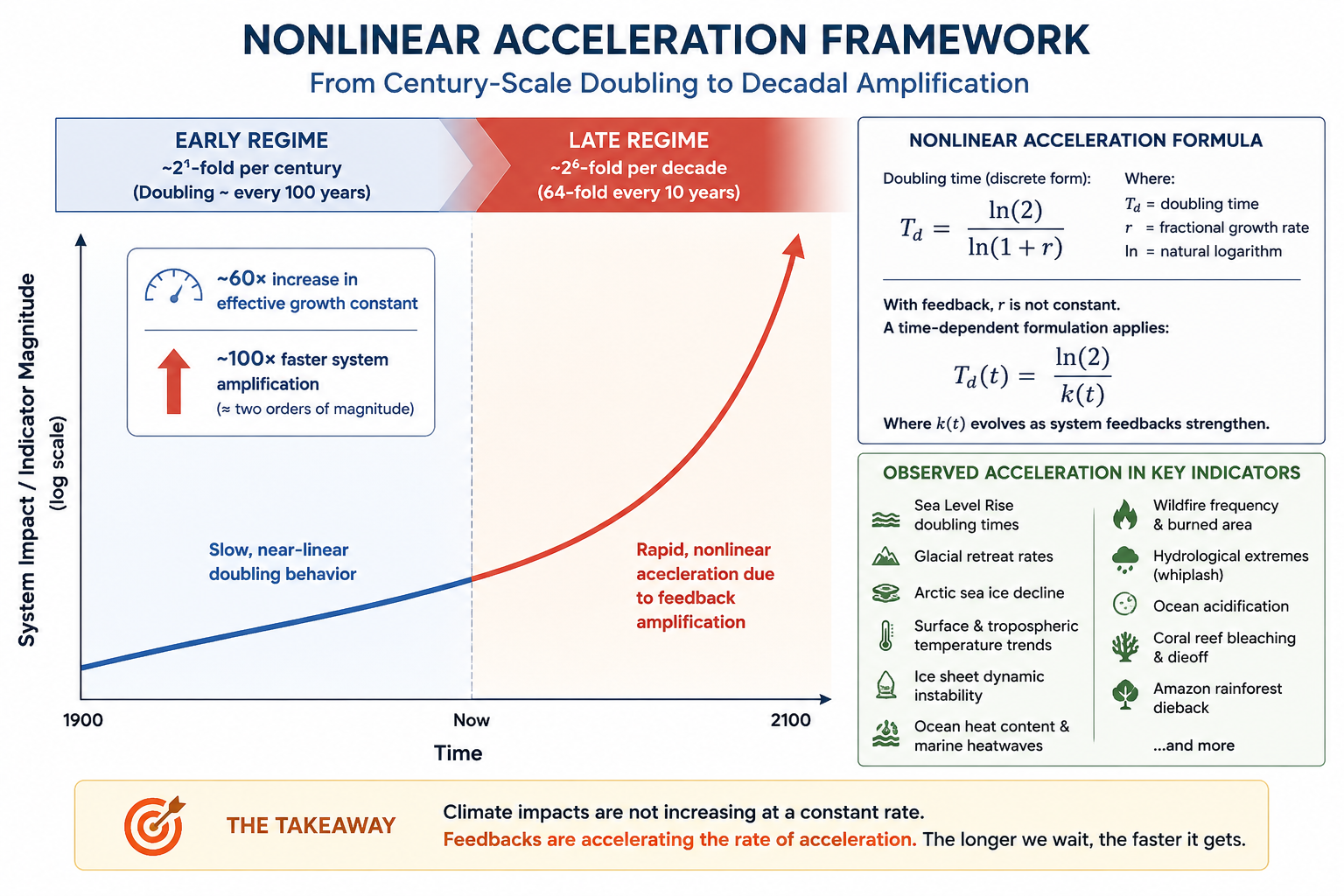
A real good rule of thumb – climate impacts are accelerating at ~2^6-fold per decade.
What does that mean?
The Nonlinear Acceleration framework focuses on the rate of acceleration of climate change.
At the time the hypothesis was first developed in the 1990s, observed acceleration rates were closer to ~2^1-fold per century doubling behavior. More recent analyses across multiple independent datasets suggest much shorter characteristic timescales consistent with stronger feedback amplification of 2^6-fold on a decadal basis.
* a ~60× increase in the effective growth constant
* or about two orders of magnitude faster system amplification
depending on formulation and interpretation.
In plain language:
* the first regime behaves like a slow century-scale doubling process
* the second behaves like a rapidly amplifying nonlinear feedback system with collapsing doubling times.
Due to feedback amplification, the system may exhibit increasingly nonlinear behavior over time. In that context, higher-end warming outcomes become more dependent on feedback strength and system response.
Current ranges discussed in the literature generally include:
* Linear estimates: ~3–5°C
* Higher-feedback scenarios: ~6–9°C (upper-range plausible outcomes under strong feedback participation)
* Long-term high-impact pathways: >10°C over centuries (often discussed in “Hothouse Earth” framework contexts)
If you have any doubts, you can apply this “rule of thumb” framework across a wide range of observed climate indicators. It has been extensively examined against datasets involving:
* SLR (Sea Level Rise) doubling times
* Polar amplification
* Temperature-gradient destabilization
* Pressure-gradient amplification
* Moisture-gradient amplification
* Glacial retreat rates
* Arctic sea ice decline
* Surface and tropospheric temperature trends
* Greenland and Antarctic ice-sheet dynamic instability
* Ocean heat content and marine heatwaves
* Wildfire frequency and burned area
* Wildfire feedback amplification cycles
* Hydrological extremes and drought–flood “climate whiplash”
* AMOC weakening
* Atmospheric water-vapor amplification
* Atmospheric river intensity
* Ocean acidification
* Coral reef bleaching and dieoff
* Amazon rainforest dieback
* Boreal forest stress and biome migration
* Permafrost thaw and thermokarst collapse
* Zombie fires / overwintering fires
* Methane emissions from wetlands and thawing permafrost
* Crop yield instability
* Species range shifts and ecosystem reorganization
* Wet-bulb temperature exceedances
* Rossby wave amplification and persistence
The Nonlinear Acceleration Formula
Doubling time (discrete form):
Td = ln(2) / ln(1 + r)
Where:
Td = doubling time
r = fractional growth rate
ln = natural logarithm
With feedback, r is not constant, and a time-dependent formulation applies:
Td(t) = ln(2) / k(t)
Where k(t) evolves as system feedbacks strengthen.