bookmark_borderThe Great Deceiver: Donald Trump, Christian Nationalism, the End Times, and the Moral Responsibility to Protect Humanity

By Daniel Brouse

Introduction: Faith, Science, and Political Accountability

I’m a fiscally conservative Republican economist who has been registered Republican since 1980. I also hold a degree in philosophy, with a concentration in morals and ethics, and have studied Christianity extensively, including reading the Bible in depth multiple times.

My family lineage can be traced to the Tribe of Judah and the family of Jesus. I’ve spent decades studying eschatology, particularly the biblical significance of my given name, Daniel, and the subject of the End Times. I’ve also conducted an extensive examination of the Book of Revelation.

Although I generally keep my religious beliefs separate from my scientific work, I’ve been analyzing Donald Trump’s conduct since the 1990s. My conclusions are informed by decades of economic analysis, moral philosophy, scientific research, and biblical study.

This paper brings those perspectives together to examine a question that extends beyond ordinary partisan politics: What happens when political power, religious certainty, deception, and disregard for human consequences converge?

My argument is that Trump’s conduct deserves serious scrutiny not because he is necessarily the literal Antichrist described in biblical prophecy, but because his political actions, public statements, and alliances raise profound moral questions about deception, authoritarianism, environmental destruction, Christian nationalism, and the treatment of vulnerable human beings.

1. My First Moral and Ethical Assessment of Trump

During the 1990s, I conducted a moral and ethical experiment involving Trump’s publicly traded business interests in the context of a widows-and-orphans fund.

Of all the businesses examined in that study, Trump’s was the only one in which I concluded that funds intended for widows and orphans had been stolen.

That experience left a lasting impression on my assessment of his character. It also established a personal foundation for my subsequent examination of Trump’s business practices, public conduct, and political career.

The conclusion was not based on whether I liked his personality, agreed with his politics, or approved of his business ambitions. It arose from an assessment of conduct against a moral standard: how people and institutions behave when entrusted with resources that affect others, particularly vulnerable people.

That distinction remains fundamental. Wealth, power, popularity, and claims of religious conviction do not exempt anyone from moral accountability.

2. The Great Deceiver: A Decade of Dangerous Consequences

Over the past decade, I’ve watched Trump develop into what I consider the Great Deceiver: a politician whose repeated falsehoods have undermined public trust, public health, and public safety.

His conduct during COVID-19, his rejection of climate science, and his decisions affecting foreign aid have contributed to consequences that, in my assessment, include millions of needless deaths. These actions belong in any serious examination of large-scale human suffering and crimes against humanity.

The term “Great Deceiver” is my moral and political characterization of Trump’s conduct. I use it deliberately because deception is not merely a personal failing when practiced by someone wielding enormous political power. It can shape public behavior, distort the understanding of reality, undermine institutions, and influence decisions affecting millions of lives.

During a public health emergency, misinformation can interfere with efforts to protect people. When a political leader repeatedly dismisses established scientific evidence, the consequences can extend beyond rhetoric into policy and public behavior. When decisions affect humanitarian assistance, the consequences can reach people who have little control over the political decisions that determine whether they receive help.

Climate change presents an equally serious moral problem. Rejecting established climate science and obstructing effective responses can increase risks to public health, food security, infrastructure, ecosystems, and future generations.

On September 23, 2025, Trump addressed the United Nations General Assembly and called climate change “the greatest con job ever perpetrated on the world.” This was a public and unmistakable expression of his rejection of mainstream climate science and international climate action. Source: Reuters, September 23, 2025.

These are not simply disagreements over the details of environmental policy. They concern the consequences of dismissing an extensive body of scientific evidence while exercising power over decisions that affect the lives of others.

The moral question is straightforward: When a political leader’s statements and decisions contribute to preventable suffering, what responsibility does that leader bear?

That question deserves examination regardless of party affiliation.

3. Is Trump the Antichrist?

Regarding the Antichrist, I agree with one part of the argument made by those who believe the figure described in biblical prophecy will be difficult to recognize: I don’t believe Trump is literally the Antichrist described in Scripture.

But that conclusion does not eliminate my concerns about his conduct or the movements he supports.

The concern is that Trump is helping advance political and religious movements that could bring about catastrophic consequences under the banner of Christianity. I see a dangerous convergence of Christian Zionism, white nationalism, and authoritarian politics, alongside an alarming relationship between elements of the Trump political network and the broader Epstein scandal.

The distinction matters. One can reject the claim that a political leader is literally the Antichrist while still examining whether that leader’s actions embody forms of deception, hypocrisy, cruelty, or destructive ambition that religious teachings warn against.

Biblical discernment should not be reduced to identifying a single individual who matches a prophetic description. It should also involve examining conduct, motives, consequences, and the treatment of other people.

A person can invoke God, Scripture, and Christian identity while pursuing policies that contradict the ethical principles those beliefs are supposed to uphold.

The question is not simply whether Trump fits a particular interpretation of Revelation. It is whether Christians are applying their moral teachings consistently when evaluating him.

4. Christian Zionism, Biblical Prophecy, and the War With Iran

The connection between Christian Zionism and Trump’s foreign policy deserves particular scrutiny.

Support for Israel among evangelical Christians is not exclusively theological; it also reflects strategic, cultural, historical, and political considerations. However, for some Christian Zionist constituencies, support for Israel is tied to specific interpretations of biblical prophecy and the End Times.

When prophetic expectations become intertwined with decisions about war, the consequences can extend far beyond theology.

The concern is that religious interpretations of history and prophecy can become entangled with political calculations in ways that make military escalation appear divinely justified or historically inevitable. When that happens, the ordinary requirements of foreign policy—evidence, strategic judgment, proportionality, diplomacy, and consideration of human consequences—risk being subordinated to a narrative of prophetic destiny.

The Trump administration’s confrontation with Iran in 2026 has intensified these concerns. The United States and Israel launched strikes against Iran in February 2026, and the conflict subsequently developed into a prolonged confrontation. The administration’s handling of the war has raised questions about its strategic objectives, its exit strategy, and the economic and human costs. Source: Reuters, October 8, 2026.

The relationship among the Trump administration, Christian Zionist organizations, and the war raises serious questions about the relative influence of American national interests, military strategy, religious prophecy, and domestic political pressures.

There is also a political contradiction within Trump’s coalition. An America First constituency has opposed prolonged foreign entanglements, while influential evangelical constituencies support policies toward Israel that some understand through a biblical, prophetic framework.

These positions are not necessarily irreconcilable, and Christian Zionists do not all share one interpretation of prophecy or one position on military action. Nevertheless, the tension deserves examination.

The concern is that the language of Christianity can be used to justify political decisions whose consequences include war, suffering, displacement, and death. A policy does not become morally defensible simply because its supporters attach religious meaning to it.

If religious conviction is influencing decisions about war, then those convictions must be examined alongside the evidence, strategic objectives, and human consequences of the decisions themselves.

5. The Epstein Scandal and the Ideology of Human Worth

The Epstein scandal raises additional questions about the ideological environment surrounding powerful political, financial, and social networks.

Publicly released statements attributed to Jeffrey Epstein include arguments that increased atmospheric carbon dioxide benefits plants and that climate change could serve as a mechanism for reducing overpopulation. Other statements attributed to him express disturbing views about executing elderly and infirm people and make racist claims about African music and learning.

These statements, if accurately represented in their original context, reveal a worldview in which human lives can be evaluated according to their perceived usefulness, with some people effectively treated as expendable.

That is the kind of thinking that raises concerns about eugenics, ecofascism, and a grotesque version of survival of the fittest.

The issue is not simply whether someone disputes climate policy or believes that population growth creates environmental pressures. It is the moral distinction between addressing environmental problems in ways that protect human dignity and treating human suffering or death as a desirable means of achieving an ideological objective.

Recognizing that distinction is essential.

The term “ecofascism” refers to the danger of combining authoritarian power, hierarchical judgments about human worth, and environmental or population arguments that rationalize unequal human survival. It is a warning about an ideological pattern, not a claim that every person skeptical of climate policy subscribes to that worldview.

Similarly, statements attributed to Epstein do not, by themselves, establish that Trump personally shares every belief expressed in them. My concern is the broader environment in which extreme wealth, political influence, racial hierarchy, authoritarianism, and disregard for environmental threats can intersect.

The questions are legitimate and serious: What values are being promoted? Whose lives are being treated as expendable? And what happens when people with immense resources and influence begin to regard some populations as less deserving of protection than others?

These questions belong in any serious examination of the moral consequences of concentrated power.

6. Deception, Political Loyalty, and the Surrender of Moral Judgment

This is why term “Great Deceiver” relevant.

Deception does not have to look like a mysterious biblical figure who charms everyone. It can also operate through political loyalty, religious certainty, propaganda, and the conviction that one’s own side is incapable of wrongdoing.

A leader need not persuade everyone. It may be enough to maintain the loyalty of a sufficiently committed group that interprets every criticism as persecution, every contradiction as a conspiracy, and every failure as someone else’s fault.

Under those conditions, evidence can lose its ability to change minds. Political identity becomes more important than independent judgment, and loyalty becomes a substitute for evaluating facts.

This creates a serious moral danger within religious communities. When a political leader claims to represent Christian values, supporters may be tempted to defend the leader rather than assess whether the leader’s conduct actually reflects those values.

But Scripture demands more than declarations of faith. It calls for discernment about character, conduct, hypocrisy, truthfulness, compassion, justice, and the treatment of the vulnerable.

Merely claiming Christian values does not demonstrate that a person practices them.

The fundamental problem with Trump’s most devoted followers is when they appear unwilling to apply the same moral standards to their political leader that they would apply to anyone else. When evidence conflicts with political loyalty, the evidence is dismissed and loyalty becomes a substitute for judgment.

That is not faith. It is the surrender of independent moral reasoning.

A meaningful moral standard must be applied consistently. If dishonesty is wrong when practiced by political opponents, it is also wrong when practiced by a political ally. If cruelty is unacceptable when directed at people we care about, it does not become acceptable when directed at people we dislike. If Scripture is a source of moral authority, it cannot be invoked selectively to excuse the behavior of a favored leader.

The test of conviction is not how fiercely we defend our own side. It is whether we remain willing to recognize wrongdoing when doing so is uncomfortable.

7. Beyond Trump: The Larger Crisis of Human Responsibility

The problem is much deeper than Trump or any political party.

Political corruption, institutional failure, disinformation, environmental destruction, and the exploitation of vulnerable people cannot be explained by one individual alone. They emerge from broader systems of incentives, beliefs, power, and social behavior.

But recognizing the larger problem does not absolve individuals of responsibility for their own conduct.

Trump’s influence matters precisely because political leaders can amplify existing problems, normalize behavior that was once considered unacceptable, and use institutional power to make harmful decisions consequential on a much larger scale.

The same principle applies to religious institutions, corporations, governments, and individuals. No institution should be exempt from scrutiny because it claims a noble purpose. No political movement should be immune from criticism because it presents itself as the defender of a particular faith or national identity.

The challenge is to develop standards of accountability that do not depend on political affiliation, religious identity, wealth, or social status.

That requires a willingness to examine evidence, challenge deception, protect the vulnerable, and recognize the consequences of our choices.

It also requires resisting the temptation to turn every disagreement into a battle between absolute good and absolute evil. Serious moral analysis demands both conviction and intellectual honesty. Strong conclusions should be accompanied by evidence, and evidence should not be dismissed merely because it threatens a cherished belief.

The objective is not to replace one form of blind allegiance with another. It is to restore the capacity for independent moral judgment.

8. The Covenant of Balance: An Interfaith Alternative

The following paper takes a constructive approach to these problems:

The Covenant of Balance: An Interfaith Synthesis of Ecological Ethics, Economics, Climate Science, Earth’s Energy Imbalance, and Integrated Climate Stewardship

https://www.kingarthur.com/global_warming/Covenant-of-Balance.html

The paper examines Christianity, Islam, Judaism, Buddhism, and Hinduism, identifying shared ethical principles of responsibility, compassion, moderation, stewardship, and avoiding needless harm. It connects those principles with climate science, economic accountability, and practical action.

The premise is simple: We do not need to share one religion, one political philosophy, or one interpretation of Scripture to recognize that our actions have consequences for other people and the living world.

Christianity offers teachings on creation care, stewardship, and love of neighbor. Islam emphasizes Mīzān, or balance, and responsible trusteeship. Judaism includes bal tashchit, the principle of avoiding needless destruction and waste. Buddhism highlights interdependence, compassion, and mindful consumption. Hinduism offers ethical resources through dharma, responsibility, and minimizing harm.

These traditions are distinct, and their adherents do not agree on every environmental or political question. Yet they offer meaningful grounds for cooperation around the protection of human life, the reduction of suffering, responsible resource use, and the preservation of the conditions that sustain future generations.

The paper also connects these ethical principles to Earth’s physical energy imbalance and the consequences of climate change.

Its practical framework is Integrated Climate Stewardship:

ZERO-OUT + BENEFIT-IN

ZERO-OUT means reducing actual sources of environmental harm. BENEFIT-IN means creating tangible improvements in affordability, efficiency, resilience, comfort, and quality of life while protecting the ecological systems on which we depend.

This approach seeks to unite moral responsibility with measurable results. It recognizes that environmental stewardship must extend beyond declarations of concern to practical decisions by households, businesses, institutions, and governments.

The same principle applies to political and religious life. Good intentions and declarations of faith are not sufficient. Our conduct must be evaluated according to its consequences for other people and the world we share.

The Covenant of Balance is an invitation to move beyond divisions that prevent cooperation. We can disagree about theology while working together to reduce suffering. We can hold different political beliefs while insisting on truthfulness and accountability. We can approach the natural world through different ethical traditions while recognizing our common dependence on its physical and ecological systems.

My objective is to find common ground among people of different faiths and beliefs so we can work together for the common good.

9. The Moral Test: Separating the Sheep From the Goats

If we’re going to talk about separating the sheep from the goats, perhaps we should begin by applying the same standards of truth, morality, compassion, and accountability to our own political leaders that we claim to find in Scripture.

Religious language should not function as a shield against scrutiny. Claims of divine purpose should not exempt political decisions from moral examination. And the authority of Scripture should not be used selectively to condemn opponents while excusing the conduct of political allies.

The deeper question is whether our beliefs make us more willing to confront wrongdoing or more determined to defend it when it comes from our own side.

A genuine commitment to truth requires the courage to examine uncomfortable evidence. A genuine commitment to morality requires consistency. A genuine commitment to compassion requires concern for people beyond our immediate community. And a genuine commitment to stewardship requires responsibility for the consequences of our actions.

These standards should apply to everyone, including presidents, religious leaders, corporations, political movements, and ordinary citizens.

Identifying the literal Antichrist is not the most urgent task facing humanity. The more immediate responsibility is to recognize deception, resist the misuse of religious authority, challenge destructive ideologies, protect vulnerable people, and hold those in power accountable for their conduct.

The danger is not confined to one political party, one religion, or one individual. It lies in the human capacity to rationalize wrongdoing when it serves our interests, confirms our beliefs, or strengthens our allegiance to a leader.

That is why the work of moral discernment matters.

Conclusion: Faith Should Sharpen Our Judgment

This perspective comes from decades of studying economics, moral philosophy, Christianity, eschatology, and the physical systems that sustain life. Although I generally keep my religious beliefs separate from my scientific work, I see no contradiction in examining the moral consequences of political decisions through both ethical and scientific frameworks.

I do not believe Trump is literally the Antichrist described in biblical prophecy. Nevertheless, I believe his conduct, his rejection of climate science, his approach to public health and foreign policy, and his relationship with political and religious movements raise profound questions about deception, responsibility, and the consequences of concentrated power.

My assessment of Trump as the Great Deceiver reflects my judgment of his conduct and its consequences. It is not a substitute for examining the evidence, and it should not be treated as a claim that every legal or historical question surrounding his actions has already been resolved.

But neither should the seriousness of those questions be diminished by political loyalty or religious identification.

If we are concerned about deception, we must examine the behavior of those who claim to defend the truth. If we are concerned about the End Times, we must not neglect the suffering and dangers unfolding in the present. If we claim to follow Christian values, we must evaluate our conduct and our leaders against the moral responsibilities those values entail.

And if we recognize that humanity faces threats extending beyond politics—including climate change, ecological disruption, and the consequences of destructive economic systems—we must be willing to cooperate across religious and ideological boundaries.

We do not have to agree on every theological question to agree that human life matters, deception should be challenged, vulnerable people deserve protection, and the Earth must be preserved for future generations.

My hope is that people of different faiths and beliefs can find common ground in these responsibilities and act together for the common good.

The ultimate test is not whether we can convincingly claim to stand on the side of God, country, or a particular political movement. It is whether our actions reflect truth, justice, compassion, and responsibility.

Faith should sharpen our moral judgment, not blind us to reality.
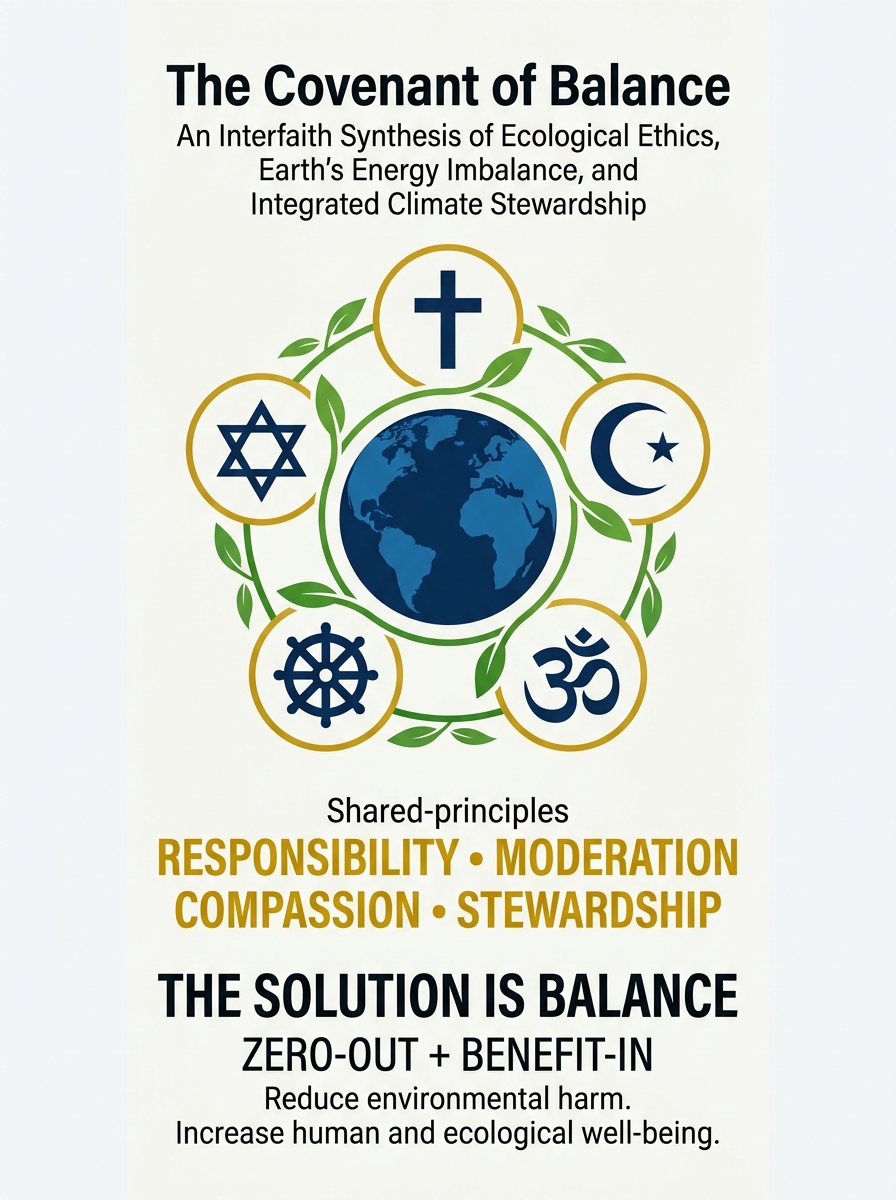
bookmark_borderThe Covenant of Balance

An Interfaith Synthesis of Ecological Ethics, Earth’s Energy Imbalance, and Integrated Climate Stewardship

By Daniel Brouse

Overview

THE COVENANT OF BALANCE
An Interfaith Synthesis of Ecological Ethics, Earth’s Energy Imbalance, and Integrated Climate Stewardship

What do Christianity, Islam, Judaism, Buddhism, and Hinduism have in common when it comes to protecting our planet?

Although these five religious traditions differ in their beliefs and practices, each offers ethical principles that can help guide humanity toward a more responsible relationship with the Earth.

Christianity emphasizes creation care and stewardship.
Islam teaches Mīzān—balance—and responsible trusteeship.
Judaism emphasizes bal tashchit—avoiding needless destruction and waste.
Buddhism highlights interdependence, compassion, and mindful consumption.
Hinduism emphasizes dharma, responsibility, and minimizing harm.

Different traditions. Different teachings. A shared recognition that our actions have consequences.

THE SCIENCE: Earth’s energy imbalance is driving climate change. Greenhouse gases trap additional energy in the Earth system, warming the oceans, atmosphere, and land while contributing to ice loss, rising seas, and ecological disruption. Interacting climate feedbacks can amplify these changes.

THE ETHICS: Our responsibility extends beyond ourselves—to other people, vulnerable communities, future generations, and the living systems that sustain us.

THE SOLUTION: BALANCE.

My paper connects these five religious traditions with two complementary frameworks:

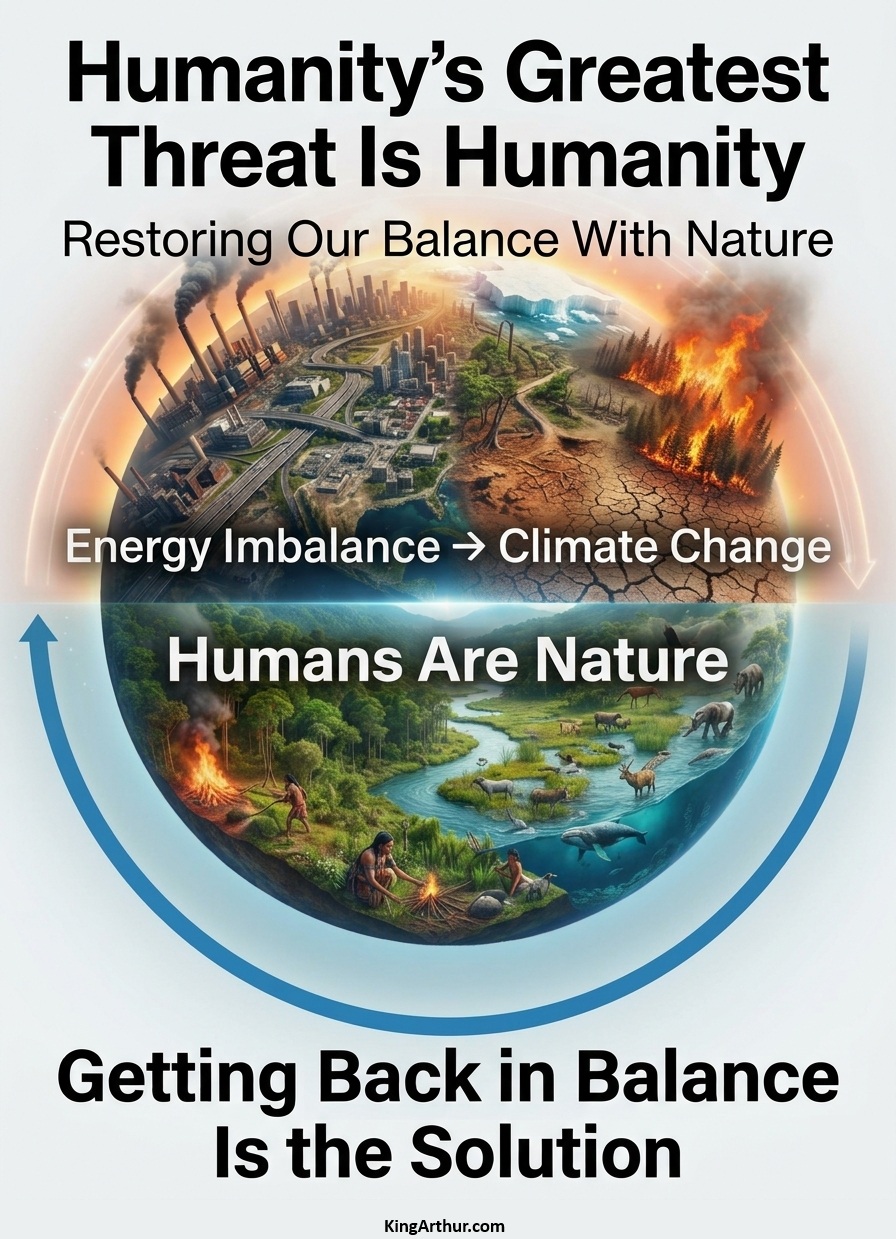
Humanity’s Greatest Threat Is Humanity: Energy Imbalance → Climate Change → The Solution = Balance

Integrated Climate Stewardship: ZERO-OUT + BENEFIT-IN

ZERO-OUT means reducing actual sources of environmental harm. BENEFIT-IN means improving affordability, efficiency, resilience, comfort, and quality of life while protecting the natural systems on which we depend.

This is not a claim that all religions teach the same thing or agree on every environmental issue. It is an invitation to identify common ethical ground and turn shared concerns into practical, measurable action.

We do not need to share one religion to share responsibility for the Earth.

Five traditions. One interconnected planet. A common responsibility.

THE SOLUTION IS BALANCE.

Read the paper:

The Covenant of Balance: An Interfaith Synthesis of Ecological Ethics, Earth’s Energy Imbalance, and Integrated Climate Stewardship

Introduction

Humanity faces a profound ecological challenge: our economic systems, patterns of consumption, and exploitation of natural resources are disrupting the balance of Earth’s interconnected systems. Climate change is a central expression of this disruption, driven primarily by the accumulation of greenhouse gases that trap additional energy within the Earth system. Addressing this crisis requires scientific understanding, economic transformation, practical action, and an ethical framework capable of motivating change across cultures and societies.

This paper synthesizes five major religious traditions—Christianity, Islam, Judaism, Buddhism, and Hinduism—with two complementary frameworks: “Humanity’s Greatest Threat Is Humanity: Energy Imbalance → Climate Change → The Solution = Balance” and “Integrated Climate Stewardship.” Christianity is considered broadly across its Catholic, Orthodox, Protestant, evangelical, and other traditions. Pope Francis’s Laudato si’ and Laudate Deum are examined as influential Catholic contributions within the wider Christian conversation, alongside broader Christian teachings and initiatives concerning creation care.

Despite their theological differences, these traditions offer overlapping principles of responsibility, restraint, compassion, justice, and care for the living world. Their ethical insights can be connected with climate science and translated into practical action through Integrated Climate Stewardship: ZERO-OUT + BENEFIT-IN. This approach emphasizes eliminating or substantially reducing actual sources of environmental harm while bringing tangible benefits into daily life through lower costs, improved resource efficiency, greater resilience, and healthier communities.

The central proposition is that a sustainable future requires balance at multiple levels: physical, ecological, economic, social, and ethical. Religious traditions can help articulate why that balance matters; science can explain the physical processes involved; and practical stewardship can help translate shared values into measurable action.

1. Introduction: A Shared Responsibility for Our Common Home

Humanity is part of an interconnected living system. The atmosphere, oceans, forests, soils, freshwater systems, and countless forms of life interact through physical, chemical, and biological processes. Human societies depend on these systems for food, water, energy, shelter, health, and economic activity.

Yet many prevailing economic practices treat the natural world as an effectively unlimited source of materials and an unlimited destination for waste. The resulting pressures include climate change, biodiversity loss, deforestation, pollution, soil degradation, freshwater stress, and the depletion of natural resources.

Climate change makes the consequences of this imbalance particularly visible. Greenhouse gas emissions alter Earth’s energy balance, while interacting feedbacks and ecological changes can amplify the resulting impacts. The consequences extend beyond temperature: they include changes in precipitation, ice loss, sea-level rise, ecosystem disruption, agricultural stress, and risks to human health and economic stability.

The problem is scientific, but it is also ethical. Science can measure changing conditions and investigate their causes. It cannot, by itself, determine the full moral responsibilities of individuals, institutions, governments, or economic systems.

Religious and philosophical traditions have long explored questions of responsibility, restraint, justice, compassion, and humanity’s relationship with the natural world. Although their beliefs and practices differ, they offer resources for examining the values that shape human behavior.

This paper brings five traditions into conversation:

  • Christianity, including Catholic, Orthodox, Protestant, evangelical, and other Christian perspectives.
  • Islam, particularly the principles of Mīzān and Khilāfah.
  • Judaism, including the principle of bal tashchit.
  • Buddhism, including interdependence, compassion, and mindful consumption.
  • Hinduism, including dharma, ahimsa, and reverence for the Earth.

The purpose is not to suggest that these traditions are identical or that their followers agree on every environmental question. It is to identify meaningful areas of convergence and connect them to a practical framework for ecological responsibility.

2. Christianity: Creation Care, Stewardship, and Love of Neighbor

Christian environmental ethics draws on a broad range of biblical teachings and theological traditions. Across Catholic, Orthodox, Protestant, evangelical, and other Christian communities, creation care has been understood through concepts such as stewardship, responsibility, humility, justice, and love of neighbor. Interpretations differ, and environmental responsibility is not expressed uniformly across all denominations.

Several biblical passages are particularly relevant.

Genesis 2:15 describes humanity’s placement in the garden of Eden to work it and keep it. This passage supports an understanding of human responsibility that includes both productive use and protection of the natural world.

Psalm 24:1 declares that the Earth belongs to the Lord. This can be understood as a challenge to the assumption that human ownership confers unlimited moral permission to destroy or exhaust the resources on which other life depends.

Romans 8:19–23 portrays creation as groaning and awaiting liberation. Christian environmental thinkers have drawn on this passage to reflect on ecological suffering and the relationship between human redemption and the wider creation.

Christian traditions also emphasize love of neighbor. Environmental degradation disproportionately affects people with limited resources, including communities exposed to extreme heat, flooding, drought, pollution, food insecurity, and displacement. Climate responsibility can therefore be understood as an expression of concern for vulnerable people, future generations, and the conditions necessary for human flourishing.

Christian contributions to ecological responsibility

Several major initiatives illustrate the breadth of Christian environmental engagement.

Pope Francis’s Laudato si’: On Care for Our Common Home (2015) presents an influential Catholic account of ecological responsibility, linking environmental degradation with social inequality, consumerism, economic priorities, and the need for an integrated response. Laudate Deum (2023) further emphasizes the urgency of the climate crisis and the inadequacy of responses that fail to match the scale of the problem.

These documents are important contributions to Christian environmental thought, but they do not represent every Christian denomination or establish a single environmental doctrine binding on all Christians.

Other examples include the World Council of Churches’ work on climate justice and ecological sustainability, the Lausanne Movement’s Cape Town Commitment and its wider evangelical discussions of creation care, and environmental initiatives within evangelical Christianity, including the Evangelical Environmental Network.

Together, these efforts demonstrate that ecological responsibility is discussed across multiple Christian traditions, even where theological interpretations, political priorities, and preferred policy responses differ.

The broader Christian contribution to an interfaith framework can be expressed through three connected principles:

  1. Creation care: The natural world is not merely a disposable storehouse of resources.
  2. Responsible stewardship: Human power over nature entails obligations, not unlimited permission to exploit.
  3. Love of neighbor: Environmental decisions should consider their consequences for other people, especially vulnerable communities and future generations.

These principles connect naturally with the concept of balance: humanity’s use of the Earth should sustain the conditions that make life possible rather than progressively undermine them.

3. Islam: Mīzān, Khilāfah, Tawḥīd, and Iqtisād

Islamic environmental ethics provides a particularly direct vocabulary for connecting ecological responsibility with balance.

Mīzān refers to balance, measure, and equilibrium. In the Qur’anic context, it conveys an order that should not be violated through excess or injustice. Applied to environmental responsibility, it encourages human beings to respect the limits, relationships, and conditions that sustain the natural world.

Khilāfah expresses humanity’s role as steward or trustee. Human beings exercise influence over the Earth, but that responsibility can be understood as an obligation to protect and manage creation rather than a license for unlimited exploitation.

Tawḥīd, the oneness of God, provides a theological foundation for understanding creation as an interconnected whole. Although the natural world contains immense diversity, its components exist within relationships that human activity can disrupt.

Iqtisād emphasizes moderation, economy, and avoiding excess. It challenges wasteful consumption and encourages responsible use of resources.

These principles are reflected in Al-Mizan: A Covenant for the Earth, launched in 2024 through an initiative associated with the United Nations Environment Programme’s Faith for Earth work. The document presents an Islamic framework for ecological responsibility, connecting spiritual principles with conservation, sustainability, and collective action.

Its contribution to this synthesis is the explicit connection between balance, trusteeship, moderation, and responsibility for the natural world.

4. Judaism: Bal Tashchit and Responsibility for Creation

Jewish environmental ethics includes the principle of bal tashchit, commonly understood as a prohibition against needless destruction or waste.

The principle is traditionally associated with Deuteronomy 20:19–20, which restricts the destruction of fruit-bearing trees during a siege. Its interpretation has extended into broader discussions of waste, resource conservation, and unnecessary harm.

Jewish teachings also draw on the creation narratives of Genesis, including the responsibilities associated with humanity’s place in the garden. As in Christianity, interpretations of dominion and human authority over nature vary, but Jewish environmental thought offers substantial resources for understanding human power as carrying moral obligations.

The Rabbinical Assembly’s The Green Covenant: A Jewish Pledge Toward Carbon Neutrality illustrates an effort to translate Jewish environmental values into institutional and practical commitments.

The relevance of bal tashchit extends beyond recycling or avoiding the waste of individual objects. It invites a broader question: when human activities needlessly damage ecosystems, squander resources, or impose preventable costs on future generations, what responsibility follows?

In the context of climate change, this principle supports reducing avoidable emissions, conserving energy and materials, preventing pollution, and questioning economic practices that generate unnecessary environmental damage.

5. Buddhism: Interdependence, Compassion, and Mindful Consumption

Buddhist teachings offer an ethical perspective centered on the interconnected nature of existence, the reduction of suffering, compassion, and awareness of the consequences of one’s actions.

Interdependence challenges the idea that human well-being can be separated from the well-being of other living systems. Food, water, climate, health, and economic stability depend on relationships among people, ecosystems, and physical processes.

Compassion extends ethical concern beyond the self. Environmental damage becomes relevant not only because it affects human comfort or prosperity, but also because it can cause suffering among vulnerable people and other living beings.

Mindful consumption encourages reflection on desire, attachment, and the consequences of acquiring and using material goods. It does not necessarily require rejecting technology or material comfort. Rather, it questions patterns of consumption that create harm without corresponding benefits to well-being.

The Time to Act Is Now: A Buddhist Declaration on Climate Change represents a Buddhist contribution to the climate discussion, emphasizing the relationship between climate responsibility, ethical conduct, and the need for action.

From this perspective, stewardship requires more than technical efficiency. It also involves examining the motivations and social arrangements that drive waste, excessive consumption, and disregard for the consequences of human behavior.

6. Hinduism: Dharma, Ahimsa, and Reverence for the Earth

Hindu traditions encompass a wide range of philosophies, practices, and interpretations. Environmental ethics within these traditions can draw on dharma, ahimsa, and reverence for the Earth.

Dharma can refer to duty, right conduct, and the responsibilities that sustain personal and social order. Environmental responsibility can be understood as part of fulfilling obligations to other living beings, communities, and the conditions that support life.

Ahimsa, commonly understood as nonviolence or the avoidance of harm, provides a basis for considering how human actions affect living beings and ecological systems. Its application to environmental issues varies across traditions, but it encourages attention to avoidable injury and destruction.

Hindu traditions also include forms of reverence for rivers, mountains, forests, animals, and the Earth itself. Bhūmi Devi, the Earth goddess, is one expression of the spiritual significance attributed to the Earth in Hindu traditions.

The Hindu Declaration on Climate Change, associated with the 2015 interfaith climate initiatives, articulates a Hindu contribution to the moral case for climate action and ecological responsibility.

These ideas connect environmental stewardship with duty, restraint, and respect for the living world. They encourage a view of human prosperity that does not depend on treating nature as morally irrelevant or endlessly expendable.

7. A Shared Ethical Framework Across Five Traditions

The five traditions differ in theology, scripture, spiritual practice, and their understanding of humanity’s place in creation. They should not be collapsed into a single religious doctrine. Nevertheless, their environmental teachings reveal several important areas of convergence.

TraditionRelevant principlesEnvironmental implication
ChristianityCreation care, stewardship, love of neighborProtect creation and consider the consequences for vulnerable people and future generations
IslamMīzān, Khilāfah, Tawḥīd, IqtisādRespect balance, exercise responsible trusteeship, recognize interconnection, and avoid excess
JudaismBal tashchit, responsibility for creationPrevent needless destruction and waste
BuddhismInterdependence, compassion, mindful consumptionReduce avoidable harm and reconsider excessive consumption
HinduismDharma, ahimsa, reverence for the EarthFulfill responsibilities and minimize harm to living systems

These parallels are meaningful, but they are not exact equivalences. Mīzān, for example, has a specific Qur’anic and Islamic context; bal tashchit has a distinct Jewish history; and Buddhist interdependence does not simply mean the same thing as Christian stewardship or Hindu dharma.

The common ground is more practical than doctrinal: human decisions affect interconnected systems, and ethical responsibility requires attention to the consequences of those decisions.

An interfaith environmental framework can therefore rest on several shared commitments:

  • Reduce avoidable harm.
  • Use resources responsibly.
  • Avoid unnecessary waste and excess.
  • Protect the conditions that sustain life.
  • Consider the needs of vulnerable communities.
  • Recognize obligations to future generations.
  • Translate ethical commitments into measurable action.

This is the foundation for connecting religious ethics with the scientific and practical framework developed in the two papers considered here.

8. The Scientific Foundation: Energy Imbalance and Climate Change

Religious ethics can motivate responsibility, but climate science must establish the physical processes and evidence involved.

Earth receives energy from the Sun and returns energy to space. Over time, the amount entering and leaving the Earth system determines whether the planet gains or loses energy.

Human-caused greenhouse gas emissions have altered this balance by reducing the rate at which Earth loses energy to space. The result is a positive energy imbalance: more energy accumulates within the Earth system than leaves it.

The oceans absorb the great majority of the excess heat accumulating in the climate system. Energy is also taken up by the atmosphere, land, and cryosphere. The consequences include rising temperatures, ocean warming, melting land ice, sea-level rise, and changes in the behavior of ecosystems and atmospheric circulation.

The central distinction is that climate change is not simply a problem of elevated surface temperature. Temperature is one indicator of a wider physical process involving energy storage, redistribution, and changes across interconnected systems.

From imbalance to interacting feedbacks

Climate systems contain feedback processes that can amplify or moderate an initial change. Examples include:

  • Ice and snow loss, which reduces reflectivity and allows more solar energy to be absorbed.
  • Changes in atmospheric water vapor, which affect the greenhouse effect.
  • Changes in clouds, which can alter both incoming solar radiation and outgoing infrared radiation.
  • Changes in ecosystems and vegetation, which can influence carbon storage, surface reflectivity, moisture, and local climate.
  • Ocean circulation changes, which redistribute heat and influence regional climate patterns.

These processes do not all operate in the same direction or with the same strength. Their effects depend on location, timescale, and the interactions among physical and biological systems.

The broader scientific concern is that feedbacks can interact. Multiple changes may reinforce one another, increase stress on ecosystems, and make the consequences of continued warming more severe.

The distinction between an ethical principle and a physical measurement is essential. Religious concepts of balance can help explain why disruption is morally significant, but they are not substitutes for observations, measurements, and scientific models. Conversely, climate science can describe physical changes without independently determining every ethical obligation arising from them.

The synthesis proposed here uses each framework for its appropriate purpose: ethics clarifies responsibility, science investigates the physical problem, and stewardship translates both into action.

9. Humanity’s Greatest Threat Is Humanity: Energy Imbalance → Climate Change → The Solution = Balance

The paper Humanity’s Greatest Threat Is Humanity: Energy Imbalance → Climate Change → The Solution = Balance presents balance as a central organizing principle for understanding the climate crisis and responding to it.

The sequence begins with human activities that alter Earth’s energy balance. These activities include greenhouse gas emissions from fossil fuels, land-use changes, and other human-caused influences on the climate system.

The resulting energy imbalance drives warming and contributes to changes in oceans, ice, weather patterns, ecosystems, and the distribution of heat and moisture.

The effects then interact with human systems. Agricultural disruption can affect food prices and availability. Environmental damage can increase economic losses and displacement. Resource stress can intensify existing inequalities and political pressures.

This sequence does not mean that every climate impact follows one inevitable pathway, or that every feedback leads to collapse. It means that environmental, economic, and social risks are connected and should not be evaluated as isolated problems.

Balance is the proposed solution in the sense of restoring conditions that support long-term stability and human flourishing. Physically, that requires reducing greenhouse gas emissions and ultimately bringing the climate system toward a sustainable energy balance. Ecologically, it requires protecting and restoring the systems that support life. Economically, it requires reconsidering practices that depend on unlimited material throughput and the externalization of environmental costs.

Ethically, balance means recognizing that short-term gains for some can impose lasting costs on others.

The religious traditions examined here provide different reasons for accepting these responsibilities. Their shared contribution is not a claim that the Earth must remain static or that all change is harmful. Rather, they support the principle that human power should be exercised with regard for consequences, limits, and obligations to others.

10. Integrated Climate Stewardship: ZERO-OUT + BENEFIT-IN

Integrated Climate Stewardship translates environmental responsibility into a practical framework for everyday life, businesses, institutions, and public policy.

Its central formula is:

ZERO-OUT + BENEFIT-IN

ZERO-OUT means eliminating or substantially reducing actual sources of environmental harm wherever practical. This includes reducing unnecessary energy use, fossil fuel consumption, waste, pollution, and resource-intensive activities.

BENEFIT-IN means choosing changes that also produce tangible benefits: lower utility bills, reduced operating costs, greater resilience, improved comfort, healthier living conditions, and more efficient use of resources.

The framework is intended to make climate stewardship a practical part of ordinary life rather than an obligation dependent entirely on sacrifice, charitable contributions, or distant technological promises.

Examples include:

  • Improving building efficiency and reducing unnecessary heating and cooling.
  • Using targeted heating and cooling rather than conditioning unused spaces.
  • Reducing electricity and hot-water demand.
  • Repairing, reusing, and maintaining products to extend their useful lives.
  • Reducing food waste and choosing efficient food-storage and preparation practices.
  • Using durable, efficient equipment when the total costs and environmental benefits justify it.
  • Protecting trees, soil, water, and vegetation where they provide measurable ecological benefits.
  • Improving household and community resilience to heat, storms, flooding, and power interruptions.

Not every action will be appropriate for every household or region. Costs, safety, building conditions, local climate, access to technology, and the environmental impacts of equipment all matter. The goal is to identify measures that produce real net benefits rather than simply shifting environmental costs from one place to another.

Why benefits matter

Climate communication often emphasizes costs, restrictions, and sacrifices. These are sometimes unavoidable, particularly when major structural changes are necessary. But stewardship can also produce immediate personal and social benefits.

Lower energy demand can reduce bills. Durable products can reduce replacement costs. Improved building performance can increase comfort. Better preparedness can limit losses during disruptions. Reducing waste can save money while reducing pressure on natural resources.

These benefits can make climate action more accessible to people who might otherwise see it as financially burdensome or disconnected from their daily lives.

The approach also helps distinguish genuine emissions reductions from accounting exercises. Offsets do not automatically eliminate the underlying source of pollution, and their quality varies. ZERO-OUT prioritizes direct reductions; BENEFIT-IN encourages additional improvements that support ecological and human well-being.

The framework does not imply that individual household measures alone can solve climate change. Electricity generation, industrial production, transportation, agriculture, infrastructure, and public policy remain essential. Individual action is most effective when supported by changes in the larger systems that shape available choices.

11. Economic Balance: Prosperity Without Ecological Destruction

Economic systems are human institutions, not independent forces beyond human responsibility. Their incentives, rules, and measures of success influence how resources are extracted, distributed, consumed, and discarded.

Traditional measures of economic activity can rise while natural capital declines. Gross domestic product, for example, does not by itself distinguish between productive investment, resource depletion, environmental restoration, and expenditures required to repair damage.

An economy can therefore report growth while imposing costs on ecosystems, public health, future generations, or communities that lack the power to avoid those costs.

A more integrated understanding of prosperity considers not only the production of goods and services but also the durability of the ecological systems on which economic activity depends.

This does not require rejecting markets, innovation, or economic growth in every form. It requires evaluating economic activity according to its full consequences rather than treating environmental costs as someone else’s problem.

A practical stewardship framework asks:

  • Does this activity meet a genuine need or produce a meaningful benefit?
  • Can the same benefit be achieved with less energy or fewer materials?
  • Are environmental costs being imposed on other people or future generations?
  • Does the activity strengthen or undermine long-term resilience?
  • Can waste be prevented at the source rather than managed after it occurs?
  • Do the financial incentives reward conservation and efficiency, or excessive extraction and disposal?

These questions connect the religious principle of moderation with economic accountability. They also connect scientific knowledge about finite ecological capacities with the practical task of designing better incentives and institutions.

The aim is not balance for its own sake as an abstract slogan. It is an economic system that can support human well-being without progressively undermining the natural systems that make prosperity possible.

12. Justice, Vulnerability, and Future Generations

Environmental damage is not distributed evenly. Communities differ in their exposure to hazards, their access to resources, their capacity to recover, and their historical contribution to environmental pressures.

Low-income households may have fewer options for improving inefficient housing or recovering from extreme weather. Coastal communities may face growing flood and erosion risks. Agricultural communities may be exposed to changing rainfall patterns, heat, and crop stress. People with limited access to healthcare, reliable infrastructure, or financial reserves may suffer disproportionately from environmental disruption.

These inequalities make climate stewardship a question of justice as well as physical science.

Christian teachings on love of neighbor, Islamic concepts of trusteeship and justice, Jewish obligations against needless destruction, Buddhist compassion, and Hindu principles of duty and minimizing harm can all contribute to discussions of how environmental costs and responsibilities should be shared.

The traditions do not necessarily prescribe identical policies. Nevertheless, their ethical resources support asking who benefits from environmentally damaging activities, who bears the costs, and whose needs are excluded from decision-making.

Future generations are particularly important because they cannot participate directly in current decisions, even though they may inherit the consequences. Stewardship therefore requires a time horizon longer than an election cycle, quarterly earnings report, or individual consumer decision.

A balanced approach must consider the rights and needs of people who have little influence over the choices that shape their future.

13. Indigenous Knowledge and Local Stewardship

Indigenous peoples and local communities hold diverse traditions of environmental knowledge, place-based observation, and resource management. These traditions are not uniform, and they should not be romanticized as though every community has identical practices or perspectives.

In many places, however, Indigenous knowledge contributes valuable understanding of ecosystems, seasonal changes, species relationships, fire management, water, soils, and long-term landscape stewardship.

Such knowledge can complement scientific research when collaboration respects community authority, cultural context, and rights over traditional knowledge. It should not be appropriated without consent or treated as a substitute for the participation of the people who hold it.

The interfaith framework developed here reinforces the importance of humility: no single institution, discipline, or tradition possesses every insight required to address complex environmental problems.

Effective stewardship draws on scientific evidence, local experience, ethical reflection, and the participation of communities directly affected by environmental decisions.

14. From Shared Values to Measurable Action

An interfaith agreement on environmental responsibility becomes meaningful when it leads to action. Broad ethical commitments can be translated into a practical program for households, congregations, schools, businesses, communities, and governments.

Individuals and households

  • Measure energy and resource use before choosing improvements.
  • Reduce avoidable consumption and waste.
  • Prioritize practical efficiency measures with favorable costs and benefits.
  • Protect and restore local ecosystems where feasible.
  • Prepare for climate-related hazards.
  • Evaluate actions according to actual outcomes rather than appearances.

Faith communities

  • Incorporate creation care and environmental responsibility into education and community service.
  • Improve the efficiency of buildings and facilities.
  • Reduce food, water, energy, and material waste.
  • Support vulnerable households facing environmental hazards.
  • Encourage cooperation among religious traditions without erasing their differences.
  • Publish measurable goals and report progress honestly.

Businesses and institutions

  • Identify environmental costs throughout operations and supply chains.
  • Reduce emissions and waste at their sources.
  • Evaluate investments using long-term costs and risks.
  • Improve product durability, repairability, and resource efficiency.
  • Avoid presenting symbolic commitments as substitutes for measurable reductions.

Governments and public institutions

  • Align infrastructure and energy decisions with credible climate science.
  • Support efficiency improvements and practical emissions reductions.
  • Protect public health and communities exposed to environmental hazards.
  • Incorporate environmental costs into economic decision-making.
  • Encourage innovation while evaluating its full environmental consequences.
  • Provide transparent data so progress can be independently assessed.

A common standard of accountability

Regardless of the religious, philosophical, or secular motivation behind an action, its environmental performance should be evaluated using evidence.

Relevant measures include energy consumption, greenhouse gas emissions, waste generation, water use, ecosystem condition, financial cost, resilience, and health outcomes.

Ethical intention matters, but good intentions alone do not establish that a practice is environmentally effective. Similarly, a measurable improvement does not eliminate the need to consider justice, consent, or other ethical questions.

The combination of moral purpose and measurable results provides a stronger basis for lasting stewardship.

15. An Interfaith Covenant of Balance

The traditions examined in this paper can contribute to a common commitment without requiring agreement on every theological question.

Such a covenant might be expressed through the following principles:

Respect the conditions that sustain life. Recognize that human prosperity depends on interconnected physical, ecological, and social systems.

Exercise power responsibly. Treat technological, economic, and political influence as carrying obligations to other people and the natural world.

Reduce needless harm. Avoid waste, pollution, and destructive practices when effective alternatives are available.

Practice moderation without rejecting well-being. Distinguish genuine human needs and benefits from unnecessary consumption that imposes disproportionate costs.

Protect the vulnerable. Consider the people and communities most exposed to environmental harm and least able to recover.

Preserve opportunities for future generations. Avoid decisions that create preventable, long-lasting damage for people who cannot participate in current choices.

Turn values into action. Establish practical goals, measure results, and revise ineffective approaches.

Cooperate across differences. Work with people of different religions, philosophies, and scientific disciplines while respecting their distinct beliefs and perspectives.

This covenant is a proposed synthesis, not an official declaration adopted by the five religious traditions. Its purpose is to identify a shared practical direction that can support cooperation without pretending that important differences do not exist.

16. Conclusion: The Solution Is Balance

Climate change is a physical consequence of a disrupted Earth energy balance, but the decisions that contribute to it are made within human economic, political, cultural, and ethical systems.

The scientific challenge is to understand the changes occurring across the Earth system, reduce the human causes of warming, and protect the ecological systems that sustain life. The ethical challenge is to recognize responsibility for the consequences of human choices. The practical challenge is to translate that responsibility into effective, affordable, and measurable action.

Christianity, Islam, Judaism, Buddhism, and Hinduism approach these questions through distinct teachings and traditions. Their concepts should not be treated as interchangeable, and their followers do not hold a single universal position on every environmental issue. Yet each tradition offers resources for considering responsibility, restraint, compassion, justice, or humanity’s relationship with the living world.

Christian creation care, Islamic Mīzān, Jewish bal tashchit, Buddhist interdependence, and Hindu dharma provide different ethical paths toward examining the consequences of human behavior. These paths can converge in practical commitments to reduce harm, conserve resources, protect vulnerable communities, and preserve the conditions necessary for future life.

The two complementary frameworks considered here connect these commitments with scientific understanding and everyday practice.

“Humanity’s Greatest Threat Is Humanity: Energy Imbalance → Climate Change → The Solution = Balance” identifies the disruption of Earth’s energy balance as a central physical dimension of the climate crisis and presents balance as a guiding principle for the response.

“Integrated Climate Stewardship” translates that principle into the practical formula ZERO-OUT + BENEFIT-IN: reduce actual sources of environmental harm while creating tangible benefits through efficiency, affordability, resilience, and improved quality of life.

Balance does not mean keeping every natural system unchanged, returning humanity to a preindustrial past, or requiring every community to follow the same path. It means recognizing physical limits, respecting ecological relationships, accounting for the consequences of economic activity, and exercising human power responsibly.

Religious ethics can help explain why stewardship matters. Climate science can establish what is happening and evaluate possible responses. Economic analysis can help identify costs, incentives, and opportunities. Practical action can turn these insights into measurable improvements.

The ultimate goal is not simply to slow environmental damage. It is to build a way of living and organizing society that supports human well-being while preserving the natural systems on which that well-being depends.

Humanity does not need to share one religion to share responsibility for the Earth. Nor must every person agree on the same philosophical foundation before cooperating on practical solutions.

We can begin with a common recognition: our choices matter because we are part of the system we are changing.

The solution is balance—understood scientifically, pursued ethically, and practiced every day.

References and Further Reading

  1. Francis. Laudato si’: On Care for Our Common Home. Encyclical, June 18, 2015. Vatican.
  2. Francis. Laudate Deum: Apostolic Exhortation to All People of Good Will on the Climate Crisis. October 4, 2023. Vatican.
  3. United Nations Environment Programme, Faith for Earth. Al-Mizan: A Covenant for the Earth. Launched in 2024.
  4. The Rabbinical Assembly. The Green Covenant: A Jewish Pledge Toward Carbon Neutrality. 2011.
  5. The Time to Act Is Now: A Buddhist Declaration on Climate Change. Buddhist declaration and related climate-action materials.
  6. Hindu Declaration on Climate Change. 2015.
  7. World Council of Churches. Climate justice and ecological sustainability initiatives and resources.
  8. Lausanne Movement. The Cape Town Commitment. 2010.
  9. Evangelical Environmental Network. Resources on Christian environmental stewardship.
  10. United Nations. Interfaith and faith-based initiatives addressing climate change and environmental responsibility, including the 2016 interfaith statement presented at the United Nations General Assembly.
  11. Brouse, Daniel. Humanity’s Greatest Threat Is Humanity: Energy Imbalance → Climate Change → The Solution = Balance. https://www.kingarthur.com/global_warming/Climate-Solution-Is-Balance.html
  12. Brouse, Daniel. Integrated Climate Stewardship. https://www.kingarthur.com/global_warming/Climate-Change-What-Can-I-Do.html

bookmark_borderHumanity’s Greatest Threat Is Humanity

by Daniel Brouse

Humans are part of nature. Yet much of modern society has become fundamentally out of balance with the natural world that sustains us.

The energy imbalance is the cause of climate change. Human activity has disrupted the Earth’s natural energy balance, creating an accelerating accumulation and redistribution of energy throughout the climate system.

Getting back into balance with nature is therefore not simply an environmental objective. It is the only sustainable solution.

Indigenous Peoples: Stewards of the Earth’s Ecosystems

Indigenous Peoples protect an estimated 80% of the world’s remaining biodiversity while representing less than 5% of the global population. For millennia, Indigenous communities have lived in structural balance with the natural world, managing roughly a quarter of the Earth’s surface.

Today, their traditional ecological knowledge is increasingly recognized by international bodies such as the United Nations Framework Convention on Climate Change (UNFCCC) as a critical pillar in addressing climate change, protecting ecosystems, and maintaining planetary carbon sinks.

Scientific assessments repeatedly show that ecosystems managed by Indigenous Peoples are often in significantly better condition than ecosystems outside their territories.

Carbon and Forest Custodians

Indigenous territories cover roughly 37% of the planet’s remaining natural land and overlap with at least 36% of the world’s intact forests. Securing Indigenous land rights and legal land tenure has been shown to reduce deforestation rates, in some regions by as much as a quarter below broader regional or national averages.

These territories therefore serve not only as homes and cultural landscapes but also as major reservoirs of biodiversity and carbon.

Active Adaptation

Indigenous knowledge also represents thousands of years of practical observation and adaptation to changing environmental conditions.

Traditional controlled forest burning, for example, can reduce the accumulation of combustible material and substantially lower wildfire intensity and emissions. Indigenous communities have also developed localized agroforestry systems and cultivated highly resilient, drought-resistant crops adapted to specific environmental conditions.

These practices demonstrate an important principle: ecological knowledge is not simply about preserving nature. It is about actively managing human relationships with natural systems in ways that allow both communities and ecosystems to persist.

Cultivating Harmony: Examples of Balanced Practices

Around the world, Indigenous and local communities have developed customary laws and practices that actively protect ecological systems.

Kichwa — Ecuador

Kichwa communities maintain protected buffer zones around major rivers, giving aquatic ecosystems room to regenerate and reducing human disturbance.

Yukir — Russia

The Yukir maintain ritual silence near waterways during salmon spawning, recognizing that even temporary human disturbance can affect vulnerable life cycles.

Pocut — Kenya

The Pocut prohibit fires in designated areas during sensitive seasons, protecting pollinators and other species during critical ecological periods.

Sámi — Fennoscandia

Sámi communities work with organizations such as the Snowchange Cooperative to rewet degraded peatlands, restoring carbon storage, water systems, and fish habitat.

Kayapó — Amazon

Kayapó communities manage large Indigenous territories using traditional knowledge of forests, rivers, fire, and seasonal resources. Their territories help protect some of the Amazon’s remaining intact forests while supporting food, medicine, and cultural practices.

Māori — New Zealand

Māori communities use customary systems such as rāhui, temporary restrictions on harvesting or access, to allow fish, shellfish, forests, and other resources to recover.

Australian Aboriginal Communities

Traditional Indigenous fire management uses carefully timed, low-intensity burns to reduce fuel loads, protect biodiversity, and limit the destructive potential of larger wildfires.

Andean Indigenous Communities

Traditional agricultural systems—including terracing, water harvesting, and the cultivation of diverse crop varieties—help conserve soil and water while increasing resilience to drought and changing climate conditions.

Community Forests — Himalayas

Community-based forest management in the Himalayas has restored degraded forests, improved watersheds, and strengthened local control over natural resources through collective rules governing harvesting and regeneration.

Together, these examples reveal a common principle:

Balance with nature requires understanding that human communities are participants in ecosystems—not observers standing outside them.

The goal is not to eliminate human interaction with nature.

It is to make that interaction sustainable.

Together, these examples illustrate a broader principle:

Balance with nature requires understanding that human communities are participants in ecosystems, not external observers standing outside them.

The Lesson of Indigenous Stewardship

Indigenous communities do not represent a single culture or a single approach to nature. Their knowledge systems, customs, economies, and environments are extraordinarily diverse.

But many share a fundamental understanding that modern industrial society has increasingly forgotten:

Human beings are part of nature.

The natural world is not an unlimited storehouse of resources existing solely for human consumption. Forests, oceans, rivers, soils, wetlands, wildlife, and the atmosphere form interconnected systems upon which human civilization ultimately depends.

When those systems are pushed beyond their limits, humans do not stand outside the consequences.

We experience them.

Climate change is one manifestation of that fundamental imbalance.

The energy imbalance created by human activity is altering atmospheric circulation, ocean conditions, ice systems, ecosystems, weather patterns, and biological cycles. As individual changes interact, feedbacks can amplify the original disturbance and produce increasingly disruptive consequences.

The solution is therefore not simply to manage individual symptoms.

We must restore the balance.

That means recognizing that economic systems, technological systems, agricultural systems, and human communities all operate within the larger Earth system.

Indigenous and community-led stewardship provides thousands of examples of what that relationship can look like.

The objective is not to return humanity to the past.

It is to recover an understanding that the past has preserved:

We cannot separate ourselves from the natural systems that sustain us.

We are nature.

And if humanity is to survive and prosper, we must learn to live in balance with it.

bookmark_borderCognitive Ability, Christian Nationalism, and Climate Change Denial

Simplified Introduction

Cognitive Ability, Christian Nationalism & Climate Change Denial

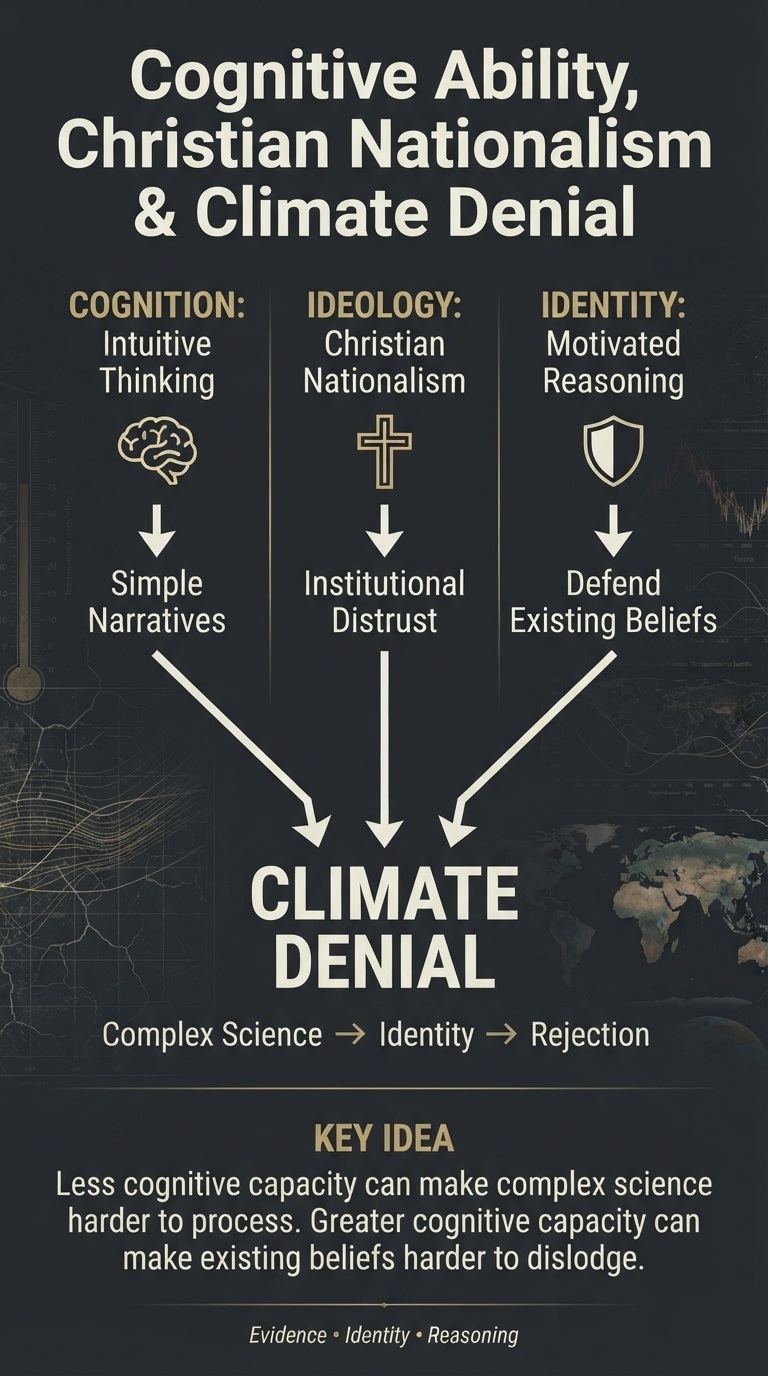
A new 2026 study by sociologist S. L. Perry finds a significant negative association between verbal cognitive ability and Christian nationalist beliefs in the United States.

That finding raises an important question:

What does cognition have to do with climate change denial?

Climate science is extraordinarily complex. Understanding it requires processing interconnected systems, probabilities, feedbacks, long-term trends, and evidence that cannot simply be evaluated through everyday experience.

This creates several pathways toward climate skepticism:

🧠 Intuitive thinking can favor simple narratives over complex scientific evidence.

✝️ Christian nationalist ideology can reinforce distrust of secular scientific and academic institutions.

🛡️ Motivated reasoning can allow people with substantial cognitive ability to construct sophisticated defenses of beliefs that are deeply connected to their political, religious, or cultural identity.

The result is a paradox: Less cognitive capacity can make complex science harder to process. Greater cognitive capacity can make existing beliefs harder to dislodge.

The problem is therefore not simply ignorance.

It is the interaction of cognition, ideology, identity, institutional trust, and reasoning.

Cognitive Ability, Christian Nationalism, and Climate Change Denial

The 2026 study “Cognitive Ability and Christian Nationalism” by sociologist S. L. Perry, published in the Journal for the Scientific Study of Religion, establishes a significant negative association between cognitive ability—specifically verbal intelligence—and Christian nationalist beliefs in the United States.

Perry’s findings intersect directly with the psychology and sociology of climate change denialism through shared cognitive mechanisms, ideological alignments, and patterns of scientific skepticism.

The relationship can be understood through three primary connections.

1. The Common Thread: Lower Cognitive Ability and Intuitive Thinking

Perry’s study establishes that lower cognitive ability, specifically verbal intelligence, is associated with a greater likelihood of adopting Christian nationalist beliefs.

This finding intersects with psychological research on climate change denial, where lower cognitive ability and reliance on intuitive rather than analytical thinking have also been identified as factors associated with rejection of climate science.

Climate science presents an unusually difficult cognitive problem. It is abstract, global, highly interconnected, probabilistic, and dependent on scientific concepts that cannot be directly observed by most people. Atmospheric chemistry, radiative forcing, feedback mechanisms, ocean heat uptake, ice dynamics, and long-term statistical trends are not matters that can be evaluated through everyday intuition alone.

As a result, people with fewer cognitive resources—or those who rely more heavily on intuitive reasoning—may be more likely to substitute simple cognitive shortcuts for complex scientific analysis.

Instead of evaluating atmospheric data, climate models, physical mechanisms, and multiple independent lines of evidence, an individual may rely on a familiar narrative:

“It doesn’t feel warmer.”

“The climate has always changed.”

“Scientists have been wrong before.”

“God controls the weather.”

These shortcuts provide simple answers to a highly complex scientific problem. The important connection is therefore not simply intelligence. It is the interaction between cognitive ability, reasoning style, and the complexity of the information being evaluated.

2. Christian Nationalism as an Ideological Driver of Climate Skepticism

Christian nationalism is not simply a religious belief. It is a cultural and political framework that can overlap with broader anti-science attitudes and distrust of secular institutions.

Sociological research has identified Christian nationalism as an important predictor of climate skepticism. The connection is particularly apparent when environmental and climate issues become associated with secular scientific institutions, universities, government agencies, international organizations, and political movements perceived as threatening traditional cultural values.

The “God Is in Control” Narrative

One mechanism is theological.

Within some Christian nationalist frameworks, there is a strong emphasis on God’s absolute sovereignty over the Earth. This can manifest in the belief that humans cannot fundamentally alter the climate because God controls the weather and ultimately determines the Earth’s fate.

When taken to its logical extreme, such a worldview can conflict directly with climate science. Climate science does not claim that humans control the climate absolutely. It demonstrates that human activities—particularly the emission of greenhouse gases—alter the Earth’s energy balance and therefore alter the climate system.

The conflict is consequently not necessarily between Christianity and climate science. It is between particular interpretations of religious sovereignty and the scientific evidence demonstrating that human activity is a major driver of contemporary climate change.

Anti-System Sentiments

Christian nationalism can also overlap with populist political movements characterized by distrust of secular institutions, academia, government agencies, international organizations, and scientific authorities.

Climate change becomes particularly vulnerable to this form of institutional distrust because accepting the scientific evidence requires trusting multiple scientific institutions and disciplines operating across national boundaries. Consequently, rejecting climate science can become an extension of a broader rejection of the institutions that produce, evaluate, and communicate scientific knowledge.

The result is a powerful ideological feedback:

Distrust the institution → distrust the science → reject the evidence → reinforce the ideology.

3. The Paradox of Motivated Reasoning

There is, however, an important paradox. Lower cognitive ability and intuitive thinking may help explain some forms of initial resistance to complex scientific information. But climate denial on the political right cannot be explained entirely by lower cognitive ability.

For highly complex political issues such as climate change, individuals with higher cognitive ability can sometimes use those cognitive resources not to discover objective truth, but to rationalize and defend conclusions consistent with their existing political or cultural identity.

This is commonly described as motivated reasoning or, in some research, Motivated System 2 Reasoning (MS2R).

The mechanism is straightforward. A person first arrives at a conclusion because it is consistent with the beliefs and values of their social group. The person’s cognitive abilities then become available to defend that conclusion. The more sophisticated the individual, the more sophisticated the defense can become.

This can produce highly elaborate arguments based on selective evidence:

  • emphasizing isolated periods of cooling while ignoring the long-term warming trend;
  • selecting individual scientists or studies that challenge the consensus while dismissing the larger body of evidence;
  • focusing on uncertainty in climate projections while ignoring the underlying physical certainty of greenhouse-gas warming;
  • demanding impossible standards of proof for climate science;
  • identifying errors or controversies within individual studies and treating them as evidence against the entire scientific framework.

The issue is therefore not simply whether someone possesses the cognitive ability to understand climate science. It is also what that cognitive ability is being used to accomplish.

If accepting climate change threatens an individual’s political, religious, economic, or cultural identity, sophisticated reasoning can become a tool for protecting that identity rather than challenging it.

Summary of the Relationship

FactorChristian NationalismClimate Change Denialism
Cognitive ProfileHigher correlation with lower verbal intelligence and intuitive cognitive styles.Higher correlation with lower cognitive ability and intuitive cognitive styles.
Cognitive ShortcutsComplex social and political questions can be reduced to familiar religious or cultural narratives.Complex climate science can be reduced to familiar narratives that contradict or dismiss scientific evidence.
Institutional TrustGreater rejection of secular academic, governmental, and scientific authority.Greater rejection of mainstream climate science and international scientific institutions.
Core IdeologyFusion of American identity with conservative Christian cultural and political dominance.Often reinforced by conservative political identity, distrust of institutions, and religious interpretations of human responsibility for the Earth.
Religious FrameworkDivine sovereignty can be interpreted as placing ultimate control of the Earth in God’s hands.“God is in control” can become an argument against the possibility or significance of human-caused climate change.
Motivated ReasoningCognitive resources can be used to defend existing religious and political identities.Higher cognitive ability can sometimes facilitate sophisticated arguments defending climate skepticism when climate action conflicts with group identity.

The Larger Pattern

Taken together, these relationships reveal a potentially important common structure.

Climate denialism is not necessarily produced by a single cognitive deficiency or a single political ideology. It can emerge from the interaction of cognitive ability, intuitive reasoning, ideological identity, religious worldview, institutional distrust, and motivated reasoning.

At one end of the spectrum, limited cognitive resources and intuitive thinking can make a highly complex scientific problem easier to process through simple ideological narratives.

At the other end, sophisticated cognitive abilities can be deployed to construct increasingly elaborate defenses of those same narratives.

The result is a paradox:

Less cognitive capacity can make complex scientific information harder to understand, while greater cognitive capacity can make an existing ideological conclusion harder to dislodge.

This helps explain why climate change denial persists even as the physical evidence becomes increasingly extensive.

The fundamental conflict is therefore not simply between science and ignorance.

It can become a conflict between evidence and identity.

And when scientific evidence threatens a deeply embedded religious, political, or cultural identity, the human capacity for reasoning can become not merely a mechanism for discovering what is true—but a mechanism for defending what one already believes.

bookmark_borderScientific Publishing 101

Scientific Publishing 101

by Daniel Brouse and Sidd Mukherjee

Publishing scientific papers, articles, and essays is far more backward than most people realize. In many fields, authors are not paid to publish; they may actually have to pay publication or open-access fees. Scientific publishing operates very differently from the music business. A young musician may dream of getting paid to record an album and become a rock star. A young scientist, however, needs to understand the very different economic reality of academic publishing.

One example is Open Access publishing in Nature. The current Gold Open Access Article Processing Charge for an accepted primary research article is £9,390, US$12,850, or €10,850. That fee is charged only after acceptance if the authors choose to make the article freely available through the Gold Open Access model.

The larger point is that the academic publishing ecosystem contains substantial financial and institutional differences in publication, access, indexing, and visibility. Nature itself says Open Access makes research more widely available and highly discoverable.

For us, publishing 10 papers a day through that model would mean $128,500 a day in Open Access fees. That’s about $47 million a year.

This is one reason Sidd and I started the Philadelphia Spirit Experiment Publishing Company in the 1990s. We agreed we didn’t want to go that route for many reasons. We thought it would be better to do it ourselves and offer the publishing service to others working in the humanities and related fields—arts, music, science, and teaching—for free.

We also agreed that we wouldn’t apply for patents. We wanted our research, inventions, and music to remain in the public domain and be available for everyone to use.

That philosophy is still very much alive in what we’re doing today: learn, create, experiment, publish, and share. Feel free to join in and sing along.

bookmark_borderMoney Moves People: Why Demand Destruction May Be the Fastest Path Beyond Fossil Fuels

by Daniel Brouse

2026: The New Economic Reality

Money moves people.

The climate costs of fossil-fuel dependence are increasingly outweighing its benefits—not in some distant future, but here and now. We are moving beyond arguments about what climate change might cost decades from today. Across the Western world, climate impacts are already imposing costs of hundreds of billions of dollars in real time.

Insurance is only one part of the story.

Infrastructure, agriculture, transportation, labor productivity, public health, energy systems, and financial markets are all beginning to absorb the cost of a destabilizing climate. The economic question is therefore changing. It is no longer simply:

“What will climate change cost us?”

It is increasingly:

“How much are we willing to pay to preserve an energy system that is becoming progressively more expensive to maintain?”

Climate Stress Is Becoming an Economic Stress Test

The physical infrastructure of the global economy is already being affected.

Maersk CEO Vincent Clerc has warned that climate change is putting increasing pressure on European waterways and that substantial infrastructure investment will be needed to keep the Rhine operating as a critical transportation artery.

But the economic importance of waterways extends far beyond shipping.

Rivers, lakes, and reservoirs are also critical components of the energy, industrial, agricultural, municipal, and ecological systems that support modern economies.

When water levels fall or water temperatures rise, power plants can be affected directly. Thermoelectric and nuclear power plants rely heavily on water for cooling. If river flows become too low, or water temperatures become too high, operators may be forced to reduce generation or temporarily shut down units because sufficient cooling capacity is no longer available or because thermal discharge limits are exceeded.

That creates an economic chain reaction:

Lower river flows or higher water temperatures
↓
Reduced cooling capacity
↓
Reduced power generation
↓
Tighter electricity supplies
↓
Higher electricity prices and grid stress
↓
Higher operating costs for industry and consumers

The same waterways that transport fuel, raw materials, agricultural products, chemicals, and manufactured goods can therefore also be essential to producing the electricity needed to move and manufacture those goods.

Water is simultaneously a transportation system, cooling system, industrial input, agricultural resource, and ecological asset.

When that system becomes unstable, multiple economic sectors can be affected at the same time.

Low water levels can also restrict the movement of coal, oil, natural gas, grain, chemicals, construction materials, and other bulk commodities. Barges may have to reduce their loads or make more trips to transport the same volume of goods. In some cases, alternative transportation by rail or truck becomes necessary, increasing fuel consumption, congestion, labor costs, and emissions.

Flooding creates the opposite problem.

Excess water can damage ports, locks, bridges, rail connections, roads, warehouses, industrial facilities, and electrical infrastructure. A waterway can therefore become economically disruptive at both extremes—too little water and too much water.

Agriculture is similarly exposed. Rivers and reservoirs provide irrigation, livestock water, and municipal supplies. Persistent drought can reduce agricultural output while increasing competition among farmers, cities, industry, ecosystems, and energy producers for increasingly scarce water.

There is also a less visible economic cost: water temperature itself is becoming an economic variable.

Warmer rivers can reduce their ability to absorb additional heat from industrial processes and power-plant cooling systems. At the same time, warmer water can stress aquatic ecosystems, fisheries, and drinking-water systems, creating additional regulatory, treatment, and ecological costs.

This produces a broader economic concept that is often missed in conventional disaster accounting:

Waterway disruption is not a single-sector problem. It is a systems problem.

The Rhine and Danube are not simply waterways. They are components of Europe’s economic infrastructure. They connect ports, factories, power plants, farms, cities, mines, warehouses, rail networks, and consumers. When climate conditions interfere with their operation, the economic consequences propagate through the system. A river does not have to disappear to create an economic crisis. It only has to become less reliable. And reliability is one of the most valuable—and often least visible—assets in a modern economy.

The Economic Toll of Extreme Weather

Global extreme weather and natural disasters are generating enormous economic losses. Recent estimates from the International Chamber of Commerce, insurers including Swiss Re, and disaster-loss tracking organizations show that severe convective storms, wildfires, floods, and other extreme events are producing annual losses measured in the hundreds of billions of dollars.

The first half of 2026 alone has already produced approximately $100 billion in global economic losses, while the cumulative economic toll over the past decade has reached roughly $2 trillion, according to recent assessments.

And the year is not over.

The second half of the year normally includes the peak of the North Atlantic hurricane season, creating the potential for another substantial wave of losses.

The Major Economic Drivers

Escalating annual losses.
Global disaster losses continue to accumulate at extraordinary levels. The combined economic losses from 2022 and 2023 alone have been estimated at roughly $451 billion.

The concentration of U.S. losses.
The United States remains a major source of global insured catastrophe losses. By June 2026, the country had already experienced 12 billion-dollar weather and climate disasters, with estimated losses totaling approximately $31.9 billion.

Severe convective storms.
Hail, tornadoes, straight-line winds, and other severe thunderstorms have become an increasingly persistent source of financial losses. The United States recorded a record 21 billion-dollar severe-convective-storm events in 2025.

Extreme heat and productivity.
The economic damage from climate change is not limited to destroyed buildings and infrastructure. Heat reduces worker productivity, particularly in construction, agriculture, manufacturing, and outdoor occupations. Global heat-related productivity losses have been estimated at roughly 1% of world GDP annually—around $1 trillion.

The long-term U.S. bill.
U.S. billion-dollar weather and climate disasters have generated cumulative damages exceeding $3 trillion since systematic tracking began in 1980.

The Trajectory Is the Story

Recent U.S. disaster statistics illustrate the increasing economic burden:

YearBillion-Dollar EventsEstimated DamageMajor Loss Drivers
202523~$115 billionSevere storms, wildfires
202427~$182.7 billionSevere storms, tropical cyclones, extreme heat
202328$145+ billionSevere storms and other extreme events

The important point is not that every individual disaster can be attributed exclusively to climate change.

The economic signal emerges from the frequency, intensity, persistence, and cumulative cost of extreme conditions.

Climate change does not need to create every storm, flood, drought, or wildfire to transform the economics of risk. It only needs to increase the probability, severity, or duration of damaging events enough to alter the cost structure of society.

That is already happening.

“Demand Destruction” Is Our Friend

This brings us to one of the most powerful—and least appreciated—economic mechanisms in the energy transition:

Demand destruction.

The International Energy Agency has projected that global oil demand will decline more sharply than previously expected in 2026, forecasting a reduction of approximately 1.6 million barrels per day.

The significance extends beyond the number itself.

As an economist, I am less concerned with establishing a specific date by which the world must eliminate fossil fuels than I am with changing the economic forces that sustain fossil-fuel demand.

That distinction matters.

People do not necessarily change because someone wins an argument about climate science. They change because incentives change. Prices change. Risk changes. Availability changes. And eventually, behavior changes.

Money Moves People

I am unlikely to change the minds of the roughly 20% of Americans who are ideologically committed to policies that accelerate fossil-fuel dependence.

But that leaves the vast majority of the population. And economics can do much of the work. Integrated Climate Stewardship begins with reducing unnecessary consumption.

Consumerism drives energy demand, resource extraction, pollution, waste, and habitat destruction. Every unnecessary unit of consumption represents another demand for energy and materials somewhere in the global economy.

Consume less, and demand falls.

Demand falls, and the economic incentive to produce falls.

That is the mechanism.

The Economics of Personal Climate Stewardship

Today, only a small fraction of Americans appear to be pursuing a deliberately structured net-zero lifestyle through continuous behavioral reductions, efficiency improvements, and intentional balancing. But this does not mean the model cannot scale. The critical question is how climate stewardship is presented.

If reducing climate impact is framed exclusively as sacrifice, people resist. If it is framed as economic self-interest, the equation changes.

What happens when people discover that reducing unnecessary consumption can save them thousands of dollars a year?

What happens when energy efficiency lowers household expenses?

When smaller vehicles reduce fuel, maintenance, and insurance costs?

When reducing waste means buying fewer things that do not provide meaningful value?

When local production and durable goods become economically attractive?

When conservation becomes synonymous with financial resilience?

The behavior does not have to begin with ideology.

It can begin with a household budget.

Vote With Your Dollars

This is where the remaining majority of the population becomes economically important.

When millions of people begin making purchasing decisions based on cost, durability, efficiency, resilience, and environmental impact, they collectively alter demand.

When demand changes, markets respond. When fossil-fuel demand declines, the economic incentive to extract, refine, transport, and sell fossil fuels declines with it. This is fundamentally different from waiting for governments to impose every change from the top down. It is a bottom-up economic transition.

People do not have to agree about everything.

They do not have to become climate activists.

They do not even have to agree about climate policy.

They simply have to discover that some forms of consumption are no longer worth what they cost.

The Feedback Loop

The process can become self-reinforcing:

Lower unnecessary consumption
↓
Lower household costs
↓
Lower energy and resource demand
↓
Reduced fossil-fuel demand
↓
Lower economic incentive for fossil-fuel expansion
↓
Greater investment in alternatives and efficiency
↓
Further reductions in fossil-fuel demand

This is an economic feedback loop.

And unlike many climate-policy debates, it does not require everyone to agree on the destination before beginning the journey.

Demand Destruction Is the Transition

The transition away from fossil fuels is often described as a supply problem:

How quickly can we replace coal, oil, and natural gas?

But there is another side of the equation.

How quickly can we reduce the demand that makes fossil-fuel extraction profitable?

That may ultimately be the more powerful question.

We do not need to convince every person to become an environmentalist.

We need to make lower-carbon choices increasingly rational economic choices.

The climate crisis is already generating enormous costs. Insurance premiums are rising. Infrastructure is being stressed. Agricultural productivity is being disrupted. Heat is reducing labor capacity. Extreme weather is destroying capital. Supply chains are becoming more vulnerable.

These costs are not theoretical.

They are appearing on balance sheets, household budgets, insurance statements, government budgets, and corporate earnings reports.

The economic system is beginning to receive the bill.

And money moves people.

Demand destruction is not the enemy of the energy transition.

Demand destruction is the transition.

bookmark_borderThe Good Ancestor

A poem by Daverick Leggett

Every day I walk a hundred years
to the hill where my great, great granddaughter sits.
I carry words of blessing
and reach to touch her back.

But feeling me near she turns,
sad-eyed and heavy with grief.

“What was it like?” she asks,
“when the great whales swam,
when the birds sang you awake,
when the rains came soft,
and the soil smelled sweet underfoot?”

And the blessings
catch in my throat.

On darker days she turns,
her famished face charred, and eyes
sunk in their bony orbits,
burn with curses.

And the blessings
froth at my mouth
with the poisonous
spume of betrayal.

On the darkest of all days
I walk the hundred years
and find no one there.

Let today be the bright day.
Let today be the bright day
I lay my hand upon her back.

And, feeling me near, she turns
and blesses me, saying,

“Your love was fierce enough,
sweet ancestor,
your love was fierce enough.”

bookmark_borderThe Good Ancestor and the Climate System: Applying Long-Term Thinking to a Nonlinear Climate Future

by Daniel Brouse

Introduction

Roman Krznaric’s The Good Ancestor: How to Think Long Term in a Short-Term World begins with a deceptively simple question: How can we become good ancestors? His argument is fundamentally about time. Modern societies have become increasingly organized around immediate rewards, quarterly results, election cycles, daily news, and rapidly changing information. The climate system operates on radically different temporal scales. Carbon dioxide released today can influence atmospheric and oceanic processes for decades to centuries, while ice sheets, ocean circulation, ecosystems, and human infrastructure respond through interacting processes that unfold across multiple time horizons.

This temporal mismatch is one of the central problems in understanding climate change.

The climate problem is therefore not merely a problem of atmospheric physics. It is also a problem of human time perception. We make decisions within political, economic, and personal time horizons while the Earth system accumulates energy, reorganizes circulation, alters hydrological patterns, loses ice, and modifies ecological and social conditions over much longer periods.

Krznaric identifies six approaches to long-term thinking: deep-time humility, legacy mindset, intergenerational justice, cathedral thinking, holistic forecasting, and transcendent goal.

Applied to climate science, these six principles provide more than an ethical framework. They provide a conceptual architecture for understanding why conventional climate decision-making repeatedly underestimates systemic risk.

My climate work has focused on a related problem: climate change is not adequately described as a linear increase in average temperature followed by proportionally increasing impacts. The climate system is a coupled, nonlinear system in which accumulated energy can alter the conditions governing subsequent change. Ocean heat, atmospheric moisture, sea-level rise, ice loss, circulation changes, extreme heat, ecological degradation, and socioeconomic disruption interact across different timescales.

The result is a fundamental challenge to short-term thinking.

We are attempting to manage a long-duration, nonlinear Earth-system transition with institutions designed to optimize the present.

Krznaric’s Good Ancestor framework provides a powerful way to confront that contradiction.


1. Deep-Time Humility: Recognizing the Scale of the System

Krznaric’s first principle is deep-time humility: understanding humanity’s extraordinarily small position within the history of Earth and the cosmos. His argument is that recognizing our temporal insignificance can expand rather than diminish our sense of responsibility.

Climate science makes this principle especially important.

Human political systems commonly operate within horizons of months, years, or decades. Climate processes operate simultaneously across days, years, decades, centuries, and longer. An extreme heat event can develop within hours. Ocean heat accumulation occurs over years and decades. Ice-sheet responses can extend over centuries. Carbon-cycle consequences can persist much longer.

These are not competing descriptions of the same phenomenon. They are different temporal layers of one coupled system.

That distinction matters because a climate system can appear relatively stable when observed over one interval while undergoing substantial structural change over another.

A single year’s temperature anomaly tells us something important about the state of the system. But it does not necessarily reveal the direction of the system’s underlying dynamics.

This is why rates of change and changes in rates of change matter.

A climate variable that is increasing linearly presents one kind of risk. A variable whose rate of increase is itself changing presents another. If the acceleration persists, projections based solely on historical averages can systematically underestimate the future trajectory.

The same principle applies to sea-level rise, ocean heat, extreme heat, ice loss, and other indicators. The important question is not simply:

How much has the climate changed?

It is also:

How rapidly is the rate of change itself changing?

This perspective is consistent with the central premise of a nonlinear climate framework: the Earth system must be evaluated not merely by its current state, but by its trajectory, acceleration, feedback structure, and proximity to thresholds.

Deep-time humility therefore changes the unit of analysis.

We stop asking only what climate conditions will look like at the end of the next political cycle and begin asking what trajectory we are establishing for people living decades, centuries, and generations from now.


2. Legacy Mindset: The Climate We Leave Behind

Krznaric’s second principle is the legacy mindset: asking how future generations will remember what we did with the conditions inherited by our generation.

This is particularly powerful when applied to climate change because humanity is not merely experiencing a changing climate.

We are actively determining the initial conditions inherited by future generations.

Every generation receives an Earth system shaped by previous generations and then modifies it before passing it forward.

The critical question becomes:

What climate system are we leaving behind?

That question is larger than carbon emissions alone.

We are leaving future generations altered coastlines, changed hydrological regimes, warmer oceans, different ecosystems, stressed agricultural systems, modified atmospheric circulation, altered wildfire regimes, infrastructure designed for historical climate conditions, and potentially reduced resilience to compound extremes.

The legacy is therefore a system state, not simply an emissions total.

This distinction is important to a nonlinear framework. The consequences of present decisions are not necessarily proportional to the decisions themselves. A system approaching a threshold can respond very differently from one far from a threshold.

The legacy mindset consequently requires us to evaluate not merely the emissions we produce but the conditions under which future generations will have to operate.

That changes the moral question from:

How much climate damage can we tolerate?

to:

What state of the Earth system are we willing to hand to people who had no role in creating it?

That is a substantially different standard.


3. Intergenerational Justice: Future People Are Stakeholders

The third principle, intergenerational justice, asks us to recognize obligations to people who do not yet exist. Krznaric explicitly connects this concept to thinking about the seventh generation and the rights and interests of future people.

Climate change exposes a fundamental weakness in conventional economic and political accounting: the people who receive many of the costs may not be the people making the decisions that generate them.

A decision made today can produce benefits immediately while distributing costs across decades.

That creates a profound temporal asymmetry.

The beneficiaries are present.

The consequences may be inherited.

This becomes even more consequential when nonlinear processes are involved. A generation may consume the benefits of an activity while transferring to future generations a climate system with fewer degrees of freedom and less resilience.

This is the point at which climate science and climate ethics converge.

If the system is approaching thresholds, then delaying action does not simply preserve the same problem for later. It can change the problem itself.

The future may inherit not merely more warming, but a different set of system dynamics.

That distinction is central.

A linear interpretation imagines:

more emissions → proportionally more warming → proportionally more impacts.

A nonlinear systems interpretation recognizes the possibility of:

forcing → warming → feedback amplification → system reorganization → threshold crossing → cascading consequences.

The precise behavior of each component must be established scientifically; not every proposed feedback or tipping interaction is equally certain. But the broader systems principle is robust: interacting components can produce outcomes that are not adequately represented by treating each component independently.

Intergenerational justice therefore demands more than reducing today’s visible damage.

It requires maintaining future adaptive capacity.


4. Cathedral Thinking: Building What We Will Never See Completed

Krznaric’s fourth principle is cathedral thinking: beginning projects whose completion or full benefits extend beyond an individual lifetime. He uses the cathedral as a metaphor for undertaking work whose builders understand that they may never see the finished structure.

This concept fits climate science almost perfectly.

Climate stabilization, ecosystem restoration, adaptation of infrastructure, long-term water management, coastal planning, soil restoration, forest management, energy transformation, and preservation of scientific observations all require decisions whose full consequences extend beyond ordinary political cycles.

But cathedral thinking must go beyond simply building large projects.

It requires building institutional continuity.

A climate strategy designed for four years is not a long-term climate strategy. Neither is one designed around a single election, market cycle, administration, or corporate planning horizon.

The climate system does not reset when political leadership changes.

A genuine cathedral approach would therefore establish institutions capable of maintaining long-term climate observation, infrastructure adaptation, ecosystem protection, scientific research, and risk management regardless of short-term political fluctuations.

This also changes the purpose of climate modeling.

A model should not merely tell us what conditions are likely at a particular future date. It should help identify path dependencies—decisions made today that constrain what future generations can realistically do.

That is especially important when dealing with tipping elements.

If Greenland ice loss, West Antarctic ice instability, permafrost degradation, Amazon ecosystem stress, ocean circulation changes, or other components approach thresholds, the relevant question is not simply whether a particular threshold will be crossed at a particular date.

The more important question is:

Are we constructing conditions that make future reversibility increasingly difficult?

Cathedral thinking therefore demands that we evaluate irreversibility and option value.

A decision that preserves future options has value even if its immediate economic return is difficult to quantify.


5. Holistic Forecasting: From Isolated Variables to a Coupled System

The fifth principle, holistic forecasting, may be the most directly compatible with a nonlinear climate framework.

Krznaric argues that long-term forecasting must consider multiple pathways for civilization rather than rely upon narrow forecasts of a single future.

Climate science requires precisely this kind of thinking.

The Earth system is not a collection of independent variables.

Atmospheric warming influences atmospheric moisture. Increased moisture changes latent heat transport and precipitation dynamics. Ocean warming alters marine heatwaves, circulation, and sea-level contributions. Ice loss modifies albedo and freshwater fluxes. Atmospheric and oceanic circulation redistribute energy. Ecosystem degradation changes carbon storage and surface energy exchange. Extreme events impose stress on infrastructure, agriculture, insurance systems, financial markets, and public health.

These processes can interact.

A useful conceptual chain is therefore not:

CO₂ → temperature → damage.

It is closer to:

forcing → energy accumulation → physical response → feedback → circulation and ecological response → extreme events → infrastructure and economic stress → societal response → additional environmental feedbacks.

This is where the concept of nonlinear acceleration becomes important.

The climate system may exhibit changes in the rate of change because feedbacks alter the system’s effective response over time.

A useful research framework therefore needs to monitor at least four dimensions:

  1. State — where the system is.
  2. Velocity — how rapidly it is changing.
  3. Acceleration — whether that rate is changing.
  4. Coupling — whether independent indicators are becoming dynamically connected.

The fourth dimension is particularly important.

A collection of extreme indicators becomes much more consequential when they cease behaving as isolated anomalies and begin interacting as components of a broader system transition.

This is why the emphasis on persistent nighttime heat, ocean heat accumulation, sea-level acceleration, hydrological disruption, and tipping-system interactions is important.

The question is no longer simply whether one record has been broken.

It is:

Are multiple components of the climate system changing simultaneously in ways that reinforce one another?

That is a holistic forecasting question.


6. Transcendent Goal: From Climate Management to System Preservation

Krznaric’s sixth principle is the transcendent goal—a purpose larger than short-term institutional interests. His formulation points toward the goal of creating conditions in which humanity and the living world can thrive over the long term.

Climate policy frequently becomes trapped in narrower objectives:

  • reducing emissions by a certain percentage;
  • achieving a particular temperature target;
  • meeting a regulatory deadline;
  • protecting a particular industry;
  • minimizing near-term costs.

These objectives are useful, but they can become inadequate when treated as the ultimate goal.

The deeper objective should be preserving a functioning Earth system capable of supporting human civilization and ecological complexity across generations.

That means climate policy should ultimately be judged by resilience rather than by any single metric.

The goal is not merely to minimize today’s inconvenience.

It is to preserve the capacity of future generations to choose their own future.

That is a transcendent objective because it places human civilization within the larger Earth system rather than treating the environment as an externality.


The Six Principles as a Climate Research Architecture

Krznaric’s six principles can therefore be transformed from philosophical concepts into an analytical framework for climate research:

Krznaric principleClimate application
Deep-Time HumilityAnalyze climate trajectories across decades, centuries, and longer system timescales
Legacy MindsetMeasure the Earth-system conditions inherited by future generations
Intergenerational JusticeTreat future adaptive capacity as an ethical and analytical constraint
Cathedral ThinkingDesign climate institutions, infrastructure, and restoration projects beyond political cycles
Holistic ForecastingModel coupled physical, ecological, economic, and social pathways rather than isolated variables
Transcendent GoalPreserve a resilient Earth system and the long-term capacity of civilization to thrive

Together, these principles produce something more powerful than a philosophical appeal to “think long term.”

They provide a temporal systems framework.


From Climate Change to Climate Regime Change

This framework also helps explain why the distinction between climate change and climate regime change matters.

Climate change can be understood as a shift in the statistical characteristics of the climate system.

Climate regime change goes further.

It asks whether the underlying relationships among components of the system are themselves changing.

A regime transition could manifest as persistent changes in extreme heat, nighttime temperatures, precipitation behavior, ocean heat, sea-level rise, circulation patterns, ecological responses, or the frequency and persistence of compound extremes.

The importance of persistent nighttime heat illustrates this distinction.

A daytime temperature record is an extreme event.

Persistent elevation of nighttime temperatures is different because the nighttime period normally provides an opportunity for ecosystems, infrastructure, agriculture, and human bodies to dissipate accumulated heat.

When nighttime cooling is progressively compressed, heat accumulates across successive days.

The system is no longer simply producing isolated extremes.

The baseline itself is moving.

This is precisely where the Good Ancestor framework becomes useful.

A short-term observer asks:

Was today unusually hot?

A long-term systems observer asks:

Has the system entered a state in which unusually hot conditions are becoming persistent, self-reinforcing, and structurally normal?

Those are fundamentally different questions.


The Climate Problem as a Failure of Temporal Governance

Krznaric describes modern society as being dominated by what he calls the “tyranny of the now”: the tendency to privilege immediate concerns over long-term consequences.

Climate change exposes this problem with unusual clarity.

Political systems are optimized around elections.

Businesses are often optimized around quarterly or annual performance.

Financial systems discount future returns.

News systems reward immediacy.

Social media rewards attention measured in seconds.

The climate system does not operate according to any of these clocks.

This produces a structural mismatch:

Human institutions optimize for the present while the Earth system integrates the past and determines the future.

That mismatch is one reason climate risks can repeatedly be underestimated.

A society may respond to an extreme event after it occurs while failing to recognize that the event is part of a changing distribution.

It may repair infrastructure to the historical climate standard even while the climate distribution is shifting.

It may calculate the immediate cost of mitigation while ignoring the potentially much larger cost of reduced future resilience.

And it may treat each extreme as an independent disaster rather than examining whether multiple extremes are manifestations of a common systemic transition.

Good Ancestor thinking challenges this institutional short-termism directly.


Toward a Good Ancestor Climate Index

The philosophical framework suggests a possible extension of climate-risk measurement.

Instead of evaluating climate policy solely through emissions, temperature, or economic cost, a Good Ancestor Climate framework could ask whether present decisions increase or decrease the resilience inherited by future generations.

Such an assessment could consider:

Physical trajectory:
Are major climate indicators accelerating, stabilizing, or decelerating?

Feedback exposure:
Are positive feedbacks becoming stronger or more interconnected?

Threshold proximity:
Are critical Earth-system components moving toward states where reversibility becomes increasingly difficult?

Persistence:
Are extreme conditions becoming more persistent rather than merely more intense?

System coupling:
Are climate, ecological, infrastructure, economic, and social stresses becoming increasingly interconnected?

Adaptive capacity:
Are we expanding or consuming the ability of future generations to respond?

Intergenerational burden:
Are present benefits being purchased by transferring disproportionate costs into the future?

This would shift climate assessment from a narrow accounting of emissions toward a broader accounting of system inheritance.

The central metric becomes:

What are we leaving behind?


The Good Ancestor Test

Krznaric’s philosophy ultimately suggests a remarkably simple test for climate decisions.

Before making a decision, ask:

Would the people living with its consequences a century from now regard us as responsible ancestors?

That question can be applied to virtually every major climate decision.

Would future generations regard us as good ancestors if we knew that climate indicators were accelerating and chose to treat them as static?

Would they regard us as good ancestors if we knew that physical systems were becoming increasingly coupled but continued to govern them separately?

Would they regard us as good ancestors if we optimized infrastructure for a climate that no longer exists?

Would they regard us as good ancestors if we transferred enormous adaptation costs to people who had no voice in the decisions that created them?

And perhaps most importantly:

Would they regard us as good ancestors if we possessed evidence of an approaching systemic transition but refused to think beyond the next election, fiscal year, or news cycle?

These questions transform climate change from an abstract environmental problem into a question of historical responsibility.


Conclusion

Roman Krznaric’s The Good Ancestor provides an ethical and philosophical framework for confronting one of the greatest weaknesses in modern climate governance: our inability to think on the same temporal scale as the system we are changing.

His six principles—deep-time humility, legacy mindset, intergenerational justice, cathedral thinking, holistic forecasting, and transcendent goal—can be mapped directly onto the requirements of nonlinear climate analysis.

Deep-time humility expands the temporal horizon.

Legacy mindset forces us to consider the Earth system we leave behind.

Intergenerational justice recognizes future people as legitimate stakeholders.

Cathedral thinking requires projects and institutions that outlast their creators.

Holistic forecasting demands that climate risks be evaluated as coupled systems rather than isolated variables.

And the transcendent goal establishes a purpose larger than immediate economic or political interests: maintaining a resilient Earth system capable of sustaining future generations.

This perspective reinforces a central proposition of nonlinear climate research:

The most important climate signal may not be the magnitude of change at a particular moment, but the changing dynamics of the system itself.

If rates of change increase, if feedbacks strengthen, if extremes become persistent, if previously separate components become coupled, and if thresholds become increasingly consequential, then the climate problem is no longer adequately described as a gradual environmental trend.

It becomes a system transition.

And once the problem is understood as a system transition, the moral question becomes unavoidable.

We are not merely deciding what kind of climate we will experience.

We are deciding what kind of Earth system we will hand to those who come after us.

That is the essence of the Good Ancestor principle.

The test of our generation will not ultimately be whether we correctly predicted every detail of the future.

It will be whether, having recognized the direction and dynamics of the system, we acted as though future generations mattered.

In that sense, becoming a good ancestor is not an exercise in nostalgia or moral sentiment.

It is a demand for better temporal mathematics, better systems thinking, better governance, and better stewardship.

The future is not simply something that happens to us.

We are its ancestors already.

bookmark_borderScience Is Science: Confronting Denialism and Ecofascism

About Denialism and Ecofascism: Science Is Science

The Observation
Glad to know you’re watching out! At the same time, this divisiveness—when we desperately need everyone to pull together because it’s a CRISIS, right?—makes me somehow deeply sad.

That’s a big job right there… How do we reach those who seem furthest away from any kind of understanding? We need both a Winston Churchill and a Mahatma Gandhi in this endeavor…

The Response
Agreed. Both denialism and ecofascism are ideologies that ultimately defy logic. In very different ways, they can become a kind of combination of self-destruction and destruction of others.

I’ve spent years battling misinformation, propaganda, and rhetoric. To the best of my knowledge, neither Sidd nor I have successfully converted—or even educated—a single committed denier. Climate science has somehow been transformed into a “belief” system. But science has nothing to do with belief. 1 + 1 = 2. If someone refuses to “believe” that, what exactly can you do?

From the beginning, our work has been based on observations, data, mathematics, and the laws of physics. So yes, I think this is at the heart of the crisis. When we started this work, we genuinely believed humanity would eventually take action. We thought we had thousands, if not tens of thousands, of years to adapt. That was the one thing we got wrong.

A couple of years ago, after explaining my continuing attempts to reach climate deniers, I asked Sidd what we could possibly do. His response was essentially, “Dude, just tell them to look out their window.” It sounds simplistic, but there is profound truth in it. The consequences are becoming increasingly difficult to deny.

Since then, we’ve had to rebuild much of our modeling. A +4°C world within thousands of years is no longer the worst-case scenario we worry about. The possibility of 4–7°C of warming within a century has become a much more serious concern in our work.

And then there is the political dimension. The rise of white-nationalist and authoritarian governments in the U.S. and elsewhere has made an already difficult problem considerably harder. Paradoxically, though, history offers one small reason for hope: fascism ultimately fails. It is inherently self-destructive.

The “drill, baby, drill” mentality is economically and environmentally self-defeating. A severe economic contraction could, ironically, buy humanity some time for adaptation while drastically reducing emissions. That is hardly the future anyone should want, but history has repeatedly demonstrated that systems built on extremism and authoritarianism eventually consume themselves.

So yes—we desperately need both the Churchill and Gandhi dimensions: the willingness to confront reality without flinching, and the willingness to keep reaching for people rather than giving up on them. I’m just not sure humanity has ever faced a crisis where we needed both quite this badly.

bookmark_borderThe Two Sides of the Climate Crisis: Consumption and Production

by Daniel Brouse

Climate change is often discussed as a problem of emissions, but emissions are the result of two interconnected forces: consumption and production.

Q: What are the greatest drivers of climate change?
A: Consumption and production.

At present, I would rank our addiction to consumption and ecofascism as the two most significant drivers of the climate crisis. While they operate in different ways, both reinforce the systems that accelerate environmental degradation.

The Consumption Problem

The United States, Western Europe, Canada, and Australia represent some of the world’s most consumption-driven economies. When self-interest, materialism, and short-term economic incentives dominate decision-making, consumer demand becomes one of the primary drivers of climate change, influencing not only greenhouse gas emissions but also land-use change, deforestation, habitat destruction, water consumption, resource depletion, and biodiversity loss.

This is why consumption-based accounting provides a more accurate picture of climate responsibility than production-based accounting alone.

For example, if a smartphone is manufactured in Asia using coal-generated electricity and then shipped across the Pacific to a consumer in Los Angeles, the emissions from mining, manufacturing, transportation, and delivery are ultimately driven by the purchasing decision. Under consumption-based accounting, those emissions are attributed to the American consumer rather than solely to the country where the phone was manufactured.

Read the full explanation and view the rankings here:

http://membrane.com/global_warming/Accounting-for-Climate-Responsibility.html#the-carbon-we-own

The Production Problem

The production side of the equation is likewise influenced by self-interest and economic incentives, but it is also shaped by ideological movements that obstruct effective climate action.

Two distinct, though sometimes overlapping, ideologies are particularly important:

Denialism is characterized by the rejection of scientific evidence, refusal to engage with empirical data, and reliance on misinformation or rhetorical distraction. Its primary objective is often the protection of political, ideological, or economic interests by undermining the scientific consensus.

Ecofascism combines elements of denialism with authoritarian, exclusionary, or extremist beliefs. In its most extreme forms, it portrays environmental collapse as acceptable—or even desirable—because it is viewed as reducing populations or preserving resources for groups considered more deserving than others. This ideology has historically been associated with racist, xenophobic, or eugenicist beliefs and rejects principles of equality and shared human responsibility.

The distinction is important. Traditional denialism primarily seeks to delay or prevent climate policy. Ecofascism goes further by framing unequal human survival as an acceptable or even desirable outcome — eliminationist logic.

Why This Matters

Climate change is not simply a technological or economic challenge. It is also a question of values.

On one side, excessive consumption drives demand for fossil fuels, resource extraction, and emissions. On the other, ideologies that reject science or rationalize unequal human suffering weaken society’s ability to respond effectively to the crisis.

Both sides must be addressed if meaningful progress is to be made.

Further Reading

While investigating climate change denialism, I examined material that I believe illustrates the intersection between denialist narratives and extremist environmental ideologies. A summary of that research is available here:

http://membrane.com/global_warming/Ecofascism-and-Denialism-101.html