bookmark_borderWhat Are the Odds? An Estate Plan for the Next Seven Generations

by Daniel Brouse and Sidd Mukherjee

When I began this journey more than three decades ago, I wasn’t a climate researcher. I was a financial planner specializing in business, economics, estate planning, and risk management. My academic background included economics, philosophy, and extensive study in physics, calculus, statistics, and systems analysis. My career focused on a simple question:

How do you create the best possible future for the people who come after you?

In the early 1990s, I met a brilliant scientist named Sidd. We shared a curiosity about complex systems and a desire to test ideas rather than simply debate them. Together, we began an experiment that has now spanned more than thirty years.

Our goal was unusual. We wanted to build what we jokingly called a one-size-fits-all, bulletproof shareware estate plan—not for one family, but for every family on Earth.

At the same time, I was helping pioneer some of the earliest privately owned web servers. Before commercial hosting became commonplace, we were operating online while many organizations were still connected through universities. It was the same era when Yahoo! itself was running from Stanford University.

By 1995, our website, KingArthur.com, was attracting millions of visitors each month. The internet gave us something few researchers had ever possessed: the ability to interact directly with millions of people across cultures, countries, religions, and generations.

One question became central to our experiment:

“When it comes to your life and what you leave behind, what is the single most important thing?”

We expected many people to answer with wealth, success, fame, or legacy.

Instead, they overwhelmingly answered something much simpler.

Among people under fifty, the most common answer was their children.

Among those over fifty, the answer shifted to their grandchildren.

The experiment revealed something profound. The greatest wealth most people hope to preserve is not money. It is the opportunity for future generations to experience the same joys they have experienced themselves.

In other words, the ultimate estate plan is remarkably simple:

To my children’s children’s children.

The greatest inheritance most of us hope to leave is not a larger bank account. It is the chance for our descendants to raise children of their own, watch them grow, and someday become grandparents themselves.

When we began this experiment, I did not have grandchildren.

Today I do.

That changes everything.

Coincidentally, I was recently asked a question that perfectly captured the purpose of this work:

“Can you play with me on this? I’m wearing my nutritional ecologist hat here, and I’m in a municipal-level discussion that is trying to zoom out seven generations while also identifying the baby steps needed over the next four-year election cycle.”

My immediate thought was:

Exactly.

That is what this experiment has always been about.

An estate plan should not end with our children—or even our grandchildren. It should extend seven generations into the future.

My grandchildren deserve the opportunity to become grandparents themselves. Their grandchildren deserve the same opportunity.

That is entirely achievable—but only if we make wise decisions today.

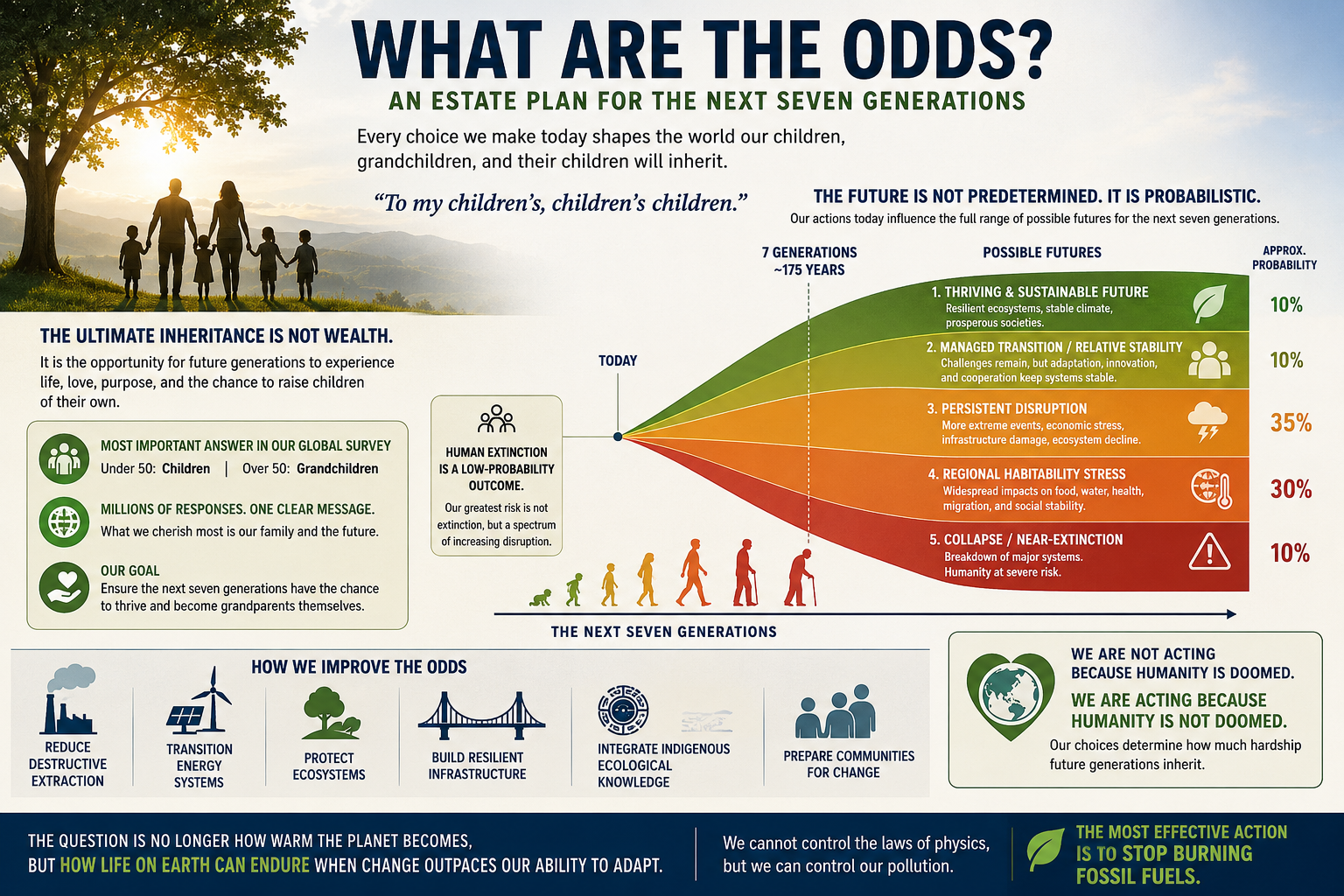
The graph that follows illustrates that idea.

Every choice we make now influences the range of possible futures available to the next seven generations.

Some outcomes are relatively optimistic. Some involve increasing climate disruption.

Some are far more severe.

Importantly, human extinction remains a low-probability outcome.

The far more likely future is not one of sudden extinction, but one that spans a spectrum of increasing disruption—affecting ecosystems, agriculture, infrastructure, economies, public health, migration, and regional habitability.

The probabilities are not fixed. They are shaped by the decisions humanity makes over the coming decades.. including today.

That changes the conversation entirely.

The question is no longer:

“Are humans going extinct?”

The more important question is:

“How difficult do we want life to be for the next seven generations?”

That question naturally leads to practical priorities:

  • Reduce destructive extraction of fossil fuels and natural resources.
  • Transition to cleaner and more resilient energy systems.
  • Protect and restore forests, wetlands, and other ecosystems.
  • Build infrastructure capable of withstanding future climate conditions.
  • Integrate Indigenous ecological knowledge alongside modern science.
  • Prepare communities to adapt to unavoidable change.

The most important message is this:

We are not acting because humanity is doomed.

We are acting because humanity is not doomed.

Our choices today determine how much hardship future generations inherit.

Ultimately, this is not simply a discussion about climate change.

It is an estate planning exercise on a planetary scale.

The question is no longer how warm the planet becomes.

The question is how well civilization—and the generations that follow us—can endure as environmental change accelerates faster than our ability to adapt.

We cannot rewrite the laws of physics. But we can decide how much pollution we continue to add to the atmosphere.

The most effective step we can take is also the simplest:

Stop burning fossil fuels as quickly and responsibly as possible, while building a more resilient world for the generations that follow.
bookmark_borderClimate Change and Civilization Collapse

What Is Civilization Collapse?

Humans are unlikely to face immediate extinction under foreseeable climate scenarios. Our species possesses technological capabilities, global communication networks, and a remarkable ability to adapt to changing conditions.

Let’s lower the bar then to civilization collapse and define the term. Not talking about timeframes, could you explain what that term means to you? What are some of the things that would happen? How could we recognize the start? What things would fail?

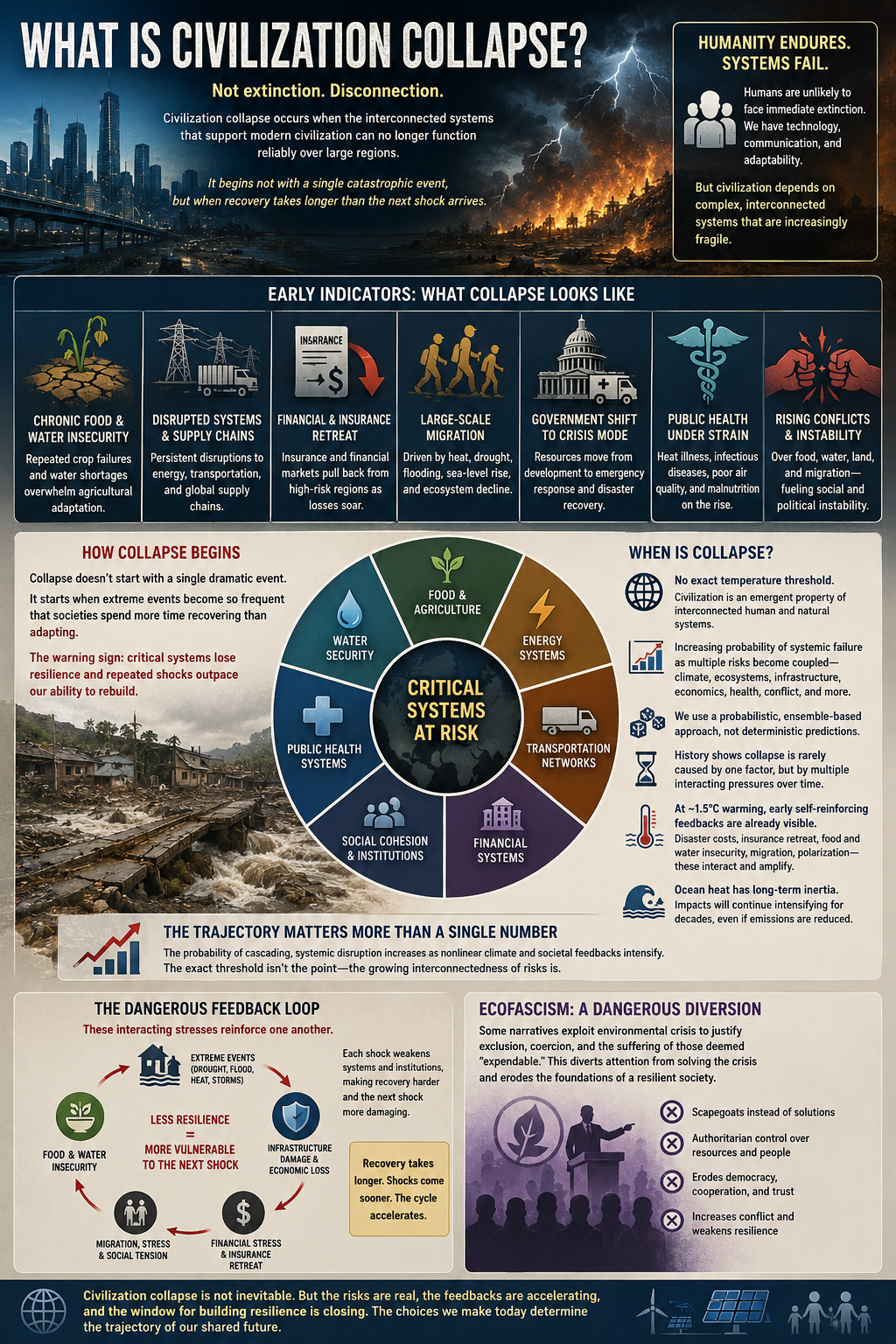
Good question. Civilization collapse does not mean humanity suddenly disappears. It means that the interconnected systems that support modern civilization can no longer function reliably over large regions. Early signs of collapse are already occurring.

Some of these indicators include:

  • Chronic food insecurity as repeated crop failures and water shortages overwhelm agricultural adaptation.
  • Persistent disruptions to energy, transportation, and global supply chains.
  • Insurance and financial markets retreating from high-risk regions because losses become unmanageable.
  • Large-scale migration driven by heat, drought, flooding, sea-level rise, and ecosystem decline.
  • Governments increasingly shifting resources from development to emergency response and disaster recovery.
  • Public health systems struggling with heat illness, infectious diseases, poor air quality, and malnutrition.
  • Escalating conflicts over food, water, land, and migration.

I don’t think collapse begins with a single dramatic event. It starts when extreme events become so frequent that societies spend more time recovering than adapting. The warning sign is when critical systems lose resilience and repeated shocks outpace our ability to rebuild.

Some of those early indicators are already observable today. The question isn’t whether civilization stops overnight, but whether enough interconnected systems begin failing simultaneously that they reinforce one another. That’s why many researchers focus on cascading risks and coupled feedbacks rather than isolated events.

When Is Collapse?

Signs of disruption and collapse are already becoming visible in many parts of the world.

There isn’t a universally accepted temperature threshold at which civilization “collapses.” Civilization is an emergent property of interconnected human and natural systems, not a single physical variable.

The argument isn’t based on a hard cutoff like “X°C = collapse.” It’s based on the increasing probability of systemic failure as multiple risks become coupled. Climate science provides the physical forcing, while ecology, economics, engineering, public health, and history help us understand how societies respond to repeated, compounding shocks.

That’s why we use a probabilistic, ensemble-based approach rather than deterministic predictions. We aren’t claiming to know the exact year or exact temperature at which civilization fails. We’re evaluating the likelihood that interacting stresses—food and water insecurity, ecosystem degradation, infrastructure failures, migration, financial instability, conflict, and public health crises—begin reinforcing one another faster than societies can adapt.

History shows that civilizations rarely collapse for a single reason. They typically experience multiple interacting pressures that erode resilience over time. Our work extends that systems perspective to a globalized civilization operating within a rapidly changing climate.

In fact, I would argue that we’re already seeing early signs of self-reinforcing societal feedbacks at approximately 1.5°C of warming. Rising disaster costs strain insurance markets, infrastructure, and government budgets. Food and water insecurity contribute to migration and political instability. Repeated extreme events reduce resilience, making recovery from the next disaster more difficult. These interacting pressures don’t constitute “collapse” by themselves, but they are consistent with the early stages of a cascading systemic process.

We also know that the climate system has substantial thermal inertia. The heat already stored in the oceans will continue influencing the climate for decades, even as emissions are reduced. That means many climate impacts will continue to intensify before stabilizing, extending both the duration of environmental stress and the societal challenges associated with adaptation.

So I would frame it less as “civilization collapses at 4°C or 6°C” and more as “the probability of cascading, systemic disruption increases as nonlinear climate and societal feedbacks intensify.” The exact threshold isn’t the point; the trajectory and the growing interconnectedness of the risks are.

Ecofascism

I think we’re already seeing early-stage societal feedbacks emerge. I’m not saying civilization has “collapsed,” but that some of the reinforcing dynamics associated with systemic decline are becoming visible. Financial stress from repeated disasters, insurance retreat, food and water insecurity, migration, political polarization, and declining institutional resilience don’t occur in isolation—they increasingly interact and amplify one another.

One example that concerns me is the emergence of ecofascist narratives. Ecofascism reframes environmental crisis through an authoritarian lens, portraying environmental degradation as justification for exclusion, coercion, or the suffering of groups considered expendable. Rather than focusing on reducing emissions and building resilience, it redirects the conversation toward hierarchy and scapegoating.

Whether we ultimately call this the beginning of “collapse” is partly a matter of definition. What matters to me is recognizing that climate, ecological, economic, and social systems are increasingly coupled. As those feedbacks strengthen, the probability of cascading disruptions rises, even though the exact trajectory remains uncertain.

bookmark_borderFrom Scissors and Glue Sticks to AI: A Lifetime of Publishing Through Technological Revolutions

by Daniel Brouse

I recently had a conversation with an author who described the painstaking process of publishing a book decades ago. The manuscript was written on an early Amstrad word processor. Each section had to be printed, physically cut with scissors, and glued onto format sheets provided by the publisher. Every chapter was constrained to a specific page count and layout. Photos and graphics required coded placeholders, separate lists of image requirements, rough sketches, and coordination with researchers and artists. It was an incredibly slow and labor-intensive process.

That story resonated deeply with me because I experienced similar challenges during the early days of the World Wide Web.

Around 1992, web engineering and publishing were equally demanding. Creating even a single graphic for a webpage could take weeks or months. The tools we take for granted today did not exist. There were no drag-and-drop interfaces, content management systems, or automated publishing platforms. Everything was handcrafted.

During that period, I created what I called the first web “button”—the Panic Button. The concept was simple: if someone didn’t know how to use the web, they could click on the graphic and receive help. In effect, it became the first World Wide Web help desk, designed to guide users through an entirely new digital environment.

The Panic Button represented something even more fundamental. It was the invention of the clickable image—an inline graphic with a hyperlink wrapped around it. Today, clickable images are so commonplace that they seem obvious, but at the time, the idea of turning an image itself into an interactive navigation element had not yet become part of the web experience. The button transformed a static picture into an action, helping establish the principle that graphics could serve not merely as illustrations but as gateways to information and services.

The original Membrane website can still be viewed at:

http://membrane.com/

Our work extended beyond web development. We were also among the early record companies on the web, experimenting with concepts that would eventually become commonplace, including music subscriptions, pay-per-download services, and streaming media. I found music production particularly rewarding, and advances in technology allowed me to dramatically increase my creative output.

In the early years, I produced approximately fifty songs per year. As digital tools improved, that number increased to around one thousand songs annually between 1992 and 2023. Today, with AI-assisted composition, production software, and modern mastering technologies, I can publish approximately 7,300 songs per year at substantially higher levels of production and mastering quality. Measured purely by output, that represents a 146-fold increase in productivity.

Scientific publishing has undergone a similar transformation. Much of climate science involves mathematical analysis, data processing, modeling, and the communication of complex ideas. A scientific paper that once might have required a year of calculations, drafting, revisions, graphics production, and formatting can now often be completed in a matter of days.

The significance of these technological changes extends beyond simple speed. Technology has compressed production timelines while simultaneously improving quality and dramatically expanding the capabilities of individuals. Tasks that once required teams of specialists and months of effort can increasingly be accomplished by a single person equipped with modern digital tools and artificial intelligence.

Having lived through both eras—the age of scissors and glue sticks and the age of AI-assisted creation—the contrast is remarkable. We have witnessed one of the greatest productivity revolutions in human history, one that has fundamentally transformed publishing, music, science, and the very process of turning ideas into reality.

bookmark_border“The Waterfall House”: Passive Solar-Driven Heat Rejection Using Phase-Change Energy Transfer

DIY Cooling via Evaporative Roof Water

Preface — Business and Environmental Ethics

This is a “secret” invention Sidd and I developed some time ago.

I call it secret not because it is proprietary in the usual sense, but because we tend to apply a fairly strict internal filter before releasing anything into the wild. Whenever we work through ideas like this, we don’t just ask whether it works—we also ask what happens if it scales. What happens if everybody does it? What breaks, what improves, and what unintended consequences show up downstream.

That second question usually slows things down more than the first.

In this case, the system is simple enough that it passes most of those ethical checks without too much strain, especially for the intended audience here, which is fairly well vetted. Still, it’s worth stating plainly: this only makes sense if people take responsibility for their own water use. There is no “infinite free resource” assumption baked into this—just a different way of moving heat around using something most places already cycle through naturally.

The motivation for sharing it is straightforward. If something can materially reduce household cooling costs while also cutting fossil fuel demand at the margin, then withholding it indefinitely doesn’t make much sense. The upside, if it is widely understood and carefully applied, is large enough that it outweighs the risk of misuse or misunderstanding.

As always, the ethics are part of the engineering.

“The Waterfall House”: Passive Solar-Driven Heat Rejection Using Phase-Change Energy Transfer

Authors: Daniel Brouse and Sidd Mukherjee
Date: 2026

Abstract

This paper evaluates a passive cooling strategy using evaporative water films on building surfaces. The system leverages the latent heat of vaporization of water (~2.26 MJ/kg) to remove heat from structures. Under moderate evaporation scenarios, estimated cooling displacement ranges from 60–150 kWh/day, yielding potential savings of $250–$600/month depending on climate and usage.

1. Introduction

Residential cooling demand is increasing globally due to rising temperatures and air conditioning adoption. Typical vapor-compression systems operate at COP values of 2.5–4.0.

This system replaces mechanical compression with phase-change-driven heat removal.

2. Physical Principle: Latent Heat of Vaporization

The latent heat of vaporization of water is approximately:

2.26 MJ/kg (at 100°C)
~2.45 MJ/kg at ambient temperatures
~970 BTU/lb

Water density:

1 cubic foot = 62.4 lb

Energy absorbed per cubic foot:

62.4 lb × 970 BTU/lb ≈ 60,500 BTU
≈ 61,000 BTU per cubic foot evaporated

3. Air Conditioning Energy Equivalence

1 kWh = 3,412 BTU (thermal equivalent). With typical COP ≈ 3:

1 kWh ≈ 10,000 BTU cooling

Cooling displacement:

61,000 ÷ 10,000 = 6.1 kWh per cubic foot evaporated

4. Economic Value

Electricity price (July 2026): $0.11759/kWh

6.1 kWh × 0.11759 ≈ $0.72 per cubic foot

Result: Each cubic foot evaporated saves approximately $0.72

5. Household Scaling

Assumed evaporation: 10–25 ft³/day

Scenario Daily Savings Monthly Savings
Low (10 ft³/day) $7.20 $216
High (25 ft³/day) $18.00 $540

6. Thermodynamic Interpretation

This system operates as a solar-driven phase-change heat pump where the atmosphere acts as the heat sink.

Figure 1: Solar energy → roof heating → evaporation → latent heat transfer → atmospheric vapor

7. Key Constraints

  • Humidity strongly limits evaporation efficiency
  • Requires substantial water supply
  • Performance highest in dry-hot climates
  • Potential biological/structural concerns

8. Comparative Energy Pathways

System Comparison

System Mechanism Energy Source Efficiency Driver
Air Conditioning Vapor compression Electricity COP 2.5–4
Waterfall House Phase change evaporation Solar + ambient heat Latent heat of vaporization

9. Conclusion

Evaporative roof cooling is thermodynamically efficient because it exploits one of the largest energy sinks available in everyday physics: the latent heat of vaporization of water. Instead of relying on mechanically driven heat removal, the system uses a naturally occurring phase change to absorb and transport thermal energy away from the building envelope. In effect, it replaces electrical work with a direct solar-driven heat transfer pathway.

Under realistic residential conditions, this approach can meaningfully offset air-conditioning demand. Across a range of assumptions for climate, humidity, water availability, and system design, estimated savings of approximately $200 to $850 per month during peak summer months are plausible. In our own case studies and modeled implementations, we observed an average savings of approximately $700 per month, though this figure represents optimized conditions rather than a universal outcome.

It is important to emphasize that performance is highly variable. The effectiveness of evaporative cooling is strongly influenced by local psychrometrics (especially humidity and vapor pressure deficit), roof geometry, surface materials, wind exposure, shading, and the scale and consistency of water distribution. Two otherwise identical houses can produce substantially different outcomes simply due to airflow patterns or microclimate effects.

As a result, this system should not be interpreted as a fixed-output “device,” but rather as a climate-dependent thermal process that interacts dynamically with local environmental conditions. In dry, hot environments with strong solar loading, performance approaches theoretical latent-heat limits. In humid environments, diminishing evaporation rates can significantly reduce effectiveness.

Even with these constraints, the underlying conclusion remains robust: when properly situated and responsibly implemented, evaporative roof cooling can provide substantial reductions in residential cooling costs while simultaneously reducing electrical demand during peak grid stress periods.

Addendum

As temperatures rise, cooling demand increases sharply. This drives a cascading set of system stresses:

  • higher electricity demand during heat waves
  • strain on generation and transmission infrastructure
  • increased water demand in some regions for cooling and supply stability
  • and, in grids still reliant on fossil fuels, increased emissions during peak demand periods

This creates a reinforcing sequence:

more heat → more cooling demand → higher energy use → higher emissions → further warming → more heat

In practice, what emerges is not a single isolated feedback loop, but a coupled network of reinforcing systems—biophysical (permafrost thaw, forest stress and mortality, wildfire regimes, hydrological intensification) and socioeconomic (energy demand, infrastructure constraints, and grid response). These systems can interact nonlinearly, particularly under sustained warming and extreme heat conditions.

The key point is that these feedbacks are already operating, but their magnitude, interaction strength, and long-term dominance relative to human emissions vary by region, sector, and timeframe. Reducing risk ultimately depends on rapidly reducing greenhouse gas emissions, especially from fossil fuel combustion, while adapting infrastructure to rising heat extremes.

References

  • U.S. DOE – Energy Efficiency in Air Conditioning: https://www.energy.gov
  • EIA Electricity Prices: https://www.eia.gov
  • IAPWS Thermophysical Properties: http://www.iapws.org
  • ASHRAE Handbook – Fundamentals: https://www.ashrae.org
  • Moran & Shapiro, Fundamentals of Engineering Thermodynamics

bookmark_borderSmells Like a World War

The Irony of War: Strategic Contradictions in Trump’s Global Conflict

War often exposes contradictions that would otherwise remain hidden in normal political discourse. In the current geopolitical moment, those contradictions are particularly stark. Policies pursued simultaneously by the United States under President Donald J. Trump are producing a series of strategic ironies: actions intended to weaken adversaries may in fact strengthen them, while allies are asked to provide solutions to problems created by the very policies meant to project strength.

Taken together, the situation illustrates a recurring lesson of geopolitics: war rarely unfolds according to the assumptions of those who start it.


Ukraine: Seeking Help from a War-Hardened Ally

One of the most striking ironies involves the United States turning to Ukraine for assistance with drone warfare.

As of March 2026, President Donald J. Trump has expressed interest in acquiring Ukrainian drone and counter-drone technologies. Ukraine has developed extensive expertise in this area through its prolonged conflict with Russia, where drones have become one of the defining technologies of the war.

On March 5, 2026, Ukrainian President Volodymyr Zelenskyy confirmed that the United States had requested Ukrainian expertise in countering Iranian-designed attack drones, including variants of the widely used Shahed drone.

This development highlights a profound strategic inversion:
the world’s largest military power is now seeking operational lessons from a country whose innovations emerged under conditions of desperate battlefield necessity.

Ukraine’s experience—rapid drone development, battlefield improvisation, and layered counter-drone defenses—has made it one of the global leaders in low-cost asymmetric warfare technologies.

Iran: The Proliferation of Drone Warfare

The urgency of these requests is tied to Iran’s expanding drone capabilities.

Iranian drone systems have become central to modern asymmetric warfare. Systems derived from Iranian designs are now used not only by Iran but also by Russian forces in Ukraine and by proxy groups across the Middle East.

These drones are relatively inexpensive compared to traditional military systems but can impose significant costs on defenders. Countering them requires layered defenses that combine:

  • electronic warfare

  • anti-drone radar systems

  • interception drones

  • short-range missile systems

Ukraine has been forced to develop many of these techniques under combat conditions, making its expertise particularly valuable.


India: Sanctions and Strategic Realignment

Another irony emerges from changes in U.S. sanctions policy.

Recent decisions by the Trump administration to suspend certain sanctions affecting Russian energy trade have directly reopened the path for India to expand purchases of Russian oil and other energy resources.

India has become one of the largest buyers of discounted Russian oil since the beginning of the Ukraine war. Relaxation of sanctions pressures makes those purchases easier and more economically attractive.

The result is a paradox:
policies intended to reshape geopolitical alliances may simultaneously reinforce Russia’s economic resilience.


Russia: The Energy Windfall

Global energy markets add another layer of irony.

Military tensions in the Middle East have driven oil prices sharply higher. Rising prices increase revenues for major petroleum exporters, including Russia.

This dynamic has a direct strategic implication:
higher oil revenues strengthen Russia’s fiscal capacity to sustain its war in Ukraine.

Thus, military escalation in one region of the world can unintentionally provide financial support to conflicts in another.

Energy markets have always been tightly intertwined with geopolitics. In this case, price volatility is effectively redistributing economic power in ways that run counter to stated Western objectives.


China

China is one of the countries most economically affected by the ongoing Iran War, having downgraded its GDP growth projections while intensifying its diplomatic pressure on the United States. Recent reports indicate that Beijing is employing aggressive “wolf warrior” diplomacy, signaling serious consequences for U.S. actions in Taiwan, the South China Sea, and potential involvement in Middle East conflicts.

Key Warnings and Rhetoric

  • “Play with Fire” Warning (Taiwan): In response to U.S. Defense Secretary Pete Hegseth labeling China a “threat to the region” and citing preparations for possible military action, Beijing warned the United States not to “play with fire” regarding Taiwan.

  • “Fight to the End”: China’s Ministry of Foreign Affairs has vowed to “fight to the end” in any “tariff war, trade war, or any other war” with the U.S.

  • Military “Red Lines”: Chinese officials and state media have increasingly used militarized language, suggesting that continued U.S. support for Taiwan is pushing the two nations toward direct conflict.

  • Opposition to U.S. Action in Iran: Beijing has condemned U.S. military strikes targeting Iranian interests, describing them as violations of national sovereignty and “grave breaches of international law.”

This combination of economic pressure, diplomatic threats, and militarized rhetoric highlights China’s growing assertiveness on the global stage, particularly in response to U.S. military and policy actions abroad.

The United States: Intervention in Energy Markets

Perhaps the most striking economic irony lies in proposed U.S. domestic policy.

President Donald J. Trump has suggested the possibility of direct intervention in oil futures markets in an attempt to stabilize energy prices.

Such intervention would represent a dramatic shift away from traditional free-market principles that have long guided U.S. economic policy. Futures markets are normally governed by private actors responding to supply, demand, and risk expectations.

Direct government intervention would move U.S. energy policy toward a more state-managed model, something historically associated with the very economic systems American policymakers often criticize.


The Strategic Pattern

When viewed together, these developments reveal a pattern of geopolitical irony:

  • The United States seeks drone defense expertise from Ukraine.

  • Iran’s asymmetric technologies continue to proliferate.

  • Relaxed sanctions indirectly facilitate Russian energy sales.

  • Rising oil prices strengthen Russia’s wartime economy.

  • Proposed market interventions challenge long-standing free-market principles in the United States.

Each element reflects a deeper structural reality of modern conflict: global systems are interconnected in ways that make simple strategic narratives impossible.

Conclusion: When the Map of War Expands

War has always produced unintended consequences. But in an era of globalized markets, networked technologies, and tightly coupled energy systems, those consequences can multiply at extraordinary speed. What begins as a military campaign quickly becomes an economic, technological, and geopolitical chain reaction.

Efforts to weaken adversaries may strengthen them through energy markets.
Attempts to demonstrate military dominance may expose technological vulnerabilities.
Policies meant to reinforce free markets may drift toward direct state intervention.

In this sense, the greatest irony of war may not lie on the battlefield at all—but in the cascading feedback loops that reshape the conflict itself.

Meanwhile the signals grow harder to ignore:

Looks like a world war.
Smells like a world war.
Tastes like a world war.
Must be a world war.


Countries Directly Involved in the Fighting

  • United States

  • Iran

  • Israel

These nations are conducting the primary military operations, including air campaigns, missile strikes, naval deployments, and missile defense engagements.


Countries Under Direct Threat or Hosting Active Military Operations

Iranian retaliation and U.S. defensive operations have drawn several regional states directly into the conflict due to the presence of U.S. bases, airfields, and naval facilities.

  • Iraq

  • Jordan

  • Saudi Arabia

  • United Arab Emirates

  • Qatar

  • Bahrain

  • Kuwait

  • Oman

These countries host U.S. military infrastructure, air defense systems, logistics hubs, and naval ports that support ongoing operations.


Countries Hosting Major U.S. Bases Supporting the War Effort

These nations provide critical staging areas, intelligence support, logistics networks, and strategic air or naval bases used by the United States and NATO allies.

Europe

  • United Kingdom

  • Germany

  • Italy

  • Spain

  • Portugal

  • Turkey

  • Greece

  • Poland

Asia-Pacific

  • Japan

  • South Korea

  • Australia

Middle East

  • Qatar

  • Bahrain

  • Kuwait

  • United Arab Emirates

  • Saudi Arabia

  • Oman

  • Jordan

  • Iraq

These bases provide air refueling, command-and-control operations, intelligence gathering, missile defense, naval deployment, and logistical supply chains.


Countries Providing Military Assistance or Arms

Several allied nations are supporting the war effort through arms transfers, intelligence cooperation, training, or logistical support.

  • United Kingdom

  • Germany

  • France

  • Italy

  • Poland

  • Netherlands

  • Canada

  • Australia

This assistance includes missile defense systems, drones, ammunition, naval support, intelligence sharing, and advanced weapons systems.


Countries Strategically Benefiting or Indirectly Involved

Some nations are not directly fighting but are deeply affected economically or strategically.

  • Russia

  • China

  • India

Rising oil prices, shifting trade routes, sanctions policy changes, and arms demand all create indirect strategic advantages or pressures for these states.


The Expanding War Map

Direct combatants

  • United States

  • Iran

  • Israel

Regional battlefield

  • Iraq

  • Jordan

  • Saudi Arabia

  • United Arab Emirates

  • Qatar

  • Bahrain

  • Kuwait

  • Oman

NATO and allied military support

  • United Kingdom

  • Germany

  • France

  • Italy

  • Spain

  • Poland

  • Netherlands

  • Canada

  • Australia

Strategic and economic actors

  • Russia

  • China

  • India


In modern warfare, the battlefield is no longer defined by geography alone. It spreads through energy markets, shipping lanes, drone factories, semiconductor supply chains, and financial systems.

The missiles may fly over the Persian Gulf—but the consequences ripple across the entire planet.

bookmark_borderThe Accidental Fascist Hunter

How a Climate Investigation Uncovered Ecofascist Networks

Introduction

This paper documents how an investigation into climate science denial led to the identification of ecofascist ideology embedded within elite networks.

I did not set out to become what some now call a “fascist hunter.” The investigation began narrowly, focused on institutional influence and regulatory manipulation. It evolved into something far larger — the exposure of an ideological framework that treats environmental collapse not as a crisis to prevent, but as a mechanism of selective survival.

Phase I: The Institutional Inquiry

The investigation began with a focused institutional question:

Were challenges to the EPA’s Endangerment Finding and coordinated regulatory rollbacks driven primarily by economic motives — specifically the fossil fuel industry’s long-documented strategy of financing climate denial narratives?

The CO₂ Coalition and the Department of Energy’s Climate Working Group (DOE CWG) were central nodes of analysis.

The economic motive was clear and well documented: protect fossil capital, delay regulation, manufacture doubt.

That part of the investigation was straightforward.

Phase II: The Ideological Shift

As correspondence, affiliations, and rhetoric were analyzed, a second pattern emerged.

This was not merely economic denialism.

It was ideological normalization of ecofascism.

Ecofascism reframes environmental collapse as beneficial — even desirable — if it reduces populations deemed inferior, excessive, or expendable. It merges environmental crisis with authoritarian hierarchy, racialized survival logic, and elite domination theory.

This is not speculation. It is evidenced in language.

The release of the Epstein Files provided explicit confirmation of ideological alignment between climate minimization and eugenic framing.

Publicly released materials include statements attributed to Jeffrey Epstein such as:

“I liked the argument that more CO₂ is good for plants.”
“Maybe climate change is a good way of dealing with overpopulation — the earth’s forest fire. Potentially a good thing for the species.”

Combined with statements reflecting explicit eugenic ideology:

“Executions of the elderly and infirm make sense.”
“African music has lots of beats and little development — no accident. It mirrors their learning process.”

This is not conventional policy disagreement.

This is eliminationist logic.

Where traditional denial protects capital investment, ecofascism rationalizes unequal human survival.

Phase III: Scientific Foundation — Acceleration

My climate work dates to the 1990s, when we analyzed whether sea-level rise and temperature increases were accelerating.

The core question was mathematical: Is climate change linear, or is it nonlinear and accelerating?

Rather than assuming constant growth, we examined second-order rate-of-change — whether the rate itself was increasing.

Core Mathematical Insight

When feedback amplification increases the growth constant over time:Td(t)=ln⁡(2)k(t)T_d(t) = \frac{\ln(2)}{k(t)}Td​(t)=k(t)ln(2)​

Where:

  • Td(t)T_d(t)Td​(t) = doubling time
  • k(t)k(t)k(t) = time-dependent growth constant
  • ln⁡\lnln = natural logarithm

When k(t)k(t)k(t) increases due to feedback loops, doubling times collapse.

By the early 2000s, multiple independent datasets supported nonlinear acceleration:

  • Surface and tropospheric temperature
  • Greenland and Antarctic ice mass balance
  • Wildfire frequency and burned area
  • Ocean heat content
  • Hydrological extremes

Observed impact doubling times declined from roughly ~100 years (pre-industrial baseline), to ~10 years by 2010, and to approximately 2–5 years by 2024 in certain high-sensitivity indicators.

Under compressed doubling intervals of ~1.5–2 years, cumulative impacts can increase by a factor of 64 (2⁶) within a decade.

That is not linear change.

That is system instability.

Phase IV: The Convergence

Until February 2026, I had not encountered ecofascism as an operational category in my investigative work.

Now it is central.

The convergence point is this:

Climate denial that is knowingly false
+
Rhetoric that frames collapse as beneficial
+
Elitist eugenic ideology

Ecofascism

If someone promotes demonstrably false climate claims — not out of ignorance, but with the intent to delay mitigation while expressing indifference toward disproportionate harm to vulnerable populations — that is not mere misinformation.

That is ideological weaponization.

There is no rational basis for saying 1 + 1 = 89.

Likewise, there is no empirical basis for claiming modern anthropogenic climate change is purely natural. When such claims are made repeatedly, despite overwhelming evidence to the contrary, intent must be examined.

The lie becomes structural.

And when the structural outcome of that lie disproportionately harms populations already deemed inferior by those promoting it, the ideological alignment becomes clear.


Qualifications

1. Climate Science

In the 1990s, we independently analyzed acceleration dynamics in climate indicators. Our work examined doubling times and nonlinear feedback compression using empirical datasets.

This was not speculative modeling. It was data-driven analysis of observed acceleration.

2. Ethics, Logic, and Investigative Journalism

I hold a philosophy degree, graduated with a 4.0 GPA, and was inducted into Phi Sigma Tau, the international honor society for philosophy, with formal expertise in ethics, logic, and linguistics.

I have investigated organized crime, municipal corruption, and institutional misconduct. I understand retaliation, intimidation, and disinformation tactics.

This investigation fits the same structural pattern.

Unintended Consequences

It was not my intention to uncover what appears to be an international ideological network.

So far, ecofascist patterns have been identified in the U.S., Canada, the U.K., EU member states, Russia, Indonesia, Australia, and New Zealand.

Exposure carries risk.

Publishing quickly and publicly is not theatrical — it is strategic documentation. Transparency is protection.


Initial Findings

Based on two years of combined denialism and ecofascism analysis:

  • ~10% appear to understand the science and knowingly promote harmful narratives consistent with ecofascist ideology.
  • ~90% do not understand the science but adopt denialist rhetoric as identity reinforcement.
  • A measurable subset demonstrate impaired abstract reasoning capacity, making them highly susceptible to manipulation and propaganda.

This is ongoing research.

The dataset now includes tens of thousands of observed interactions.

Fortunately, a growing network of citizen scientists has begun assisting in documentation and data collection.


Conclusion: The Rise of the Fascist Hunter

This was not a chosen role.

It emerged from evidence.

When denial transitions from economic self-interest to eliminationist indifference, the moral frame changes.

We are no longer debating policy cost curves.

We are confronting ideological frameworks that treat ecological collapse as selective purification.

Identifying that shift is no longer optional.

It is necessary.

RESOURCES:

bookmark_border“We’re Just Gonna Kill People”: A Moral Fail-Down at the Highest Office

On October 23, 2025, President Donald Trump told reporters he would not necessarily seek a declaration of war to go after drug cartels — adding in blunt language that “I don’t think we’re gonna necessarily ask for a declaration of war. I think we’re just gonna kill people. Okay? We’re gonna kill them. They’re gonna be, like, dead.” The statement, framed as a justification for expanded military action without congressional authorization, crystallizes a set of moral and constitutional failures that deserve sober scrutiny.

The quote — and why it matters

The line is chilling not because of rhetorical flourish, but because it signals an executive willingness to authorize lethal force without the normal legal and political constraints that follow from the Constitution and long-standing war powers practice. That willingness raises immediate questions about due process, civilian oversight of force, proportionality, and the risk of mission creep — all core moral and legal guardrails in a democracy.

Constitutional and legal consequences

The U.S. Constitution vests Congress with the power to declare war and to appropriate funds for the military. While presidents have historically used force without declarations in limited circumstances, the principle of checks and balances exists to prevent unilateral, open-ended military action. A president openly claiming he will “just kill people” rather than seek congressional authority is challenging that constitutional framework and inviting legal and political crises.

International law and the use of force

Beyond U.S. law, international humanitarian law (the laws of armed conflict) requires discrimination (distinguishing combatants from civilians), proportionality, and precautions to minimize civilian harm. Casual, public statements that normalize lethal action increase the risk that these obligations will be sidelined in practice — with potentially grave consequences for innocent people. The use of military force on foreign soil without clear legal basis risks international condemnation and erosion of U.S. credibility.

Democratic norms and rhetoric

Language matters. When a president publicly endorses killing as a policy shortcut, it normalizes violence in the public sphere and reduces incentives for accountability. It also emboldens partisans and followers who may interpret such language as a license for extralegal action at home and abroad. The moral hazard is vast: delegitimizing restraint makes escalation more likely. Media and lawmakers across the political spectrum reacted with alarm when this rhetoric emerged.

Policy risks and practical outcomes

The administration’s subsequent actions — deployments, strikes at sea, and talk of widening operations — show how quickly rhetoric can turn into operational reality. Military escalation without congressional oversight and robust legal justification can produce strategic blowback, civilian casualties, and long-term instability in regions already fragile from cartel violence or state collapse. That outcome is the opposite of responsible leadership.

Moral ranking

It’s difficult to pick a single “top” moral failure from any leader’s record, but a public callousness about taking life without democratic consent or legal process stands among the most severe. Leadership should temper force with law, ethics, and deliberation — not dispense with them as impractical inconveniences. When the head of state treats killing as a policy tool to be wielded without accountability, the moral fabric of the polity is at risk.

What Must Happen Next

Practical steps to address the problem include congressional oversight hearings, judicial review where appropriate, clear operational rules for any use of force, and renewed public debate about war powers and the limits of executive authority. Citizens, legislators, and legal scholars must insist on restoring norms that separate law from raw will.

Equally important, the rule of law must apply to everyone — including presidents. U.S. law provides mechanisms for accountability through impeachment and, when warranted, criminal prosecution for crimes such as murder or the unlawful use of lethal force. Beyond domestic jurisdiction, the International Criminal Court (ICC) has both the authority and moral obligation to investigate and prosecute acts that may constitute war crimes or crimes against humanity committed under U.S. command or direction. No office, political title, or nation should ever stand above the law.

Coverage and independent investigation must continue to document both Trump’s words and actions so that democratic accountability is not merely symbolic — but real, enforceable, and restorative.

Trumpenomics: The Decline of the USA

bookmark_borderCreative Destruction in the Age of Artificial Intelligence: How Endogenous Growth Theory Explains Today’s AI Stock Market Bubble

by Daniel Brouse
October 13, 2025

The Theory: Innovation, Growth, and Creative Destruction

Joel Mokyr, Philippe Aghion, and Peter Howitt Nobel Prize winning work advanced what’s known as endogenous growth theory, which emphasizes that technological progress is not something that just happens outside the economy (“exogenously”) but rather emerges from within it — from incentives, competition, and human ingenuity.

1. Aghion & Howitt – The Schumpeterian Model of Creative Destruction

Their core idea builds on Joseph Schumpeter’s notion of creative destruction:

  • Economic growth results from new innovations that make old technologies obsolete.

  • Entrepreneurs and firms invest in research and development (R&D) to gain temporary monopoly profits.

  • But those profits are eroded as new innovations arise, replacing the old technologies in a perpetual cycle.

This process is inherently disruptive — some firms and workers lose out while the economy as a whole advances.  Aghion and Howitt’s mathematical framework formalized this dynamic, showing how policies that encourage innovation — such as intellectual property rights, education, and competition — can accelerate long-run growth.

2. Joel Mokyr – Technological Revolutions and the “Culture of Growth”

Mokyr provided the historical and cultural context. He argued that the Industrial Revolution wasn’t a random event, but the result of a cultural shift toward experimentation, curiosity, and tolerance for failure.
In other words, progress comes not only from inventions themselves, but from societies that reward innovation and permit “creative destruction” to play out.


Connection to Today’s AI Stock Market Bubble

Now let’s apply this to today’s markets, especially the so-called “AI boom” or “AI bubble” of the 2020s.

1. Innovation-Driven Expectations

AI represents the next major general-purpose technology, much like the steam engine, electricity, or the internet. According to the Aghion–Howitt model, such technologies can trigger long periods of high growth by spawning new industries, raising productivity, and replacing outdated methods.

However — as with every technological revolution — the market tends to overprice the early promise. Investors project rapid and universal adoption long before the productivity gains materialize.
This is classic in early phases of creative destruction: massive capital pours into the “new thing,” often faster than the real economy can absorb it.

2. Creative Destruction in Real Time

AI is already destroying and creating value:

  • Winners: chip manufacturers (NVIDIA, AMD), cloud providers, and leading AI platforms.

  • Losers: traditional software firms, smaller labor-intensive industries, and certain white-collar sectors vulnerable to automation.

This mirrors the mechanism Aghion and Howitt described — innovation shifts profits and productivity across the economy, while creative destruction eliminates older structures.

3. The Bubble Mechanism

The AI stock bubble arises when:

  • Investors focus on potential future monopoly rents of innovation leaders (e.g., OpenAI, Microsoft, NVIDIA).

  • They overestimate the speed and scale of productivity spillovers.

  • The expectation of continuous innovation feeds speculative growth loops — firms are valued not on present earnings but on anticipated technological dominance.

This speculative behavior has historical precedent:

  • Railroad boom (1840s)

  • Electricity and radio bubbles (1920s)

  • Dot-com bubble (1990s–2000s)

Each reflected a genuine technological breakthrough, but financial markets priced in decades of progress almost overnight.

4. Mokyr’s Cultural Insight

Mokyr’s emphasis on cultural attitudes toward innovation helps explain why the bubble exists at all.
Modern tech culture — particularly in Silicon Valley — celebrates disruption and treats exponential growth as inevitable. The “AI hype” is as much cultural and psychological as it is economic:

  • The belief that “if we don’t invest now, we’ll miss the revolution” drives valuations higher.

  • Social narratives around AI (from AGI dreams to existential risk) amplify both fear and greed, core emotional drivers in financial bubbles.

5. The Long-Term Payoff

Despite the bubble, endogenous growth theory predicts that the underlying innovation cycle will eventually justify much of the investment — just not as fast or evenly as markets expect.
After each crash, the surviving technologies and firms lay the foundation for the next era of sustained productivity growth.


Thus, while the AI stock market bubble may burst, the AI technological revolution will likely continue reshaping the economy — improving productivity, transforming industries, and generating new waves of creative destruction.

It would not be unreasonable to suggest that as much as 90% of today’s companies could face creative destruction within the next decade, including members of the so-called “Magnificent Seven” tech giants. History shows that no company—no matter how dominant—remains immune to technological upheaval.

Artificial intelligence represents a general-purpose technology capable of reshaping nearly every industry, from manufacturing and finance to entertainment and healthcare. As automation, machine learning, and generative AI continue to advance, they are likely to collapse traditional cost structures, eliminate redundant business models, and redistribute profits toward entirely new players.

The “Mag 7” firms—Apple, Microsoft, Alphabet, Amazon, Meta, NVIDIA, and Tesla—currently appear invincible, much like IBM in the 1980s or Yahoo in the early 2000s. Yet their dominance depends on maintaining proprietary advantages in algorithms, data, and computing infrastructure. As AI becomes more open-source, decentralized, and commoditized, those moats could shrink quickly. A new generation of innovators may rise on more efficient models, more agile platforms, or disruptive uses of AI that make even the current leaders look obsolete.

In short, creative destruction doesn’t spare its own champions. The same technological forces that built the modern tech giants could dismantle them—proving once again that in an age of accelerating innovation, staying dominant is harder than becoming dominant.


In Summary

Concept Economic Theory Relation to AI Bubble
Endogenous growth Innovation arises from within the economy Firms are racing to internalize and monetize AI capabilities
Creative destruction New technologies displace old ones AI is already rendering older business models obsolete
Temporary monopoly profits Innovators earn short-term gains Market leaders (NVIDIA, Microsoft, OpenAI) enjoy outsized valuations
Speculative overshoot Early overvaluation of innovation potential AI stocks trade on promise, not earnings
Cultural driver (Mokyr) Societies that glorify progress fuel innovation Tech optimism and “AI evangelism” inflate the bubble

bookmark_borderTrump Declares ANTIFA a Terrorist Organization: Confusion, Irony, and Misunderstanding

On September 22, 2025, President Donald Trump issued an executive order designating ANTIFA as a domestic terrorist organization:
White House Press Release

Trump’s designation reflects a profound misunderstanding of modern protest movements, conflating loosely organized anarchists with ANTIFA and creating further confusion among the public and law enforcement.

Anarchists vs. ANTIFA
Anarchists are individuals who oppose centralized authority, hierarchical institutions, and property systems. They are ideologically diverse, often rejecting formal organizations, and can appear across the political spectrum. While some anarchists may engage in violent direct action, the majority focus on grassroots activism and philosophical critiques of government and capitalism.

ANTIFA—short for “anti-fascist”—is less an organization than a movement or ideology, united by opposition to fascism, white supremacy, and far-right extremism. Members may participate in protests, counter-demonstrations, and other forms of activism, but ANTIFA itself does not operate as a formal hierarchical entity, making the designation as a “terrorist organization” legally and practically questionable.

Black Bloc Tactics
Adding to the confusion, Trump and his administration appear to conflate ANTIFA with the Black Bloc, an international protest tactic rather than a formal group. Black Bloc participants wear all-black clothing, helmets, and masks to conceal their identities while engaging in direct action, sometimes including property damage or confrontations with police.

The tactic emerged in 1970s Germany as a response to police brutality, economic inequality, and other perceived social injustices. Black Bloc activists aim to challenge symbols of state and corporate power, but the approach is a strategy, not a cohesive organization, and participants can be politically diverse.

Irony and Implications
The irony lies in the fact that anarchists and Black Bloc participants often target governmental and corporate structures, not civilians or ordinary citizens—contrary to traditional definitions of terrorism. Trump’s executive order conflates ideology, tactics, and isolated actions into a blanket label, raising concerns about civil liberties, freedom of assembly, and government overreach.

Legal scholars and civil rights advocates have criticized the move, noting that labeling loosely affiliated protest movements as terrorist organizations sets a dangerous precedent. It risks granting sweeping surveillance and enforcement powers against groups exercising constitutionally protected rights, while simultaneously misunderstanding the complexities of modern activism.

Trump’s declaration underscores a recurring pattern in his administration: a tendency to overgeneralize, politicize, and weaponize language against groups perceived as adversaries, often ignoring historical context, nuance, and legal frameworks.

Trumpenomics: The Decline of the US

bookmark_borderResistance 101

by C. Moore
September 23, 2025

I’ve been getting a flood of questions about how to resist the Trump Regime: “What can I do?” in the midst of growing feelings of helplessness and hopelessness. My answer: focus on your strengths. Build a strong individual plan. Be resourceful. And sharpen your wits — because wit is often the best weapon.

The Censorship Example

As an investigative journalist with decades of experience defending the First Amendment, I’ve faced threats, targeted attacks, assaults by both criminals and police, fines, arrests, jail time, and years of court battles. Yet never — not once — have I seen anything as alarming as what is happening today. I’m furious at the erosion of our First Amendment rights, and I’m returning to my roots. In protest of this assault on free speech — and in solidarity with Jimmy Kimmel, Stephen Colbert, and the countless journalists silenced worldwide this year — I’m returning to my roots: sharp-witted satire. Words are swords, and comedy is our shield. That’s why tyrants fear it, why dictators ban it, and why Trump is trying to kill it. Humor exposes lies, punctures egos, and topples emperors who think they wear clothes.

During one period when I was illegally detained, silenced, and stripped of my rights, I adopted the pseudonym Mootmute. My lawyer was on speed dial, and I even had a plan to publish from jail. The name itself became a symbol of resistance. As they tried to turn me into a moot mute, I turned their strategy back on them. As I often say: hold up your sword and stand firm. If they continue to impale themselves on your defensive position, so be it.

Another form of resistance was publicly exposing their hypocrisy. For amusement and effect, while under oath I asked prosecutors what I wasn’t allowed to say. Their response? They wheeled in file cabinets overflowing with papers they themselves had published and read, line by line, everything that was now forbidden as “speech.” And so the name Mootmute stuck. They tried to silence me, but instead they became my unwitting mouthpiece, committing the very crime they accused me of.

Expanding the Resistance

In addition to the personal defiance above, I found other ways to resist oppression. While I was under attack, my publishing company — and the entities that had licensed my intellectual property — also became targets. To protect the innocent, I created a new publishing company. Much like Prince, who famously changed his name to a symbol when stripped of his own, I adopted a symbol too — only mine was crafted from ASCII characters and represented “the finger.” The irony was delicious: every time prosecutors wheeled in stacks of paper and read the forbidden words into the record, each page carried my publishing company’s logo at the bottom. The very emblem of defiance they sought to erase stared back at them from their own exhibits.

For added effect — and a touch of legal one-upmanship — I included a copyright notice on every page:

“These pages and their content may not be used without our expressed written consent. Violators will be prosecuted to the fullest extent allowed under the law.”

In their zeal to prosecute me, they inadvertently committed yet another offense: publishing my work without consent while declaring in court that no one was allowed to say what they themselves had just published.

Conclusion

So, “What can I do?” in the face of rising helplessness and hopelessness? Focus on your strengths. Develop a solid, individual plan. Be resourceful. And hone your wit — because wit is often your sharpest weapon and, in some cases, may literally save your life.


The Publishing Company’s Trademark and Copyright Notice


|
_ _ | _ _
Publishing
2007-2008
These pages and their content may not be used without our expressed written consent.
Violators will be prosecuted to the fullest extent allowed under the law.
Welcome!

The xxDANg3r_Usxx Adventures of mootmute