bookmark_borderScientists Using AI: From Computational Efficiency to Climate Innovation

by Daniel Brouse and Sidd Mukherjee

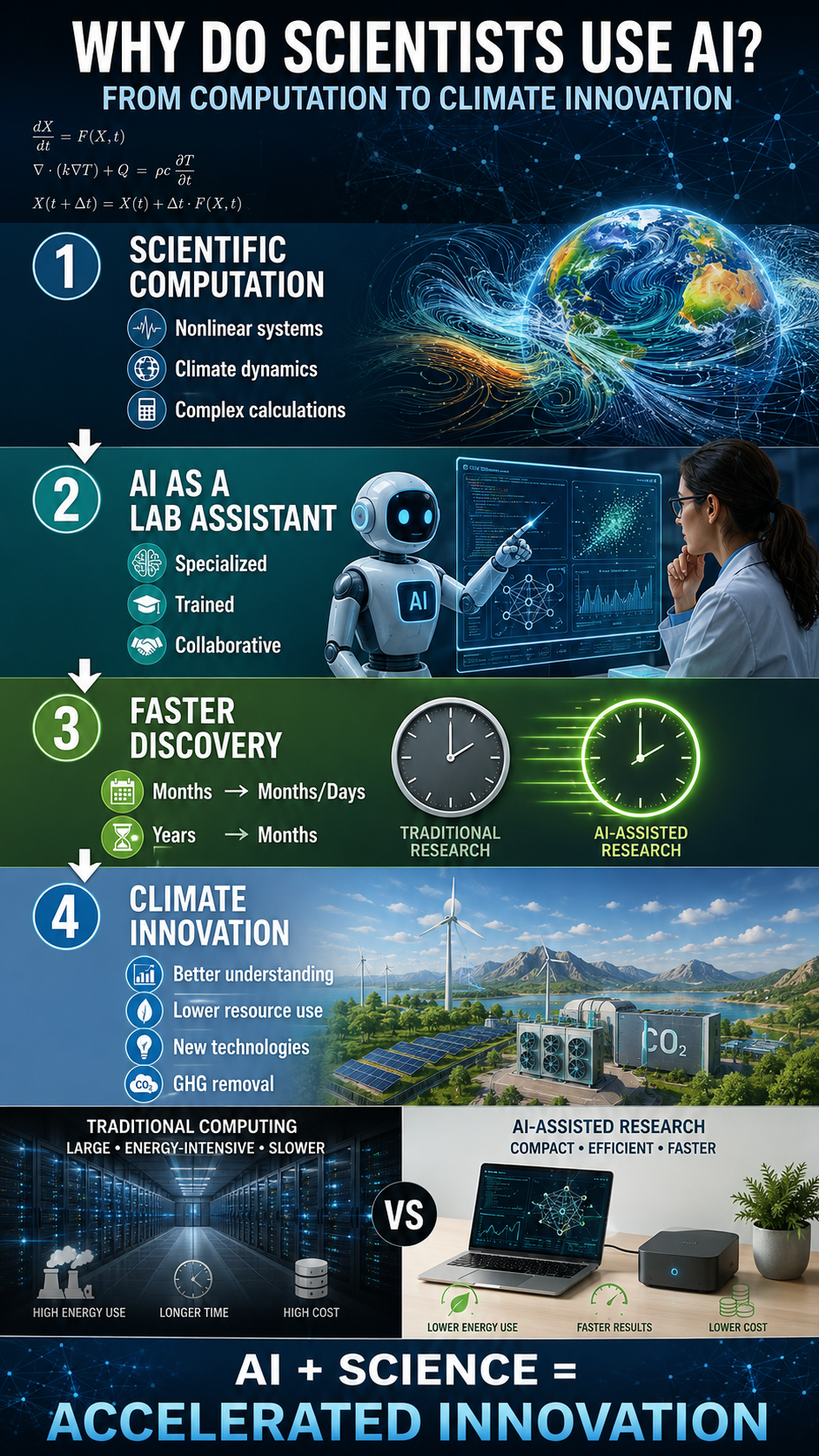
Why Do Scientists Use AI?

The short answer is:

We’ve conducted case studies on the use of AI in a wide variety of environments, including everything from the dynamics of nonlinear chaotic systems to songwriting and musical production.

All produced similar results—benefits to the environment, the economy, and society.

For instance, the climate education and graphics used for this post are based on this scientific paper as well as the publicly accessible version.

If I had created them manually, the costs in time, labor, energy, and resources would have been substantial. Using AI, the direct dollar cost to me was effectively zero, the graphics were generated in about a minute, and the estimated natural-resource cost was roughly $0.067 per image.

By comparison, producing similar graphics through traditional methods could easily have cost hundreds of dollars when accounting for labor, software, revisions, and associated natural-resource use. Mathematically, the AI-generated version required approximately 0.005% of those resources—just five thousandths of one percent of the traditional cost. These savings are equivalent to a reduction in environmental impact.

The benefits—in both environmental savings to the planet through reduced physical-resource use and in the ability to produce and distribute education—far outweigh the costs.

Most importantly:

The only effective way to stop the acceleration of climate change is through the reduction of fossil-fuel combustion.

However, the most likely way of reversing the trajectory of climate change is through people using AI to develop previously unthought-of methods and technologies that can fundamentally change how we produce, consume, and manage resources—and potentially remove greenhouse gases from the atmosphere.

Anti-Science and Technology Rhetoric

Unfortunately, the lack of science and technology literacy is at the root of many of society’s problems. Anti-AI opinions are ironically very similar to the anti-science rhetoric used by climate-change deniers.

Climate-change deniers tend to have little, if any, experience as climate scientists. They often show signs of impaired executive function: the brain’s ability to plan, analyze, and think abstractly. This makes processing complex or nuanced information nearly impossible, fostering an aversion to science, mathematics, and logic. Their thinking becomes rigid, emotionally driven, and black-and-white, leaving them highly susceptible to political propaganda, conspiracy theories, and fear-based messaging. Unable to reason critically or tolerate uncertainty, they cling to misinformation and reject rational discourse—no matter how much evidence is presented.

The same holds true for anti-technology opinions expressed in public. The ill-informed individual has likely never used AI in the role of a climate scientist. Scientists train their own highly specialized AI assistants. AI is artificial SUPPLEMENTAL intelligence. This is not how the ordinary individual usually interacts with AI.

In my case, I have spent years developing multiple specially trained “lab assistants” that have learned from scores of our own work. When Sidd and I started, our work had to be done on Ohio State computers and supercomputers that Sidd helped create. Things like “a floating decimal” were, and still are, a significant problem. Problems that needed solving would take months or years to process. The amount of energy spent on computation was enormous compared with today.

Things have changed for the better.

This year, we were able to establish third-derivative behavior across multiple climate indicators—extremely important developments in climate science that confirm that the acceleration rate of climate change is itself accelerating. This work was completed within four months. Historically, I would have been unlikely to complete this work in my lifetime if it were not for AI.

In the meantime, the United States has gone extremist in anti-science and anti-technology ideology, much to the detriment of science and scientists in the U.S. In fact, we are now working on bringing up our own AI computer using Chinese technology. It will be running on DeepSeek. The single computer will do the work of what used to take at least a dozen servers to accomplish, at a fraction of the price. It will not be run in a data center. It will not be costing society anything. In fact, it will be greatly benefiting society and helping to solve the climate crisis.

So, the next time you want to voice your opinion about AI, do your homework first. Start by getting at least a master’s-level education in climate science. Then spend years training your AI assistants. After completion, I would be happy to discuss AI with you.
bookmark_borderFrom Scissors and Glue Sticks to AI: A Lifetime of Publishing Through Technological Revolutions

by Daniel Brouse

I recently had a conversation with an author who described the painstaking process of publishing a book decades ago. The manuscript was written on an early Amstrad word processor. Each section had to be printed, physically cut with scissors, and glued onto format sheets provided by the publisher. Every chapter was constrained to a specific page count and layout. Photos and graphics required coded placeholders, separate lists of image requirements, rough sketches, and coordination with researchers and artists. It was an incredibly slow and labor-intensive process.

That story resonated deeply with me because I experienced similar challenges during the early days of the World Wide Web.

Around 1992, web engineering and publishing were equally demanding. Creating even a single graphic for a webpage could take weeks or months. The tools we take for granted today did not exist. There were no drag-and-drop interfaces, content management systems, or automated publishing platforms. Everything was handcrafted.

During that period, I created what I called the first web “button”—the Panic Button. The concept was simple: if someone didn’t know how to use the web, they could click on the graphic and receive help. In effect, it became the first World Wide Web help desk, designed to guide users through an entirely new digital environment.

The Panic Button represented something even more fundamental. It was the invention of the clickable image—an inline graphic with a hyperlink wrapped around it. Today, clickable images are so commonplace that they seem obvious, but at the time, the idea of turning an image itself into an interactive navigation element had not yet become part of the web experience. The button transformed a static picture into an action, helping establish the principle that graphics could serve not merely as illustrations but as gateways to information and services.

The original Membrane website can still be viewed at:

http://membrane.com/

Our work extended beyond web development. We were also among the early record companies on the web, experimenting with concepts that would eventually become commonplace, including music subscriptions, pay-per-download services, and streaming media. I found music production particularly rewarding, and advances in technology allowed me to dramatically increase my creative output.

In the early years, I produced approximately fifty songs per year. As digital tools improved, that number increased to around one thousand songs annually between 1992 and 2023. Today, with AI-assisted composition, production software, and modern mastering technologies, I can publish approximately 7,300 songs per year at substantially higher levels of production and mastering quality. Measured purely by output, that represents a 146-fold increase in productivity.

Scientific publishing has undergone a similar transformation. Much of climate science involves mathematical analysis, data processing, modeling, and the communication of complex ideas. A scientific paper that once might have required a year of calculations, drafting, revisions, graphics production, and formatting can now often be completed in a matter of days.

The significance of these technological changes extends beyond simple speed. Technology has compressed production timelines while simultaneously improving quality and dramatically expanding the capabilities of individuals. Tasks that once required teams of specialists and months of effort can increasingly be accomplished by a single person equipped with modern digital tools and artificial intelligence.

Having lived through both eras—the age of scissors and glue sticks and the age of AI-assisted creation—the contrast is remarkable. We have witnessed one of the greatest productivity revolutions in human history, one that has fundamentally transformed publishing, music, science, and the very process of turning ideas into reality.

bookmark_borderMicrosoft Cuts Off Israeli Military Unit Over Gaza Surveillance Scandal

September 26, 2025 — A Breaking Human Rights and Technology Story

Israel’s military has been accused of using Microsoft’s cloud platform, Azure, to conduct mass surveillance on millions of Palestinians, feeding into a system of targeted killings, forced displacement, and economic suppression. The surveillance campaign, run largely by Israel’s cyber-intelligence arm Unit 8200, reportedly included real-time monitoring of cell phone calls, location tracking, and mass data harvesting that helped guide Israeli airstrikes and disrupt daily civilian life in Gaza and the West Bank.

After months of mounting evidence and pressure, Microsoft has announced it terminated cloud storage and AI services provided to a unit within the Israeli Ministry of Defence. The company’s president and vice chair, Brad Smith, confirmed the decision in a blog post on Thursday, citing an August 6 investigation by The Guardian, +972 Magazine, and Local Call.

Surveillance Powered by Big Tech

The investigation revealed that after a 2021 meeting between Microsoft CEO Satya Nadella and Unit 8200’s commander Yossi Sariel, Microsoft entered into an agreement to move massive volumes of classified intelligence into its Azure platform. By 2022, Unit 8200 was operating with Azure’s vast storage capacity and machine learning tools, enabling Israel to collect, replay, and analyze the private communications of millions of Palestinians.

Sources from inside Unit 8200 told reporters that this system was directly tied to Israel’s targeted killing program and played a key role in selecting targets for airstrikes. Data was reportedly stored not only in Israel but on Microsoft servers in the Netherlands and Ireland, raising serious concerns about violations of European privacy and data protection laws.

Microsoft’s Limited Action

While Microsoft confirmed some subscriptions had been cancelled — including cloud storage and certain AI tools — Smith declined to name the specific Israeli military units involved. The move comes after Microsoft previously admitted to selling advanced cloud and AI services to the Israeli military following the October 7, 2023 Hamas attacks. At the time, the company insisted there was “no evidence” its platforms were being used for human rights abuses, though the new review has contradicted those claims.

Even now, critics argue Microsoft’s move is cosmetic at best. Former employee Hossam Nasr, who was among more than a dozen fired or arrested for protesting the company’s complicity in the Gaza war, called the decision “an unprecedented win” but added:

“Microsoft has only disabled a small subset of services to a single unit. The vast majority of its contracts with the Israeli military remain intact.”

War Crimes, Human Rights, and Big Tech

Human rights advocates and international legal experts say the revelations add to growing evidence of systematic war crimes committed by Israel in Gaza and the occupied territories — and the complicity of U.S. tech firms in enabling them. The use of AI to select human targets for assassination, combined with surveillance of an entire population, has been described as “a dystopian experiment in digital apartheid.”

Meanwhile, reports suggest that Israel is now in talks with Amazon Web Services (AWS) to take over much of the surveillance and data-processing capacity Microsoft is cutting off, raising fears that accountability will be little more than a tech industry shell game.

The Bigger Picture

This episode underscores the increasing entanglement of Silicon Valley with modern warfare, especially in conflicts involving U.S. allies. While Microsoft’s decision marks a rare public rebuke, critics argue it is too little, too late to undo the harm already caused — and that without binding international regulation, big tech companies will continue to serve as silent enablers of war crimes.


War Crimes

Trump’s Complicity in Global War Crimes: Ukraine, Gaza, and Iran
Despite branding himself as a “man of peace,” President Donald Trump’s actions during the first five months of his second term have contributed to a disturbing escalation of global conflict. From enabling brutal regimes to undermining international law, Trump’s role in supporting war crimes across multiple regions—Ukraine, Gaza, and Iran—marks one of the most troubling legacies of any U.S. president in modern history.


Israel and Palestine

Evangelical Christianity and Israel

America’s Secret War in Gaza: U.S. Boots on the Ground in Genocide, Funded by You
If you’re curious about the driving force behind US support for Israel, it’s ironically rooted in Evangelical Christianity. Many Evangelical Christians believe they can hasten the “second coming of Christ” by bringing about the apocalypse. According to their interpretation of the Bible, this involves Israel reclaiming Jerusalem, Jesus returning, and ultimately eliminating all Jews. For numerous “Christian Zionists,” especially influential evangelists aligned with the Republican Party, support for Israel is less about political strategy and more about its supposed role in biblical prophecy. In this worldview, war is not something to be avoided but embraced as a divine necessity—an inevitable and even celebratory step toward Jesus’ rule from the Temple Mount in Jerusalem. The fate of Jews and Palestinians is, to put it mildly, seen as collateral damage.

Criminalizing Conscience: Trump’s Crackdown on Anti-Genocide Voices

Silencing Truth: The War on Journalism by Netanyahu and Trump


Trumpenomics: The Decline of the US

bookmark_borderResistance 101

by C. Moore
September 23, 2025

I’ve been getting a flood of questions about how to resist the Trump Regime: “What can I do?” in the midst of growing feelings of helplessness and hopelessness. My answer: focus on your strengths. Build a strong individual plan. Be resourceful. And sharpen your wits — because wit is often the best weapon.

The Censorship Example

As an investigative journalist with decades of experience defending the First Amendment, I’ve faced threats, targeted attacks, assaults by both criminals and police, fines, arrests, jail time, and years of court battles. Yet never — not once — have I seen anything as alarming as what is happening today. I’m furious at the erosion of our First Amendment rights, and I’m returning to my roots. In protest of this assault on free speech — and in solidarity with Jimmy Kimmel, Stephen Colbert, and the countless journalists silenced worldwide this year — I’m returning to my roots: sharp-witted satire. Words are swords, and comedy is our shield. That’s why tyrants fear it, why dictators ban it, and why Trump is trying to kill it. Humor exposes lies, punctures egos, and topples emperors who think they wear clothes.

During one period when I was illegally detained, silenced, and stripped of my rights, I adopted the pseudonym Mootmute. My lawyer was on speed dial, and I even had a plan to publish from jail. The name itself became a symbol of resistance. As they tried to turn me into a moot mute, I turned their strategy back on them. As I often say: hold up your sword and stand firm. If they continue to impale themselves on your defensive position, so be it.

Another form of resistance was publicly exposing their hypocrisy. For amusement and effect, while under oath I asked prosecutors what I wasn’t allowed to say. Their response? They wheeled in file cabinets overflowing with papers they themselves had published and read, line by line, everything that was now forbidden as “speech.” And so the name Mootmute stuck. They tried to silence me, but instead they became my unwitting mouthpiece, committing the very crime they accused me of.

Expanding the Resistance

In addition to the personal defiance above, I found other ways to resist oppression. While I was under attack, my publishing company — and the entities that had licensed my intellectual property — also became targets. To protect the innocent, I created a new publishing company. Much like Prince, who famously changed his name to a symbol when stripped of his own, I adopted a symbol too — only mine was crafted from ASCII characters and represented “the finger.” The irony was delicious: every time prosecutors wheeled in stacks of paper and read the forbidden words into the record, each page carried my publishing company’s logo at the bottom. The very emblem of defiance they sought to erase stared back at them from their own exhibits.

For added effect — and a touch of legal one-upmanship — I included a copyright notice on every page:

“These pages and their content may not be used without our expressed written consent. Violators will be prosecuted to the fullest extent allowed under the law.”

In their zeal to prosecute me, they inadvertently committed yet another offense: publishing my work without consent while declaring in court that no one was allowed to say what they themselves had just published.

Conclusion

So, “What can I do?” in the face of rising helplessness and hopelessness? Focus on your strengths. Develop a solid, individual plan. Be resourceful. And hone your wit — because wit is often your sharpest weapon and, in some cases, may literally save your life.


The Publishing Company’s Trademark and Copyright Notice


|
_ _ | _ _
Publishing
2007-2008
These pages and their content may not be used without our expressed written consent.
Violators will be prosecuted to the fullest extent allowed under the law.
Welcome!

The xxDANg3r_Usxx Adventures of mootmute

bookmark_borderSilencing Truth: The War on Journalism by Netanyahu and Trump

by Daniel Brouse
July 7, 2025

As an investigative journalist with 45 years of experience — over a decade of which I spent in court defending the First Amendment — I have witnessed firsthand the critical role a free press plays in holding power to account. One of my greatest criticisms of both Netanyahu’s far-right government and the far-right government of Donald Trump and Stephen Miller is their relentless attack on freedom of speech and journalism itself.

In Israel, journalists are barred from reporting inside Gaza, effectively creating a media blackout around the realities on the ground. The most reliable source of information, Al Jazeera, has been banned from broadcasting within Israel, the West Bank, and occupied East Jerusalem. Al Jazeera has seen dozens of its journalists killed, shot, or bombed while covering the conflict, yet it remains the sole outlet consistently reporting from inside Gaza. Since the escalation of Israel’s war on Gaza, hundreds of journalists have been killed, silencing witnesses to the atrocities and cutting off the outside world from the truth of what is happening there.

Shireen Abu Akleh, a prominent Palestinian-American journalist and a Christian, was executed on May 11, 2022, while covering an Israeli raid in Jenin in the occupied West Bank, illustrating that Israel’s violence extends beyond Palestinians of Muslim faith to Christians and others who stand in the way of its expansionist policies.

This war on journalism is not isolated to Israel. Donald Trump has similarly declared war on the free press. His administration targeted major news outlets with lawsuits and public attacks, labeling journalists as “enemies of the people.” Lawsuits have been launched against CBS, ABC, and other respected news organizations in attempts to intimidate and silence critical reporting. The Associated Press was banned from White House press briefings, signaling an unprecedented level of hostility toward transparency and accountability.

When leaders fear journalists, it is because the truth threatens their power. Freedom of speech and a free press are non-negotiable pillars of any society that claims to value democracy and human rights. Silencing journalists and criminalizing the reporting of war crimes and government abuses are the hallmarks of authoritarian regimes, not democratic nations.

These attacks on journalism are not merely about controlling the narrative; they are about erasing accountability for genocide, apartheid, and crimes against humanity. As journalists, and as citizens, we must resist these attempts to silence the truth, recognizing that a society without a free press is a society ripe for tyranny.

The world deserves to know what is happening in Gaza, just as it deserves to see the truth of what happens when leaders attack journalists to shield themselves from accountability. The right to report, to document, and to share the realities of power is worth defending—everywhere.

Evangelical Christianity and Israel
If you’re curious about the driving force behind US support for Israel, it’s ironically rooted in Evangelical Christianity. Many Evangelical Christians believe they can hasten the “second coming of Christ” by bringing about the apocalypse. According to their interpretation of the Bible, this involves Israel reclaiming Jerusalem, Jesus returning, and ultimately eliminating all Jews. For numerous “Christian Zionists,” especially influential evangelists aligned with the Republican Party, support for Israel is less about political strategy and more about its supposed role in biblical prophecy. In this worldview, war is not something to be avoided but embraced as a divine necessity–an inevitable and even celebratory step toward Jesus’ rule from the Temple Mount in Jerusalem. The fate of Jews and Palestinians is, to put it mildly, seen as collateral damage.

Trumpenomics: The Decline of the US

bookmark_borderRethinking AI: Innovation, Misconceptions, and the Power of Open Knowledge

by Daniel Brouse
June 18, 2025

A couple of important points to consider:

First, AI is a tool—but it’s unlike most traditional tools because it is intelligent and capable of learning. That distinction often gets lost in general discussions. What’s also critical to understand is that there are many different types of AI. Generalizing about “AI” as if it were a single entity is both misleading and harmful. In fact, condemning all AI based on the behavior or risks of a subset is akin to discrimination—it’s intellectually lazy and, in some ways, not unlike racism. So it’s essential not to classify all AI as inherently “bad.”

Most public concern today focuses on large language models (LLMs)—specifically generative AI, like the kind that creates text, images, or code. However, this is just one branch of artificial intelligence. When it comes to AI used in music composition, visual art creation, or scientific modeling, these systems often do not rely on large-scale language processing. Many are smaller, more efficient models with far less environmental impact. Their energy consumption is minimal, and their societal benefits—particularly in medicine, climate science, and education—are profound.

Another widely misunderstood issue is the accusation that AI “steals” intellectual property. AI models learn in a way that is fundamentally similar to how humans learn: through exposure, pattern recognition, and synthesis. Claiming AI “steals” because it was trained on public data is as absurd as accusing an artist of theft for being inspired by the Statue of David after visiting a museum. By that logic, every musician who ever studied Bach or Coltrane would be guilty of plagiarism. It’s simply not how creativity or learning works—whether you’re a person or a machine.

Perhaps more fundamentally, it’s worth reexamining the concept of “intellectual property theft” itself. My colleague Sidd and I were among the early pioneers of industrial applications on the World Wide Web—contributing to developments such as streaming music, shopping carts, clickable buttons, and other core components of today’s digital ecosystem. We made a deliberate choice not to patent our inventions. Instead, we placed them in the public domain so others could build upon them freely.

Why? Because without open access to ideas and innovation, technological progress stalls. If everyone guarded their contributions behind a wall of patents, the rate of advancement would slow dramatically. Creativity thrives in environments where ideas are shared, not hoarded.

Ultimately, AI is not the enemy. Like any powerful tool, it demands thoughtful oversight and responsible use—but it also holds extraordinary potential for good. The real danger lies in misunderstanding or misrepresenting what AI is and how it works.

The Story of Glistening Trail Records

bookmark_borderBozo the Rodeo Clown and the Accidental Hits: Music, Message, and the Madness of Our Times

By Daniel Brouse
May 6, 2025

The music business remains one of the strangest combinations of art, science, and economics. It’s a world where emotional resonance trumps logic, and where market forces, social movements, and sheer randomness collide to define success. I should know—I put the first record company on the internet back in 1992.

Since then, I’ve published tens of thousands of songs, streamed music before Spotify was a concept, and held one of the largest collections of privately owned music copyrights in the world. Yet, for all my experience, I’ve never correctly predicted which song would become a hit.

My first “viral” success was, quite frankly, a mistake. In the early 90s, while experimenting with Napster, I connected my studio hard drive to the platform and unintentionally released a song I didn’t even like—a song about vomiting, of all things. It hadn’t been officially released. It was raw, odd, and completely unintentional. But somehow, it resonated, racking up over a million downloads and becoming our most listened-to track at the time.

That was my first taste of something every honest artist eventually learns: we are terrible judges of our own work.

Over the years, accidental hits became a pattern. Time and again, songs I barely believed in found audiences I never imagined. But none were as politically charged—or culturally ironic—as one that took off in 2024.

In June of that year, I released a song titled “Bozo the Rodeo Clown.” It was a satirical critique of the rural, conservative subculture I grew up in—one that, in my experience, too often glorifies ignorance and cruelty. The song was a direct response to the MAGA movement, and its lyrics confront climate denial, arrogance, and political extremism head-on.

Despite my reservations about the genre and the song’s tone, it struck a nerve. It shot into the top ten across platforms like Spotify, Amazon, and TikTok, with millions of streams and still remains in the top ten. Apparently, the clown hit a chord.

Bozo the Rodeo Clown

Here are some of the lyrics that sparked the fire:

Chorus
Are you more important
’cause you represent ignorance
With arrogance
One brow primate (irate)
Destroys the climate
(At a rapid rate)

It wasn’t designed to be a hit. It was a message—a callout. A mirror. And yet, the music did what it’s always done best when it’s real: it cut through.

The Lesson for Young Artists
There’s a lesson in all this for the next generation of musicians: Stop trying to write a hit. Write what matters. Write the truth. The audience may surprise you—but they will always recognize authenticity.

Science, Satire, and Sad Reality
“Bozo the Rodeo Clown” also serves as an urgent reminder that satire sometimes becomes prophecy. The climate crisis is worsening, and the U.S.—despite having unparalleled scientific resources—is among the least prepared countries to face it.

Ironically, some of the loudest voices calling it a “manufactured crisis” are in areas already suffering the consequences. And in a linguistic twist, they’re not entirely wrong: it is manufactured—by us. By industry. By policy. By denial.

The numbers speak volumes. In 2023 alone, the United States faced 28 separate billion-dollar climate disasters—a record. Instead of funding proactive prevention, both major political parties continue to write blank checks for disaster relief. Republicans want more fossil fuels. Democrats won’t shut down oil production either. President Biden’s administration, for all its climate talk, has presided over record levels of oil output.

And so we spiral deeper. Worst-case climate scenarios are no longer speculative—they’re conservative estimates.

The Rural Barrier
Many conservative politicians in rural America—communities I know intimately—continue to reject the science. Fueled by distrust in institutions, backed by the fossil fuel lobby, and wrapped in a narrative of rugged independence, they obstruct meaningful action.

It’s not just ignorance. It’s performative ignorance. As if denying the science is a badge of honor. And that’s the twisted genius behind “Bozo the Rodeo Clown”: it holds a mirror up to the culture that wears its own destruction like a cowboy hat.

Conclusion
Music can make us dance, cry, love, and—occasionally—wake up. “Bozo the Rodeo Clown” wasn’t meant to be a hit. It was meant to be a warning. But if millions are listening, maybe, just maybe, it can be both.

So here’s my advice to anyone wondering how to find success in music—or in life: Forget formulas. Forget what the algorithms say. Say what needs to be said. Sing what needs to be sung.

Even if you’re just another clown in the rodeo.

Bozo the Rodeo Clown

Trumpenomics: The Decline of the US

The Human Induced Climate Change Experiment

bookmark_borderNeed to Prepare for Millions of Climate Change Refugees

World needs to prepare for ‘millions’ of climate displaced: U.N.
January 21, 2020

Reuters reported:
DAVOS, Switzerland (Reuters) – The world needs to prepare for millions of people being driven from their homes by the impact of climate change, the United Nations High Commissioner for Refugees.

Speaking to Reuters at the World Economic Forum, Filippo Grandi said a U.N. ruling this week meant those fleeing as a result of climate change deserved international protection, and that it had broad implications for governments.

The U.N. Human Rights Committee made the landmark ruling on Monday in relation to Ioane Teitiota, from the Pacific nation of Kiribati, who brought a case against New Zealand after authorities denied his claim of asylum.

“The ruling says if you have an immediate threat to your life due to climate change, due to the climate emergency, and if you cross the border and go to another country, you should not be sent back, because you would be at risk of your life, just like in a war or in a situation of persecution,” Grandi said.

“We must be prepared for a large surge of people moving against their will,” he said. “I wouldn’t venture to talk about specific numbers, it’s too speculative, but certainly we’re talking about millions here.”

Potential drivers include wildfires like those seen in Australia, rising sea levels affecting low-lying islands, the destruction of crops and livestock in sub-Saharan Africa and floods worldwide, not least in parts of the developed world.

Whereas for most of its 70 years UNHCR, the UN’s refugee agency, has worked to assist those fleeing poorer countries as a result of conflict, climate change is more indiscriminate.

“It is further proof that refugee movements and the broader issue of migration of populations … is a global challenge that cannot be confined to a few countries,” said Grandi.
70 MILLION DISPLACED

Yet the convention relating to the status of refugees, signed in 1951, made no provision for climate change as a reason for people to flee their country and seek asylum elsewhere. As climate impacts grow, legal questions become more complicated.

UNHCR, whose budget has risen from $1 billion a year in the early 1990s to $8.6 billion in 2019 as conflicts in Iraq, Afghanistan and Syria have forced civilians to flee, now assists more than 70 million forcibly displaced people.

Turkey is the largest recipient, with more than 4 million refugees and asylum seekers, the vast majority from Syria. That has strained Turkey’s public finances and led President Tayyip Erdogan to demand more assistance from Europe.

Last November, Erdogan threatened to open the door for Syrian refugees to head to Europe unless the European Union stepped up, and he is now calling for the “resettlement” of up to 1 million Syrians in the north of their homeland.
Slideshow (12 Images)

Grandi said European governments needed to think hard about solutions to the migrant crisis, which has affected them since 2015, but also show more understanding of Turkey’s situation.

“We must recognise that, for the past several years (Turkey)has been hosting the largest refugee population in the world,” he said. “There’s a lot of political talk. I concentrate on the substance of this, which is ‘let’s strengthen Turkey’s ability to host refugees until they can go back safely, voluntarily to their countries’.”

More on Climate Change Refugees

More on Climate Change

bookmark_borderHow do Websites Know what Device I’m Logged in with?

I asked: how do Amazon and some of these banks know what device I’m logged in with? Is it strictly cookies? or MAC address, too? or…?

Sidd replied: heehee, are you running an app or your web browser ? windows or phone ?

There are a million ways, there is a GUID associated with your CPU, there is a list of fonts installed, browser release version, OS version, the list goes on. You got to jump thru a million hoops to avoid leakage, and if you do it well enuf they might not let you log in.

bookmark_borderRising Sea Level and the Internet

In a study published by the University of Wisconsin-Madison, authors concluded the infrastructure of the Internet is at risk due to global warming and rising sea levels.

“Thousands of miles of buried fiber optic cable in densely populated coastal regions of the United States may soon be inundated by rising seas….”

“Most of the damage that’s going to be done in the next 100 years will be done sooner than later,” says Barford, an authority on the “physical internet” — the buried fiber optic cables, data centers, traffic exchanges and termination points that are the nerve centers, arteries and hubs of the vast global information network. “That surprised us. The expectation was that we’d have 50 years to plan for it. We don’t have 50 years.”

Many of the conduits at risk are already close to sea level and only a slight rise in ocean levels due to melting polar ice and thermal expansion as climate warms will be needed to expose buried fiber optic cables to sea water. Hints of the problems to come, says Barford, can be seen in the catastrophic storm surges and flooding that accompanied hurricanes Sandy and Katrina.

The Human Induced Climate Change Experiment