bookmark_borderNeed to Prepare for Millions of Climate Change Refugees

World needs to prepare for ‘millions’ of climate displaced: U.N.
January 21, 2020

Reuters reported:
DAVOS, Switzerland (Reuters) – The world needs to prepare for millions of people being driven from their homes by the impact of climate change, the United Nations High Commissioner for Refugees.

Speaking to Reuters at the World Economic Forum, Filippo Grandi said a U.N. ruling this week meant those fleeing as a result of climate change deserved international protection, and that it had broad implications for governments.

The U.N. Human Rights Committee made the landmark ruling on Monday in relation to Ioane Teitiota, from the Pacific nation of Kiribati, who brought a case against New Zealand after authorities denied his claim of asylum.

“The ruling says if you have an immediate threat to your life due to climate change, due to the climate emergency, and if you cross the border and go to another country, you should not be sent back, because you would be at risk of your life, just like in a war or in a situation of persecution,” Grandi said.

“We must be prepared for a large surge of people moving against their will,” he said. “I wouldn’t venture to talk about specific numbers, it’s too speculative, but certainly we’re talking about millions here.”

Potential drivers include wildfires like those seen in Australia, rising sea levels affecting low-lying islands, the destruction of crops and livestock in sub-Saharan Africa and floods worldwide, not least in parts of the developed world.

Whereas for most of its 70 years UNHCR, the UN’s refugee agency, has worked to assist those fleeing poorer countries as a result of conflict, climate change is more indiscriminate.

“It is further proof that refugee movements and the broader issue of migration of populations … is a global challenge that cannot be confined to a few countries,” said Grandi.
70 MILLION DISPLACED

Yet the convention relating to the status of refugees, signed in 1951, made no provision for climate change as a reason for people to flee their country and seek asylum elsewhere. As climate impacts grow, legal questions become more complicated.

UNHCR, whose budget has risen from $1 billion a year in the early 1990s to $8.6 billion in 2019 as conflicts in Iraq, Afghanistan and Syria have forced civilians to flee, now assists more than 70 million forcibly displaced people.

Turkey is the largest recipient, with more than 4 million refugees and asylum seekers, the vast majority from Syria. That has strained Turkey’s public finances and led President Tayyip Erdogan to demand more assistance from Europe.

Last November, Erdogan threatened to open the door for Syrian refugees to head to Europe unless the European Union stepped up, and he is now calling for the “resettlement” of up to 1 million Syrians in the north of their homeland.
Slideshow (12 Images)

Grandi said European governments needed to think hard about solutions to the migrant crisis, which has affected them since 2015, but also show more understanding of Turkey’s situation.

“We must recognise that, for the past several years (Turkey)has been hosting the largest refugee population in the world,” he said. “There’s a lot of political talk. I concentrate on the substance of this, which is ‘let’s strengthen Turkey’s ability to host refugees until they can go back safely, voluntarily to their countries’.”
More on Climate Change Refugees

More on Climate Change

bookmark_borderClimate-related Health Risks

The World Health Organization calls for stronger action on climate-related health risks:

“The evidence is overwhelming: climate change endangers human health,” says Dr Margaret Chan, WHO Director-General. “Solutions exist and we need to act decisively to change this trajectory.”

Previously unrecognized health benefits could be realized from fast action to reduce climate change and its consequences. For example, changes in energy and transport policies could save millions of lives annually from diseases caused by high levels of air pollution. The right energy and transport policies could also reduce the burden of disease associated with physical inactivity and traffic injury.

Measures to adapt to climate change could also save lives around the world by ensuring that communities are better prepared to deal with the impact of heat, extreme weather, infectious disease and food insecurity.

Cholera, malaria and dengue highly sensitive to weather and climate

WHO and its partners highlight the importance of acting now to help protect health in the present as well as the future. The health community is working hard to improve its capacity for surveillance and control of infectious diseases such as cholera, malaria and dengue, which are highly sensitive to weather and climate.

Climate change is already causing tens of thousands of deaths every year from shifting patterns of disease, from extreme weather events, such as heat-waves and floods, and from the degradation of water supplies, sanitation, and impacts on agriculture, according to the most recent WHO data.

“Vulnerable populations, the poor, the disadvantaged and children are among those suffering the greatest burden of climate-related impacts and consequent diseases, such as malaria, diarrhoea and malnutrition, which already kill millions every year”, notes Dr Flavia Bustreo, WHO Assistant Director-General, Family, Women’s and Children’s Health. “Without effective action to mitigate and adapt to the adverse effects of climate change on health, society will face one of its most serious health challenges,” she says.

“But the good news is that reducing climate change can yield substantial and immediate health benefits” says Dr Maria Neira, WHO Director, Department of Public Health, Environmental and Social Determinants of Health. “The most powerful example is air pollution, which in 2012 was responsible for 7 million deaths – one in eight of all deaths worldwide. There is now solid evidence that mitigating climate change can greatly reduce this toll,” she adds.

bookmark_borderWinter Storm Battering Mid-Atlantic and New England

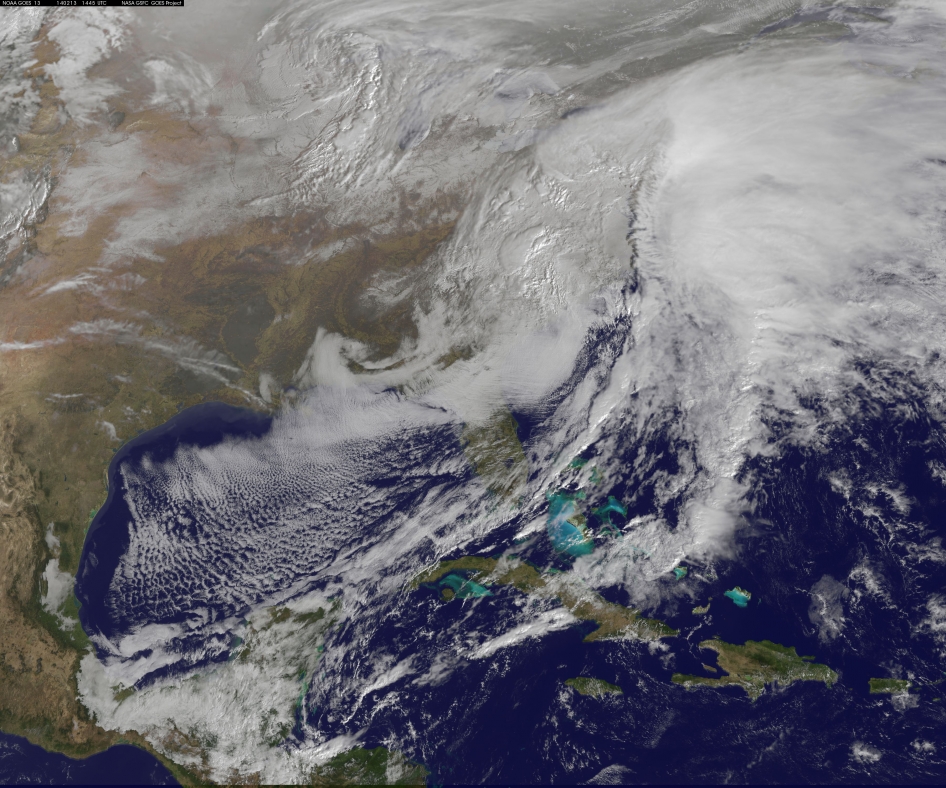
This visible image of the winter storm over the U.S. south and East Coast was taken by NOAA's GOES-13 satellite on Feb. 13 at 1455 UTC/9:45 a.m. EST. Snow covered ground can be seen over the Great Lakes region and Ohio Valley. Image Credit:  NASA/NOAA GOES Project
This visible image of the winter storm over the U.S. south and East Coast was taken by NOAA’s GOES-13 satellite on Feb. 13 at 1455 UTC/9:45 a.m. EST. Snow covered ground can be seen over the Great Lakes region and Ohio Valley. Image Credit: NASA/NOAA GOES Project

NASA — The monster winter storm that brought icing to the U.S. southeast moved northward along the Eastern Seaboard and brought snow, sleet and rain from the Mid-Atlantic to New England on February 13. A new image from NOAA’s GOES satellite showed clouds associated with the massive winter storm stretch from the U.S. southeast to the northeast.

Data from NOAA’s GOES-East satellite taken on Feb. 13 at 1455 UTC/9:45 a.m. EST were made into an image by NASA/NOAA’s GOES Project at NASA’s Goddard Space Flight Center in Greenbelt, Md. The clouds and fallen snow data from NOAA’s GOES-East satellite were overlaid on a true-color image of land and ocean created by data from the Moderate Resolution Imaging Spectroradiometer or MODIS instrument that flies aboard NASA’s Aqua and Terra satellites.The image showed that the clouds associated with the storm were blanketing much of the U.S. East Coast.

At 3:11 a.m. EST, a surface map issued by the National Weather Service or NWS showed the storm’s low pressure area was centered over eastern North Carolina. Since then, the low has continued to track north along the eastern seaboard. By 11 a.m. EST, precipitation from the storm was falling from South Carolina to Maine, according to National Weather Service radar.

By 11 a.m. EST, the Washington, D.C. region snow and sleet totals ranged from 3″ in far eastern Maryland to over 18″ in the northern and western suburbs in Maryland and Virginia. NWS reported that snow, sleet and rain were still falling and more snow is expected as the back side of the low moves into the region.

The New York City region remained under an NWS Winter Storm Warning until 6 a.m. on Friday, February 14 and the National Weather Service expects minor coastal impacts Thursday into Friday afternoon.

New England was also being battered by the storm. At 10:56 a.m. EST, Barnstable, Mass. on Cape Cod was experiencing rain and winds gusting to 28 mph. An NWS wind advisory is in effect for Cape Cod until 7 p.m. EST.

Further north, Portland, Maine was experiencing heavy snow with winds from the northeast at 6 mph. The National Weather Service in Gray, Maine noted “Significant snowfall is likely for much of western Maine and New Hampshire as this storm passes by. There will be a mix or changeover to sleet and freezing rain over southern and coastal sections tonight…before all areas end as a period of snow Friday (Feb. 14) morning.”

On February 13 at 10 a.m. EST, NOAA’s National Weather Service noted “An abundance of Atlantic moisture getting wrapped into the storm will continue to fuel widespread precipitation…which should lift through the Mid-Atlantic States and Northeast Thursday into Friday. A wide swath of heavy snow accumulations are expected with this storm…but air [moving] off the warmer ocean water should change snow over to rain along the coastal areas. Also…a narrow axis of sleet and freezing rain will be possible within the transition zone…which is expected to set up near the I-95 corridor.” For updates on local forecasts, watches and warnings, visit NOAA’s www.weather.gov webpage.

GOES satellites provide the kind of continuous monitoring necessary for intensive data analysis. Geostationary describes an orbit in which a satellite is always in the same position with respect to the rotating Earth. This allows GOES to hover continuously over one position on Earth’s surface, appearing stationary. As a result, GOES provide a constant vigil for the atmospheric “triggers” for severe weather conditions such as tornadoes, flash floods, hail storms and hurricanes.

For updated information about the storm system, visit NOAA’s WPC website: http://www.hpc.ncep.noaa.gov/

bookmark_borderClimate Change in the United States

The U.S. Environmental Protection Agency says:

The Earth’s climate is changing. Temperatures are rising, snow and rainfall patterns are shifting, and more extreme climate events—like heavy rainstorms and record high temperatures—are already affecting society and ecosystems. Scientists are confident that many of the observed changes in the climate can be linked to the increase in greenhouse gases in the atmosphere, caused largely by people burning fossil fuels to generate electricity, heat and cool buildings, and power vehicles.

EPA is working with many other organizations to better understand the causes and effects of climate change. With help from these partners, EPA has compiled a set of 26 indicators tracking signs of climate change. Most of these indicators focus on the United States, but some include global trends to provide context or a basis for comparison. These indicators represent a selected set of key climate change measurements, and are not an exhaustive group of all climate change indicators. EPA’s indicators are based on peer-reviewed data from various government agencies, academic institutions, and other organizations. EPA selected these indicators based on the quality of the data and other criteria.

EPA published these indicators in a comprehensive report in December 2012. Indicators will be updated periodically on the Web as newer data become available.

Use this site to learn more about EPA’s indicators related to greenhouse gases, weather and climate, oceans, snow and ice, and society and ecosystems.

bookmark_borderBelief in Anthropogenic Climate Change

From the American Meteorological Society

A series of polls provides new tests for how weather influences public beliefs about climate change. Statewide data from 5000 random-sample telephone interviews conducted on 99 days over 2.5 yr (2010–12) are merged with temperature and precipitation indicators derived from U.S. Historical Climatology Network (USHCN) station records. The surveys carry a question designed around scientific consensus statements that climate change is happening now, caused mainly by human activities. Alternatively, respondents can state that climate change is not happening, or that it is happening but mainly for natural reasons. Belief that humans are changing the climate is predicted by temperature anomalies on the interview day and the previous day, controlling for season, survey, and individual characteristics. Temperature effects concentrate among one subgroup, however: individuals who identify themselves as independent, rather than aligned with a political party. Interviewed on unseasonably warm days, independents tend to agree with the scientific consensus regarding anthropogenic climate change. On unseasonably cool days, they tend not to agree. Although temperature effects are sharpest for just a 2-day window, positive effects are seen for longer windows as well. As future climate change shifts the distribution of anomalies and extremes, this will first affect beliefs among unaligned voters.