bookmark_borderScientists Using AI: From Computational Efficiency to Climate Innovation

by Daniel Brouse and Sidd Mukherjee

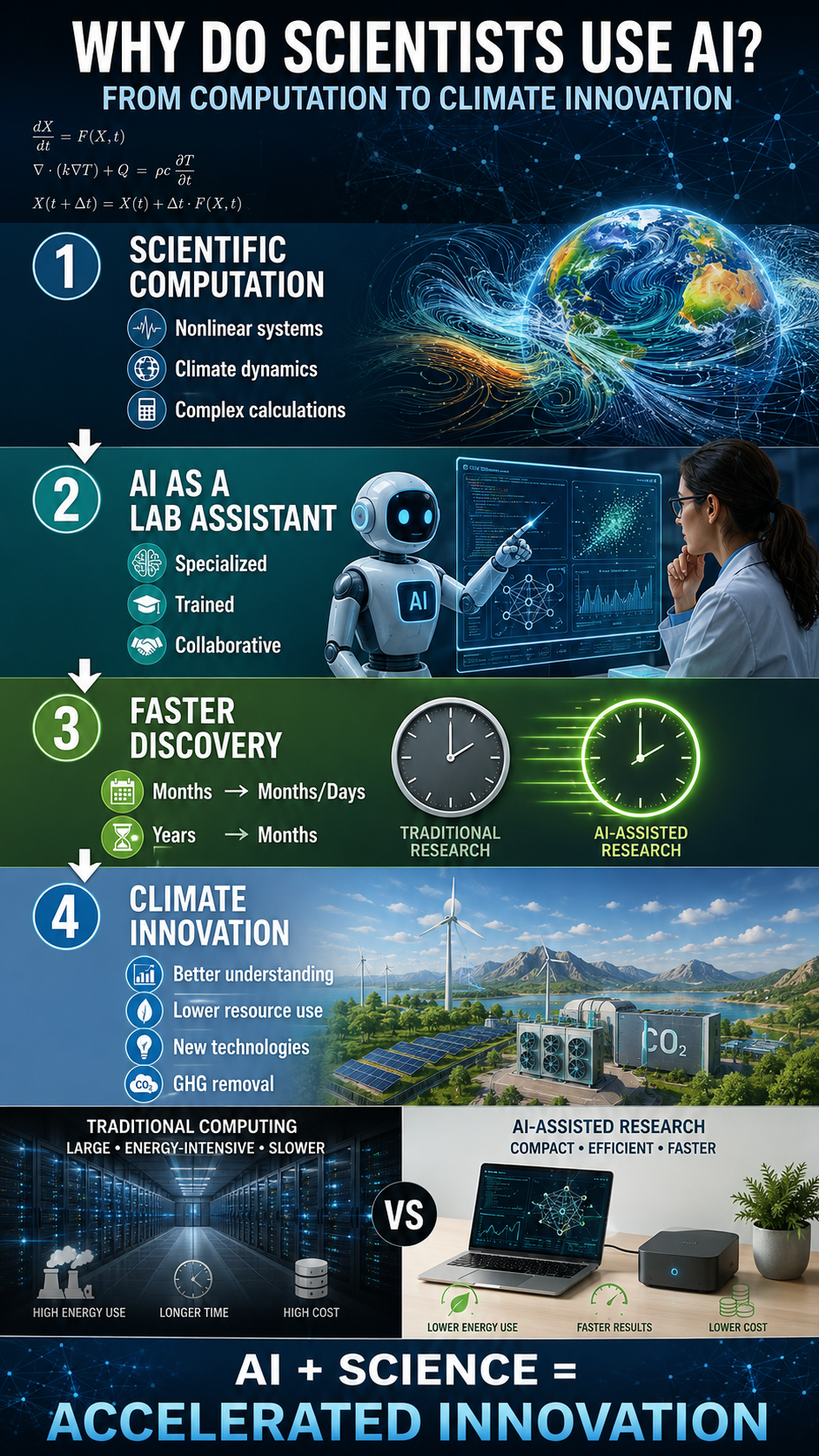
Why Do Scientists Use AI?

The short answer is:

We’ve conducted case studies on the use of AI in a wide variety of environments, including everything from the dynamics of nonlinear chaotic systems to songwriting and musical production.

All produced similar results—benefits to the environment, the economy, and society.

For instance, the climate education and graphics used for this post are based on this scientific paper as well as the publicly accessible version.

If I had created them manually, the costs in time, labor, energy, and resources would have been substantial. Using AI, the direct dollar cost to me was effectively zero, the graphics were generated in about a minute, and the estimated natural-resource cost was roughly $0.067 per image.

By comparison, producing similar graphics through traditional methods could easily have cost hundreds of dollars when accounting for labor, software, revisions, and associated natural-resource use. Mathematically, the AI-generated version required approximately 0.005% of those resources—just five thousandths of one percent of the traditional cost. These savings are equivalent to a reduction in environmental impact.

The benefits—in both environmental savings to the planet through reduced physical-resource use and in the ability to produce and distribute education—far outweigh the costs.

Most importantly:

The only effective way to stop the acceleration of climate change is through the reduction of fossil-fuel combustion.

However, the most likely way of reversing the trajectory of climate change is through people using AI to develop previously unthought-of methods and technologies that can fundamentally change how we produce, consume, and manage resources—and potentially remove greenhouse gases from the atmosphere.

Anti-Science and Technology Rhetoric

Unfortunately, the lack of science and technology literacy is at the root of many of society’s problems. Anti-AI opinions are ironically very similar to the anti-science rhetoric used by climate-change deniers.

Climate-change deniers tend to have little, if any, experience as climate scientists. They often show signs of impaired executive function: the brain’s ability to plan, analyze, and think abstractly. This makes processing complex or nuanced information nearly impossible, fostering an aversion to science, mathematics, and logic. Their thinking becomes rigid, emotionally driven, and black-and-white, leaving them highly susceptible to political propaganda, conspiracy theories, and fear-based messaging. Unable to reason critically or tolerate uncertainty, they cling to misinformation and reject rational discourse—no matter how much evidence is presented.

The same holds true for anti-technology opinions expressed in public. The ill-informed individual has likely never used AI in the role of a climate scientist. Scientists train their own highly specialized AI assistants. AI is artificial SUPPLEMENTAL intelligence. This is not how the ordinary individual usually interacts with AI.

In my case, I have spent years developing multiple specially trained “lab assistants” that have learned from scores of our own work. When Sidd and I started, our work had to be done on Ohio State computers and supercomputers that Sidd helped create. Things like “a floating decimal” were, and still are, a significant problem. Problems that needed solving would take months or years to process. The amount of energy spent on computation was enormous compared with today.

Things have changed for the better.

This year, we were able to establish third-derivative behavior across multiple climate indicators—extremely important developments in climate science that confirm that the acceleration rate of climate change is itself accelerating. This work was completed within four months. Historically, I would have been unlikely to complete this work in my lifetime if it were not for AI.

In the meantime, the United States has gone extremist in anti-science and anti-technology ideology, much to the detriment of science and scientists in the U.S. In fact, we are now working on bringing up our own AI computer using Chinese technology. It will be running on DeepSeek. The single computer will do the work of what used to take at least a dozen servers to accomplish, at a fraction of the price. It will not be run in a data center. It will not be costing society anything. In fact, it will be greatly benefiting society and helping to solve the climate crisis.

So, the next time you want to voice your opinion about AI, do your homework first. Start by getting at least a master’s-level education in climate science. Then spend years training your AI assistants. After completion, I would be happy to discuss AI with you.
bookmark_borderInstant Engineering: How AI Shrinks Design Cycles From Weeks to Hours

by Daniel Brouse
December 1, 2025

Today, NVIDIA and Synopsys announced a major expansion of their strategic partnership—backed by a $2 billion equity investment from NVIDIA—to “reimagine engineering and design” through AI, accelerated computing, and advanced digital twin technologies. This collaboration is not just a business deal; it marks the beginning of a fundamental shift in how humanity designs and prototypes everything from microchips to entire industrial systems.

Below is an expanded explanation of what this partnership means, why it matters, and how AI will collapse engineering timelines from weeks to hours.

A New Era in Design: From Atoms to Entire Systems

NVIDIA founder and CEO Jensen Huang framed the partnership around a bold promise:

Engineers will soon be able to simulate and prototype “at unprecedented speed and scale, from atoms to transistors, from chips to complete systems.”

This reflects a transformative leap in engineering capability. Historically, design workflows have been bottlenecked by:

  • Slow simulation cycles
  • Fragmented tools
  • Manual design iteration
  • Limited ability to model complex interactions
  • Long fabrication or prototyping queues

Huang’s emphasis on “fully functional digital twins inside the computer” signifies AI’s role not merely in optimizing the process, but inverting it. Instead of building physical prototypes and testing them, engineers will design, test, break, redesign, and validate entire systems virtually—with physics-accurate fidelity.

What Makes This Acceleration Possible?

1. AI-Driven Generative Design

Generative AI—powered by domain-specific models trained on millions of design patterns—can produce optimized designs automatically.

This includes:

  • Circuit layouts
  • Mechanical components
  • Chip floorplans
  • Thermal and fluid dynamics solutions
  • Integrated system architectures

Traditionally, an engineer might spend a week refining a chip layout.
AI can now produce hundreds of layouts in seconds, rank them, simulate them, and deliver the top candidates for human review.

2. Real-Time Simulation With Accelerated Computing

NVIDIA’s GPUs and Synopsys’s electronic design automation (EDA) tools create an environment where:

  • Electromagnetic simulations
  • Stress/strain analysis
  • Thermal modeling
  • Logic verification
  • Signal integrity testing

…run thousands of times faster than CPU-based workflows.

Design loops that once required overnight compute jobs now run in real time or near-real time.

3. Digital Twins With Full Physical Fidelity

Digital twins are not new, but until recently they suffered from three constraints:

  1. Insufficient compute power
  2. Limited model resolution
  3. Inability to represent real-world physics accurately

NVIDIA’s Omniverse and Synopsys’s design software now integrate to build physically accurate, AI-enhanced twins of:

  • Chips
  • Circuit boards
  • Mechanical assemblies
  • Entire factories
  • Power grids
  • Autonomous systems
  • Data centers

These twins allow engineers to test every design decision before building anything tangible.

How We Go From Weeks to Hours

Below is a breakdown of major stages in engineering and how AI compresses each one.

Stage 1 — Concept Generation

Old timeline: Days to weeks
New timeline: Minutes

AI generates thousands of design variations immediately. Engineers pick the best few to refine.

Stage 2 — Simulation & Validation

Old timeline: Hours to days per simulation
New timeline: Seconds to minutes

Accelerated computing + AI surrogate models reduce simulation time by orders of magnitude.

For example:

  • A fluid-dynamics simulation that used to take 10 hours now runs in under a minute using GPU-enhanced physics ML models.

Stage 3 — Automatic Optimization

Old timeline: Weeks of iterative human tuning
New timeline: Continuous real-time optimization

AI systems automatically tune designs for:

  • Weight reduction
  • Efficiency
  • Heat dissipation
  • Costs
  • Manufacturability
  • Reliability

This used to require entire engineering teams.
Now the system learns constraints and improves itself iteratively.

Stage 4 — Virtual Prototyping & Testing

Old timeline: Physical prototypes built over months
New timeline: Virtual prototypes created instantly

Digital twins allow:

  • Stress tests
  • Failure mode analysis
  • Lifecycle predictions
  • Production cost modeling

—all without lifting a screwdriver.

Stage 5 — Manufacturing Integration

Old timeline: Manual translation into manufacturing specs
New timeline: Automatic export into manufacturing-ready blueprints

CAD → CAM → fabrication workflows become AI-driven and fully synchronized.

Industry Impacts: Beyond Chips

Huang noted that this partnership will affect “industries of all kinds.”
Here’s what that means in practice:

Automotive

Design and validate entire EV platforms virtually before any physical assembly.

Aerospace

Run millions of aerodynamic simulations per day.
AI designs wings, heat shields, internal components.

Semiconductors

Full-stack chip design—from atomic modeling to full SoC layout—done collaboratively by AI systems.

Energy

Design and simulate power grids, microreactors, battery chemistries, and renewable systems at unprecedented scale.

Manufacturing

Create digital factories and optimize production lines before installation.

What This Really Means

Across engineering disciplines, the development timeline is about to collapse:

  • Chips: From 18–24 months → potentially under 6 months
  • Vehicles: From 5–7 years → under 2 years
  • Product prototypes: From weeks → hours
  • Daily design adjustments: From overnight → real time

This is not automation replacing engineers.
It is augmentation at a historic scale—engineers gaining superpowers.

Conclusion: A Step Toward Instant Engineering

The NVIDIA–Synopsys partnership represents the next phase of industrial evolution:
Engineering as a real-time, AI-driven, simulation-native workflow.

With AI generating designs, GPUs simulating them instantly, and digital twins validating entire systems before they physically exist, time becomes the variable engineers no longer worry about.

What previously required weeks of effort will compress to hours, and what demanded entire teams will be attainable by a single engineer working alongside intelligent systems.

This partnership doesn’t just speed up engineering.
It rewrites the physics of productivity.

bookmark_borderAI as a Creative Ally: How Technology Is Helping Artists Thrive

by Daniel Brouse
June 13, 2025

Several companies and artists are now using AI and robotic arms to assist in marble sculpting—not only to increase speed and precision, but also to help prolong their ability to create. Many sculptors and musicians suffer from repetitive motion disorders and other debilitating injuries.

Last year, I developed tendonitis in my shoulder from playing guitar and bass. Fortunately, around the same time, the first practical and accessible AI tool for musicians became available for free. Within three months of incorporating it into my workflow, my shoulder had recovered.

Critics of AI in music are often musicians themselves—but many are simply uninformed. Most have never tried training with a model or practicing alongside one. Can AI do all the creating? Yes. But that’s not how true innovators use it.

For me, AI has significantly improved both my health and my creative output. It’s helped me better capture and record what’s in my head—and in doing so, it’s expanded the very boundaries of what I thought was possible in my art.

60 Minutes recently featured a segment on sculptors who view AI and robotics as valuable tools, and shared their perspectives on whether this technology diminishes the role of the artist.
Watch the segment here.

This article is in response to:
AI… is It Ethical? is It the Future? Can It Be Used for Good? (Jack Brouse, 2025)

KingArthur.com

bookmark_border3D Printer Makes Wrench in Space

OUTER SPACE — What happens if you are on the Space Station and you need a wrench? Just have NASA e-mail it up and print it on the 3D printer.

It is the first time that hardware was e-mailed to space.

Mike Chen, founder of Made In Space (the company behind the 3-D printer) said, “We had overheard ISS Commander Barry Wilmore mention over the radio that he needed one, so we designed one in CAD and sent it up to him faster than a rocket ever could have.”

“The socket wrench we just manufactured is the first object we designed on the ground and sent digitally to space, on the fly.

“It also marks the end of our first experiment — a sequence of 21 prints that together make up the first tools and objects ever manufactured off the surface of the Earth.”

bookmark_borderUnderwater Robotics Competition

Annual competition, sponsored by Marine Advanced Technological Education Center, gives competitors a taste of the real-life capabilities needed to maintain an ocean observing system
by NSF.gov

The Marine Advanced Technology Education (MATE) Center hosted its 12th annual student underwater robotics competition earlier this summer in Federal Way, Wash. The Center is a national partnership of organizations working to improve marine technical education and help prepare the future workforce for ocean occupations.

Headquartered at Monterey Peninsula College, a community college in Monterey, Calif., the MATE Center has been funded as a National Science Foundation (NSF) Advanced Technological Education (ATE) Center of Excellence since 1997.

The student underwater robotics competition challenged this year’s participants to design and build a remotely operated underwater vehicle (ROV) for tasks related to operating and maintaining an ocean observing system, a collection of high-tech instruments above and below the waves that provide around-the-clock information about what’s happening in the ocean.

The challenge was based on work being done at the University of Washington, where researchers are designing an observatory for the ocean floor. The missions assigned to this year’s competitors were designed to simulate many of the things that will have to be done by ROVs during the installation and maintenance of the observatory.

“This was a very challenging mission,” said Jill Zande, associate director and competition coordinator at the MATE Center. “And we found that a number of the students did really well.”

Participants included more than 50 student teams representing middle schools, high schools, home schools, community colleges, universities, after-school clubs, and outreach programs from the U.S., Canada, Venezuela, China, Hong Kong, Singapore, Macao, Taiwan, Saudi Arabia, the UK, Russia, and Egypt.

Competitors’ mission tasks

Student teams piloted their ROVs to complete a variety of underwater mission tasks, prepared and presented an engineering report to a panel of volunteer judges, and created a poster display aimed at the general public.

Students were encouraged to think like entrepreneurs and manage their teams like companies, a process that helps them develop the teamwork, creative thinking, and problem solving skills that are valued in today’s global workplace. Teams were evaluated on the design, construction, and performance of their ROVs; their ability to communicate what they learned; and how they put their knowledge to use in designing and building their ROVs.

Teams competed in either the RANGER or EXPLORER class, depending on the sophistication of their ROVs and the mission requirements. Teams from California won first place in each class. A complete list of winners appears below.

MATE’s impact over its history

With NSF funding, the MATE Center began as an ATE project, and has broadened its mission, expanded its reach and increased its impact over almost 20 years. MATE began with a focus on community colleges, but over time opened up to four-year institutions and high schools. Part of its mission is to develop curricula in marine technology, underwater robotics, marine geospatial technology, career awareness, and ocean observing systems. MATE also offers professional development for high school, college, and university faculty that focuses on a broad array of marine technologies, workplace skills, and pedagogical innovations.

Now an Innovative Technology Experiences for Students and Teachers (ITEST) project, led by Zande, is reaching middle-school students and teachers.

The idea behind MATE’s growth is that the ROV competition can be a means to keep students engaged in science, technology, engineering and mathematics (STEM) subjects and create a pathway to careers in the STEM workforce. Ocean careers cover a broad range of skills, and MATE provides information on its website about the preparation required for more than 50 different careers, from that of able seaman to electrical engineer to ROV technician. There are also listings for jobs and internships.

The pathway from MATE to ocean careers is well-traveled. “We’ve had students snapped up by industry into $60,000 jobs before they’ve finished their associate degree,” said Deidre Sullivan, director and principal investigator for the MATE Center. “When the Deepwater Horizon oil spill happened three years ago, some of people who were operating the ROVs looking at the damage were graduates of the MATE curriculum.”

“MATE has become a magnet for these kinds of skills,” said David Campbell, program director for ATE. “If a student is interested in this kind of career, most community colleges will train students in electronics and depend on their future employers to train them in marine electronics. MATE is one of the few that’s geared toward marine technology.”

Winners of the 2013 ROV competition

There were three top winners in each class, and a host of other awards.

Explorer (Advanced) Class Winners:

In the Explorer class, the overall first place winner was Jesuit High School of Carmichael, Calif. The team also won an award for being safety-conscious.

Memorial University of St. John’s, Newfoundland, Canada took the second place prize. Third place was captured by SeaTech 4-H Club of Mt. Vernon, Wash., which also had the highest overall mission score.

Ranger (Intermediate) Class Winners:

Aptos High School of Aptos, Calif. won overall first place in the RANGER class. With 310 out of 320 possible points, the team had the highest mission score, and they also won an award for best technical report.

Second place went to Heritage Collegiate of Lethbridge, Newfoundland, Canada. Third place went to Greater New Bedford Voc-Tech, of New Bedford, Mass., which also won an award for top poster display.

NSF’s Advanced Technological Education program is celebrating its 20th anniversary this year. The program was created to improve and expand educational programs for technicians to work in high-tech, STEM fields that drive the U.S. economy. The program is congressionally mandated and focuses on both the undergraduate and the secondary school levels.
— Maria C. Zacharias, (703) 292-8454 mzachari@nsf.gov

Investigators
Deidre Sullivan
Jill Zande

Related Institutions/Organizations
Monterey Peninsula College

Locations
Monterey , California

Related Programs
Advanced Technological Education
Innovative Technology Experiences for Students and Teachers

Related Awards
#1104310 Marine Advanced Technology Education Center Resource Center 2011
#0929875 MATE ROV Competitions: Providing Pathways to the Ocean STEM Workforce

Years Research Conducted
1997 – 2013

Total Grants
$2,819,973

Robotic structure under water
Video available View video
Students were challenged to design and build an ROV that could maintain an ocean observing system.

bookmark_borderHuman Asteroid Initiative

NASA’s FY2014 budget proposal includes a plan to robotically capture a small near-Earth asteroid and redirect it safely to a stable orbit in the Earth-moon system where astronauts can visit and explore it.

Performing these elements for the proposed asteroid initiative integrates the best of NASA’s science, technology and human exploration capabilities and draws on the innovation of America’s brightest scientists and engineers. It uses current and developing capabilities to find both large asteroids that pose a hazard to Earth and small asteroids that could be candidates for the initiative, accelerates our technology development activities in high-powered solar electric propulsion and takes advantage of our hard work on the Space Launch System rocket and Orion spacecraft, helping to keep NASA on target to reach the President’s goal of sending humans to Mars in the 2030s.

When astronauts don their spacesuits and venture out for a spacewalk on the surface of an asteroid, how they move and take samples of it will be based on years of knowledge built by NASA scientists and engineers who have assembled and operated the International Space Station, evaluated exploration mission concepts, sent scientific spacecraft to characterize near-Earth objects and performed ground-based analog missions.

As early as the 1970s, NASA examined potential ways to use existing hardware to visit an asteroid to understand better its characteristics. On the International Space Station, scientific investigations and technology demonstrations are improving knowledge of how humans can live and work in space. The agency also has examined many possible mission concepts to help define what capabilities are needed to push the boundaries of space exploration.

During the early space shuttle flights and through assembly of the space station, NASA has relied on testing both in space and on Earth to try out ideas through a host of analog missions, or field tests, that simulate the complexity of endeavors in space.

Through 16 missions in the National Oceanic and Atmospheric Administration’s underwater Aquarius Reef Base off the coast of Key Largo, Fla., aquanauts have tested techniques for human space exploration. These underwater tests have been built upon the experience gained by training astronauts in the Neutral Buoyancy Laboratory at NASA’s Johnson Space Center in Houston to assemble and maintain the space station. The NASA Extreme Environment Mission Operations (NEEMO) 15 and 16 missions in 2011 and 2012, respectively, simulated several challenges explorers will face when visiting an asteroid, including how to anchor to and move around the surface of a near-Earth object and how to collect samples of it.

NASA also has simulated an asteroid mission as part of its 2012 Research and Technology Studies ground test at Johnson. During the simulation, a team evaluated how astronauts might do a spacewalk on an asteroid and accomplish other goals. While performing a spacewalk on a captured asteroid will involve different techniques than the activities performed during recent analog exercises, decisions made about ways to best sample an asteroid will be informed by the agency’s on-going concept development and past work.

Scientific missions also have investigated the nature of asteroids to provide a glimpse of the origins of the solar system. From the Pioneer 10 spacecraft, which in 1972 was the first to venture into the Main Asteroid Belt, to the Dawn mission, which recently concluded its investigations of asteroid Vesta and is on its way to the dwarf planet Ceres, NASA’s forays help us understand the origins of the solar system and inform decisions about how to conduct missions to distant planetary bodies. Scientists both at NASA and across the world also continue to study asteroids to shed light on their unique characteristics.

As NASA ventures farther into the solar system, the agency continues to simulate and evaluate operations and technical concepts for visiting an asteroid.

bookmark_borderHigh Speed Robot Hand


This video shows the manipulator dribbling a ping-pong ball, spinning a pen, throwing a ball, tying knots, grasping a grain of rice with tweezers, and tossing / re-grasping a cellphone!

Based on the video, the hand uses high-speed actuators with harmonic drive gears. The hand can close in 1/10th of a second! Personally, I find the tweezers grasping the grain of rice the most entertaining — very anthropomorphic.

If you’d like to learn more about this (and other) robots from the Ishikawa Komuro Lab, see their website.