by Daniel Brouse
The short answer is:
We’ve conducted case studies on the use of AI in a variety of environments, from the dynamics of nonlinear chaotic systems to songwriting and musical production.
All produced similar results.
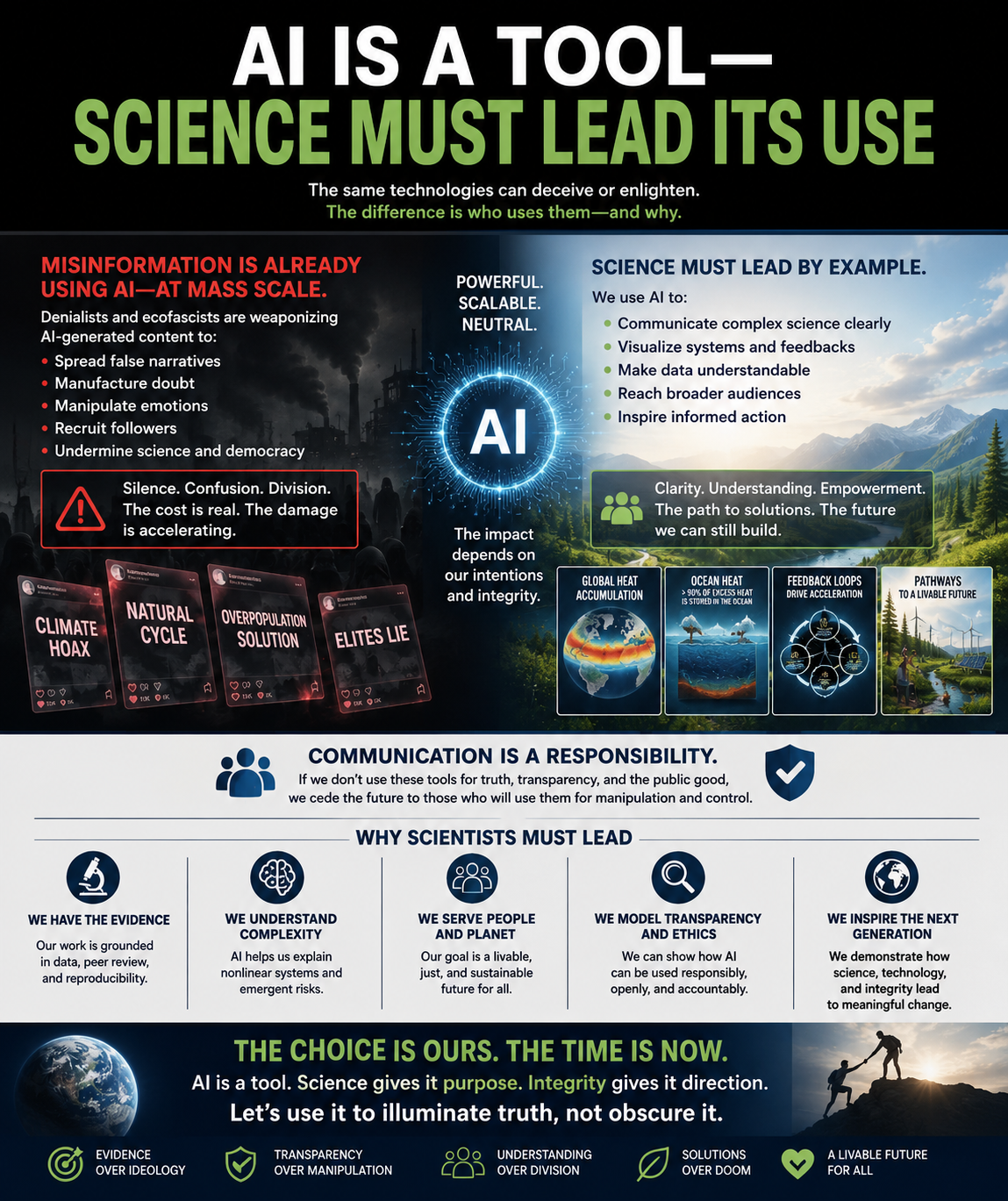
For instance, climate education and the graphics used for this post are based on this scientific paper as well as the publicly accessible version.
If I had created them manually, the costs in time, labor, energy, and resources would have been substantial. Using AI, the direct dollar cost to me was effectively zero, the graphics were generated in about a minute, and the estimated natural-resource cost was roughly $0.067 per image.
By comparison, producing similar graphics through traditional methods could easily have cost hundreds of dollars when accounting for labor, software, revisions, and associated natural-resource use. Mathematically, the AI-generated version required approximately 0.005% of those resources—just five thousandths of one percent of the traditional cost. These savings are equivalent to the reduction in environmental impact.
The benefits—in both environmental savings to the planet, through reduced physical-resource use, and in the ability to produce and distribute education—far outweigh the costs.
Most importantly:
The only effective way to stop the acceleration of climate change is through the reduction of fossil-fuel combustion.
However, the most likely way to reverse the trajectory of climate change is through people using AI to develop previously unthought-of methods and technologies that can fundamentally change how we produce, consume, and manage resources—or potentially remove greenhouse gases from the atmosphere.