bookmark_borderNASA Interplanetary Travel Posters

NASA released print quality travel posters promoting space exploration.

Greetings from your First Exoplanet
While there is much debate over which exoplanet discovery is considered the “first,” one stands out from the rest. In 1995, scientists discovered 51 Pegasi b, forever changing the way we see the universe and our place in it. The exoplanet is about half the mass of Jupiter, with a seemingly impossible, star-hugging orbit of only 4.2 Earth days. Not only was it the first planet confirmed to orbit a sun-like star, it also ushered in a whole new class of planets called Hot Jupiters: hot, massive planets orbiting closer to their stars than Mercury. Today, powerful observatories like NASA’s Kepler space telescope will continue the hunt of distant planets.

PSO J318.5-22 – Where the Nightlife Never Ends
Discovered in October 2013 using direct imaging, PSO J318.5-22 belongs to a special class of planets called rogue, or free-floating, planets. Wandering alone in the galaxy, they do not orbit a parent star. Not much is known about how these planets come to exist, but scientists theorize that they may be either failed stars or planets ejected from very young systems after an encounter with another planet. These rogue planets glow faintly from the heat of their formation. Once they cool down, they will be dancing in the dark.

Experience the Gravity of a Super Earth
Twice as big in volume as the Earth, HD 40307g straddles the line between “Super-Earth” and “mini-Neptune” and scientists aren’t sure if it has a rocky surface or one that’s buried beneath thick layers of gas and ice. One thing is certain though: at eight time the Earth’s mass, its gravitational pull is much, much stronger.

Relax on Kepler-16b – Where your shadow always has company
Like Luke Skywalker’s planet “Tatooine” in Star Wars, Kepler-16b orbits a pair of stars. Depicted here as a terrestrial planet, Kepler-16b might also be a gas giant like Saturn. Prospects for life on this unusual world aren’t good, as it has a temperature similar to that of dry ice. But the discovery indicates that the movie’s iconic double-sunset is anything but science fiction.

Kepler-186 f – Where the Grass is Always Redder
Kepler-186f is the first Earth-size planet discovered in the potentially ‘habitable zone’ around another star, where liquid water could exist on the planet’s surface. Its star is much cooler and redder than our Sun. If plant life does exist on a planet like Kepler-186f, its photosynthesis could have been influenced by the star’s red-wavelength photons, making for a color palette that’s very different than the greens on Earth. This discovery was made by Kepler, NASA’s planet hunting telescope.

bookmark_borderDeath Star

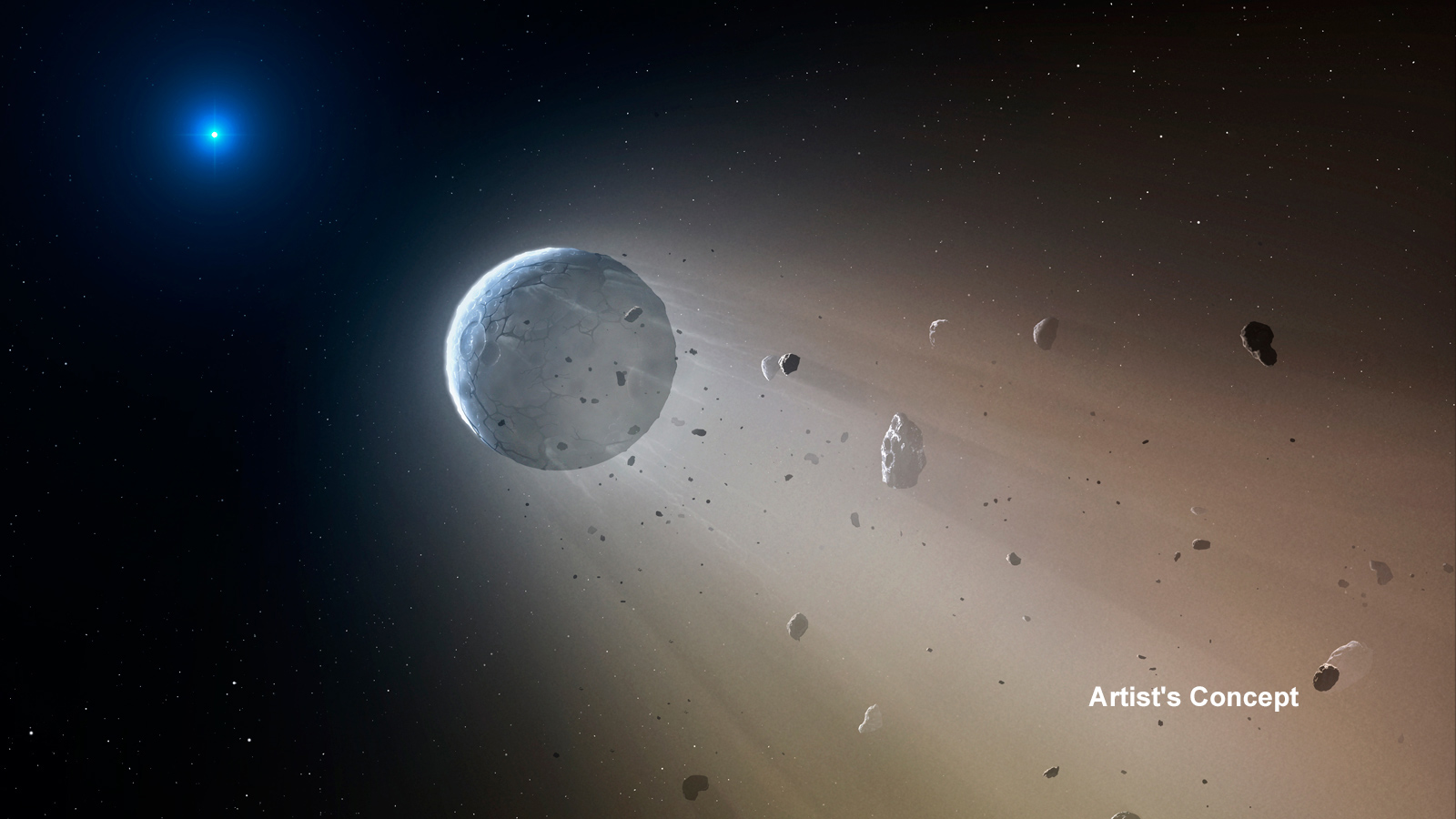
NASA — Scientists using NASA’s repurposed Kepler space telescope, known as the K2 mission, have uncovered strong evidence of a tiny, rocky object being torn apart as it spirals around a white dwarf star. This discovery validates a long-held theory that white dwarfs are capable of cannibalizing possible remnant planets that have survived within its solar system.

“We are for the first time witnessing a miniature “planet” ripped apart by intense gravity, being vaporized by starlight and raining rocky material onto its star,” said Andrew Vanderburg, graduate student at the Harvard-Smithsonian Center for Astrophysics in Cambridge, Massachusetts, and lead author of the paper published in Nature.

As stars like our sun age, they puff up into red giants and then gradually lose about half their mass, shrinking down to 1/100th of their original size to roughly the size of Earth. This dead, dense star remnant is called a white dwarf.

Artist's Concept of Death Star
Artist’s Concept of Death Star

bookmark_borderEarth

It’s been many years since NASA has taken a picture of Earth. Now, they released the Blue Marble image captured by the National Oceanic and Atmospheric Administration (NOAA)’s #DSCOVR spacecraft.

This is the first photo of the entire Earth taken in 43 years:

Earth From 1 Million Miles

bookmark_border3D Printer Makes Wrench in Space

OUTER SPACE — What happens if you are on the Space Station and you need a wrench? Just have NASA e-mail it up and print it on the 3D printer.

It is the first time that hardware was e-mailed to space.

Mike Chen, founder of Made In Space (the company behind the 3-D printer) said, “We had overheard ISS Commander Barry Wilmore mention over the radio that he needed one, so we designed one in CAD and sent it up to him faster than a rocket ever could have.”

“The socket wrench we just manufactured is the first object we designed on the ground and sent digitally to space, on the fly.

“It also marks the end of our first experiment — a sequence of 21 prints that together make up the first tools and objects ever manufactured off the surface of the Earth.”

bookmark_borderInterstellar Overdrive

NASA’s Voyager 1 spacecraft officially is the first human-made object to venture into interstellar space. The 36-year-old probe is about 12 billion miles (19 billion kilometers) from our sun.

New and unexpected data indicate Voyager 1 has been traveling for about one year through plasma, or ionized gas, present in the space between stars. Voyager is in a transitional region immediately outside the solar bubble, where some effects from our sun are still evident. A report on the analysis of this new data, an effort led by Don Gurnett and the plasma wave science team at the University of Iowa, Iowa City, is published in Thursday’s edition of the journal Science.

“Now that we have new, key data, we believe this is mankind’s historic leap into interstellar space,” said Ed Stone, Voyager project scientist based at the California Institute of Technology, Pasadena. “The Voyager team needed time to analyze those observations and make sense of them. But we can now answer the question we’ve all been asking — ‘Are we there yet?’ Yes, we are.”

Voyager 1 first detected the increased pressure of interstellar space on the heliosphere, the bubble of charged particles surrounding the sun that reaches far beyond the outer planets, in 2004. Scientists then ramped up their search for evidence of the spacecraft’s interstellar arrival, knowing the data analysis and interpretation could take months or years.

Voyager 1 does not have a working plasma sensor, so scientists needed a different way to measure the spacecraft’s plasma environment to make a definitive determination of its location. A coronal mass ejection, or a massive burst of solar wind and magnetic fields, that erupted from the sun in March 2012 provided scientists the data they needed. When this unexpected gift from the sun eventually arrived at Voyager 1’s location 13 months later, in April 2013, the plasma around the spacecraft began to vibrate like a violin string. On April 9, Voyager 1’s plasma wave instrument detected the movement. The pitch of the oscillations helped scientists determine the density of the plasma. The particular oscillations meant the spacecraft was bathed in plasma more than 40 times denser than what they had encountered in the outer layer of the heliosphere. Density of this sort is to be expected in interstellar space.

The plasma wave science team reviewed its data and found an earlier, fainter set of oscillations in October and November 2012. Through extrapolation of measured plasma densities from both events, the team determined Voyager 1 first entered interstellar space in August 2012.

“We literally jumped out of our seats when we saw these oscillations in our data — they showed us the spacecraft was in an entirely new region, comparable to what was expected in interstellar space, and totally different than in the solar bubble,” Gurnett said. “Clearly we had passed through the heliopause, which is the long-hypothesized boundary between the solar plasma and the interstellar plasma.”

The new plasma data suggested a timeframe consistent with abrupt, durable changes in the density of energetic particles that were first detected on Aug. 25, 2012. The Voyager team generally accepts this date as the date of interstellar arrival. The charged particle and plasma changes were what would have been expected during a crossing of the heliopause.

“The team’s hard work to build durable spacecraft and carefully manage the Voyager spacecraft’s limited resources paid off in another first for NASA and humanity,” said Suzanne Dodd, Voyager project manager, based at NASA’s Jet Propulsion Laboratory, Pasadena, Calif. “We expect the fields and particles science instruments on Voyager will continue to send back data through at least 2020. We can’t wait to see what the Voyager instruments show us next about deep space.”

Voyager 1 and its twin, Voyager 2, were launched 16 days apart in 1977. Both spacecraft flew by Jupiter and Saturn. Voyager 2 also flew by Uranus and Neptune. Voyager 2, launched before Voyager 1, is the longest continuously operated spacecraft. It is about 9.5 billion miles (15 billion kilometers) away from our sun.

Voyager mission controllers still talk to or receive data from Voyager 1 and Voyager 2 every day, though the emitted signals are currently very dim, at about 23 watts — the power of a refrigerator light bulb. By the time the signals get to Earth, they are a fraction of a billion-billionth of a watt. Data from Voyager 1’s instruments are transmitted to Earth typically at 160 bits per second, and captured by 34- and 70-meter NASA Deep Space Network stations. Traveling at the speed of light, a signal from Voyager 1 takes about 17 hours to travel to Earth. After the data are transmitted to JPL and processed by the science teams, Voyager data are made publicly available.

“Voyager has boldly gone where no probe has gone before, marking one of the most significant technological achievements in the annals of the history of science, and adding a new chapter in human scientific dreams and endeavors,” said John Grunsfeld, NASA’s associate administrator for science in Washington. “Perhaps some future deep space explorers will catch up with Voyager, our first interstellar envoy, and reflect on how this intrepid spacecraft helped enable their journey.”

Scientists do not know when Voyager 1 will reach the undisturbed part of interstellar space where there is no influence from our sun. They also are not certain when Voyager 2 is expected to cross into interstellar space, but they believe it is not very far behind.

JPL built and operates the twin Voyager spacecraft. The Voyagers Interstellar Mission is a part of NASA’s Heliophysics System Observatory, sponsored by the Heliophysics Division of NASA’s Science Mission Directorate in Washington. NASA’s Deep Space Network, managed by JPL, is an international network of antennas that supports interplanetary spacecraft missions and radio and radar astronomy observations for the exploration of the solar system and the universe. The network also supports selected Earth-orbiting missions.

The cost of the Voyager 1 and Voyager 2 missions — including launch, mission operations and the spacecraft’s nuclear batteries, which were provided by the Department of Energy — is about $988 million through September.

bookmark_borderComet ISON

Comet Ison
Comet ISON comes in from the bottom right and moves out toward the upper right, getting fainter and fainter, in this time-lapse image from the ESA/NASA Solar and Heliospheric Observatory. The image of the sun at the center is from NASA’s Solar Dynamics Observatory.
Image Credit:
ESA/NASA/SOHO/SDO/GSFC

NASA — Did comet Ison survive its trip around the sun? After several days of continued observations, scientists continue to work to determine and to understand the fate of Comet ISON: There’s no doubt that the comet shrank in size considerably as it rounded the sun and there’s no doubt that something made it out on the other side to shoot back into space. The question remains as to whether the bright spot seen moving away from the sun was simply debris, or whether a small nucleus of the original ball of ice was still there. Regardless, it is likely that it is now only dust.

Comet ISON, which began its journey from the Oort Cloud some 3 million years ago, made its closest approach to the sun on Nov. 28, 2013. The comet was visible in instruments on NASA’s Solar Terrestrial Relations Observatory, or STEREO, and the joint European Space Agency/NASA Solar and Heliospheric Observatory, or SOHO, via images called coronagraphs. Coronagraphs block out the sun and a considerable distance around it, in order to better observe the dim structures in the sun’s atmosphere, the corona. As such, there was a period of several hours when the comet was obscured in these images, blocked from view along with the sun. During this period of time, NASA’s Solar Dynamics Observatory could not see the comet, leading many scientists to surmise that the comet had disintegrated completely. However, something did reappear in SOHO and STEREO coronagraphs some time later – though it was significantly less bright.

Whether that spot of light was merely a cloud of dust that once was a comet, or if it still had a nucleus – a small ball of its original, icy material – intact, is still unclear. It seems likely that as of Dec. 1, there was no nucleus left. By monitoring its changes in brightness over time, scientists can estimate whether there’s a nucleus or not, but our best chance at knowing for sure will be if the Hubble Space Telescope makes observations later in December 2013.

Regardless of its fate, Comet ISON did not disappoint researchers. Over the last year, observatories around the world and in space gathered one of the largest sets of comet observations of all time, which should provide fodder for study for years to come. The number of space-based, ground-based, and amateur observations were unprecedented, with twelve NASA space-based assets observing over the past year.

VIDEO
Comet ISON is shown approaching the sun and curving away from it in this movie containing imagery from both NASA’s Solar Terrestrial Relations Observatory and the joint ESA/NASA Solar and Heliospheric Observatory from November 2013. ISON dims dramatically as it streams away from the sun.

bookmark_borderGalaxy Growth Like Watching Paint Dry

NASA — Watching a tree grow might be more frustrating than waiting for a pot to boil, but luckily for biologists, there are tree rings. Beginning at a tree trunk’s dense core and moving out to the soft bark, the passage of time is marked by concentric rings, revealing chapters of the tree’s history.

Galaxies outlive trees by billions of years, making their growth impossible to see. But like biologists, astronomers can read the rings in a galaxy’s disk to unravel its past. Using data from NASA’s Wide-field Infrared Survey Explorer (WISE) and Galaxy Evolution Explorer (GALEX), scientists have acquired more evidence for the “inside-out” theory of galaxy growth, showing that bursts of star formation in central regions were followed one to two billion years later by star birth in the outer fringes.

“Initially, a rapid star-forming period formed the mass at the center of these galaxies, followed later by a star-forming phase in the outer regions. Eventually, the galaxies stop making stars and become quiescent,” said Sara Petty of Virginia Tech, Blacksburg, Va., lead author of a paper appearing in the October 2013 issue of the Astronomical Journal. “This later star-forming phase could have been caused by minor mergers with gas-rich neighbors, which provide the fuel for new stars.”

The discovery may also solve a mystery of elderly galaxies. The galaxies in the study, known as “red and dead” for their red color and lack of new star births, have a surprising amount of ultraviolet light emanating from the outer regions. Often, ultraviolet light is generated by hot, young stars, but these galaxies were considered too old to host such a young population.

The solution to the puzzle is likely hot, old stars. Petty and colleagues used a new multi-wavelength approach to show that the unexplained ultraviolet light appears to be coming from a late phase in the lives of older stars, when they blow off their outer layers and heat up.

GALEX and WISE turned out to be the ideal duo for the study. GALEX was sensitive to the ultraviolet light, whereas WISE sees the infrared light coming from older stars. GALEX is no longer operating, but WISE was recently reactivated to hunt asteroids, a project called NEOWISE (see http://www.jpl.nasa.gov/news/news.php?release=2013-257 ). Both telescopes have large fields of view, allowing them to easily capture images of entire galaxies.

“The synergy between GALEX and WISE produces a very sensitive measurement of where the hot, older stars reside in these red-and-dead galaxies,” said Don Neill, co-author of the paper from the California Institute of Technology, Pasadena. “This allows us to map the progress of star formation within each galaxy.”

Ned Wright of UCLA, a co-author of the study and the principal investigator of WISE before it was reactivated, compares the multi-wavelength range of the two telescopes to musical notes, “WISE itself covers the equivalent of a three-octave range, while WISE and GALEX together cover a seven-octave range.”

The technical paper for this study is online at http://arxiv.org/abs/1307.6282 .

NASA’s Jet Propulsion Laboratory, Pasadena, Calif., manages and operates the recently activated NEOWISE mission for NASA’s Science Mission Directorate. The WISE mission was selected competitively under NASA’s Explorers Program managed by the agency’s Goddard Space Flight Center in Greenbelt, Md. The science instrument was built by the Space Dynamics Laboratory in Logan, Utah. The spacecraft was built by Ball Aerospace & Technologies Corp. in Boulder, Colo. Science operations and data processing take place at the Infrared Processing and Analysis Center at Caltech. Caltech manages JPL for NASA. More information is online at http://www.nasa.gov/wise and http://wise.astro.ucla.edu and http://jpl.nasa.gov/wise .

Caltech led the Galaxy Evolution Explorer mission and was responsible for science operations and data analysis. JPL managed the mission and built the science instrument. The mission was developed under NASA’s Explorers Program managed by the Goddard Space Flight Center, Greenbelt, Md. Researchers sponsored by Yonsei University in South Korea and the Centre National d’Etudes Spatiales (CNES) in France collaborated on this mission. Graphics and additional information about the Galaxy Evolution Explorer are online at http://www.nasa.gov/galex and http://www.galex.caltech.edu.

bookmark_borderHuman Asteroid Initiative

NASA’s FY2014 budget proposal includes a plan to robotically capture a small near-Earth asteroid and redirect it safely to a stable orbit in the Earth-moon system where astronauts can visit and explore it.

Performing these elements for the proposed asteroid initiative integrates the best of NASA’s science, technology and human exploration capabilities and draws on the innovation of America’s brightest scientists and engineers. It uses current and developing capabilities to find both large asteroids that pose a hazard to Earth and small asteroids that could be candidates for the initiative, accelerates our technology development activities in high-powered solar electric propulsion and takes advantage of our hard work on the Space Launch System rocket and Orion spacecraft, helping to keep NASA on target to reach the President’s goal of sending humans to Mars in the 2030s.

When astronauts don their spacesuits and venture out for a spacewalk on the surface of an asteroid, how they move and take samples of it will be based on years of knowledge built by NASA scientists and engineers who have assembled and operated the International Space Station, evaluated exploration mission concepts, sent scientific spacecraft to characterize near-Earth objects and performed ground-based analog missions.

As early as the 1970s, NASA examined potential ways to use existing hardware to visit an asteroid to understand better its characteristics. On the International Space Station, scientific investigations and technology demonstrations are improving knowledge of how humans can live and work in space. The agency also has examined many possible mission concepts to help define what capabilities are needed to push the boundaries of space exploration.

During the early space shuttle flights and through assembly of the space station, NASA has relied on testing both in space and on Earth to try out ideas through a host of analog missions, or field tests, that simulate the complexity of endeavors in space.

Through 16 missions in the National Oceanic and Atmospheric Administration’s underwater Aquarius Reef Base off the coast of Key Largo, Fla., aquanauts have tested techniques for human space exploration. These underwater tests have been built upon the experience gained by training astronauts in the Neutral Buoyancy Laboratory at NASA’s Johnson Space Center in Houston to assemble and maintain the space station. The NASA Extreme Environment Mission Operations (NEEMO) 15 and 16 missions in 2011 and 2012, respectively, simulated several challenges explorers will face when visiting an asteroid, including how to anchor to and move around the surface of a near-Earth object and how to collect samples of it.

NASA also has simulated an asteroid mission as part of its 2012 Research and Technology Studies ground test at Johnson. During the simulation, a team evaluated how astronauts might do a spacewalk on an asteroid and accomplish other goals. While performing a spacewalk on a captured asteroid will involve different techniques than the activities performed during recent analog exercises, decisions made about ways to best sample an asteroid will be informed by the agency’s on-going concept development and past work.

Scientific missions also have investigated the nature of asteroids to provide a glimpse of the origins of the solar system. From the Pioneer 10 spacecraft, which in 1972 was the first to venture into the Main Asteroid Belt, to the Dawn mission, which recently concluded its investigations of asteroid Vesta and is on its way to the dwarf planet Ceres, NASA’s forays help us understand the origins of the solar system and inform decisions about how to conduct missions to distant planetary bodies. Scientists both at NASA and across the world also continue to study asteroids to shed light on their unique characteristics.

As NASA ventures farther into the solar system, the agency continues to simulate and evaluate operations and technical concepts for visiting an asteroid.

bookmark_borderHappy Birthday Universe!

Map Of The Universe
Map Of The Universe


Q: How old is the universe?
A: 13.8 billion years old

Planck, the European space agency, in cooperation with NASA have created a detailed map of the universe. “Astronomers worldwide have been on the edge of their seats waiting for this map,” said Joan Centrella, Planck scientist. “These measurements are profoundly important to many areas of science, as well as future space missions.”

“The Planck map reveals not only the very young universe, but also matter, including dark matter, everywhere in the universe.”

“You can see the seeds from which the Universe is come,” said Jean-Jacques Dordain, the agency’s director general.

Findings:

  • The universe appears to be 13.81 billion years old, slightly older than previous estimates.
  • The universe also contains a bit more matter than previously thought. A new precision measurement based on Planck shows that ordinary matter – including atoms, stars, galaxies and everything else astronomers can observe directly – accounts for about 4.9 per cent of the energy content of the universe. Another 26.98 per cent is taken up by dark matter, which cannot be seen but only “felt” through its gravitational influence. The remaining 68.3 per cent is in the form of dark energy, a mysterious phenomenon thought to be causing the expansion of the Universe to accelerate.
  • There are no signs for new, unknown particles of ordinary matter, such as new types of neutrinos, which have been proposed by some theories.