The ancient Babylonians (flourishing c. 2000 BCE) constructed the mathematical skeleton upon which modern timekeeping still rests. Their sexagesimal (base-60) numerical system—likely chosen for its exceptional divisibility—gave us the 60-minute hour and the 360-degree circle. Sixty is divisible by 2, 3, 4, 5, and 6, making it uniquely suited for astronomical calculation.
Babylonian astronomer-priests meticulously recorded lunar phases, planetary motions, and eclipses over centuries. These observations allowed them to detect periodicities and construct predictive cycles—early forms of time series analysis. In essence, they transformed celestial motion into structured mathematics. Time became measurable, divisible, and forecastable.
Yet mathematics does not belong solely to human civilization. In a striking example from evolutionary biology, prime numbers appear embedded in the life cycles of periodical cicadas.
Prime Life Cycles: Mathematics as an Evolutionary Strategy
Certain species of North American periodical cicadas (genus Magicicada) emerge synchronously every 13 or 17 years—both prime numbers. After spending over a decade underground as nymphs, entire broods surface in massive, synchronized events.
The evolutionary advantage of these prime-numbered cycles lies in predator avoidance.
Most predators operate on shorter, often composite reproductive cycles—2, 3, 4, or 6 years. When prey species follow composite cycles, overlaps with predators occur more frequently. Prime-numbered emergence intervals minimize this synchronization.
For example:
A predator with a 4-year cycle would overlap with a 12-year cicada every 12 years.
But with a 13-year cicada, overlap occurs only every 52 years (4 × 13).
With a 17-year cicada, overlap with a 4-year predator happens only every 68 years.
Because prime numbers share no divisors other than 1 and themselves, they minimize coincident periodic alignment. In mathematical terms, primes maximize the least common multiple between interacting cycles. In ecological terms, they reduce predictable synchronization with predators.
This is not accidental numerology. Population models show that prime-numbered periodicity confers strong selective advantage in environments with cyclic predation pressure. Over evolutionary time, natural selection effectively “solved” a number theory optimization problem.
Ancient Plagues and Cyclical Swarms
Biblical and ancient Near Eastern accounts of locust plagues describe overwhelming, seemingly apocalyptic swarms. While locust cycles are not prime-numbered like cicadas, their mass emergences are also governed by environmental triggers, population density thresholds, and nonlinear feedbacks.
In both cases—cicadas and locusts—we observe biological systems operating on periodic, threshold-driven dynamics. Ancient observers, including the Babylonians and later Hebrew chroniclers, documented these cycles carefully. Although they lacked formal number theory, they recognized recurring temporal patterns—early empirical timekeeping grounded in ecological observation.
Ironically, what appeared to ancient societies as divine timing or supernatural plague may also represent one of the earliest intersections of mathematics, ecology, and recorded history.
Nonlinear Timing Across Systems
The deeper insight connecting Babylonian astronomy and cicada biology is periodicity under constraint.
The Babylonians mapped celestial cycles using divisible composite numbers.
Cicadas evolved prime-numbered life cycles to avoid ecological resonance.
Both systems reveal how timing interacts with structure.
Both illustrate that periodic systems can produce stability—or chaos—depending on synchronization.
In complex systems theory, resonance amplifies interaction. Desynchronization dampens it. Prime periodicity is, in effect, a biological strategy of controlled desynchronization.
Nature, long before formal mathematics, discovered the power of prime numbers.
The Geminid meteor shower is reaching its peak, but unfortunately, weather conditions will prevent many people in my area from seeing the show tonight. Even so, there’s good news: you should still be able to spot remnants of the Geminids over the next several nights as activity gradually tapers off.
What makes the Geminid meteor shower truly unique is its origin. It is the only major annual meteor shower caused by debris from an asteroid rather than a comet. The source is the near-Earth asteroid 3200 Phaethon, a rocky body that behaves a bit like a comet, shedding material as it passes close to the Sun. In contrast, most familiar meteor showers—such as the Perseids or Leonids—occur when Earth passes through dusty trails left behind by comets.
Despite these different origins, the underlying physics is the same. Tiny particles—some no larger than grains of sand—slam into Earth’s atmosphere at tremendous speeds. Friction and compression heat the particles so intensely that they vaporize, producing the bright streaks of light we call meteors, or “shooting stars.”
The Geminids are especially prized by skywatchers because they tend to be bright, slow-moving, and often colorful, making them easier to spot than many other showers. So even if clouds spoil the peak night, it’s still worth stepping outside over the next few evenings. With a bit of luck and a break in the clouds, you may catch one of these rare asteroid-born streaks lighting up the winter sky.
In recent times, there has been an increasing surge of posts about planetary alignments, planets in retrograde, and other celestial “phenomena.” These concepts are often popularized in media and social networks, but it’s important to understand the significant difference between astronomy and astrology, which lies in the distinction between perception and reality.
Astronomy is the scientific study of celestial objects, space, and the universe as a whole. It is grounded in rigorous observation, data collection, and mathematical models, aiming to understand the true nature of our universe. Astrology, on the other hand, is a belief system that suggests the positions and movements of celestial bodies can influence human affairs and natural events.
When it comes to planetary alignments, the idea that planets are perfectly lined up in space is a misconception. In reality, planets do not align in a way that has any meaningful or lasting effect. This is because planets in our solar system orbit the Sun at different speeds and on different planes. While from Earth’s perspective, certain alignments may seem visually significant, they are merely optical illusions—temporary and inconsequential arrangements that occur due to the relative positions of Earth and the other planets.
Similarly, the concept of planets going into retrograde is based on the apparent motion of planets across the sky. In reality, planets never truly “go backwards” in their orbit. What we observe as retrograde motion is an illusion that occurs when Earth, in its orbit, passes slower-moving outer planets. It’s the appearance of backward movement, not an actual change in the planet’s orbit. These so-called “mirages” lead to incorrect attributions about their influence on our lives. Astrological claims about these phenomena have no scientific backing and no measurable impact on Earth.
What Does Impact Earth?
While these celestial phenomena may be fascinating from a cultural or astrological perspective, there are much more significant and scientifically relevant events occurring in space that impact Earth. One such event involves the Sun, the most influential celestial body in our solar system.
NASA’s Parker Solar Probe, launched on August 12, 2018, is conducting groundbreaking research into the Sun’s outer atmosphere, known as the corona. On December 24, 2024, the probe achieved a historic milestone by making a close approach to the Sun—within approximately 3.8 million miles (6.1 million kilometers) of its surface. This marks the closest any human-made object has ever come to the Sun.
During this perihelion (the point in its orbit closest to the Sun), the Parker Solar Probe reached speeds of up to 430,000 miles per hour (700,000 kilometers per hour), setting a new record for the fastest human-made object in history. This mission is providing unparalleled data about the Sun, especially regarding the origins of solar wind and the mechanisms behind solar energetic particles.
Solar Wind and Solar Weather: Impacts on Earth
The study of the Sun’s corona and solar wind is crucial for understanding space weather, which can have significant effects on Earth. Solar wind, a continuous flow of charged particles emitted by the Sun, can impact technological systems on Earth and in space. For example, powerful solar storms, or coronal mass ejections (CMEs), can disrupt satellite communications, GPS systems, and power grids on Earth. Understanding the behavior of solar wind is essential for preparing for these potentially harmful events, which can affect everything from navigation to critical infrastructure.
The Parker Solar Probe’s mission is designed to help scientists better understand these space weather phenomena and improve forecasting models, which will help protect Earth’s technology and astronauts in space. The data from the probe will give us greater insight into solar activity and its effects on our planet.
Equipped with an advanced heat shield, the Parker Solar Probe can withstand extreme temperatures exceeding 2,500°F (1,377°C) as it passes through the Sun’s outer atmosphere. This impressive engineering allows the probe to gather vital data without being destroyed by the intense heat and radiation near the Sun.
What’s Next for the Parker Solar Probe?
This recent close approach is part of a series of planned perihelia for the Parker Solar Probe. The mission will continue to bring back data from the Sun’s corona and solar wind, with two more close flybys scheduled for next year. The next major data transmission from the probe is expected on December 27, 2024, which will offer even more insight into the dynamics of solar wind and solar weather.
While astrological beliefs around planetary alignments may be entertaining, the real science lies in understanding the Sun’s powerful influence on our solar system and its potential to shape life on Earth. The Parker Solar Probe is on the cutting edge of solar research, helping us unlock the mysteries of space weather that truly impact our planet.
Solar Weather and Solar Wind
Solar weather refers to the various phenomena originating from the Sun that can impact the space environment in our solar system. It is driven by the Sun’s magnetic activity, including solar flares, coronal mass ejections (CMEs), and solar wind.
Solar wind is a continuous stream of charged particles (plasma) ejected from the Sun’s outer atmosphere, known as the corona. It consists primarily of electrons, protons, and alpha particles, traveling at speeds of 400-800 km/s. While plasma particles move incredibly fast by human standards, they are much slower compared to the speed of light. This difference explains why light from the Sun reaches Earth in about 8 minutes, whereas charged particles from a CME (coronal mass ejections) can take 1 to 3 days to travel the same distance.
Impact of Solar Storms on Earth
Solar storms occur when solar activity intensifies, particularly during periods of increased sunspot activity in the solar cycle. These storms include:
Solar flares: Sudden bursts of radiation from the Sun’s surface.
Coronal Mass Ejections (CMEs): Massive eruptions of plasma and magnetic fields that can travel outward into the solar system.
Solar storms can have significant effects on Earth:
Geomagnetic Storms: Disturbances in Earth’s magnetic field caused by the interaction of solar wind or CMEs with the magnetosphere.
Disruptions to GPS, satellite communications, and radio signals.
Damage to power grids, potentially causing blackouts.
Auroras: The interaction of charged particles with Earth’s magnetic field and atmosphere creates spectacular light displays, such as the Northern and Southern Lights.
Increased Radiation: Harmful to astronauts, satellites, and high-altitude flights, particularly near the poles.
Space Weather Effects: Potential damage to spacecraft electronics and increased atmospheric drag, which can alter satellite orbits.
How the Sun Protects the Solar System
The Sun plays a protective role in the solar system through the heliosphere, a vast bubble of solar wind and magnetic field that extends beyond Pluto’s orbit.
Deflection of Cosmic Rays: The solar wind and magnetic field reduce the number of high-energy cosmic rays from outside the solar system that reach the inner planets, including Earth.
Stabilizing Space Environment: The Sun’s gravity and energy output maintain the conditions necessary for the solar system’s structure and life on Earth.
While the Sun’s activity can sometimes be disruptive, its overall influence provides a dynamic yet protective environment for the planets.
Q: How do you make gold and platinum?
A: Collide two neutron stars
“It’s so beautiful. It’s so beautiful it makes me want to cry. It’s the fulfillment of dozens, hundreds, thousands of people’s efforts, but it’s also the fulfillment of an idea suddenly becoming real,” said Peter Saulson of Syracuse University.
Not only does a collision of neutron stars create heavy metals, it also causes a wrinkle in space-time. Gravitational waves had been an Albert Einstein theory until 2015. Since then, there have been three recordings of gravitational waves; however, they were all colliding black holes. This was the first recording of gravitational waves in light.
The observation was made by LIGO:
Laser Interferometer Gravitational-Wave Observatory
Supported by the National Science Foundation
Operated by Caltech and MIT
Gravitational waves are ripples in the curvature of spacetime that are generated in certain gravitational interactions and propagate as waves outward from their source at the speed of light. The possibility of gravitational waves was discussed in 1893 by Oliver Heaviside using the analogy between the inverse-square law in gravitation and electricity. In 1905 Henri Poincaré first proposed gravitational waves (ondes gravifiques) emanating from a body and propagating at the speed of light as being required by the Lorentz transformations. Predicted in 1916 by Albert Einstein on the basis of his theory of general relativity, gravitational waves transport energy as gravitational radiation, a form of radiant energy similar to electromagnetic radiation. Newton’s law of universal gravitation, part of classical mechanics, does not provide for the existence of gravitational waves, since that law is predicated on the assumption that physical interactions propagate at infinite speed—showing one of the ways that the methods of classical physics is unable to explain phenomena associated with relativity.
GW170817 Press Release
LIGO and Virgo make first detection of gravitational waves produced by colliding neutron stars
Discovery marks first cosmic event observed in both gravitational waves and light.
Watch the recording of a press conference announcing the discovery, at the National Press Club in Washington, DC:
Watch the recording of a seminar at Caltech titled “Seeing and Hearing the Cataclysmic Universe” following the announcement:
For the first time, scientists have directly detected gravitational waves — ripples in space-time — in addition to light from the spectacular collision of two neutron stars. This marks the first time that a cosmic event has been viewed in both gravitational waves and light.
The discovery was made using the U.S.-based Laser Interferometer Gravitational-Wave Observatory (LIGO); the Europe-based Virgo detector; and some 70 ground- and space-based observatories.
Neutron stars are the smallest, densest stars known to exist and are formed when massive stars explode in supernovas. As these neutron stars spiraled together, they emitted gravitational waves that were detectable for about 100 seconds; when they collided, a flash of light in the form of gamma rays was emitted and seen on Earth about two seconds after the gravitational waves. In the days and weeks following the smashup, other forms of light, or electromagnetic radiation — including X-ray, ultraviolet, optical, infrared, and radio waves — were detected.
GW170817: A Global Astronomy Event
The observations have given astronomers an unprecedented opportunity to probe a collision of two neutron stars. For example, observations made by the U.S. Gemini Observatory, the European Very Large Telescope, and the Hubble Space Telescope reveal signatures of recently synthesized material, including gold and platinum, solving a decades-long mystery of where about half of all elements heavier than iron are produced.
The LIGO-Virgo results are published today in the journal Physical Review Letters; additional papers from the LIGO and Virgo collaborations and the astronomical community have been either submitted or accepted for publication in various journals.
“It is tremendously exciting to experience a rare event that transforms our understanding of the workings of the universe,” says France A. Córdova, director of the National Science Foundation (NSF), which funds LIGO. “This discovery realizes a long-standing goal many of us have had, that is, to simultaneously observe rare cosmic events using both traditional as well as gravitational-wave observatories. Only through NSF’s four-decade investment in gravitational-wave observatories, coupled with telescopes that observe from radio to gamma-ray wavelengths, are we able to expand our opportunities to detect new cosmic phenomena and piece together a fresh narrative of the physics of stars in their death throes.”
A stellar sign
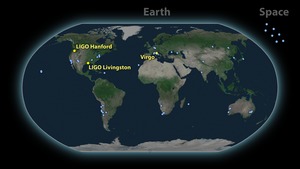
The gravitational signal, named GW170817, was first detected on Aug. 17 at 8:41 a.m. Eastern Daylight Time; the detection was made by the two identical LIGO detectors, located in Hanford, Washington, and Livingston, Louisiana. The information provided by the third detector, Virgo, situated near Pisa, Italy, enabled an improvement in localizing the cosmic event. At the time, LIGO was nearing the end of its second observing run since being upgraded in a program called Advanced LIGO, while Virgo had begun its first run after recently completing an upgrade known as Advanced Virgo.
Current operating facilities in the global network include the twin LIGO detectors—in Hanford, Washington, and Livingston, Louisiana— Virgo in Italy and GEO600 in Germany.
The NSF-funded LIGO observatories were conceived, constructed, and operated by Caltech and MIT. Virgo is funded by the Istituto Nazionale di Fisica Nucleare (INFN) in Italy and the Centre National de la Recherche Scientifique (CNRS) in France, and operated by the European Gravitational Observatory. Some 1,500 scientists in the LIGO Scientific Collaboration and the Virgo Collaboration work together to operate the detectors and to process and understand the gravitational-wave data they capture.
Each observatory consists of two long tunnels arranged in an L shape, at the joint of which a laser beam is split in two. Light is sent down the length of each tunnel, then reflected back in the direction it came from by a suspended mirror. In the absence of gravitational waves, the laser light in each tunnel should return to the location where the beams were split at precisely the same time. If a gravitational wave passes through the observatory, it will alter each laser beam’s arrival time, creating an almost imperceptible change in the observatory’s output signal.
On Aug. 17, LIGO’s real-time data analysis software caught a strong signal of gravitational waves from space in one of the two LIGO detectors. At nearly the same time, the Gamma-ray Burst Monitor on NASA’s Fermi space telescope had detected a burst of gamma rays. LIGO-Virgo analysis software put the two signals together and saw it was highly unlikely to be a chance coincidence, and another automated LIGO analysis indicated that there was a coincident gravitational wave signal in the other LIGO detector. Rapid gravitational-wave detection by the LIGO-Virgo team, coupled with Fermi’s gamma-ray detection, enabled the launch of follow-up by telescopes around the world.
The LIGO data indicated that two astrophysical objects located at the relatively close distance of about 130 million light-years from Earth had been spiraling in toward each other. It appeared that the objects were not as massive as binary black holes — objects that LIGO and Virgo have previously detected. Instead, the inspiraling objects were estimated to be in a range from around 1.1 to 1.6 times the mass of the sun, in the mass range of neutron stars. A neutron star is about 20 kilometers, or 12 miles, in diameter and is so dense that a teaspoon of neutron star material has a mass of about a billion tons.
While binary black holes produce “chirps” lasting a fraction of a second in the LIGO detector’s sensitive band, the Aug. 17 chirp lasted approximately 100 seconds and was seen through the entire frequency range of LIGO — about the same range as common musical instruments. Scientists could identify the chirp source as objects that were much less massive than the black holes seen to date.
LIGO’s data shows the “chirp” sound produced as the two neutron stars inspiral.
“It immediately appeared to us the source was likely to be neutron stars, the other coveted source we were hoping to see — and promising the world we would see,” says David Shoemaker, spokesperson for the LIGO Scientific Collaboration and senior research scientist in MIT’s Kavli Institute for Astrophysics and Space Research. “From informing detailed models of the inner workings of neutron stars and the emissions they produce, to more fundamental physics such as general relativity, this event is just so rich. It is a gift that will keep on giving.”
“Our background analysis showed an event of this strength happens less than once in 80,000 years by random coincidence, so we recognized this right away as a very confident detection and a remarkably nearby source,” adds Laura Cadonati, professor of physics at Georgia Tech and deputy spokesperson for the LIGO Scientific Collaboration. “This detection has genuinely opened the doors to a new way of doing astrophysics. I expect it will be remembered as one of the most studied astrophysical events in history.”
Theorists have predicted that when neutron stars collide, they should give off gravitational waves and gamma rays, along with powerful jets that emit light across the electromagnetic spectrum. The gamma-ray burst detected by Fermi, and soon thereafter confirmed by the European Space Agency’s gamma-ray observatory INTEGRAL, is what’s called a short gamma-ray burst; the new observations confirm that at least some short gamma-ray bursts are generated by the merging of neutron stars — something that was only theorized before.
“For decades we’ve suspected short gamma-ray bursts were powered by neutron star mergers,” says Fermi Project Scientist Julie McEnery of NASA’s Goddard Space Flight Center. “Now, with the incredible data from LIGO and Virgo for this event, we have the answer. The gravitational waves tell us that the merging objects had masses consistent with neutron stars, and the flash of gamma rays tells us that the objects are unlikely to be black holes, since a collision of black holes is not expected to give off light.”
But while one mystery appears to be solved, new mysteries have emerged. The observed short gamma-ray burst was one of the closest to Earth seen so far, yet it was surprisingly weak for its distance. Scientists are beginning to propose models for why this might be, McEnery says, adding that new insights are likely to arise for years to come.
A patch in the sky
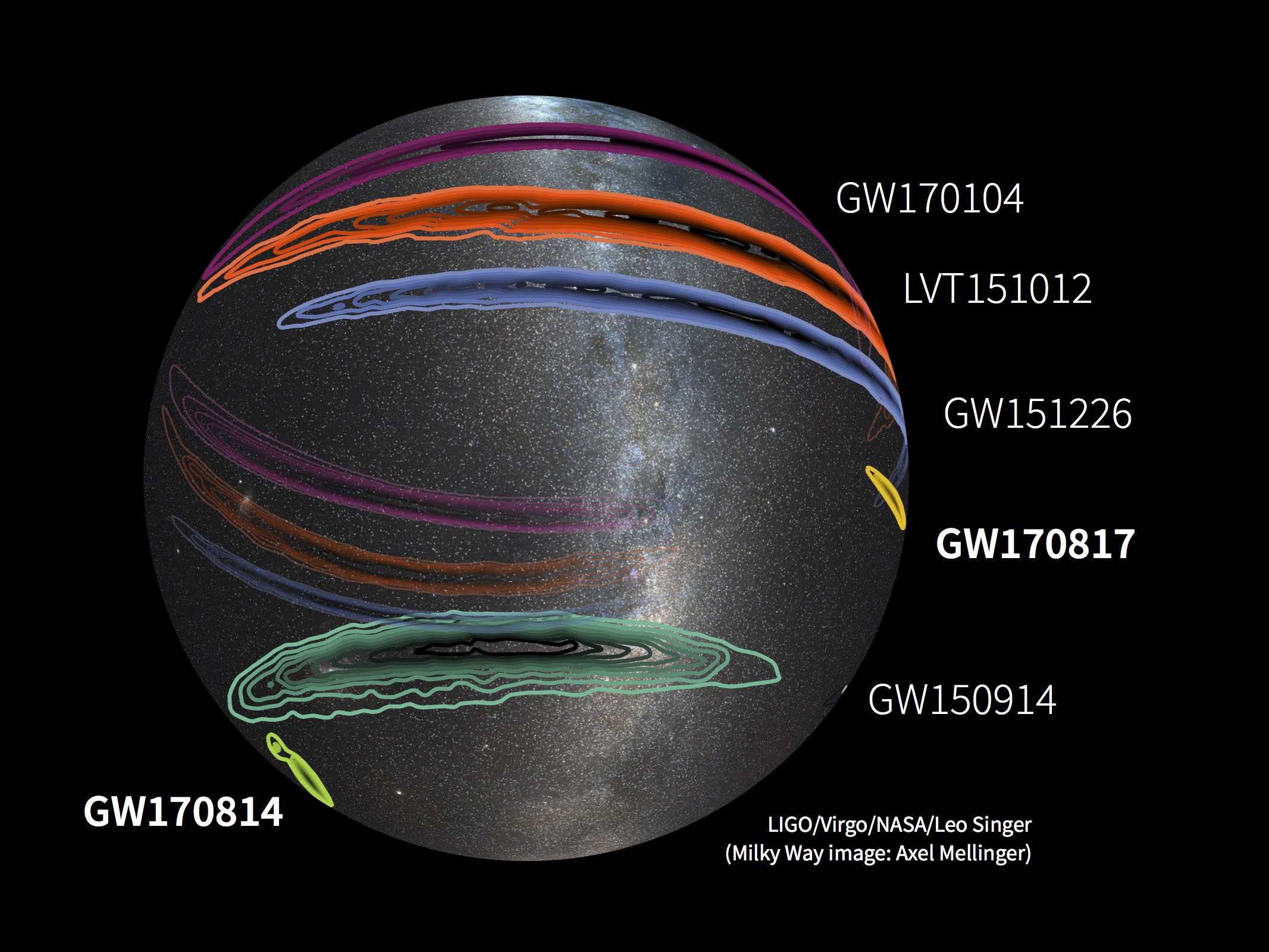
Though the LIGO detectors first picked up the gravitational wave in the United States, Virgo, in Italy, played a key role in the story. Due to its orientation with respect to the source at the time of detection, Virgo recovered a small signal; combined with the signal sizes and timing in the LIGO detectors, this allowed scientists to precisely triangulate the position in the sky. After performing a thorough vetting to make sure the signals were not an artifact of instrumentation, scientists concluded that a gravitational wave came from a relatively small patch in the southern sky.
Virgo Helps Localize Gravitational-Wave Signals
“This event has the most precise sky localization of all detected gravitational waves so far,” says Jo van den Brand of Nikhef (the Dutch National Institute for Subatomic Physics) and VU University Amsterdam, who is the spokesperson for the Virgo collaboration. “This record precision enabled astronomers to perform follow-up observations that led to a plethora of breathtaking results.”
“This result is a great example of the effectiveness of teamwork, of the importance of coordinating, and of the value of scientific collaboration,” adds EGO Director Federico Ferrini. “We are delighted to have played our relevant part in this extraordinary scientific challenge: Without Virgo, it would have been very difficult to locate the source of the gravitational wave.
Fermi was able to provide a localization that was later confirmed and greatly refined with the coordinates provided by the combined LIGO-Virgo detection. With these coordinates, a handful of observatories around the world were able, hours later, to start searching the region of the sky where the signal was thought to originate. A new point of light, resembling a new star, was first found by optical telescopes. Ultimately, about 70 observatories on the ground and in space observed the event at their representative wavelengths.
“This detection opens the window of a long-awaited ‘multi-messenger’ astronomy,” says Caltech’s David H. Reitze, executive director of the LIGO Laboratory. “It’s the first time that we’ve observed a cataclysmic astrophysical event in both gravitational waves and electromagnetic waves — our cosmic messengers. Gravitational-wave astronomy offers new opportunities to understand the properties of neutron stars in ways that just can’t be achieved with electromagnetic astronomy alone.”
A fireball and an afterglow
Each electromagnetic observatory will be releasing its own detailed observations of the astrophysical event. In the meantime, a general picture is emerging among all observatories involved that further confirms that the initial gravitational-wave signal indeed came from a pair of inspiraling neutron stars.
Approximately 130 million years ago, the two neutron stars were in their final moments of orbiting each other, separated only by about 300 kilometers, or 200 miles, and gathering speed while closing the distance between them. As the stars spiraled faster and closer together, they stretched and distorted the surrounding space-time, giving off energy in the form of powerful gravitational waves, before smashing into each other.
Neutron Star Merger Seen in Gravity and Matter
At the moment of collision, the bulk of the two neutron stars merged into one ultradense object, emitting a “fireball” of gamma rays. The initial gamma-ray measurements, combined with the gravitational-wave detection, also provide confirmation for Einstein’s general theory of relativity, which predicts that gravitational waves should travel at the speed of light.
Theorists have predicted that what follows the initial fireball is a “kilonova” — a phenomenon by which the material that is left over from the neutron star collision, which glows with light, is blown out of the immediate region and far out into space. The new light-based observations show that heavy elements, such as lead and gold, are created in these collisions and subsequently distributed throughout the universe.
In the weeks and months ahead, telescopes around the world will continue to observe the afterglow of the neutron star merger and gather further evidence about various stages of the merger, its interaction with its surroundings, and the processes that produce the heaviest elements in the universe.
“When we were first planning LIGO back in the late 1980s, we knew that we would ultimately need an international network of gravitational-wave observatories, including Europe, to help localize the gravitational-wave sources so that light-based telescopes can follow up and study the glow of events like this neutron star merger,” says Caltech’s Fred Raab, LIGO associate director for observatory operations. “Today we can say that our gravitational-wave network is working together brilliantly with the light-based observatories to usher in a new era in astronomy, and will improve with the planned addition of observatories in Japan and India.”
More than 1,200 scientists and some 100 institutions from around the world participate in the effort through the LIGO Scientific Collaboration, which includes the GEO Collaboration and the Australian collaboration OzGrav. Additional partners are listed at http://ligo.org/partners.php
The Virgo collaboration consists of more than 280 physicists and engineers belonging to 20 different European research groups: six from Centre National de la Recherche Scientifique (CNRS) in France; eight from the Istituto Nazionale di Fisica Nucleare (INFN) in Italy; two in the Netherlands with Nikhef; the MTA Wigner RCP in Hungary; the POLGRAW group in Poland; Spain with the University of Valencia; and the European Gravitational Observatory, EGO, the laboratory hosting the Virgo detector near Pisa in Italy, funded by CNRS, INFN, and Nikhef.
High Res. versions of these graphics can be found in our gallery.
GW170817’s numbers
Masses of Neutron Stars and Black Holes
Current operating facilities in the global network include the twin LIGO detectors—in Hanford, Washington, and Livingston, Louisiana – Virgo in Italy, and GEO600 in Germany.
Neutron Star Merger Seen in Gravity and Matter
Virgo Helps Localize Gravitational-Wave Signals
GW170817: A Global Astronomy Event
Artist’s illustration of two merging neutron stars.
LIGO’s data shows the “chirp” sound produced as the two neutron stars inspiral.
Videos
Neutron star merger (Credit: Christopher W. Evans/Georgia Tech)
Jets and Debris from Neutron Star Collision (Credit: NASA/Goddard Space Flight Center/CI Lab)
Last Dance of Neutron Star Pair (Credit: W. Kastaun/T. Kawamura/B. Giacomazzo/R. Ciolfi/A. Endrizzi)
Ripples of Gravity, Flashes of Light (Credit: LIGO/Virgo)
Zooming in on the Source of Gravitational Waves (Credit: LIGO-Virgo)
Final Flight of Neutron Star Pair (Credit: LIGO-Virgo/Aaron Geller/Northwestern University)
Hearing the Wave (Credit: Alex Nitz/Max Planck Institute for Gravitational Physics/LIGO)
The Universal Theorem contains elements from: Einstein’s Theory of Relativity / Space-time Continuum, Vortex Physics, Chaos Theory and The Laws of Thermodynamics. The combination of these elements form a system. The interaction between the system and matter is commonly called time.
Imagine Earth as it starts on the edge of the vortex and slowly gets pulled toward the center and bottom… spiraling faster and faster.
Spiral Galaxy
NASA states, “Messier 74, also called NGC 628, is a stunning example of a grand-design spiral galaxy that is viewed by Earth observers nearly face-on. Its perfectly symmetrical spiral arms emanate from the central nucleus and are dotted with clusters of young blue stars and glowing pink regions of ionized hydrogen (hydrogen atoms that have lost their electrons). These regions of star formation show an excess of light at ultraviolet wavelengths.”
You can not really take a picture of a black hole. No light escapes from a black hole, so you won’t see anything. That is why it is called a black hole; however, theoretical astronomers have attempted to take the first picture. Instead, they try to piece together an image of a black hole’s “event horizon”. An event horizon is a term from general relativity that describes a boundary in spacetime. What is beyond the event horizon cannot affect an outside observer (the shell of “points of no return” at which the gravitational pull becomes so great as to make escape impossible including light.)
The event horizon allows you to see the shadow from a black hole. The Event Horizon Telescope links telescopes from around the world to create one Earth-sized telescope.
Vincent Fish, a research scientists at MIT, said, “What we expect to see is an asymmetric image where you have a circular dark region. That’s the black hole shadow. And there might be a bright ring at the edge of that—which is the photon ring [a spherical region of space where gravity is so strong photons are forced to travel in orbits]. Then around it you will see one side is bright and the other side is faint, so kind of like a crescent.
The reason for the crescent is that material near the black hole is moving at a few tenths of the speed of light. Special relativity tells you when particles emit photons—when they shine light at you—if the particles are moving towards you, it looks very bright, if they’re moving away from you, then it gets very dim. That produces this asymmetry.”
The Event Horizon Telescope will allow for the first time an image with high enough resolution to show the event horizon from a black hole. In early April 2017, astronomers took five days worth of images. It will take several months before the images can be pieced together to form “a picture of a black hole”.
A teenager from Canada has discovered a Mayan City. William Gadoury, a 15-year-old from Saint-Jean-de-Matha in Canada, used images from NASA, the Canadian Space Agency and the Japanese Space Agency to connect the position of the stars in constellations to the position of Mayan cities.
“Geometric shapes, such as squares or rectangles, appeared on these images, forms that can hardly be attributed to natural phenomena,” says remote sensing specialist at the University of New Brunswick, Dr. Armand LaRocque.
“When Dr. LaRocque told me in January, we distinguish a pyramid and thirty structures, it was extraordinary,” said young Gadoury. William has named the lost city K’ÀAK ‘CHI’ or ‘fire mouth’ in French. “I did not understand why the Maya built their cities away from rivers, on marginal lands and in the mountains, said William. “They had to have another reason, and as they worshiped the stars, the idea came to me to verify my hypothesis. I was really surprised and excited when I realized that the most brilliant stars of the constellations matched the largest Maya cities.”
NASA released print quality travel posters promoting space exploration.
Greetings from your First Exoplanet
While there is much debate over which exoplanet discovery is considered the “first,” one stands out from the rest. In 1995, scientists discovered 51 Pegasi b, forever changing the way we see the universe and our place in it. The exoplanet is about half the mass of Jupiter, with a seemingly impossible, star-hugging orbit of only 4.2 Earth days. Not only was it the first planet confirmed to orbit a sun-like star, it also ushered in a whole new class of planets called Hot Jupiters: hot, massive planets orbiting closer to their stars than Mercury. Today, powerful observatories like NASA’s Kepler space telescope will continue the hunt of distant planets.
PSO J318.5-22 – Where the Nightlife Never Ends
Discovered in October 2013 using direct imaging, PSO J318.5-22 belongs to a special class of planets called rogue, or free-floating, planets. Wandering alone in the galaxy, they do not orbit a parent star. Not much is known about how these planets come to exist, but scientists theorize that they may be either failed stars or planets ejected from very young systems after an encounter with another planet. These rogue planets glow faintly from the heat of their formation. Once they cool down, they will be dancing in the dark.
Experience the Gravity of a Super Earth
Twice as big in volume as the Earth, HD 40307g straddles the line between “Super-Earth” and “mini-Neptune” and scientists aren’t sure if it has a rocky surface or one that’s buried beneath thick layers of gas and ice. One thing is certain though: at eight time the Earth’s mass, its gravitational pull is much, much stronger.
Relax on Kepler-16b – Where your shadow always has company
Like Luke Skywalker’s planet “Tatooine” in Star Wars, Kepler-16b orbits a pair of stars. Depicted here as a terrestrial planet, Kepler-16b might also be a gas giant like Saturn. Prospects for life on this unusual world aren’t good, as it has a temperature similar to that of dry ice. But the discovery indicates that the movie’s iconic double-sunset is anything but science fiction.
Kepler-186 f – Where the Grass is Always Redder
Kepler-186f is the first Earth-size planet discovered in the potentially ‘habitable zone’ around another star, where liquid water could exist on the planet’s surface. Its star is much cooler and redder than our Sun. If plant life does exist on a planet like Kepler-186f, its photosynthesis could have been influenced by the star’s red-wavelength photons, making for a color palette that’s very different than the greens on Earth. This discovery was made by Kepler, NASA’s planet hunting telescope.
SpaceX is a private company that manufactures and launches advanced rockets and spacecraft. The company was founded in 2002 to revolutionize space technology, with the ultimate goal of enabling people to live on other planets.
After several recent failed missions, SpaceX has launched and recovered the first ever reusable rocket. The SpaceX rocket launched multiple satellites into space, then came back to Earth, using rockets to stabilize itself and land on a pad in at Cape Canaveral in Florida.
“If one can figure out how to effectively reuse rockets just like airplanes, the cost of access to space will be reduced by as much as a factor of a hundred. A fully reusable vehicle has never been done before. That really is the fundamental breakthrough needed to revolutionize access to space,” said founder Elon Musk.
About The Mission
With this mission, SpaceX’s Falcon 9 rocket will deliver 11 satellites to low-Earth orbit for ORBCOMM, a leading global provider of Machine-to-Machine communication and Internet of Things solutions. The ORBCOMM launch is targeted for an evening launch from Space Launch Complex 40 at Cape Canaveral Air Force Station, Fla. If all goes as planned, the 11 satellites will be deployed approximately 20 minutes after liftoff, completing a 17-satellite, low Earth orbit constellation for ORBCOMM. This mission also marks SpaceX’s return-to-flight as well as its first attempt to land a first stage on land. The landing of the first stage is a secondary test objective.
Nine-minute exposure picture of the launch, re-entry and landing burns of SpaceX’s Falcon 9 rocket at Cape Canaveral Air Force Station.
Cutting the space budget really restores my faith in humanity. It
eliminates dreams, goals, and ideals and lets us get straight to the
business of hate, debauchery, and self-annihilation.
— Johnny Hart