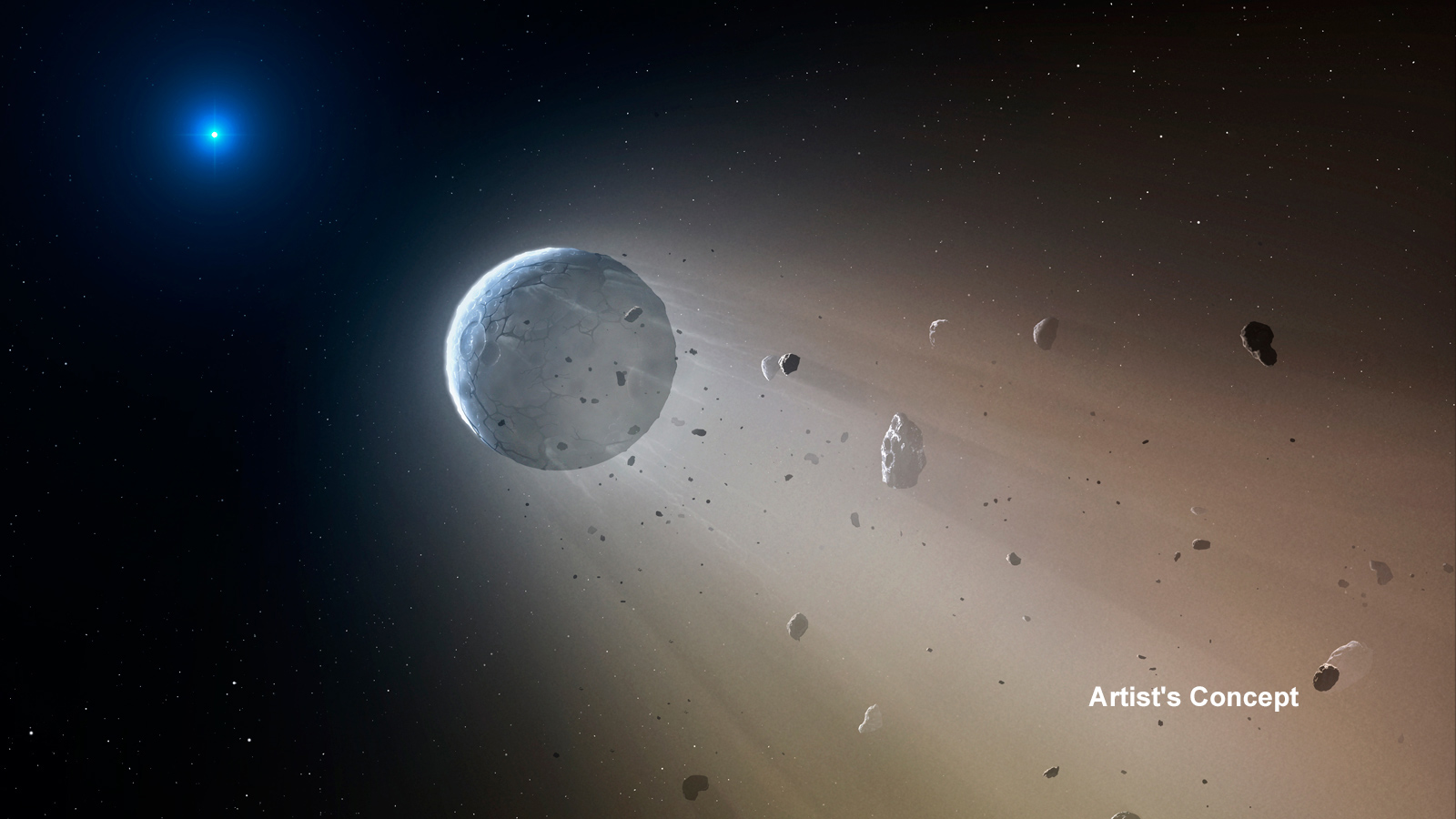
NASA — Scientists using NASA’s repurposed Kepler space telescope, known as the K2 mission, have uncovered strong evidence of a tiny, rocky object being torn apart as it spirals around a white dwarf star. This discovery validates a long-held theory that white dwarfs are capable of cannibalizing possible remnant planets that have survived within its solar system.
“We are for the first time witnessing a miniature “planet” ripped apart by intense gravity, being vaporized by starlight and raining rocky material onto its star,” said Andrew Vanderburg, graduate student at the Harvard-Smithsonian Center for Astrophysics in Cambridge, Massachusetts, and lead author of the paper published in Nature.
As stars like our sun age, they puff up into red giants and then gradually lose about half their mass, shrinking down to 1/100th of their original size to roughly the size of Earth. This dead, dense star remnant is called a white dwarf.
Hubble Space Telescope: Captures New Image of Galaxy 72 Million Light-Years From Earth
The telescope, operated by NASA and the European Space Agency, was used to photograph NCG 4639, a barred spiral galaxy located in the Virgo constellation.
“There is no dark side of the moon really. Matter of fact it’s all dark.”
— Pink Floyd
NASA has taken a picture of the far side of the moon:
The far side of the moon, illuminated by the sun, is seen as it crosses between our ‘EPIC’ camera on the Deep Space Climate Observatory (DSCOVR) satellite, and the Earth – one million miles away.
NASA — NASA’s Kepler mission has confirmed the first near-Earth-size planet in the “habitable zone” around a sun-like star. This discovery and the introduction of 11 other new small habitable zone candidate planets mark another milestone in the journey to finding another “Earth.”
The newly discovered Kepler-452b is the smallest planet to date discovered orbiting in the habitable zone — the area around a star where liquid water could pool on the surface of an orbiting planet — of a G2-type star, like our sun. The confirmation of Kepler-452b brings the total number of confirmed planets to 1,030.
“On the 20th anniversary year of the discovery that proved other suns host planets, the Kepler exoplanet explorer has discovered a planet and star which most closely resemble the Earth and our Sun,” said John Grunsfeld, associate administrator of NASA’s Science Mission Directorate at the agency’s headquarters in Washington. “This exciting result brings us one step closer to finding an Earth 2.0.”
Kepler-452b is 60 percent larger in diameter than Earth and is considered a super-Earth-size planet. While its mass and composition are not yet determined, previous research suggests that planets the size of Kepler-452b have a good chance of being rocky.
While Kepler-452b is larger than Earth, its 385-day orbit is only 5 percent longer. The planet is 5 percent farther from its parent star Kepler-452 than Earth is from the Sun. Kepler-452 is 6 billion years old, 1.5 billion years older than our sun, has the same temperature, and is 20 percent brighter and has a diameter 10 percent larger.
“We can think of Kepler-452b as an older, bigger cousin to Earth, providing an opportunity to understand and reflect upon Earth’s evolving environment,” said Jon Jenkins, Kepler data analysis lead at NASA’s Ames Research Center in Moffett Field, California, who led the team that discovered Kepler-452b. “It’s awe-inspiring to consider that this planet has spent 6 billion years in the habitable zone of its star; longer than Earth. That’s substantial opportunity for life to arise, should all the necessary ingredients and conditions for life exist on this planet.”
To help confirm the finding and better determine the properties of the Kepler-452 system, the team conducted ground-based observations at the University of Texas at Austin’s McDonald Observatory, the Fred Lawrence Whipple Observatory on Mt. Hopkins, Arizona, and the W. M. Keck Observatory atop Mauna Kea in Hawaii. These measurements were key for the researchers to confirm the planetary nature of Kepler-452b, to refine the size and brightness of its host star and to better pin down the size of the planet and its orbit.
The Kepler-452 system is located 1,400 light-years away in the constellation Cygnus. The research paper reporting this finding has been accepted for publication in The Astronomical Journal.
In addition to confirming Kepler-452b, the Kepler team has increased the number of new exoplanet candidates by 521 from their analysis of observations conducted from May 2009 to May 2013, raising the number of planet candidates detected by the Kepler mission to 4,696. Candidates require follow-up observations and analysis to verify they are actual planets.
Twelve of the new planet candidates have diameters between one to two times that of Earth, and orbit in their star’s habitable zone. Of these, nine orbit stars that are similar to our sun in size and temperature.
“We’ve been able to fully automate our process of identifying planet candidates, which means we can finally assess every transit signal in the entire Kepler dataset quickly and uniformly,” said Jeff Coughlin, Kepler scientist at the SETI Institute in Mountain View, California, who led the analysis of a new candidate catalog. “This gives astronomers a statistically sound population of planet candidates to accurately determine the number of small, possibly rocky planets like Earth in our Milky Way galaxy.”
These findings, presented in the seventh Kepler Candidate Catalog, will be submitted for publication in the Astrophysical Journal. These findings are derived from data publicly available on the NASA Exoplanet Archive.
Scientists now are producing the last catalog based on the original Kepler mission’s four-year data set. The final analysis will be conducted using sophisticated software that is increasingly sensitive to the tiny telltale signatures of Earth-size planets.
Ames manages the Kepler and K2 missions for NASA’s Science Mission Directorate. NASA’s Jet Propulsion Laboratory in Pasadena, California, managed Kepler mission development. Ball Aerospace & Technologies Corporation operates the flight system with support from the Laboratory for Atmospheric and Space Physics at the University of Colorado in Boulder.
Kepler 452b Compared to Earth
For more information about the Kepler mission, visit:
http://www.nasa.gov/kepler
A related feature story about other potentially habitable planets is online at: http://www.nasa.gov/jpl/finding-another-earth
It’s been many years since NASA has taken a picture of Earth. Now, they released the Blue Marble image captured by the National Oceanic and Atmospheric Administration (NOAA)’s #DSCOVR spacecraft.
This is the first photo of the entire Earth taken in 43 years:
NASA’s New Horizons spacecraft returned images of Pluto from over three billion miles away. After a decade-long journey through our solar system, New Horizons made its closest approach to Pluto, about 7,750 miles above the surface.
“My dad would be thrilled with New Horizons,” said Clyde Tombaugh’s daughter Annette Tombaugh, of Las Cruces, New Mexico. “To actually see the planet that he had discovered, and find out more about it — to get to see the moons of Pluto– he would have been astounded. I’m sure it would have meant so much to him if he were still alive today.”
NASA Kepler’s Hall of Fame: Of the more than 1,000 verified planets found by NASA’s Kepler Space Telescope, eight are less than twice Earth-size and in their stars’ habitable zone. All eight orbit stars cooler and smaller than our sun. The search continues for Earth-size habitable zone worlds around sun-like stars.
How many stars like our sun host planets like our Earth? NASA’s Kepler Space Telescope continuously monitored more than 150,000 stars beyond our solar system, and to date has offered scientists an assortment of more than 4,000 candidate planets for further study — the 1,000th of which was recently verified.
Using Kepler data, scientists reached this millenary milestone after validating that eight more candidates spotted by the planet-hunting telescope are, in fact, planets. The Kepler team also has added another 554 candidates to the roll of potential planets, six of which are near-Earth-size and orbit in the habitable zone of stars similar to our sun.
Three of the newly-validated planets are located in their distant suns’ habitable zone, the range of distances from the host star where liquid water might exist on the surface of an orbiting planet. Of the three, two are likely made of rock, like Earth.
“Each result from the planet-hunting Kepler mission’s treasure trove of data takes us another step closer to answering the question of whether we are alone in the Universe,” said John Grunsfeld, associate administrator of NASA’s Science Mission Directorate at the agency’s headquarters in Washington. “The Kepler team and its science community continue to produce impressive results with the data from this venerable explorer.”
To determine whether a planet is made of rock, water or gas, scientists must know its size and mass. When its mass can’t be directly determined, scientists can infer what the planet is made of based on its size.
Two of the newly validated planets, Kepler-438b and Kepler-442b, are less than 1.5 times the diameter of Earth. Kepler-438b, 475 light-years away, is 12 percent bigger than Earth and orbits its star once every 35.2 days. Kepler-442b, 1,100 light-years away, is 33 percent bigger than Earth and orbits its star once every 112 days.
Both Kepler-438b and Kepler-442b orbit stars smaller and cooler than our sun, making the habitable zone closer to their parent star, in the direction of the constellation Lyra. The research paper reporting this finding has been accepted for publication in The Astrophysical Journal.
“With each new discovery of these small, possibly rocky worlds, our confidence strengthens in the determination of the true frequency of planets like Earth,” said co-author Doug Caldwell, SETI Institute Kepler scientist at NASA’s Ames Research Center at Moffett Field, California. “The day is on the horizon when we’ll know how common temperate, rocky planets like Earth are.”
With the detection of 554 more planet candidates from Kepler observations conducted May 2009 to April 2013, the Kepler team has raised the candidate count to 4,175. Eight of these new candidates are between one to two times the size of Earth, and orbit in their sun’s habitable zone. Of these eight, six orbit stars that are similar to our sun in size and temperature. All candidates require follow-up observations and analysis to verify they are actual planets.
“Kepler collected data for four years — long enough that we can now tease out the Earth-size candidates in one Earth-year orbits”, said Fergal Mullally, SETI Institute Kepler scientist at Ames who led the analysis of a new candidate catalog. “We’re closer than we’ve ever been to finding Earth twins around other sun-like stars. These are the planets we’re looking for”.
These findings also have been submitted for publication in The Astrophysical Journal Supplement.
Work is underway to translate these recent discoveries into estimates of how often rocky planets appear in the habitable zones of stars like our sun, a key step toward NASA’s goal of understanding our place in the universe.
Scientists also are working on the next catalog release of Kepler’s four-year data set. The analysis will include the final month of data collected by the mission and also will be conducted using sophisticated software that is more sensitive to the tiny telltale signatures of small Earth-size planets than software used in the past.
Ames is responsible for Kepler’s mission operations, ground system development and science data analysis. NASA’s Jet Propulsion Laboratory in Pasadena, California, managed Kepler mission development. Ball Aerospace & Technologies Corp. in Boulder, Colorado, developed the Kepler flight system and supports mission operations with the Laboratory for Atmospheric and Space Physics at the University of Colorado in Boulder. The Space Telescope Science Institute in Baltimore archives, hosts and distributes Kepler science data. Kepler is NASA’s 10th Discovery Mission and was funded by the agency’s Science Mission Directorate in Washington.
OUTER SPACE — What happens if you are on the Space Station and you need a wrench? Just have NASA e-mail it up and print it on the 3D printer.
It is the first time that hardware was e-mailed to space.
Mike Chen, founder of Made In Space (the company behind the 3-D printer) said, “We had overheard ISS Commander Barry Wilmore mention over the radio that he needed one, so we designed one in CAD and sent it up to him faster than a rocket ever could have.”
“The socket wrench we just manufactured is the first object we designed on the ground and sent digitally to space, on the fly.
“It also marks the end of our first experiment — a sequence of 21 prints that together make up the first tools and objects ever manufactured off the surface of the Earth.”
Better than imagination… realization… “The Rosetta Lander Imaging System (ROLIS) on Philae took this picture three kilometres above the surface as the craft descended.”
The European Space Agency has successfully landed a spaceship on a comet. The Rosetta mission started 10 years ago when Philae was launched into space. An ESA spokesman said, “We are the first to have done that, and that will stay forever.”
Astronomers are building a new telescope called the “European Extremely Large Telescope”. Construction has started in Chile where they have blown the top off of the Cerro Armazones mountain. The telescope will be the largest in the world and consisting of 789 hexagonal mirrors.