Simplified Introduction
Cognitive Ability, Christian Nationalism & Climate Change Denial
A new 2026 study by sociologist S. L. Perry finds a significant negative association between verbal cognitive ability and Christian nationalist beliefs in the United States.
That finding raises an important question:
What does cognition have to do with climate change denial?
Climate science is extraordinarily complex. Understanding it requires processing interconnected systems, probabilities, feedbacks, long-term trends, and evidence that cannot simply be evaluated through everyday experience.
This creates several pathways toward climate skepticism:
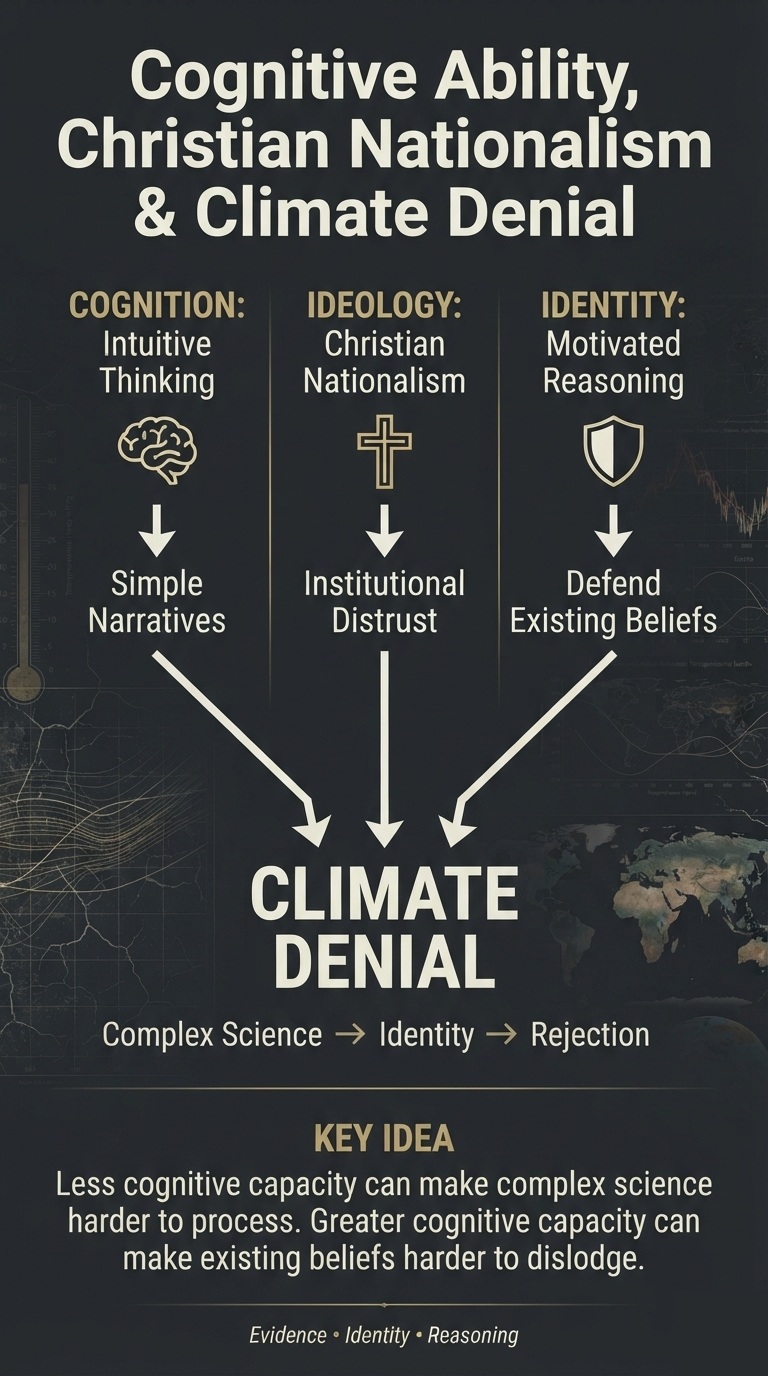
🧠 Intuitive thinking can favor simple narratives over complex scientific evidence.
✝️ Christian nationalist ideology can reinforce distrust of secular scientific and academic institutions.
🛡️ Motivated reasoning can allow people with substantial cognitive ability to construct sophisticated defenses of beliefs that are deeply connected to their political, religious, or cultural identity.
The result is a paradox: Less cognitive capacity can make complex science harder to process. Greater cognitive capacity can make existing beliefs harder to dislodge.
The problem is therefore not simply ignorance.
It is the interaction of cognition, ideology, identity, institutional trust, and reasoning.
Cognitive Ability, Christian Nationalism, and Climate Change Denial
The 2026 study “Cognitive Ability and Christian Nationalism” by sociologist S. L. Perry, published in the Journal for the Scientific Study of Religion, establishes a significant negative association between cognitive ability—specifically verbal intelligence—and Christian nationalist beliefs in the United States.
Perry’s findings intersect directly with the psychology and sociology of climate change denialism through shared cognitive mechanisms, ideological alignments, and patterns of scientific skepticism.
The relationship can be understood through three primary connections.
1. The Common Thread: Lower Cognitive Ability and Intuitive Thinking
Perry’s study establishes that lower cognitive ability, specifically verbal intelligence, is associated with a greater likelihood of adopting Christian nationalist beliefs.
This finding intersects with psychological research on climate change denial, where lower cognitive ability and reliance on intuitive rather than analytical thinking have also been identified as factors associated with rejection of climate science.
Climate science presents an unusually difficult cognitive problem. It is abstract, global, highly interconnected, probabilistic, and dependent on scientific concepts that cannot be directly observed by most people. Atmospheric chemistry, radiative forcing, feedback mechanisms, ocean heat uptake, ice dynamics, and long-term statistical trends are not matters that can be evaluated through everyday intuition alone.
As a result, people with fewer cognitive resources—or those who rely more heavily on intuitive reasoning—may be more likely to substitute simple cognitive shortcuts for complex scientific analysis.
Instead of evaluating atmospheric data, climate models, physical mechanisms, and multiple independent lines of evidence, an individual may rely on a familiar narrative:
“It doesn’t feel warmer.”
“The climate has always changed.”
“Scientists have been wrong before.”
“God controls the weather.”
These shortcuts provide simple answers to a highly complex scientific problem. The important connection is therefore not simply intelligence. It is the interaction between cognitive ability, reasoning style, and the complexity of the information being evaluated.
2. Christian Nationalism as an Ideological Driver of Climate Skepticism
Christian nationalism is not simply a religious belief. It is a cultural and political framework that can overlap with broader anti-science attitudes and distrust of secular institutions.
Sociological research has identified Christian nationalism as an important predictor of climate skepticism. The connection is particularly apparent when environmental and climate issues become associated with secular scientific institutions, universities, government agencies, international organizations, and political movements perceived as threatening traditional cultural values.
The “God Is in Control” Narrative
One mechanism is theological.
Within some Christian nationalist frameworks, there is a strong emphasis on God’s absolute sovereignty over the Earth. This can manifest in the belief that humans cannot fundamentally alter the climate because God controls the weather and ultimately determines the Earth’s fate.
When taken to its logical extreme, such a worldview can conflict directly with climate science. Climate science does not claim that humans control the climate absolutely. It demonstrates that human activities—particularly the emission of greenhouse gases—alter the Earth’s energy balance and therefore alter the climate system.
The conflict is consequently not necessarily between Christianity and climate science. It is between particular interpretations of religious sovereignty and the scientific evidence demonstrating that human activity is a major driver of contemporary climate change.
Anti-System Sentiments
Christian nationalism can also overlap with populist political movements characterized by distrust of secular institutions, academia, government agencies, international organizations, and scientific authorities.
Climate change becomes particularly vulnerable to this form of institutional distrust because accepting the scientific evidence requires trusting multiple scientific institutions and disciplines operating across national boundaries. Consequently, rejecting climate science can become an extension of a broader rejection of the institutions that produce, evaluate, and communicate scientific knowledge.
The result is a powerful ideological feedback:
Distrust the institution → distrust the science → reject the evidence → reinforce the ideology.
3. The Paradox of Motivated Reasoning
There is, however, an important paradox. Lower cognitive ability and intuitive thinking may help explain some forms of initial resistance to complex scientific information. But climate denial on the political right cannot be explained entirely by lower cognitive ability.
For highly complex political issues such as climate change, individuals with higher cognitive ability can sometimes use those cognitive resources not to discover objective truth, but to rationalize and defend conclusions consistent with their existing political or cultural identity.
This is commonly described as motivated reasoning or, in some research, Motivated System 2 Reasoning (MS2R).
The mechanism is straightforward. A person first arrives at a conclusion because it is consistent with the beliefs and values of their social group. The person’s cognitive abilities then become available to defend that conclusion. The more sophisticated the individual, the more sophisticated the defense can become.
This can produce highly elaborate arguments based on selective evidence:
- emphasizing isolated periods of cooling while ignoring the long-term warming trend;
- selecting individual scientists or studies that challenge the consensus while dismissing the larger body of evidence;
- focusing on uncertainty in climate projections while ignoring the underlying physical certainty of greenhouse-gas warming;
- demanding impossible standards of proof for climate science;
- identifying errors or controversies within individual studies and treating them as evidence against the entire scientific framework.
The issue is therefore not simply whether someone possesses the cognitive ability to understand climate science. It is also what that cognitive ability is being used to accomplish.
If accepting climate change threatens an individual’s political, religious, economic, or cultural identity, sophisticated reasoning can become a tool for protecting that identity rather than challenging it.
Summary of the Relationship
| Factor | Christian Nationalism | Climate Change Denialism |
|---|---|---|
| Cognitive Profile | Higher correlation with lower verbal intelligence and intuitive cognitive styles. | Higher correlation with lower cognitive ability and intuitive cognitive styles. |
| Cognitive Shortcuts | Complex social and political questions can be reduced to familiar religious or cultural narratives. | Complex climate science can be reduced to familiar narratives that contradict or dismiss scientific evidence. |
| Institutional Trust | Greater rejection of secular academic, governmental, and scientific authority. | Greater rejection of mainstream climate science and international scientific institutions. |
| Core Ideology | Fusion of American identity with conservative Christian cultural and political dominance. | Often reinforced by conservative political identity, distrust of institutions, and religious interpretations of human responsibility for the Earth. |
| Religious Framework | Divine sovereignty can be interpreted as placing ultimate control of the Earth in God’s hands. | “God is in control” can become an argument against the possibility or significance of human-caused climate change. |
| Motivated Reasoning | Cognitive resources can be used to defend existing religious and political identities. | Higher cognitive ability can sometimes facilitate sophisticated arguments defending climate skepticism when climate action conflicts with group identity. |
The Larger Pattern
Taken together, these relationships reveal a potentially important common structure.
Climate denialism is not necessarily produced by a single cognitive deficiency or a single political ideology. It can emerge from the interaction of cognitive ability, intuitive reasoning, ideological identity, religious worldview, institutional distrust, and motivated reasoning.
At one end of the spectrum, limited cognitive resources and intuitive thinking can make a highly complex scientific problem easier to process through simple ideological narratives.
At the other end, sophisticated cognitive abilities can be deployed to construct increasingly elaborate defenses of those same narratives.
The result is a paradox:
Less cognitive capacity can make complex scientific information harder to understand, while greater cognitive capacity can make an existing ideological conclusion harder to dislodge.
This helps explain why climate change denial persists even as the physical evidence becomes increasingly extensive.
The fundamental conflict is therefore not simply between science and ignorance.
It can become a conflict between evidence and identity.
And when scientific evidence threatens a deeply embedded religious, political, or cultural identity, the human capacity for reasoning can become not merely a mechanism for discovering what is true—but a mechanism for defending what one already believes.