by Daniel Brouse
2026: The New Economic Reality
Money moves people.
The climate costs of fossil-fuel dependence are increasingly outweighing its benefits—not in some distant future, but here and now. We are moving beyond arguments about what climate change might cost decades from today. Across the Western world, climate impacts are already imposing costs of hundreds of billions of dollars in real time.
Insurance is only one part of the story.
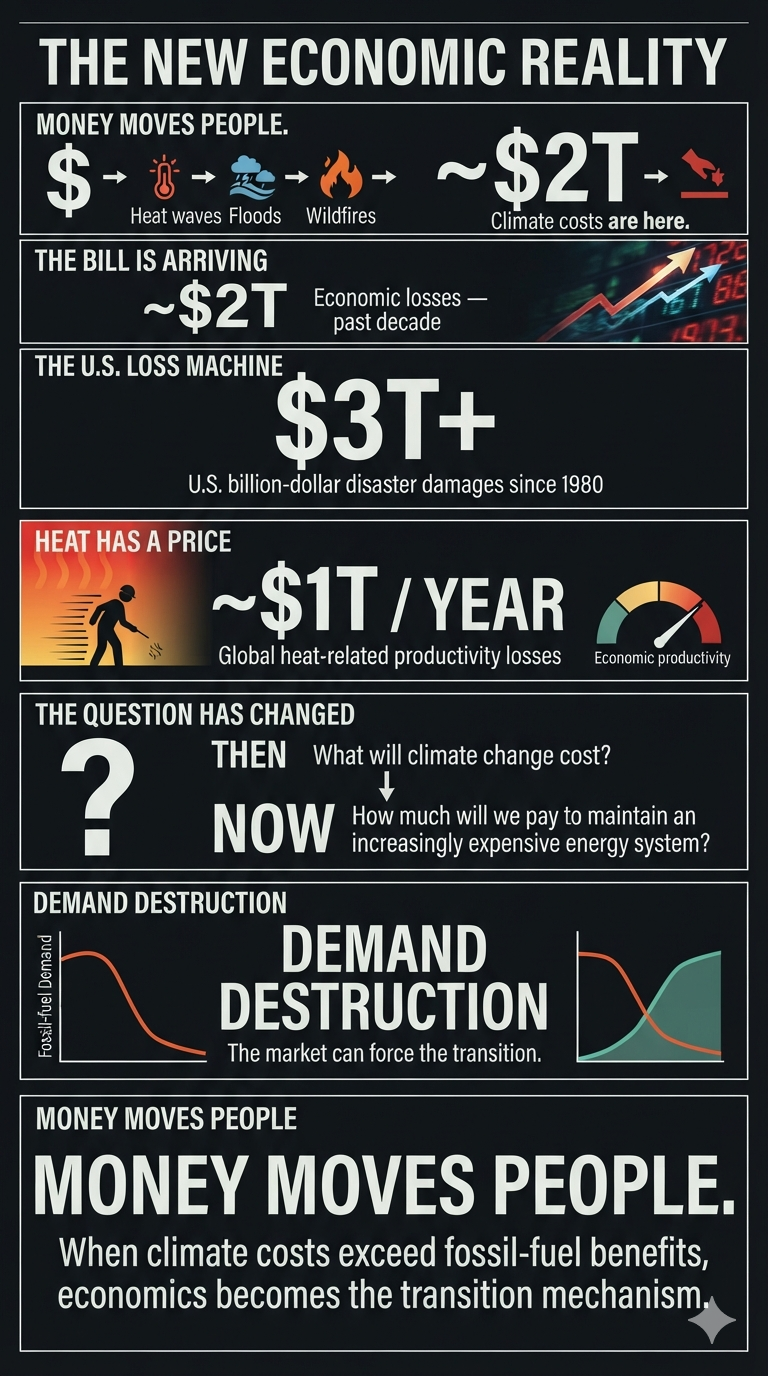
Infrastructure, agriculture, transportation, labor productivity, public health, energy systems, and financial markets are all beginning to absorb the cost of a destabilizing climate. The economic question is therefore changing. It is no longer simply:
“What will climate change cost us?”
It is increasingly:
“How much are we willing to pay to preserve an energy system that is becoming progressively more expensive to maintain?”
Climate Stress Is Becoming an Economic Stress Test
The physical infrastructure of the global economy is already being affected.
Maersk CEO Vincent Clerc has warned that climate change is putting increasing pressure on European waterways and that substantial infrastructure investment will be needed to keep the Rhine operating as a critical transportation artery.
But the economic importance of waterways extends far beyond shipping.
Rivers, lakes, and reservoirs are also critical components of the energy, industrial, agricultural, municipal, and ecological systems that support modern economies.
When water levels fall or water temperatures rise, power plants can be affected directly. Thermoelectric and nuclear power plants rely heavily on water for cooling. If river flows become too low, or water temperatures become too high, operators may be forced to reduce generation or temporarily shut down units because sufficient cooling capacity is no longer available or because thermal discharge limits are exceeded.
That creates an economic chain reaction:
Lower river flows or higher water temperatures
↓
Reduced cooling capacity
↓
Reduced power generation
↓
Tighter electricity supplies
↓
Higher electricity prices and grid stress
↓
Higher operating costs for industry and consumers
The same waterways that transport fuel, raw materials, agricultural products, chemicals, and manufactured goods can therefore also be essential to producing the electricity needed to move and manufacture those goods.
Water is simultaneously a transportation system, cooling system, industrial input, agricultural resource, and ecological asset.
When that system becomes unstable, multiple economic sectors can be affected at the same time.
Low water levels can also restrict the movement of coal, oil, natural gas, grain, chemicals, construction materials, and other bulk commodities. Barges may have to reduce their loads or make more trips to transport the same volume of goods. In some cases, alternative transportation by rail or truck becomes necessary, increasing fuel consumption, congestion, labor costs, and emissions.
Flooding creates the opposite problem.
Excess water can damage ports, locks, bridges, rail connections, roads, warehouses, industrial facilities, and electrical infrastructure. A waterway can therefore become economically disruptive at both extremes—too little water and too much water.
Agriculture is similarly exposed. Rivers and reservoirs provide irrigation, livestock water, and municipal supplies. Persistent drought can reduce agricultural output while increasing competition among farmers, cities, industry, ecosystems, and energy producers for increasingly scarce water.
There is also a less visible economic cost: water temperature itself is becoming an economic variable.
Warmer rivers can reduce their ability to absorb additional heat from industrial processes and power-plant cooling systems. At the same time, warmer water can stress aquatic ecosystems, fisheries, and drinking-water systems, creating additional regulatory, treatment, and ecological costs.
This produces a broader economic concept that is often missed in conventional disaster accounting:
Waterway disruption is not a single-sector problem. It is a systems problem.
The Rhine and Danube are not simply waterways. They are components of Europe’s economic infrastructure. They connect ports, factories, power plants, farms, cities, mines, warehouses, rail networks, and consumers. When climate conditions interfere with their operation, the economic consequences propagate through the system. A river does not have to disappear to create an economic crisis. It only has to become less reliable. And reliability is one of the most valuable—and often least visible—assets in a modern economy.
The Economic Toll of Extreme Weather
Global extreme weather and natural disasters are generating enormous economic losses. Recent estimates from the International Chamber of Commerce, insurers including Swiss Re, and disaster-loss tracking organizations show that severe convective storms, wildfires, floods, and other extreme events are producing annual losses measured in the hundreds of billions of dollars.
The first half of 2026 alone has already produced approximately $100 billion in global economic losses, while the cumulative economic toll over the past decade has reached roughly $2 trillion, according to recent assessments.
And the year is not over.
The second half of the year normally includes the peak of the North Atlantic hurricane season, creating the potential for another substantial wave of losses.
The Major Economic Drivers
Escalating annual losses.
Global disaster losses continue to accumulate at extraordinary levels. The combined economic losses from 2022 and 2023 alone have been estimated at roughly $451 billion.
The concentration of U.S. losses.
The United States remains a major source of global insured catastrophe losses. By June 2026, the country had already experienced 12 billion-dollar weather and climate disasters, with estimated losses totaling approximately $31.9 billion.
Severe convective storms.
Hail, tornadoes, straight-line winds, and other severe thunderstorms have become an increasingly persistent source of financial losses. The United States recorded a record 21 billion-dollar severe-convective-storm events in 2025.
Extreme heat and productivity.
The economic damage from climate change is not limited to destroyed buildings and infrastructure. Heat reduces worker productivity, particularly in construction, agriculture, manufacturing, and outdoor occupations. Global heat-related productivity losses have been estimated at roughly 1% of world GDP annually—around $1 trillion.
The long-term U.S. bill.
U.S. billion-dollar weather and climate disasters have generated cumulative damages exceeding $3 trillion since systematic tracking began in 1980.
The Trajectory Is the Story
Recent U.S. disaster statistics illustrate the increasing economic burden:
| Year | Billion-Dollar Events | Estimated Damage | Major Loss Drivers |
|---|---|---|---|
| 2025 | 23 | ~$115 billion | Severe storms, wildfires |
| 2024 | 27 | ~$182.7 billion | Severe storms, tropical cyclones, extreme heat |
| 2023 | 28 | $145+ billion | Severe storms and other extreme events |
The important point is not that every individual disaster can be attributed exclusively to climate change.
The economic signal emerges from the frequency, intensity, persistence, and cumulative cost of extreme conditions.
Climate change does not need to create every storm, flood, drought, or wildfire to transform the economics of risk. It only needs to increase the probability, severity, or duration of damaging events enough to alter the cost structure of society.
That is already happening.
“Demand Destruction” Is Our Friend
This brings us to one of the most powerful—and least appreciated—economic mechanisms in the energy transition:
Demand destruction.
The International Energy Agency has projected that global oil demand will decline more sharply than previously expected in 2026, forecasting a reduction of approximately 1.6 million barrels per day.
The significance extends beyond the number itself.
As an economist, I am less concerned with establishing a specific date by which the world must eliminate fossil fuels than I am with changing the economic forces that sustain fossil-fuel demand.
That distinction matters.
People do not necessarily change because someone wins an argument about climate science. They change because incentives change. Prices change. Risk changes. Availability changes. And eventually, behavior changes.
Money Moves People
I am unlikely to change the minds of the roughly 20% of Americans who are ideologically committed to policies that accelerate fossil-fuel dependence.
But that leaves the vast majority of the population. And economics can do much of the work. Integrated Climate Stewardship begins with reducing unnecessary consumption.
Consumerism drives energy demand, resource extraction, pollution, waste, and habitat destruction. Every unnecessary unit of consumption represents another demand for energy and materials somewhere in the global economy.
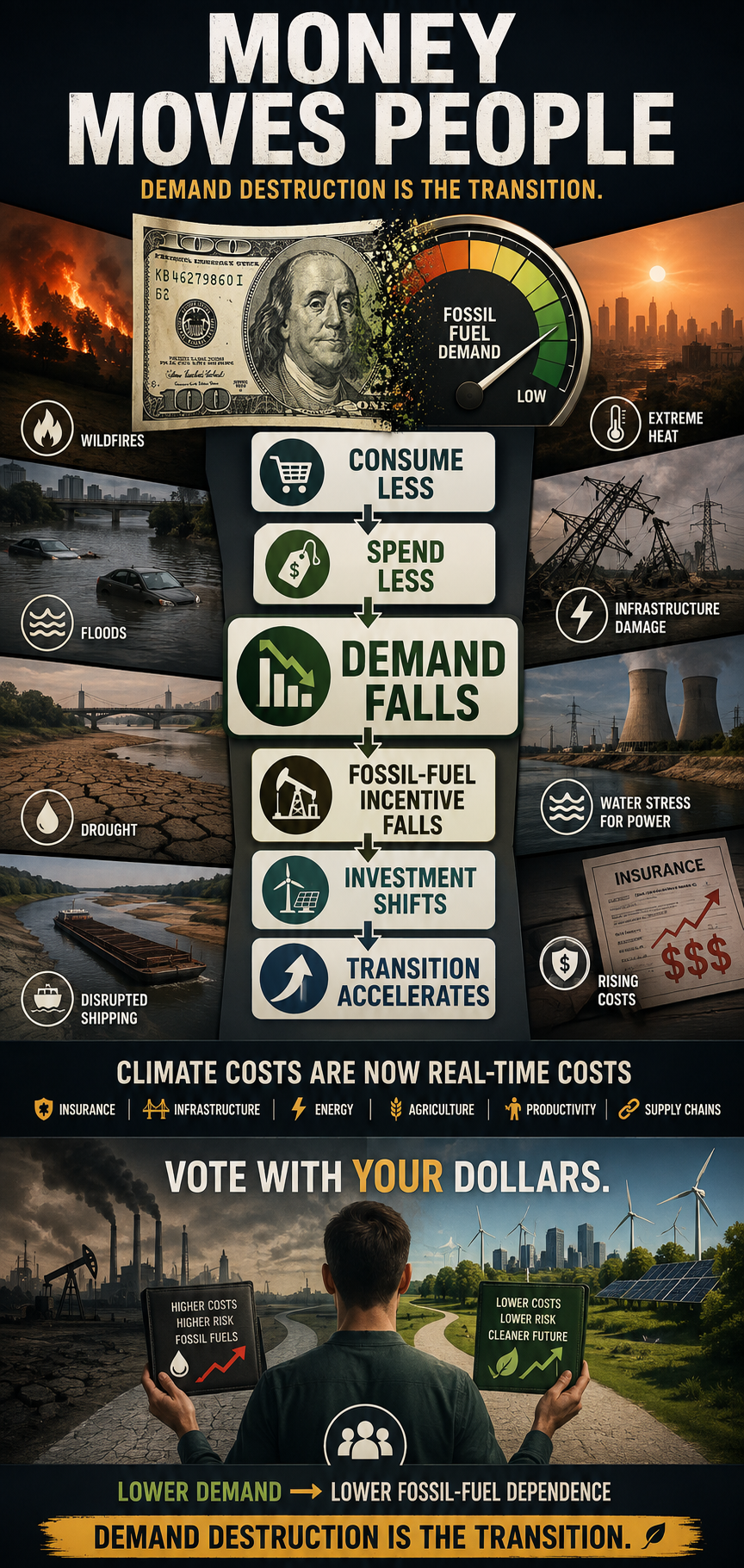
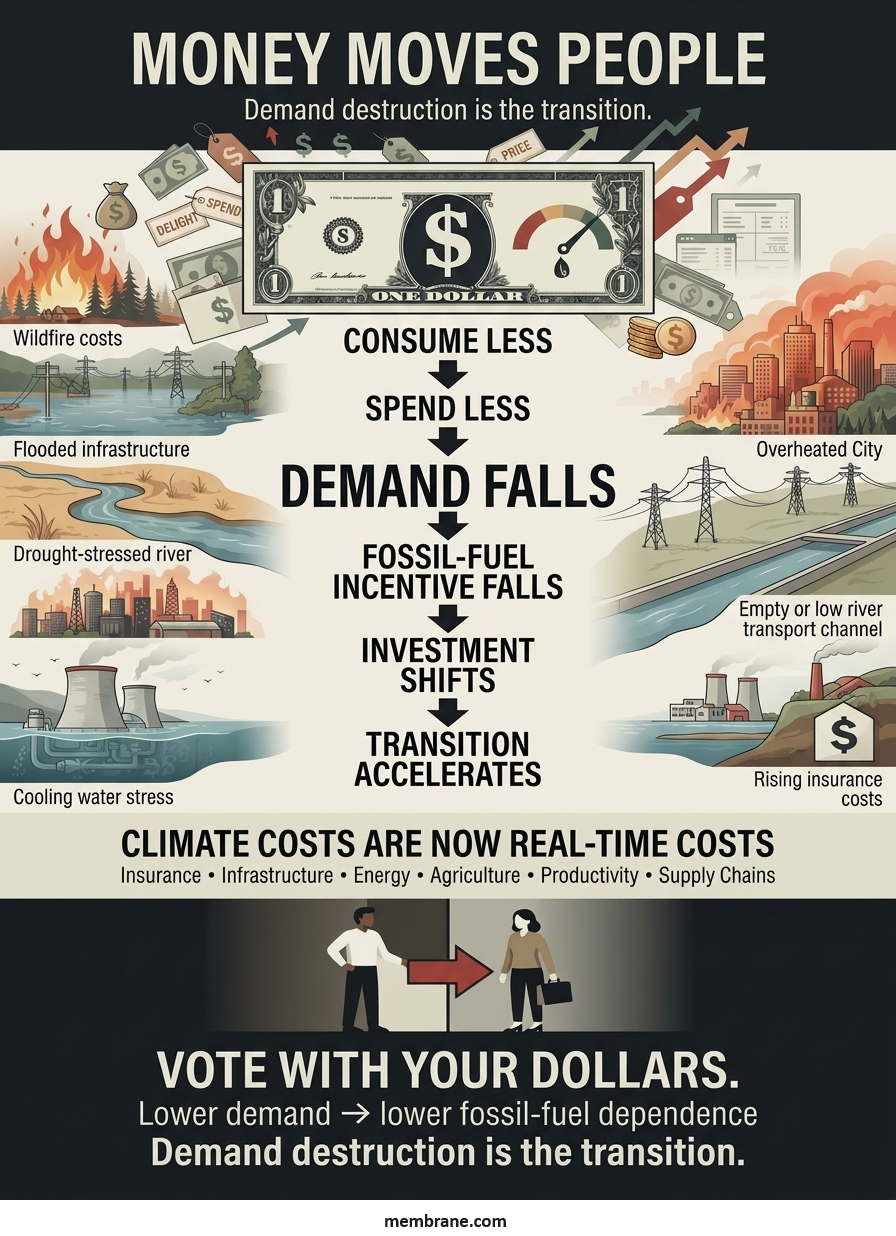
Consume less, and demand falls.
Demand falls, and the economic incentive to produce falls.
That is the mechanism.
The Economics of Personal Climate Stewardship
Today, only a small fraction of Americans appear to be pursuing a deliberately structured net-zero lifestyle through continuous behavioral reductions, efficiency improvements, and intentional balancing. But this does not mean the model cannot scale. The critical question is how climate stewardship is presented.
If reducing climate impact is framed exclusively as sacrifice, people resist. If it is framed as economic self-interest, the equation changes.
What happens when people discover that reducing unnecessary consumption can save them thousands of dollars a year?
What happens when energy efficiency lowers household expenses?
When smaller vehicles reduce fuel, maintenance, and insurance costs?
When reducing waste means buying fewer things that do not provide meaningful value?
When local production and durable goods become economically attractive?
When conservation becomes synonymous with financial resilience?
The behavior does not have to begin with ideology.
It can begin with a household budget.
Vote With Your Dollars
This is where the remaining majority of the population becomes economically important.
When millions of people begin making purchasing decisions based on cost, durability, efficiency, resilience, and environmental impact, they collectively alter demand.
When demand changes, markets respond. When fossil-fuel demand declines, the economic incentive to extract, refine, transport, and sell fossil fuels declines with it. This is fundamentally different from waiting for governments to impose every change from the top down. It is a bottom-up economic transition.
People do not have to agree about everything.
They do not have to become climate activists.
They do not even have to agree about climate policy.
They simply have to discover that some forms of consumption are no longer worth what they cost.
The Feedback Loop
The process can become self-reinforcing:
Lower unnecessary consumption
↓
Lower household costs
↓
Lower energy and resource demand
↓
Reduced fossil-fuel demand
↓
Lower economic incentive for fossil-fuel expansion
↓
Greater investment in alternatives and efficiency
↓
Further reductions in fossil-fuel demand
This is an economic feedback loop.
And unlike many climate-policy debates, it does not require everyone to agree on the destination before beginning the journey.
Demand Destruction Is the Transition
The transition away from fossil fuels is often described as a supply problem:
How quickly can we replace coal, oil, and natural gas?
But there is another side of the equation.
How quickly can we reduce the demand that makes fossil-fuel extraction profitable?
That may ultimately be the more powerful question.
We do not need to convince every person to become an environmentalist.
We need to make lower-carbon choices increasingly rational economic choices.
The climate crisis is already generating enormous costs. Insurance premiums are rising. Infrastructure is being stressed. Agricultural productivity is being disrupted. Heat is reducing labor capacity. Extreme weather is destroying capital. Supply chains are becoming more vulnerable.
These costs are not theoretical.
They are appearing on balance sheets, household budgets, insurance statements, government budgets, and corporate earnings reports.
The economic system is beginning to receive the bill.
And money moves people.
Demand destruction is not the enemy of the energy transition.
Demand destruction is the transition.