bookmark_borderFeedback Loops: How They Accelerate Global Warming

By Daniel Brouse and Sidd Mukherjee

In the 1990s, the Membrane Domain initiated groundbreaking research on human-induced climate change, challenging the prevailing linear models of global warming. Our research introduced a nonlinear, exponential model—akin to the shape of a bathtub curve or hockey stick—which has since been repeatedly confirmed by real-world data.

At the heart of this acceleration are feedback loops, also known in climate science as positive feedback mechanisms. These are processes where an initial change in a system leads to additional changes that reinforce and amplify the original effect, setting off a self-reinforcing cycle. Though technically termed “positive,” their consequences for the planet are overwhelmingly negative.

Arctic Feedback Loops: The Ice-Albedo Crisis

One of the most well-documented feedback loops involves the melting of Arctic sea ice. Ice and snow reflect sunlight (a property called albedo), helping keep the planet cool. But as global temperatures rise and ice melts, darker ocean surfaces are exposed. These surfaces absorb more heat, further warming the oceans, accelerating ice loss, and releasing trapped greenhouse gases—especially methane, a gas more than 80 times more potent than CO₂ over a 20-year period.

A 2022 study published in Nature found the Arctic is warming nearly four times faster than the global average since 1979. That warming feeds into multiple simultaneous loops:

  • Ice-Albedo Loop: Loss of reflectivity speeds up warming.

  • Ocean Heating Loop: Warmer oceans melt more ice.

  • Methane Release Loop: Thawing permafrost and seafloor methane seeps intensify greenhouse effects.

Snow-Albedo and Greenland’s Darkening Ice Sheet

Another feedback loop is the snow-albedo loop. A warmer atmosphere leads to more rain and less snow. Less snowfall means less surface reflectivity, which leads to increased heat absorption and more warming.

In Greenland, NASA has tracked how the ice sheet has been darkening over the past two decades. During warmer summers, fresh snow disappears, exposing older, impurity-laden snow and larger snow grains that absorb more sunlight. The result: accelerated melt and rising sea levels.

Wildfires, Lightning, and Brown Carbon

A dangerous and expanding set of feedback loops involve wildfires, lightning, and brown carbon:

  • Warmer temperatures lead to more lightning, which sparks more forest fires.

  • Forest fires release vast amounts of CO₂ and brown carbon (a form of organic carbon with low albedo), further warming the atmosphere.

  • Brown carbon settles on ice and snow, darkening surfaces and accelerating melt.

According to Forests at Risk Due to Lightning Fires, 77% of forest fires in intact forest regions outside the tropics are now started by lightning. The number of strikes is expected to rise by 11–33% per degree of warming.

Prof. Sander Veraverbeke, Vrije Universiteit Amsterdam, warns:

“Thousands of lightning strikes in remote forests can spark hundreds of small fires. These merge into mega-fires—blazes the size of small countries. Once they reach this scale, they’re nearly impossible to stop.”

The Canadian wildfires of 2023 exemplify a crossed tipping point: they released more CO₂ than the annual emissions of all but three countries. In some places, permafrost is now burning year-round.

Permafrost Thaw and the Methane Bomb

Permafrost, long considered a stable carbon sink, is thawing rapidly, releasing methane and CO₂ into the atmosphere. This creates a powerful and terrifying loop:

  • Warming thaws permafrost.

  • Thawed permafrost emits methane and CO₂.

  • These emissions intensify warming.

  • Which thaws more permafrost.

This “methane bomb” effect could release hundreds of gigatons of carbon, pushing the climate system into uncharted territory.

Water Vapor: The Master Feedback Loop

The most dominant feedback loop is water vapor. As CO₂ warms the Earth, the atmosphere can hold more moisture. Water vapor itself is a potent greenhouse gas, amplifying the greenhouse effect. This leads to more warming, more evaporation, and thus, more water vapor.

This also intensifies precipitation events. Studies like A Harder Rain Is Falling and The Reign of Violent Rain show that storms are becoming more extreme, more sudden, and more destructive—another feedback loop fueled by warming.

Summary of Major Feedback Loops


Feedback Loop Mechanism Amplifying Effect
Ice-Albedo Melting ice exposes darker surfaces More heat absorption, more ice melt
Water Vapor Warmer air holds more moisture Increased greenhouse effect
Permafrost Thaw Thawing releases methane and CO₂ More warming, more thawing
Vegetation Loss Fewer plants absorb CO₂ More CO₂ in the atmosphere
Brown Carbon Deposits on snow reduce albedo Accelerated melt and warming
Forest Fires Fires release CO₂ and dark particles Warmer temps trigger more fires
Lightning More warming increases lightning More fire ignition events

Conclusion: The Dangerous Dance Between Feedback and Tipping Points

Feedback loops are not just theoretical—they are active, compounding, and interlinked. Many of them are already accelerating the breakdown of Earth’s climate systems.

When feedback loops interact with tipping points—critical thresholds beyond which irreversible change occurs—they can trigger cascading effects. These Domino Effects can cause widespread ecological collapse and rapid shifts in climate much faster than models predict.

Understanding these loops is not just an academic exercise. It’s a survival imperative. Stopping emissions is no longer enough—we must now act to halt the self-reinforcing feedbacks that threaten to run out of control.

URGENT CLIMATE WARNING
Our latest climate model — now incorporating complex social-ecological feedback loops within a dynamic, non-linear system — projects that global temperatures could rise by up to 9°C (16.2°F) within this century. This far exceeds earlier estimates, which predicted a 4°C rise over the next thousand years, and signals a dramatic acceleration of warming.

At this level of heating, large regions of the planet will become uninhabitable due to extreme heat, sea level rise, agricultural collapse, and mass migration. Critically, parts of the U.S. are already experiencing wet-bulb temperatures approaching or exceeding 31°C (87.8°F) — a physiological limit beyond which the human body can no longer regulate its internal temperature, even in the shade with ample water.

This is no longer a distant threat. The climate system is entering a phase of compound risk and cascading collapse — and we are already seeing the early signs.

Immediate, radical mitigation and adaptation efforts are now essential to preserve habitable zones, food systems, and public health.
Tipping points and feedback loops are parts of an equation that determine the rate of acceleration in climate change.

The Human Induced Climate Change Experiment

bookmark_borderTipping Points and the Domino Effect

By Daniel Brouse and Sidd Mukherjee
September 2022 – August 2023 (Updated April 2025)

Understanding Tipping Points

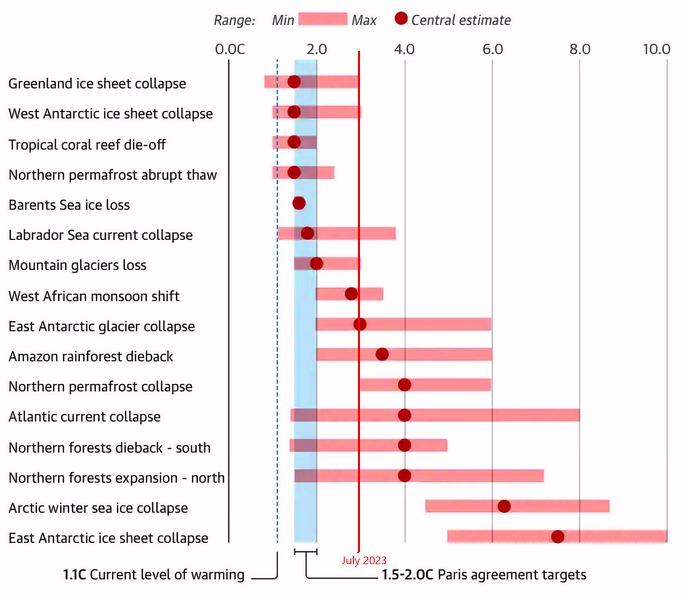
Tipping points and feedback loops are key factors in determining the rate of acceleration of climate change. When one tipping point is breached and triggers others to fall, the result is known as the Domino Effect.

To explain: push a glass slowly toward the edge of a table. Eventually, no matter how cautious you are, it will reach a critical point where it tips over and falls. Once the tipping point is crossed, the fall is inevitable—regardless of your intentions or beliefs.

Climate tipping points operate the same way. They are not a matter of opinion, but of science. Once breached, they lead to rapid, self-perpetuating change that is difficult—often impossible—to reverse.

What Are Climate Tipping Points?

Climate tipping points mark thresholds in Earth’s systems beyond which change becomes self-sustaining. These shifts push the climate into a new and often irreversible state—without requiring further human influence.

Many of these tipping points have already been crossed. For instance:

  • Methane released from beneath melting Arctic ice cannot be re-sequestered.

  • Alpine glaciers formed over 25,000 years ago are gone and will not return for millennia.

  • Permafrost is thawing across the Northern Hemisphere, from Alaska to Siberia, unleashing carbon and methane, destabilizing landscapes, and destroying ecosystems.

The Iberdrola Group reports, “Melting Siberian permafrost is turning tundra into muddy, barren terrain, starving local wildlife. Water bodies vanish as their bases thaw, worsening drought conditions.”

These are not isolated incidents. They mark the formation of positive feedback loops—like methane release accelerating further warming, which causes more methane to be released. The cycle feeds itself.

Evidence of Crossed Tipping Points

In 2019, Professor Tim Lenton of the University of Exeter warned:

“A decade ago we identified a suite of potential tipping points in the Earth system. Now we see evidence that over half of them have been activated… It is no longer responsible to wait and see.”

Some already-active or dangerously close tipping points include:

  • Greenland and East Antarctic Ice Sheet collapse

  • Mountain glacier loss

  • Atlantic Meridional Overturning Circulation (AMOC)

  • Amazon rainforest dieback

  • Arctic sea ice loss

  • Boreal forest degradation

  • Permafrost thaw

  • Warm-water coral bleaching

  • West Antarctic Ice Sheet instability

AMOC Tipping Point Crossed?
Until recently, the collapse of the AMOC was projected centuries away. But in July 2023, Nature Communications published “Warning of a forthcoming collapse of the Atlantic Meridional Overturning Circulation.” The data now projects AMOC collapse around 2050 under current emissions scenarios.

This collapse could accelerate sea level rise along the U.S. East Coast, intensify storms in Europe, and increase drought in West Africa. Prof. Stefan Rahmstorf warned:

“Climate history shows AMOC changes have led to some of the most abrupt and extreme temperature shifts. We must avoid disrupting it at all costs.”

Feedback Loops and Cascading Tipping Points

In Climate Change: How Long Is “Ever”?, we wrote:

“Extreme weather will increase. Coastlines will vanish. The most troubling shift, however, is the emergence of feedback loops—where plants and carbon sinks die off, accelerating warming independently of human activity.”

Sidd Mukherjee noted:

“That’s just one study. The window is between 2025 and 2095. I suspect we’ll be seeing many unpleasant surprises before then.”

The Domino Effect
When one tipping point triggers another, the domino effect begins. For example:

  • Melting mountain glaciers contribute to sea level rise.

  • This rise disrupts ocean circulation (AMOC).

  • AMOC disruption weakens rainfall in the Amazon.

  • Amazon dieback reduces carbon sequestration, amplifying global warming.

The Journal Science study “Triggering Multiple Climate Tipping Points” confirms:

“Even 1°C of global warming—the level we’ve already exceeded—risks triggering multiple tipping points.”

Each tenth of a degree beyond this increases the risk dramatically. Yet the world is on track for 2–3°C of warming—well above the Paris Agreement’s 1.5°C goal.

Cascading Crisis: Tipping Points Triggering Tipping Points

Climate scientist Sidd Mukherjee warned:

“Remember: these thresholds come with error bars. What we think might tip at 1.5°C may already be tipped at 1°C.”

This appears to be happening now.

For example:

  • Sea ice loss exposes darker ocean surfaces.

  • These absorb more heat, leading to more ice loss.

  • This heat also accelerates methane release from thawing permafrost.

  • Thawing permafrost releases yet more methane, feeding the loop.

In July 2023, the global temperature briefly reached 3°C above pre-industrial levels—an unprecedented and alarming milestone.

Conclusion: The Window is Closing

Adapted from Exceeding 1.5℃ Global Warming Could Trigger Multiple Climate Tipping Points (Sept. 2022):

We are now living with the reality of crossed tipping points. Some systems—like AMOC, Arctic sea ice, and permafrost—may already be in irreversible decline. These shifts will affect the Earth for thousands of years, regardless of future emissions cuts.

The imperative is clear: We must act not only to reduce emissions, but to halt the cascade of tipping points before they spiral out of control.

Tipping points and feedback loops are parts of an equation that determine the rate of acceleration in climate change.

The Human Induced Climate Change Experiment

bookmark_borderCanadian Wildfires: Over the Tipping Point

by Daniel Brouse
August 28, 2024

A study published in the Journal Nature found Canada’s 2023 wildfires released more carbon into the atmosphere than the annual emissions of all but three countries, underscoring a troubling trend. A new study raises serious concerns that Canada’s forests, long considered crucial carbon sinks, may no longer reliably absorb carbon in the long term.

This signals a dangerous acceleration of global warming, pushing us over a tipping point. Permafrost, once thought to be a stable, frozen barrier, is now thawing and burning year-round, releasing even more carbon and methane into the atmosphere. The resulting domino effect exacerbates climate instability, leading to more extreme weather, rising sea levels, and declining air quality.

These human-driven changes are not just ecological crises — they pose direct threats to human health, increasing the likelihood of premature death due to heatwaves, pollution, and the cascading impacts of an increasingly volatile climate.

The Study: Carbon emissions from the 2023 Canadian wildfires

Abstract
The 2023 Canadian forest fires have been extreme in scale and intensity with more than seven times the average annual area burned compared to the previous four decades. Here, we quantify the carbon emissions from these fires from May to September 2023 on the basis of inverse modelling of satellite carbon monoxide observations. We find that the magnitude of the carbon emissions is 647 TgC (570–727 TgC), comparable to the annual fossil fuel emissions of large nations, with only India, China and the USA releasing more carbon per year. We find that widespread hot–dry weather was a principal driver of fire spread, with 2023 being the warmest and driest year since at least 1980. Although temperatures were extreme relative to the historical record, climate projections indicate that these temperatures are likely to be typical during the 2050s, even under a moderate climate mitigation scenario (shared socioeconomic pathway, SSP 2–4.5). Such conditions are likely to drive increased fire activity and suppress carbon uptake by Canadian forests, adding to concerns about the long-term durability of these forests as a carbon sink.

About Feedback Loops and Tipping Points

Tipping cascades have emerged between biogeophysical and social-ecological systems. This Domino Effect is causing climate change to accelerate at an exponential rate.

Tipping points are Critical Milestones that directly impact the rate of acceleration in climate change by multiplying the number and intensity of feedback loops. Identifying and understanding these tipping points is crucial for climate science and policymaking. Crossing multiple tipping points could lead to a domino effect, resulting in a much more rapid and severe climate change than currently projected.

Tipping Points

Push a glass toward the edge of a table and eventually it will fall off on its own. No matter how slowly or meticulously you push… no matter how you weight or fill the glass, it will reach a tipping point and fall off before being pushed completely off the table. No matter whether you believe the glass is half-empty or half-full, when the tipping point is reached it will plummet out-of-control to its end. This is science not fate, faith, nor belief. Human induced climate change has resulted in environmental tipping points being breached.

Tipping points, when crossed, trigger self-sustaining feedback loops that are no longer dependent on human activity. Similar to when a domino topples over hitting two more dominoes that in turn fall hitting more dominoes. Thus, the name The Domino Effect. It can also be visualized as The Snowball Effect. A tipping point is like a snowball rolling down a hill growing in mass and velocity (momentum). When a tipping point is crossed, it results in cumulative and reinforced global warming.

The Human Induced Climate Change Experiment

bookmark_borderCoral Reefs’ Tipping Point

by Daniel Brouse
February 14, 2024

Coral reefs confront unprecedented challenges arising from various stressors, many of which are directly tied to human activities. Some of these stressors possess critical tipping points, surpassing which can lead to the collapse of coral ecosystems. According to the European Geosciences Union’s statement on January 2, 2024, specific tipping points include a temperature increase of 1.2℃ above pre-industrial levels and atmospheric CO2 concentrations exceeding 350 parts per million. Disturbingly, as of February 2024, the Earth’s yearly average temperature has already risen to +1.5℃, underscoring the urgency of addressing climate-related threats to coral reefs.

Climate change is having significant and detrimental effects on coral reefs around the world. Some of the key impacts include:

  1. Coral Bleaching:
    • One of the most immediate and visible impacts of climate change on coral reefs is coral bleaching. Elevated sea temperatures cause corals to expel the symbiotic algae (zooxanthellae) living within their tissues. Without these algae, corals lose their vibrant colors and become more susceptible to stress, disease, and death. While corals can recover from mild bleaching events, severe or prolonged bleaching can lead to widespread coral mortality.
  2. Ocean Acidification:
    • Increased carbon dioxide (CO2) levels in the atmosphere not only contribute to global warming but also lead to ocean acidification. The absorption of excess CO2 by the oceans results in a decrease in pH, making the water more acidic. This acidification can weaken coral skeletons and hinder the ability of corals to build and maintain their calcium carbonate structures.
  3. Sea Level Rise:
    • Rising global temperatures contribute to the melting of polar ice caps and glaciers, causing sea levels to rise. Elevated sea levels can lead to increased stress on coral reefs, especially those located in shallow waters. This can result in reduced sunlight reaching the corals and increased sedimentation, impacting their growth and survival.
  4. Extreme Weather Events:
    • Climate change is linked to an increase in the frequency and intensity of extreme weather events, such as hurricanes and cyclones. These events can physically damage coral reefs by causing coral breakage, dislodgment, and destruction of the reef structure. The recovery time for damaged reefs is often extended, making them more vulnerable to subsequent disturbances.
  5. Changes in Ocean Circulation:
    • Climate change can alter ocean currents and circulation patterns. Changes in water flow can affect the distribution of nutrients and impact the resilience of coral reefs. Some regions may experience altered temperature regimes, nutrient imbalances, and disruptions in the supply of food sources for corals and their associated ecosystems.
  6. Shifts in Coral Species Distribution:
    • As sea temperatures change and habitats are modified, the distribution of coral species may shift. Some species may migrate to cooler waters, while others may struggle to adapt or face local extinctions. These shifts can disrupt the balance of ecosystems and affect the biodiversity associated with coral reefs.

The cumulative impact of these climate-related stressors poses a severe threat to coral reefs worldwide. It’s crucial to address the root causes of climate change and implement conservation measures to enhance the resilience of coral ecosystems. Protection of coral reefs involves both local and global efforts, including sustainable fishing practices, marine protected areas, reducing greenhouse gas emissions, and promoting coral reef restoration initiatives.

Coral reef ecosystems can be influenced by several feedback loops that contribute to reaching tipping points. These feedback loops often involve interactions between various environmental stressors and the responses of coral reefs. Here are some feedback loops associated with the coral reef tipping point:

  1. Coral Bleaching Feedback Loop:
    • Mechanism: Elevated sea temperatures, driven by climate change, can trigger coral bleaching, where corals expel their symbiotic algae.
    • Effect: As bleaching occurs, corals become stressed and more susceptible to diseases. If bleaching is severe or occurs frequently, it weakens coral resilience and can lead to widespread coral mortality, reducing the ability of the reef to recover.
  2. Ocean Acidification and Coral Growth Feedback Loop:
    • Mechanism: Increased atmospheric carbon dioxide (CO2) leads to ocean acidification, hindering the ability of corals to build and maintain their calcium carbonate structures.
    • Effect: Weakened coral skeletons make corals more vulnerable to physical damage and limit their capacity to recover from disturbances. This feedback loop can contribute to a decline in overall coral reef health.
  3. Storm Damage and Reef Structure Feedback Loop:
    • Mechanism: Intense tropical storms, hurricanes, or cyclones, influenced by climate change, can cause physical damage to coral reefs.
    • Effect: Damaged coral structures provide less protection for the reef against future storms. If storms become more frequent or severe, the cumulative impact can compromise the structural integrity of the reef and hinder recovery.
  4. Overfishing and Algae Overgrowth Feedback Loop:
    • Mechanism: Overfishing of herbivorous fish, such as parrotfish, reduces their population, leading to increased algae growth on coral reefs.
    • Effect: Algae can outcompete corals for space, hindering coral growth and recovery. Reduced herbivory exacerbates the overgrowth of algae, creating a feedback loop that undermines the resilience of the coral reef ecosystem.
  5. Disease Spread and Coral Health Feedback Loop:
    • Mechanism: Climate change and environmental stressors can weaken coral health, making them more susceptible to diseases.
    • Effect: As diseases spread among stressed corals, the overall health of the reef declines. Weakened corals are less able to withstand additional stressors, leading to a feedback loop of declining health and increased vulnerability.
  6. Loss of Biodiversity and Ecosystem Function Feedback Loop:
    • Mechanism: Environmental stressors, such as coral bleaching and disease, can lead to the loss of key species and a decline in overall biodiversity on the reef.
    • Effect: A reduction in biodiversity weakens the resilience and functioning of the coral reef ecosystem. This can create a feedback loop where the loss of key species further compromises the ability of the reef to recover from disturbances.

Mitigating these feedback loops requires comprehensive conservation strategies, including reducing greenhouse gas emissions, implementing sustainable fishing practices, establishing marine protected areas, and addressing local stressors to enhance the resilience of coral reefs.

ALSO SEE:

Toppled Tipping Points: The Domino Effect / Brouse and Mukherjee (2023)

Sea-level Rise: Greenland and the Collapse of the East Antarctic Ice Sheet / Mukherjee and Brouse (2022 and 2023)

Sea Level Rise: Then and Now / Mukherjee and Brouse (2023)

Feedback Loops / Daniel Brouse and Sidd Mukherjee (2016)

The Human Induced Climate Change Experiment

bookmark_borderClimate Change and the Carbon Feedback Loop

by Daniel Brouse

The atmosphere is acting like a blanket… and the earth (land and sea) is acting like a battery. 91% of the energy (as heat) is trapped/stored in the oceans.

Feedback Loops Example

The Albedo feedback loop between the earth and the CO2 in the atmosphere accelerates global warming at an exponential rate. Albedo is the fraction of incoming solar radiation that gets reflected back into space. Carbon plays a double whammy role in feedback loops.

Brown carbon on ice, snow, or permafrost absorbs more heat and releases more carbon and methane into the atmosphere… resulting in more warming… leading to more carbon being released from the earth, etc.

Brown carbon is light-absorbing organic carbon with a very low Albedo. “This class of organic carbon, known for its light brownish color, absorbs strongly in the ultraviolet wavelengths and less significantly going into the visible,” reports the Argonne National Laboratory.

There are several feedback loops between brown carbon, lightning, wildfires, and arctic warming. Brown carbon from wildfires warms the arctic. The warmer arctic absorbs more heat causing more wildfires. In turn, more wildfires cause more brown carbon resulting in a warmer arctic. The cycle keeps reinforcing itself as it repeats.

Studies have found lightning and forest fires are creating a feedback loop. Global warming causes more extreme weather events and conditions for lightning. More lightning sparks a vicious cycle, as trees and soil set ablaze release warming CO2 creating more storms and more lightning. The study Forests at Risk Due to Lightning Fires found a sensitivity of extratropical intact forests to potential increases in lightning fires, which would have far-reaching consequences for terrestrial carbon storage and biodiversity.

More wildfires create more CO2 and more brown carbon that result in more global warming that results in more lightning strikes creating more wildfires resulting in more global warming thawing more permafrost  allowing more emissions of CO2 and methane resulting in more warming, creating many more feedback loops.

Feedback loops and tipping points are parts of an equation that determine the rate of acceleration in climate change. Triggering these tipping points results in the CO2 stored in nature to be released without the assistance of humans. Though we do not know how much carbon is stored in nature, it would be reasonable to assume that the temperature could be pushed from 3 degrees to 6 degrees above pre-industrial levels. Humans cannot thrive above a rise of 1.5 degrees. Much of the Earth will be uninhabitable if the temperature rises an additional 6 degrees Celsius. If humans also add 3 degrees Celsius, the temperature and humidity will approach a wet-bulb temperature that will not sustain human life.

When a tipping point topples and knocks over other tipping points, it is called the Domino Effect.

bookmark_borderThe Snowfall Feedback Loop

by Daniel Brouse
November 26, 2023

Global warming is causing warmer and shorter winters. Not only are White Christmases less frequent, so are icebergs, sea ice, and glaciers. An analysis and maps from NOAA found snowfall is declining globally as temperatures warm due to anthropological climate change.

Snowfall Decline
Snowfall Decline

As the atmosphere’s heat and humidity increase, precipitation is more likely to fall as violent rain or hail than snow. “Eventually the laws of thermodynamics mean that as you keep warming you’re just going to transition more and more of that snow over to rain. You can get away with things for a little bit, and it can hide some trends, but overall the laws of thermodynamics will win out,” said Brian Brettschneider, a climate scientist with the National Weather Service in Alaska.

Justin Mankin, a climate scientist and associate professor of geography at Dartmouth College, said with rising temperatures snowfall will not decline linearly (at a 1-to-1 rate.) Rather, there is a tipping point. Once a certain temperature threshold is reached, “we should expect the losses to accelerate. It means we can expect a lot of the places that haven’t exhibited massive snowfall declines to maybe start to exhibit them with just a little bit more warming.”

Albedo is the reflective nature of snow and measures how much light is reflected without being absorbed when hitting an object (e.g. the fraction of incoming solar radiation that gets reflected back into space). Snow has a very high albedo that reflects most of the light and absorbs very little heat. The snow-albedo feedback loop occurs when the atmosphere gets warmer due to human induced climate change resulting in less snowfall. The less snow reflecting heat back into space, the warmer the earth becomes. The warmer the earth, the less snowfall. The less snowfall, the warmer the earth.

Feedback loops and tipping points are parts of an equation that determine the rate of acceleration in climate change.

The Human Induced Climate Change Experiment

bookmark_borderThe Domino Effect / Snowball Effect

by Brouse and Mukherjee

Tipping points are Critical Milestones that directly impact the rate of acceleration in climate change by multiplying the number and intensity of feedback loops.

Tipping Points

Push a glass toward the edge of a table and eventually it will fall off on its own. No matter how slowly or meticulously you push… no matter how you weight or fill the glass, it will reach a tipping point and fall off before being pushed completely off the table. No matter whether you believe the glass is half-empty or half-full, when the tipping point is reached it will plummet out-of-control to its end. This is science not fate, faith, nor belief. Human induced climate change has resulted in environmental tipping points being breached.

Tipping points, when crossed, trigger self-sustaining feedback loops that are no longer dependent on human activity. Similar to when a domino topples over hitting two more dominoes that in turn fall hitting more dominoes. Thus, the name The Domino Effect. It can also be visualized as The Snowball Effect. A tipping point is like a snowball rolling down a hill growing in mass and velocity (momentum). When a tipping point is crossed, it results in cumulative and reinforced global warming.

A look at five (5) of the multiple tipping points that show the proverbial snowball is already rolling. The first dominoes have fallen and will continue to knock down more tiles with each escalating step.

  • Mountain Glacier Loss
  • Greenland Ice Sheet Collapse
  • Antarctic Ice Sheet Collapse
  • Collapse of AMOC (Atlantic Meridional Overturning Circulation)
  • Amazon Rainforest Dieback

Crossing even a single tipping point is alarming. For instance, crossing the tipping point for ‘mountain glacier loss‘ has immediate consequences: millions of people in Europe will be impacted by the lack of fresh water. Billions of people that live along coasts will be impacted by the saline infiltration and eventually by the submerging of their property. In September of 2022, UNESCO reported accelerated melting of glaciers in World Heritage sites, with glaciers in a third of sites set to disappear by 2050. In September of 2023, the GLAMOS glacier monitoring center found 10% of Swiss glaciers had disappeared in the last 2 years. They do not expect any Swiss glaciers will be left by 2050 no matter what actions are taken. If extreme measures are taken, they anticipate we may be able to save some polar glaciers.

This in and of itself should be alarming; however, it gets worse. Tipping points are parts of feedback loop systems. The ice-albedo feedback loop is an expression of the ability of surfaces to reflect sunlight (heat from the sun). Any loss of ice over a darker surface means the surface will absorb more heat and reflect less heat. This process makes the Earth warmer causing more loss of ice, which in turn causes more warming of the Earth. So, yes, the mountain ice tipping point is quite alarming for both its immediate impact as well as its self-sustaining growth to global warming; but wait, it gets more alarming. The increasing temperatures due to crossing a tipping point cause other tipping points to be toppled (The Domino Effect).

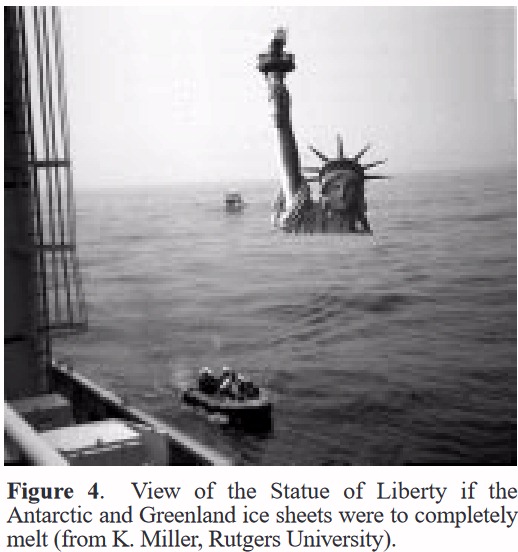
Long run sea level rise New Jersey Coast

By the Autumn of 2023, it had become evident the West Antarctic and Greenland ice sheets will completely melt. The process is irreversible and inevitable. The cool water from the melting ice at the poles is being drawn toward the center of the Earth and getting warmed to record high temperatures. The warm, moist air is circulating and moving over land. These changes in climate systems will cause other areas to experience unprecedented drought. We expect sea level rise will total about 270 feet over the next several millennia. It is episodic, and in the fast bits it can go up 3 feet every twenty years for five hundred years. The melting Arctic and Antarctic have multiple feedback loops including: enhanced oceanic heating and ice-albedo, Planck feedback, lapse-rate feedback, and cloud feedback.

The tipping point for the collapse of AMOC (Atlantic Meridional Overturning Circulation) was thought to be centuries away, at the earliest. In July of 2023, the study Warning of a forthcoming collapse of the Atlantic meridional overturning circulation was published in the journal Nature Communications. “Here we provide statistical significance and data-driven estimators for the time of tipping. We estimate a collapse of the AMOC to occur around mid-century (2025-2095) under the current scenario of future emissions.” The collapse is likely to cause faster sea level rise on the east coast of the US, more severe storms in Europe, and increasing drought in the Sahel in Africa. “From the study of past climate, we know changes in the AMOC have been some of the most abrupt and impactful events in the history of climate,” said Prof. Stefan Rahmstorf, at the Potsdam Institute for Climate Impact Research in Germany and world leading oceanographer. During the last Ice Age, winter temperatures changed by up to 10C within three years in some places. “We are dealing with a system that in some aspects is highly non-linear, so fiddling with it is very dangerous, because you may well trigger some surprises,” he said. “I wish I knew where this critical tipping point is, but that is unfortunately just what we don’t know. We should avoid disrupting the AMOC at all costs. It is one more reason why we should stop global warming as soon as possible.” A feedback loop created by the AMOC tipping point would cause a disruption of weather systems and circulation. The result would be the loss of naturally occurring carbon sinks. One scenario is desertification of the Amazon rainforest. In 2023, the Amazon River and the Rio Negro set record low levels.

The tipping point / feedback loop problem is very complex (chaos theory) and exponentially alarming. Yet another tipping point appears to have been triggered before 2024 — Amazon Rainforest Dieback. The Amazon is often referred to as ‘the lungs of our planet.’ Not only does the Amazon suck in huge quantities of CO2 and breath out O2, but the Amazon soils also store huge amounts of CO2. The desertification of the Amazon would result in a release of the carbon as the soils disappeared.

1) part of July was spent at record temperatures +3C
2) the collapse of the Amazon rainforest is likely to happen between +2 – 4C. The collapse of the Amazon is expected to occur because of changing weather patterns and circulation that result in drought.
3) Brazil set up a task force for “unprecedented drought in the Amazon”

Low river levels and hotter waters have killed masses of fish seen floating on river surfaces, contaminating the drinking water, Environment Minister Marina Silva said. “We have a very worrying situation. This record drought has disrupted river transport routes (dropping 30 cm / day) threatening food and water shortages, and a large fish mortality is already beginning.” This was the effect of a periodic El Nino mixing with changes in weather patterns brought by global warming. “We are seeing a collision of two phenomena, one natural which is El Nino and the other a phenomenon produced by humans, which is the change in the Earth’s temperature.” Worsened by climate change, this combination has caused drought not seen before in the Amazon and “is incomparably stronger and could happen more frequently.”

The average temperature for Brazil had been above the historical average from July through October of 2023. Rio de Janeiro recorded 42.5C on November 12, 2023 (a record for November) and high humidity on the 14th meant that it felt like 58.5C, municipal authorities said. Deadly humid heat is the greatest short term climate change risk to human health. On November 17, “a young Brazilian fan of US singer Taylor Swift died in Rio de Janeiro after falling ill inside the sweltering stadium where the superstar’s concert was held, amid a record-breaking heatwave across large swathes of Brazil,” as reported by ABC. “The show took place on the same day that Rio recorded its highest-ever heat index reading, which combines temperature and humidity, at 59.3 degrees Celsius (139 degrees Fahrenheit).”

Conclusion
Feedback loops and tipping points are parts of an equation that determine the rate of acceleration in climate change. Triggering these tipping points results in the CO2 stored in nature to be released without the assistance of humans. Though we do not know how much carbon is stored in nature, it would be reasonable to assume that the temperature could be pushed from 3 degrees to 6 degrees above pre-industrial levels. Humans cannot thrive above a rise of 1.5 degrees. Much of the Earth will be uninhabitable if the temperature rises an additional 6 degrees Celsius. If humans also add 3 degrees Celsius, the temperature and humidity will approach a wet-bulb temperature that will not sustain human life.

For the first time in human history, global warming is going to continue no matter what humans do. Even if humans stopped their greenhouse gas emissions today, humans have invoked nature’s greenhouse gas emissions. Nevertheless, the sooner humans stop their emissions, the better. In addition, humans must adapt their habitat to remove, reduce, and hinder nature’s greenhouse gas emissions.

What Can I Do?
There are plenty of things you can do to help save the planet. Stop using fossil fuels. Consume less. Love more. Here is a list of additional actions you can take.


bookmark_borderThe Lightning Feedback Loop

by Daniel Brouse
November 11, 2023

Feedback is the process in which changing one quantity changes a second quantity, and the change in the second quantity in turn changes the first. Positive feedback loops amplify the change in the first quantity.

Studies have found lightning and forest fires are creating a feedback loop. More lightning sparks a vicious cycle, as trees and soil set ablaze release warming CO2 creating more storms and more lightning.

The study Forests at Risk Due to Lightning Fires found a sensitivity of extratropical intact forests to potential increases in lightning fires, which would have far-reaching consequences for terrestrial carbon storage and biodiversity. The results show that, on a global scale, lightning is the primary ignition source of fires in temperate and boreal forests.

“What many people may not be aware of is that lightning is the most common ignition source for fires in remote temperate and boreal forests,” says Thomas Janssen, research associate at VU Amsterdam. These forests store large amounts of carbon, which is released in the form of greenhouse gases during the fire. The research reveals that 77 % of the burned area in intact forest regions outside the tropics is due to lightning fires, and the number of strikes is expected to increase by 11 to 31 % per degree warming with ongoing climate change.

“When a thunderstorm passes through this landscape, there are thousands of lightning strikes, and some hundreds of them start little fires,” said Prof Sander Veraverbeke from the Vrije Universiteit Amsterdam, one of the authors on the research paper. “And these can grow together into mega-fire complexes that become the size of small countries. Once these fires are so big, it becomes very difficult to do anything about them.”

Toppled Tipping Points: The Domino Effect / Brouse and Mukherjee (2023)

bookmark_borderRio Negro Climate Change Case Study

by Daniel Brouse
November 11, 2023

What do you know about the Rio Negro as it relates to climate change and carbon sinks? The Rio Negro gets its name from its color. The black water is caused by highly acidic and carbon rich water. One scientist that lives on the river called it similar to Coca-cola. In 2023, the Rio Negro recorded record low levels.

Most of the carbon discharged into the water helps the carbon to eventually sink in the ocean as a literal carbon sink. The lack of rain and drought conditions result in more vegetation dying and contribute to a feedback loop — more plants die from less rain… and there is less rain to wash the excess carbon to the bottom of the ocean… resulting in more global warming… resulting in more dead vegetation.

A study of Dissolved Organic Carbon (DOC) in South American rivers found, “Small and steep catchments hosting organic rich forest soils and peatlands were the most sensitive and showed the highest and fastest DOC release if evaluated on a per unit area basis. Here, rain events caused a rapid exponential increase in DOC release….”

The study Effects of natural light and depth on rates of photo-oxidation of dissolved organic carbon in a major black-water river, the Rio Negro, Brazil found under natural sunlight during the dry seasons rates of complete photo-oxidation and changes in absorbance indices decayed exponentially. The deeper the water the less CO2 created.

The Amazon river was also at record lows during 2023. The drought conditions in the Amazon rain forest are unusual. We are watching the Rio Negro and Amazon Rivers as a case study for the slowing and/or collapse of the AMOC. The tipping point for the collapse of AMOC (Atlantic Meridional Overturning Circulation) was thought to be centuries away, at the earliest. In July of 2023, the study Warning of a forthcoming collapse of the Atlantic meridional overturning circulation was published in the journal Nature Communications. “Here we provide statistical significance and data-driven estimators for the time of tipping. We estimate a collapse of the AMOC to occur around mid-century (2025-2095) under the current scenario of future emissions.” The collapse is likely to cause faster sea level rise on the east coast of the US, more severe storms in Europe, and increasing drought in the Sahel in Africa. “From the study of past climate, we know changes in the AMOC have been some of the most abrupt and impactful events in the history of climate,” said Prof. Stefan Rahmstorf, at the Potsdam Institute for Climate Impact Research in Germany and world leading oceanographer. During the last Ice Age, winter temperatures changed by up to 10C within three years in some places. “We are dealing with a system that in some aspects is highly non-linear, so fiddling with it is very dangerous, because you may well trigger some surprises,” he said. “I wish I knew where this critical tipping point is, but that is unfortunately just what we don’t know. We should avoid disrupting the AMOC at all costs. It is one more reason why we should stop global warming as soon as possible.” A feedback loop created by the AMOC tipping point would cause a disruption of weather systems and circulation. The result would be the loss of naturally occurring carbon sinks.

Conclusion
The carbon sequestration from dissolved organic carbon is only one of the many carbon sinks in the Amazon. It is likely Amazon droughts will become more frequent and intense resulting in decarbonization at an exponential rate. The collapse of the AMOC will hasten the collapse of the Amazon. The collapse of the Amazon will hasten the collapse of the AMOC.

A case study for: Toppled Tipping Points: The Domino Effect Brouse and Mukherjee (2023)

Climate Change: How Long Is “Ever”? Brouse (2023)

Climate Change: The End of Times Brouse and Mukherjee (2023)

The Reign of Violent Rain Brouse and Mukherjee (2023)

Climate Change: Rate of Acceleration Brouse and Mukherjee (2023)

bookmark_borderTipped Tipping Points, Feedback Loops, and the Domino Effect

By Daniel Brouse and Sidd Mukherjee
September 29, 2023

A look at three (3) of the multiple tipping points we appear to have breached and The Domino Effect:

  • Mountain Glacier Loss
  • Collapse of AMOC (Atlantic Meridional Overturning Circulation)
  • Amazon Rainforest Dieback

Crossing one tipping point would be alarming. For instance, crossing the tipping point for ‘mountain glacier loss‘ has immediate consequences: millions of people in Europe will be impacted by the lack of fresh water. Billions of people that live along coasts will be impacted by the saline infiltration and eventually by the submerging of their property. In September of 2022, UNESCO reported accelerated melting of glaciers in World Heritage sites, with glaciers in a third of sites set to disappear by 2050. In September of 2023, the GLAMOS glacier monitoring center found 10% of Swiss glaciers had disappeared in the last 2 years. They do not expect any Swiss glaciers will be left by 2050 no matter what actions are taken. If extreme measures are taken, they anticipate we may be able to save some polar glaciers.

This in and of itself should be alarming; however, it gets worse. Tipping points are parts of feedback loop systems. The ice–albedo feedback loop is an expression of the ability of surfaces to reflect sunlight (heat from the sun). Any loss of ice over a darker surface means the surface will absorb more heat and reflect less heat. This process makes the Earth warmer causing more loss of ice… which in turn causes more warming of the Earth. So, yes, the mountain ice tipping point is quite alarming for both its immediate impact as well as its self-sustaining growth to global warming; but wait, it gets more alarming. The increasing temperatures due to crossing a tipping point cause other tipping points to be toppled (The Domino Effect).

The tipping point for the collapse of AMOC (Atlantic Meridional Overturning Circulation) was thought to be centuries away, at the earliest. In July of 2023, the study Warning of a forthcoming collapse of the Atlantic meridional overturning circulation was published in the journal Nature Communications. “Here we provide statistical significance and data-driven estimators for the time of tipping. We estimate a collapse of the AMOC to occur around mid-century (2025-2095) under the current scenario of future emissions.” The collapse is likely to cause faster sea level rise on the east coast of the US, more severe storms in Europe, and increasing drought in the Sahel in Africa. “From the study of past climate, we know changes in the AMOC have been some of the most abrupt and impactful events in the history of climate,” said Prof. Stefan Rahmstorf, at the Potsdam Institute for Climate Impact Research in Germany and world leading oceanographer. During the last Ice Age, winter temperatures changed by up to 10C within three years in some places. “We are dealing with a system that in some aspects is highly non-linear, so fiddling with it is very dangerous, because you may well trigger some surprises,” he said. “I wish I knew where this critical tipping point is, but that is unfortunately just what we don’t know. We should avoid disrupting the AMOC at all costs. It is one more reason why we should stop global warming as soon as possible.” A feedback loop created by the AMOC tipping point is disruption in weather systems and circulation that cause loss of naturally occurring carbon sinks. One scenario is desertification of the Amazon rainforest.

The tipping point / feedback loop problem is very complex (chaos theory) and exponentially alarming. A third tipping point appears to have been triggered by the summer of 2023 — Amazon Rainforest Dieback. The Amazon is often referred to as ‘the lungs of our planet.’ Not only does the Amazon suck in huge quantities of CO2 and breath out O2, but the Amazon soils also store huge amounts of CO2.  The desertification of the Amazon would result in a release of the carbon as the soils disappeared.

1) much of July was spent at record temperatures +3C
2) the collapse of the Amazon rainforest is likely to happen between +2 – 4C. The collapse of the Amazon is expected to occur because of changing weather patterns and circulation that result in drought.
3) Brazil set up a task force for “unprecedented drought in the Amazon”

Low river levels and hotter waters have killed masses of fish seen floating on river surfaces, contaminating the drinking water, Environment Minister Marina Silva said. “We have a very worrying situation. This record drought has disrupted river transport routes (dropping 30 cm / day) threatening food and water shortages, and a large fish mortality is already beginning.” This was the effect of a periodic El Niño mixing with changes in weather patterns brought by global warming. “We are seeing a collision of two phenomena, one natural which is El Niño and the other a phenomenon produced by humans, which is the change in the Earth’s temperature.” Worsened by climate change, this combination has caused drought not seen before in the Amazon and “is incomparably stronger and could happen more frequently.”

Feedback loops and tipping points are parts of an equation that determine the rate of acceleration in climate change.. Triggering these tipping points results in the CO2 stored in nature to be released. Though we do not know how much carbon is stored in nature, it would be reasonable to assume that the temperature could be pushed from 3 degrees to 6 degrees above pre-industrial levels. Humans cannot thrive above a rise of 1.5 degrees. Humans cannot survive if the temperature rises 6 degrees.

Climate Change Tipping Points

What you can do today. How to save the planet.

Climate Change: The End of Times

The Human Induced Climate Change Experiment