bookmark_borderClimate Change and Cigarette Litigation

by Daniel Brouse
2016 and 2023

In 2016, I had said: What will create the change needed?
The oil industry is going to be like the tobacco industry. The consumers are going to claim they were misled about the dangers of burning fossil fuels and will file lawsuits against the oil companies. You will not be able to buy oil or get insurance at a reasonable price (similar to what happened to cigarette smokers, or oil could be banned altogether.)

In 2022, WGUR Massachusetts reported, “State attorneys general from around the nation, including here in Massachusetts, are suing fossil fuel companies over climate change. Late last month, the state’s highest court rejected ExxonMobil’s bid to dismiss a lawsuit by Attorney General Maura Healey. And yes, you’ve seen this movie before. The states took Big Tobacco to court, and they won. The 1998 Master Settlement Agreement imposed tight restrictions on how tobacco companies can promote cigarettes, and requires tobacco makers to pay billions of dollars in damages to the states annually, for as long as they do business in the U.S.”

Commonwealth v. Exxon Mobil Corp.
Massachusetts High Court Affirmed Denial of Motion to Dismiss Attorney General’s Climate Change-Related Enforcement Action Against Exxon. The Massachusetts Supreme Judicial Court affirmed a trial court’s denial of Exxon Mobil Corporation’s (Exxon’s) special motion to dismiss the Massachusetts Attorney General’s enforcement action alleging that Exxon’s communications with investors and consumers related to climate change constituted unfair and deceptive practices. Exxon filed the special motion under Massachusetts’s anti-SLAPP (Strategic Litigation Against Public Participation) law, which protects parties exercising their right of petition. The Supreme Judicial Court held that the anti-SLAPP law did not apply to government enforcement actions brought by the Attorney General. The court found that this interpretation was grounded in the statutory language, the rules of construction applicable to enforcement of statutes against the Commonwealth, and the legislative history and purpose of the anti-SLAPP law.

In 2023, the BBC reported, “The findings add to ongoing pressure on the company over what it knew about climate change. Campaigners allege it spread misinformation in order to protect its business interests in fossil fuels and are suing the company in a number of US courts. ExxonMobil’s private research predicted how burning fossil fuels would warm the planet but the company publicly denied the link.”

The report published in Science will be used as evidence against ExxonMobil:
Assessing ExxonMobil’s global warming projections

However, ExxonMobil continues to deny the facts. “This issue has come up several times in recent years and, in each case, our answer is the same: those who talk about how “Exxon Knew” are wrong in their conclusions,” the company told BBC News.

“It really underscores the stark hypocrisy of ExxonMobil leadership, who knew that their own scientists were doing this very high quality modelling work and had access to that privileged information while telling the rest of us that climate models were bunk,” Naomi Oreskes, professor of the history of science at Harvard University, told BBC News.

“Our analysis allows us for the first time to actually put a number on what Exxon knew, which is that the burning of their fossil fuel products was going to heat the planet by about 0.2C of warming every decade,” says co-author Geoffrey Supran, associate professor of environmental science and policy at the University of Miami.

“Their excellent climate modelling was at least comparable in performance to one of the most influential and well-regarded climate scientists of modern history,” Prof Supran said, comparing ExxonMobil’s work to Nasa’s James Hansen who sounded the alarm on climate in 1988.

Prof Oreskes said the findings show that ExxonMobil “knowingly misled” the public and governments. “They had all this information at their disposal but they said very, very different things in public,” she explained.

The research, published in the academic journal Science, also suggests that ExxonMobil had reasonable estimates for how emissions would need to be reduced in order to avoid the worst effects of climate change in a world warmed by 2C or more.

Their scientists also correctly rejected the theory that an ice age was coming at a time when other researchers were still debating the prospect.

The findings add to ongoing pressure on the company over what it knew about climate change. Campaigners allege it spread misinformation in order to protect its business interests in fossil fuels and are suing the company in a number of US courts.
Global Warming and Anthropologic Climate Change

bookmark_borderThe Cost of Climate Change: USD 178 trillion

“Time is no longer running out to act on climate change; it’s up,” reports Deloitte. Unchecked climate change could cost the global economy USD 178 trillion over the next 50 years. “The human costs would be far greater: a lack of food and water, a loss of jobs, worsening health and well-being, reduced standard of living.”

Time is no longer running out to act on climate change; it’s up. Download the report.

Time to act—accelerating to zero

With global emissions continuing to rise over the last two decades, we have squandered the chance to decarbonize at our leisure. The global economy needs to execute a rapid, coordinated, sequenced energy and industrial transition that will play out in distinct phases.

* Bold climate plays: Coordination and collaboration set the stage for decarbonization by formulating policies and frameworks for a low-carbon future.
* Accelerating to net zero: Deep investment across systems instigates structural economic adjustments. The decline of emissions-intensive industries would create growing pains for some economies.
* Turning point: Investment in structural economic adjustment is almost complete. Economies would realize the dividend of the transformation and experience net positive growth.
* Low-emission future: Interconnected, low-carbon systems underpin a clean economy that would grow at an increasingly faster rate than its carbon-intensive alternative.

The Human Induced Climate Change Experiment

bookmark_borderChina Drought: Shortage of Hydropower

Al Jazeera reports, Chinese factories close as drought hits hydropower. “Factories in China’s southwest have shut down after reservoirs used to generate hydropower ran low in a worsening drought.” Unfortunately, the factory shutdowns include most of the global solar panel production, as well as Tesla electric vehicles.

Leave power for the people,” said an order from the provincial government.

Barron’s reports, “One of the suppliers with capacity in the region is the largest EV battery maker in the world — Contemporary Amperex Technology Co Ltd (300750.China), better known as CATL. That company has idled some production in Sichuan, according to reports. GM and SAIC have a joint venture that produces a lot of small electric vehicles in China.”

“A reduction in the supply of parts would affect nearly all auto makers. The industry has dealt with a lot in recent years, including Covid-19 and a semiconductor shortage. Drought is just another issue in a long line of recent problems, and it isn’t the first act of God to hit the sector. Back in March 2021, a fire at a chip plant in Japan worsened the semiconductor shortage.”

The Human Induced Climate Change Experiment

bookmark_borderThe Cumulative Costs of Climate Change

“The crisis carries a profound warning. As climate change brings more frequent and intense storms, floods, heat waves, wildfires and other extreme events, it is placing growing stress on the foundations of the country’s economy: Its network of roads and railways, drinking-water systems, power plants, electrical grids, industrial waste sites and even homes. Failures in just one sector can set off a domino effect of breakdowns in hard-to-predict ways,” as reported by The New York Times in the article Texas Blackouts Point to Coast-to-Coast Crises Waiting to Happen.

“We are colliding with a future of extremes,” said Alice Hill, who oversaw planning for climate risks on the National Security Council during the Obama administration. “We base all our choices about risk management on what’s occurred in the past, and that is no longer a safe guide.”

“Sewer systems are overflowing more often as powerful rainstorms exceed their design capacity. Coastal homes and highways are collapsing as intensified runoff erodes cliffs. Coal ash, the toxic residue produced by coal-burning plants, is spilling into rivers as floods overwhelm barriers meant to hold it back. Homes once beyond the reach of wildfires are burning in blazes they were never designed to withstand.”

“I am extremely concerned by the lack of emergency-management expertise reflected in Biden’s climate team,” said Samantha Montano, an assistant professor at the Massachusetts Maritime Academy who focuses on disaster policy. “There’s an urgency here that still is not being reflected.”

A White House spokesman, Vedant Patel, said in a statement, “Building resilient and sustainable infrastructure that can withstand extreme weather and a changing climate will play an integral role in creating millions of good paying, union jobs” while cutting greenhouse gas emissions.

“All these issues are converging,” said Robert D. Bullard, a professor at Texas Southern University who studies wealth and racial disparities related to the environment. “And there’s simply no place in this country that’s not going to have to deal with climate change.”

bookmark_borderSelling Short / How a Put Works Using GameStop (GME) as an Example

By Daniel Brouse
January 30, 2021

This is a more detailed answer to how puts work using GameStop (GME) as an example:

There are two entities. One owns 100 shares of GME. This entity believes the stock price will remain stable or go up. Lets call this entity U. Another entity thinks the price of the stock will go down. Lets call this entity Melvin.

This transaction took place when the stock price was $5/share.

Melvin comes to U and says I would like to borrow your 100 shares of GME for the next 90 days. Melvin agrees to pay U $1/share for this contract. U gets $100. U gets to keep that money no matter what and gets their 100 shares back in 90 days.

Melvin thinks the stock price is going down in the future… so, Melvin goes out and sells the 100 shares for $5/share. If the price of the stock goes down to $4/share, Melvin can buy back the 100 shares and make $100. (500-400=100). Melvin paid U $100. Melvin breaks even. The most Melvin can make on this deal is $4/share. If the price goes down to $0.01, Melvin can buy back 100/shares for a dollar. 500-100 (contract fee to U)-$1(to buy back the shares) = $399 profit.
On the other hand, if Melvin sells the 100 shares at the market rate of $5/share and the price of the stock goes up, the downside for Melvin is infinite. So, Melvin’s brokerage firm puts limits on how much Melvin can lose. As the price of the stock goes higher, the brokerage firm starts to make “margin calls”. For instance, if the price of the stock goes to $10/share, the brokerage may say Melvin needs to cover half of your shares. Instead of having 100 of U’s shares outstanding, Melvin has to go to the market and buy 50 of U’s shares back at $10/share. Then, if the stock continues to go up to say $15/share, Melvin’s brokerage makes another margin call making Melvin “cover” their outstanding shares by another 50%. Melvin then goes back to the market and buys another 25 shares at $15/share… and so on.
At the end of the 90 days, U get your 100 shares back. U can do with them as U please, and U get to keep the initial $100.

There are no good guys and bad guys. Anyone is allowed to do this. You do not have to be rich or from Wall Street. Instead of playing the side Melvin played, I recommend playing the role of U. It is a riskless way to make money. A smarter way to do this is with an option called a “covered call“.

You say: Interesting you are using “put”. I call this “Sell Short” or “Short Sale” or take a “Short Position.”

I respond: A put is the writer’s side of the short option — “A short position in a put option is called writing a put. Traders who do so are generally neutral to bullish on a particular stock in order to earn premium income. They also do so to purchase a company’s stock at a price lower than its current market price.” — Investopedia

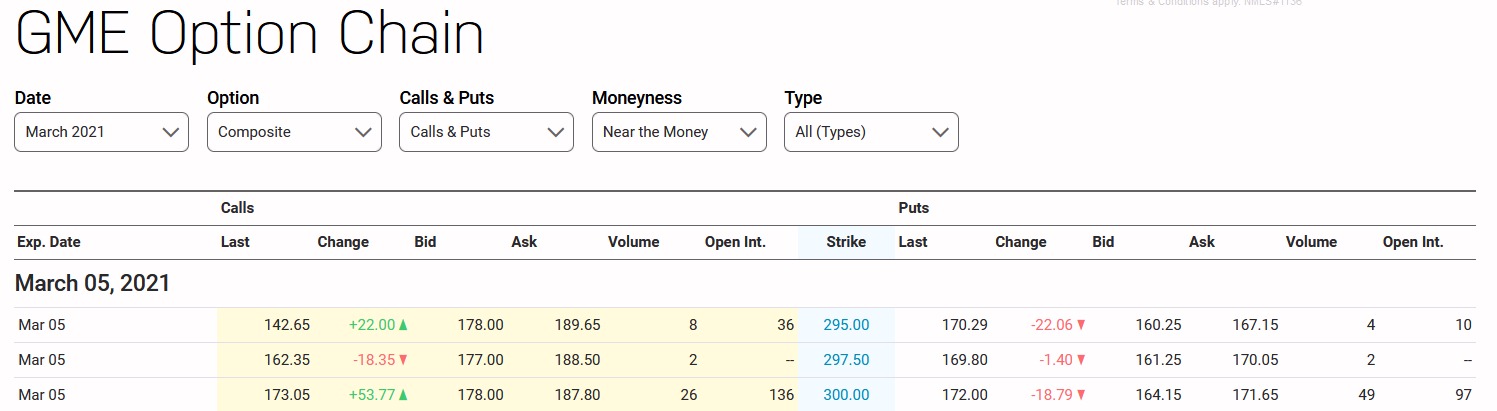
You can buy 1 put option (a contract on 100 shares) with a strike price of $300 that expires on March 5, 2021 for $172/share. If you pay $17,200, you will get an option that allows you to sell 100 shares of GME stock for $300/share between now and March 5. The last days closing price for GME was $325/share. In the event that GME falls below $300/share, you could exercise the option, buy 100 shares on the open market at the lower price and sell it for $300/share. The stock would have to fall below $128/share for you to make a profit. If you do not exercise the option, you lost your $17,200 investment.

GME (GameStop) Options Chain


RobinHood Investors Steal from the Poor and Give to the Rich (GME / GameStop)

bookmark_borderBig Brother Is Watching: FBI and NSA Spying on You

Two newspapers, The Washington Post and the Guardian (UK), have published articles about the United States government invading the civil rights of its own citizens. The information was obtained from a “top secret” document and states that the National Security Agency and the FBI are collecting information directly from the servers of Microsoft, Yahoo, Google, Facebook, PalTalk, AOL, Skype, YouTube, Apple.


The National Security Agency and the FBI are tapping directly into the central servers of nine leading U.S. Internet companies, extracting audio and video chats, photographs, e-mails, documents, and connection logs that enable analysts to track foreign targets, according to a top-secret document obtained by The Washington Post.


Find out about connecting to the Internet through a secure private server.

More on cyber security and privacy.

bookmark_borderJust Say No To Taxes

by Daniel Brouse

I suggested that there should be little (to no) taxes.

You responded:
How does any of this function
without taxation…?
I would like to know your thinking on this…
it doesn’t seem to be working now
and sure doesn’t favor poor to middle class…
but I think this is too long to write?

I respond:
There are a few ways one can look upon it. Here are two of the shorter versions —

1) Evolution
In the beginning there was Adam and Lilith. There were no taxes. For more generations than I can count, the world got along fine without taxes. In fact, humans prospered in the Garden Of Edan without taxation until we evolved into corrupt beings.

2) Exploitation And Corruption
An economic evaluation of taxation reveals a costs and benefits shutout. That is to say, there are no known benefits to taxation. On the other hand, there are at least a trillion costs to taxing (see the National Deficit for a an exhaustive list.) A small sampling includes…
The cost of taxing productive people
The cost of corruption inherent in collecting money
The cost of additional bureaucracy
The cost of removing the efficiency inherent in the competition of the free market place

You may want to think of it this way… every adult in the USA owes about $42,614.99 just for the Iraq War. (And, that is if we pay off the debt today. Oh, yeah. The cost of life and limb is not included.)

Next time, in order to be fair to everyone… maybe we should be required to pay the tax in advance… instead of 1% of the population footing 40% of the bill?

Additional resources: Occupy Wall Street? Occupy Yourself