bookmark_borderClimate Change: Code Red for Humanity

The UN’s IPCC (Intergovernmental Panel on Climate Control) release their latest report that has been compiled and peer-reviewed over the last 8 years.

U.N. Secretary-General, António Guterres described the report as “a code red for humanity.”

“The alarm bells are deafening, and the evidence is irrefutable: greenhouse gas emissions from fossil fuel burning and deforestation are choking our planet and putting billions of people at immediate risk,” said Mr. Guterres.

Some of the changes already set in motion will be “irreversible” for centuries to come.

A press release from the IPCC states:

The report provides new estimates of the chances of crossing the global warming level of 1.5°C in the next decades, and finds that unless there are immediate, rapid and large-scale reductions in greenhouse gas emissions, limiting warming to close to 1.5°C or even 2°C will be beyond reach.

The report shows that emissions of greenhouse gases from human activities are responsible for approximately 1.1°C of warming since 1850-1900, and finds that averaged over the next 20 years, global temperature is expected to reach or exceed 1.5°C of warming. This assessment is based on improved observational datasets to assess historical warming, as well progress in scientific understanding of the response of the climate system to human-caused greenhouse gas emissions.

“This report is a reality check,” said IPCC Working Group I Co-Chair Valérie Masson-Delmotte. “We now have a much clearer picture of the past, present and future climate, which is essential for understanding where we are headed, what can be done, and how we can prepare.”

Every region facing increasing changes

Many characteristics of climate change directly depend on the level of global warming, but what people experience is often very different to the global average. For example, warming over land is larger than the global average, and it is more than twice as high in the Arctic.

“Climate change is already affecting every region on Earth, in multiple ways. The changes we experience will increase with additional warming,” said IPCC Working Group I Co-Chair Panmao Zhai.

The report projects that in the coming decades climate changes will increase in all regions. For 1.5°C of global warming, there will be increasing heat waves, longer warm seasons and shorter cold seasons. At 2°C of global warming, heat extremes would more often reach critical tolerance thresholds for agriculture and health, the report shows.

But it is not just about temperature. Climate change is bringing multiple different changes in different regions – which will all increase with further warming. These include changes to wetness and dryness, to winds, snow and ice, coastal areas and oceans. For example:

* Climate change is intensifying the water cycle. This brings more intense rainfall and associated flooding, as well as more intense drought in many regions.
* Climate change is affecting rainfall patterns. In high latitudes, precipitation is likely to increase, while it is projected to decrease over large parts of the subtropics. Changes to monsoon precipitation are expected, which will vary by region.
* Coastal areas will see continued sea level rise throughout the 21st century, contributing to more frequent and severe coastal flooding in low-lying areas and coastal erosion. Extreme sea level events that previously occurred once in 100 years could happen every year by the end of this century.
* Further warming will amplify permafrost thawing, and the loss of seasonal snow cover, melting of glaciers and ice sheets, and loss of summer Arctic sea ice.
* Changes to the ocean, including warming, more frequent marine heatwaves, ocean acidification, and reduced oxygen levels have been clearly linked to human influence. These changes affect both ocean ecosystems and the people that rely on them, and they will continue throughout at least the rest of this century.
* For cities, some aspects of climate change may be amplified, including heat (since urban areas are usually warmer than their surroundings), flooding from heavy precipitation events and sea level rise in coastal cities.

For the first time, the Sixth Assessment Report provides a more detailed regional assessment of climate change, including a focus on useful information that can inform risk assessment, adaptation, and other decision-making, and a new framework that helps translate physical changes in the climate – heat, cold, rain, drought, snow, wind, coastal flooding and more – into what they mean for society and ecosystems.

This regional information can be explored in detail in the newly developed Interactive Atlas interactive-atlas.ipcc.ch as well as regional fact sheets, the technical summary, and underlying report.

Human influence on the past and future climate

“It has been clear for decades that the Earth’s climate is changing, and the role of human influence on the climate system is undisputed,” said Masson-Delmotte. Yet the new report also reflects major advances in the science of attribution – understanding the role of climate change in intensifying specific weather and climate events such as extreme heat waves and heavy rainfall events.

The report also shows that human actions still have the potential to determine the future course of climate. The evidence is clear that carbon dioxide (CO2) is the main driver of climate change, even as other greenhouse gases and air pollutants also affect the climate.

“Stabilizing the climate will require strong, rapid, and sustained reductions in greenhouse gas emissions, and reaching net zero CO2 emissions. Limiting other greenhouse gases and air pollutants, especially methane, could have benefits both for health and the climate,” said Zhai.
More on The Human Induced Climate Change Experiment

bookmark_borderBomb Cyclone: Extreme Weather Events

Bomb Cyclone Storm on January 4, 2018 off the Northeastern Shore

“‘Bomb cyclone’ blasting East Coast before polar vortex uncorks tremendous cold late this week.  The most severe winter weather yet will assault the area late this week.” — washingtonpost.com (January 3, 2018)

The bomb cyclone blizzard was a 1,000 mile wide Nor’easter classified as a “bomb cyclone” because of its sharp drop in atmospheric pressure. “Bombogenesis, a popular term used by meteorologists, occurs when a midlatitude cyclone rapidly intensifies, dropping at least 24 millibars over 24 hours,” said NOAA.

“We are not saying that the Earth’s temperature is just going to rise. In general, as energy is added to a system, the fluctuations in the system increase. So, we expect more storms, more droughts, more wildfires, more floods, more fluctuations of all kinds. What we are saying is that weather conditions will become more volatile due to the impact of humans,” said Sidd Mukherjee and Daniel Brouse (2004)

“What use to be a once-in-a-hundred year event is now an annual event.” (2017)

“I think the public and many policymakers don’t really take those 100-year forecasts very seriously,” said Myles Allen, an Oxford scientist who is now one of the world’s leading experts in attribution science. “They are much more seriously interested in the question of what is happening now and why—which boils down to attribution.”

It use to be that scientists were reluctant to relate any single weather event to climate change; however, that has changed.

NOAA now issues a report for extreme weather events, “This report provides information on direct economic losses, deaths, and other impacts for numerous weather and climate disasters including tropical cyclones, floods, droughts and heat waves, severe storms (e.g., tornadoes, hail, and straight-line winds), wildfires, crop freeze events, and winter storms.”

The Bulletin of the American Meteorological Society now issues a special report each year assessing the impact of climate change on the previous year’s extreme events.

Scientific American reported, Myles Allen had hinted about “litigation two years before Hurricane Katrina occurred. In his Nature commentary, he mused about the possibility of massive class-action lawsuits—carrying the potential for “up to six billion plaintiffs” around the world—attempting to hold greenhouse gas emitters liable for damages.

Attribution studies could help to apportion the blame, he noted. For instance, he wrote, “If, at a given confidence level, past greenhouse-gas emissions have increased the risk of a flood tenfold, and that flood occurs, then we can attribute, at that confidence level, 90% of any damage to those past emissions.”

About 2017, NPR reported, “This year will go down in history for its extreme weather. Researchers have now definitively attributed three major extreme weather events to climate change.”

LINDA WERTHEIMER, HOST:

If you’re listening to this program from the Midwest or East Coast, well, I hope you’re nice and warm inside your house or car. President Trump took note of the frigid temperatures in the East this holiday season with this tweet – perhaps we could use a little bit of that good, old global warming.

Climate scientists note that while parts of the U.S. are much colder than average now, the world as a whole this week is warmer than the average over recent decades. One thing climate scientists have long been reluctant to say is that specific extreme weather events are the result of climate change. But NPR’s Christopher Joyce says a little-noticed study this past year did prove a link.

CHRISTOPHER JOYCE, BYLINE: This was this – a study that determined that, yes, looking at events in 2016, 27 of them – they found three that were so off the charts that they had to be the result of what we have done to the planet. They’re just beyond what is expected to be a natural event.

WERTHEIMER: What are they? What are the three events?

JOYCE: Well, one was the incredible heat that we experienced – the average temperature around the globe in 2016. It was 1.7 degrees Fahrenheit above the average in the 20th century. And that is just enormous. The second one – extreme heat waves in Asia, especially India and Pakistan. Hundreds of people died. The temperatures were just beyond belief. And the third one – one not noticed that much – but something called the blob, which was a section of water in the Bering Sea off the coast of Alaska that was just unusually warm – again, so warm that it’s just beyond what could be modeled as being – as happening in a natural world.

WERTHEIMER: But still, how do they know that this was not just weird weather – certainly, extreme, unexpected, unusual?

JOYCE: You know, again, I have to use the word model, which people are afraid of. But they’re computer models. And what you basically do is you recreate the world as it was before the Industrial Revolution and certainly before the mid-20th century when we started warming it up. And you put in all of the atmosphere. You put in the oceans, the circulation, the temperature. And you sort of create this world before we changed it. And then you create another model of the world we’re in. And you take these events, and you put them in that model of what the world used to be like. And you can tell that they couldn’t have been created by the forces that were at work before we warmed the planet.

WERTHEIMER: So those three things could not have happened absent global warming.

JOYCE: Yeah. I talked to one of the scientists who did the work – who compiled the work – Stephanie Herring of the National Oceanic and Atmospheric Administration. And this is how she put it.

(SOUNDBITE OF ARCHIVED RECORDING)

STEPHANIE HERRING: Not even one in a million. They cannot replicate them in a world without climate change is what the scientists are saying. It’s a big result, yes. It’s – again, you know, we’ve been doing this for six years, 131 papers. This is our first time seeing this.

bookmark_borderExtreme Weather Hits U.S., England and Australia

The United States, England and Australia are all experiencing severe and extreme weather events. In the United States, the East and Southeast have been hit with all types of winter storms. On the West Coast, the drought has reached critical stages of water conservation, as well as, causing wildfires. England is getting hit with the worst precipitation and flooding in the last 250 years. Australia is getting record temperature heat waves while other parts are underwater from deluges.

“Fire crews spend the day battling fires in South Australia and Victoria as the southern states endure a weekend of extreme weather conditions.” “The weather records keep tumbling in Adelaide – this time due to heavy rainfall. “– Australian Broadcasting Corporation

“Thousands of sandbags are being piled up to protect homes and businesses as more heavy rain and gale-force winds sweep across southern Britain.” — British Broadcasting Corporation

“Global Warming — We are not saying that the Earth’s temperature is just going to rise. In general, as energy is added to a system, the fluctuations in the system increase. So, we expect more storms, more droughts, more wildfires, more floods, more fluctuations of all kinds. What we are saying is that weather conditions will become more volatile due to the impact of humans.” — S. Mukherjee & D. Brouse (2004)

More On Global Warming

bookmark_borderWhat Is Global Warming

by the National Oceanic And Atmospheric Administration

What is Global Warming?

sun.jpg, photo courtesy of NOAA Photo Library
The term Global Warming refers, without any implications for the cause or magnitude, to the observation that the atmosphere near the Earth’s surface is warming. This warming is one of many kinds of climate change that the Earth has gone through in the past and will continue to go through in the future.

Why is Global Warming important?

Temperature increases will have significant impacts on human activities, including: where we can live, what food we can grow, how and where we can grow food, and where organisms we consider pests can thrive. To be prepared for the effects of these potential impacts we need to know how much the Earth is warming, how long the Earth has been warming, and what has caused the warming. Answers to these questions provide us with a better basis for making decisions related to issues such as water resources and agricultural planning.

What is the Greenhouse Effect?

Greenhouse effect image Our planet absorbs radiant energy from the sun and emits some of that energy back to space. The term greenhouse effect describes how water vapor, carbon dioxide, and other “greenhouse” gases in the atmosphere alter the return of energy to space, and in turn, change the temperature at the Earth’s surface. These greenhouse gases absorb some of the energy that is emitted from the Earth’s surface, preventing this energy from being lost to space. As a result, the lower atmosphere warms and sends some of this energy back to the Earth’s surface. When the energy is “recycled” in this way, the Earth’s surface warms.

Life on Earth would be very different without the greenhouse effect. The greenhouse effect keeps the long term annual average temperature of the Earth’s surface approximately 32°C (or about 58°F) higher than it would be otherwise.

How is the Greenhouse Effect related to Global Warming?

Greenhouse gases occur naturally in the Earth’s atmosphere, but are also being added by human activities. This happens primarily through the burning of fossil fuels, such as coal, oil and natural gas, which releases carbon dioxide to the atmosphere. Over the past century, atmospheric carbon dioxide (as measured from ice cores) has increased due to human activities from 300 to 380 parts per million (ppm), and the average Earth temperature has increased approximately 0.7°C (or about 1.3°F).

Co2 image
Given what we know about the ability of greenhouse gases to warm the Earth’s surface, it is reasonable to expect that as concentrations of greenhouse gases in the atmosphere rise above natural levels, the Earth’s surface will become increasingly warm. Many scientists have now concluded that global warming can be explained by a human-caused enhancement of the greenhouse effect.

It is important to remember both that the greenhouse effect occurs naturally, and that it has been intensified by humankind’s input of greenhouse gases into the atmosphere.

Are Ozone Holes related to Global Warming or the Greenhouse Effect?

ozone.gif, photo courtesy of NASA The formation of ozone holes is related to these scientific issues, yet is still distinct.
Ozone plays a very important, natural role in the upper atmosphere (called the stratosphere), where 90% of it exists. Stratospheric ozone acts as a shield against harmful ultraviolet (UV) radiation from the sun. This ozone can be destroyed by human-produced chemical compounds called chlorofluorocarbons, or CFCs. When these CFCs are combined with extremely cold stratospheric temperatures over the poles, solar radiation, and particular patterns of atmospheric circulation, chemical reactions occur that cause “Ozone Holes” over Antarctica (pictured above) and the Arctic.

The formation of ozone holes is related to global warming and the greenhouse effect in two ways. First, CFCs are greenhouse gases. Thus, the release of these compounds into the atmosphere will have two separate effects: to destroy ozone and to add to the greenhouse effect. Second, if stratospheric temperatures or patterns of atmospheric circulation change as part of global warming, this will affect the chemical reactions that destroy ozone and cause the ozone holes to either grow or shrink.

daily ozone image
For daily updated images of the ozone, please visit NOAA’s Stratosphere: SBUV-2 Total Ozone Page with images of the ozone from the NOAA-14 Satellite by clicking here or on image at left.

bookmark_borderPrepare For Severe Weather

FEMA has issued an announcement for residents of the Northeastern United States to be prepared for severe weather.

FEMA encourages all individuals in areas where severe weather is expected to monitor NOAA Weather Radio, and local news for severe weather updates and warnings and to always follow the direction provided by local officials. When natural disasters like severe weather and tornadoes strike, the first responders are local emergency and public works personnel, volunteers, humanitarian organizations, and numerous private interest groups who provide emergency assistance required to protect the public’s health and safety and to meet immediate human needs.

Everyone should become familiar with the terms used to identify a severe weather hazard and discuss with your family what to do if a watch or warning is issued. Some of the more common terms used to describe severe weather and tornado hazards include the following:

  • Severe Thunderstorm Watch – Tells you when and where severe thunderstorms are likely to occur. Watch the sky and stay tuned to NOAA Weather Radio, commercial radio or television for information.
  • Severe Thunderstorm Warning – Issued when severe weather has been reported by spotters or indicated by radar. Warnings indicate imminent danger to life and property to those in the path of the storm.
  • Tornado Watch – Tornadoes are possible. Remain alert for approaching storms. Watch the sky and stay tuned to NOAA Weather Radio, commercial radio or television for information.
  • Tornado Warning – A tornado has been sighted or indicated by weather radar. Take shelter immediately.

For a complete listing of weather-related forecasts in your area, visit www.weather.gov

If you are in an area that is in the track of the storm system but has not yet been affected by the severe weather, it’s never too early to prepare:

  • Keep up to date with local conditions – Follow TV and radio reports from your area, or visit www.weather.gov (http://mobile.weather.gov on your phone) for the latest forecast.
  • Check your family’s emergency supply kit – Make sure you have food, water, medications, and other necessities to sustain you and your family for at least 72 hours. This includes a battery-powered radio, flashlight, extra batteries, cell phone charger, medicines, non-perishable food, and first aid supplies.
  • Listen to the instructions of local officials. Local officials make decisions on sheltering in place or going to your pre-designated safe meeting location.

For more information on severe weather and tornado preparedness tips, visit www.ready.gov or www.listo.gov to find out how you can protect your family during emergencies.

Follow FEMA online at blog.fema.gov, www.twitter.com/fema, www.facebook.com/fema, and www.youtube.com/fema.  Also, follow Administrator Craig Fugate’s activities at www.twitter.com/craigatfema. 

The social media links provided are for reference only. FEMA does not endorse any non-government websites, companies or applications. 

FEMA’s mission is to support our citizens and first responders to ensure that as a nation we work together to build, sustain, and improve our capability to prepare for, protect against, respond to, recover from, and mitigate all hazards.

bookmark_borderActs Of God

Natural Disasters in August, 2012

Tropical Storm IsaacAugust 29, 2012
Tropical Storm Isaac
 Hurricane IsaacAugust 28, 2012
Hurricane Isaac
Trinity Ridge FireAugust 28, 2012
Trinity Ridge Fire
Tropical Storm BolavenAugust 28, 2012
Tropical Storm Bolaven
Tropical Storm IsaacAugust 28, 2012
Tropical Storm Isaac
Wildfires in SiberiaAugust 28, 2012
Wildfires in Siberia
Tropical Storm IsaacAugust 27, 2012
Tropical Storm Isaac
Typhoon BolavenAugust 26, 2012
Typhoon Bolaven
Wildfires in AlgeriaAugust 25, 2012
Wildfires in Algeria
Typhoon BolavenAugust 24, 2012
Typhoon Bolaven
Tropical Storm IsaacAugust 23, 2012
Tropical Storm Isaac
Wildfires in CaliforniaAugust 23, 2012
Wildfires in California
Typhoon TembinAugust 20, 2012
Typhoon Tembin
Wildfires in CaliforniaAugust 19, 2012
Wildfires in California
 Wildfire on ChiosAugust 18, 2012
Wildfire on Chios
Typhoon Kai-takAugust 17, 2012
Typhoon Kai-tak
Typhoon Kai-takAugust 16, 2012
Typhoon Kai-tak
Plume from Batu TaraAugust 15, 2012
Plume from Batu Tara
Thick Smoke over WyomingAugust 14, 2012
Thick Smoke over Wyoming
Wildfires in IdahoAugust 14, 2012
Wildfires in Idaho
Tropical Storm Kai-takAugust 13, 2012
Tropical Storm Kai-tak
Western WildfiresAugust 13, 2012
Western Wildfires
Tropical Storm ErnestoAugust 8, 2012
Tropical Storm Ernesto
2012 Arctic CycloneAugust 7, 2012
2012 Arctic Cyclone
Hurricane ErnestoAugust 7, 2012
Hurricane Ernesto
 Mount Tongariro EruptsAugust 7, 2012
Mount Tongariro Erupts
Typhoon HaikuiAugust 7, 2012
Typhoon Haikui
Tropical Storm ErnestoAugust 6, 2012
Tropical Storm Ernesto
Typhoon HaikuiAugust 6, 2012
Typhoon Haikui
Halstead Fire, IdahoAugust 3, 2012
Halstead Fire, Idaho
 Typhoons Saola and DamreyAugust 1, 2012
Typhoons Saola and Damrey

bookmark_borderIsaac

Isaac The Storm
Isaac The Storm


tab Eastern Pacific tab tab Atlantic tab
tab
Click for Eastern Pacific
TC Activity
Graphical Tropical Weather Outlook   |   Active Storms   |   Marine Forecasts


Atlantic – Caribbean Sea – Gulf of Mexico
Tropical Weather Outlook (en Español*)
800 AM EDT MON AUG 27 2012
Tropical Weather Discussion
805 AM EDT MON AUG 27 2012
Tropical Storm ISAAC RSS Feed icon NESDIS Satellite | NDBC Obs | Storm Archive
…ISAAC GETTING A LITTLE BETTER ORGANIZED AS IT MOVES WEST-NORTHWESTWARD OVER THE EASTERN GULF OF MEXICO… …U.S. Warnings in Effect…


8:00 AM EDT Mon Aug 27
Location: 25.7°N 84.7°W
Moving: WNW at 14 mph
Min pressure: 988 mb
Max sustained: 65 mph
Public
Advisory
#25A

800 AM EDT
Aviso
Publico
#25A

800 AM EDT
Forecast
Advisory
#25

0900 UTC
Forecast
Discussion
#25

500 AM EDT
Wind Speed
Probabilities
#25

0900 UTC
NWS Local
Statements
US Watch/
Warning

800 AM EDT
Hurricane Wind Speed Probability
Hurricane Wind
Speed Probability
50-knot Wind Speed Probability
50-knot Wind
Speed Probability
34-knot Wind Speed Probability
Trop Storm Wind
Speed Probability
Max Wind Speed Probability Table
Maximum Wind
Speed Probability
Google Maps API Warnings and Track Forecast Cone
Warnings/Cone
Interactive Map
Warnings and 5-Day Cone
Warnings/Cone
Static Images
Surface Wind Field
Warnings and
Surface Wind
Mariner's 1-2-3 Rule
Mariner’s
1-2-3 Rule
Wind History
Wind
History

*Spanish translations courtesy of the NWS San Juan Weather Forecast Office


Eastern Pacific (out to 140°W)
Tropical Weather Outlook
500 AM PDT MON AUG 27 2012
Tropical Weather Discussion
1005 UTC MON AUG 27 2012
There are no tropical cyclones at this time.


Hurricane Preparedness Sign Image of Hurricane Preparedness
Learn about hurricane hazards and what you can do to help protect yourself, your family, and your
property.

Tropical Cyclone Centers Worldwide

Lat/Lon Distance Calculator
Find distance between latitude/longitude points

Hurricane Season Dates

Hurricane season in the Atlantic begins June 1st and ends November 30th. The Eastern Pacific hurricane season begins May 15th and also ends November 30th.

Hurricane Season Summaries and Reports

Atlantic: Monthly Tropical Cyclone Summary | Tropical Cyclone Reports
East Pacific: Monthly Tropical Cyclone Summary | Tropical Cyclone Reports

bookmark_borderLarge Storm System in Eastern U.S.

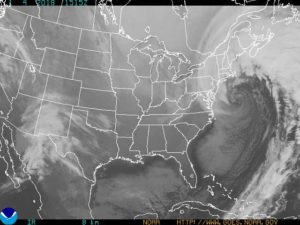
The large storm in the eastern U.S. is visible in the satellite image below, taken by GOES East at 1715Z (12:15 EST) today.

The storm system continues to bring significant rainfall to Indiana and Michigan, where Flood Warnings and Advisories are in effect. The bulk of the precipitation has ended in Kentucky and southern Indiana, but several Flood Warnings and advisories continue. Central Kentucky and southern Indiana have received 2.5 to 5 inches of rainfall over the past 2 days. Additional rainfall amounts of 1 to 2 inches are possible in northern Indiana, northwest Ohio, and central and eastern lower Michigan before changing over to snow late this afternoon and evening for the first significant snowfall of the season. Winter Storm Watches and Warnings have been posted for northern Indiana, northwest Ohio, and central and southeast lower Michigan, where 4 to 8 inches of snow will be possible, with locally higher amounts possible if rain changes to snow earlier than expected.

Get the latest forecasts, watches and warnings from your local NWS Weather Forecast Office at http://www.weather.gov/.

Latest Storm Summary from the NWS Hydrometeorological Prediction Center:
http://www.hpc.ncep.noaa.gov/discussions/nfdscc3.html

High-Res version of image from NOAA’s Environmental Visualization Lab:
http://www.nnvl.noaa.gov/images/high_resolution/900_20111129-eastcoast.jpg

· · Share · about an hour ago ·