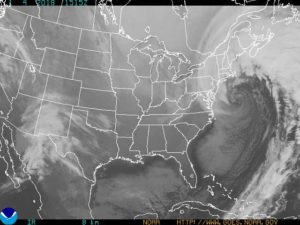
“‘Bomb cyclone’ blasting East Coast before polar vortex uncorks tremendous cold late this week. The most severe winter weather yet will assault the area late this week.” — washingtonpost.com (January 3, 2018)
The bomb cyclone blizzard was a 1,000 mile wide Nor’easter classified as a “bomb cyclone” because of its sharp drop in atmospheric pressure. “Bombogenesis, a popular term used by meteorologists, occurs when a midlatitude cyclone rapidly intensifies, dropping at least 24 millibars over 24 hours,” said NOAA.
“We are not saying that the Earth’s temperature is just going to rise. In general, as energy is added to a system, the fluctuations in the system increase. So, we expect more storms, more droughts, more wildfires, more floods, more fluctuations of all kinds. What we are saying is that weather conditions will become more volatile due to the impact of humans,” said Sidd Mukherjee and Daniel Brouse (2004)
“What use to be a once-in-a-hundred year event is now an annual event.” (2017)
“I think the public and many policymakers don’t really take those 100-year forecasts very seriously,” said Myles Allen, an Oxford scientist who is now one of the world’s leading experts in attribution science. “They are much more seriously interested in the question of what is happening now and why—which boils down to attribution.”
It use to be that scientists were reluctant to relate any single weather event to climate change; however, that has changed.
NOAA now issues a report for extreme weather events, “This report provides information on direct economic losses, deaths, and other impacts for numerous weather and climate disasters including tropical cyclones, floods, droughts and heat waves, severe storms (e.g., tornadoes, hail, and straight-line winds), wildfires, crop freeze events, and winter storms.”
The Bulletin of the American Meteorological Society now issues a special report each year assessing the impact of climate change on the previous year’s extreme events.
Scientific American reported, Myles Allen had hinted about “litigation two years before Hurricane Katrina occurred. In his Nature commentary, he mused about the possibility of massive class-action lawsuits—carrying the potential for “up to six billion plaintiffs” around the world—attempting to hold greenhouse gas emitters liable for damages.
Attribution studies could help to apportion the blame, he noted. For instance, he wrote, “If, at a given confidence level, past greenhouse-gas emissions have increased the risk of a flood tenfold, and that flood occurs, then we can attribute, at that confidence level, 90% of any damage to those past emissions.”
About 2017, NPR reported, “This year will go down in history for its extreme weather. Researchers have now definitively attributed three major extreme weather events to climate change.”
LINDA WERTHEIMER, HOST:
If you’re listening to this program from the Midwest or East Coast, well, I hope you’re nice and warm inside your house or car. President Trump took note of the frigid temperatures in the East this holiday season with this tweet – perhaps we could use a little bit of that good, old global warming.
Climate scientists note that while parts of the U.S. are much colder than average now, the world as a whole this week is warmer than the average over recent decades. One thing climate scientists have long been reluctant to say is that specific extreme weather events are the result of climate change. But NPR’s Christopher Joyce says a little-noticed study this past year did prove a link.
CHRISTOPHER JOYCE, BYLINE: This was this – a study that determined that, yes, looking at events in 2016, 27 of them – they found three that were so off the charts that they had to be the result of what we have done to the planet. They’re just beyond what is expected to be a natural event.
WERTHEIMER: What are they? What are the three events?
JOYCE: Well, one was the incredible heat that we experienced – the average temperature around the globe in 2016. It was 1.7 degrees Fahrenheit above the average in the 20th century. And that is just enormous. The second one – extreme heat waves in Asia, especially India and Pakistan. Hundreds of people died. The temperatures were just beyond belief. And the third one – one not noticed that much – but something called the blob, which was a section of water in the Bering Sea off the coast of Alaska that was just unusually warm – again, so warm that it’s just beyond what could be modeled as being – as happening in a natural world.
WERTHEIMER: But still, how do they know that this was not just weird weather – certainly, extreme, unexpected, unusual?
JOYCE: You know, again, I have to use the word model, which people are afraid of. But they’re computer models. And what you basically do is you recreate the world as it was before the Industrial Revolution and certainly before the mid-20th century when we started warming it up. And you put in all of the atmosphere. You put in the oceans, the circulation, the temperature. And you sort of create this world before we changed it. And then you create another model of the world we’re in. And you take these events, and you put them in that model of what the world used to be like. And you can tell that they couldn’t have been created by the forces that were at work before we warmed the planet.
WERTHEIMER: So those three things could not have happened absent global warming.
JOYCE: Yeah. I talked to one of the scientists who did the work – who compiled the work – Stephanie Herring of the National Oceanic and Atmospheric Administration. And this is how she put it.
(SOUNDBITE OF ARCHIVED RECORDING)
STEPHANIE HERRING: Not even one in a million. They cannot replicate them in a world without climate change is what the scientists are saying. It’s a big result, yes. It’s – again, you know, we’ve been doing this for six years, 131 papers. This is our first time seeing this.