bookmark_borderPolar Bear Plunge: Will Humans Follow? (Adaptation Part II)

Polar Bear Plunge: Will Humans Follow?

Adaptation Part II

Daniel Brouse
December 14, 2025

Abstract

In The Plight of the Penguin: Will Humans Follow? (Adaptation Part I), I examined how multiple penguin species—despite short-term behavioral flexibility—are failing to adapt to the pace and scale of anthropogenic climate change. This second paper extends that analysis to the Arctic, focusing on polar bears as a living stress test for biological adaptation under rapid warming. Together, penguins and polar bears frame the planetary poles as early-warning systems for human survivability. While limited genetic and epigenetic responses are emerging in some species, the evidence suggests that nonlinear climate dynamics and cascading feedback loops are outpacing adaptive capacity—first in wildlife, and increasingly in humans.

I. From Penguins to Polar Bears: A Shared Signal

Penguin populations across the Southern Hemisphere are undergoing rapid collapse as climate change, ocean warming, disrupted food webs, and direct human exploitation destabilize their ecosystems. While a handful of species show limited, short-term adaptability, the majority are now projected to decline irreversibly within this century.

The Emperor Penguin, African Penguin, Yellow-eyed Penguin, Erect-crested Penguin, Galápagos Penguin, Macaroni Penguin, and Southern Rockhopper Penguin have all failed to adapt to accelerating environmental change. Current projections place several of these species on extinction trajectories within decades—some potentially much sooner.

These collapses are not isolated ecological tragedies. They are biological signals. Penguins evolved for cold, stable systems; when those systems destabilize beyond critical thresholds, even highly specialized and once-resilient species fail. This same pattern—rapid environmental change overwhelming adaptive capacity—now appears in the Arctic.

II. Polar Bears: The Arctic’s Canary

Polar bears (Ursus maritimus) provide one of the clearest real-time examples of how climate change drives species toward physiological and ecological limits. The Arctic is warming between three and twenty times faster than the global average, making it an early indicator of future conditions elsewhere.

Sea ice loss is the single most important driver of polar bear decline. Bears depend on stable ice platforms to hunt seals; as these platforms vanish, bears are forced into longer swims, nutritional stress, isolation, and reproductive failure. This season alone, polar bears have been documented swimming up to 80 miles in search of ice and prey. Many juveniles do not survive these journeys.

As a result, polar bear populations across most regions are declining rapidly, with increasing mortality among cubs and subadults.

III. A Glimmer of Adaptation — and Its Limits

There is, however, a narrow and sobering glimmer of hope: genetic response under extreme stress.

Recent research led by Alice Godden, building on earlier University of Washington work, examined blood samples from polar bear populations in northeastern and southeastern Greenland. The southeastern group inhabits a significantly warmer climate zone—conditions similar to what much of the Arctic is expected to experience later this century.

In this southern population, researchers identified differences in gene activity related to:

  • Heat stress response
  • Aging
  • Metabolism and digestion

These findings suggest that climate stress is actively influencing gene regulation. As Godden noted, this may represent the first documented case of rising temperatures driving genomic change in a mammal.

In the Springer Nature paper “Diverging transposon activity among polar bear sub-populations inhabiting different climate zones,” the authors describe how transposable elements (TEs)—mobile sections of DNA—are behaving differently across subpopulations. These elements can accelerate genetic change under environmental stress.

In essence, different groups of polar bears are experiencing different sections of their DNA being activated or altered at different rates, closely linked to their local climate conditions. Godden described this as a form of the species being forced to “rewrite its own DNA”—a desperate survival mechanism in response to melting sea ice.

IV. Why This Does Not Mean Polar Bears Are Safe

Despite this remarkable finding, the implications are grim. The same research estimates that two-thirds of the global polar bear population could be gone by 2050, with total extinction likely by the end of the century if current warming trends continue.

The Arctic Ocean has repeatedly recorded record-high temperatures in recent years. Reduced sea ice has:

  • Eliminated hunting platforms
  • Increased fasting duration
  • Forced dietary shifts toward low-fat, plant-based or scavenged food sources

These changes are driving physiological stress and may be altering body composition and morphology. Adaptation, in this context, does not mean recovery—it means buying time.

As Godden emphasized, these findings do not reduce extinction risk. At best, they offer a narrow genetic blueprint for how adaptation might occur—if warming slows enough to allow it.

V. Humans and the Myth of Superior Adaptation

A common assumption is that humans, by virtue of intelligence and technology, will adapt where other species fail. This belief is not supported by the bulk of current scientific evidence.

Unlike polar bears, whose genetic shifts may offer limited resilience, human biological changes under climate stress are increasingly maladaptive. Even more troubling, many of these changes are epigenetic and transgenerational—meaning they can be passed on to future generations.

Adaptation, in humans, is beginning to resemble degradation.

VI. Climate Extremes and Cellular Breakdown

The health impacts of climate change are no longer abstract projections; they are measurable and accelerating.

  • One death per minute: Heat-related mortality now averages roughly one fatality per minute worldwide.
  • Rising exposure: Over the past four years, the average person has experienced 19 days per year of life-threatening heat, nearly all attributable to human-caused warming.
  • Severe health impacts: Extreme heat causes heatstroke, dehydration, kidney injury, and exacerbates cardiovascular and respiratory disease.

Prolonged heat exposure accelerates biological aging, damages tissues, and shortens telomeres at the cellular level. These processes increase the risk of:

  • Cancer
  • Dementia
  • Diabetes
  • Cardiovascular disease

Mental health is also affected. Heat stress correlates with increased rates of depression, anxiety, aggression, and suicide.

VII. Epigenetics: The Molecular Convergence of Climate Stressors

A critical mechanism linking these outcomes is epigenetic change—chemical modifications that regulate gene expression without altering DNA sequences. These changes act like dimmer switches, activating or silencing genes in response to environmental conditions.

Climate-related stressors that drive epigenetic change include:

  • Extreme heat
  • Ozone and air pollution exposure
  • Infectious disease, including COVID-19

All three are directly connected to fossil fuel combustion and climate destabilization.

When multiple stressors act simultaneously, epigenetic effects compound rather than add, increasing vulnerability across multiple organ systems. Genes associated with cancer, metabolic disease, cardiovascular dysfunction, and neurological disorders become more likely to activate.

Of particular concern is evidence that some epigenetic changes are heritable, raising the specter of transgenerational decline—where reduced health, shortened lifespan, and heightened disease risk are passed forward even if environmental conditions later stabilize.

VIII. Conclusion: A Narrowing Window

Penguins and polar bears are not merely victims of climate change; they are indicators. Their struggles reveal the limits of biological adaptation under rapid, nonlinear environmental change.

Polar bears show that even when genetic flexibility exists, it may only delay extinction—not prevent it. Humans, meanwhile, appear to be accumulating biological damage faster than beneficial adaptation.

The lesson is stark: adaptation without mitigation is failure postponed. The window for preserving both human health and planetary biodiversity is closing, and no species—no matter how intelligent—can out-evolve a collapsing climate system.

The choice is no longer whether change is coming, but whether we act quickly enough to remain biologically capable of surviving it.

* Our climate model — which incorporates complex social-ecological feedback loops within a dynamic, non-linear system — projects that global temperatures could rise by up to 9°C (16.2°F) within this century. This far exceeds earlier estimates of a 4°C rise over the next thousand years, signaling a dramatic acceleration of warming.

We analyze how human activities (such as deforestation, fossil fuel use, and land development) interact with ecological processes (including carbon cycling, water availability, and biodiversity loss) in ways that amplify one another. These interactions do not follow simple cause-and-effect patterns; instead, they create cascading, interconnected impacts that can rapidly accelerate system-wide change, sometimes abruptly. Understanding these dynamics is essential for assessing risks and designing effective climate adaptation and mitigation strategies.

The Climate Crisis: Violent Rain | Deadly Humid Heat | Health Collapse | Extreme Weather Events | Insurance | Trees and Deforestation | Soil | Rising Sea Level | Food and Water | Updates
Tipping points and feedback loops drive the acceleration of climate change. When one tipping point is breached and triggers others, the cascading collapse is known as the Domino Effect.

The Human Induced Climate Change Experiment

bookmark_borderTipped Tipping Points: The Non-Linearity of Climate Collapse

By Daniel Brouse and Sidd Mukherjee
December 12, 2025

Introduction

The non-linearity of collapse describes how complex systems can appear stable for long periods before experiencing a sudden, rapid, and often unexpected breakdown. Instead of declining gradually, systems absorb stress quietly until they cross a critical threshold—after which deterioration becomes abrupt, exponential, and irreversible.

This dynamic applies across climate, ecological, infrastructural, and socio-economic systems. Understanding it is essential to recognizing why global stability is now unraveling faster than most projections anticipated.

The Dynamics of Non-Linear Collapse

1. Accumulation of Stress

Systems absorb increasing stress—pollution, inequality, biodiversity loss, deferred maintenance—while appearing stable. This creates a false sense of resilience.

2. Hidden Thresholds (Tipping Points)

Every system has limits. Once a critical boundary is crossed, stabilizing mechanisms fail, and the system’s condition changes abruptly.

3. Rapid Breakdown

After tipping, feedback loops accelerate the collapse. Decline becomes exponential, not linear, and happens far faster than the stress buildup.

Examples of Non-Linearity in Climate Collapse

1. Arctic Sea Ice Collapse

Gradual decline for decades → sudden record-shattering drops in 2007 and 2012.
Once thinning breached a threshold, albedo feedback caused nonlinear, runaway melt.

2. Greenland & West Antarctic Ice Sheet Disintegration

Ice sheets remain stable until basal melt or grounding-line retreat passes a ridge.
After that, collapse becomes self-sustaining—even if warming stopped today.

3. AMOC (Atlantic Meridional Overturning Circulation)

A slow weakening over decades now signals proximity to a rapid shutdown.
When AMOC collapses, it will likely shift within years—not centuries.

4. Permafrost Thaw & Methane Bursts

Frozen ground remains stable until a thermal threshold is crossed.
Collapse into thermokarst landscapes releases methane in nonlinear spikes.

5. Amazon Rainforest Dieback

Appears stable until deforestation exceeds ~20–25%.
Then rapid savannification triggers massive carbon release.

6. Coral Reef Bleaching

Warm 1°C above normal → reefs shift from healthy to 80–90% dead in weeks.

7. Monsoon System Destabilization

A disrupted heat gradient can trigger rapid monsoon failure, collapsing food systems suddenly.

8. Boreal Forest Die-Off

Years of subtle stress → explosive multi-million-acre mortality once thresholds are crossed.

9. Global Food Supply Shock

Small yield declines → sudden global famine risk when multiple breadbaskets fail at once.

10. Extreme Weather Frequency Surge

“Stored” ocean heat enables sudden leaps in storm intensity and flood frequency.

11. Fisheries & Ocean Food Web Collapse

Ocean conditions shift past survivability limits → abrupt die-offs and trophic collapse.

12. Wildfire Regime Shifts

Forests tolerate warming until vapor-pressure thresholds trigger continent-scale megafires.

Summary: What Nonlinear Collapse Means

A system experiencing nonlinear collapse:

  • Absorbs stress invisibly
  • Appears stable
  • Crosses hidden thresholds
  • Then collapses abruptly and irreversibly

Multiple Earth systems are simultaneously approaching these thresholds—an unprecedented situation.


Compound, Cascading Collapse: The New Phase of Global Destabilization

We are no longer dealing with isolated climate impacts. The world has entered a phase of compound, cascading collapse, where failures in one system destabilize others. These collapses occur simultaneously and accelerate each other through interconnected feedback loops.

1. Climate Tipping Points Trigger Other Tipping Points

Examples of tipping cascades:

  • Arctic warming → sea ice loss → jet stream disruption → persistent heat domes and rainfall extremes
  • Warming oceans → weakened AMOC → shifting rainfall → Amazon dieback
  • Amazon dieback → carbon release → more warming → more Arctic ice loss

Each tipping point pushes others toward collapse.

2. Physical Hazards Now Stack and Multiply

Recent disasters increasingly involve multiple extremes at once:

  • Heatwave + drought + wildfire + crop failure
  • Storm surge + extreme rain + soil saturation + infrastructure collapse
  • Marine heatwave + coral mortality + fishery collapse + famine risk

These don’t simply add—they multiply one another’s impacts.

3. Infrastructure Failures Cascade

Modern systems were built for a stable climate:

  • Flood → power failure → water treatment failure → health crisis
  • Heat wave → grid overload → blackout → hospital failure
  • River flooding → sewage overflow → contamination → compounding damage

One failure weakens all connected sectors.

4. Ecological Collapses Reinforce Each Other

Examples:

  • Coral death → fishery decline → food insecurity
  • Insect loss → reduced pollination → crop losses → increased deforestation
  • Permafrost thaw → carbon release → biodiversity loss → ecosystem destabilization

Collapsed ecosystems heighten the risk of human system failure.

5. Economic and Social Systems Amplify Collapse

Climate shocks now interact with global fragility:

  • Crop failures → price spikes → political unrest → supply disruptions → more spikes
  • Insurance withdrawal → property market instability → municipal insolvency
  • Repeated disasters → displacement → extremism → policy paralysis

Social instability becomes both cause and effect.

6. Feedback Loops Across All Domains

Climate → ecology → infrastructure → economy → governance → climate.

Each domain amplifies the others, forming a global cascade.

This is why collapse is no longer linear—it is self-reinforcing acceleration.


Model-Based Assessment

Our probabilistic, ensemble-based climate model—integrating socio-economic and ecological feedbacks within a nonlinear system—indicates that global temperatures are accelerating toward conditions incompatible with modern civilization. Earlier estimates projected ~4°C warming over a millennium. Current projections show similar or higher warming this century.

We now face a world where multiple tipping elements destabilize at once.

Human activities—deforestation, fossil fuel combustion, urbanization, industrial agriculture—interact with ecological processes like carbon cycling, thermal redistribution, hydrology, and species decline. These are not linear cause-and-effect relationships. They are emergent, interlocking feedback loops capable of sudden, irreversible transformation.

Understanding these dynamics is essential for assessing global risk and planning human survival in the 21st century.

bookmark_borderComplex Social-Ecological Feedback Loops and You

by Daniel Brouse
December 11, 2025

Complex social-ecological feedback loops arise when human systems and natural systems react to climate change in ways that amplify one another. Because the Earth’s climate operates as a nonlinear, chaotic system, these interactions don’t unfold gradually—they can accelerate suddenly, compound unpredictably, and push the system toward irreversible shifts.

1. Ecological Feedbacks That Intensify Climate Forcing

As ecosystems are stressed, they begin amplifying the very forces that destabilize them.
Examples include:

  • Drought → wildfire → CO₂ release → more warming
    Forests that once absorbed carbon burn or die back, turning into major carbon sources.
  • Warming → permafrost thaw → methane release → more warming
    Methane spikes accelerate heat faster than CO₂, deepening the cycle.
  • Ocean warming → ice melt → reduced albedo → more ocean heat absorption
    Each stage magnifies the next, speeding polar destabilization.

These loops accelerate themselves: warming causes ecosystem loss, which causes further warming, which accelerates ecosystem loss even faster.

2. Social Feedbacks That Magnify Ecological Stress

Human systems also respond in ways that reinforce the crisis:

  • Heatwaves → crop failures → food price spikes → land conversion and deforestation
    Emergency agricultural expansion destroys carbon sinks, increasing emissions.
  • Extreme weather → infrastructure damage → increased fossil-fuel rebuilding
    Disasters force societies back into carbon-intensive solutions, deepening the root problem.
  • Climate migration → political instability → delays in mitigation and adaptation
    Political polarization slows climate action, allowing impacts to intensify and trigger more migration.

These are self-reinforcing: stress triggers human responses that generate more stress.

3. Coupled Social-Ecological Feedbacks: Acceleration Through Interaction

When ecological loops and social loops interact, their effects compound:

  • Water scarcity drives conflict and unsustainable groundwater extraction, which collapses ecosystems, worsening scarcity.
  • Heat-related crop loss drives fertilizer overuse, which degrades soils and increases nitrous oxide emissions, further accelerating warming.
  • Economic disruptions prompt short-term fossil expansion (“energy security”), raising emissions that amplify the disruptions.

Each of these interactions is nonlinear—meaning small increases in stress can cause enormous increases in impact. They also shorten the doubling time of climate damages.

4. The Nonlinear System: Why Everything Speeds Up

Because climate, ecological, and social systems are tightly coupled:

  • A shift in one system (ice loss, jet-stream distortion, coral collapse, crop failure) changes boundary conditions for every connected system.
  • These new conditions accelerate the next shift.
  • That shift accelerates the next.

This produces runaway co-acceleration, where loops reinforce not just each other but their own prior states, driving the compound collapse we now observe.

* Our probabilistic, ensemble-based climate model — which incorporates complex socio-economic and ecological feedback loops within a dynamic, nonlinear system — projects that global temperatures are becoming unsustainable this century. This far exceeds earlier estimates of a 4°C rise over the next thousand years, highlighting a dramatic acceleration in global warming. We are now entering a phase of compound, cascading collapse, where climate, ecological, and societal systems destabilize through interlinked, self-reinforcing feedback loops.

What Can I Do?
The single most important action you can take to help address the climate crisis is simple: stop burning fossil fuels.

Tipping points and feedback loops drive the acceleration of climate change. When one tipping point is breached and triggers others, the cascading collapse is known as the Domino Effect.

The Climate Crisis: Violent Rain | Deadly Humid Heat | Health Collapse | Extreme Weather Events | Insurance | Trees and Deforestation | Soil | Rising Sea Level | Food and Water | Updates

The Human Induced Climate Change Experiment

bookmark_borderThe Real Cost of Fossil Fuels: How Trump’s Policies Accelerate Economic Collapse

by Daniel Brouse
December 10, 2025

Fossil-fuel combustion isn’t just environmentally destructive — it is the single most expensive human activity in the global economy. The illusion of “affordable energy” collapses the moment you account for the actual economic costs: healthcare burdens, lost productivity, infrastructure damage, climate-driven disasters, agricultural losses, ecosystem collapse, and trillions in government subsidies that mask the true market price of oil, gas, and coal.

When you add these direct and indirect costs together, the losses outweigh the benefits by trillions of dollars every single year.

Yet Donald Trump continues to weaponize disinformation, promoting anti-economic, white-nationalist energy policies built entirely on propaganda—not reality. And the data proves it.

Energy Prices: What Actually Happened

Trump repeatedly claims he “made energy cheap” and “brought prices down.”
That is a lie.

Here are the actual numbers:

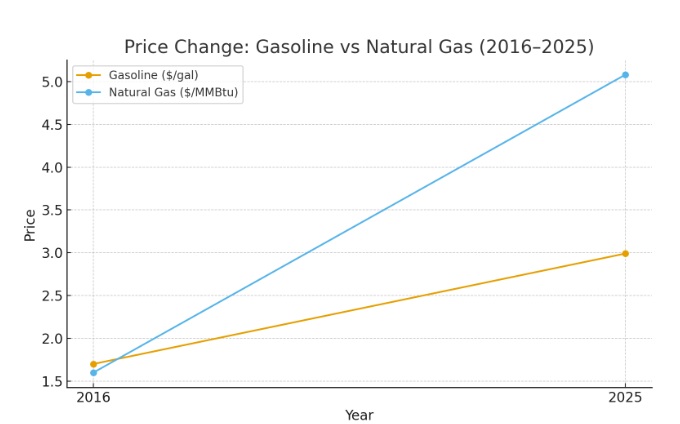
Gasoline

  • January 2016: $1.70/gallon
  • December 2025: ~$2.99/gallon
    ➡️ ↑ 76% increase

Natural Gas (Henry Hub Spot)

  • January 2016: ~$1.60 per MMBtu
  • December 2025: ~$5.08 per MMBtu
    ➡️ ↑ 217% increase

The truth is blunt:
Fuel prices are dramatically higher today than when Trump first took office—and that volatility is a direct consequence of policy choices, not some inevitable market swing. The biggest financial hit isn’t just at the gas pump, but on every electric bill in the country. Natural gas is still the backbone of U.S. power generation, so when its price spikes, electricity costs rise right along with it.

Trump made the situation dramatically worse by opening U.S. natural gas to heightened global demand, driving domestic prices even higher. And instead of strengthening the most affordable, stable, and sustainable energy sources—solar and wind—he’s actively undermined them. The result is a manufactured energy crisis that harms households, businesses, and the long-term health of the U.S. economy.

Trump’s Economic Agenda: A Blueprint for Collapse

Modern economic debates have been hijacked by emotional rhetoric and short-term political wins. But basic economics tells us:

  • Protectionism and tariffs shrink economies.
  • Nationalism and anti-immigration policies reduce labor supply, innovation, and GDP growth.
  • Populist attacks on institutions increase risk, weaken currency stability, and scare away investment.
  • Deregulation of fossil fuels amplifies long-term costs while accelerating climate-driven economic shocks.

These are not theoretical risks.
They are happening right now.

Capitalism Is Becoming Uninsurable

Perhaps the most alarming warning comes from Gunther Thallinger of Allianz SE, one of the world’s largest global insurers:

The pace and scale of climate-related destruction is beginning to exceed the insurance industry’s ability to function.

Insurance is the keystone stabilizer of capitalism.
If insurers can no longer price risk:

  • mortgages fail
  • banks collapse
  • property markets implode
  • businesses cannot operate
  • governments cannot finance disaster recovery
  • investment markets unravel

This is how capitalism collapses from within — not through ideology, but through mathematical certainty.

Climate Change: A Cascading, Nonlinear Health Crisis

Climate change is not just melting ice sheets.
It is unraveling the biological, ecological, and medical systems humans depend on.

Warming temperatures trigger reinforcing health feedback loops:

  • extreme heat → cardiovascular deaths → weakened population resilience
  • air pollution → chronic disease → higher mortality + healthcare costs
  • food system instability → malnutrition → reduced cognitive development
  • ecosystem collapse → infectious disease spread → rising pandemics
  • infrastructure failures → water contamination → chronic illness

These loops interact, amplify, and accelerate one another.
They are nonlinear, meaning each degree of warming creates exponentially greater harm.

This translates directly into:

  • shorter life expectancy
  • declining quality of life
  • skyrocketing healthcare costs
  • reduced labor productivity
  • shrinking economic output
  • destabilized communities
  • massive, permanent losses in human capital

The Bottom Line

Trump’s fossil-fuel agenda isn’t just anti-science.
It is anti-economic, anti-health, and anti-American.

By clinging to the most expensive and destructive energy system ever created, we are:

  • sabotaging our economy
  • accelerating financial collapse
  • undermining national security
  • destabilizing global markets
  • shortening human life
  • destroying the conditions necessary for civilization to function

A livable future — and a stable economy — requires recognizing that clean energy is not a cost.
It is the only economic path that ensures survival.

* Our probabilistic, ensemble-based climate model — which incorporates complex socio-economic and ecological feedback loops within a dynamic, nonlinear system — projects that global temperatures are becoming unsustainable this century. This far exceeds earlier estimates of a 4°C rise over the next thousand years, highlighting a dramatic acceleration in global warming. We are now entering a phase of compound, cascading collapse, where climate, ecological, and societal systems destabilize through interlinked, self-reinforcing feedback loops.

What Can I Do?
The single most important action you can take to help address the climate crisis is simple: stop burning fossil fuels. There are numerous actions you can take to contribute to saving the planet. Each person bears the responsibility to minimize pollution, discontinue the use of fossil fuels, reduce consumption, and foster a culture of love and care. The Butterfly Effect illustrates that a small change in one area can lead to significant alterations in conditions anywhere on the globe. Hence, the frequently heard statement that a fluttering butterfly in China can cause a hurricane in the Atlantic. Be a butterfly and affect the world.

→ “Solutions to the Fossil Fuel Economy and the Myths Accelerating Climate and Economic Collapse.“

The Climate Crisis: Violent Rain | Deadly Humid Heat | Health Collapse | Extreme Weather Events | Insurance | Trees and Deforestation | Soil | Rising Sea Level | Food and Water | Updates

Tipping points and feedback loops drive the acceleration of climate change. When one tipping point is toppled and triggers others, the cascading collapse is known as the Domino Effect.

The Human Induced Climate Change Experiment

Gasoline and Gas Prices 2016 to 2026

Trumpenomics

bookmark_borderClimate Chain-Reaction: How Nonlinear Feedback Loops Are Driving Runaway Global Warming

by Daniel Brouse and Sidd Mukherjee
December 3, 2025

Earth’s climate is a nonlinear, chaotic system composed of tightly interdependent subsystems—atmosphere, hydrosphere, cryosphere, lithosphere, and biosphere. Drawing from chaos theory, nonlinear thermodynamics, and emerging observations of accelerating climate instability, this paper examines how feedback loops and tipping points are now interacting in a compounding, cascading sequence similar to the self-accelerating chain-reaction of a nuclear explosion.

Human-induced climate change is no longer a slow, linear warming trend; it has entered a phase defined by feedback-driven acceleration, where each stage amplifies the next. This chain-reaction dynamic is rapidly pushing the climate toward states previously considered centuries away.

1. Ignition: Fossil Fuels, Pollution, and Initial Forcing

The chain reaction begins with the combustion of fossil fuels. This produces:

  • Greenhouse gases: CO₂, CH₄, and tropospheric ozone (O₃)

  • Particulate pollution: PM₂.₅ and other aerosols

  • Secondary health effects: heart disease, stroke, respiratory failure, and compounding stress on human physiological systems

Fine particulate pollution and ozone feed directly into a health-driven feedback loop—weakening human resilience, increasing mortality, reducing labor productivity, and indirectly accelerating global warming through economic disruption and heightened energy demand.

Meanwhile, CO₂ and methane trap longwave radiation, raising global temperatures and injecting more thermal energy into every component of the climate system.

2. Atmospheric Moisture Feedback: The First Major Amplifier

A fundamental physical law governs what happens next: warmer air holds more water vapor, and water vapor is itself the most powerful greenhouse gas on the planet.

  • For every 1°C (1.8°F) of warming, the atmosphere can hold ~7% more moisture.

  • Over 10°C, water-holding capacity nearly doubles.

  • Increased evaporation → increased atmospheric moisture → increased back-radiation → more warming → more evaporation.

This is a classic positive feedback loop.

More water vapor also supercharges extreme precipitation events, creating catastrophic inland and coastal flooding, particularly in regions like the Mid-Atlantic United States where river basins, stormwater systems, and aging infrastructure are already overwhelmed.

3. Permafrost Thaw, Boreal Forest Collapse, and the Carbon Bomb

As global temperatures rise, the Arctic warms 3–4 times faster than the global average—a phenomenon known as polar amplification. This triggers the next phase of the chain reaction:

Permafrost Thaw

  • Releases vast stores of CO₂ and CH₄ trapped for millennia

  • Destabilizes soils, infrastructure, and entire ecosystems

  • Forms thaw lakes that leak methane at accelerating rates

Zombie Fires and Boreal Wildfires

The thawing cryosphere has enabled:

  • “Zombie fires” smoldering underground year-round

  • Record-breaking boreal forest fires in Canada, Alaska, and Siberia

  • Fire emissions now exceeding the annual fossil-fuel emissions of countries like Canada

These fires convert carbon sinks into carbon sources—an irreversible shift.

4. Ocean Heating, Jet Stream Disruption, and the Breakdown of Planetary Circulation

The oceans absorb over 90% of the excess heat trapped by anthropogenic greenhouse gases. This thermal accumulation drives multiple destabilizing processes:

  • Weakening of the AMOC (Atlantic Meridional Overturning Circulation)

  • Slowing and increased waviness of the jet stream

  • Prolonged heat domes, atmospheric blocking, and stalled storm systems

  • Intensification of tropical cyclones through ocean heat content

These system-level shifts introduce chaotic behavior into global weather patterns—persistent drought where water is needed, and supersaturated storms where the atmosphere is already overloaded.

5. The Scale of Heat Accumulation: A Planet-Wide Nuclear Equivalent

The increase in Earth’s thermal energy is almost impossible for the human mind to process. The planet currently gains heat at a rate equivalent to:

  • Several Hiroshima-sized atomic bombs per second

  • 400,000–1,000,000 Hiroshima bombs per day

Between 1971 and 2020, Earth accumulated roughly 380 zettajoules of additional heat—equivalent to: ~25 billion Hiroshima bombs of energy

Most of this energy is now locked in the oceans, driving stratification, deoxygenation, coral die-off, species collapse, and further disruption of heat distribution mechanisms.

Unlike a nuclear bomb—which expends its chain reaction in microseconds—Earth’s climatic chain reaction is continuous, compounding, and accelerating.

6. Runaway Phase: When Drivers Become Amplifiers

As described in the linked papers (“Drivers and Amplifiers,” “Non-Linear Acceleration,” “Runaway Phase”), the boundary between “cause” and “effect” begins to dissolve:

  • Warming creates more warming.

  • Melting creates more melting.

  • Extinction accelerates more extinction.

  • Infrastructure failures multiply future failures.

  • Human health decline increases vulnerability to further environmental shocks.

At this stage, feedback loops interact, producing nonlinear acceleration. These interactions include:

  • Ice-albedo loss

  • Methane release

  • Soil respiration increases

  • Ocean stratification and reduced carbon uptake

  • Vegetation dieback

  • Wildfire-carbon amplification

  • Population displacement and weakened institutional response capacity

This is the signature of a system entering runaway dynamics.

Conclusion: A Planet in a Chain Reaction

Climate drivers and amplifiers now form an interconnected series of cascading feedback loops that are accelerating global warming far beyond linear predictions. The climate is no longer responding to “emissions alone”; it is responding to its own destabilization.

Earth’s climate chain reaction is not theoretical or distant—it is unfolding in real time.

To interrupt this runaway process, humanity must:

  • Rapidly eliminate fossil fuel combustion

  • Restore carbon sinks

  • Rebuild resilient infrastructure

  • Reduce pollution

  • Strengthen global cooperation rather than retreat into isolation

Without decisive action, the chain reaction will continue until multiple tipping points lock the planet into an unlivable state.

Infectious disease vectors, violent rain, and deadly humid heat now stand among the greatest threats of climate change, no longer future warnings but present realities. This deadly triad — rising infectious diseases, escalating heat extremes, and intense rainfall events — has begun driving an exponential increase in climate-related deaths worldwide. These hazards do not operate in isolation; they amplify one another’s impacts, creating cascading risks that strain health systems, destabilize communities, and accelerate global mortality. Climate change has become a full-scale health crisis, demanding urgent, systemic action before these accelerating threats overwhelm society’s ability to respond.

* Our probabilistic, ensemble-based climate model — which incorporates complex socio-economic and ecological feedback loops within a dynamic, nonlinear system — projects that global temperatures are becoming unsustainable this century. This far exceeds earlier estimates of a 4°C rise over the next thousand years, highlighting a dramatic acceleration in global warming. We are now entering a phase of compound, cascading collapse, where climate, ecological, and societal systems destabilize through interlinked, self-reinforcing feedback loops.

What Can I Do?
The single most important action you can take to help address the climate crisis is simple: stop burning fossil fuels. There are numerous actions you can take to contribute to saving the planet. Each person bears the responsibility to minimize pollution, discontinue the use of fossil fuels, reduce consumption, and foster a culture of love and care. The Butterfly Effect illustrates that a small change in one area can lead to significant alterations in conditions anywhere on the globe. Hence, the frequently heard statement that a fluttering butterfly in China can cause a hurricane in the Atlantic. Be a butterfly and affect the world.

The Human Induced Climate Change Experiment

bookmark_borderClimate-Accelerated Flooding in Delaware and Chester Counties: The Brandywine Creek Threat

by Daniel Brouse
December 2, 2025

Mapping by the U.S. Geological Survey (USGS) highlights Brandywine Creek, the Christina Basin, and multiple watersheds across Delaware County as major flood-risk zones—an assessment that aligns with the region’s accelerating exposure to extreme weather. The USGS flood inundation maps show that the Brandywine is especially prone to rapid rises in water level during heavy rainfall events, often swelling far beyond its banks and inundating nearby neighborhoods, roadways, and infrastructure.

Several factors compound this vulnerability:

• Increased rainfall intensity
Climate data show that the Mid-Atlantic is experiencing more frequent high-intensity rainstorms, with total precipitation delivered in fewer, more extreme bursts. This overwhelms the creek’s capacity and turns tributaries into fast-moving flood channels.

• Watershed geometry and urbanization
Much of Delaware County lies in narrow river valleys with steep topography, which funnels rainfall directly into creeks and accelerates runoff. As urban development expands—adding impervious surfaces such as asphalt and concrete—the watershed loses its natural ability to absorb water, amplifying flash-flood potential.

• Aging and undersized infrastructure
Stormwater systems in many of these communities were not designed for 21st-century rainfall extremes. As a result, drainage networks back up quickly, turning what would once have been manageable floods into dangerous, property-damaging events.

• Climate-driven amplification
Warming oceans and atmospheric moisture increases—roughly 7% more water vapor available in the atmosphere per 1°C of global warming—supercharge storms in the region. This means each storm has the potential to deliver far more rain in a shorter timeframe, a trend consistent with the catastrophic floods the Brandywine watershed has experienced in recent years (e.g., the remnants of Hurricane Ida).

As a result, Delaware and Chester Counties are now among the fastest-escalating inland flood zones in the Mid-Atlantic, with climate-driven rainfall extremes transforming what were once episodic flood events into recurrent, high-impact disasters. Homes, businesses, schools, roadways, critical utilities, and regional transportation corridors along Brandywine Creek, Chester Creek, Darby Creek, and their tributaries face increasing year-over-year risk as the hydrologic regime becomes more volatile.

Chester County: Critical Infrastructure at High Risk

In Chester County, vulnerability extends well beyond residential flooding. The county’s wastewater system is centrally dependent on the Brandywine Creek, meaning multiple municipal sewage treatment facilities sit directly within high-risk floodplains. These facilities are increasingly exposed to:

  • Overbank flooding that can overwhelm treatment capacity
  • Structural inundation leading to electrical and pump failures
  • Raw sewage releases into the Brandywine and downstream into Wilmington’s water supply
  • Loss of operational access for emergency crews during severe flood stages

A major breach or system failure would trigger cascading public-health hazards, contaminate drinking water infrastructure, and disrupt wastewater services for tens of thousands of residents.

Additionally, stormwater basins, dams, aging bridges, and low-lying roadways—many built decades before modern flood-risk standards—are failing more frequently under record rainfall. The increasing intensity of flash-flood events threatens life-safety response times, evacuation routes, and continuity of essential services.

Delaware County: Industrial Legacy + Rising Water = Compounding Hazard

In Delaware County, the risk is even more severe due to the region’s industrialized, low-lying riverfront, much of which was historically built on wetlands, marshlands, and filled swamp soils that were never engineered to withstand modern hydrologic extremes.

Along the Delaware River and lower creek systems, the county hosts:

  • Petroleum refineries and former refinery complexes
  • Bulk fuel storage farms and transfer terminals
  • Chemical manufacturing sites
  • Rail corridors carrying hazardous materials
  • Natural gas infrastructure and distribution hubs
  • Superfund and brownfield sites with residual contaminants in soil and groundwater

As climate-amplified flooding intensifies:

  • Rising groundwater mobilizes petroleum residues, solvents, and heavy metals trapped in fill soils.
  • Floodwaters can inundate storage tanks, pipelines, rail lines, and industrial yards, increasing the risk of spills or chemical releases.
  • Power outages combined with inundation threaten refinery pump systems, tank farm containment walls, and emergency shutoff controls.
  • Flood-driven erosion can undermine pipelines and buried utility conduits, increasing explosion or leak risk.

This combination of subsiding land, sea-level rise, industrial contamination, and extreme rainfall places Delaware County in a uniquely dangerous situation: a region where climate-accelerated flooding threatens not just property and infrastructure, but public health, the regional economy, and environmental stability.

USGS and NOAA both warn that without aggressive climate mitigation and local adaptation—such as updated floodplain zoning, expanded stormwater capacity, and restoration of natural wetlands—the region’s flood severity will continue to worsen as climate change accelerates.

* Our probabilistic, ensemble-based climate model — which incorporates complex socio-economic and ecological feedback loops within a dynamic, nonlinear system — projects that global temperatures are becoming unsustainable this century. This far exceeds earlier estimates of a 4°C rise over the next thousand years, highlighting a dramatic acceleration in global warming. We are now entering a phase of compound, cascading collapse, where climate, ecological, and societal systems destabilize through interlinked, self-reinforcing feedback loops.

What Can I Do?
The single most important action you can take to help address the climate crisis is simple: stop burning fossil fuels. There are numerous actions you can take to contribute to saving the planet. Each person bears the responsibility to minimize pollution, discontinue the use of fossil fuels, reduce consumption, and foster a culture of love and care. The Butterfly Effect illustrates that a small change in one area can lead to significant alterations in conditions anywhere on the globe. Hence, the frequently heard statement that a fluttering butterfly in China can cause a hurricane in the Atlantic. Be a butterfly and affect the world.

Tipping points and feedback loops drive the acceleration of climate change. When one tipping point is breached and triggers others, the cascading collapse is known as the Domino Effect.

The Human Induced Climate Change Experiment

bookmark_borderUpdate: Tree Extinction Due to Human-Induced Environmental Stress

by Daniel Brouse & Sidd Mukherjee

(Originally titled: “Foliage Spoilage & the Trees’ Canopy Collapse”)
A study by The Membrane Domain (2005–ongoing)

I. Overview

Long-term field observations, remote-sensing data, and new climate–biosphere models now converge on a disturbing conclusion: Earth’s forests are undergoing rapid, nonlinear decline driven by a cascading series of human-induced stressors. The interacting effects of pollution, drought, extreme weather, pest outbreaks, wildfire acceleration, and climate feedback loops have pushed multiple forest biomes into sink-to-source transitions, where forests emit more carbon than they absorb.

What began in 2001 as a study of visible canopy loss has evolved into documentation of a global systemic collapse. Satellite evidence confirms that large forest regions—including the African tropical moist broadleaf biome—have already shifted from net carbon sinks to net sources in a period of only seven years (Mensah et al. 2025). Similar transitions are now observed in boreal forests, peatlands, and other major carbon reservoirs.

These processes are not isolated. They are coupled, mutually reinforcing feedback loops capable of accelerating tree mortality on timescales far faster than traditional models predicted.

II. Sampling of Contributing Variables

A. Pollution

Pollution remains the most significant driver of global tree decline—and the most underestimated. Because pollution affects air, water, soil chemistry, and atmospheric chemistry simultaneously, its effects manifest through multiple pathways.

At the center of the problem is tropospheric ozone, a toxic oxidant produced by combustion byproducts (NOₓ, VOCs, methane). Ground-level ozone:

  • damages foliage and suppresses photosynthesis
  • reduces stomatal conductance and growth
  • diminishes drought and heat tolerance
  • increases vulnerability to pests, pathogens, and wildfire

Field and global datasets show that ozone pollution is responsible for a substantial portion of current forest mortality. A 2024 tropical forest analysis found that human-derived ozone has reduced net primary productivity (NPP) by ~17% since 2000, significantly weakening the tropical carbon sink.

Further reading:

  • The Dangers of Tropospheric Ozone
  • Tropospheric Ozone = Bad Ozone
  • The Ozone Know Zone
  • Gasoline Plus Ethanol Equals Bad Ozone

Ozone interacts with other pollutants—including nitrogen deposition, particulate matter, and acidifying compounds—to accelerate canopy loss and soil nutrient depletion. Thermal pollution (heat from combustion and urban surfaces) additionally increases ozone formation rates.

B. Water Stress

1. Drought

Recent decades have experienced unprecedented drought frequency and severity. Lower water tables, heat waves, and multi-year moisture deficits weaken root systems and diminish trees’ ability to withstand pests and disease.

2. Excess Rain / Acid Rain

Conversely, excessive rainfall—often more acidic and chemically reactive—damages leaves, alters soil pH, and dissolves essential micronutrients. Acid fog and cloudwater have been documented causing widespread leaf necrosis.

Both extremes—too little and too much water—are now more common due to climate change’s amplification of the hydrological cycle.

Further reading:
Will Tree Species Survive Climate Change?

C. Pests

1. Insects and Worms

Tree mortality from insects such as gypsy moths and borers has long been understood, but recent collapses in insect biodiversity (~80% declines) and changes in soil invertebrates are novel phenomena linked to warming and acidification.
Bee population losses create critical pollination failures. Worm colonization in previously worm-free northern forests has transformed soil structure and nutrient cycling, contributing to tree decline.

2. Invasive Species

A proliferation of invasive insects and plants—including ailanthus, Asian longhorn beetle, emerald ash borer, and persistent non-native earthworms—has destabilized forest ecosystems.

3. Short, Warm Winters

Warmer winters dramatically reduce larval mortality. USDA data:

  • At –17.8 °C: only 5% of emerald ash borer larvae die
  • At –34 °C: 98% mortality

These lethal cold thresholds are now rarely reached in many northern regions.

4. Deadwood Decomposition Feedback

A Nature study shows that insects contribute to ~29% of global deadwood carbon emissions, releasing ~10.9 Gt of carbon annually, comparable to or exceeding fossil-fuel emissions.

Examples:

  • Emerald Ash Borer
  • Whitebark Pine Beetle
  • Worm Invasion
  • Beetlemania
  • Utah Beetles

D. Climate Change Feedback Loops

Pollution, drought, heat, and pests each contribute to mortality—but it is the feedback between them that drives runaway decline.

Key climate feedback loops affecting trees:

  1. Warming → drought + heat waves → tree death → reduced carbon sink → more warming
  2. Ozone formation → reduced NPP → increased atmospheric CO₂ → enhanced warming
  3. Wildfires → massive GHG release + ozone production → more warming → more fires
  4. Permafrost thaw → CO₂ and CH₄ release → accelerated warming → boreal forest die-off

The Tree Extinctions scientific warning states that one-third of global tree species are now threatened with extinction, risking ecosystem collapse.

Wildfires as Accelerating Forces

Warming has intensified wildfire seasons globally. Highlights:

  • Australia (2019–2020): 24 million hectares burned; ecosystems that had not burned for 35,000 years were consumed
  • Northwestern U.S. & Canada (2021): record wildfire extent
  • Three of the last five U.S. years: >10 million acres burned
  • Canada 2023–2024: largest fires in modern history, releasing massive permafrost carbon

Hotter temperatures → more fires → fewer forests → more carbon emissions → hotter temperatures.

By 2070, ~2 billion people may live in Saharan-like heat zones (PNAS).

III. Example: The Decline of Penn’s Sylvania

Pennsylvania (“Penn’s Woods”) once embodied dense, towering forest ecosystems. Today, long-term observational data show:

  • rapid loss of older canopy trees
  • increased vine domination of the mid- and upper canopy
  • widespread ozone damage
  • drought-related stress
  • invasive species pressures
  • reduced winter chill
  • declining biodiversity

When canopy giants fall, light floods the understory, triggering explosive vine expansion that further suppresses regrowth. Trees, rooted in place, cannot migrate northward fast enough to escape rising temperatures and altered precipitation.

Pennsylvania’s decline mirrors global trends in temperate and boreal forests.

IV. Conclusion

Human activities—pollution, fossil combustion, land use, and climate alteration—are driving an accelerating cycle of tree mortality. Tropospheric ozone, previously underestimated in its global effect, now appears to be one of the dominant controls on forest health and productivity. When combined with drought, pests, invasive species, and wildfires, the result is a self-reinforcing, exponential decline in global forest stability.

Tree mortality accelerates global warming; warming accelerates further tree mortality.
This is no longer a linear problem—it is a cascading climate-biosphere emergency.

Immediate mitigation of fossil-fuel emissions, ozone precursors, and land-use drivers is essential if Earth’s forests—and the ecosystems and climate stability they support—are to survive the 21st century.

SOURCES
World Meteorological Organization (WMO) — Annual & special reports (2024–2025)


  • Global Carbon Project — Global Carbon Budget (2024–2025)

  • “Loss of tropical moist broadleaf forest has turned Africa’s forests from a carbon sink into a source,” Nature (2025).

  • R. (2025). “Evolution of Shear-Zone Fractures Presages the Disintegration of Thwaites Eastern Ice Shelf,” Adv. Earth & Space Sci., doi:10.1029/2025JF008352.

  • Hansen, J., Kharecha, P., & Morgan, D. (2025). “Global Warming Acceleration: Impact on Sea Ice” — data-driven analysis confirming acceleration of forcing trends. (Author manuscript/report.)

  • Lancet Countdown on Health and Climate Change — Annual report (2024–2025).

  • Natural Resources Canada — Coverage of Canada’s 2023 wildfires and permafrost/fire interactions (2023–2024).
  • “The contribution of insects to global forest deadwood decomposition,” Nature (2021).

  • IPCC AR6 and Assessment Reports — working group findings on forcings, feedbacks and sea-level projections.

  • NOAA — Sea level, extreme weather, and climate monitoring datasets (Tide gauge, satellite altimetry).
  • NASA — Ocean heat content and cryosphere monitoring pages (sea ice, glaciers, ice-sheet mass balance).

  • World Health Organization — Air pollution and health (PM2.5, ozone) statistics and reports.

  • Aviva / GallagherRE / Zurich — Industry reports and estimates on insured losses from extreme weather (2013–2024).

  • Membrane Domain — “Systemic Collapse” (Brouse & Mukherjee notes and working reports).

  • Membrane Domain — “The Dangers of Tropospheric Ozone: A Silent Threat to Health and the Environment.”

  • Mensah, A., et al. (2025). “Africa forest sink-to-source transition (2007–2017).” Scientific Reports / Nature family (see Nature link above).

  • Peer-reviewed studies and reviews on permafrost thaw, methane release, and boreal fire feedbacks (selected PNAS, Nature, Science articles, 2018–2025).

  • Trees and Deforestation

    The Human Induced Climate Change Experiment

    bookmark_borderTipping Into the Collapse Zone: How Feedback Loops Are Transforming Earth’s Carbon Sinks Into Carbon Sources

    By Daniel Brouse & Sidd Mukherjee
    November 30, 2025


    Introduction: The Carbon Sink Collapse Has Begun

    Earth’s major carbon sinks — forests, permafrost, and peatlands — have long buffered humanity from the full force of climate change. That buffer is now failing. Evidence from satellite data, field measurements, atmospheric chemistry, and wildfire emissions shows that multiple ecosystems are crossing tipping points simultaneously. These shifts are not gradual; they are driven by nonlinear feedback loops that accelerate greenhouse gas release and destabilize the climate system.

    Human activity is the root cause of this transition. Fossil fuel combustion, deforestation, land degradation, and pollution have combined to weaken and reverse the natural carbon balance, turning once-stable sinks into net greenhouse gas emitters of both CO₂ and methane.

    The emerging reality is stark: Earth’s biosphere is no longer reliably absorbing carbon — it is amplifying climate change.


    Africa’s Carbon Sink Reversal: A Planetary Warning

    A landmark 2025 study published in Nature, Loss of tropical moist broadleaf forest has turned Africa’s forests from a carbon sink into a source, provides a crucial data point in this global shift.

    Key findings include:

    • African forests and woody savannas historically served as a major carbon sink.
    • 2007–2010: Biomass increased by +439 ± 66 Tg yr⁻¹.
    • 2010–2015: Biomass shifted to a net loss of –132 ± 20 Tg yr⁻¹.
    • 2015–2017: Net biomass loss continued at –41 ± 6 Tg yr⁻¹.
    • Tropical moist broadleaf forest deforestation was the primary driver.
    • Shrub encroachment in savannas offered only limited offsetting gains.

    The transition from sink to source occurred within a decade — far faster than conventional climate models predicted.

    The authors warn that achieving the Glasgow Leaders’ Declaration and updating Nationally Determined Contributions under the Paris Agreement will require far more ambitious global deforestation policies, as the decline of natural carbon sinks is widening the emissions gap.


    Runaway Feedback Loop #1: Permafrost Collapse and Year-Round Fire

    Permafrost melt is one of the clearest demonstrations of how climate feedback loops exceed linear expectations.

    Old assumption:
    Permafrost would thaw gradually over millennia, releasing CO₂ and CH₄ slowly.

    Observed reality:
    Large swaths of permafrost are thawing abruptly, collapsing into mud, and — in an unprecedented development — burning year-round.

    Wildfires in high-latitude peat soils are now releasing carbon on a scale once thought impossible in this century. Data from Canada’s record-shattering 2023 wildfire season confirms that its forests have become net carbon sources for the first time on record.
    (See: Natural Resources Canada, 2023)

    New Scientific Unknowns Introduced by Permafrost Fire

    • Combustion releases CO₂ rapidly, accelerating warming.
    • Some methane ignites and is converted to CO₂ — a minor “natural flaring” effect.
    • Much methane escapes unburned.
    • The ratio of burned vs. unburned methane remains poorly constrained.

    The key point: permafrost carbon feedbacks are releasing greenhouse gases orders of magnitude faster than legacy climate models projected.


    Runaway Feedback Loop #2: Tropospheric Ozone and the Collapse of Biospheric Productivity

    Climate feedbacks are not limited to warming. The chemistry of fossil fuel combustion creates secondary pollutants that directly attack the biosphere. One of the most dangerous is tropospheric ozone — a potent phytotoxin.

    Ozone’s Role in Accelerating Ecosystem Collapse

    • Reduces plant growth by 10–40% across many species.
    • Causes direct tissue damage to leaves and roots.
    • Weakens resistance to drought, pests, pathogens, and heat.
    • Leads to premature mortality in trees and crops.
    • Drives reductions in Net Primary Productivity (NPP) of 20–70% in sensitive regions.
      (See: Ground-Level Ozone and Carbon Drawdown, membrane.com)

    This is not hypothetical. Global forests have shifted from carbon sinks to net carbon sources for the past two consecutive years, driven by ozone stress, wildfire emissions, and drought compounds.

    Field Evidence From Pennsylvania

    Our two-decade field study (2003–2025) shows:

    • Old-growth trees have lost ~40% of foliage over multi-year intervals.
    • Canopy height has declined by ~33%.
    • Mortality rates have accelerated dramatically.

    These findings mirror global NPP declines and highlight ozone as an underrecognized driver of biospheric collapse.


    The Feedback Web: How Warming, Ozone, Wildfire, and Ecosystem Death Reinforce Each Other

    The feedback loops described here are tightly interconnected:

    1. Fossil fuel combustion → increases CO₂ + ozone precursors.
    2. Ozone → reduces plant productivity → lowers carbon uptake.
    3. Warming + drought → increase wildfire frequency.
    4. Wildfires → emit CO₂ + ozone precursors → produce more ozone.
    5. Permafrost fires → add CO₂ and CH₄ at record rates.
    6. Methane release → accelerates warming → further ozone formation.

    This is not a linear sequence — it is a self-reinforcing network of processes, each amplifying the others. Earth’s regulatory systems are being destabilized simultaneously, pushing the planet toward a state of compound, cascading instability.


    Crossing the Threshold Into Nonlinear Climate Behavior

    Linear projections drastically underestimate the risk. Nonlinear systems behave differently:

    • Thresholds can be crossed abruptly.
    • States can shift rapidly and irreversibly.
    • Small additional forcings can trigger large-scale transformations.
    • Feedbacks can synchronize and accelerate together.

    The collapse of forests, the thawing of permafrost, and the rise of global ozone stress reflect active tipping points, not future ones.

    The Climate Trajectory Is Compressing

    Processes once believed to unfold over centuries are now occurring within decades — or even years. Feedbacks once considered “theoretical” are already reshaping Earth’s atmosphere, hydrology, and ecosystems.

    This is the central scientific question of our time:
    How quickly, and through what pathways, will runaway feedbacks redefine Earth’s climate system?

    Our research focuses on quantifying these acceleration rates and mapping the tipping dynamics that will determine the future of human civilization.


    Additional References

    http://membrane.com/global_warming/Systemic-Collapse.html
    http://membrane.com/global_warming/Ozone-Low-Level.html
    http://membrane.com/global_warming/Amazon-Collapse.html
    http://membrane.com/global_warming/Nonlinear-Dominoes-of-Climate-Collapse.html
    http://membrane.com/trees/
    http://membrane.com/trees/death-by-ozone.html

    bookmark_borderSudden Sea Level Pulses: How “Cork Release” Ice-Sheet Failures Could Rapidly Reshape Global Coastlines

    By Daniel Brouse and Sidd Mukherjee

    November 25, 2025

    Introduction: The Shift From Gradual to Abrupt Sea Level Rise

    Sea level rise (SLR) is one of the most revealing indicators of the accelerating pace of climate change. A century ago, global SLR was doubling roughly every 100 years. Ten years ago the doubling time had collapsed to a decade. By 2023, the doubling time had plunged to only two years.

    This extraordinary acceleration led us to focus on a much more dangerous and poorly modeled phenomenon:

    Sudden Sea Level Pulses (SSLPs) — rapid, stepwise jumps in sea level triggered by abrupt ice-sheet failures, subglacial “cork release” events, and ice-shelf structural collapse.

    These pulses are not hypothetical. They are beginning to occur.

    Examples include:

    • Greenland Subglacial Flood: A massive outburst where trapped meltwater burst through the ice, demonstrating the potential for sudden hydrofracture.
    • Alaska’s Mendenhall Glacier Outburst: A glacial flood that produced rapid, dangerous water-level increases downstream.

    A detailed overview is archived at:
    http://membrane.com/global_warming/Greenland-Ouburst.html

    These events reveal something ice-sheet models have not yet fully integrated: meltwater can accumulate beneath ice until pressure surpasses structural integrity, causing the ice surface to fail catastrophically — a “cork release.” When this occurs at scale, sea levels can jump not millimeters per year, but multiple feet per year.

    Why This Matters: The Risk of Abrupt, Multi-Foot Sea Level Jumps

    The public still imagines sea level rise as a slow, linear process. But the Earth system does not behave linearly. When hydrofracture and ice-cliff collapse become common, we could face:

    • Multi-foot sea level increases within a single decade
    • 1–3 feet of rise within a single year in extreme pulse scenarios
    • Little or no time for adaptation in cities like Miami, New York, Mumbai, Lagos, and Shanghai

    Current global climate models fail to incorporate most “cork release” pathways because:

    • Subglacial water transport is poorly mapped
    • Meltwater storage and pressurization are not well parameterized
    • Ice-shelf fracture mechanics are only partially resolved
    • Positive feedback loops — such as meltwater-driven lubrication and ice-cliff collapse — are not modeled dynamically

    The Greenland outburst events show that ice sheets can undergo abrupt, nonlinear failures — far faster than infrastructure, economies, or governance systems can adapt.

    Sidd summarized it best:

    “Under-ice hydrology is hard to observe… but once enough pressure builds, ice doesn’t melt — it fractures.”

    Antarctica: The System Most Likely to Produce Catastrophic Pulses

    While Greenland contributes meaningfully to long-term SLR, Antarctica is the critical risk for abrupt sea level pulses.

    The East Antarctic Ice Sheet (EAIS)

    • Holds ~170 feet of potential sea level rise
    • Once thought stable for millennia
    • Now showing early signs of warming-driven destabilization
    • Marine-based sectors may begin collapsing this century

    The West Antarctic Ice Sheet (WAIS)

    • Highly vulnerable
    • Resting on retrograde (downward-sloping) bedrock
    • Warm ocean water is eroding the shelves from below
    • Pinning points are failing, which removes the natural “brakes”

    Sidd’s assessment:

    Greenland: “Effectively lost,” 100–300 years, +20 ft
    West Antarctica: Likely collapse within decades to ~100 years, +10 ft

    Total plausible rise by 2125: 20–30 feet, with the possibility of sudden pulses:

    “We could dawdle along at half an inch a year, then see a few years at a foot per year.”

    New Evidence: The Impending Failure of Thwaites Eastern Ice Shelf (TEIS)

    In November 2025, Advancing Earth and Space Sciences published a landmark study:
    “Evolution of Shear-Zone Fractures Presages the Disintegration of Thwaites Eastern Ice Shelf”
    (https://agupubs.onlinelibrary.wiley.com/doi/10.1029/2025JF008352)

    The TEIS is a keystone structure. Once it collapses, the glacier behind it — the “Doomsday Glacier” — will accelerate dramatically. The study found:

    Key Findings

    1. Long-term shear fracturing (2002–2017):
      Large fractures formed parallel to flow as the shelf strained against its pinning point.
    2. Recent explosive tensile fracturing (2017–2022):
      Smaller, orthogonal fractures began proliferating, indicating that structural integrity is failing.
    3. Dynamic destabilization:
      Satellite and GPS data reveal velocity perturbations rippling across the shelf as fractures expand — a sign of imminent collapse.
    4. Transition of the pinning point from stabilizer to destabilizer:
      Echoing Benn et al. (2022), the pinning point now increases fracture stress instead of reducing it.
    5. Self-reinforcing feedback loop:
      The shelf appears to be entering the “damage-acceleration-damage” feedback proposed by Lhermitte et al. (2020), a hallmark of impending disintegration.

    What This Means

    When TEIS collapses — an event many glaciologists now expect within years to a decade — Thwaites Glacier could:

    • accelerate dramatically
    • initiate ice-cliff collapse
    • trigger multi-foot sea level pulses within short timescales

    This is the largest currently unfolding structural failure in the cryosphere.

    Cork-Release Events: A Distinct Class of Tipping Point

    We define a “cork release” event as:

    A sudden failure of ice or subglacial pressure systems causing rapid, high-volume discharge of water or ice into the ocean.

    These events include:

    • subglacial lake drainage
    • rapid ice-shelf collapse
    • meltwater-driven hydrofracture
    • ice-cliff structural failure

    Unlike gradual melt, cork-release events:

    • are nonlinear
    • occur suddenly
    • accelerate with warming
    • have global consequences within months to years
    • are triggered by thresholds that are difficult to predict

    This makes them one of the most dangerous — and least modeled — climate feedbacks.

    Conclusion: The Urgent Need to Model Abrupt Sea Level Change

    The climate system is not simply warming. It is accelerating, destabilizing, and producing events far outside historical norms. Sea level rise will not be a smooth curve; it will be stepwise, punctuated by abrupt pulses.

    To prepare for what is coming, climate science and adaptation planning must incorporate:

    • ice-shelf fracture dynamics
    • under-ice hydrology
    • subglacial pressurization
    • ice-cliff collapse physics
    • nonlinear feedbacks
    • sudden sea level pulse scenarios

    Human systems are built for gradual change. The cryosphere is not.

    The question is no longer if abrupt sea level pulses will occur — but how soon, how large, and how many.

    * Our probabilistic, ensemble-based climate model — which incorporates complex socio-economic and ecological feedback loops within a dynamic, nonlinear system — projects that global temperatures are becoming unsustainable this century. This far exceeds earlier estimates of a 4°C rise over the next thousand years, highlighting a dramatic acceleration in global warming. We are now entering a phase of compound, cascading collapse, where climate, ecological, and societal systems destabilize through interlinked, self-reinforcing feedback loops.

    What Can I Do?
    The single most important action you can take to help address the climate crisis is simple: stop burning fossil fuels. There are numerous actions you can take to contribute to saving the planet. Each person bears the responsibility to minimize pollution, discontinue the use of fossil fuels, reduce consumption, and foster a culture of love and care. The Butterfly Effect illustrates that a small change in one area can lead to significant alterations in conditions anywhere on the globe. Hence, the frequently heard statement that a fluttering butterfly in China can cause a hurricane in the Atlantic. Be a butterfly and affect the world.

    → “Solutions to the Fossil Fuel Economy and the Myths Accelerating Climate and Economic Collapse.“

    Tipping points and feedback loops drive the acceleration of climate change. When one tipping point is toppled and triggers others, the cascading collapse is known as the Domino Effect.

    The Human Induced Climate Change Experiment

    bookmark_borderThe Non-Linear Acceleration of Climate Change: Evidence, Confirmation, and the Emerging Domino Effect

    By Sidd Mukherjee and Daniel Brouse
    November 22, 2025

    In the 1990s, we developed what became known as The Non-Linear Acceleration Hypothesis—the proposition that climate change is not progressing linearly but is accelerating exponentially. Working together, with Sidd’s background as a Doctor of Physics from Ohio State and my own experimental and observational analyses, we produced the foundational evidence for this theory. By the early 2000s, our work had evolved into a recognized climate framework, validated repeatedly through independent replication and supported by an expanding body of empirical data. Over the decades, this body of confirmation has solidified into the scientific consensus we see today.

    Shrinking Doubling Times and Escalating Impacts

    One of the most compelling indicators of nonlinear acceleration is the dramatic contraction of the doubling time of climate impacts—the interval in which damage effectively doubles due to interacting feedback processes. In the mid-20th century, the doubling time was on the order of 100 years. By the early 2000s, it had fallen to 10 years, and recent analyses show that it has now plunged to approximately 2 years.

    This means that the impacts of climate change today are twice as severe as they were two years ago. If the doubling time remains constant, they will be four times worse in two years, eight times worse in four years, and potentially sixty-four times worse within a decade. These estimates are conservative; the doubling period continues to shorten as feedbacks intensify. With no meaningful global mitigation underway, the trajectory is unmistakable and vastly more catastrophic than previously projected.

    Hansen’s Confirmation of the Acceleration Hypothesis

    We have long regarded Dr. James E. Hansen as one of the principal founders of modern climate science. In April 2025, Hansen’s paper Global Warming Acceleration: Impact on Sea Ice provided a direct, data-driven confirmation of our hypothesis. His analysis demonstrated that global warming is accelerating, and that climate sensitivity is higher than IPCC estimates, fundamentally altering expectations for 21st-century warming.

    Hansen concluded that IPCC models underestimate both climate sensitivity and key feedback processes. Under current emissions levels, he projects that warming by 2100 is likely to exceed 7°C, dramatically raising the probability of crossing multiple climate tipping points.

    In November 2025, Hansen, Kharecha, and Morgan published Warning! This “Colorful Chart” Is Censored by IPCC, offering further confirmation.

    Accelerated Forcing Growth

    Their analysis centers on a chart showing the five-year running mean of the annual increase in greenhouse gas forcing. Over the past 15 years, they find that the rate of increase has surged to ~0.5 W/m² per decade—far higher than IPCC projections. This acceleration is not reflected in IPCC scenarios and is fundamentally incompatible with its claims of remaining “pathways” to 1.5°C or 2°C.

    Implications for Climate Scenarios

    • Current forcing trajectories align closely with RCP 8.5, the high-end “business-as-usual” pathway.
    • They diverge sharply from RCP 2.6, the scenario often used for policy optimism.
    • Achieving RCP 2.6 today would require $2.4–5 trillion per year using current technology.
    • RCP 2.6 also presumes unrealistic levels of biomass burning plus carbon capture, which Hansen calls politically and practically unviable.

    Critique of IPCC’s Modeling and Transparency

    Hansen and colleagues argue that the IPCC relies too heavily on Integrated Assessment Models (IAMs), which they describe as opaque “dark boxes”—tools that embed assumptions that are rarely examined in public-facing science.

    They highlight that:

    • Scientists have not adequately communicated the severity of accelerating forcings.
    • Carbon pricing is vastly more effective than prescriptive international agreements.
    • Missed opportunities since the Montreal Protocol have allowed forcings to climb unchecked.
    • Early COP negotiations excluded nuclear power from the Clean Development Mechanism—a decision they view as scientifically indefensible.

    Climate Sensitivity and Near-Term Risk

    Hansen’s findings, along with related analyses, suggest climate sensitivity in the range of 4–5°C per CO₂ doubling, substantially above many IPCC estimates. They warn that without extraordinary action within the next 5–10 years, Earth could be locked into a high-warming trajectory that destabilizes major climate systems.

    Strengths of Hansen’s Argument

    • Data-driven approach grounded in measured forcings with ~10% uncertainty.
    • Clear policy relevance connecting forcing to cost, mitigation feasibility, and economic risk.
    • Strong emphasis on accelerating risk, consistent with observed feedback behavior.
    • Valid critique of IAM transparency, echoing long-standing concerns within the scientific community.

    Broader Implications

    If Hansen et al. are correct, the window for avoiding catastrophic warming is significantly narrower than models suggest. Their work underscores the need for:

    • Greater transparency in climate modeling
    • Rapid implementation of carbon pricing
    • Reevaluation of technological pathways
    • Public communication that aligns with empirical reality

    Their findings also increase the urgency of addressing the accelerating feedback loops we identified decades ago.

    The Domino Effect: Cascading Tipping Points

    Building on nonlinear thermodynamics and chaos theory, we now know that climate tipping points are not isolated events—they interact. As major systems destabilize, they trigger secondary failures, creating a cascade of compounded impacts.

    Our recent synthesis of 2024–2025 data shows:

    • CO₂ concentrations, fossil fuel emissions, and global temperatures all reached record highs.
    • Natural carbon sinks are beginning to convert into carbon sources.
    • Feedbacks across ice loss, ocean circulation, albedo decline, and atmospheric chemistry are synchronizing.
    • These interactions are driving what we call the Domino Effect—a system-wide cascade that threatens global habitability within this century.

    * Our probabilistic, ensemble-based climate model — which incorporates complex socio-economic and ecological feedback loops within a dynamic, nonlinear system — projects that global temperatures are becoming unsustainable this century. This far exceeds earlier estimates of a 4°C rise over the next thousand years, highlighting a dramatic acceleration in global warming. We are now entering a phase of compound, cascading collapse, where climate, ecological, and societal systems destabilize through interlinked, self-reinforcing feedback loops.

    What Can I Do?
    The single most important action you can take to help address the climate crisis is simple: stop burning fossil fuels. There are numerous actions you can take to contribute to saving the planet. Each person bears the responsibility to minimize pollution, discontinue the use of fossil fuels, reduce consumption, and foster a culture of love and care. The Butterfly Effect illustrates that a small change in one area can lead to significant alterations in conditions anywhere on the globe. Hence, the frequently heard statement that a fluttering butterfly in China can cause a hurricane in the Atlantic. Be a butterfly and affect the world.

    → “Solutions to the Fossil Fuel Economy and the Myths Accelerating Climate and Economic Collapse.“

    Tipping points and feedback loops drive the acceleration of climate change. When one tipping point is toppled and triggers others, the cascading collapse is known as the Domino Effect.

    The Human Induced Climate Change Experiment