Our Infrastructure Is Being Built for a Climate That’s Already Gone
Our drain pipes, reservoirs, power lines, roads, sewage systems, and more are all designed based on past climate data. But with the climate crisis comes the uncomfortable realization that the past can’t predict what we’ll need in the future.
by Shayla Love
Jun 2 2020, 1:05pm
In 1979, the Army Corps of Engineers predicted that by 2014, Optima Lake, in the panhandle of Oklahoma, would have 600,000 visitors a year camping, fishing, boating, and swimming. Instead, the lake sat empty, a dry expanse of land about three miles long. Today, it is still abandoned.
The Optima Lake and Dam was originally intended to control flooding from Beaver Creek and the North Canadian River. After $45 million was spent on its construction, though, the lake never filled up, and it has never reached more than 5 percent of its capacity.
Ed Rossman, a planning branch chief for the Corps of Engineers’ Tulsa District, told a local NPR station in 2013 that the project had been led astray because planners used historical climate data to pick the spot where the dam would be built. That data was wrong by the time construction was completed, and the water no longer flowed there. “We know that the historic record may not be a good snapshot for the future,” Rossman said.
In other parts of the world, the opposite problem has occurred. A flooding barrier put up in the 1990s in the Netherlands to protect Rotterdam will likely fail 25 years sooner than was predicted when it was first built in the 1990s. Replacing the barrier will cost around a billion euros, 10 million of which would be just the cost for taking it down.
The issue here, in its different guises, is one that engineers and city planners continue to face, and which reveals an inherent problem with how we’ve planned, designed, built, and made predictions around all of our infrastructure. At its core, this problem revolves around a concept called stationarity.
The tropics lost 11.9 million hectares (46,000 square miles) of tree cover, the study found, 3.8 million in older, primary forest areas – the third highest loss of primary trees since 2000 and a slight increase on 2018.
“The level of forest loss that we saw in 2019 is unacceptable,” Frances Seymour, from the World Resources Institute, said.
“And one of the reasons that it’s unacceptable is that we actually already know how to turn it around.
“If governments put into place good policies and enforce the law, forest loss goes down.
“But if governments relax restrictions on burning, or [are] signalling that they intend to open up indigenous territories for commercial exploration, forest loss goes up.”
Miami’s fight against rising seas
By Amanda Ruggeri
22nd May 2020
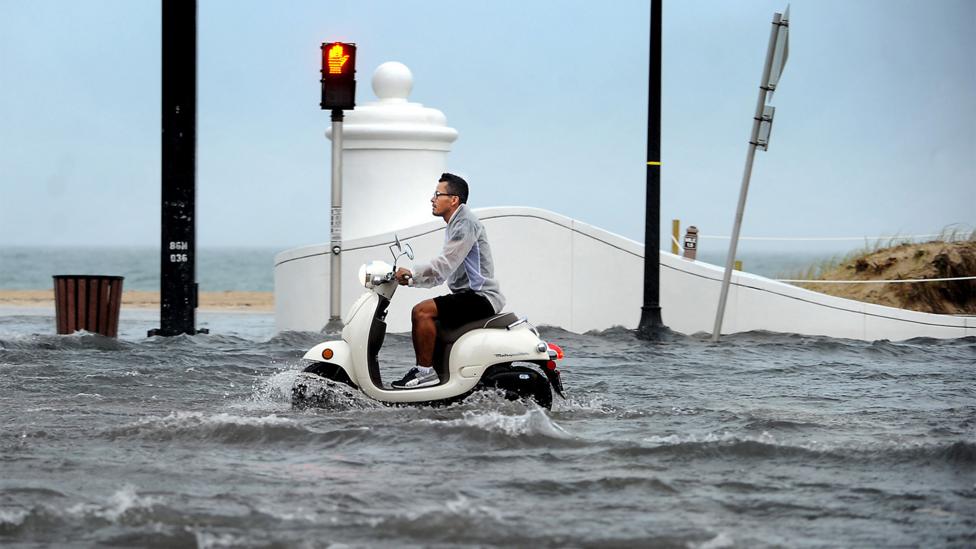
Just down the coast from Donald Trump’s weekend retreat, the residents and businesses of south Florida are experiencing regular episodes of water in the streets. In the battle against rising seas, the region – which has more to lose than almost anywhere else in the world – is becoming ground zero.
Stationarity is the idea that, statistically, the past can help you predict and plan for the future—that the variations in climate, water flow, temperature, and storm severity have remained and will remain stationary, or constant.
Nearly all the infrastructure decisions with which we live have been made with the assumption of stationarity. Engineers make choices about stormwater drainage pipes based on past data of inches of rain. Bridge engineers design foundations that can withstand a certain intensity of water flow based on the severity a certain location has experienced in the past. Reservoirs are designed to hold water based on historical information about water flow, and the historical water needs of a community.
Climate change: older trees loss continue around the world
By Matt McGrath Environment correspondent
In 2019, an area of primary forest the size of a football pitch was lost every six seconds, the University of Maryland study of trees more than 5 metres says.
Brazil accounted for a third of it, its worst loss in 13 years apart from huge spikes in 2016 and 2017 from fires.
However, Indonesia and the Democratic Republic of Congo both managed to reduce tree loss.
Meanwhile, Australia saw a sixfold rise in total tree loss, following dramatic wildfires late in 2019, .
As well as storing massive amounts of carbon, primary, tropical rainforests, where trees can be hundreds or even thousands of years old, are home to species such as orangutans and tigers.
The first time my father’s basement flooded, it was shortly after he moved in. The building was an ocean-front high-rise in a small city north of Miami called Sunny Isles Beach. The marble lobby had a waterfall that never stopped running; crisp-shirted valets parked your car for you. For the residents who lived in the more lavish flats, these cars were often BMWs and Mercedes. But no matter their value, the cars all wound up in the same place: the basement.
When I called, I’d ask my dad how the building was doing. “The basement flooded again a couple weeks ago,” he’d sometimes say. Or: “It’s getting worse.” It’s not only his building: he’s also driven through a foot of water on a main road a couple of towns over and is used to tiptoeing around pools in the local supermarket’s car park.
Ask nearly anyone in the Miami area about flooding and they’ll have an anecdote to share. Many will also tell you that it’s happening more and more frequently. The data backs them up.
It’s easy to think that the only communities suffering from sea level rise are far-flung and remote. And while places like the Solomon Islands and Kiribati are indeed facing particularly dramatic challenges, they aren’t the only ones being forced to grapple with the issue. Sea levels are rising around the world, and in the US, south Florida is ground zero – as much for the adaptation strategies it is attempting as for the risk that it bears.
Florida State Road A1A runs the entire length of Florida along the ocean, making it vulnerable to flooding – as shown here in Fort Lauderdale in 2013 (Credit: Alamy)
One reason is that water levels here are rising especially quickly. The most frequently-used range of estimates puts the likely range between 15-25cm (6-10in) above 1992 levels by 2030, and 79-155cm (31-61in) by 2100. With tides higher than they have been in decades – and far higher than when this swampy, tropical corner of the US began to be drained and built on a century ago – many of south Florida’s drainage systems and seawalls are no longer enough. That means not only more flooding, but challenges for the infrastructure that residents depend on every day, from septic tanks to wells. “The consequences of sea level rise are going to occur way before the high tide reaches your doorstep,” says William Sweet, an oceanographer at the National Oceanic and Atmospheric Administration (NOAA).
The flooding would be a challenge for any community, but it poses particular risks here. One recent report estimated that Miami has the most to lose in terms of financial assets of any coastal city in the world, just above Guangzhou, China and New York City. This 120-mile (193km) corridor running up the coast from Homestead to Jupiter – taking in major cities like Miami, Fort Lauderdale and West Palm Beach – is the eighth most populous metropolitan area in the US. It’s also booming. In 2015, the US Census Bureau found that the population of all three counties here was growing – along with the rest of Florida – at around 8%, roughly twice the pace of the US average. Recent studies have shown that Florida has more residents at risk from climate change than any other US state.
* extreme weather events
* flood insurance
* feedback loops
* tree deaths and deforestation
* The Human Induced Climate Change Experiment
bookmark_borderWill Tree Species Survive Climate Change?
A Pennsylvania Department of Conservation and Natural Resources article reported:
The theory of evolution suggests that species will adapt to changing environmental conditions. The belief is that these changes occur over long periods of geologic time.
But, instead of warming over a period of 1,000 years, the climate is changing faster due to human activity — several degrees per century (100 years).
Due to the rate of climate change, the gradual natural selection of genetic traits that allow species to adapt and reproduce over time may not be enough to preserve the abundance of tree species in Pennsylvania.
Some tree species won’t be able to thrive here as the climate continues to change faster than the plants can adapt.
Northern species like mountain maple, American beech, balsam fir, paper birch, and quaking aspen are especially at risk. Our climate may warm too quickly for these species to adapt before dying out.
Yet, warming due to climate change is not the only threat to the commonwealth’s trees.
Wetter Conditions Impact Many Tree Species

Rainy day in Penn’s Woods.
Last year (2018), many areas of the state set records for number of days of rain and total annual rainfall.
Climate change scientists forecasted that the northeastern U.S. climate would become not only warmer, but wetter — which is be proving to be true.
Since 1991, heavy rain events have increased more than 30 percent when compared to the 1901-1960 period. (source: National Climate Assessment)
Many Pennsylvania tree species do not thrive in continuous soggy conditions; and could significantly decline across the state over the long term.
The American mountain ash is a species which may suffer double risk due to its northern habit and upland site preference.
Given current climate trends and future considerations, it wouldn’t make much sense to plant northern/upland species.
A more practical strategy would be to choose climate change-resilient trees to replace those we lose.
Climate Change-Resilient Trees for Pennsylvania
Climate change-resilient trees for Pennsylvania should be southern tree species that tolerate or prefer wetter soil.
Species meeting these criteria include:
- Sycamore
- Hackberry
- Boxelder
- Eastern redbud

Bark of Hackberry tree.

Spring blooms on Eastern redbud tree.
Suitable trees for a warming climate, but well-drained sites include several oak and hickory varieties:
- Pin oak
- Black oak
- Shagbark hickory
- Mockernut hickory
Other adaptable species likely to be climate change-resilient include:
- Slippery elm
- Black gum
- Shortleaf pine
- Eastern hophornbeam
New Thinking in Forest Management

Newly planted trees in forest.
Climate change doesn’t mean the end of Penn’s Woods, but it does require new thinking when examining what tree species we should plant.
Savvy growers may want to think about choosing trees with fungal and insect resistance — as some southern pests are moving northward.
Climate change caused by human activities will outpace some native trees’ ability to adapt and persist.
Wise choices for replacements could be part of the solution to ensure that our forests remain healthy, viable, and productive.
For more information about climate change predictions for tree species, see Appendix E in DCNR’s Climate Change Adaptation and Mitigation Plan (PDF).
Foliage Spoilage & the Trees’ Canopy Collapse
The Human Induced Climate Change Experiment
bookmark_borderLosing 10 Billion Trees Per Year
Part of the study Foliage Spoilage & the Trees’ Canopy Collapse
Thomas Crowther is a Yale Climate & Energy Institute postdoctoral fellow at the Yale School of Forestry & Environmental Studies (F&ES) and led a study and census of the world’s trees (2015). The study determined there are 3 trillion trees on Earth; however, the study also estimates we are losing 10 billion trees per year.
bookmark_border12.5 Million Dead Trees in California
CALIFORNIA — In a survey conducted by the U.S. Forest Service, they found the severe drought in California has caused the death of over 12 million trees.

bookmark_borderDeath Of Ash Trees
Ash trees are dying for a variety of reasons. In the USA, Emerald Ash Borer is killing many trees. In Europe, the fungus Chalara is spreading and killing trees.
More about the decline of the forests.
Emerald Ash Borer
The signs and symptoms of an EAB attack
The symptoms an ash tree shows when it is infested with emerald ash borer are similar to symptoms caused by other ash pests or diseases in Wisconsin.
For example, crown dieback can occur due to EAB damage, but can also be the result of drought stress, soil compaction or verticillium wilt, just to name a few.
Therefore, it is important to look for a combination of at least two symptoms or signs when trying to figure out if emerald ash borer is in your ash tree. If you see two or more from the lists below report your findings here.
Symptoms
Crown dieback: Dieback of the upper and outer crown begins after multiple years of EAB larval feeding. Trees start to show dead branches throughout the canopy, beginning at the top. Larval feeding disrupts nutrient and water flow to the upper canopy, resulting in leaf loss. Leaves at the top of the tree may be thin and discolored. An example of this is shown below.
Epicormic Sprouting: When trees are stressed or sick, they will try to grow new branches and leaves wherever they still can. Trees may have new growth at the base of the tree and on the trunk, often just below where the larvae are feeding. An example of this is shown in the picture above, where small branches are growing on the trunk, about 6 feet off the ground.
Bark splits: Vertical splits in the bark are caused due to callus tissue that develops around larval galleries. Larval galleries can often be seen beneath bark splits.
Woodpecker feeding: Woodpeckers eat emerald ash borer larvae that are under the bark. This usually happens higher in the tree where the emerald ash borer prefers to attack first. If there are large numbers of larvae under the bark the woodpecker damage can make it look like strips of bark have been pulled off of the tree. This is called “flecking.” An example of this is shown below.
Signs
D-shaped emergence holes: As adults emerge from under the bark they create a D-shaped emergence hole that is about 1/8 inch in diameter. An example of this is shown below.
S-shaped larval galleries: As larvae feed under the bark they wind back and forth, creating galleries that are packed with frass (larva poop) and sawdust and follow a serpentine pattern. An example of this is shown below.
Larvae: Larvae are cream-colored, slightly flattened (dorso-ventrally) and have pincher-like appendages (urogomphi) at the end of their abdomen. By the time larvae are done growing they are 1 1/2 inches long. Larvae are found feeding beneath the bark.
Adults: Adult beetles are metallic green and about the size of one grain of cooked rice (3/8 – 1/2 inch long and 1/16 inch wide). Adults are flat on the back and rounded on their underside.
Chalara
Description
Chalara dieback of ash is a serious disease of ash trees caused by a fungus called Chalara fraxinea (C. fraxinea), including its sexual stage, Hymenoscyphus pseudoalbidus (H. pseudoalbidus). The disease causes leaf loss and crown dieback in affected trees, and usually leads to tree death.
Threat
It is potentially a very serious threat. It has caused widespread damage to ash populations in continental Europe, including estimated losses of between 60 and 90 per cent of Denmark’s ash trees. We have no reason to believe that the consequences of its entering the natural environment in Britain would be any less serious. Experience on the Continent indicates that it kills young ash trees very quickly, while older trees tend to resist it for some time until prolonged exposure causes them to succumb as well.
Susceptible species
Chalara fraxinea is especially destructive of common ash (Fraxinus excelsior), including its ‘Pendula’ ornamental variety. Narrow-leaved ash (Fraxinus angustifolia) is also susceptible. Chalara dieback of ash is particularly destructive of young ash plants, killing them within one growing season of symptoms becoming visible. Older trees can survive initial attacks, but tend to succumb eventually after several seasons of infection.
Spread
Local spread, up to some tens of miles, may be by wind. Over longer distances the risk of disease spread is most likely to be through the movement of diseased ash plants. Movement of logs or unsawn wood from infected trees might also be a pathway for the disease, although this is considered to be a low risk.
Outbreak stage
Ash trees suffering with the infection have been found widely across Europe since trees believed to have been infected with this newly identified pathogen were reported dying in large numbers in Poland in 1992. These have included forest trees, trees in urban areas such as parks and gardens, and also young trees in nurseries.
In February 2012 it was found in a consignment of infected trees sent from a nursery in the Netherlands to a nursery in Buckinghamshire, England. Since then it has been found in young ash trees in a number and variety of locations in Great Britain, including urban landscaping schemes, newly planted woodland, and more nurseries.
In October 2012, Food & Environment Research Agency (FERA) scientists confirmed a small number of cases in Norfolk and Suffolk in ash trees at sites in the wider natural environment, including established woodland, which do not appear to have any association with recently supplied nursery stock. Further finds in trees in the wider environment have since been confirmed in a number of places, mostly on the eastern side of England and Scotland, and mostly concentrated in the south-eastern region of England. In May 2013 the first wider-environment case was found in south-west Wales, which is the farthest west site in Britain that a wider-environment case has been confirmed. (Map below)
C. fraxinea is now being treated as a quarantine pest under national emergency measures and any suspected sighting must be reported.
Hundreds of staff from government agencies checked ash trees across the UK for signs of the disease during early November 2012. It was one of several actions to emerge from a meeting of the Government’s emergency committee, COBR, chaired by Environment Secretary Owen Paterson.
Survey results
Plant health experts are also undertaking a survey of about a thousand sites which have received saplings from nurseries where Chalara dieback has been found.
National plans have been drawn up for Chalara.