bookmark_borderClimate Change, Personal Health, and Personal Wealth

Risk Exposure in an Era of Accelerating Climate Instability

Daniel Brouse
February 21, 2026

Introduction: Climate Risk Is Personal

Climate change is often discussed in abstract global terms — temperature targets, emissions pathways, distant timelines. But the impacts are not abstract. They are immediate, measurable, and increasingly personal.

Climate change is already affecting your health, your property value, your insurance availability, your utility reliability, and your long-term financial security.

This paper focuses specifically on climate-driven risks. It does not attempt to quantify the already substantial damages caused by conventional fossil-fuel pollution — particulates, ozone, and toxic co-pollutants — which independently impose significant health and economic burdens. Climate impacts are layered on top of those existing costs.

The Primary Climate Stressors Affecting Individuals

Four accelerating climate stressors are reshaping risk across the United States:

1. Violent Rainfall and Hydroclimatic Whiplash

Warming increases atmospheric moisture capacity. The result is more intense precipitation events interspersed with longer dry periods — a pattern often called hydroclimatic whiplash.

Consequences include:

  • Flash flooding
  • Infrastructure failure
  • Sewer overflows
  • Foundation damage
  • Landslides and soil erosion
  • Insurance loss exposure

Shorter, more intense rainfall events overwhelm drainage systems that were designed for 20th-century climate norms.

2. Deadly Humid Heat

Extreme heat is not new. Extreme humid heat is different.

When wet-bulb temperatures approach 31°C (87.8°F), the human body struggles to cool itself through sweating — even in shade. Prolonged exposure can result in fatal heat stress within hours.

Historically, such conditions were rare in the continental United States. Today, they are being observed in isolated events and are trending upward.

U.S. regions currently at highest risk include:

  1. South Texas & Gulf Coast (Brownsville, Corpus Christi, Houston)
  2. Louisiana, Mississippi & Coastal Alabama
  3. Florida (Miami, Tampa, Fort Myers, Everglades)
  4. Lower Mississippi River Valley
  5. Southwest urban heat islands (Phoenix, Las Vegas) — traditionally dry heat, but humidity spikes are increasing

Heat is now the leading weather-related cause of death in the United States.

3. Sea Level Rise and Coastal Devaluation

Sea-level rise is not linear. It compounds with:

  • Storm surge
  • King tides
  • Saltwater intrusion
  • Infrastructure corrosion
  • Mortgage and insurance repricing

Properties below approximately 70 feet above sea level face long-term exposure risk under current trajectories. Over the next generation or two, that threshold could expand significantly as sea-level rise accelerates and storm intensification increases episodic flooding beyond mapped zones.

The financial sequence typically unfolds as:

Higher premiums → Insurance withdrawal → Uninsurable → Unsalable → Uninhabitable

4. Soil Degradation and Desertification

Soil is not inert matter. It is a living biological system.

Unlike the atmosphere and oceans, soil is biologically active — hosting microbes, fungi, plant roots, and complex nutrient cycles. It plays a critical role in:

  • Carbon sequestration
  • Water retention
  • Nutrient cycling
  • Flood buffering
  • Agricultural productivity

Healthy soil acts as a carbon sink. Degraded soil releases stored carbon, accelerates warming, reduces water retention, and increases erosion.

Hydroclimatic whiplash — alternating extreme rain and drought — degrades soil structure. When soil “dies,” it enters desertification:

  • Loss of fertility
  • Increased dust and particulates
  • Reduced water infiltration
  • Increased wildfire risk
  • Long-term property instability

Soil is both a barometer and a buffer in the climate system. Once degraded, recovery can take decades.

Public Utilities: Increasing Self-Reliance

Many public utilities were built for a stable climate.

Water and sewage systems are increasingly strained by:

  • Flood damage
  • Saltwater intrusion
  • Drought cycles
  • Aging infrastructure

Electricity systems are vulnerable to:

  • Heat stress on transmission lines
  • Peak demand overload
  • Storm damage
  • Fuel supply disruptions

Resilience planning increasingly includes:

  • Distributed solar and storage
  • Water storage and filtration
  • Backup generation
  • Microgrid integration

Energy independence is shifting from luxury to risk mitigation.


Health and Wealth Recommendations

While systemic solutions are essential, individuals must assess personal exposure.

Key considerations:

  • Avoid long-term investment in high-elevation floodplains and low-lying coastal zones.
  • Assess wet-bulb heat risk, not just dry temperature averages.
  • Monitor insurance trends — insurance markets often signal emerging physical risk before public policy does.
  • Invest in soil health and drainage management.
  • Prioritize buildings designed for heat resilience and passive cooling.
  • Consider long-term water security.

Climate risk is now a financial variable.

Conclusion: The Insurance Signal

As climate impacts intensify, the first economic indicator is insurance repricing and withdrawal.

High-risk areas typically move through three stages:

  1. Uninsurable
  2. Unsellable
  3. Uninhabitable

Over the next decade or two, a substantial share of U.S. real estate faces rising insurance stress under current trajectories. Remaining properties will face increasing hydroclimatic volatility, soil instability, erosion risk, particulate pollution, and heat exposure.

The long-term built environment may evolve toward:

  • Heat-shielded urban design
  • Climate-controlled infrastructure
  • Hardened utilities
  • In extreme heat zones, expanded subterranean or insulated construction

Climate change is not just an environmental issue. It is a restructuring force across health systems, financial markets, and property valuation.

The earlier risk is recognized, the more options remain available.
The Human Induced Climate Change Experiment

bookmark_borderBounded but Accelerating: Nonlinear Climate Dynamics and the Real Risk Landscape of the 21st Century

By Daniel Brouse and Sidd Mukherjee
February 17, 2026

Executive Summary

Human extinction from climate change in the next century is unlikely based on current mainstream physical science.

However, the rate of climate system acceleration is deeply concerning.

The risk facing humanity is not runaway “Venus-style” physics. The risk is rapid nonlinear acceleration within thermodynamic bounds — a trajectory capable of producing severe ecological disruption, large-scale biodiversity loss, systemic economic destabilization, and profound stress on human civilization.

Understanding that distinction is critical.

Acceleration: The Troubling Signal

Observed climate change acceleration has intensified markedly over the past several decades. In the 1990s, key climate indicators exhibited doubling behaviors on roughly century-long scales. By the 2010s, aspects of warming and associated extremes were accelerating on decadal scales. Recent observations suggest that certain feedback-driven components are now shifting on multi-year (2–5 year) intervals.

This compression of timescales is the primary concern.

Acceleration does not imply infinite warming. But it does imply that previously assumed gradual trajectories likely no longer apply.

No Venus Scenario — But That Is Not the Point

Earth system feedbacks are powerful, yet they are bounded by:

  • Thermodynamics
  • Radiative transfer constraints
  • Solar luminosity limits
  • Carbon cycle saturation dynamics

There is no credible physical pathway to a Venus analog under present solar forcing. Even high-end warming projections remain constrained by known radiative forcing limits and ocean heat uptake physics.

However, rejecting runaway planetary physics does not mean rejecting severe destabilization.

The danger lies within the bounded system.

Tipping Elements and Feedback Networks

Current Earth system research identifies approximately 12–16 major tipping elements. Evidence suggests that several — potentially nine — show signs of destabilization or partial activation.

Each tipping element contains nested sub-feedbacks across:

  • Cryosphere
  • Biosphere
  • Hydrosphere
  • Atmosphere
  • Ocean circulation systems

Many of these are amplifying (positive) feedbacks. Some are stabilizing (negative) feedbacks. The balance between them is not yet fully constrained.

Examples:

Polar Greening vs. Albedo Loss
Localized biological carbon uptake is increasing in some polar regions as ice retreats. However, simultaneous albedo loss increases absorbed solar radiation. Preliminary radiative balance assessments suggest the warming effect dominates, though quantification remains ongoing.

Permafrost Thaw and Fire Dynamics
Rapid thaw is mobilizing large carbon reservoirs. Year-round “zombie fires” increase surface energy absorption, carbon emissions, and tropospheric ozone creation. Methane combustion converts CH₄ to CO₂, reducing short-term radiative potency but not eliminating long-term forcing.

Opposing feedbacks do exist. However, current evidence indicates they are unlikely to offset the dominant amplifying mechanisms at scale. In fact, preliminary analyses suggest the imbalance is substantial — not marginal. That said, we remain far from fully identifying, mapping, and quantifying the nested structure of these feedback networks across coupled Earth systems. Ironically, advanced AI-assisted modeling and pattern detection may prove instrumental in resolving these uncertainties and improving constraint estimates.

The “Near-Term Human Extinction” Claim

This is where precision matters.

There is no credible peer-reviewed scientific evidence supporting near-term human extinction from climate change this century.

  • Serious systemic risk? Yes.
  • Major destabilization? Possible.
  • Regional collapse? Plausible under current trajectories. Insurance market destabilization is already emerging as an early indicator. Large portions of high-risk regions are experiencing rising premiums, coverage withdrawals, or outright market exits. If current warming and extreme-weather trends continue, a majority of U.S. ZIP codes could face serious insurability constraints within the next decade or two — particularly in areas exposed to wildfire, flood, hurricane, and severe convective storm risk. When insurance fails, it is often a precursor to broader economic stress, infrastructure decline, and population displacement.
  • Civilizational stress? Increasingly likely without mitigation.

Extinction-level scenarios for humanity are not supported by mainstream climate physics.

However, paleoclimate evidence shows that during rapid warming events in Earth’s history, approximately 66–80% of species were lost during major mass extinctions.

The more plausible risk is severe ecological disruption — including:

  • Large-scale biodiversity collapse
  • Mammalian die-off
  • Destabilized food systems
  • Ocean circulation shifts
  • Fisheries decline
  • Water system stress

These are civilization-altering risks even without human extinction.

4–7°C: Catastrophic but Not Planet-Killing

Under current policy trajectories:

  • If emissions plateau but are not deeply reduced: ~2.5–4°C
  • High-emissions pathway with reinforcing feedbacks and tipping cascades: ~4–7°C

Even 4–7°C of global mean warming would have catastrophic impacts on modern societies, including:

  • Severe agricultural disruption and crop failures
  • Amplified water scarcity and stress on freshwater resources
  • Degradation of infrastructure due to heat, flooding, and extreme weather
  • Increased heat-related mortality
  • Migration pressures from uninhabitable regions
  • Heightened geopolitical instability and resource conflicts

Importantly, 4–7°C of warming does not eliminate all habitable zones. Humans survived the Last Glacial Maximum and the warmer Eemian interglacial, demonstrating significant adaptability. Likely

However, adaptation under such rapid warming would likely require major societal and technological shifts, such as:

  • Expansion of climate-controlled infrastructure
  • Urban redesign to mitigate heat and flooding
  • Development of heat-resilient agriculture
  • Large-scale water recycling and conservation measures
  • Expanded use of insulated or subterranean infrastructure in regions with extreme heat

While adaptation is technically possible, it will be economically, politically, and socially disruptive, requiring coordinated global action and long-term planning.

The Real Question

The central issue is not whether Earth becomes Venus.

It is how quickly interacting feedback networks shift the trajectory within physically bounded limits — and how much systemic disruption occurs during that transition.

Nonlinear acceleration compresses decision windows.

That is the frontier of current research.

Important Caveat

Continued denial and politicization of climate change — coupled with intensified competition over water, food, and migration — could trigger large-scale conflict, including the potential for nuclear war. Such a collapse of human systems could lead to near-term extinction, even though the climate physics alone do not make that outcome likely.

Much of the world could become uninhabitable. Billions of people might be reduced to millions, with severely diminished quality of life and drastically shortened life expectancy.

Research highlights another layer of risk: climate change aggravates infectious disease. Camilo Mora, data analyst and associate professor at the University of Hawaii at Manoa, found that climatic hazards exacerbate 58% of all known human pathogens — over half of the infectious diseases discovered since the end of the Roman Empire. Mora called this “shocking,” emphasizing that movement of humans and animals, as well as milder winters at higher latitudes allowing pathogen survival, are key factors.

Mora notes:

“The human pathogenic diseases and transmission pathways aggravated by climatic hazards are too numerous for comprehensive societal adaptation, highlighting the urgent need to work at the source of the problem: reducing greenhouse gas emissions.”

He further explained:

“The magnitude of the vulnerability — when you think about one or two diseases, okay, we can deal with that. But when 58% of diseases can be affected or triggered in a thousand different ways, it’s clear we are not going to be able to adapt to climate change.”

In short, while the physical limits of the Earth system constrain the ultimate magnitude of warming, human behavior, social instability, and geopolitical failures could still produce catastrophic outcomes far beyond what climate physics alone would dictate.

Conclusion

At least nine major climate tipping elements show signs of activation according to emerging peer-reviewed literature. The complexity of nested feedback systems demands more sophisticated modeling, higher temporal resolution, and cross-disciplinary integration.

The science does not support panic narratives — runaway, Venus-style warming this century is physically unlikely.

However, the science also does not support complacency. Continued denial, politicization, and conflict over the facts of climate science — combined with resource scarcity and societal stress — could trigger cascading failures, including large-scale conflict or even nuclear war. Such outcomes could make human extinction within a century a real possibility, even if the climate system alone would not.

We must address both the physical limits of the climate and the social systems that govern our response to prevent catastrophic outcomes.

If the discussion is to continue, it must be grounded in:

  • Physics
  • Data
  • Paleoclimate evidence
  • System dynamics
  • Peer-reviewed research

For those interested in a science-based examination of nonlinear feedback dynamics, our related work is available here:

http://membrane.com/global_warming/

Debate is welcome.
But it must be evidence-based.

bookmark_borderThe Domino Effect: Cascading Climate Tipping Points and Nonlinear Acceleration

Daniel Brouse and Sidd Mukherjee
February 12, 2026

Abstract

Since the 1990s, we have advanced what we termed the Non-Linear Acceleration Hypothesis — the proposition that climate change impacts do not progress linearly, but instead accelerate over time as interacting physical processes amplify one another. Early analysis suggested an approximate doubling time of major climate impacts on the order of a century, signaling systemic nonlinear behavior rather than gradual change.

Over the following decades, accumulating observational and theoretical evidence has supported and expanded this framework. By the 2010s, we extended the hypothesis into what we called the Domino Effect: the cascading interaction of climate tipping points and feedback loops, in which the activation of one destabilizing mechanism increases the probability of triggering others.

Recent empirical studies and independent research now increasingly validate this cascading systems perspective.

I. The Non-Linear Acceleration Hypothesis (1990s–2000s)

In the 1990s, we introduced the concept that climate change impacts were accelerating nonlinearly. Rather than a steady, incremental progression, the data suggested that feedback mechanisms were compounding the rate of change.

By the early 2000s, multiple independent datasets — including temperature records, ice mass balance observations, wildfire trends, and ocean heat content — provided strong confirmation that the trajectory of climate impacts was not linear. Since then, numerous independent researchers have documented accelerating trends across cryospheric loss, hydrological extremes, ecosystem degradation, and atmospheric greenhouse gas concentrations.

The core insight was straightforward:
Feedback loops alter the rate of change itself.

II. Expansion to the Domino Effect (2010s)

During the 2010s, we expanded this framework to incorporate interacting tipping elements within the Earth system. We termed this cascading interaction the Domino Effect.

The Domino Effect describes a process in which:

  • A tipping point is crossed in one subsystem (e.g., Arctic sea ice loss).
  • That shift alters boundary conditions in another subsystem (e.g., albedo reduction increasing regional warming).
  • Secondary systems destabilize (e.g., permafrost thaw releasing methane).
  • Feedback interactions accelerate further tipping behavior.

Unlike isolated tipping points, this framework emphasizes interconnected collapse dynamics — a network of reinforcing processes capable of producing abrupt systemic change.

III. Empirical Expansion (2020s)

By the 2020s, mounting evidence supported this cascading systems perspective. In 2025, we published:

These studies examined the interconnected nature of:

  • Albedo feedback amplification
  • Brown carbon radiative forcing
  • Freshwater-driven AMOC destabilization
  • Permafrost–methane release
  • Amazon rainforest dieback
  • Sudden sea-level “cork release” pulses
  • Hydroclimate whiplash
  • Arctic sea ice collapse

Our central finding: these are not isolated processes. They form a coupled instability network. When multiple nodes destabilize simultaneously, the system behaves less like a slow cascade and more like a chain reaction.

We are not merely observing a sequence — we are observing interaction.

IV. Independent Validation

In 2026, a study published in One Earth and highlighted by Yale Environment 360 stated:

“Scientists warn that the crossing of one tipping point can push the Earth past another, in a domino effect.”

(https://www.cell.com/one-earth/fulltext/S2590-3322(25)00391-4)
(https://e360.yale.edu/digest/hothouse-earth-study)

To the best of our knowledge, Sidd Mukherjee and I were the first to formally frame climate tipping interactions explicitly as a cascading domino effect and to apply that terminology to Earth system feedback dynamics.

This framing originally appeared in earlier work:

“Cascading Feedbacks: The Domino Effect
Climate feedback loops do not act independently; rather, they interact synergistically in what we term the Domino Effect — a cascade of tipped tipping points where each system failure accelerates the next.”

It is encouraging to see the broader scientific community converging on this systems-level interpretation.

V. Validation of Physics — Not Celebration of Outcome

When we say it is validating to see this hypothesis increasingly reflected in mainstream climate science, we are referring to confirmation of the underlying physics and systems theory — not any satisfaction about the consequences.

The physics of nonlinear systems, coupled feedbacks, radiative forcing amplification, and threshold behavior is now being widely recognized as central to understanding 21st-century climate dynamics.

There is no triumph in being correct about destabilization.

This is one of those moments where scientific validation carries profound discomfort.

Conclusion

The Domino Effect is not a metaphor for dramatic effect — it is a systems description. The Earth system is composed of interconnected feedback loops. When enough thresholds are crossed, the response is nonlinear, accelerated, and potentially abrupt.

The evolution from hypothesis (1990s), to observational support (2000s), to networked tipping theory (2010s), to broad empirical validation (2020s) reflects a maturation in climate science: from linear projection models to complex systems dynamics.

Understanding these cascades is no longer theoretical. It is essential to anticipating the pace, scale, and risks of future change.

And while it is scientifically affirming to see the physics confirmed, it is deeply sobering to witness the system behave exactly as nonlinear theory predicts.

Tipping points and feedback loops drive the acceleration of climate change. When one tipping point is toppled and triggers others, the cascading collapse is known as the Domino Effect.

The Human Induced Climate Change Experiment

bookmark_borderSystemic Infrastructure Risk in a Nonlinear Climate: Economic and Public Safety Implications for the United States

Daniel Brouse and Sidd Mukherjee
February 8, 2026

Abstract

One of the largest and fastest-growing economic costs of climate change in the United States is infrastructure degradation and failure. Intensifying extreme weather events — including flooding, windstorms, heat waves, and heavy precipitation — are stressing systems that were designed for a more stable 20th-century climate. Because many of the nation’s most densely populated cities are located along coasts and low-lying river systems, the risks are both geographically concentrated and nationally significant. This paper examines emerging infrastructure failures as indicators of systemic climate risk and outlines the compounding economic and public health implications.

1. Infrastructure Exposure in Coastal and Riverine Cities

Urban America is disproportionately situated in vulnerable zones: coastal plains, estuaries, and floodplains. These regions now face accelerating risks from sea-level rise, storm surge, extreme rainfall, and groundwater intrusion.

Philadelphia represents a clear example of multi-directional vulnerability. Located at the confluence of the Delaware and Schuylkill Rivers and influenced by tidal dynamics, the city faces increasing flood frequency alongside saltwater intrusion into drinking water and wastewater systems.

The historic Fairmount Water Works, a symbol of early American engineering, now faces what local officials describe as an existential threat — “adapt or collapse.” Pennsylvania already endures more flooding events than any other U.S. state, and the intensity of rainfall has measurably increased in recent decades. Aging stormwater and combined sewer systems were not engineered for present precipitation extremes.

(See also:
http://membrane.com/global_warming/Brandywine-Creek.html)

2. Compounding Costs: Pollution and Public Health

Infrastructure damage is only one dimension of climate-related economic cost. Air pollution — amplified by heat, wildfire smoke, and stagnant atmospheric conditions — compounds healthcare burdens.

Fine particulate matter (PM2.5) remains one of the leading contributors to premature mortality in the United States. Tropospheric ozone, formed through photochemical reactions intensified by heat, damages lung tissue and reduces agricultural productivity. These are not isolated environmental concerns; they represent measurable costs in healthcare expenditures, lost labor productivity, and long-term morbidity.

(See also:
http://membrane.com/global_warming/Trees-for-Climate-Change.html)

3. Cascading Infrastructure Failure: Washington, D.C. Sewer Collapse

On January 19, 2026, a major sewer pipeline collapsed near Washington, D.C., triggering a cascading infrastructure emergency. Following the structural failure, snowmelt and ice increased groundwater infiltration into the system, raising flow volumes beyond temporary bypass capacity.

Subsequent pump clogging caused additional sewage overflows even after the main break had been rerouted. This sequence illustrates a broader pattern: infrastructure failures are no longer isolated mechanical breakdowns but compound events intensified by climate-driven hydrological volatility.

Such cascading stress reveals systemic fragility in aging urban systems under nonlinear climate pressure.

4. Record Wind Extremes: Wyoming, December 2025

On December 17, 2025, Wyoming experienced one of the most extreme wind events in its recorded history.

  • Peak Gust: 144 mph near Smoot, Wyoming
  • Location: Mount Coffin weather station
  • Additional Extremes: 123 mph in Red Canyon; 121 mph in Lincoln County

These wind speeds approach Category 4 hurricane intensity — occurring inland, outside tropical systems. Such events signal increasing atmospheric energy within mid-latitude systems.

Transportation and Public Safety Impacts

  • Dozens of semi-trucks were blown over on December 17 alone.
  • Between December 9–12, Wyoming Highway Patrol responded to 39 blowovers.
  • Major freight corridors (I-80, I-25) required closures.

These events are not merely episodic disruptions. They expose freight systems, insurance structures, and roadway design standards that were calibrated to historical wind distributions — distributions that are shifting.

5. Insurance and Fiscal Implications

Infrastructure stress is increasingly socialized through public insurance systems. Florida now operates effectively as the largest insurer of residential property in the state after repeated private insurer withdrawals. This represents implicit public assumption of escalating climate risk.

Nationally, approximately 10% of high-risk ZIP codes have become effectively uninsurable or subject to severe premium escalation. This trend signals market recognition of structural climate exposure before federal policy fully accounts for it.

As climate volatility accelerates, risk is transferred from private capital markets to taxpayers.

6. Conclusion

Climate change is no longer a distant environmental issue; it is an infrastructure and fiscal stability issue. Extreme weather events are interacting with aging systems, increasing failure frequency and repair costs. Urban water systems, transportation networks, freight corridors, and insurance markets are all experiencing structural stress.

As current trends continue, large portions of U.S. infrastructure — particularly in coastal and riverine regions — are becoming economically and physically unsustainable. Adaptation investments are no longer optional; they are prerequisites for maintaining fiscal stability, public safety, and long-term economic viability.

The central economic question is no longer whether infrastructure will be affected, but whether adaptation can proceed quickly enough to prevent cascading fiscal and public safety crises. Equally important is a more difficult policy question: should strategic managed retreat be implemented sooner rather than later to minimize long-term losses and systemic risk?

The Human Induced Climate Change Experiment

bookmark_borderJudge Rules Trump’s Secret Climate Panel Unlawful: A Crucial Win for Science and Justice

The Trump administration’s covert effort to undermine climate science has been dealt a significant legal blow. A federal judge ruled that the secretive “Climate Working Group,” convened by the U.S. Department of Energy to produce a report minimizing global warming risks, violated federal law. This report was central to attempts by the Trump administration to halt regulations on climate pollution — one of many assaults on science. Whether it’s attacks on children’s health, vaccines, or the deadly consequences of anthropogenic climate change, the harms have been profound.

Thankfully, the judiciary has now called out these unlawful tactics, reaffirming the importance of transparency and scientific integrity in policymaking.

1. Federal Judge Declares the Process Unlawful

The U.S. District Court ruled that the Department of Energy’s formation of the secret “Climate Working Group” violated the Federal Advisory Committee Act (FACA). This law mandates that federal advisory panels must operate transparently, include balanced viewpoints, and maintain public records — none of which were met by this clandestine group. Instead, it operated behind closed doors, excluding critical voices and public oversight.

2. The Panel’s Report Fueled Harmful Policy Actions

This covert report was used by the Trump administration to challenge and seek repeal of the EPA’s Endangerment Finding, a cornerstone legal determination that greenhouse gases threaten public health and can be regulated under the Clean Air Act. The report’s climate-skeptic conclusions, authored by a small circle of like-minded researchers, were cited to justify rolling back vital climate protections.

3. The Ruling Centers on Legal Process, Not Science

Importantly, the judge’s decision did not dispute the overwhelming scientific consensus on climate change. Instead, it emphasized that advisory panels influencing federal policy must comply with legal standards. Operating in secret with a narrow ideological perspective violated those standards, undermining the integrity of the policy process.

4. Widespread Scientific Rejection of the Report

Leading climate scientists and organizations have widely condemned the secret panel’s report. More than 85 experts released a detailed rebuttal exposing serious errors and misrepresentations of climate data, reaffirming that the report does not reflect the state of climate science.

5. Environmental Groups Fight Against the Report’s Influence

Groups such as the Environmental Defense Fund and Union of Concerned Scientists are actively pursuing litigation to prevent this unlawfully produced report from undermining critical climate regulations. Their efforts highlight the risks of allowing shadowy, unaccountable panels to dictate environmental policy.

6. The Stakes Extend Far Beyond Legal Technicalities

If the EPA’s Endangerment Finding were repealed based on this flawed and illicit report, it would strip the agency of its authority to regulate greenhouse gas emissions — a move with profound consequences for U.S. climate policy, public health, and global efforts to combat climate change.

Bottom Line: Transparency and Science Must Guide Policy

This court ruling reinforces that government decisions affecting national and global health must be grounded in transparent, lawful, and scientifically sound processes. Secret panels with predetermined agendas are an affront to both science and democracy.

Moreover, it is hoped that continued scrutiny will hold accountable those who, including Trump, have propagated falsehoods about climate change being “a hoax,” “a scam,” or “bullshit.” Such disinformation not only distorts public understanding but directly contributes to preventable deaths, illnesses, and environmental destruction. The rule of law and scientific truth must prevail to protect current and future generations.

Trumpenomics

Climate Science

bookmark_borderBlack Zombie Fires and the Rise of Green Unicorn Algae

Daniel Brouse and Sidd Mukherjee
February 5, 2026

Introduction

For decades, Sidd and I have studied applied systems analysis in nonlinear dynamic climate systems. We have co-authored papers on carbon cycles, jet stream dynamics, albedo shifts, brown carbon, AMOC instability, permafrost thaw, Amazon rainforest dieback, sea-level rise pulses, hydroclimate whiplash, Arctic sea ice loss, and interacting tipping points — using a probabilistic, ensemble-based model integrating socio-economic and ecological feedbacks within a dynamic nonlinear framework.

For many years, much of it remained theoretical.

By the early 2000s, we had gathered sufficient evidence to articulate what we called The Nonlinear Acceleration Hypothesis:

Climate feedback loops do not act independently.
They interact synergistically in what we termed the Domino Effect — a cascade of tipped tipping points in which each destabilized system accelerates the next.

Since then, what was once hypothesis has steadily moved toward mainstream climate science. By 2024, the acceleration was observable to the layperson. As Sidd would say: “Just look out your window.”

The real issue is not any single dramatic event. It is the cumulative interaction of multiple reinforcing feedback loops that amplify warming and destabilization.

For example, a recent study identified a previously underappreciated Ice–Albedo feedback: mineral dust deposited on the Greenland ice sheet promotes algal growth, darkening the ice and accelerating melt. This raises deeper questions:

How many such feedback mechanisms exist?
How do they interact?
And how do they collectively influence the pace and severity of climate change?

Fully cataloguing every feedback may be impossible. A practical heuristic may therefore be more useful. Our research suggests that many observable climate impacts are doubling in intensity or frequency on timescales of roughly 2 to 10 years. At current emission levels — with multiple feedbacks already activated — large regions of Earth risk becoming increasingly uninhabitable within this century.

A Deep Dive Into Unimaginable Feedbacks

The apparent acceleration has shifted from century-scale doubling to multi-year doubling within just three decades — not three millennia.

In 2023, Sidd remarked:

“Do you remember in the early 2000s when we thought we wouldn’t live to see the extreme changes from global warming?”

I replied:

“2023 may be the most significant year yet. We saw confirmation of tipping dynamics involving mountain glaciers, Greenland mass loss, Antarctic destabilization, and potentially AMOC weakening.”

Sidd responded:

“We suspected those. What stunned me was Canada burning. I never thought I’d see that.”

I asked:

“Will permafrost peatlands produce sustained zombie fires and trigger large-scale thaw feedback?”

Sidd answered:

“They already are. Siberia showed us.”

By 2025, I reflected:

We anticipated tipping points would eventually activate self-reinforcing loops. I was prepared for that in theory.

What I did not fully envision was the speed of interaction — the rapid coupling of physical, ecological, and economic systems into cascading acceleration.

Abstract models were becoming measurable reality.

Black Zombie Fires and Green Unicorn Algae

In the 1990s, neither of us fully accounted for the scale of human delay. We assumed mitigation would begin in earnest. It did not.

By 2026, feedback loops that once seemed remote were unfolding in real time.

Permafrost: From Slow Thaw to Persistent Fire

Old assumption:
Permafrost would thaw gradually over centuries to millennia, steadily releasing CO₂ and CH₄.

Observed reality:
Large regions are no longer reliably frozen. Peatlands and thawed soils are igniting — sometimes overwintering as “zombie fires” beneath snowpack — releasing greenhouse gases on compressed timescales.

This introduces significant uncertainties:

  • Combustion accelerates CO₂ release.
  • Methane may combust in situ, converting to CO₂ (less potent but still warming).
  • A substantial fraction likely escapes unburned.
  • The net balance between flaring and direct methane release remains poorly constrained.

What is clear: release rates are faster than many early models anticipated. These feedbacks are no longer theoretical.

Linear Ice Loss Meets Nonlinear Surface Processes

Separately, we had been discussing Greenland’s near-linear cumulative ice mass loss over the past 25 years — surprising in a system governed by nonlinear physics.

Then came an additional layer.

A 2026 University of Waterloo study found that windblown mineral dust from proglacial regions supplies phosphorus to surface algae on the Greenland ice sheet. The algae darken the ice, reduce albedo, and accelerate melt — a self-reinforcing loop.

Sidd added:

“And smoke and dust from Canadian wildfires — not to mention Russian ones.”

That connection reframed the system.

Glacial retreat exposes sediment.
Sediment and wildfire aerosols are transported by intensifying wind patterns.
Nutrients land on ice.
Algae bloom.
Albedo drops.
Melt accelerates.

Regional feedbacks intertwine across continents.

I found myself thinking:

Glacial retreat alters weather patterns — rain, wind, atmospheric circulation —
transporting sediments and aerosols onto remaining ice sheets.
Surface darkening becomes biological terraforming.
Algae plumes and blooms spread.
Feedbacks cascade.

Not abstractly —
but visibly.
Now.

Canada and Russia’s wildfire carbon fallout adds an unmistakably international dimension.

Such strange interacting loops:

Black zombie fires.
Green unicorn algae.

The poetic framing reflects something real: systems interacting in ways that once seemed implausible but are now measurable.

A Final Question

If permafrost combustion and biologically enhanced albedo reduction are active, what other feedbacks are emerging?

  • Boreal forest transition from carbon sink to source
  • Ocean stratification weakening biological carbon pumps
  • Soil microbial regime shifts under heat stress
  • Aerosol–cloud interactions altering regional precipitation
  • Jet stream persistence amplifying drought-flood oscillations

The central challenge is not identifying one catastrophic event.
It is understanding the network.

The nonlinear acceleration of interacting systems may be the defining feature of this century.

The question is no longer whether feedbacks exist.

It is how many are already active — and how tightly coupled they have become.

Easy to Read Resources

Climate Change Made Simple: Understanding Feedback Loops and Acceleration

The Nonlinear Acceleration Hypothesis: Easy-Read Format

Chaos Theory Basics (quick refresher)

Statistical Mechanics and Chaos Theory in Climate Science

bookmark_borderAccelerating Climate Collapse: Understanding Feedback Networks and Their Impact

by Daniel Brouse and Sidd Mukehrjee

Climate doesn’t respond instantly — it has inertia. The oceans absorb enormous amounts of heat, so even after greenhouse gases are emitted, warming continues for years and decades. That’s why the hottest days of summer come weeks after the longest day of the year — the system takes time to heat up.

Permafrost is already thawing and releasing carbon, adding more greenhouse gases to the atmosphere and reinforcing warming. But it’s only one piece of a larger pattern of interacting feedbacks:

Ice–Albedo Feedback — As reflective ice disappears, darker land and ocean surfaces absorb more heat, locking in additional warming.

Permafrost Thaw & Boreal Fires — Thawing soils and intensifying wildfires release vast quantities of CO₂ and methane.

Amazon & Rainforest Dieback — Critical carbon sinks are shifting from absorbing carbon to emitting it.

Ocean Circulation Disruption — Weakening currents are destabilizing weather patterns, affecting jet streams, monsoons, and global food systems.

Marine Ecosystem Stress — Coral bleaching and plankton decline threaten fisheries and ocean-based food security.

Soil Degradation & Crop Failure — Intensifying drought and heat stress are reducing yields, increasing famine risk and forced migration.

Individually, each of these feedbacks is serious. Together, they form an interconnected network of reinforcing processes that amplify overall climate instability. As these feedbacks compound, the energy in the system increases — helping explain why extreme weather events are becoming more frequent, more intense, and more disruptive.

The real issue isn’t just one dramatic event — it’s the stacking and interaction of multiple feedbacks that accelerate climate change. For example, a January study revealed a new feedback mechanism tied to the Ice–Albedo Feedback: mineral dust promotes algae growth, which speeds up the melting of the Greenland ice sheet. But how many feedback mechanisms exist, and how do they interact?

To better understand the pace of this acceleration, more research on all feedback mechanisms is needed. Since this may be an impossible task, adopting a practical rule of thumb is helpful. Our research suggests that climate change impacts are doubling every 2 to 10 years for most climate-related events, underscoring the rapid rate of acceleration. At current emission levels and with multiple feedback loops already activated, much of the Earth is likely to become uninhabitable within this century.

The Human Induced Climate Change Experiment

Additional Resource:

Large-scale melting of the Greenland Ice Sheet is irreversible and happening at a rapid rate, and now a new international study is the first to understand why. A University of Waterloo scientist and a team of international collaborators found that airborne mineral dust and other aerosols are directly connected to how much algae grows on the ice. The algae interfere with albedo, or the reflection of the sun’s rays, exacerbating melting. The work is published in the journal Environmental Science & Technology.

bookmark_borderCracked Fractals: Climate Thermodynamics, Insurance Instability, and Sovereign Debt Transmission in Late-Stage Capitalism

by Daniel Brouse (February 2, 2026 update to an ongoing study)

Abstract

The relationships between climate physics and modern financial structure are complex, dynamic, and fundamentally non-linear. This paper examines the transmission mechanisms linking climate destabilization to structural fragility within advanced capitalist economies. Drawing on thermodynamics, actuarial science, and sovereign debt dynamics, it argues that the insurance sector functions as the primary systemic tripwire between physical climate risk and financial abstraction. Evidence from Florida and California demonstrates how accelerating climate losses are already migrating from private balance sheets to public backstops. As these liabilities propagate through municipal bonds, mortgage-backed securities, and ultimately federal debt, the system exhibits the instability patterns of complex systems approaching critical thresholds—what I describe as “cracked fractals.” The convergence of climate acceleration and fiscal overextension suggests not isolated sectoral stress, but the emergence of systemic collapse dynamics.

1. Introduction: Nonlinear Coupling of Climate and Capital

Climate systems and financial systems share defining characteristics: feedback loops, lag structures, threshold behavior, and sensitivity to compounding shocks. Both are governed by non-linear dynamics. Small perturbations can produce outsized consequences when systems are near critical states.

In previous work, I have described the interaction between climate destabilization and financial fragility through a “Domino Effect” framework. The metaphor applies equally to ice sheets and balance sheets. When one structural support fails, stress redistributes across the network. In tightly coupled systems, redistribution accelerates failure elsewhere.

The central analytical question is not whether climate change affects the economy—it demonstrably does—but how physical climate risk transmits into financial architecture, and where the first irreversible fractures appear.

2. Insurance as Systemic Tripwire

The insurance sector occupies the interface between physical risk and financial abstraction. It translates meteorological volatility into actuarial pricing and reserve allocation. When tail risks accelerate beyond historical probability distributions, actuarial tables lose predictive reliability. At that point, the system’s shock absorbers begin to fail.

This failure mode is already visible in:

  • Property insurance withdrawals from high-risk geographies
  • Rapid repricing of premiums
  • Reinsurance market tightening
  • Escalating deductibles and coverage exclusions

Insurance does not create climate risk; it prices it. When pricing becomes impossible, risk migrates.

3. Florida and California: Real-Time Case Studies

Florida and California provide contemporary illustrations of this transmission dynamic.

Florida:
Repeated hurricane losses have driven private insurers into insolvency or retreat. Citizens Property Insurance Corporation—the state-backed insurer of last resort—has become the largest property insurer in the state. Citizens is ultimately backed by policyholder surcharges and post-event assessments that function as a quasi-tax. Climate risk has therefore migrated from private capital to public balance sheets. This model is politically expedient but structurally fragile: if losses outpace premium growth and reserve accumulation, the public backstop itself becomes a destabilizing liability.

California:
Escalating wildfire losses have led major carriers to pause or withdraw new policies. Exposure has shifted toward the California FAIR Plan, increasing the state’s implicit fiscal exposure. As in Florida, the public sector has become the de facto reinsurer of last resort.

In both cases, actuarial strain precedes broader financial contagion. Insurance is the first derivative that breaks.

4. Contagion Pathways

Once insurance destabilizes, transmission channels are straightforward:

  1. Municipal Infrastructure Bonds
    Communities facing repeated disasters encounter rising borrowing costs and impaired credit ratings.
  2. Mortgage-Backed Securities (MBS)
    Real estate values depend on insurability. If coverage becomes unaffordable or unavailable, collateral assumptions underlying MBS structures erode.
  3. Federal Backstops and U.S. Treasuries
    Disaster recovery increasingly migrates to federal balance sheets. As sovereign exposure rises, climate risk becomes embedded in national debt markets.

Bond markets rarely collapse in isolation. They absorb and socialize losses until confidence fractures. Insurance is simply the earliest visible fracture plane.

5. Cracked Fractals and Statistical Deviation

The U.S. economy and climate system increasingly resemble complex systems approaching critical thresholds—what I term “cracked fractals.” These fragile branching patterns represent fragmented stability and inflection points beyond which recovery becomes progressively constrained.

Key indicators—including federal deficits, disaster recovery expenditures, housing unaffordability, and insurance exposure—are now running 2 to 3 standard deviations above historical norms. When multiple independent systems deviate simultaneously at that magnitude, the signal is structural, not cyclical.

Through the lens of chaos theory and nonlinear dynamics, such clustering of extreme deviations indicates tightening feedback loops. Climate volatility increases fiscal strain; fiscal strain reduces adaptive capacity; diminished adaptation increases climate damages. The system begins to fracture along its weakest seams.

6. Integrating Thermodynamics, Actuarial Science, and Sovereign Debt

Climate acceleration is thermodynamically grounded. Greenhouse gas accumulation increases radiative forcing, intensifies energy imbalances, and drives nonlinear physical responses. These physical processes do not negotiate with financial models.

Simultaneously, sovereign debt expansion in advanced economies has accelerated. Aging populations and slowing labor-force growth undermine the growth assumptions that traditionally support debt sustainability. In several Western nations, restrictive immigration policies further weaken demographic resilience, while rapid advances in automation and AI introduce structural labor displacement that complicates income growth, tax base stability, and long-term fiscal balance.

Overlaying these trends are trillions of dollars in climate-related healthcare expenditures, infrastructure repair, disaster recovery, and supply chain disruption. As these costs compound, fiscal space narrows. When exponential climate acceleration meets expanding sovereign liabilities, the result is a coupled instability—what can be described as a domino effect across thermodynamic and financial domains.

Both systems—climate and sovereign debt—exhibit trajectories that are unsustainable under current structural assumptions.

7. Conclusion

The destabilization of insurance markets in high-risk states is not a regional anomaly; it is an early-stage manifestation of a broader structural convergence. Climate thermodynamics and financial architecture are not separate systems—they are dynamically coupled.

Insurance represents the first systemic derivative to fail because it directly translates physical volatility into financial liability. As that failure propagates through municipal finance, mortgage markets, and sovereign debt, the risk becomes nationalized and eventually globalized.

The emerging pattern is not cyclical stress but nonlinear convergence toward structural thresholds. Recognizing insurance instability as the primary transmission mechanism clarifies both the scale of the risk and the urgency of structural reform.


References and Related Work

Brouse, D. (2025). Deviation, Cracked Fractals, Climate, and Economics.
http://membrane.com/global_warming/Cracked-Fractals-Deviations.html

Brouse, D. et al. Insurance Collapse – Introduction.
http://membrane.com/global_warming/Insurance-Collapse-intro.html

Brouse, D. Systemic Collapse.
http://membrane.com/global_warming/Systemic-Collapse.html

Brouse, D. Social-Ecological Feedbacks.
http://membrane.com/global_warming/Social-Ecological-Feedbacks.html

Brouse, D. Dollars and Demise.
http://membrane.com/global_warming/Dollars-Demise.html

Additional materials available at:
http://membrane.com/global_warming/

bookmark_borderExtreme Energy Events: How a Warming Planet Converts Heat Into Destruction

by Daniel Brouse and Sidd Mukherjee
December 18, 2025

From “Global Warming” to System-Wide Energy Overload

The phrase global warming is widely misunderstood. While it accurately describes a rise in Earth’s average temperature, it fails to capture the true source of risk: a rapid increase in total energy within the Earth system. Heat is only the entry point. Once added, that energy is transformed, transferred, and amplified through atmospheric, oceanic, and terrestrial processes.

In 2025, global mean temperatures exceeded the long-recognized 1.5 °C threshold. To a lay observer, this may sound insignificant. It is not. Earth’s climate is a nonlinear system. Small average increases translate into large, destabilizing changes in circulation, moisture, pressure, and momentum—producing what are better described as extreme energy events.

What Are Extreme Energy Events?

Terms like heat waves or extreme weather describe symptoms, not mechanisms. The real driver is energy—thermal, kinetic, latent, and gravitational—moving through a destabilized system.

Extreme energy events include:

  • Violent precipitation and flash flooding
  • Extreme winds and pressure-gradient-driven storms
  • Rapid thermal and moisture swings (“climate whiplash”)
  • Coastal storm surge and marine heatwaves
  • Convective, solid, and chemical energy releases (hail, microbursts, wildfire)

These events are becoming more frequent and more destructive because energy scales nonlinearly.

Violent Rain: When Moisture Becomes Momentum

A critical mistake is equating climate change solely with heat. As air warms, it holds more water vapor—about 7% more moisture per 1 °C of warming. Over a 10 °C increase, moisture capacity nearly doubles.

This excess moisture does not fall gently.

Larger and more numerous raindrops increase mass (m), and falling from greater heights increases velocity (v). Momentum (p = mv) rises sharply. Upon impact, that momentum transfers to surfaces and to runoff, increasing erosion, infrastructure failure, and flood velocity.

Flow forces scale with the square of velocity (v²). Even modest increases in rainfall intensity dramatically increase destructive power.

Because water is ~800 times denser than air, fast-moving floodwater exerts exponentially greater force than wind at the same speed.

In July 2025 alone, hundreds of flash floods occurred across the United States, including multiple so‑called 1‑in‑1,000‑year rainfall events in Texas, New Mexico, North Carolina, Florida, and Illinois—statistics that no longer describe rarity, but systemic change.

Extreme Wind: Pressure, Acceleration, and Failure

As temperature gradients shift and circulation destabilizes, pressure contrasts intensify and reorganize. The result is stronger, more erratic winds.

Wyoming Wind Event — December 17, 2025

  • Peak gust: 144 mph near Smoot, Wyoming
  • Location: Mount Coffin weather station—one of the windiest sites in the state
  • Context: One of the strongest recorded gusts in Wyoming history

Transportation Impacts

  • Dozens of tractor‑trailers blown over statewide
  • 39 blowover incidents responded to by Wyoming Highway Patrol between December 9–12
  • Repeated closures of I‑80 and I‑25 to high‑profile vehicles

These were not isolated anomalies; they were the mechanical outcome of a hotter, more unstable atmosphere.

Rapid Pressure Gradients: The Hidden Engine

Wind is driven by pressure gradients. As climate energy increases, these gradients sharpen.

Bomb Cyclones (Explosive Cyclogenesis)

  • Defined by pressure drops ≥ 24 mb in 24 hours
  • Produce hurricane‑force winds and extreme precipitation

Notable examples include record‑breaking North Atlantic and Pacific storms whose pressures rival major hurricanes.

Hurricanes and Tropical Cyclones

These systems are extreme pressure machines. Tight gradients around the eye wall accelerate winds to catastrophic speeds. Rapid intensification has become increasingly common as ocean heat content rises.

Localized Gradient Events

  • Derechos and squall lines: Long‑lived straight‑line windstorms
  • Santa Ana winds: Pressure‑driven downslope accelerations fueling megafires
  • Tornadoes: Among the steepest pressure gradients on Earth, capable of 300‑knot winds

Coastal Storm Surge: When Pressure Lifts the Sea

Atmospheric pressure alone can raise sea level. Roughly 1 cm of sea‑level rise occurs for every 1 mb pressure drop.

Deep low‑pressure systems can elevate ocean levels by half a meter before wind is even considered. When combined with wave energy and rising baseline seas, the result is catastrophic coastal flooding.

Climate Whiplash: Rapid Energy Reversals

A destabilized system oscillates.

  • Hydroclimate whiplash: Drought rapidly followed by extreme flooding
  • Flash freezes: Sudden thermal energy loss causing infrastructure collapse

These shifts strain ecosystems and human systems designed for gradual change.

Marine, Solid, and Convective Energy Events

  • Marine heatwaves: Long‑lasting ocean heat anomalies devastating fisheries and coral reefs
  • Rogue waves: Spontaneous high‑energy wave convergence
  • Severe hail: Sustained by intense convective updrafts
  • Microbursts: Localized downdrafts exceeding 90 mph
  • Wildfires: Massive chemical energy releases enabled by heat, dryness, and wind

Alignment With Tipping Points and Cascading Collapse

This framework of extreme energy events directly aligns with—and physically underpins—tipping-point theory and cascading-collapse dynamics.

Extreme Energy as the Mechanism of Tipping Points

Tipping points are not abstract thresholds; they are energy thresholds. A system appears stable while excess energy is absorbed internally—through ocean heat uptake, cryosphere melt, soil moisture loss, or atmospheric moisture loading. Once buffering capacity is exhausted, the system reorganizes abruptly.

Examples include:

  • Jet stream destabilization once polar amplification erodes the equator-to-pole temperature gradient
  • AMOC weakening as freshwater input disrupts density-driven circulation
  • Cryosphere collapse when latent heat thresholds are exceeded and albedo feedbacks flip sign

Extreme energy events are therefore the observable phase transition—the moment when stored energy is released into motion, flow, and force.

Cascading Collapse: When One Failure Accelerates the Next

Earth’s climate is a tightly coupled system. When one component crosses a tipping point, it injects energy or removes stability from adjacent systems, accelerating their failure.

For example:

  • Arctic amplification weakens the jet stream → stalled Rossby waves → prolonged heat domes and floods → soil moisture loss → wildfire → atmospheric aerosol loading → further circulation disruption.
  • Ocean heat uptake delays surface warming → stratification increases → circulation slows → marine heatwaves intensify → ecosystem collapse → reduced carbon uptake → accelerated atmospheric warming.

Each collapse feeds energy forward, amplifying stress on the next subsystem. This is why observed change is no longer sequential—it is simultaneous.

Nonlinearity: Why Change Appears Sudden

In nonlinear systems, stress accumulates invisibly. The release is abrupt.

Extreme energy events mark the transition from:

  • Energy accumulation → energy expression
  • Buffering → breakdown
  • Variability → instability

This explains why multiple “once-in-1,000-year” events are now occurring within the same season, across unrelated regions, and through different physical mechanisms.

From Climate Risk to Systems Failure

Our tipping-point and cascading-collapse work emphasizes a critical insight: the danger is not the magnitude of warming alone, but the synchronization of failures.

Extreme energy events are the connective tissue between:

  • Climate physics
  • Infrastructure collapse
  • Economic destabilization
  • Ecological failure
  • Human habitability limits

They are how abstract thresholds become lived reality.

The Core Reality

Climate change is not simply warming the planet—it is pushing multiple Earth systems past energetic thresholds simultaneously.

Once tipping points are crossed, the system no longer returns to its prior state. Energy flows reconfigure permanently, cascades accelerate, and collapse becomes self-reinforcing.

We are no longer approaching this phase.

We are inside it.


* Our probabilistic, ensemble-based climate model — which incorporates complex socio-economic and ecological feedback loops within a dynamic, nonlinear system — projects that global temperatures are becoming unsustainable this century. This far exceeds earlier estimates of a 4°C rise over the next thousand years, highlighting a dramatic acceleration in global warming. We are now entering a phase of compound, cascading collapse, where climate, ecological, and societal systems destabilize through interlinked, self-reinforcing feedback loops.

We examine how human activities — such as deforestation, fossil fuel combustion, mass consumption, industrial agriculture, and land development — interact with ecological processes like thermal energy redistribution, carbon cycling, hydrological flow, biodiversity loss, and the spread of disease vectors. These interactions do not follow linear cause-and-effect patterns. Instead, they form complex, self-reinforcing feedback loops that can trigger rapid, system-wide transformations — often abruptly and without warning. Grasping these dynamics is crucial for accurately assessing global risks and developing effective strategies for long-term survival.

What Can I Do?
The single most important action you can take to help address the climate crisis is simple: stop burning fossil fuels. There are numerous actions you can take to contribute to saving the planet. Each person bears the responsibility to minimize pollution, discontinue the use of fossil fuels, reduce consumption, and foster a culture of love and care. The Butterfly Effect illustrates that a small change in one area can lead to significant alterations in conditions anywhere on the globe. Hence, the frequently heard statement that a fluttering butterfly in China can cause a hurricane in the Atlantic. Be a butterfly and affect the world.

Tipping points and feedback loops drive the acceleration of climate change. When one tipping point is breached and triggers others, the cascading collapse is known as the Domino Effect.

The Climate Crisis: Violent Rain | Deadly Humid Heat | Health Collapse | Extreme Weather Events | Insurance Collapse | Forest Collapse | Soil Collapse | Rising Sea Level | Food and Water Collapse | Updates

The Human Induced Climate Change Experiment

bookmark_borderHow the “Global Average” Is Hiding the Real Climate Emergency

by Daniel Brouse
December 16, 2025

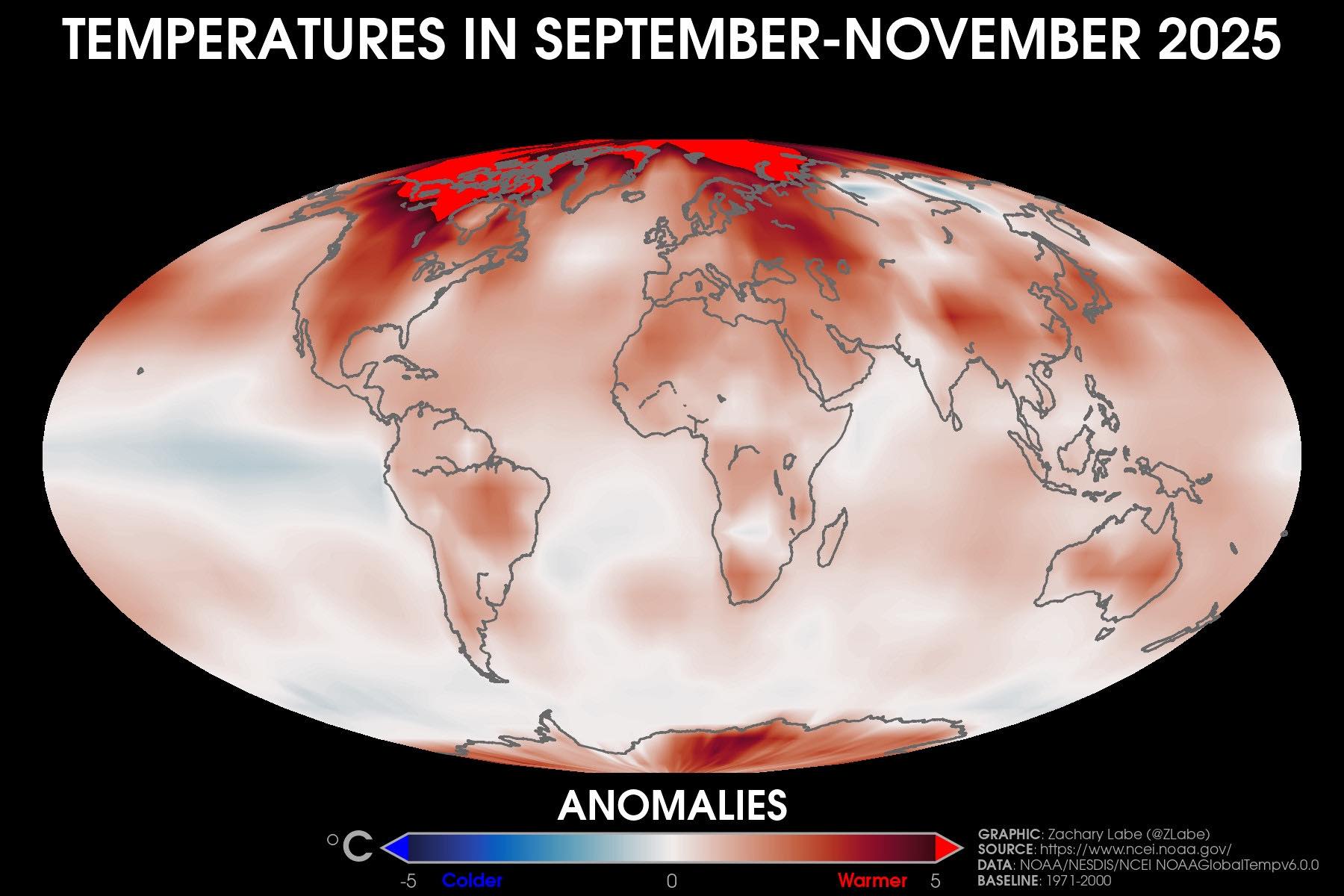
Q3 2025: Extreme Global Temperature Anomalies

Autumn (September–November) climate data reveal two features that matter far more than the global average: what is happening at the poles and what is happening at the equator.

Both the Arctic and Antarctic are experiencing record-breaking temperatures—warming at rates up to 20 times faster than much of the rest of the planet, visible as deep red anomalies on global maps. This extreme polar amplification is not a regional curiosity; it is destabilizing the foundational circulation systems that regulate Earth’s climate, including the jet stream, the Atlantic Meridional Overturning Circulation (AMOC), and the Pacific Meridional Overturning Circulation (PMOC).

As a direct consequence, the Northeastern United States is now experiencing sharp climate whiplash: record cold conditions this week, followed by unseasonably warm temperatures days later. These are not random swings—they are signatures of a circulation system that is losing coherence.

The Poles: Where Climate Change Is Accelerating Fastest

The polar regions act as the planet’s thermal anchors. Normally, the large temperature contrast between the equator and the poles powers a fast, stable jet stream and robust ocean circulation. But as the Arctic warms nearly four times faster than the global average, and Antarctic ice loss accelerates, that temperature gradient is collapsing.

With less contrast to drive it, the jet stream weakens and becomes increasingly wavy and prone to stalling. This allows weather patterns to linger—producing prolonged heatwaves, extended cold outbreaks, persistent flooding, and flash droughts. At the same time, freshwater from polar melt is disrupting deep-water formation in the North Atlantic, weakening the AMOC and altering global heat transport.

The Equator: The Illusion of Cooling

The other key feature in the data is a small blue patch along the equatorial Pacific—a weak La Niña signal. This localized cooling will likely prevent 2025 from being recorded as the single hottest year on record by slightly suppressing the global mean temperature.

But this is precisely where the global average becomes misleading.

Oceans absorb the vast majority of excess heat and require far more energy to warm than air or land. A small cooling anomaly in the tropical Pacific can therefore offset massive heating elsewhere in the global average—especially at the poles—without reducing actual climate risk.

In other words, the planet can appear “less hot” on paper while becoming far more dangerous in reality.

Why “Global Average Temperature” Misleads

A 3 °C increase in the global average temperature sounds abstract and manageable. In reality, it masks extreme regional outcomes that determine human survivability.

  • The Arctic is already warming more than four times faster than the global mean, with localized increases exceeding 10 °C. In 2025, parts of the Arctic are running as much as 20 °C above normal.

  • Land and air temperatures rise far faster than ocean averages.

  • Human limits are governed not by global means, but by regional extremes and wet-bulb temperatures—the point at which heat and humidity overwhelm the body’s ability to cool itself.

When policymakers talk about “holding warming below 1.5 °C,” they are referring to a blended average across oceans, land, and atmosphere. But oceans absorb over 90% of the excess heat trapped by greenhouse gases, heavily damping the apparent rise in the global mean.

This creates a dangerous illusion of control.

The Ocean Heat Mask

Recent deep-ocean studies show that even the deepest layers of the ocean are warming. A change of just 0.1 °C in ocean temperature represents an enormous amount of stored energy. If that heat were redistributed over land, it would be equivalent to roughly a 35 °C increase—a level incompatible with large-scale human survival.

The oceans are acting as a temporary buffer, hiding the true magnitude of warming while simultaneously destabilizing themselves through:

  • Increased stratification

  • Slowing circulation

  • Oxygen loss

  • Ecosystem collapse

During 2025, the Pacific Ocean has been running approximately 1.6 °C above its long-term average—a deviation of six standard deviations above the mean. In climate science, values this far from normal variability are essentially off the charts.

The Thresholds That Matter

Two temperature thresholds now demand urgent attention:

  • ~1.5 °C global average warming
    This marks the widespread activation of major climate tipping points—ice sheet instability, circulation slowdown, ecosystem collapse.

  • ~9 °C land and air warming
    This represents the upper boundary of human physiological survivability across much of the planet.

These are not distant, theoretical limits. They are rapidly approaching—and in some regions, already being exceeded.

The climate crisis is no longer about slow, linear warming. It is about where the heat is accumulating, how it is destabilizing Earth’s life-support systems, and how misleading averages are masking the speed and severity of the transformation now underway.

* Our probabilistic, ensemble-based climate model — which incorporates complex socio-economic and ecological feedback loops within a dynamic, nonlinear system — projects that global temperatures are becoming unsustainable this century. This far exceeds earlier estimates of a 4°C rise over the next thousand years, highlighting a dramatic acceleration in global warming. We are now entering a phase of compound, cascading collapse, where climate, ecological, and societal systems destabilize through interlinked, self-reinforcing feedback loops.

We examine how human activities — such as deforestation, fossil fuel combustion, mass consumption, industrial agriculture, and land development — interact with ecological processes like thermal energy redistribution, carbon cycling, hydrological flow, biodiversity loss, and the spread of disease vectors. These interactions do not follow linear cause-and-effect patterns. Instead, they form complex, self-reinforcing feedback loops that can trigger rapid, system-wide transformations — often abruptly and without warning. Grasping these dynamics is crucial for accurately assessing global risks and developing effective strategies for long-term survival.

Tipping points and feedback loops drive the acceleration of climate change. When one tipping point is breached and triggers others, the cascading collapse is known as the Domino Effect.

The Climate Crisis: Violent Rain | Deadly Humid Heat | Health Collapse | Extreme Weather Events | Insurance | Trees and Deforestation | Rising Sea Level | Food and Water

The Human Induced Climate Change Experiment

Runaway Feedbacks: Can Earth Warm 9°C This Century?