bookmark_borderClimate Change And Credit

by Daniel Brouse

Part of a series of articles on Climate Change And Flood Insurance

Homeowners living in flood plain have learned the hard way that climate change has effected their ability to get a mortgage. As the sea level rises and extreme weather events intensify, homeowners have found their insurance rates increasing or their total inability to obtain insurance coverage. Without insurance it is very, very hard to get a mortgage.

Moody’s credit ratings are now going to have a similar impact on municipalities. “What we want people to realize is: If you’re exposed, we know that. We’re going to ask questions about what you’re doing to mitigate that exposure,” Lenny Jones, a managing director at Moody’s, said in an interview. “That’s taken into your credit ratings.”

Bloomberg news agency reports:

In its report, Moody’s lists six indicators it uses “to assess the exposure and overall susceptibility of U.S. states to the physical effects of climate change.” They include the share of economic activity that comes from coastal areas, hurricane and extreme-weather damage as a share of the economy, and the share of homes in a flood plain.

Based on those overall risks, Texas, Florida, Georgia and Mississippi are among the states most at risk from climate change. Moody’s didn’t identify which cities or municipalities were most exposed.

“If I was a city official, I’d be asking a whole lot of questions about what vulnerabilities their community has, and how each new proposed development adds to that vulnerability,” said Rob Moore, a senior policy analyst at the Natural Resources Defense Council. “Because at some point, your creditors certainly will.”

Real Estate and the Rising Sea Level
Top 5 Risks
How Do We Handle Flood Risk?
Senegal Forecasts Climate Change Changes
Biloxi-Chitimacha-Choctaw Indians Climate Change Refugees
Atlantic City Going Under
Biggert Waters Flood Insurance Reform Act of 2012
Flood Insurance Reform 2011
About Flood Insurance
Who Pays For Flood Losses?
Floodplain Maps Force Towns Into Tricky Waters
Head of the Federal Flood Insurance Program Resigns
Sacramento And FEMA Fight On Flood Insurance
Global Warming


bookmark_borderEmissions Worst Ever

The World Meteorological Organization reported on October 30, 2017:
Greenhouse gas concentrations surge to new record

Green-House-Gas-Bulletin-2017.pdf

Concentrations of carbon dioxide in the atmosphere surged at a record-breaking speed in 2016 to the highest level in 800,000 years, according to the World Meteorological Organization’s Greenhouse Gas Bulletin. The abrupt changes in the atmosphere witnessed in the past 70 years are without precedent.

Globally averaged concentrations of CO2 reached 403.3 parts per million in 2016, up from 400.00 ppm in 2015 because of a combination of human activities and a strong El Niño event. Concentrations of CO2 are now 145% of pre-industrial (before 1750) levels, according to the Greenhouse Gas Bulletin.

Rapidly increasing atmospheric levels of CO2 and other greenhouse gases have the potential to initiate unprecedented changes in climate systems, leading to “severe ecological and economic disruptions,” said the report.

The annual bulletin is based on observations from the WMO Global Atmosphere Watch Programme. These observations help to track the changing levels of greenhouse gases and serve as an early warning system for changes in these key atmospheric drivers of climate change.

Population growth, intensified agricultural practices, increases in land use and deforestation, industrialization and associated energy use from fossil fuel sources have all contributed to increases in concentrations of greenhouse gases in the atmosphere since the industrial era, beginning in 1750.

Since 1990, there has been a 40% increase in total radiative forcing – the warming effect on our climate – by all long-lived greenhouse gases, and a 2.5% increase from 2015 to 2016 alone, according to figures from the US National Oceanic and Atmospheric Administration quoted in the bulletin.

“Without rapid cuts in CO2 and other greenhouse gas emissions, we will be heading for dangerous temperature increases by the end of this century, well above the target set by the Paris climate change agreement,” said WMO Secretary-General Petteri Taalas. “Future generations will inherit a much more inhospitable planet, “ he said.

“CO2 remains in the atmosphere for hundreds of years and in the oceans for even longer. The laws of physics mean that we face a much hotter, more extreme climate in the future. There is currently no magic wand to remove this CO2 from the atmosphere,”said Mr Taalas.

The last time the Earth experienced a comparable concentration of CO2 was 3-5 million years ago, the temperature was 2-3°C warmer and sea level was 10-20 meters higher than now.

In a separate report, the United Nations (UN) released the Emissions Gap Report for 2017. The report concludes that world treaties are only slowing emissions by 1/3 of what is needed to meet the maximum 2 degree rise in temperature. A 2 degree Celsius rise in temperature would likely cause a 20-40 foot rise in sea levels.

Emissions-Gap-Report_2017.pdf

If the trend continues, most coastal and port cities (including the Jersey Shore and Philadelphia) will be submerged in your lifetime.

2 Degree Temp. Rise and Sea Level Rise
New Jersey Shore Under Sea Level

bookmark_borderReal Estate and the Rising Sea Level

by Daniel Brouse

“Living near the water is incredibly appealing for people around the country, but it also comes with additional considerations for buyers and homeowners,” Zillow chief economist Svenja Gudell wrote in a new report. “Homes in low-lying areas are also more susceptible to storm flooding and these risks could be realized on a much shorter timeline as we have seen time and time again.”

Climate change is causing the sea level to rise. The effects are already being felt in places like the Jersey Shore. Atlantic City, N.J. ranked third in the top ten U.S. areas that experience nuisance flooding with a 682% surge since 1957.

“As relative sea level increases, it no longer takes a strong storm or a hurricane to cause flooding”said William Sweet, Ph.D., oceanographer at NOAA’s Center for Operational Oceanographic Products and Services (CO-OPS) and the report’s lead author. “Flooding now occurs with high tides in many locations due to climate-related sea level rise, land subsidence and the loss of natural barriers. The effects of rising sea levels along most of the continental U.S. coastline are only going to become more noticeable and much more severe in the coming decades, probably more so than any other climate-change related factor.”

“We’ve seen the enormous impact flooding can have on a city and its residents,” said Gudell. “It’s harder for us to think about it on a long-term timeline, but the real risks that come with rising sea levels should not be ignored until it’s too late to address them.”

The Zillow report found:

  • Coastal homes are threatened by the prospect of rising sea levels
  • More than $900 billion worth of U.S. residential real estate could be lost by a 6-foot rise in sea levels
  • The rise in water levels projected by 2100 could destroy 2 million homes

A CNBC analysis of the report said, “Of the nation’s largest cities, Miami, New York, Boston, Tampa and Fort Myers, Florida, have the highest volume of homes at risk of flooding. Los Angeles, Charleston, South Carolina, Houston and New Orleans are also in the top 20 markets at risk.”

Flood insurance is usually needed to obtain a mortgage for a property located in a flood zone. Flood insurance is the only insurance offered by the federal government that can be obtained by anybody. The National Flood Insurance Program (NFIP) is made available by the Federal Emergency Management Agency (FEMA).

The NFIP offers coverage for: 1) Building Property, up to $250,000, and 2) Personal Property (Contents), up to $100,000. The coverage is cumulative which means NFIP will pay out a maximum of $250,000 for the structure. If you make a claim for $100,000 and then sell the property, the next owner can only get insurance for up to $150,000.

The Zillow study found:

  • One-third (32 percent) of underwater homes would be valued in the bottom third nationally, meaning $123 billion in losses.
  • Two in five (39 percent) underwater homes would be valued in the top third nationally, translating to $597 billion in lost high-end real estate.
  • In rural and suburban areas, homes in the top value tier may face particular risk, while in urban areas homes in the bottom value tier are more likely to be affected.

MORE INFORMATION:
Top 5 Risks
How Do We Handle Flood Risk?
Senegal Forecasts Climate Change Changes
Biloxi-Chitimacha-Choctaw Indians Climate Change Refugees
Atlantic City Going Under
Biggert Waters Flood Insurance Reform Act of 2012
Flood Insurance Reform 2011
About Flood Insurance
Who Pays For Flood Losses?
Floodplain Maps Force Towns Into Tricky Waters
Head of the Federal Flood Insurance Program Resigns
Sacramento And FEMA Fight On Flood Insurance
Global Warming

bookmark_borderPollution And Health: 9 Million Deaths Per Year

The Lancet Commission published a report on October 19, 2017 that outlined the results of pollution and health. The report concluded that 9 million people suffered premature deaths due to pollution in 2015.

“Pollution is the largest environmental cause of disease and premature death in the world today. Diseases caused by pollution were responsible for an estimated 9 million premature deaths in 2015—16% of all deaths worldwide—three times more deaths than from AIDS, tuberculosis, and malaria combined and 15 times more than from all wars and other forms of violence. In the most severely affected countries, pollution-related disease is responsible for more than one death in four,” the report states.

Air pollution is the leading cause of death followed by water pollution. The financial cost from pollution-related death, sickness and welfare costs about $4.6 trillion in annual losses.

The report highlights:

  • Air pollution was linked to 6.5 million premature deaths;
  • Water pollution was linked to 1.8 million premature deaths;
  • Workplace pollution was linked to 1 million premature deaths;
  • Premature deaths resulting from pollution-related diseases like heart disease and cancer outnumbered AIDS, tuberculosis, and malaria combined 3 to 1;
  • About 92% of all premature deaths linked to pollution occur in low and middle-income countries.
  • Up to one in four deaths can be attributed to pollution in countries like China, India, Pakistan, or Bangladesh.
  • In absolute numbers, China (1.8 million) and India (2.5 million) had the most pollution-related deaths for the year 2015.
  • The United States, home to the world’s biggest economy, saw 155,000 premature deaths linked to pollution in 2015.


MORE REFERENCES
Death By Ozone
Health And Air Quality
Air Pollution Deaths
Air Pollution Killing Millions
Largest Health Risk

bookmark_borderSenegal Forecasts Climate Change Changes

Senegal is an African country on the west coast of the continent. The country is on the forefront of global warming’s impacts.

“Climate change makes life harder for Senegalese farmers in many different ways: shorter rainy seasons, more frequent and longer dry spells and droughts, a lower water table, floods, coastal erosion, destruction of mangroves, and disruption of fish stocks. But most pernicious of all is the salinization of soil across large tracts of coastal and riverine farmland,” reports the IRIN news agency.

Salinization is an example of a problem that is likely to effect many areas in the United States.

“For decades in Sine-Saloum, the soil, which used to be known for its quality and productivity, has been badly damaged by climate change, which has led to the salinization of the waterways of the delta,” explained Seydou Cissé, who works at Senegal’s National Institute of Pedology (the study of soils).

In an attempt to abate the problem, anti-salt dykes were built. They did help for a while; however, man’s plans do not compare to the force of nature. Already several islands along the Saint-Louis river have been washed away. “Three or four days after the rain, everything goes white. There are piles of salt. All the crops we sow die. All this is due to the salinity caused by the rising waters of the sea. And when we store valuables in our rooms, rust eats away little-by-little and eventually destroys them,” said Fatou Faye, a resident of Diamniadio island said in 2015. Since that time, the island has been washed away.

“When the sea enters in the river, because you have increasing of salt, it has killed many mangroves. And you know the mangroves are the nurseries of all the seafood,” said Aissata Dia of Actionaid Senegal.

“When the tide is high, the water goes into the kitchen and then gradually the water enters the rooms. My kitchen was rebuilt last year, but even today it is threatened by the rising waters. The high salinity of the seawater eventually breaks down even the cement. After three years, the building collapses,” said islander Faye.

In 2017, a sea wall built to help protect Senegal failed. The miles long breach is not repairable.

Reuters reported in May of 2017: “As Senegal’s coast crumbles, residents ponder move to safer ground”

“A French man told us once that there will be a time when this land won’t exist,” said Badiane, who lives in the working-class district of Guet Ndar. “Maybe in 30 years, maybe in 50. I don’t know.”

“(The people) are trying to fight, but in reality the phenomenon has become very serious,” said Abdou Sane, a former parliamentarian based in Dakar who has spearheaded efforts to reduce the threat of disasters. “It exceeds the means of the government, the means of communities,” he added.

Experts have urged the government to relocate other communities before they face a similar fate.

A UN-Habitat program in 2011 helped move about 60 families out of Guet Ndar to a settlement a short distance inland.

“That’s a way of being resilient,” said Mateugue Diack, a professor of agronomy and disaster risk reduction at the nearby Gaston Berger University.

But communication was lacking and people were reluctant to move, he said. The relocation effort fizzled out before it was completed.

Guet Ndar is populated primarily by fishermen whose families have lived there for generations. Most of those who have lost their homes have remained in the overcrowded area, squeezing in with relatives and neighbors.

“Unfortunately my country is one of those that has this huge problem. We always record that something may happen, that something has happened… but still do nothing,” said Diack.

bookmark_borderWildfires: Increase In Extreme Weather

The Membrane Domain started conducting global warming experiments in the 1990’s. It was about 1997 when we suggested the climate in Pennsylvania would turn more like Florida and the climate in California would turn more like Hades. The change wasn’t predicted to take place for hundreds of years. Now, only twenty years later, Pennsylvania has hot humid weather in October and California is on fire.

The Los Angeles Times entitled their article “The climate-change fire alarm from Northern California”. “These kinds of catastrophes have happened and they’ll continue to happen.” Gov. Jerry Brown observed at a news briefing Wednesday. “That’s the way it is with a warming climate, dry weather and reducing moisture.”

The article goes on to say, “California is fortunate to have a governor who understands the perils of ignoring climate change and is aggressively pushing policies to mitigate its future harm. Unfortunately, that puts him at odds with a head-in-the-sand president who blithely disregards the obvious connection between the warming climate and the multiple federal disaster areas he’s been forced to declare in Texas, Florida, Puerto Rico and, now, California.”

An article in Scientific American is entitled “Scientists See Climate Change in California’s Wildfires”. The subtitle is “Strong winds and months of record-high temperatures have fueled the destructive fires.”

As humans add fuel to storm systems, weather will become more extreme.

bookmark_borderAir Quality and Climate Change

Current models indicate an increase in air quality alerts. The increase risk is not necessarily from an increase in pollution. An on-going research study conducted by InternetU.org suggests a warming climate is likely contributing to reduction in air quality.

The frequency of air quality alerts is on the rise in the United States and many other parts of the world. The Philadelphia Area is a prime example. Philly and suburbs have had multiple days in a row when it was unhealthy to breath. The Action Alert days are also starting earlier in the season and lasting longer into the summer. In fact, a recent string of days with temperatures above 90 have resulted in an Action Alert on September 25, 2017.

Ozone Action Alert for September 25, 2017

When the Earth’s surface temperature is hot enough and sunlight provides enough ultraviolet light, Nitrogen Oxides (NOx) and Volatile Organic Compounds (VOCs) in the air create a chemical reaction. The result is ozone. Tropospheric ozone is very destructive to plants and animals. Tropospheric ozone is killing an unprecedented number of trees. Unfortunately, it is also causing a massive amount of respiratory and immune system problems in humans, such as, asthma.

Check the current Air Quality Index

More About Ozone

bookmark_borderOne Trillion Ton Iceberg

By Daniel Brouse

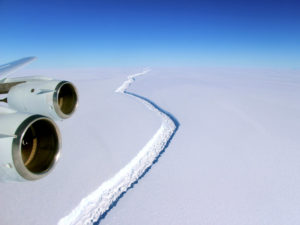
An iceberg weighing over one trillion tons (about the size of Delaware) broke off Antarctica. “Antarctica contains 90% of the world’s fresh water as ice. If all the ice melts, sea levels will rise by 60 meters (200 feet). The sea ice melting doesn’t raise the sea level as the ice is already floating.” (Brouse / Mukerhjee 2017)

Antarctica Larsen C Ice Crack

The new iceberg was already floating, so it won’t have much effect on the sea level; however, it may a destabilizing effect on the rest of Antarctica. “One warning sign that a dangerous warming is beginning in Antarctica, will be a breakup of ice shelves in the Antarctic Peninsula just south of the recent January 0C isotherm; the ice shelf in the Prince Gustav Channel on the east side of the peninsula, and the Wordie Ice Shelf; the ice shelf in George VI Sound, and the ice shelf in Wilkins Sound on the west side.” (John Mercer 1978)

In January of 2017, a UK research team discovered a huge increase in a massive 90-mile crack running through the Larsen C shelf (pictured to the right). In June of 2017, the crack broke and a huge iceberg was created.

Ice Shelf Animation By Doyle Rice and Jim Sergent

See: Antarctica And Rising Sea Level

bookmark_borderBounty of the Sea: More Plastic Than Fish?

The Ellen MacArthur Foundation and the World Economic Forum, in a report called The New Plastics Economy  (which looks at the amount of plastic that ends up in the sea) claims there will be more plastic than fish in the sea by 2050. “If we continue dumping plastic in the sea at the present rate, measured by weight, there will be more plastic than fish by 2050.”

The study examines just one area – San Francisco Bay. “If that’s not representative of the rest of the globe then you can see the potential for large deviations in this calculation,” says Prof Callum Roberts from the University of York.

Plastic Vs. Fish in the Ocean

The Human Induced Climate Change Experiment

bookmark_borderWhy “Fresh Air and Sunshine” is Dangerous

By Daniel Brouse

Q: Do you know what are two of the most dangerous exposures for children and the elderly?
A: Fresh air and sunshine. Either may be hazardous; however, when fresh air and sunshine are combined, the result can be extreme.

On days like today, do not go out and play.

The sun can damage your skin and cause cancer. Air pollution causes many health risks, too.


Fresh Air + Sunshine = Dangerous

Sunshine is also part of a deadly reaction. When combined with heat and volatile gases in the air, ultraviolet light causes a deadly reaction. The result is tropospheric ozone.

The dangerous ozone (O3) is created when vehicle (and other) exhaust is not completely combusted. Nitrogen Oxides (NOx) and Volatile Organic Compounds (VOCs) in the exhaust react to temperature and sunlight creating tropospheric ozone (O3).

The ozone in the air can cause permanent damage to your respiratory and immune systems. Millions of micro-explosions enter through your mouth and nose (and to some extent eyes, ears and skin)… then, if lucky, complete their short lives in your lungs. (NOTE: Lucky, for the length of their life. Unlucky, for the length of yours.)