bookmark_border26% Increase in US Flood Risk by 2050 Due to Climate Change

A study published in the Journal Nature, Inequitable patterns of US flood risk in the Anthropocene, models a 26.4% (24.1–29.1%) increase in US flood risk by 2050 due to climate change.

Flood Risk % Increase

“Our national depiction of comprehensive and high-resolution flood risk estimates in the United States indicates current average annual losses of US$32.1 billion (US$30.5–33.8 billion) in 2020’s climate, which are borne disproportionately by poorer communities with a proportionally larger White population. The future increase in risk will disproportionately impact Black communities, while remaining concentrated on the Atlantic and Gulf coasts. Furthermore, projected population change (SSP2) could cause flood risk increases that outweigh the impact of climate change fourfold. These results make clear the need for adaptation to flood and emergent climate risks in the United States, with mitigation required to prevent the acceleration of these risks.”

This study/model shows the heaviest impact on the Atlantic and Gulf coasts; however, as the Earth warms, the air will hold more moisture.
More moisture-laden air moves over land and creates atmospheric rivers (Pineapple Express). The Journal EOS in the article Atmospheric Rivers Spur High-Tide Floods on U.S. West Coast said, “Atmospheric rivers are narrow bands of moisture that travel across the lower troposphere, generally at the leading edges of massive low-pressure systems. At their peak, they can carry as much water through the sky as the Amazon River does on land. They unleash intense winds and heavy rain as they surge across the Pacific Ocean, eventually making landfall on the U.S. West Coast, contributing to many high-tide flooding events.”

The atmospheric rivers also bring heavy rainfall inland causing extreme flooding. In October of 2021 NOAA said, “a convergence of storms brought more than half a foot of rain to parts of the Bay area in addition to strong winds, flash floods, and mud/landslides. They also bring the potential for heavy snow to higher elevations in the Sierra Nevada mountain range.” (Atmospheric River Hits the West Coast)

More articles on Flood Insurance, Rising Sea Levels and Global Warming.

bookmark_border25% of Critical Infrastructure at Risk of Flooding

The First Street Foundation, a nonprofit research and technology group that assesses the threat posed by flooding across the country, released a report that found one-forth of critical infrastructure in the USA is at risk of flooding including: police and fire stations, hospitals, airports and wastewater treatment facilities.

“With an increasing number of flooding 1events making U.S. headlines, there is a greater awareness of the economic and human cost that
flood-damaged infrastructure can produce. For instance, Hurricane Sandy flooded hospitals, crippled electrical substations, overwhelmed waste water treatment centers, and shut down power and water to tens of millions of people (U.S. Senate Committee on Commerce, Science, and Transportation, 2012). More recently, the impact of Hurricane Ida stretched across the country crippling the electrical grid in southern Louisiana, flooding the transportation infrastructure in the NYC metro area, and killing nearly 100 people. It is clear, now more than ever, that the ways and places in which we live are likely to continue to be impacted by our changing environment. One of the most important implications in this development is the vulnerability of our national infrastructure.”

About 1/4 (2 million miles) of roads are already at risk of becoming impassable due to flooding.

“And as global warming melts ice sheets, raises sea levels and tilts the odds in favor of more extreme rainfall events, the risk will grow in many more communities, the First Street report found. Over the next 30 years, the number of residential properties at risk of flooding is expected to grow from 12.4 million today to 13.6 million by 2051, the report says. For critical infrastructure and commercial properties, the number of vulnerable facilities are projected to grow by 6% and 7% respectively over the next three decades,” said Drew Kann and Ella Nilsen.

Infrastructure Flood Risk

More articles on Flood Insurance, Rising Sea Levels and Global Warming.

bookmark_borderThe Cost of Flood Insurance

An article in the New York Times entitled The Cost of Insuring Expensive Waterfront Homes Is About to Skyrocket states, “Federal officials say the goal is fairness — and also getting homeowners to understand the extent of the risk they face, and perhaps move to safer ground, reducing the human and financial toll of disasters.”

“Subsidized insurance has been critical for supporting coastal real estate markets,” said Benjamin Keys, a professor at the University of Pennsylvania’s Wharton School. Removing that subsidy, he said, is likely to affect where Americans build houses and how much people will pay for them. “It’s going to require a major rethink about coastal living.”

In 2019, FEMA said it would instead price flood insurance based on the particular risks facing each individual property, a change the agency called “Risk Rating 2.0.”

“With a rapidly escalating threat of natural disasters, Risk Rating 2.0 is a much needed and timely change,” said Laura Lightbody of Pew Charitable Trusts, which has pushed governments to better respond to climate threats. Higher insurance costs, she said, were “a reflection of our new, wet reality.”

“For the first time, our policyholder premiums will be based on their individual risk,” said David Maurstad, who runs the flood insurance program at FEMA. “We pledge to continue to evaluate and make adjustments where and when it’s warranted.”

But the growing threat of climate change may make that kind of intervention less successful, said Roy Wright, who ran the flood insurance program until 2018 and now runs the Insurance Institute for Business & Home Safety.

“We cannot hide the truth of this increasing risk,” Mr. Wright said. “We shouldn’t hide it. Tell people the truth.”

More articles on Flood Insurance, Rising Sea Levels and Global Warming.

bookmark_borderClimate Change: Code Red for Humanity

The UN’s IPCC (Intergovernmental Panel on Climate Control) release their latest report that has been compiled and peer-reviewed over the last 8 years.

U.N. Secretary-General, António Guterres described the report as “a code red for humanity.”

“The alarm bells are deafening, and the evidence is irrefutable: greenhouse gas emissions from fossil fuel burning and deforestation are choking our planet and putting billions of people at immediate risk,” said Mr. Guterres.

Some of the changes already set in motion will be “irreversible” for centuries to come.

A press release from the IPCC states:

The report provides new estimates of the chances of crossing the global warming level of 1.5°C in the next decades, and finds that unless there are immediate, rapid and large-scale reductions in greenhouse gas emissions, limiting warming to close to 1.5°C or even 2°C will be beyond reach.

The report shows that emissions of greenhouse gases from human activities are responsible for approximately 1.1°C of warming since 1850-1900, and finds that averaged over the next 20 years, global temperature is expected to reach or exceed 1.5°C of warming. This assessment is based on improved observational datasets to assess historical warming, as well progress in scientific understanding of the response of the climate system to human-caused greenhouse gas emissions.

“This report is a reality check,” said IPCC Working Group I Co-Chair Valérie Masson-Delmotte. “We now have a much clearer picture of the past, present and future climate, which is essential for understanding where we are headed, what can be done, and how we can prepare.”

Every region facing increasing changes

Many characteristics of climate change directly depend on the level of global warming, but what people experience is often very different to the global average. For example, warming over land is larger than the global average, and it is more than twice as high in the Arctic.

“Climate change is already affecting every region on Earth, in multiple ways. The changes we experience will increase with additional warming,” said IPCC Working Group I Co-Chair Panmao Zhai.

The report projects that in the coming decades climate changes will increase in all regions. For 1.5°C of global warming, there will be increasing heat waves, longer warm seasons and shorter cold seasons. At 2°C of global warming, heat extremes would more often reach critical tolerance thresholds for agriculture and health, the report shows.

But it is not just about temperature. Climate change is bringing multiple different changes in different regions – which will all increase with further warming. These include changes to wetness and dryness, to winds, snow and ice, coastal areas and oceans. For example:

* Climate change is intensifying the water cycle. This brings more intense rainfall and associated flooding, as well as more intense drought in many regions.
* Climate change is affecting rainfall patterns. In high latitudes, precipitation is likely to increase, while it is projected to decrease over large parts of the subtropics. Changes to monsoon precipitation are expected, which will vary by region.
* Coastal areas will see continued sea level rise throughout the 21st century, contributing to more frequent and severe coastal flooding in low-lying areas and coastal erosion. Extreme sea level events that previously occurred once in 100 years could happen every year by the end of this century.
* Further warming will amplify permafrost thawing, and the loss of seasonal snow cover, melting of glaciers and ice sheets, and loss of summer Arctic sea ice.
* Changes to the ocean, including warming, more frequent marine heatwaves, ocean acidification, and reduced oxygen levels have been clearly linked to human influence. These changes affect both ocean ecosystems and the people that rely on them, and they will continue throughout at least the rest of this century.
* For cities, some aspects of climate change may be amplified, including heat (since urban areas are usually warmer than their surroundings), flooding from heavy precipitation events and sea level rise in coastal cities.

For the first time, the Sixth Assessment Report provides a more detailed regional assessment of climate change, including a focus on useful information that can inform risk assessment, adaptation, and other decision-making, and a new framework that helps translate physical changes in the climate – heat, cold, rain, drought, snow, wind, coastal flooding and more – into what they mean for society and ecosystems.

This regional information can be explored in detail in the newly developed Interactive Atlas interactive-atlas.ipcc.ch as well as regional fact sheets, the technical summary, and underlying report.

Human influence on the past and future climate

“It has been clear for decades that the Earth’s climate is changing, and the role of human influence on the climate system is undisputed,” said Masson-Delmotte. Yet the new report also reflects major advances in the science of attribution – understanding the role of climate change in intensifying specific weather and climate events such as extreme heat waves and heavy rainfall events.

The report also shows that human actions still have the potential to determine the future course of climate. The evidence is clear that carbon dioxide (CO2) is the main driver of climate change, even as other greenhouse gases and air pollutants also affect the climate.

“Stabilizing the climate will require strong, rapid, and sustained reductions in greenhouse gas emissions, and reaching net zero CO2 emissions. Limiting other greenhouse gases and air pollutants, especially methane, could have benefits both for health and the climate,” said Zhai.

More on The Human Induced Climate Change Experiment

bookmark_borderBittle at the Baffler on Floods and Sea Level Impacts in the USA

Bittle at the Baffler on flood and sea level impacts in the USA:

“a neighborhood that feels more like an unclaimed frontier than a subdivision in one of the nation’s fastest-growing metropolitan areas. Dogs run free across acres of empty land, the sound of a falling acorn echoes for blocks”

“Funded by the federal government, local governments in coastal states are buying out thousands of homes in vulnerable areas every year, reshaping and breaking up communities as they go. In their wake, the departed residents of these communities have left what may be the country’s first climate ghost towns, abandoned places made uninhabitable by the warming of the planet.”

“the federal bureaucracy tasked with handling response to these disasters still treats them as individual events rather than constituent parts of a larger crisis”

“No one would argue that these projects are useless, but they represent an outmoded way of thinking, one that assumes Mother Nature wreaks havoc in a relatively stable and predictable manner. Recent storm events in particular have disproved that assumption, becoming so monstrous and erratic over the past decade as to make designing the flood barriers of the 2030s and the 2040s a task akin to dressing for the weather on this day ten years from now.”

“what about the lessons no one sees coming? The other question, of course, is why invest in a barricade that you know will someday burst, if not in the 2040s then in the 2050s?”

“While the program often had to borrow money from the Treasury, the sums were once small and quickly repaid. But as the pace of natural disasters has escalated, the cost of flood recovery has outstripped the amount the program’s five million participating households can afford to pay into the central pot, and it has fallen into unprecedented debt. ”

“one house in Houston that flooded on twenty-two separate occasions between 1979 and 2017, filing an insurance claim each time.”

“The people who continue to live in these areas are doing something so risky that the government will at some point no longer be able to subsidize it, whether by repairing homes after a flood or fortifying them against the next one. ”

” “You have some places where there are high property values, high development, and people are incentivized to build there,” she says—think South Beach or the Hamptons. “But then you have these other communities in the same states, where [people are] not living there because it’s prime real estate or they’re wealthy, they’re living there because they historically can’t afford to live anywhere else.” ”

“Where buyouts do occur, they lead to different outcomes for the rich and the poor, disproportionately benefiting wealthier and whiter families who have the means to sustain themselves as they buy new houses and settle in new communities.”

“Even if New York City one day builds a seawall around Manhattan, protecting the East Village forever from the kind of dissolution that took place in Arbor Oaks, hundreds of smaller and less affluent communities will fall apart piece by piece in the coming decades as the storms continue.”

“Americans displaced by weather events often have at most the right to material compensation for whatever property they lost during a natural disaster. Such a system, pegged as it is to real estate valuations, will always reproduce the inequality that existed prior to the catastrophe, if it doesn’t make that inequality even worse.”

“In 2018, when the National Oceanic and Atmospheric Administration (NOAA) finally released new rainfall predictions for Texas, the agency found that storms which were previously considered once-in-a-century events could now be expected every twenty-five years.”

“When the new maps take effect in the early 2020s, Wade says, the floodplain will get much larger … the floodplain area will likely expand from a thin stripe on either side of a creek into a swath of land a mile wide, covering thousands of homes and businesses. ”

“A lot of our job, really, is to physically uncover the environment so we can have a more resilient place,”

” “[There] are entire neighborhoods that are now within the hundred-year floodplain,” and many residents are living there because that’s what they can afford. They aren’t likely to find comparable housing elsewhere for what the county can offer them in a buyout.”

“Our future is part of what we lost,”

“families who can’t move or don’t want to will become the living collateral of the retreat process, their neighborhoods emptied and lives uprooted because of forces well beyond their control: not only the weather itself, but the policies of the people who govern them. ”

https://thebaffler.com/salvos/on-the-waterfronts-bittle

Do you need flood insurance?

  • Homeowners insurance does NOT cover flooding
  • Flood insurance is obtained through the government’s flood insurance program
  • Flood insurance does not cover the basement of a house
  • Flood insurance covers a lifetime maximum of $250,000 in coverage
    This means if you make a claim for $150,000 the maximum coverage for the life of the property drops to $100,000.

The Human Induced Climate Change Experiment

bookmark_borderFlood Buyouts, Savings and Climate Change

The AP article Flood buyout costs rise as storms intensify, seas surge reports:
“‘… nearly half of the homeowners in Mosby signed up in 2016 for a program in which the government would buy and then demolish their properties rather than paying to rebuild them over and over. They’re still waiting for offers, joining thousands of others across the country in a slow-moving line to escape from flood-prone homes.

Patience is wearing thin in Mosby, a town of fewer than 200 people with a core of lifelong residents and some younger newcomers drawn by the cheap prices of its modest wood-frame homes. Residents watched nervously this past week as high waters again threatened the town.

“It really is frustrating, because here we are, we’re coming through a wet season. There’s a chance that we could possibly flood, and we’re still waiting,” said Jason Stooksbury, an alderman who oversees the town’s efforts to curb flooding. “It’s not a good situation, but what are you going to do — it’s the government process.”’

With more extreme weather events, flooding “is going to become more and more of an issue, and there will be more and more properties that are at risk of total loss or near total loss,” said Democratic U.S. Rep. Peter DeFazio of Oregon, chairman of the House Transportation and Infrastructure Committee, which has jurisdiction over FEMA. “Then the question is: Are we just going to keep selling them insurance and building in the same place?”

An article in Barrons Young People Blame Climate Change for Their Small Retirement Accounts states:
‘”Some 88% of millennials — a higher percentage than any other age group — accept that climate change is happening, and 69% say it will impact them in their lifetimes. Engulfed in a constant barrage of depressing news stories, many young people are skeptical about saving for an uncertain future.

“I want to hope for the best and plan for a future that is stable and secure, but, when I look at current events and at the world we are predicting, I do not see how things could not be chaotic in 50 years,” Rodriguez says. “The weather systems are already off, and I don’t think it’s hyperbolic to be a little apocalyptic.”’

An article in WIRED entitled For the Midwest, Epic Flooding Is the Face of Climate Change reports:
“Fierce storms lashed across the central US this week, unleashing hundreds of powerful tornadoes that carved a path of destruction through parts of Missouri and Oklahoma Wednesday night, and left at least three dead. While the worst of the violent winds has passed, the region is now bracing for massive flooding, following record amounts of rain brought by the severe weather system and with more expected over the weekend. And it’s coming on the heels of the wettest 12 months the US has seen since record-keeping began in 1895.

That’s according to the National Oceanic and Atmospheric Administration, which earlier this year predicted that two-thirds of the states in the lower 48 would risk major or moderate flooding between March and May. “This is shaping up to be a potentially unprecedented flood season, with more than 200 million people at risk for flooding in their communities,” Ed Clark, director of NOAA’s National Water Center said in the agency’s spring outlook report.

So far, it’s proven prescient—with rivers from North Dakota east to Ohio and south to Louisiana all overflowing their banks in recent weeks. The damage to homes, businesses, and farms is likely to rise into the hundreds of millions of dollars.”

“n South Bend, Indiana, where Notre Dame is located, the city is still recovering from back-to-back biblical deluges—a 500-year flood last spring preceded by a 1,000-year flood in 2016 that broke all historical records. Fellow South Bender Mayor Pete Buttigieg has referenced the series of extreme weather disasters on the presidential campaign trail, linking them to climate change. “It’s not just happening in the North Pole, it’s happening in communities like mine,” he told the Late Show host Stephen Colbert in February. “That’s an emergency.”

Besides all the damage to homes, businesses, and municipal infrastructure, increasingly frequent flooding events in the Midwest would have a huge impact on the nation’s ability to produce food. Wet fields make it difficult for farmers to operate their large, heavy planting machinery without getting stuck. And seedlings struggle to develop root systems when there’s too much moisture in the ground.”

The Human Induced Climate Change Experiment

bookmark_borderEarth Status 2018

Humanity has wiped out 60% of animal populations since 1970 according to a report issued on October 30, 2018 by the World Wildlife Foundation.

Plummeting numbers of mammals, reptiles, amphibians, birds and fish around the world are an urgent sign that nature needs life support. Our Living Planet Report 2018 shows population sizes of wildlife decreased by 60% globally between 1970 and 2014.

For the last 20 years, scientists from ZSL, WWF and other organisations, have been monitoring changes in the populations of thousands of animal species around the world. Sadly, they’ve concluded that the variety of life on Earth and wildlife populations is disappearing fast.

“We are sleepwalking towards the edge of a cliff” said Mike Barrett, executive director of science and conservation at WWF. “If there was a 60% decline in the human population, that would be equivalent to emptying North America, South America, Africa, Europe, China and Oceania. That is the scale of what we have done.”

“This is far more than just being about losing the wonders of nature, desperately sad though that is,” he said. “This is actually now jeopardising the future of people. Nature is not a ‘nice to have’ – it is our life-support system.”

On September 26, 2018, the UN released a report that concluded climate change is happening faster that models predicted, and we reaching the point of no return.

As governments prepare to meet later this year for the next round of climate talks, Secretary-General António Guterres today underscored the need to speed up action on an issue that is “the absolute priority” for the United Nations.

Climate change is the defining issue of our time – and we are at a defining moment,” the Secretary-General said at the Informal Leaders Dialogue on Climate Change, held on the margins of the annual high-level debate of the General Assembly.

“[…] we have many priorities in the UN – peace and security, human rights, and development – but I would say that this is the absolute priority.”

Mr. Guterres recalled that when world leaders signed the Paris Agreement on Climate Change three years ago, they pledged to keep global temperature rise to well below 2 degrees Celsius above pre-industrial levels and to work to keep the increase as close as possible to 1.5 degrees.

These objectives were agreed, he noted, as the “bare minimum” to avoid the worst impacts of climate change.

“The commitment was universal – but we are nowhere close to where we need to be to meet these minimum targets,” he stated, adding that a UN study found that the commitments made so far by Parties to the Paris Agreement represent just one-third of what is needed.

“We need to do more and we need to do it quicker: we need more ambition and accelerated action by 2020.”

On November 23, 2018, a congressionally mandated report on the impacts of climate change. It is believed the White House released it on Black Friday in an attempt to bury it. The report summary:

Climate change creates new risks and exacerbates existing vulnerabilities in communities across the United States, presenting growing challenges to human health and safety, quality of life, and the rate of economic growth.

Impacts from climate change on extreme weather and climate-related events, air quality, and the transmission of disease through insects and pests, food, and water increasingly threaten the health and well-being of the American people, particularly populations that are already vulnerable.

* Climate change will cost the U.S. economy hundreds of billions of dollars by the end of the century, damaging everything from human health to infrastructure and agricultural production, according to a government report.
* The report issued a dire warning at odds with the Trump administration’s pro-fossil fuels agenda.
* The White House dismissed the congressionally mandated reported as inaccurate.

“With continued growth in emissions at historic rates, annual losses in some economic sectors are projected to reach hundreds of billions of dollars by the end of the century – more than the current gross domestic product (GDP) of many U.S. states,” reports the Fourth National Climate Assessment Volume II. “While President Trump continues to ignore the threat of climate change, his own administration is sounding the alarm,” said Abigail Dillen, president of environmental group Earthjustice. “This report underscores what we are already seeing firsthand: climate change is real, it’s happening here, and it’s happening now.”

On November 27, 2018, the UN’s emissions gap report concluded that despite pledges of industrial countries CO2 emissions rose in 2017.

To meet the goals of the Paris climate pact, the study says it’s crucial that global emissions peak by 2020.

But the analysis says that this is now not likely even by 2030.

The Human Induced Climate Change Experiment

bookmark_borderExtreme Weather Events Getting More Extreme

The U.N. has released a report entitled, “Extreme Weather Continues in 2018 – a Continuing Call to Climate Action”.

Addressing the dangers associated with extreme weather conditions, the Executive Secretary of the UN Climate Change Patricia Espinosa said: “We must keep an eye on the future. As the superstorms and monsoon flooding of last year and the extreme heat and extreme cold of this year show – we still have a long way to go to deliver on the promise of the Paris Climate Change Agreement”.

This year, record warmth was observed across parts of North America, Europe and Asia, as well as the Atlantic, Pacific and Indian Oceans. Record cold May temperatures were limited to northeastern Canada and the northern Atlantic Ocean, off the southern coast of Greenland.

The study published in the journal Nature showed that ice losses from Antarctica are causing sea levels to rise faster today than at any time in the past 25 years. Results of the Ice Sheet Mass Balance Inter-Comparison Exercise (IMBIE).

According to NASA, “Antarctica’s potential contribution to global sea level rise from its land-held ice is almost 7.5 times greater than all other sources of land-held ice in the world combined. The continent stores enough frozen water to raise global sea levels by 190 feet (58 meters), if it were to melt entirely. Knowing how much ice it’s losing is key to understanding the impacts of climate change now and its pace in the future.”

NOAA points to climate change as part of the problem causing the largest wildfires in California.

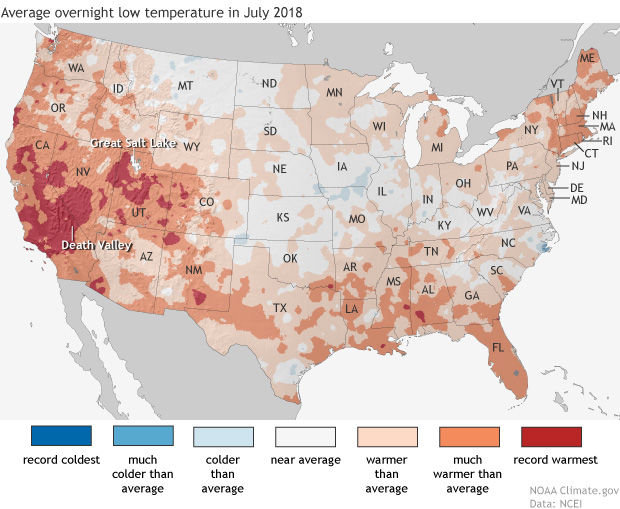
Daytime high temperatures were well above average across much of the western United States in July, but it was overnight low temperatures that were really extreme in large areas of California—where firefighters are battling multiple wildfires—and the Great Basin, and in isolated pockets of Colorado and the Southwest.

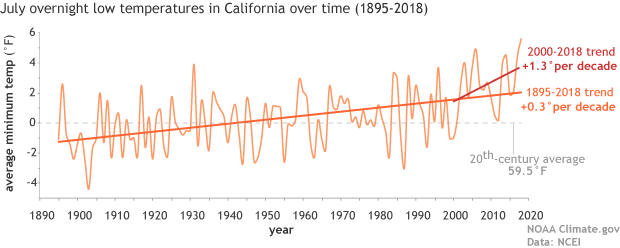
Map of the contiguous United States showing July 2018 overnight low temperature ranksAs the NCEI’s Deke Arndt has blogged about before, nighttime low temperatures are increasing faster than daytime high temperatures across most of the contiguous United States. For much of the West and Southwest, July’s record-breaking nighttime heat is a new highpoint in a long-term trend—one that has rapidly accelerated in recent decades. In California, average overnight low temperature in July rose by 0.3°F per decade over the historical record (1895-2018), but since 2000, the pace of warming has accelerated to 1.3°F per decade.

graph of July minimum temperature 1895–2018 with long-term trend and trend since 2000 shown

Average July minimum temperatures (overnight lows) in California  (light orange line) from 1895–2018. The trend over the historical record is shown in dark orange, and the recent trend (2000-2018) is shown in red. The twentieth-century average is shown with a gray line. NOAA Climate.gov graph, based on data from NCEI’s Climate at a Glance.

According to Tim Brown, director of NOAA’s Western Region Climate Center (WRCC), it’s a pattern that has serious consequences for wildfires and those who combat them. When temperatures cool off overnight, it’s not just a physical relief for firefighters who may be working in conditions that push the limits of human endurance; fire behavior itself relaxes as temperatures drop, winds grow calmer, and relative humidity rises. He explained via email,

Moisture in dead vegetation continuously tries to reach equilibrium with atmospheric moisture. So if nighttime temperature is staying warmer, then the humidity is lower, and the fuels stay drier. A dead fuel moisture reduction of a few percent can increase flammability, flame length, and subsequent overall fire behavior.

When fires remain active at night, it can increase both the time to containment and total burned area, while also affecting public health and safety through more smoke production and lower air quality.  Brown says that qualitatively, there seems to be an increase in firefighters’ reports of active nighttime fire behavior since around 2000.  He and other researchers are currently investigating whether that relationship can be confirmed quantitatively.

satellite image of fires and smoke near Clear Lake, California on August 6, 2018

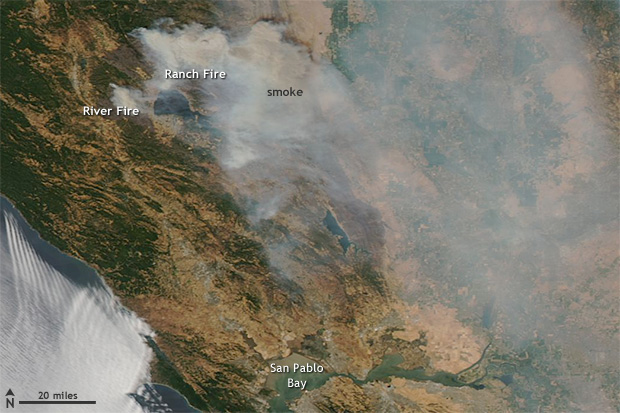
NASA Aqua satellite image of the Ranch and River Fires in Northern California on August 6, 2018, with a pall of smoke spreading to the east.  These fires are part of the Mendocino Complex  Fire, which has become the largest fire in California history.  Extreme fire activity in the state was exacerbated by record-warm overnight low temperatures in July. Image from NASA Worldview website.

Nighttime warming has consequences for other aspects of public health. WRCC climatologist Nina Oakley pointed out via email that the South Coast region of California is experiencing the largest warming trends in nighttime temperatures, according to an environmental health hazard report from the California Environmental Protection Agency. In many communities in the region, air conditioning—rarely needed in the past—is uncommon. In addition, since 2000, heat waves in California have become more humid. In the report, experts offered a warning about the change:

People, animals, and plants that are adapted to California’s traditionally dry daytime heat and nighttime cooling are unable to recover from extreme heat, especially when humidity is high at night. The increase in nighttime heat waves presents an additional risk factor for vulnerable populations.

The rapid increase in the rate of warming in California and other parts of the U.S. West since the start of the new century is a sharp reminder that we can’t necessarily count on the future changing as slowly as the past. Asked about the July nighttime heat in California, California state climatologist Mike Anderson answered via email, “As for the past decade or two, we have noticed observations have looked different than the rest of the historical record. We are consistently sampling at the warm edge of the historical distribution now, and expectations are for that to continue, with new records being set with increasing frequency in the coming years.”

Parts of Pennsylvania recorded record rainfall during the summer of 2018 with frequent “tropical downpours” delivering thirteen or more inches of rain in a 5 day period. The Penn Environment Organization released a report entitled, “Hitting Close to Home | Global Warming is Fueling Extreme Weather Across the U.S.”

Weather-related disasters affect millions

  • Since September 2010, counties housing 84 percent of the total Pennsylvania population (over 10 million residents) were affected by federally-declared weather disasters.
  • Pennsylvania experienced five weather-related disasters, including severe storms, tornadoes, floods, and tropical storms since September 2010.

Extreme weather causes widespread destruction

  • In February 2015 a large winter storm and associated cold wave impacted many central, eastern and northeastern states, including Pennsylvania. The storm and cold wave caused at least 30 deaths and the total estimated costs were over $1 billion in the affected region.
  • In October 2012 Hurricane Sandy caused extensive damage to several states, including Pennsylvania from wind, rain, and heavy snow. Hurricane Sandy caused at least 159 deaths and the total estimated costs were $67.6 billion in the affected regions.
  • Since 2010, extreme weather events have caused at least 30 power outages in Pennsylvania, including one outage that lasted 10 days in 2012 during Hurricane Sandy. [3]


Weather extremes are becoming more common 

Globally, 2015 was Earth’s hottest year on record, surpassing 2014. [4] Many types of extreme weather are expected to become more frequent or severe in a warming world, which could lead to more weather-related disasters.

  • Tropical Storms and Hurricanes: Global warming has the potential to make tropical storms more destructive. Hurricanes and other coastal storms are likely to be more powerful [5] and rainier, [6] while storm surges could be more destructive as sea levels rise. [7]
  • Heavy Rain and Snow: Extreme precipitation is already increasing; continued trends could increase the risk of intense downpours, heavy snowstorms and severe flooding. [8]
  • Droughts and Wildfires: While global warming is anticipated to bring more rain to some areas, it will also likely elevate temperatures and extend dry spells. The potential for stronger drought—and greater area burned by wildfires—will increase, particularly in the West and Southwest.

Every year the World Economic Forum publishes the Global Risks Report. This year’s report suggests that experts anticipate another year of heightened risk. From the approximately 1000 respondents of the annual Global Risks Perception Survey, 59% expect an intensified risk, compared to 7% pointing to declining risks.

Environmental risks have grown in prominence over the 13-year history of the Global Risks Report. This trend continues in the 2018 report. All five risks in the environmental category are ranked higher than average in both likelihood and impact over a 10-year horizon.

“Extreme weather events” and “Natural disasters” rank among the top three risks in terms of likelihood and impact. “Failure of climate-change mitigation and adaptation” ranks among the top five.


The Human Induced Climate Change Experiment (Global Warming Research and Educational Materials)

bookmark_borderCan You Weather The Whether?

Sidd says:

i can’t believe anybody is moving to the coast. But apparently
some people like throwing their money into the ocean.
https://www.bloomberg.com/news/articles/2018-04-23/the-latest-climate-threat-for-coastal-cities-more-rich-people

paper on Miami Dade climate effect on real estate appreciation
the higher the better…
paper is at
http://iopscience.iop.org/article/10.1088/1748-9326/aabb32#supplementarydata

may affect us at some point. lets b careful
not to post more than fair use allows, not the
whole article.
https://phys.org/news/2018-05-news-agencies-hail-major-eu.html

total precip goin up (mainly over ocean)
but areas of precip shrinking (also mainly over ocean)
== smaller and more intense storms over ocean
(in case i didn’t spell it out: watch out coastline and islands)
open access paper at
http://iopscience.iop.org/article/10.1088/1748-9326/aab375/pdf

roundup more toxic than claimed
https://www.theguardian.com/us-news/2018/may/08/weedkiller-tests-monsanto-health-dangers-active-ingredient

“Perhaps you think youâ??re safe because the flood map shows your home is on high ground. But you still need infrastructure â?? things like roads, power plants, water treatment facilities, airports and drinking-water wellfields. So while your house may be high and dry, good luck getting to the grocery store, the doctorâ??s office or out of town.”
http://www.miamiherald.com/opinion/editorials/article210451219.html

More on Climate Change and Flood Insurance<?h2>

bookmark_borderCalifornia Increasing Weather Volatility

One of the most notable changes in weather doing to global warming is volatility. “We are not saying that the Earth’s temperature is just going to rise. In general, as energy is added to a system, the fluctuations in the system increase. So, we expect more storms, more droughts, more wildfires, more floods, more fluctuations of all kinds. What we are saying is that weather conditions will become more volatile due to the impact of humans,” said Sidd Mukherjee and Daniel Brouse of The Membrane Domain (2004). The increase in extreme weather events wreak havoc on humans’ ability to adapt to the changing environment. For instance, severe droughts followed by severe rains create devastating floods.

A new study (23 April 2018) published in the Journal Nature, Increasing precipitation volatility in twenty-first-century California, forecasts extreme weather events in California:

Mediterranean climate regimes are particularly susceptible to rapid shifts between drought and flood—of which, California’s rapid transition from record multi-year dryness between 2012 and 2016 to extreme wetness during the 2016–2017 winter provides a dramatic example. Projected future changes in such dry-to-wet events, however, remain inadequately quantified, which we investigate here using the Community Earth System Model Large Ensemble of climate model simulations. Anthropogenic forcing is found to yield large twenty-first-century increases in the frequency of wet extremes, including a more than threefold increase in sub-seasonal events comparable to California’s ‘Great Flood of 1862’. Smaller but statistically robust increases in dry extremes are also apparent. As a consequence, a 25% to 100% increase in extreme dry-to-wet precipitation events is projected, despite only modest changes in mean precipitation. Such hydrological cycle intensification would seriously challenge California’s existing water storage, conveyance and flood control infrastructure.