bookmark_borderClimate Denial Part II: Freedom of Speech

by Daniel Brouse
Climate Scientist

Climate Denial Part I: A Climate Denier Making a “False Narrative” Political Stand

Climate Denial Part II: Freedom of Speech, Authority, and Regulation

According to an analysis from the Center for American Progress, there are still 139 Republicans in the 117th Congress, including 109 representatives and 30 senators, who refuse to acknowledge the scientific evidence of human-caused climate change. All 139 of these climate-denying Republicans have made recent statements casting doubt on the clear, established scientific consensus that the world is warming—and that human activity is to blame. These same 139 climate-denying Republicans have received more than $61 million in lifetime contributions from the coal, oil, and gas industries.

Michael Bierly asked:
which is worse — the gop denying it or the dems accepting it verbally yet doing nothing about it?

I responded:
Both are equally responsible for this part: “In the spring of 2023, the USA suspended their national debt ceiling. Included in the debt ceiling suspension is a provision for unlimited emergency federal spending. The result is the government can continue to ignore the causes of climate change and instead give trillion-dollar subsidies to the fossil fuel industry through emergency disaster relief. Yes, another vicious circle — more fossil fuels subsidies result in more climate catastrophes resulting in more fossil fuel subsidies, etc. The end result will be additional trillions in government borrowing while the standard of living declines.” — Daniel Brouse

After I asked Darren Wolfe to stop posting climate denial lies on my page, Darren replied:
I guess I’m the world’s first authoritarian libertarian. Anyway, I’m not the one threatening legal action to silence a different POV. Who is the authoritarian now?

Let me repackage what I’ve already posted. Do agree that the Earth goes through natural warming and cooling cycles that have nothing to do with CO2 emissions?

I replied:
No. Not during the existence of humans has the Earth warmed to the levels of July 2023. That’s why I asked you to read my peer reviewed research. You also need to learn the difference between your opinion/point of view and facts. I’m not trying to silence your point of view. I’m trying to silence your dangerous and inaccurate information. What you are doing is equivalent to telling people to ignore the fire alarm in a crowded theater during a fire. So, back to your good question. No. The Earth has never been through a warming cycle like the one caused by burning fossil fuels.

Darren Wolfe:
Ja wohl Herr Gestapoman! You really need a shrink. I’m merely trying to have a discussion with you. Are you really so weak and insecure that you can’t handle respectful disagreement? I will cease and desist because I’m tired of your dogma. You win and freedom of speech loses. I hope you’re happy now.

Daniel Brouse:
No. Freedom of speech wins! Liars lose. This is not a respectful disagreement… this has been an ignoramus making a “false narrative” political stand on a climate scientist’s page.

Oliver Kocher said:
I find there certainly isn’t scientific consensus about catastrophic, human caused climate change, it’s just that those who don’t agree with the agenda are minimized and have their voices silenced. And besides, the idea of “consensus” being the right thing to go by is sketchy at best. Remember when the Copernican theory of the solar system was “consensus” and people were jailed or worse for disagreeing? Or as a more recent example, COVID 19. Consensus certainly wasn’t a sure thing on that, but those who disagreed were threatened, cancelled, and silenced, just to find out a year later that many of them were right, and their very valid concerns were often at least partially correct. So, your claim of consensus is a logical fallacy of “appeal to authority.”

I replied:
Sorry to say, but you are wrong. When you disagree with facts you are not exercising freedom of speech. You are committing fraud or libel. Science has nothing to do with consensus. 1 = 1. Nevertheless, there is also consensus: “A 2021 report by Cornell University found that 99.9% of more than 88,000 climate change studies agree that humans have accelerated the phenomenon, largely due to carbon emissions.” It’s when you use fraudulent consensus like Darren did (in Part I) that you get yourself into legal trouble.

Ken V Kaplan added:
Oliver Kocher, it’s people like you who put people like them in Congress. To compare Copernican theory with CC denial is preposterous. The empirical evidence is incontrovertible that over 90% of Covid deaths once vaccines were introduced (hundreds of thousands) were among the unvaccinated.
Look the frack around and wake up. You live in a developed country that relies on air conditioning. Others aren’t so lucky. People got third degree burns in AZ from the pavement. The new normal is once in a 100 year disasters are now common. And it will get worse.

Oliver Kocher:
So consensus that agrees with you is right, but consensus that disagrees with you is “fraudulent.” Got it. That’s awfully convenient.

Ken V Kaplan:
Oliver Kocher, there is no actual consensus against CC except for deep deniers about man made CC. Your stement is an example of “false equivalence.” Daniel is an expert in this field. What are your credentials?
BTW, look around. What the hell do you think is happening? 100-500 year occurances are now yearly, on every front, hurricanes, fires, droughts, floods, you name it.
People in AZ got frigging third degree burns from the pavement. Without AC the state would be uninhabitable. You can’t get insurance in Fla.
This is just the beginning.

Daniel Brouse:
Oliver Kocher, no. That’s not what I said. I said my research is not based on consensus… our team are the originators of the hypothesis. Since that time we have gone on to prove our hypothesis, as well as, get 80,000 studies to confirm our results. Now our hypothesis has become theory. That means it is fact. It has nothing to do with consensus. Another fact is people need education about politics, economics, and science. Normally this problem would be only of concern to the individual; however, when people spread dangerous, deadly misinformation, it becomes my concern.

Oliver Kocher:
Daniel Brouse, ok. How am I an authoritarian libertarian? That doesn’t even make sense.
In addition, I do not deny that the climate is changing. I question whether that change is caused by human activity, and more specifically, if it is, whether the impact of the US is sufficient to change the course of said climate change. It is part of the nature of climate to change, so no, I’m not a climate change denier, I’m just skeptical of the alleged cause and theorized effects of it.

Daniel Brouse:
An authoritarian libertarian means you insist on your opinion of “freedom of speech”. You are not free to make false scientific claims. I’m not saying you have, but Darren has. You are allowed to say that you are skeptical of whatever you believe. However, if your opinion is wrong about a fact… expressing that opinion makes you a liar, at best.

“Our team are the originators of the hypothesis. Since that time we have gone on to prove our hypothesis, as well as, get 80,000 studies to confirm our results. Now our hypothesis has become theory. That means it is fact.” If you are skeptical of the facts I have presented (and are supported by over 80,000 independent studies), then prove me wrong with your own scientific study. Otherwise, you should learn these new facts… new to you.

FACT: Human induced climate change is an exponential component of an unordered system (chaos theory). That means global warming is accelerating at a rapid rate in a complex way.

What you can do today. How to save the planet.

The Human Induced Climate Change Experiment

bookmark_borderClimate Change Case Study: How to Shutdown a Climate Denier

by Daniel Brouse
Climate Scientist

Climate Change Case Study:
How to shutdown a climate denier making a “false narrative” political stand

Darren Wolfe is the self-proclaimed “world’s first authoritarian libertarian”

Darren Wolfe
Darren Wolfe

In this study, we show how to prove liars about climate change are lying.

According to an analysis from the Center for American Progress, there are still 139 Republicans in the 117th Congress, including 109 representatives and 30 senators, who refuse to acknowledge the scientific evidence of human-caused climate change. All 139 of these climate-denying Republicans have made recent statements casting doubt on the clear, established scientific consensus that the world is warming—and that human activity is to blame. These same 139 climate-denying Republicans have received more than $61 million in lifetime contributions from the coal, oil, and gas industries.

Darren Wolfe replied: Did human CO2 emissions cause the Medieval Warm Period? How about the Roman Warm Period? Or the Minoan Warm Period? No, they didn’t, just like they aren’t causing the Modern Warm Period now. These are natural cycles the Earth goes through.

I responded:  Wrong. Everything you said is incorrect. I’m a climate scientist. Read my work. This peer reviewed paper addresses your misconception on natural cycles:
Climate Change: How Long Is Ever?

And here is the math if you want to test your knowledge of physics.
Climate Change: Rate of Acceleration

And here is the basic peer reviewed primer (written at an 8th grade level) for help gaining the basic concepts. “Human induced climate change is an exponential component of an unordered system (chaos theory). That means global warming is accelerating at a rapid rate in a complex way.”
Anthropogenic Global Warming: The Human Induced Climate Change Experiment

Darren Wolfe replied: I don’t see much but unsubstantiated assertions. There’s no explanation of how CO2 is causing warming. To repeat, the Earth goes through natural warming and cooling cycles. We’re in a warm one now.

The article is wrong about deforestation. Per NASA the Earth is getting greener 
https://www.nasa.gov/…/carbon-dioxide-fertilization…/

Here are 1600 scientists and professionals declaring that there’s no crisis 
https://clintel.org/world-climate-declaration/

Here’s Greenpeace founder, Patrick Moore on the AGW hoax 
Dr. Patrick Moore– Carbon and Climate Catastrophe

I responded: Are you literate? Do you have an education? Did you read my peer reviewed papers? You have not supplied a single scientific nor peer reviewed paper. Everything you have said is incorrect, ignorant, and arrogant. Sorry, but I do not suffer fools gladly. You are a danger to yourself and others. Seek help. Get educated.

By the way, you face potential legal action for posting the clintel link on my timeline. The “paper” is known to be fraudulent. Shame on you.
Fact check: Did 1,200 climate experts sign viral misinformation?

Darren Wolfe responded: Well Mr Educated, is this how you have a discussion? Insulting people and threatening legal action? You haven’t debunked a single point I’ve made. All you do is appeal to authority. BTW, the government spends $billions on climate research. Guess what side of the debate you have to be on to ride that gravy train. You worship that bought and paid for “consensus” while posting articles critical of people connected to oil companies. Both sides have monetary incentives for what they say. Even the writers of peer reviewed papers and the reviewers too. Try looking at the facts yourself and stop the threats and insults. If you’re not interested in discussions why are you posting?

I replied: You weren’t having a discussion. You were spreading lies and misinformation. And, no… there is no appeal to authority. Everything I’ve said and written is based on my own research. Not opinion. Not belief. Our research has nothing to do with government, money, nor consensus. We are the team that first concluded — “Human induced climate change is an exponential component of an unordered system (chaos theory). That means global warming is accelerating at a rapid rate in a complex way. ” So, you are completely off-base in your false assumptions… as well as your personal authoritarian point-of-view. You have yet to ask an intelligent question. If you want to learn the facts and have a meaningful discussion, why not ask some good questions?

Darren Wolfe responded: I guess I’m the world’s first authoritarian libertarian. Anyway, I’m not the one threatening legal action to silence a different POV. Who is the authoritarian now?
Let me repackage what I’ve already posted. Do you agree that the Earth goes through natural warming and cooling cycles that have nothing to do with CO2 emissions?

I replied: No. Not during the existence of humans has the Earth warmed to the levels of July 2023. That’s why I asked you to read my peer reviewed research. You also need to learn the difference between your opinion/point of view and facts. I’m not trying to silence your point of view. I’m trying to silence your dangerous and inaccurate information. What you are doing is equivalent to telling people to ignore the fire alarm in a crowded theater during a fire. So, back to your good question. No. The Earth has never been through a warming cycle like the one caused by burning fossil fuels. Climate Change: How Long Is Ever?

Darren Wolfe responded: Actually it was warmer thousands of years ago coming out of the last ice age
https://cdn.vox-cdn.com/…/file/4385537/still_forpost.0.jpg

I replied: No. Again, you do not listen nor learn. Instead you post a misleading link… then make statements that are not true — “Actually it was warmer thousands of years ago coming out of the last ice age.” No. It was not. Shame on you. Your point of view is wrong. You should apologize and change your point of view. More importantly, you should not purposely propagate false and misleading information.

Darren Wolfe responded: What are you talking about misleading? Peak temperatures were reached thousands of years ago. Temperatures have been relatively stable since with a slight downward trend:

“By 5000 to 3000 BC average global temperatures reached their maximum level during the Holocene and are estimated by some to be 1 to 2 degrees Celsius warmer than they are today. Climatologists call this period either the Climatic Optimum or the Holocene Optimum.”

ATMO336 – Fall 2016

I replied: You are an idiot. Once again, you provide a bogus link written by a student years ago… and make false statements about it. You are a liar. You are WRONG. Today’s temperatures are 1.5 degrees C higher than they were 3,000 to 5,000 ago. Sit down and shut up. The next lie you post on my timeline will result in action against you. You are causing harm to my work and reputation by knowingly making false and misleading statements. Cease and Desist.

Darren Wolfe responded: Ja wohl Herr Gestapoman! You really need a shrink. I’m merely trying to have a discussion with you. Are you really so weak and insecure that you can’t handle respectful disagreement? I will cease and desist because I’m tired of your dogma. You win and freedom of speech loses. I hope you’re happy now.

I concluded: No. Freedom of speech wins! Liars lose. This is not a respectful disagreement… this has been an ignoramus making a “false narrative” political stand on a climate scientist’s page.

Climate Denial Part II: Freedom of Speech
Climate Denial Part III: The Climate Denier Syndrome

What you can do today. How to save the planet.

The Human Induced Climate Change Experiment

bookmark_borderClimate Change: The End of Times

by Daniel Brouse
July 21, 2023

What will the “End of Times” look like?

In the 1990’s, we wrote a paper on the worst-case scenario entitled, “The Impact of Governance & Globalization on Forecasting (The Tunnel Under Thesis).” The theory predicted that forecasting would become increasing difficult. “The result — a figurative, as well as, literal tunneling underground.”

Since that time, forecasting has become increasing more difficult. “In general, as energy is added to a system, the fluctuations in the system increase. So, we expect more storms, more droughts, more wildfires, more floods, more fluctuations of all kinds. What we are saying is that weather conditions will become more volatile due to the impact of humans,” said Mukherjee and Brouse. (2004)

In a report published in Nature entitled Over half of known human pathogenic diseases can be aggravated by climate change, data analyst and associate professor in the Department of Geography and Environment at the University of Hawaii Manoa, Camilo Mora, said climate hazards aggravated 58% of all known human pathogens. That is over half of infectious diseases discovered since the end of the Roman Empire. 58% of an authoritative list of infectious diseases documented to have impacted humanity have already been shown to be aggravated by climatic hazards — a finding the researchers found “shocking,” Mora said.

Movement of people and animals caused by climate is one factor. Warming at higher latitudes allowed vectors and pathogens to survive winter is another factor. The report goes on to say, “The human pathogenic diseases and transmission pathways aggravated by climatic hazards are too numerous for comprehensive societal adaptations, highlighting the urgent need to work at the source of the problem: reducing GHG (Greenhouse Gas) emissions.”

This research reveals more evidence that humans will have difficulty adapting to climate change, especially those in developing countries, Mora said. “The magnitude of the vulnerability when you think about one or two diseases — okay, sure, we can deal with that,” he said. “But when you’re talking about 58% of the diseases, and 58% of those diseases can be affected or triggered in 1,000 different ways. So that, to me, was also revealing of the fact that we’re not going to be able to adapt to climate change.”

In 2023, I wrote the paper, “Climate Change: How Long Is ‘Ever’?“. When we wrote the Tunnel Under Thesis, we forecast these events would not happen for centuries. We underestimated Man’s ignorance and arrogance. Fossil fuel consumption and greenhouse gas emissions have continued to set record highs. Humans have caused chain-reactions resulting in domino-effects, snowball effects, and feedback loops.

Events we thought would not happen in our lifetimes are happening now. My last resort emergency plan was to escape to Canada. (I am a dual citizen.) This summer that plan literally went up in smoke. “Beginning in March 2023, and with increased intensity starting in June, Canada has been affected by an ongoing, record-setting series of wildfires.” — Wikipedia

All of my life I have located my office and bedrooms in the uppermost southern exposure (preferably in the tree canopy.) I love sunlight, elevation, trees, fresh air, and wildlife. It is becoming ever more obvious my dreamlife is coming to an end, and I will be forced to tunnel under. For those forward thinkers, think about your poop. Pumping sewage above ground level will be a major problem at all times. In addition, the inability to pump flood water will become deadly during extreme weather events. In July of 2020 NPR reported, “The remnants of Hurricane Ida dropped unprecedented rainfall on several eastern states, killing dozens of people. Eleven of them were Queens residents who died when their basement apartments flooded.” In August of 2022 CNN reported, “Seoul has vowed to move some of the city’s poorest families out of underground and semi-subterranean homes after 13 people were killed in flooding caused by record rainfall this week, sparking public horror and calls for government accountability.” Drowning in your own poop may result for those unprepared.

Fresh air, water, food, and light will also be problematic; however, your most severe concern will likely be security. Those with supplies will be at high risk of being raped and looted. Good luck!

More From the Human Induced Climate Change Experiment

bookmark_borderEconomic Update: Inflation, Interest Rates, AI, Consumer Spending, Climate Change, and Fiscal Policy

by Daniel Brouse
February 3, 2023

This article is about the economic conditions up to 2023 and a forecast for the foreseeable future. It helps to understand fiscal and monetary polices prior to reading the following.

In 2022 and 2023, the Federal Reserve raised their interest rates charged to other banks 4.75 percent in an effort to fight inflation. In the later part of 2022, inflation appeared to level-off and start to decline; however, it would be a mistake to think the war is won.

In essence, the short term rise in Fed interest rates is a fiscal facade. In the short term, the rise in Fed rates strengthens the dollar reversing the pressure on real market interest rates. The rise in rates causes inflows of foreign currency dampening the effect on the Treasury’s borrowing costs. At the same time, it makes imported consumer goods cheaper. What the Fed has done with rate hikes so far has not touched the root causes of inflation — lack of immigration/young workers, consumer spending and debt, and government spending and debt.

Unfortunately, the first one — immigration/young workers — appears to have caused a new paradigm. Instead of workers/employment/unemployment causing a wage inflation spiral, AI and robotics are replacing human labor at a rapid rate. Whereas before we thought it would be 20-50 years before impacting economic models, it appears to already be happening. We don’t know the impact yet, but likely this will be good for inflation (eg no wage inflation.) However, it will be devastating to workers’ incomes. Though income inequality will likely be justified, it won’t be a good thing since everyone will earn next to nothing. There are still a few years for this to play out, so downward pressure on wage inflation will not be felt in time for our current fiscal fiasco.

The second part — consumer spending and debt — has been increasing throughout the Fed’s rate rises fueled in part by the stronger dollar. As long as there is strong consumer demand, there are inflationary pressures. The GDP has been increasing to historic highs during the Fed rate rises. The greater the consumer debt the more severe the inevitable recession will be (multiplied by how much technology replaces workers.) In addition, climate change disasters and ill health effects are growing exponentially. Consumer spending and mass consumption through the exploitation of natural resources is the greatest long-term risk to world economics (and human life.)

The last part — government spending and debt – is the real part of the worst to come in the short term. The increase in the price of the dollar has kept marketplace interest rates artificially low. Over the last several years, the government has budgeted huge multi-trillion dollar spending packages. Most of this money has yet to be borrowed and spent (see debt limit crisis.). When the money is borrowed, the price of the dollar will get hammered, and consumers will feel a huge jump in inflation of imported goods. Long term marketplace interest rates will come under severe pressure. The Fed will be forced to buy Treasuries and print money. This is also hugely inflationary. Next, when the money is spent, hundreds of millions of dollars will be pumped into the economy causing a shift in the demand curve for many goods and services. Again, this is biggly inflationary. A microcosm of what’s to come can be seen in the stimulus checks. The 3.2k/person stimulus checks caused this first little bump in inflation we are seeing now. This is just a drop in the bucket compared to the trillions of government stimulus yet to come. There are some Republicans trying to squash the borrowing/spending, but I doubt they will be successful. Soo….

In conclusion, it will be near impossible to curb inflation through monetary policy. The greatest risk to short term world economics is US fiscal policy.

UPDATE: November 9, 2023

Attention armchair economists, investors, and homeowners:
the 30-year Treasury auction was “bad” today
… when I say bad, I mean bad for those not investing in Treasuries.

What does it mean? The government went to borrow money today, and people didn’t want to lend them money. The 30-year interest rate spiked higher. This is because the government is borrowing record amounts of money.

A Double Whammy
This has two negative feedback loops.
1) the higher interest rates mean the government has to borrow more money to make the interest payments… resulting in higher budget deficits… resulting in more borrowing… resulting in higher interest rates, etc.
2) the government is borrowing the current trillions of dollars over the next couple years… but they have yet to spend it… spending the trillions will result in inflation… which will result in higher interest rates… causing a larger deficit… requiring more borrowing, etc.

The Greatest Risks to the US Economy

  1. Climate Change
  2. Government Spending / Debt
  3. Lack of Immigration

Human induced climate change is an exponential component of an unordered system (chaos theory).

The Age of Loss and Damage is a new way of thinking about economics by combining economics, climate science, statistics, and physics. Until now, economic models have been unfit to capture the full extent of climate damage. Traditionally, “integrated assessment models” (IAMs) were used to forecast “shock” events. IAMs use “quadratic function” to calculate GDP losses by squaring the temperature change, yet ignore other methods (such as the exponential function) that are better suited for rapid change. “Climate change is fundamentally different to other shocks because once it has hit, it doesn’t go away,” said Thierry Philipponnat, author of a report by Finance Watch, a Brussels-based public interest NGO on financial issues. “And if the fundamental assumption is flawed, all the rest makes little sense — if any.”

Reuters reported, “Critics say this (IAMs) choice is doomed to underplay the likely impact – particularly if the planet hits environmental tipping points in which damage is not only irreversible but happens at an ever-accelerating rate.” Thierry Philipponnat’s report, Finance in a Hot House World, concludes: “Climate risk is growing to disruptive levels throughout the financial system and the guardians of financial stability urgently need to adapt their tools to regain control.” The report calls for economic models that do not mislead, scenario analyses that prepare the market, and a new prudential tool to address the build-up of systemic climate risk.

Traditional economics is based upon the “costs and benefits” to society. Since there are no known long-term benefits of climate change to society, the Age of Loss and Damage economics focuses on the exponential costs of climate change to society.

Loss and damage litigation against oil companies and governments will change world economics.

In the spring of 2023, the USA suspended their national debt ceiling. Included in the debt ceiling suspension is a provision for unlimited emergency federal spending. The result is the government can continue to ignore the causes of climate change and instead give trillion-dollar subsidies to the fossil fuel industry through emergency disaster relief. Yes, another vicious circle — more fossil fuels subsidies result in more climate catastrophes resulting in more fossil fuel subsidies, etc. The end result will be additional trillions in government borrowing while the standard of living declines.

According to NOAA, in 2023 (as of November 8), there have been 25 confirmed weather/climate disaster events with losses exceeding $1 billion each to affect United States. These events included 1 drought event, 2 flooding events, 19 severe storm events, 1 tropical cyclone event, 1 wildfire event, and 1 winter storm event. This is the largest number of climate disasters recorded with a notable increase in extreme precipitation events (violent rain).

Meanwhile, the US politicians also fail to address the declining and aging population. By restricting immigration, the government is forcing the acceleration of AI and robotics technology. Although this is great for “productivity”, neither AI nor robots pay taxes. The US economy is based on population growth. Increased emergency spending and a declining tax base results in insolvency.

ALSO SEE: The Economic Monsters: Inflation and Interest Rates

UPDATE 2024: Economic Facts on Immigration, Budget Deficits and Inflation

Business, Finance, and Economics

bookmark_borderClimate Change: No Credible Pathway to 1.5C Limit

The UN Environment Programme (UNEP) insisted there is “no credible pathway to 1.5C in place.” The report Climate change: No ‘credible pathway’ to 1.5C limit found:

National pledges to reduce harmful emissions offer little hope of avoiding climate disaster, UN climate experts said on Thursday, in an urgent appeal for a radical transformation of the energy sector, before it’s too late.

There’s “no credible pathway to 1.5C in place” today, the UN Environment Programme (UNEP) insisted in a new report, despite legally binding promises made at the 2015 Paris Climate Conference to prevent average temperatures rising by more than 1.5C above pre-industrial levels.

Uncomfortable truth
“This report tells us in cold scientific terms what nature has been telling us all year, through deadly floods, storms and raging fires: we have to stop filling our atmosphere with greenhouse gases, and stop doing it fast,” said Inger Andersen, Executive Director of UNEP.

“We had our chance to make incremental changes, but that time is over. Only a root-and-branch transformation of our economies and societies can save us from accelerating climate disaster.”

Despite Nationally Determined Contributions (NDC) promises made by governments in favour of reducing their carbon footprint, pledges made since the last climate summit in Glasgow in 2021 will lead to cuts of less than one per cent of projected 2030 greenhouse gas emissions, according to UNEP.
Paltry reductions

This is the equivalent of just 0.5 gigatonnes of CO2, UNEP calculated, adding that only a 45 per cent emissions reduction will limit global warming to 1.5C.

As it stands today, latest data indicates that the world is on track for a temperature rise of between 2.4C and 2.6C by the end of this century.

“In the best-case scenario, full implementation of unconditional NDCs and additional net-zero emissions commitments point to only a 1.8C increase, so there is hope. However, this scenario is not currently credible based on the discrepancy between current emissions, short-term NDC targets and long-term net-zero targets,” UNEP said.
Fossil fuel-free solution

For the situation to improve, a “large-scale, rapid” and fossil fuel-free shake-up is needed of our “electricity supply, industry, transport and buildings sectors, and the food and financial systems” to cut emissions by 45 per cent to limit global warming to 1.5C, and by 30 per cent to keep average temperature rise to 2C, the UN agency explained.

And although the transformation towards net-zero greenhouse gas emissions is underway in electricity supply, industry, transportation and buildings, it needs to move “much faster”, the report concludes.

It found that electricity supply transformation had made most progress in some countries, amid dramatically reduced renewable electricity prices.

“It is a tall, and some would say impossible order, to reform the global economy and almost halve greenhouse gas emissions by 2030, but we must try,” said Ms. Andersen. “Every fraction of a degree matters: to vulnerable communities, to species and ecosystems, and to every one of us.”
Food system reform

Rapid and lasting emissions cuts are needed in food production industries too, as this accounts for about a third of greenhouse gases, UNEP continued.

It noted that action in four areas – protection of natural ecosystems, dietary changes, improvements in farm food production and decarbonization of food supply chains – would reduce food system emissions by 2050 to around a third of current levels.

Global Warming

bookmark_borderThe Federal Reserve, the Treasury, and You

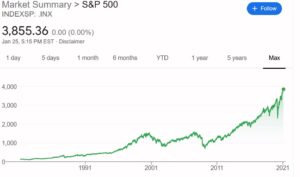
S&P 500 Rise since Fed and Treasury Intervention
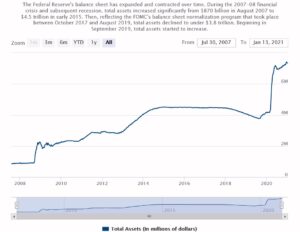
Federal Reserve Bank Balance Sheet 2020

We were talking about a graph of the record high stock market… and, I said:
You definitely need to keep this graph with it… the main reason the stock market is at this level is because the Federal Reserve has been buying stocks and bonds… lots of them. (That’s over 7 trillion pictured in the graph.) The old, bankers’ saying is “you can’t fight the fed”.

You asked: So, what will happen next?

I replied:
It all depends on how long the Fed can print money. A goodly portion of the bond and equity markets are owned by the Fed. (aka us / socialism / communism) . The US can do this because the dollar is the world reserve currency. Unfortunately for us, the Trump administration has put the dollar’s status in jeopardy. My guess is we have some time… until the dollar implodes. When the dollar implodes, the artificially inflated real estate, bond, and equity markets will collapse. Something like the next 10-20 years all your assets will be worthless.

You asked: do you think Janet will be Yellen and Screamin’ about this practice?

I replied:
Sad to say, no. The gov’t started propping up the private sector in 2008-2009. That was suppose to unwind. There was no unwinding under Yellen…. the real unwinding was suppose to happen under Trump. In 2017, the unwinding stopped… in 2020, the spigot was opened wide and trillions more were pumping in. Now, it is essential to keep the markets from collapsing. Thus, I expect Yellen will be forced to “Buy high and sell low”. Obviously, a failing investment practice.

ETFs are stocks as are Fannie Mae, Freddie Mac, and Ginnie Mae. Nobody knows exactly what the Fed buys, but it is widely believed the Fed started buying S&P 500 ETFs in 2020. In any event, 7 trillion in public and private debt and equities has a significant impact on artificially inflating real estate and the stock market.

You replied:
I understand it as “ETF’s” are “Exchange Traded Funds” and can be ANY investment vehicle.
To your point the Fed is documented to have made ETF Corporate Bond purchases last year …
What I could use your help on is in seeing how the (to Tom’s point) rather nominal $8 billion purchase is causing the dramatic effect seen in the graph.

I responded:
Yes. “An exchange-traded fund is a type of investment fund and exchange-traded product, i.e. they are traded on stock exchanges as stocks.” The reason(s) it bolsters the stock market include: purchases of corporate bond ETFs; purchase of equity based ETFs; purchase of specific corporate debt (eg Amazon, VISA, Kroger); most importantly the lowering of interest rates so that corporations can borrow money at near zero percent and use the money to purchase back their own stock. These are just a few ways the FED is propping up the stock market. Less direct but just as significant is the inflation of real estate (through purchase of mortgage backed securities.) The inflated value of real estate gives individuals the ability to invest (or not cashout) in the stock market. That is to say, if real estate was not inflated right now, people would be cashing out their 401k and IRAs to survive.

The Fed started doing these dirty deals in 2008. When I say dirty deals, I mean using their authority to maintain liquidity in the markets to interfere in private assets and equity. Since 2008, they have gone further and further over the line. In 2008-2009 it was focused mainly on real estate and large purchases (automobiles). In 2020, the Fed added direct and indirect ownership in corporations. For instance, airline debt… $2.2 million in Southwest Airlines debt. This allowed Southwest to borrow billions to keep afloat during the pandemic. Here is an article that explains a lot of it… “the Federal Reserve announced the deployment of additional “tools to support households, businesses, and the U.S. economy overall in this challenging time.” “Overall, $1 trillion in investment-grade bonds have been issued this year, nearly as much as all of 2019, along with tens of billions more in junk bonds from risky companies, which the Fed has also signaled that it would purchase.”

Something that is very important to consider… what is the difference between owning stock in the corporation or junk bonds issued by that corporation? That is to say, what happens to the Fed’s asset when the corporation goes bankrupt? What happens to the Fed’s good bonds when that company is taken over?

You said:
Something we should all remember … zooming back on the nation with a fresh alien perspective is a great exercise and skill …
We have a median household income barely budge since 1980 even after the majority of households went to duel income. It’s about 62,000 against 300% increases in real estate, health insurance and college costs …
Meanwhile market capitalization, cash reserves and productivity for corporations skyrocketed and the wealth gap of a tiny minority of both private individuals and elected officials skyrocketed …
To say “nothing to see here” is impossible if you look from afar …
This is one thing, the Fed, we can focus on for a better understanding. Thanks Daniel Brouse for initiating the discussion.

I add:
Agreed. The best case scenario for the USA would be to eliminate all existing Federal taxes. Establish a Federal pollution tax. Give every American 40k/year stipend.

The FED really does openly keep 2 sets of books. In general, both the Treasury and the Fed do not want to publicly disclose exactly what they are doing. 1) they don’t want to endanger private companies or industries by giving the impression that a company is in trouble 2) they don’t want the markets to undermine their efforts by trying to profit from their actions. A public example of this is in 2008-2009 when all the big banks were forced to take TARP money… whether they needed it or not. [The Fed and the Treasury have two sets of books… one for the public and one that is classified. It’s why we don’t know what stocks they are buying.)

“Making matters worse, the proportion of buybacks funded by corporate bonds reached as high as 30% in both 2016 and 2017,” according to JP Morgan Chase.

The Fed is buying stocks and bonds. And, the Fed is in cahoots with the Treasury (where do you think the Treasury borrows the money from?) The Fed has purchased trillions of dollars in direct and indirect purchase of stocks and bonds. It started in 2008 and continues to this day. US citizens have ownership in many airlines, cruise ships, real estate, General Motors, Chrysler, a multitude of banks and mortgage companies, insurance companies, and much more. That is not to mention the billions and billions lent to corporations to buy back their own stocks. This is the Fed’s money buying stocks. This is The Fed using the money multiplier to bolster the stock market since 2008.

You ask:
I tried to find data on the “stocks” you are referring to and can’t … does one of the articles you attached above have info.

This also pulls in my skepticism that the media is covering everything it should be … but I just can’t find any info so I could use sources.

I reply:

Yes. You can find out about many of the stocks owned by the government. It is a bit tangled. But, you can follow the money. Ask where the money to purchase the assets comes from? A: The Fed. Corporations and the Treasury obtain near zero interest rate money from the Fed. So, in many cases, how the Fed pays for the stocks becomes obscured. It often takes the private sector years so figure out the cash flow. We don’t know that much about 2020… except what was revealed in the CARES act, as well as, the pattern of stock buy backs (there was a big dip in buy backs in the 2nd quarter that coincides with the stock market.) You will have to dig a bit to find the names of the stocks… but they include airlines (Alaska Airlines, Allegiant Air, American Airlines, Delta Air Lines, Frontier Airlines, Hawaiian Airlines, JetBlue Airways, United Airlines, SkyWest Airlines, and Southwest Airlines), cruise ships, and supply chain companies like Amazon and Kruger. Some of the stock buybacks that lineup with the market include MGM, Best Buy, Qualcomm, Kansas City Southern, Lennar, Cummins and Xerox. The acquisition of stocks and stock options from earlier periods has been better routed out by analysts… all of the companies listed in “red” are all on the list: https://projects.propublica.org/bailout/list

You wondered: Am I missing something … these appear to be loans, not stock purchases, yes?

I explain: In 2008 the Federal Reserve and the Treasury colluded on circumventing the restriction on the both the Fed and the Treasury. Now, they are working in concert. You can no longer differentiate between the Fed and the Treasury. Quantitative Easing (QE) and the Troubled Asset Relief Program TARP) completely changed how things worked. (You can see it in the original chart above.) In most instances, the Treasury enters into stock ownership agreements and uses the Fed’s money to complete the deal. So, is it the Fed? or is it the Treasury? is the wrong the question… the right question is “Is it the Fed and treasury? The answer is yes. Now, most of the purchases/deals are under the CARES act. This is in addition to the Fed’s direct investment in public and private bonds, as well as, equities. The Fed is buy ETF’s and individual stocks, as well as… but the public can not find out exactly which ones.

It is very convoluted and in my opinion illegal. Neither the Fed nor the Treasury should be intervening / competing in the private markets. It costs the average citizen a lot of money.

The simplest way to explain is comparing it to an individual trading options with a margin account. In this scenario, the Treasury would be the account holder and the Fed would be the broker — “Buying on margin involves borrowing money from a broker to purchase stock. A margin account increases your purchasing power and allows you to use someone else’s money to increase financial leverage. Margin trading confers a higher profit potential than traditional trading but also greater risks.”

The most important part might be to start with the fact that there should be NO assets on the Fed’s balance sheet. The Fed is suppose to be the banks’ bank… regulating banks to maintain their liquidity and control inflation. Q. Is the Fed part of the government? A. No. The Federal Reserve Banks are not government agencies. The Federal Reserve is quasi-governmental. The Fed is not suppose to lend money to anyone other than member banks and only “overnight” to meet reserve requirements. (Reserve requirements are suppose to be to ensure banks remain solvent.)

Though this is not rocket science, it is convoluted high finance shell games. Very similar to investigating money laundering.

Economics and civics should be taught in every grade K-12 IMHO

bookmark_borderDaniel Brouse: About the Author

Q: Any background on membrane .com?

A: In 1994, I started a publishing company with another scientist (low temperature physicist and co-builder of the Ohio States supercomputer). The name of the publishing company is The Philadelphia Spirit Experiment. As the name suggests, it is a scientific experiment in the publishing of arts and science. At the time, domain names were free and the world wide web was 6 months old. We wanted a name that both rhymed and made a good scientific pun — everything passes through the Membrane Domain. The KingArthur.com anti-IQ test launched in 1995.

We were the first record company, fine arts, science, technology, math, and engineering publisher on the web. As such, we were the first to analize web traffic. Our monthly audience is over 300 million. Innovations include: the clickable button on a webpage, MP3 distribution, pay-per-download, free streaming music, the web-based video… and interactive games to save the planet (including a $1,000,000 prize to solve the Anthropogenic Global Warming problem.

My areas of expertise include: musicology, geology, meteorology, anthropology, biology, health & wellness, sociology, security, climate change, physics, finance, economics, statistics, computer science, data science, chaos theory, political science, publishing, logic, and philosophy. In general, my aptitude is in science, technology, engineering, and math.

— Daniel Brouse

bookmark_borderNew Jersey Requires Climate Change Risk Analysis for Building Permits

The New York Times reports, “With 130-Mile Coast, New Jersey Marks a First in Climate Change Fight

New Jersey will become the first state to require that builders take into account the impact of climate change, including rising sea levels, in order to win government approval for projects, Gov. Philip D. Murphy announced on Monday.

The move by Mr. Murphy, a Democrat, is part of a widening effort by states to use regulations to address worsening climate conditions and to aggressively counteract the Trump administration’s push to roll back environmental regulations.

“This is not abstract for us,” Mr. Murphy said in an interview. “This is real. The dangers are there.”

New Jersey’s initiative is believed to be the broadest, and most specific, attempt to leverage land-use rules to control where and what developers can build, and to limit the volume of emissions that are spewed into the air.

“It gives us the ability to say no, or to say, ‘You have to do it differently,’” said Kathleen Frangione, the governor’s chief policy adviser.

Mr. Murphy, through executive order, will require the state Department of Environmental Protection to begin the process of drafting new regulations to be adopted by January 2022. The changes do not require legislative approval, but could face legal and political challenges.

Do you need flood insurance?

  • Homeowners insurance does NOT cover flooding
  • Flood insurance is obtained through the government’s flood insurance program
  • Flood insurance does not cover the basement of a house
  • Flood insurance covers a lifetime maximum of $250,000 in coverage
    This means if you make a claim for $150,000 the maximum coverage for the life of the property drops to $100,000.

The Human Induced Climate Change Experiment

bookmark_borderNeed to Prepare for Millions of Climate Change Refugees

World needs to prepare for ‘millions’ of climate displaced: U.N.
January 21, 2020

Reuters reported:
DAVOS, Switzerland (Reuters) – The world needs to prepare for millions of people being driven from their homes by the impact of climate change, the United Nations High Commissioner for Refugees.

Speaking to Reuters at the World Economic Forum, Filippo Grandi said a U.N. ruling this week meant those fleeing as a result of climate change deserved international protection, and that it had broad implications for governments.

The U.N. Human Rights Committee made the landmark ruling on Monday in relation to Ioane Teitiota, from the Pacific nation of Kiribati, who brought a case against New Zealand after authorities denied his claim of asylum.

“The ruling says if you have an immediate threat to your life due to climate change, due to the climate emergency, and if you cross the border and go to another country, you should not be sent back, because you would be at risk of your life, just like in a war or in a situation of persecution,” Grandi said.

“We must be prepared for a large surge of people moving against their will,” he said. “I wouldn’t venture to talk about specific numbers, it’s too speculative, but certainly we’re talking about millions here.”

Potential drivers include wildfires like those seen in Australia, rising sea levels affecting low-lying islands, the destruction of crops and livestock in sub-Saharan Africa and floods worldwide, not least in parts of the developed world.

Whereas for most of its 70 years UNHCR, the UN’s refugee agency, has worked to assist those fleeing poorer countries as a result of conflict, climate change is more indiscriminate.

“It is further proof that refugee movements and the broader issue of migration of populations … is a global challenge that cannot be confined to a few countries,” said Grandi.
70 MILLION DISPLACED

Yet the convention relating to the status of refugees, signed in 1951, made no provision for climate change as a reason for people to flee their country and seek asylum elsewhere. As climate impacts grow, legal questions become more complicated.

UNHCR, whose budget has risen from $1 billion a year in the early 1990s to $8.6 billion in 2019 as conflicts in Iraq, Afghanistan and Syria have forced civilians to flee, now assists more than 70 million forcibly displaced people.

Turkey is the largest recipient, with more than 4 million refugees and asylum seekers, the vast majority from Syria. That has strained Turkey’s public finances and led President Tayyip Erdogan to demand more assistance from Europe.

Last November, Erdogan threatened to open the door for Syrian refugees to head to Europe unless the European Union stepped up, and he is now calling for the “resettlement” of up to 1 million Syrians in the north of their homeland.
Slideshow (12 Images)

Grandi said European governments needed to think hard about solutions to the migrant crisis, which has affected them since 2015, but also show more understanding of Turkey’s situation.

“We must recognise that, for the past several years (Turkey)has been hosting the largest refugee population in the world,” he said. “There’s a lot of political talk. I concentrate on the substance of this, which is ‘let’s strengthen Turkey’s ability to host refugees until they can go back safely, voluntarily to their countries’.”

More on Climate Change Refugees

More on Climate Change

bookmark_borderThe True Costs (and Benefitlessness) of a Trump Economy

January 23, 2020

What are the costs and benefits to the United States under a Trump economy?

Financial Analysis: Current State of Affairs
First, start with a financial analysis — a snapshot of the current economic health of the nation. What would a financial analysis that is similar to an individual applying for a bank loan, or a married couple visiting a financial planner for their retirement plan, look like? What are the assets and liabilities? What type of assets and liabilities are in your portfolio? What are your saving patterns? Did you get a large gift from your parents or have you been showing a strong pattern of saving over time? What is your income? Have you made dubious loans to yourself? Where does your income come from? What is your credit history?

A financial analysis of the U.S.A. results in a failing grade.

Impacts of Fiscal and Monetary Policy
After examining the current state of affairs, examine the fiscal policies of the Executive Branch and the monetary policies pushed onto the Federal Reserve. The Trump administration has taken extremely negative positions with free-trade, as well as, jeopardized the standing of the world reserve currency.

Tariffs
The Trump administration has destroyed the United States leadership in free-trade. Huge taxes were placed upon the American public through the use of tariffs. The tariffs were put on goods and services from around the world and paid for by the American consumer. The placement of tariffs have circumvented congress’ oversight and consumer protection considerations. Not only do tariffs introduce new taxes on the population, they also destroy trade relationships with other countries. That is to say, tariffs and retaliatory tariffs cause foreign countries to look elsewhere for their imports. For example, China’s retaliatory tariffs on agriculture resulted in China developing new trade partnerships that do not include the USA.

Here is a partial list of Trump Tariffs:
Solar panels: 15 – 30%
Washing machines: 16 – 50%
Steel and aluminum: 10 – 25%
Chinese products: 15 – 50%
South Korean products: 25%

More tariffs were placed on India, Canada, Mexico, the European Union and others.

Tariffs not only have a direct impact on U.S. current affairs, but they will leave everlasting damage.

Inflation
The overall Trump economic policy has put the economy at risk of high inflation and interest rates.

Inflation Update: Immigration and the Wage Inflation Spiral (June 12, 2022)
An important factor in the 2022 record inflation situation can be traced back to the Trump immigration policy.

The US has stagnant population growth (as does the UK, EU, etc. Japan has a declining population.)

During the Trump administration, the US drastically curtailed immigration. The Biden administration continues to do so today.

The result has been wage inflation. The wage inflation that started in 2018 began the overall inflation spiral that continues today. A wage inflation spiral happens when the initial wage inflation is canceled out by the price inflation requiring further wage inflation to keep up with the price inflation… the increase prices require more wage inflation for employees to keep pace with the cost of living… the subsequent rise in wages results in the need to raise prices to pay the workers… and round and round we go.

The solutions are to either increase our population (through immigration) and/or increase our productivity by eliminating the need for humans.

How the Inflation Spiral Started: Immigration
The Trump administration’s policy on immigration and building The Wall have a devastating impact on the economy. The U.S. economy is a capitalistic system based on population growth. The birth rate in America is close to zero percent. In order to maintain the standard of living, the country needs to gain millions of people through immigration. The Trump policies have attempted to eliminate immigration.
— Daniel Brouse (2020)

* “Over the course of four years, the Trump administration set an unprecedented pace for executive action on immigration, enacting 472 administrative changes that dismantled and reconstructed many elements of the U.S. immigration system. Humanitarian protections were severely diminished. The U.S.-Mexico border became more closed off. Immigration enforcement appeared more random. And legal immigration became out of reach for many. All of this was accomplished nearly exclusively by the executive branch, with sweeping presidential proclamations and executive orders, departmental policy guidance, and hundreds of small, technical adjustments.” — Migration Policy Institute’s Four Years of Profound Change (2022>

* “After years of wage stagnation, we are finally seeing rising wages,” Donald Trump (State of the Union 2018)
“The Employment Cost Index, a measure of salary and benefit costs, registered a 2.6 percent gain for the full year, tied for the best since 2007.” — CNBC (January 31, 2018)

* From December of 2020 through January of 2022, nominal wages and salaries were up 4.5 percent, the fastest increase since 1983. — Bureau of Labor Statistics (BLS)

World Reserve Currency
“A nation that prints its own currency, and that currency is the world reserve currency, is not threatened by deficits. Until that currency stops being the reserve currency,” said Sidd Mukherjee.

The U.S. dollar as the world reserve currency has given the United States an unfair economic advantage. The U.S. has been able to “print” and borrow money in ways that break the rules of economics; however, the Trump administration has jeopardized the standing of the dollar as the world reserve currency.

The major economic powers of the world entered into a nuclear arms deal with Iran called the Joint Comprehensive Plan of Action (JCPOA). In October of 2017, Trump began pulling out of the agreement. On May 8, 2018, Trump announced the United States withdrawal from JCPOA and declared economic warfare on Iran. The warfare included “tough new sanctions” on Iran. The other countries to the treaty attempted to maintain the JCPOA by developing a new system to by-pass the world reserve currency.

Germany, France and Britain officially set up a European mechanism to facilitate non-dollar trade with Iran, the Instrument in Support of Trade Exchanges (Instex). Russia and other countries have since joined Instex.

Risk Management
The future of the nation is dependent on current risk management. “On the High Risk List; the fragmentation, overlap, and duplication annual report; natural disasters and climate change; and other topics,” reports the General Accounting Office of the USA. Pollution, in particular air pollution, is also a substantial risk. CO2, methane and other greenhouse gases have all increased under the Trump plan. Trump has withdrawn from the Paris Agreement and has consistently called climate change a hoax.

It’s never a good idea to say “never”… but, risk-management-denial always increases the probability of a worse case scenario.

Not only is our nation’s current cash-flow severely hemorrhaging due to extreme weather events (and other costs associated with climate change), but this is just the tip of the iceberg. Climate change denial is risk-management-denial.

Pollution and Climate Change Costs Unsustainable

Trump recently stated, “We have the cleanest air.” This is a boldfaced lie. Air pollution in the form of particulates and ozone are a severe health emergency in the United States.

“According to a 2009 report, around ’60 percent of Americans live in areas where air pollution has reached unhealthy levels that can make people sick.’ Air pollution can cause a variety of health problems including, but not limited to infections, behavioral changes, cancer, organ failure, and even premature death.” (Wikipedia) Air pollution is the number one cause of illness in the world and the second leading cause of death. The cost of air pollution can not be contained by one country — pollution knows no borders. It is estimated 8 million people a year die from air pollution.

A report by Stanford and Carnegie Mellon University states, “Air pollution negatively impacts the U.S. economy, costing the U.S. roughly 5 percent of its yearly gross domestic product (GDP) in damages ($790 billion in 2014). The highest costs come from early deaths, attributable to exposure to fine particulate matter (PM2.5).” The number had been falling up to 2016, but Trump has dramatically undermined clean air laws. As of December 2019, Trump had rolled back 95 environmental protection laws.

Air pollution also contributes to the climate change crisis, and in an exponential feedback loop, climate change contributes to air pollution. For instance, the wildfires in California and Australia were made more severe due to human induced climate change. The wildfires resulted in air pollution that costs billions of dollars in damages, illness and death. The wildfires also contributed to greenhouse gases and climate change that will result in more wildfires.

Though a huge cost, the climate change / air pollution feedback loop is just a small cost of climate change. Not only has the Trump administration not properly assessed the risk of climate change, the administration has undermined efforts to mitigate climate change. Even more brazen, the administration has enacted policies that hasten the devastation of global warming.

The costs of climate change are huge. The Hamilton Project and the Stanford Institute for Economic Policy Research reports, “Damages to the U.S. economy grow with temperature change at an increasing rate.” The Washington Post reports, “Climate change could cost the U.S. economy up to 10.5% of GDP by 2100.” The cost of not adapting to climate change will likely cripple the American economy.

The current costs, the costs of not adapting, and the costs of not preventing climate change are overwhelming to calculate. Take flood insurance as an example. Sea level rise and extreme weather events have redrawn floodmaps and bankrupted the National Flood Insurance Program. What flood insurance that is still available has started a series of exponential increases in premiums. Real estate along the coasts and flood prone areas will become worthless in the coming years.

The other costs associated with the Trump administration’s climate change policy is too long to list.  Fossil fuel elimination and climate change mitigation our essential for risk management.

Immigration and the Acquisition Of Private Property
The Trump administration’s policy on immigration and building The Wall have a devastating impact on the economy. First, the U.S. economy is a capitalistic system based on population growth. The birth rate in America is close to zero percent. In order to maintain the standard of living, the country needs to gain millions of people through immigration. The Trump policies have attempted to eliminate immigration.

Also of a long-term negative impact is the building of The Wall. Funds to build the wall were diverted against the will of congress. The funds were then used to seize private land. The land seizures and The Wall have had a major impact on nature preserves and indigenous sacred grounds. Just as detrimental are the eminent domain acquisitions of individuals’ land. Socialization of private property is an attack on the economic system. The costs to the economy and freedom are not quantifiable.

Income Inequality
The Trump administration’s policies have widened the economic divide and income inequality in the United States.  Trump said, “inequality is down.” The next day federal data was released and the Washington Post reported, “The separation between rich and poor from 2017 and 2018 was greater than it has ever been.”

“Wages are up, and inequality is down. Something that people don’t like writing about.” Trump said during a press conference following the United Nations General Assembly meeting in New York. Again, this is not true. The Economic Policy Institute reports, “Slow wage growth is a key sign of how far the U.S. economy remains from a full recovery. Nominal wage growth since the recovery officially began in mid-2009 has been low and flat.”

BENEFITS
There have not been any real benefits from Trump policies. Some people try to point to employment and tax cuts.

Employment
Employment and unemployment numbers became irrelevant as an economic indicator in the 1990’s. The internet and the worldwide web transformed the definition of employment. In addition, you would need to deduct all the jobs lost through the elimination of most temporary work visas. Many of these jobs have not been filled, especially in agriculture, horticulture and hospitality. Billions of dollars in wages and taxes have been eliminated through the Trump immigration policy. These numbers are not included in employment figures.

During the fourth quarter of 2016, 7.6 million people were unemployed. At the end of 2018, 9.0 million people remained unemployed. Yet, Trump claims to have created 5 million new jobs. Do the math.

In January 2020, Trump boasted at a campaign rally in Wildwood, NJ that “factory jobs were the best ever in the history of the United States.” Reuters reported, U.S. factory sector in deepest slump in more than 10 years. “The U.S. manufacturing sector fell into its deepest slump in more than a decade in December as the U.S.-China trade war kept a lid on factory output, orders and employment…. The Institute for Supply Management (ISM) said its index of national factory activity fell to 47.2 last month from 48.1 in November. It was the lowest reading since June 2009 and, coupled with readings for both new orders and factory employment at multi-year lows, thwarted expectations for a leveling off in the pace of decline in a sector buffeted by trade tensions. ”

Tax Cuts
The only beneficial tax cut that has been made by the administration was to lower corporate taxes. Corporate profits are already taxed as income to shareholders. The corporate tax is double taxation. A fair tax policy would not have corporate taxation. However, the other Trump trade and tax policies’ negative impacts far outweigh the positive impact of a reduction in corporate tax rates.

But, What About Obama?
Obama increased the national debt by about $1 trillion/year. Trump is increasing the national debt by about $1 trillion/year. What makes Trump worse than Obama — Trump is suppose to be a fiscally conservative Republican. Obama wasn’t suppose to be. So, for that reason, Trump’s deceit makes it worse than Obama. Trump is not stopping the problem. Worse yet, he is contributing to the problem at the same rate as Obama, as well as, putting the future economy at risk through bad trade and environmental policies. Trump is trying to con the American public into a false narrative on the economy.  In fact, this is not “the best economy ever. Rather, it is the worst economy ever.

Morning Brew reported, U.S. Budget Deficit to Exceed $1 Trillion in 2020. “The U.S. budget deficit will top $1 trillion this year, according to a new report from the nonpartisan Congressional Budget Office (CBO). What that means: The government will spend $1.02 trillion more than it collects in 2020. The widening deficit is a result of the 2017 tax cuts and an increase in spending on federal programs.”

By 2020, the debt to GDP ratio hit its highest level ever at 125%.

Conclusion
The national debt is unsustainable. The debt, risk-management-denial, deceit, nationalism, and greed will sink our ship.


ABOUT THE AUTHOR
The responsibility an economist accepts is to determine the “costs and benefits of our actions on society.” Then, attempt to convert the difference into dollars. Is economics opinion? That depends on your value of the costs and benefits of your actions on society.