bookmark_borderYour National Debt

by Daniel Brouse
June 8, 2023

The Economic Monsters: Inflation and Interest Rates
I Economic Forecast = Inflation (2018)
II Inflation Bites (2022)
III U.S. Mass Consumption Results in Global Economic Disparity, Inequity, and Poverty (2023)
IV Investment Recommendation: Savings Bonds / I Bonds (2023)

Part V: Your National Debt

The federal government currently has $31.83 trillion in federal debt. So, what does that mean to you?

Some economists say it doesn’t mean anything. As long as the U.S. dollar remains the world’s reserve currency, the federal government can spend without limit. Other economists disagree.

Here is what to watch for:
1. a declining influence of the dollar as the world reserve currency
The dollar has been falling out of favor with many world economies. The dollar has also been sanctioned to be used by many countries and companies. Though efforts by groups like BRICS (Brazil, Russia, India, China, and South Africa) to form their own reserve currency will likely fail, the overall dependency on the dollar is weakening. The dollar will not be able to go on with “business as usual”.

2. the amount of debt (bills, notes, bonds) being sold by the Treasury
In 2023, Congress suspended the debt ceiling. During the April – June 2023 quarter and the Treasury said, “Treasury expects to borrow $726 billion in privately-held net marketable debt, assuming an end-of-June cash balance of $550 billion. The borrowing estimate is $449 billion higher than announced in January 2023.” Now that the debt ceiling has been suspended the Treasury is staring a $1tn borrowing drive. The trillion-dollar borrowing spree will have many impacts. For instance The Financial Times reports, “analysts fear scale of new issuance following debt ceiling fight will push up yields and suck cash out of deposits.” As investors pull their savings out of bank accounts and put it into high yielding Treasuries, this will put an added burden on the already struggling banking sector and further put into play the role of the Federal Reserve.

3. the amount of national debt being bought by the Federal Reserve
What will the Federal Reserve do? In the Spring of 2022, the Fed said they would not only stop buying Treasuries, but they would also start selling their Treasury assets. Initially, the Fed said the inflation was transitory. They were wrong. In order to fight inflation, the Fed needed to raise interest rates and reduce their assets (Treasuries). The Federal Reserve really shouldn’t be holding assets in the first place. During the financial crisis of 2007-2014, the Federal Reserve started buying trillions of dollars of assets including Treasury securities. Then during the COVID financial crisis, the Fed bought trillions more. In 2022, the Fed did stop buying Treasuries and as the securities matured, the Fed did not participate in as many Treasury rollovers. (Treasury rollover describes the process by which principal payments from maturing Treasury securities held by the SOMA are reinvested in newly auctioned securities.) However, in the graph below you see a sudden uptick in 2023.
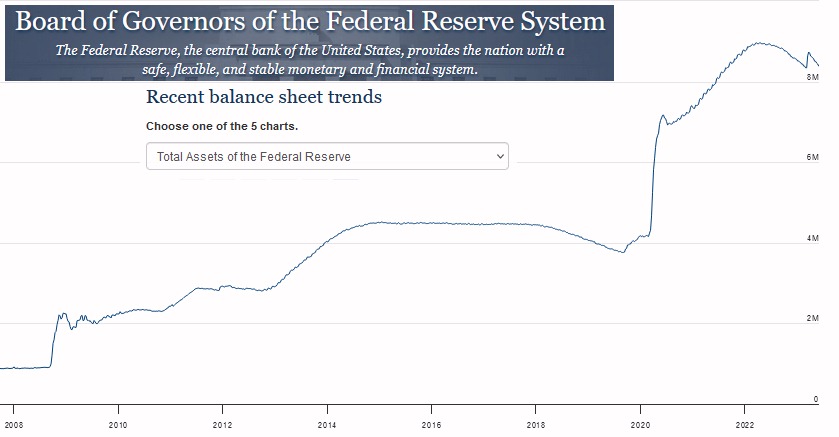
Federal Reserve Balance Sheet Assets

The spike in assets in the Spring of 2023 was due to bank failures. The failing banks had billions of dollars in Treasuries that had lost value due to the rising interest rates. When interest rates go up, the value of existing lower yielding securities goes down. So, the Fed bought the devalued assets at full face value. The Fed may also have intervened in the markets to prop up the price of marketable securities in the open market.

What’s Next?
All of these interventions by the Fed have failed to bring inflation down to an acceptable level. Now the Treasury is going to borrow an addition 1 trillion dollars further increasing the demands on borrowing, interest rates, and the banking system. In fact, anything further the Fed does may stoke inflation. If the Fed buys more Treasuries, interest rates will be subsidized lower stimulating inflation. It will in effect be the same as printing money. Rising interest rates will increase the National Debt. Increasing the National Debt will raise interest rates. It is a vicious circle.

While our fiscal and monetary mess is unraveling, the costs of climate change are growing exponentially. Included in the debt ceiling suspension is a provision for unlimited emergency federal spending. Unfortunately this means that the government can continue to ignore the causes of climate change and instead give trillion dollar subsidies to the fossil fuel industry through emergency disaster relief. Yes, another vicious circle — more fossil fuels subsidies result in more climate catastrophes… resulting in more fossil fuel subsidies, etc. The end result will be additional trillions in government borrowing while the standard of living declines.

Recommendations
Given the above, our outlook and recommendations remain the same — persistent inflation and higher interest rates. Individual investors should max-out their annual I Bonds of up to $10k. Leftover saving should be invested in 4-week and 26-week Treasury bills. At maturity securities should be rolled over for the same length of time UNTIL interest rates peak. At that time, longer maturities should be considered.

BONUS
You can make all your transactions commission free at Treasury Direct. Marketable Treasuries are issued at a discounted rate. That means you get paid your interest in advance (giving you an even higher rate of return.)

The Economic Monsters: Inflation and Interest Rates

  1. Economic Forecast = Inflation (2018)
  2. Inflation Bites (2022)
  3. U.S. Mass Consumption Results in Global Economic Disparity, Inequity, and Poverty (2023)
  4. Investment Recommendation: Savings Bonds / I Bonds
  5. Your National Debt

Business & Economics

bookmark_borderEconomic Update: Inflation, Interest Rates, AI, Consumer Spending, Climate Change, and Fiscal Policy

by Daniel Brouse
February 3, 2023

This article is about the economic conditions up to 2023 and a forecast for the foreseeable future. It helps to understand fiscal and monetary polices prior to reading the following.

In 2022 and 2023, the Federal Reserve raised their interest rates charged to other banks 4.75 percent in an effort to fight inflation. In the later part of 2022, inflation appeared to level-off and start to decline; however, it would be a mistake to think the war is won.

In essence, the short term rise in Fed interest rates is a fiscal facade. In the short term, the rise in Fed rates strengthens the dollar reversing the pressure on real market interest rates. The rise in rates causes inflows of foreign currency dampening the effect on the Treasury’s borrowing costs. At the same time, it makes imported consumer goods cheaper. What the Fed has done with rate hikes so far has not touched the root causes of inflation — lack of immigration/young workers, consumer spending and debt, and government spending and debt.

Unfortunately, the first one — immigration/young workers — appears to have caused a new paradigm. Instead of workers/employment/unemployment causing a wage inflation spiral, AI and robotics are replacing human labor at a rapid rate. Whereas before we thought it would be 20-50 years before impacting economic models, it appears to already be happening. We don’t know the impact yet, but likely this will be good for inflation (eg no wage inflation.) However, it will be devastating to workers’ incomes. Though income inequality will likely be justified, it won’t be a good thing since everyone will earn next to nothing. There are still a few years for this to play out, so downward pressure on wage inflation will not be felt in time for our current fiscal fiasco.

The second part — consumer spending and debt — has been increasing throughout the Fed’s rate rises fueled in part by the stronger dollar. As long as there is strong consumer demand, there are inflationary pressures. The GDP has been increasing to historic highs during the Fed rate rises. The greater the consumer debt the more severe the inevitable recession will be (multiplied by how much technology replaces workers.) In addition, climate change disasters and ill health effects are growing exponentially. Consumer spending and mass consumption through the exploitation of natural resources is the greatest long-term risk to world economics (and human life.)

The last part — government spending and debt – is the real part of the worst to come in the short term. The increase in the price of the dollar has kept marketplace interest rates artificially low. Over the last several years, the government has budgeted huge multi-trillion dollar spending packages. Most of this money has yet to be borrowed and spent (see debt limit crisis.). When the money is borrowed, the price of the dollar will get hammered, and consumers will feel a huge jump in inflation of imported goods. Long term marketplace interest rates will come under severe pressure. The Fed will be forced to buy Treasuries and print money. This is also hugely inflationary. Next, when the money is spent, hundreds of millions of dollars will be pumped into the economy causing a shift in the demand curve for many goods and services. Again, this is biggly inflationary. A microcosm of what’s to come can be seen in the stimulus checks. The 3.2k/person stimulus checks caused this first little bump in inflation we are seeing now. This is just a drop in the bucket compared to the trillions of government stimulus yet to come. There are some Republicans trying to squash the borrowing/spending, but I doubt they will be successful. Soo….

In conclusion, it will be near impossible to curb inflation through monetary policy. The greatest risk to short term world economics is US fiscal policy.

UPDATE: November 9, 2023

Attention armchair economists, investors, and homeowners:
the 30-year Treasury auction was “bad” today
… when I say bad, I mean bad for those not investing in Treasuries.

What does it mean? The government went to borrow money today, and people didn’t want to lend them money. The 30-year interest rate spiked higher. This is because the government is borrowing record amounts of money.

A Double Whammy
This has two negative feedback loops.
1) the higher interest rates mean the government has to borrow more money to make the interest payments… resulting in higher budget deficits… resulting in more borrowing… resulting in higher interest rates, etc.
2) the government is borrowing the current trillions of dollars over the next couple years… but they have yet to spend it… spending the trillions will result in inflation… which will result in higher interest rates… causing a larger deficit… requiring more borrowing, etc.

The Greatest Risks to the US Economy

  1. Climate Change
  2. Government Spending / Debt
  3. Lack of Immigration

Human induced climate change is an exponential component of an unordered system (chaos theory).

The Age of Loss and Damage is a new way of thinking about economics by combining economics, climate science, statistics, and physics. Until now, economic models have been unfit to capture the full extent of climate damage. Traditionally, “integrated assessment models” (IAMs) were used to forecast “shock” events. IAMs use “quadratic function” to calculate GDP losses by squaring the temperature change, yet ignore other methods (such as the exponential function) that are better suited for rapid change. “Climate change is fundamentally different to other shocks because once it has hit, it doesn’t go away,” said Thierry Philipponnat, author of a report by Finance Watch, a Brussels-based public interest NGO on financial issues. “And if the fundamental assumption is flawed, all the rest makes little sense — if any.”

Reuters reported, “Critics say this (IAMs) choice is doomed to underplay the likely impact – particularly if the planet hits environmental tipping points in which damage is not only irreversible but happens at an ever-accelerating rate.” Thierry Philipponnat’s report, Finance in a Hot House World, concludes: “Climate risk is growing to disruptive levels throughout the financial system and the guardians of financial stability urgently need to adapt their tools to regain control.” The report calls for economic models that do not mislead, scenario analyses that prepare the market, and a new prudential tool to address the build-up of systemic climate risk.

Traditional economics is based upon the “costs and benefits” to society. Since there are no known long-term benefits of climate change to society, the Age of Loss and Damage economics focuses on the exponential costs of climate change to society.

Loss and damage litigation against oil companies and governments will change world economics.

In the spring of 2023, the USA suspended their national debt ceiling. Included in the debt ceiling suspension is a provision for unlimited emergency federal spending. The result is the government can continue to ignore the causes of climate change and instead give trillion-dollar subsidies to the fossil fuel industry through emergency disaster relief. Yes, another vicious circle — more fossil fuels subsidies result in more climate catastrophes resulting in more fossil fuel subsidies, etc. The end result will be additional trillions in government borrowing while the standard of living declines.

According to NOAA, in 2023 (as of November 8), there have been 25 confirmed weather/climate disaster events with losses exceeding $1 billion each to affect United States. These events included 1 drought event, 2 flooding events, 19 severe storm events, 1 tropical cyclone event, 1 wildfire event, and 1 winter storm event. This is the largest number of climate disasters recorded with a notable increase in extreme precipitation events (violent rain).

Meanwhile, the US politicians also fail to address the declining and aging population. By restricting immigration, the government is forcing the acceleration of AI and robotics technology. Although this is great for “productivity”, neither AI nor robots pay taxes. The US economy is based on population growth. Increased emergency spending and a declining tax base results in insolvency.

ALSO SEE: The Economic Monsters: Inflation and Interest Rates

UPDATE 2024: Economic Facts on Immigration, Budget Deficits and Inflation

Business, Finance, and Economics

bookmark_borderFinancial Risks From Climate Change

A New York Times Report on Federal Reserve Bank of San Francisco

* Home values could fall significantly.

* Banks could stop lending to flood-prone communities.

* Towns could lose the tax money they need to build sea walls and other protections.

* Volatility related to climate change has become “increasingly relevant” as a consideration for the central bank.

The Full Federal Reserve Report
Volume 14 , Issue 1, 2019Community DevelopmentINNOVATION REVIEW

climeate-change-risk-federal-reserve