The Federal Reserve chairman was questioned in Congress today about the potential impacts of the ‘Chevron Decision’ on the Fed. Although he mentioned that it was too early to determine the full effects, he acknowledged that numerous frivolous lawsuits could become a significant hindrance. This uncertainty clearly poses challenges for the future stability of our economy. It was not a reassuring day for economic prospects.
The Chevron Decision refers to the landmark Supreme Court case Chevron U.S.A., Inc. v. Natural Resources Defense Council, Inc. (1984). This decision established the principle of judicial deference to administrative agencies’ interpretations of ambiguous statutes that they administer. The ruling essentially meant that courts should defer to agencies’ expertise unless their interpretations are unreasonable.
However, recent shifts in judicial philosophy and subsequent rulings, often termed “Chevron deference rollback,” seek to limit this deference. This change could significantly impact how agencies, including the Federal Reserve, operate.
Here’s how the erosion of Chevron deference could result in lawsuits every time the Federal Reserve makes a decision:
1. Increased Legal Challenges
Without Chevron deference, every decision or rule made by the Federal Reserve that involves interpreting ambiguous statutes could be more easily challenged in court. Previously, courts would defer to the Fed’s expertise, but now, they might feel more empowered to overrule the Fed’s interpretations. This invites more lawsuits from parties who disagree with the Fed’s decisions.
2. Reduced Predictability and Stability
Chevron deference provided a level of predictability and stability, as agencies knew their interpretations would likely be upheld if reasonable. With this predictability diminished, every decision becomes a potential legal battleground. This can disrupt the consistency and effectiveness of the Fed’s policies, as they could be constantly tied up in litigation.
3. Resource Strain
The Federal Reserve would likely face a significant increase in legal challenges, requiring more resources to defend its decisions in court. This could divert time, money, and effort away from its primary functions of managing monetary policy, regulating banks, and ensuring financial stability.
4. Policy Hesitation
Knowing that decisions could be frequently overturned, the Fed might become more hesitant or conservative in its policy-making. This could stifle innovation and responsiveness in addressing economic issues, as the fear of legal repercussions might outweigh the need for proactive measures.
Example Scenario
Imagine the Federal Reserve decides to implement a new regulation on bank capital requirements based on its interpretation of an ambiguous provision in the Dodd-Frank Act. Without Chevron deference, banks could challenge this interpretation in court, arguing that the Fed overstepped its authority. If the court agrees, the regulation could be struck down, leading to regulatory uncertainty and potentially undermining financial stability.
Conclusion
The potential rollback of Chevron deference could expose the Federal Reserve to frequent lawsuits over its interpretive decisions, hampering its ability to effectively manage the economy. This shift could lead to a more contentious and litigious regulatory environment, challenging the Fed’s authority and efficiency.
Chevron Deference Rollback and the Environment
In June 2024, the Supreme Court significantly expanded its authority and severely curtailed the Environmental Protection Agency’s (EPA) ability to enforce environmental protection laws. This ruling represents a dramatic shift in the balance of power, undermining decades of regulatory progress aimed at mitigating environmental damage and climate change. The court’s decision essentially nullifies the EPA’s mandate to regulate emissions and enforce compliance with existing environmental standards.
This judicial overreach is viewed by many as an act of arrogance and ignorance, resulting in a scenario where “worst-case” predictions for climate change have become the “best-case” expectations. The ramifications of this decision are dire, prompting a revision of climate models to reflect a much grimmer outlook. The new projections indicate a potential maximum global temperature increase of 9°C within this century, a stark rise from the previously estimated 4°C over the next millennium.
Such an unprecedented increase in global temperatures would push Earth toward a wet-bulb temperature threshold that is incompatible with human life. Wet-bulb temperature, which combines heat and humidity, represents a critical limit beyond which the human body can no longer effectively cool itself through perspiration, leading to potentially fatal heat stress.
Attention armchair economists, investors, and homeowners:
the 30-year Treasury auction was “bad” today
… when I say bad, I mean bad for those not investing in Treasuries.
What does it mean? The government went to borrow money today, and people didn’t want to lend them money. The 30-year interest rate spiked higher. This is because the government is borrowing record amounts of money.
A Double Whammy
This has two negative feedback loops.
1) the higher interest rates mean the government has to borrow more money to make the interest payments… resulting in higher budget deficits… resulting in more borrowing… resulting in higher interest rates, etc.
2) the government is borrowing the current trillions of dollars over the next couple years… but they have yet to spend it… spending the trillions will result in inflation… which will result in higher interest rates… causing a larger deficit… requiring more borrowing, etc.
The Greatest Risks to the US Economy
Climate Change
Government Spending / Debt
Lack of Immigration
Human induced climate change is an exponential component of an unordered system (chaos theory).
The Age of Loss and Damage is a new way of thinking about economics by combining economics, climate science, statistics, and physics. Until now, economic models have been unfit to capture the full extent of climate damage. Traditionally, “integrated assessment models” (IAMs) were used to forecast “shock” events. IAMs use “quadratic function” to calculate GDP losses by squaring the temperature change, yet ignore other methods (such as the exponential function) that are better suited for rapid change. “Climate change is fundamentally different to other shocks because once it has hit, it doesn’t go away,” said Thierry Philipponnat, author of a report by Finance Watch, a Brussels-based public interest NGO on financial issues. “And if the fundamental assumption is flawed, all the rest makes little sense — if any.”
Reuters reported, “Critics say this (IAMs) choice is doomed to underplay the likely impact – particularly if the planet hits environmental tipping points in which damage is not only irreversible but happens at an ever-accelerating rate.” Thierry Philipponnat’s report, Finance in a Hot House World, concludes: “Climate risk is growing to disruptive levels throughout the financial system and the guardians of financial stability urgently need to adapt their tools to regain control.” The report calls for economic models that do not mislead, scenario analyses that prepare the market, and a new prudential tool to address the build-up of systemic climate risk.
Traditional economics is based upon the “costs and benefits” to society. Since there are no known long-term benefits of climate change to society, the Age of Loss and Damage economics focuses on the exponential costs of climate change to society.
Real Estate and Infrastructure
A warmer world will present widespread challenges across many aspects of food-energy-water security and economic development. Infrastructure including roads, bridges, sewer and water plants will become unsustainable. Personal property will suffer loss and damage as homeowners and flood insurance become increasingly difficult to obtain.
In October of 2023 Dr. Sidd Mukherjee said, “Now I am thinking the violent rain will be a bigger problem before we die… still thinking it through. In the long run, yes, sea level rise will hit big. If you look at the history, it is episodic, and in the fast bits it can go up 3 feet every twenty years for five hundred years. But, the rain intensity is increasing faster today, and drainage cannot cope, whether in the city or out, culverts and such put in over the last hundred years cannot handle. So, I am paying a lot of attention to terrain and drainage far inland from the seacoast (like Ohio.) By drainage I don’t mean just human built. I mean that the natural streams and gullies and ravines have not evolved to a state that can handle the water volumes we see and the worse, larger volumes we will see. So expect huger erosion, steeper slopes to waterways, land collapses and such. Build out your drainage.”
In the spring of 2023, the USA suspended their national debt ceiling. Included in the debt ceiling suspension is a provision for unlimited emergency federal spending. The result is the government can continue to ignore the causes of climate change and instead give trillion-dollar subsidies to the fossil fuel industry through emergency disaster relief. Yes, another vicious circle — more fossil fuels subsidies result in more climate catastrophes resulting in more fossil fuel subsidies, etc. The end result will be additional trillions in government borrowing while the standard of living declines.
According to NOAA, in 2023 (as of November 8), there have been 25 confirmed weather/climate disaster events with losses exceeding $1 billion each to affect United States. These events included 1 drought event, 2 flooding events, 19 severe storm events, 1 tropical cyclone event, 1 wildfire event, and 1 winter storm event. This is the largest number of climate disasters recorded with a notable increase in extreme precipitation events (violent rain).
Meanwhile, the US politicians also fail to address the declining and aging population. By restricting immigration, the government is forcing the acceleration of AI and robotics technology. Although this is great for “productivity”, neither AI nor robots pay taxes. The US economy is based on population growth. Increased emergency spending and a declining tax base results in insolvency.
This article is about the economic conditions up to 2023 and a forecast for the foreseeable future. It helps to understand fiscal and monetary polices prior to reading the following.
In 2022 and 2023, the Federal Reserve raised their interest rates charged to other banks 4.75 percent in an effort to fight inflation. In the later part of 2022, inflation appeared to level-off and start to decline; however, it would be a mistake to think the war is won.
In essence, the short term rise in Fed interest rates is a fiscal facade. In the short term, the rise in Fed rates strengthens the dollar reversing the pressure on real market interest rates. The rise in rates causes inflows of foreign currency dampening the effect on the Treasury’s borrowing costs. At the same time, it makes imported consumer goods cheaper. What the Fed has done with rate hikes so far has not touched the root causes of inflation — lack of immigration/young workers, consumer spending and debt, and government spending and debt.
Unfortunately, the first one — immigration/young workers — appears to have caused a new paradigm. Instead of workers/employment/unemployment causing a wage inflation spiral, AI and robotics are replacing human labor at a rapid rate. Whereas before we thought it would be 20-50 years before impacting economic models, it appears to already be happening. We don’t know the impact yet, but likely this will be good for inflation (eg no wage inflation.) However, it will be devastating to workers’ incomes. Though income inequality will likely be justified, it won’t be a good thing since everyone will earn next to nothing. There are still a few years for this to play out, so downward pressure on wage inflation will not be felt in time for our current fiscal fiasco.
The second part — consumer spending and debt — has been increasing throughout the Fed’s rate rises fueled in part by the stronger dollar. As long as there is strong consumer demand, there are inflationary pressures. The GDP has been increasing to historic highs during the Fed rate rises. The greater the consumer debt the more severe the inevitable recession will be (multiplied by how much technology replaces workers.) In addition, climate change disasters and ill health effects are growing exponentially. Consumer spending and mass consumption through the exploitation of natural resources is the greatest long-term risk to world economics (and human life.)
The last part — government spending and debt – is the real part of the worst to come in the short term. The increase in the price of the dollar has kept marketplace interest rates artificially low. Over the last several years, the government has budgeted huge multi-trillion dollar spending packages. Most of this money has yet to be borrowed and spent (see debt limit crisis.). When the money is borrowed, the price of the dollar will get hammered, and consumers will feel a huge jump in inflation of imported goods. Long term marketplace interest rates will come under severe pressure. The Fed will be forced to buy Treasuries and print money. This is also hugely inflationary. Next, when the money is spent, hundreds of millions of dollars will be pumped into the economy causing a shift in the demand curve for many goods and services. Again, this is biggly inflationary. A microcosm of what’s to come can be seen in the stimulus checks. The 3.2k/person stimulus checks caused this first little bump in inflation we are seeing now. This is just a drop in the bucket compared to the trillions of government stimulus yet to come. There are some Republicans trying to squash the borrowing/spending, but I doubt they will be successful. Soo….
In conclusion, it will be near impossible to curb inflation through monetary policy. The greatest risk to short term world economics is US fiscal policy.
UPDATE: November 9, 2023
Attention armchair economists, investors, and homeowners:
the 30-year Treasury auction was “bad” today
… when I say bad, I mean bad for those not investing in Treasuries.
What does it mean? The government went to borrow money today, and people didn’t want to lend them money. The 30-year interest rate spiked higher. This is because the government is borrowing record amounts of money.
A Double Whammy
This has two negative feedback loops.
1) the higher interest rates mean the government has to borrow more money to make the interest payments… resulting in higher budget deficits… resulting in more borrowing… resulting in higher interest rates, etc.
2) the government is borrowing the current trillions of dollars over the next couple years… but they have yet to spend it… spending the trillions will result in inflation… which will result in higher interest rates… causing a larger deficit… requiring more borrowing, etc.
The Greatest Risks to the US Economy
Climate Change
Government Spending / Debt
Lack of Immigration
Human induced climate change is an exponential component of an unordered system (chaos theory).
The Age of Loss and Damage is a new way of thinking about economics by combining economics, climate science, statistics, and physics. Until now, economic models have been unfit to capture the full extent of climate damage. Traditionally, “integrated assessment models” (IAMs) were used to forecast “shock” events. IAMs use “quadratic function” to calculate GDP losses by squaring the temperature change, yet ignore other methods (such as the exponential function) that are better suited for rapid change. “Climate change is fundamentally different to other shocks because once it has hit, it doesn’t go away,” said Thierry Philipponnat, author of a report by Finance Watch, a Brussels-based public interest NGO on financial issues. “And if the fundamental assumption is flawed, all the rest makes little sense — if any.”
Reuters reported, “Critics say this (IAMs) choice is doomed to underplay the likely impact – particularly if the planet hits environmental tipping points in which damage is not only irreversible but happens at an ever-accelerating rate.” Thierry Philipponnat’s report, Finance in a Hot House World, concludes: “Climate risk is growing to disruptive levels throughout the financial system and the guardians of financial stability urgently need to adapt their tools to regain control.” The report calls for economic models that do not mislead, scenario analyses that prepare the market, and a new prudential tool to address the build-up of systemic climate risk.
Traditional economics is based upon the “costs and benefits” to society. Since there are no known long-term benefits of climate change to society, the Age of Loss and Damage economics focuses on the exponential costs of climate change to society.
In the spring of 2023, the USA suspended their national debt ceiling. Included in the debt ceiling suspension is a provision for unlimited emergency federal spending. The result is the government can continue to ignore the causes of climate change and instead give trillion-dollar subsidies to the fossil fuel industry through emergency disaster relief. Yes, another vicious circle — more fossil fuels subsidies result in more climate catastrophes resulting in more fossil fuel subsidies, etc. The end result will be additional trillions in government borrowing while the standard of living declines.
According to NOAA, in 2023 (as of November 8), there have been 25 confirmed weather/climate disaster events with losses exceeding $1 billion each to affect United States. These events included 1 drought event, 2 flooding events, 19 severe storm events, 1 tropical cyclone event, 1 wildfire event, and 1 winter storm event. This is the largest number of climate disasters recorded with a notable increase in extreme precipitation events (violent rain).
Meanwhile, the US politicians also fail to address the declining and aging population. By restricting immigration, the government is forcing the acceleration of AI and robotics technology. Although this is great for “productivity”, neither AI nor robots pay taxes. The US economy is based on population growth. Increased emergency spending and a declining tax base results in insolvency.
One of the best investments is Treasury Direct I Bonds. I Bonds’ interest rates are determined by the rate of inflation.
The rate of return on January 11, 2023 is 6.89%.
I Bonds can be purchased directly from the Treasury Department without a middle man, brokerage, or bank. There is no risk of losing your principle investment. They are redeemable after 12 months with three months interest penalty. No penalty after 5 years. The maturity is 30 years. Tax reporting of interest can be deferred until redemption or final maturity. If you use the money for qualified higher education expenses, you may not have to pay tax on the earnings.
In 2006 and 2007, we forecast the impending “great recession”. Our investment advice was to sell all your real estate. If you could not sell it, leverage it to the hilt (so you had your cash out before failure.)
Turned out to be an accurate forecast.
In 2017 and 2018, we are forecasting inflation and rising interest rates. Buy real estate now and lock-in your 30-year interest rates ASAP. [WARNING: Do not buy real estate on or near floodplain. See disclaimer below.] [WARNING: This paper was first published in 2018. Since that time the forecast has reached fruition. It is too late to beat rising interest rates.]
WHY?
* Quantitative Easing and the Troubled Asset Relief Program (TARP) was started during the height of the 2008 financial crisis. In essence, it allowed the Treasury to print money.
* In 2017 Donald Trump started enacting policies that mirrored his personal finances — borrow too much money and don’t plan on paying it back. Mr. Trump has been involved in 6 bankruptcies.
* When the government borrows lots of money without a payback plan, they compete with the private sector to borrow money resulting in a rise in interest rates. This phenomena is known as crowding out (economics). (1)
* President Trump bragged about wage inflation during his State Of The Union (SOTU) address. When wages go up without an increase in productivity, the prices of goods and services inflate.(2)
* “Make America Great Again” policies make the American dollar weak. Tariffs and trade protectionism undermine the value of the dollar and contribute to inflation. (3)
* President Trump replaced the Chairwoman of the Federal Reserve with a new chair who is not an economist. A first in U.S. history.
* Tax cuts without spending cuts result in a budget deficit. The nation’s debt is now bigger than its gross domestic product. Net interest payments on the debt are estimated to total $276.2 billion this fiscal year, or 6.8% of all federal outlays. The tax cuts are expected to make this payment explode.
* The Federal Reserves primary weapon for fighting inflation is to raise interest rates. (4)
You could say inflation and rising interest rates are a two-headed monster. When the government creates money, it is “inflationary.” The government fights inflation by raising interest rates. Rising interest rates exponentially increase the national debt. When the government borrows, it competes with consumer borrowing causing interest rates to rise.
The name given to the worst-case scenario is hyper-inflation. We don’t expect hyperinflation in the US in the near future; however, higher interest rates in the US will result in hyperinflation in other parts of the world. (See Part III below.)
WARNING: Do not buy real estate on or near floodplain.
Do not invest in real estate that is located near floodplain. Make sure your property has land ingress and egress from the closest 1,000-year-floodplain. Do not invest in any property located near a coast. Do not invest in a property that is below sea level. Do not invest in real estate located in Florida.
“Mostly stay away from the coasts because of both wind and rain issues from weather systems spinning inland. Even if you are not in a floodplain, a couple feet of rain in a day will cut off roads and overwhelm your sump pumps. Not to speak of wind taking power and telecom down.” — Sidd Mukerhjee (February 5, 2018)
NOTES
(1) “In economics, crowding out is argued by some economists to be a phenomenon that occurs when increased government involvement in a sector of the market economy substantially affects the remainder of the market, either on the supply or demand side of the market.
One type frequently discussed is when expansionary fiscal policy reduces investment spending by the private sector. The Government is “crowding out” investment because it is demanding more Loanable Funds and it is increasing interest rates from the borrowing, but that was broadened to multiple channels that might leave total output little changed or smaller.” — Olivier Jean Blanchard (2008) “crowding out,” The New Palgrave Dictionary of Economics, 2nd Edition. Abstract and Roger W. Spencer & William P. Yohe, 1970. “The ‘Crowding Out’ of Private Expenditures by Fiscal Policy Actions,” Federal Reserve Bank of St. Louis Review, October, pp. 12-24
(2) “After years of wage stagnation, we are finally seeing rising wages,” Donald Trump (State of the Union 2018)
“The Employment Cost Index, a measure of salary and benefit costs, registered a 2.6 percent gain for the full year, tied for the best since 2007.” — CNBC (January 31, 2018)
(3) “Recently, Trump levied steep tariffs on imported solar panel technology and washing machines, which immediately boosted prices for U.S. consumers.” — The Hill (February 6, 2018)
(4) “Federal Reserve officials followed through on an expected interest-rate increase and raised their forecast for economic growth in 2018, even as they stuck with a projection for three (rate) hikes in the coming year.
“This change highlights that the committee expects the labor market to remain strong, with sustained job creation, ample opportunities for workers and rising wages,” Chair Janet Yellen told reporters Wednesday in Washington following the decision. In her final scheduled press conference, Yellen noted that her nominated successor, Jerome Powell, has been part of the consensus shaping the Fed’s gradual rate-hike strategy.” — “Fed Raises Rates, Eyes Three 2018 Hikes as Yellen Era Nears End” (December 13, 2017)
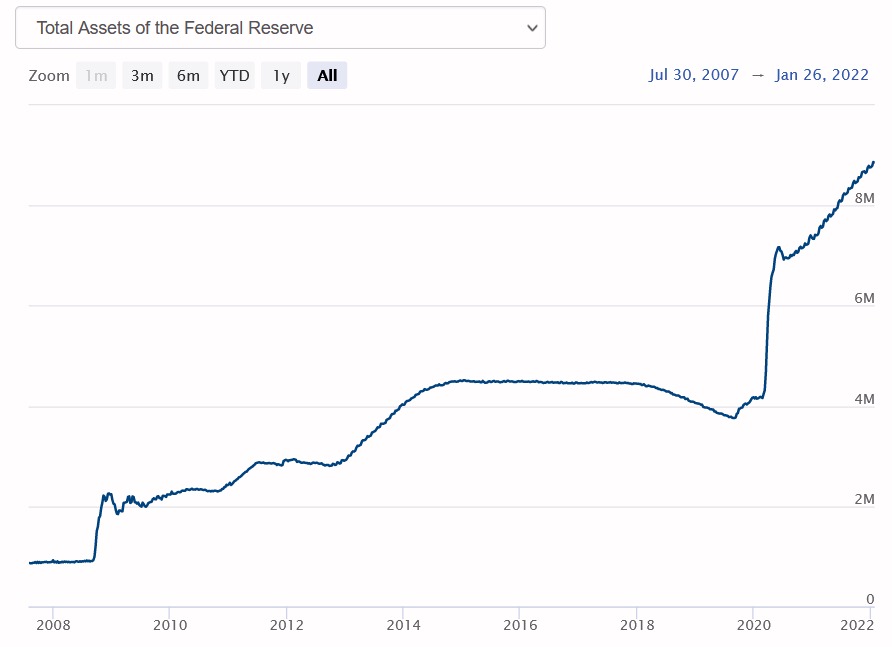
Part II: Inflation Bites
In March of 2020, the global pandemic put the Fed on hold. Then, the Fed reversed course, did not increase rates, and did substantially more (trillions) quantitative easing (see chart below.) In addition, the federal government borrowed trillions of dollars with no repayment plan. A large portion of this money was given to consumers as stimulus. The consumers shifted the demand curve causing a sharp rise in prices. “A demand curve shift refers to fundamental changes in the balance of supply and demand that alter the quantity demanded at the same price,” says The Balance Economic Theory. Consumers continued to spend beyond their means raising consumer debt. “Household debt in the third quarter of 2022, increasing by $351 billion (2.2%) to $16.51 trillion. Balances now stand $2.36 trillion higher than at the end of 2019, before the pandemic recession,” as reported by the Federal Reserve Bank of New York.
UPDATE: January 30, 2022
Inflation has hit 7% — the highest rate in 40 years.
The Fed has signaled that they are:
1) stopping quantitative easing in March
2) raising interest rates in March
Stopping quantitative easing means the Fed will no longer be supporting low Treasury yields by buying bonds. To date, they have bought over 8 trillion in Treasuries and other instruments that undercut interest rates. When the Fed stops buying Treasuries, the demand will go down and rates will go up.
Federal Reserve Balance Sheet 2022
The market has increased their forecast on the Fed raising rates to 4-5 times in 2022. When the Fed raises rates that banks charge each other, the banks charge you higher interest rates.
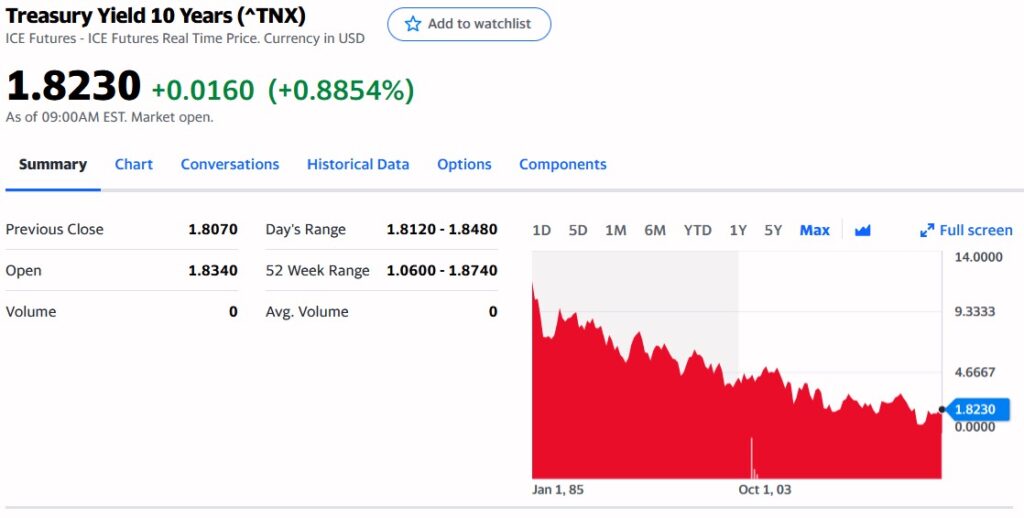
The 10 Year Treasury Note is the best indicator to watch for mortgage interest rates. It will reflect both the ending of quantitative easing and the increase in Fed funds rates. That is to say, if the Fed raises rates 1/4%, mortgage interest rates will likely rise 1/2%. That changes the forecast for mortgage rates in 2022 to rise 2 to 2.5%.
Borrow any long term money today before it is too late. [WARNING: This paper was first published in 2018. Since that time the forecast has reached fruition. It is too late to beat rising interest rates.] After rates rise for the next several years, there will be a recession. So, a long time before you may see conditions like we’ve had for the last 14 years.
10 Year Treasury Notes Interest Rates
Part III: U.S. Mass Consumption Results in Global Economic Disparity, Inequity, and Poverty
In Part I we mention the worst-case inflation scenario is hyper-inflation. We don’t expect hyperinflation in the US in the near future; however, higher interest rates in the US will result in hyperinflation in other parts of the world.
As long as the US Dollar is the world’s reserve currency, it is unlikely that the US will see hyperinflation. The US Congress defines the world’s reserve currency as, “a currency held by central banks in significant quantities. It is widely used to conduct international trade and financial transactions, eliminating the costs of settling transactions involving different currencies.”
When there is inflation in the US, the US Federal Reserve Bank raises interest rates. The rise in US interest rates results in other countries’ investors putting their money in dollar denominated US interest bearing investments. That is to say, foreign investors buy dollars with their home currencies. The result is a widened disparity in the exchange rates between the currencies. The US dollar increases in value and the foreign currency depreciates in value. There is a benefit to the US consumer — imported goods and services are cheaper. The disadvantage to the foreign countries is the dollar disparity causes a much greater rise in their domestic inflation as all their imports experience both the local inflation rate as well the inflation in buying dollars. In an even worse case scenario, the foreign country has debt that has to be repaid in dollars. In essence, their debt is multiplied by a factor equal to the decline in the value of their currency.
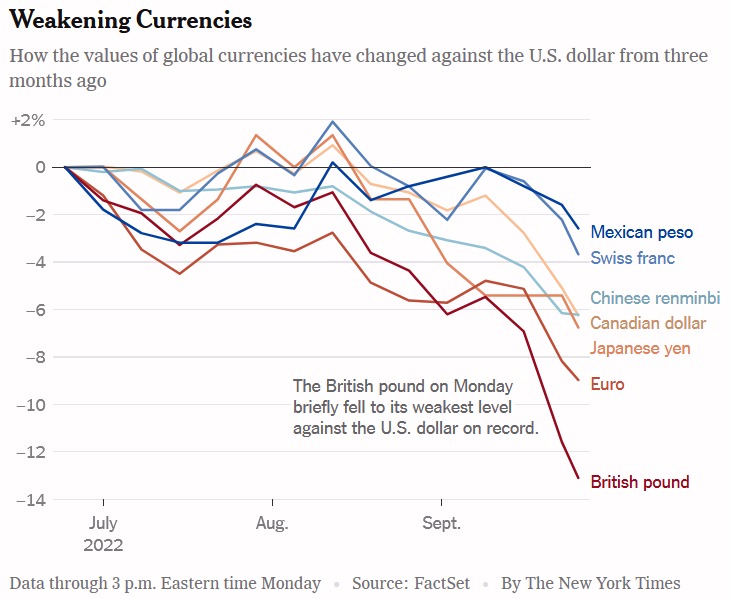
In September of 2022, the New York Times reported, “The Federal Reserve’s determination to crush inflation at home by raising interest rates is inflicting profound pain in other countries — pushing up prices, ballooning the size of debt payments and increasing the risk of a deep recession”
“Those interest rate increases are pumping up the value of the dollar — the go-to currency for much of the world’s trade and transactions — and causing economic turmoil in both rich and poor nations. In Britain and across much of the European continent, the dollar’s acceleration is helping feed stinging inflation.”
Weakening Currencies
Also in September of 2022, the Nikkei Asia reported, “Superstrong dollar threatens debt crisis across emerging economies. Mexico pressured to follow Fed hikes, while Sri Lanka’s repayment costs soar.”
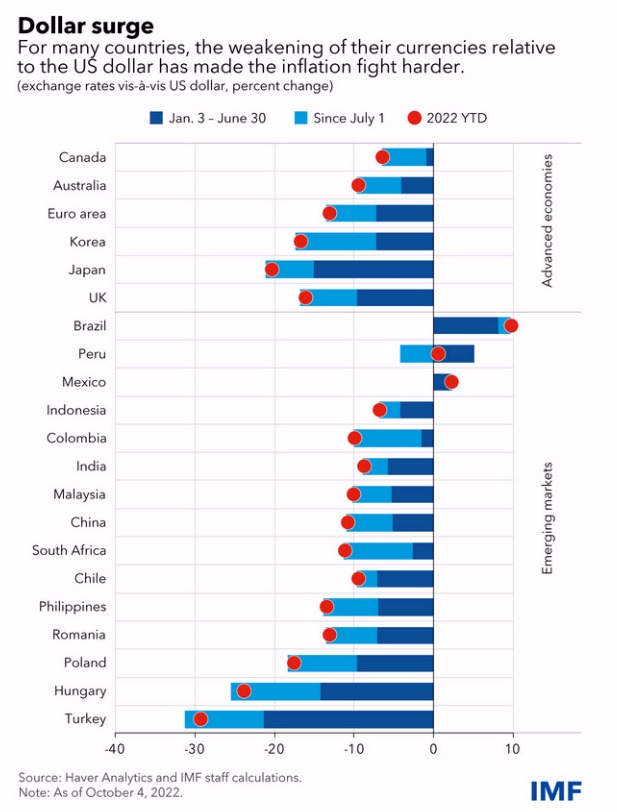
In October of 2022, the IMF reported, “The dollar is at its highest level since 2000, having appreciated 22 percent against the yen, 13 percent against the Euro and 6 percent against emerging market currencies since the start of this year. Such a sharp strengthening of the dollar in a matter of months has sizable macroeconomic implications for almost all countries, given the dominance of the dollar in international trade and finance.”
Dollar Surge
Conclusion
The United States has unsustainable mass consumption. US consumers are destroying the world’s environment and economies. The excessive demand of US consumers has resulted in the exploitation of natural resources, the largest emissions of pollution and greenhouse gases, inflation, currency disparity, and the largest redistribution of wealth in the world. Americans’ mass consumption is responsible for creating the greatest income disparity, wealth inequity, and poverty.