bookmark_borderImmigration and the Wage Inflation Spiral

An important factor in our inflation situation is immigration.

The US has stagnant population growth (as does the UK, EU, etc. Japan has a declining population.)

During the Trump administration, the US drastically curtailed immigration. The Biden administration continues to do so today.

The result has been wage inflation. The wage inflation that started in 2018 began the overall inflation spiral that continues today.

A wage inflation spiral happens when the initial wage inflation is canceled out by the price inflation requiring further wage inflation to keep up with the price inflation… the increase prices require more wage inflation for employees to keep pace with the cost of living… the subsequent rise in wages results in the need to raise prices to pay the workers… and round and round we go.

The solutions are to either increase our population (through immigration) and/or increase our productivity by eliminating the need for humans.

How the Inflation Spiral Started: Immigration
The Trump administration’s policy on immigration and building The Wall have a devastating impact on the economy. The U.S. economy is a capitalistic system based on population growth. The birth rate in America is close to zero percent. In order to maintain the standard of living, the country needs to gain millions of people through immigration. The Trump policies have attempted to eliminate immigration.
— Daniel Brouse (2020)

* “Over the course of four years, the Trump administration set an unprecedented pace for executive action on immigration, enacting 472 administrative changes that dismantled and reconstructed many elements of the U.S. immigration system. Humanitarian protections were severely diminished. The U.S.-Mexico border became more closed off. Immigration enforcement appeared more random. And legal immigration became out of reach for many. All of this was accomplished nearly exclusively by the executive branch, with sweeping presidential proclamations and executive orders, departmental policy guidance, and hundreds of small, technical adjustments.” — Migration Policy Institute’s Four Years of Profound Change (2022>

* “After years of wage stagnation, we are finally seeing rising wages,” Donald Trump (State of the Union 2018)
“The Employment Cost Index, a measure of salary and benefit costs, registered a 2.6 percent gain for the full year, tied for the best since 2007.” — CNBC (January 31, 2018)

* From December of 2020 through January of 2022, nominal wages and salaries were up 4.5 percent, the fastest increase since 1983. — Bureau of Labor Statistics (BLS)

ALSO SEE:
The True Costs (and Benefitlessness) of a Trump Economy
The Economic Monsters: Inflation and Interest Rates

bookmark_borderThe True Costs (and Benefitlessness) of a Trump Economy

January 23, 2020

What are the costs and benefits to the United States under a Trump economy?

Financial Analysis: Current State of Affairs
First, start with a financial analysis — a snapshot of the current economic health of the nation. What would a financial analysis that is similar to an individual applying for a bank loan, or a married couple visiting a financial planner for their retirement plan, look like? What are the assets and liabilities? What type of assets and liabilities are in your portfolio? What are your saving patterns? Did you get a large gift from your parents or have you been showing a strong pattern of saving over time? What is your income? Have you made dubious loans to yourself? Where does your income come from? What is your credit history?

A financial analysis of the U.S.A. results in a failing grade.

Impacts of Fiscal and Monetary Policy
After examining the current state of affairs, examine the fiscal policies of the Executive Branch and the monetary policies pushed onto the Federal Reserve. The Trump administration has taken extremely negative positions with free-trade, as well as, jeopardized the standing of the world reserve currency.

Tariffs
The Trump administration has destroyed the United States leadership in free-trade. Huge taxes were placed upon the American public through the use of tariffs. The tariffs were put on goods and services from around the world and paid for by the American consumer. The placement of tariffs have circumvented congress’ oversight and consumer protection considerations. Not only do tariffs introduce new taxes on the population, they also destroy trade relationships with other countries. That is to say, tariffs and retaliatory tariffs cause foreign countries to look elsewhere for their imports. For example, China’s retaliatory tariffs on agriculture resulted in China developing new trade partnerships that do not include the USA.

Here is a partial list of Trump Tariffs:
Solar panels: 15 – 30%
Washing machines: 16 – 50%
Steel and aluminum: 10 – 25%
Chinese products: 15 – 50%
South Korean products: 25%

More tariffs were placed on India, Canada, Mexico, the European Union and others.

Tariffs not only have a direct impact on U.S. current affairs, but they will leave everlasting damage.

Inflation
The overall Trump economic policy has put the economy at risk of high inflation and interest rates.

Inflation Update: Immigration and the Wage Inflation Spiral (June 12, 2022)
An important factor in the 2022 record inflation situation can be traced back to the Trump immigration policy.

The US has stagnant population growth (as does the UK, EU, etc. Japan has a declining population.)

During the Trump administration, the US drastically curtailed immigration. The Biden administration continues to do so today.

The result has been wage inflation. The wage inflation that started in 2018 began the overall inflation spiral that continues today. A wage inflation spiral happens when the initial wage inflation is canceled out by the price inflation requiring further wage inflation to keep up with the price inflation… the increase prices require more wage inflation for employees to keep pace with the cost of living… the subsequent rise in wages results in the need to raise prices to pay the workers… and round and round we go.

The solutions are to either increase our population (through immigration) and/or increase our productivity by eliminating the need for humans.

How the Inflation Spiral Started: Immigration
The Trump administration’s policy on immigration and building The Wall have a devastating impact on the economy. The U.S. economy is a capitalistic system based on population growth. The birth rate in America is close to zero percent. In order to maintain the standard of living, the country needs to gain millions of people through immigration. The Trump policies have attempted to eliminate immigration.
— Daniel Brouse (2020)

* “Over the course of four years, the Trump administration set an unprecedented pace for executive action on immigration, enacting 472 administrative changes that dismantled and reconstructed many elements of the U.S. immigration system. Humanitarian protections were severely diminished. The U.S.-Mexico border became more closed off. Immigration enforcement appeared more random. And legal immigration became out of reach for many. All of this was accomplished nearly exclusively by the executive branch, with sweeping presidential proclamations and executive orders, departmental policy guidance, and hundreds of small, technical adjustments.” — Migration Policy Institute’s Four Years of Profound Change (2022>

* “After years of wage stagnation, we are finally seeing rising wages,” Donald Trump (State of the Union 2018)
“The Employment Cost Index, a measure of salary and benefit costs, registered a 2.6 percent gain for the full year, tied for the best since 2007.” — CNBC (January 31, 2018)

* From December of 2020 through January of 2022, nominal wages and salaries were up 4.5 percent, the fastest increase since 1983. — Bureau of Labor Statistics (BLS)

World Reserve Currency
“A nation that prints its own currency, and that currency is the world reserve currency, is not threatened by deficits. Until that currency stops being the reserve currency,” said Sidd Mukherjee.

The U.S. dollar as the world reserve currency has given the United States an unfair economic advantage. The U.S. has been able to “print” and borrow money in ways that break the rules of economics; however, the Trump administration has jeopardized the standing of the dollar as the world reserve currency.

The major economic powers of the world entered into a nuclear arms deal with Iran called the Joint Comprehensive Plan of Action (JCPOA). In October of 2017, Trump began pulling out of the agreement. On May 8, 2018, Trump announced the United States withdrawal from JCPOA and declared economic warfare on Iran. The warfare included “tough new sanctions” on Iran. The other countries to the treaty attempted to maintain the JCPOA by developing a new system to by-pass the world reserve currency.

Germany, France and Britain officially set up a European mechanism to facilitate non-dollar trade with Iran, the Instrument in Support of Trade Exchanges (Instex). Russia and other countries have since joined Instex.

Risk Management
The future of the nation is dependent on current risk management. “On the High Risk List; the fragmentation, overlap, and duplication annual report; natural disasters and climate change; and other topics,” reports the General Accounting Office of the USA. Pollution, in particular air pollution, is also a substantial risk. CO2, methane and other greenhouse gases have all increased under the Trump plan. Trump has withdrawn from the Paris Agreement and has consistently called climate change a hoax.

It’s never a good idea to say “never”… but, risk-management-denial always increases the probability of a worse case scenario.

Not only is our nation’s current cash-flow severely hemorrhaging due to extreme weather events (and other costs associated with climate change), but this is just the tip of the iceberg. Climate change denial is risk-management-denial.

Pollution and Climate Change Costs Unsustainable

Trump recently stated, “We have the cleanest air.” This is a boldfaced lie. Air pollution in the form of particulates and ozone are a severe health emergency in the United States.

“According to a 2009 report, around ’60 percent of Americans live in areas where air pollution has reached unhealthy levels that can make people sick.’ Air pollution can cause a variety of health problems including, but not limited to infections, behavioral changes, cancer, organ failure, and even premature death.” (Wikipedia) Air pollution is the number one cause of illness in the world and the second leading cause of death. The cost of air pollution can not be contained by one country — pollution knows no borders. It is estimated 8 million people a year die from air pollution.

A report by Stanford and Carnegie Mellon University states, “Air pollution negatively impacts the U.S. economy, costing the U.S. roughly 5 percent of its yearly gross domestic product (GDP) in damages ($790 billion in 2014). The highest costs come from early deaths, attributable to exposure to fine particulate matter (PM2.5).” The number had been falling up to 2016, but Trump has dramatically undermined clean air laws. As of December 2019, Trump had rolled back 95 environmental protection laws.

Air pollution also contributes to the climate change crisis, and in an exponential feedback loop, climate change contributes to air pollution. For instance, the wildfires in California and Australia were made more severe due to human induced climate change. The wildfires resulted in air pollution that costs billions of dollars in damages, illness and death. The wildfires also contributed to greenhouse gases and climate change that will result in more wildfires.

Though a huge cost, the climate change / air pollution feedback loop is just a small cost of climate change. Not only has the Trump administration not properly assessed the risk of climate change, the administration has undermined efforts to mitigate climate change. Even more brazen, the administration has enacted policies that hasten the devastation of global warming.

The costs of climate change are huge. The Hamilton Project and the Stanford Institute for Economic Policy Research reports, “Damages to the U.S. economy grow with temperature change at an increasing rate.” The Washington Post reports, “Climate change could cost the U.S. economy up to 10.5% of GDP by 2100.” The cost of not adapting to climate change will likely cripple the American economy.

The current costs, the costs of not adapting, and the costs of not preventing climate change are overwhelming to calculate. Take flood insurance as an example. Sea level rise and extreme weather events have redrawn floodmaps and bankrupted the National Flood Insurance Program. What flood insurance that is still available has started a series of exponential increases in premiums. Real estate along the coasts and flood prone areas will become worthless in the coming years.

The other costs associated with the Trump administration’s climate change policy is too long to list.  Fossil fuel elimination and climate change mitigation our essential for risk management.

Immigration and the Acquisition Of Private Property
The Trump administration’s policy on immigration and building The Wall have a devastating impact on the economy. First, the U.S. economy is a capitalistic system based on population growth. The birth rate in America is close to zero percent. In order to maintain the standard of living, the country needs to gain millions of people through immigration. The Trump policies have attempted to eliminate immigration.

Also of a long-term negative impact is the building of The Wall. Funds to build the wall were diverted against the will of congress. The funds were then used to seize private land. The land seizures and The Wall have had a major impact on nature preserves and indigenous sacred grounds. Just as detrimental are the eminent domain acquisitions of individuals’ land. Socialization of private property is an attack on the economic system. The costs to the economy and freedom are not quantifiable.

Income Inequality
The Trump administration’s policies have widened the economic divide and income inequality in the United States.  Trump said, “inequality is down.” The next day federal data was released and the Washington Post reported, “The separation between rich and poor from 2017 and 2018 was greater than it has ever been.”

“Wages are up, and inequality is down. Something that people don’t like writing about.” Trump said during a press conference following the United Nations General Assembly meeting in New York. Again, this is not true. The Economic Policy Institute reports, “Slow wage growth is a key sign of how far the U.S. economy remains from a full recovery. Nominal wage growth since the recovery officially began in mid-2009 has been low and flat.”

BENEFITS
There have not been any real benefits from Trump policies. Some people try to point to employment and tax cuts.

Employment
Employment and unemployment numbers became irrelevant as an economic indicator in the 1990’s. The internet and the worldwide web transformed the definition of employment. In addition, you would need to deduct all the jobs lost through the elimination of most temporary work visas. Many of these jobs have not been filled, especially in agriculture, horticulture and hospitality. Billions of dollars in wages and taxes have been eliminated through the Trump immigration policy. These numbers are not included in employment figures.

During the fourth quarter of 2016, 7.6 million people were unemployed. At the end of 2018, 9.0 million people remained unemployed. Yet, Trump claims to have created 5 million new jobs. Do the math.

In January 2020, Trump boasted at a campaign rally in Wildwood, NJ that “factory jobs were the best ever in the history of the United States.” Reuters reported, U.S. factory sector in deepest slump in more than 10 years. “The U.S. manufacturing sector fell into its deepest slump in more than a decade in December as the U.S.-China trade war kept a lid on factory output, orders and employment…. The Institute for Supply Management (ISM) said its index of national factory activity fell to 47.2 last month from 48.1 in November. It was the lowest reading since June 2009 and, coupled with readings for both new orders and factory employment at multi-year lows, thwarted expectations for a leveling off in the pace of decline in a sector buffeted by trade tensions. ”

Tax Cuts
The only beneficial tax cut that has been made by the administration was to lower corporate taxes. Corporate profits are already taxed as income to shareholders. The corporate tax is double taxation. A fair tax policy would not have corporate taxation. However, the other Trump trade and tax policies’ negative impacts far outweigh the positive impact of a reduction in corporate tax rates.

But, What About Obama?
Obama increased the national debt by about $1 trillion/year. Trump is increasing the national debt by about $1 trillion/year. What makes Trump worse than Obama — Trump is suppose to be a fiscally conservative Republican. Obama wasn’t suppose to be. So, for that reason, Trump’s deceit makes it worse than Obama. Trump is not stopping the problem. Worse yet, he is contributing to the problem at the same rate as Obama, as well as, putting the future economy at risk through bad trade and environmental policies. Trump is trying to con the American public into a false narrative on the economy.  In fact, this is not “the best economy ever. Rather, it is the worst economy ever.

Morning Brew reported, U.S. Budget Deficit to Exceed $1 Trillion in 2020. “The U.S. budget deficit will top $1 trillion this year, according to a new report from the nonpartisan Congressional Budget Office (CBO). What that means: The government will spend $1.02 trillion more than it collects in 2020. The widening deficit is a result of the 2017 tax cuts and an increase in spending on federal programs.”

By 2020, the debt to GDP ratio hit its highest level ever at 125%.

Conclusion
The national debt is unsustainable. The debt, risk-management-denial, deceit, nationalism, and greed will sink our ship.


ABOUT THE AUTHOR
The responsibility an economist accepts is to determine the “costs and benefits of our actions on society.” Then, attempt to convert the difference into dollars. Is economics opinion? That depends on your value of the costs and benefits of your actions on society.
bookmark_borderThe Economic Monsters: Inflation and Interest Rates

Economist

  1. Economic Forecast = Inflation (2018)
  2. Inflation Bites (2022)
  3. U.S. Mass Consumption Results in Global Economic Disparity, Inequity, and Poverty (2023)
  4. Investment Recommendation: Savings Bonds / I Bonds (2023)
  5. Your National Debt (2023)
  6. Economic Facts on Immigration, Budget Deficits and Inflation (2024)
  7. The Federal Reserve and the Chevron Decision (2024)
  8. Drill, Baby, Drill: The Existential Threat of Trump Economics (2024)
  9. The National Debt and the Printing of Money (2024)

Part I: Economic Forecast = Inflation

In 2006 and 2007, we forecast the impending “great recession”. Our investment advice was to sell all your real estate. If you could not sell it, leverage it to the hilt (so you had your cash out before failure.)

Turned out to be an accurate forecast.

In 2017 and 2018, we are forecasting inflation and rising interest rates. Buy real estate now and lock-in your 30-year interest rates ASAP. [WARNING: Do not buy real estate on or near floodplain. See disclaimer below.] [WARNING: This paper was first published in 2018. Since that time the forecast has reached fruition. It is too late to beat rising interest rates.]

WHY?

* Quantitative Easing and the Troubled Asset Relief Program (TARP) was started during the height of the 2008 financial crisis. In essence, it allowed the Treasury to print money.

* In 2017 Donald Trump started enacting policies that mirrored his personal finances — borrow too much money and don’t plan on paying it back. Mr. Trump has been involved in 6 bankruptcies.

* When the government borrows lots of money without a payback plan, they compete with the private sector to borrow money resulting in a rise in interest rates. This phenomena is known as crowding out (economics). (1)

* President Trump bragged about wage inflation during his State Of The Union (SOTU) address. When wages go up without an increase in productivity, the prices of goods and services inflate.(2)

* “Make America Great Again” policies make the American dollar weak. Tariffs and trade protectionism undermine the value of the dollar and contribute to inflation. (3)

* President Trump replaced the Chairwoman of the Federal Reserve with a new chair who is not an economist. A first in U.S. history.

* Tax cuts without spending cuts result in a budget deficit. The nation’s debt is now bigger than its gross domestic product. Net interest payments on the debt are estimated to total $276.2 billion this fiscal year, or 6.8% of all federal outlays. The tax cuts are expected to make this payment explode.

* The Federal Reserves primary weapon for fighting inflation is to raise interest rates. (4)

You could say inflation and rising interest rates are a two-headed monster. When the government creates money, it is “inflationary.” The government fights inflation by raising interest rates. Rising interest rates exponentially increase the national debt. When the government borrows, it competes with consumer borrowing causing interest rates to rise.

The name given to the worst-case scenario is hyper-inflation. We don’t expect hyperinflation in the US in the near future; however, higher interest rates in the US will result in hyperinflation in other parts of the world. (See Part III below.)

WARNING: Do not buy real estate on or near floodplain.
Do not invest in real estate that is located near floodplain. Make sure your property has land ingress and egress from the closest 1,000-year-floodplain. Do not invest in any property located near a coast. Do not invest in a property that is below sea level. Do not invest in real estate located in Florida.

“Mostly stay away from the coasts because of both wind and rain issues from weather systems spinning inland. Even if you are not in a floodplain, a couple feet of rain in a day will cut off roads and overwhelm your sump pumps. Not to speak of wind taking power and telecom down.” — Sidd Mukerhjee (February 5, 2018)

For more information on Flood Insurance please see “Who Pays For Flood Insurance?“

NOTES
(1) “In economics, crowding out is argued by some economists to be a phenomenon that occurs when increased government involvement in a sector of the market economy substantially affects the remainder of the market, either on the supply or demand side of the market.

One type frequently discussed is when expansionary fiscal policy reduces investment spending by the private sector. The Government is “crowding out” investment because it is demanding more Loanable Funds and it is increasing interest rates from the borrowing, but that was broadened to multiple channels that might leave total output little changed or smaller.” — Olivier Jean Blanchard (2008) “crowding out,” The New Palgrave Dictionary of Economics, 2nd Edition. Abstract and Roger W. Spencer & William P. Yohe, 1970. “The ‘Crowding Out’ of Private Expenditures by Fiscal Policy Actions,” Federal Reserve Bank of St. Louis Review, October, pp. 12-24

(2) “After years of wage stagnation, we are finally seeing rising wages,” Donald Trump (State of the Union 2018)
“The Employment Cost Index, a measure of salary and benefit costs, registered a 2.6 percent gain for the full year, tied for the best since 2007.” — CNBC (January 31, 2018)

(3) “Recently, Trump levied steep tariffs on imported solar panel technology and washing machines, which immediately boosted prices for U.S. consumers.” — The Hill (February 6, 2018)

(4) “Federal Reserve officials followed through on an expected interest-rate increase and raised their forecast for economic growth in 2018, even as they stuck with a projection for three (rate) hikes in the coming year.

“This change highlights that the committee expects the labor market to remain strong, with sustained job creation, ample opportunities for workers and rising wages,” Chair Janet Yellen told reporters Wednesday in Washington following the decision. In her final scheduled press conference, Yellen noted that her nominated successor, Jerome Powell, has been part of the consensus shaping the Fed’s gradual rate-hike strategy.” — “Fed Raises Rates, Eyes Three 2018 Hikes as Yellen Era Nears End” (December 13, 2017)


Part II: Inflation Bites

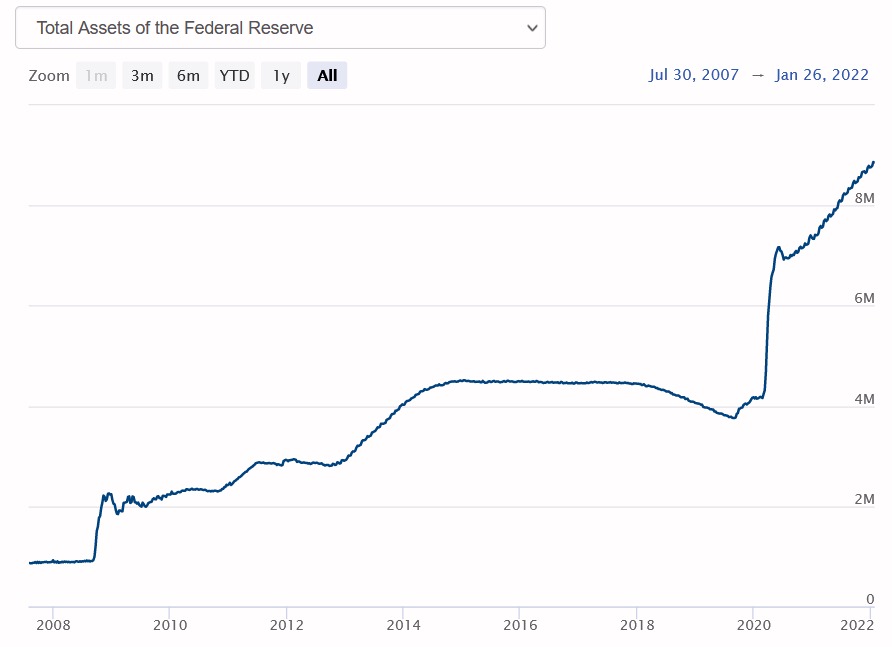
In March of 2020, the global pandemic put the Fed on hold. Then, the Fed reversed course, did not increase rates, and did substantially more (trillions) quantitative easing (see chart below.) In addition, the federal government borrowed trillions of dollars with no repayment plan. A large portion of this money was given to consumers as stimulus. The consumers shifted the demand curve causing a sharp rise in prices. “A demand curve shift refers to fundamental changes in the balance of supply and demand that alter the quantity demanded at the same price,” says The Balance Economic Theory. Consumers continued to spend beyond their means raising consumer debt. “Household debt in the third quarter of 2022, increasing by $351 billion (2.2%) to $16.51 trillion. Balances now stand $2.36 trillion higher than at the end of 2019, before the pandemic recession,” as reported by the Federal Reserve Bank of New York.

UPDATE: January 30, 2022
Inflation has hit 7% — the highest rate in 40 years.

The Fed has signaled that they are:
1) stopping quantitative easing in March
2) raising interest rates in March

Stopping quantitative easing means the Fed will no longer be supporting low Treasury yields by buying bonds. To date, they have bought over 8 trillion in Treasuries and other instruments that undercut interest rates. When the Fed stops buying Treasuries, the demand will go down and rates will go up.

Federal Reserve Balance Sheet 2022

The market has increased their forecast on the Fed raising rates to 4-5 times in 2022. When the Fed raises rates that banks charge each other, the banks charge you higher interest rates.

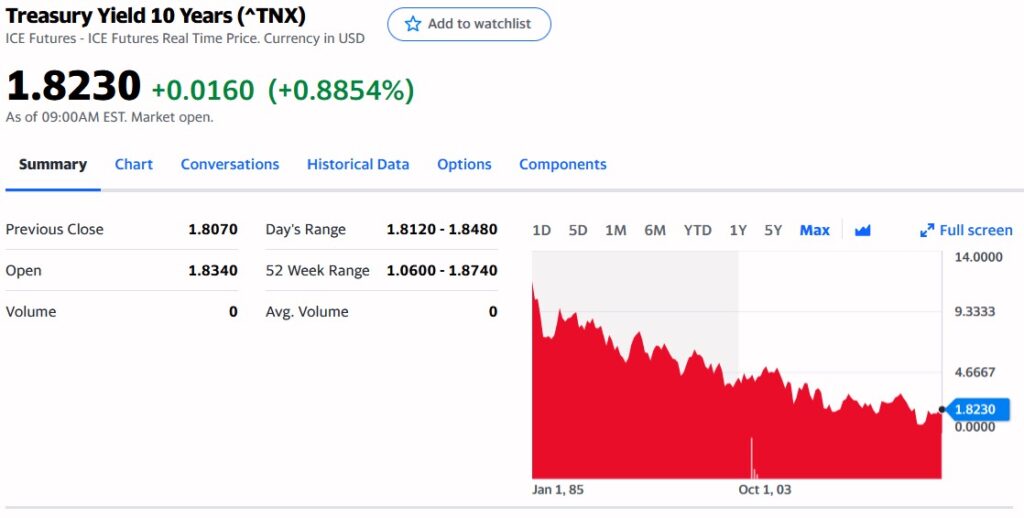
The 10 Year Treasury Note is the best indicator to watch for mortgage interest rates. It will reflect both the ending of quantitative easing and the increase in Fed funds rates. That is to say, if the Fed raises rates 1/4%, mortgage interest rates will likely rise 1/2%. That changes the forecast for mortgage rates in 2022 to rise 2 to 2.5%.

Borrow any long term money today before it is too late. [WARNING: This paper was first published in 2018. Since that time the forecast has reached fruition. It is too late to beat rising interest rates.] After rates rise for the next several years, there will be a recession. So, a long time before you may see conditions like we’ve had for the last 14 years.

10 Year Treasury Notes Interest Rates


Part III: U.S. Mass Consumption Results in Global Economic Disparity, Inequity, and Poverty

In Part I we mention the worst-case inflation scenario is hyper-inflation. We don’t expect hyperinflation in the US in the near future; however, higher interest rates in the US will result in hyperinflation in other parts of the world.

As long as the US Dollar is the world’s reserve currency, it is unlikely that the US will see hyperinflation. The US Congress defines the world’s reserve currency as, “a currency held by central banks in significant quantities. It is widely used to conduct international trade and financial transactions, eliminating the costs of settling transactions involving different currencies.”

When there is inflation in the US, the US Federal Reserve Bank raises interest rates. The rise in US interest rates results in other countries’ investors putting their money in dollar denominated US interest bearing investments. That is to say, foreign investors buy dollars with their home currencies. The result is a widened disparity in the exchange rates between the currencies. The US dollar increases in value and the foreign currency depreciates in value. There is a benefit to the US consumer — imported goods and services are cheaper. The disadvantage to the foreign countries is the dollar disparity causes a much greater rise in their domestic inflation as all their imports experience both the local inflation rate as well the inflation in buying dollars. In an even worse case scenario, the foreign country has debt that has to be repaid in dollars. In essence, their debt is multiplied by a factor equal to the decline in the value of their currency.

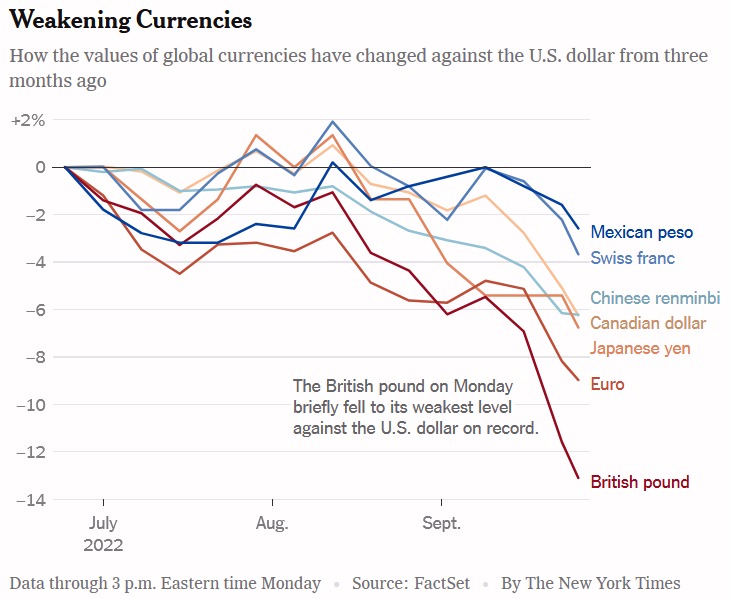
In September of 2022, the New York Times reported, “The Federal Reserve’s determination to crush inflation at home by raising interest rates is inflicting profound pain in other countries — pushing up prices, ballooning the size of debt payments and increasing the risk of a deep recession”

“Those interest rate increases are pumping up the value of the dollar — the go-to currency for much of the world’s trade and transactions — and causing economic turmoil in both rich and poor nations. In Britain and across much of the European continent, the dollar’s acceleration is helping feed stinging inflation.”

Weakening Currencies

Also in September of 2022, the Nikkei Asia reported, “Superstrong dollar threatens debt crisis across emerging economies. Mexico pressured to follow Fed hikes, while Sri Lanka’s repayment costs soar.”

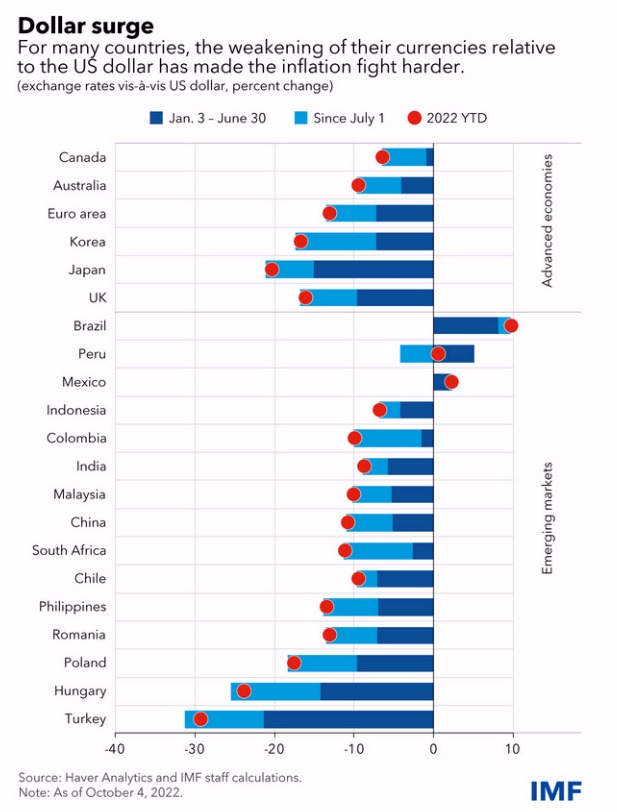
In October of 2022, the IMF reported, “The dollar is at its highest level since 2000, having appreciated 22 percent against the yen, 13 percent against the Euro and 6 percent against emerging market currencies since the start of this year. Such a sharp strengthening of the dollar in a matter of months has sizable macroeconomic implications for almost all countries, given the dominance of the dollar in international trade and finance.”

Dollar Surge
Dollar Surge

Conclusion

The United States has unsustainable mass consumption. US consumers are destroying the world’s environment and economies. The excessive demand of US consumers has resulted in the exploitation of natural resources, the largest emissions of pollution and greenhouse gases, inflation, currency disparity, and the largest redistribution of wealth in the world. Americans’ mass consumption is responsible for creating the greatest income disparity, wealth inequity, and poverty.

Part V: Your National Debt (2023)

ALSO SEE: Immigration and the Wage Inflation Spiral
Anthropologic Climate Change and Pollution

Business, Finance, and Economics

bookmark_borderProof Of Russian Hacks in U.S. Election

GRIZZLY STEPPE – Russian Malicious Cyber Activity

Original release date: December 29, 2016

Russian attacks on the 2016 election were detected by many sources in early 2016. The Department of Homeland Security published the proof on December 29, 2016.

Additional Documentation on Russian Malicious Cyber Activity

Overview

On October 7, 2016, the Department Of Homeland Security (DHS) and the Office of the Director of National Intelligence (DNI) issued a joint statement on election security compromises. DHS has released a Joint Analysis Report (JAR) attributing those compromises to Russian malicious cyber activity, designated as GRIZZLY STEPPE.

The JAR package offers technical details regarding the tools and infrastructure used by Russian civilian and military intelligence services (RIS). Accompanying CSV and STIX format files of the indicators, and an enhanced analysis of GRIZZLY STEPPE activity is available:

  • GRIZZLY STEPPE Indicators (CSV)
  • GRIZZLY STEPPE Indicators (STIX xml)
  • AR-17-20045: Enhanced Analysis of GRIZZLY STEPPE Activity (PDF)

DHS recommends that network administrators review JAR-16-20296.pdf for more information and implement the recommendations provided.

EVIDENCE OF RUSSIAN INTERFERENCE IN US ELECTION: Enhanced_Analysis_of_GRIZZLY_STEPPE_ActivityPDF

Joint Statement from the Department Of Homeland Security and Office of the Director of National Intelligence on Election Security

Release Date:
October 7, 2016

For Immediate Release
DHS Press Office
Contact: 202-282-8010

The U.S. Intelligence Community (USIC) is confident that the Russian Government directed the recent compromises of e-mails from US persons and institutions, including from US political organizations. The recent disclosures of alleged hacked e-mails on sites like DCLeaks.com and WikiLeaks and by the Guccifer 2.0 online persona are consistent with the methods and motivations of Russian-directed efforts. These thefts and disclosures are intended to interfere with the US election process. Such activity is not new to Moscow—the Russians have used similar tactics and techniques across Europe and Eurasia, for example, to influence public opinion there. We believe, based on the scope and sensitivity of these efforts, that only Russia’s senior-most officials could have authorized these activities.

Some states have also recently seen scanning and probing of their election-related systems, which in most cases originated from servers operated by a Russian company. However, we are not now in a position to attribute this activity to the Russian Government. The USIC and the Department of Homeland Security (DHS) assess that it would be extremely difficult for someone, including a nation-state actor, to alter actual ballot counts or election results by cyber attack or intrusion. This assessment is based on the decentralized nature of our election system in this country and the number of protections state and local election officials have in place. States ensure that voting machines are not connected to the Internet, and there are numerous checks and balances as well as extensive oversight at multiple levels built into our election process.

Nevertheless, DHS continues to urge state and local election officials to be vigilant and seek cybersecurity assistance from DHS. A number of states have already done so. DHS is providing several services to state and local election officials to assist in their cybersecurity. These services include cyber “hygiene” scans of Internet-facing systems, risk and vulnerability assessments, information sharing about cyber incidents, and best practices for securing voter registration databases and addressing potential cyber threats. DHS has convened an Election Infrastructure Cybersecurity Working Group with experts across all levels of government to raise awareness of cybersecurity risks potentially affecting election infrastructure and the elections process. Secretary Johnson and DHS officials are working directly with the National Association of Secretaries of State to offer assistance, share information, and provide additional resources to state and local officials.