There is a prevailing myth or conspiracy theory that suggests hourly workers’ wages are negatively impacted by the high compensation packages of CEOs and other corporate executives. This myth can be debunked for several reasons:
1. Hourly Wages Are Not Suppressed by Executive Pay
In the current economy, the minimum wage has little to do with actual hourly wages, which are often higher. For example, in the Greater Philadelphia Region, the average hourly wages for various entry-level positions are as follows:
Janitors: Approximately $17.26 per hour.
Fast Food Workers: Around $15.45 per hour.
Grocery Store Employees: This category includes various roles such as cashiers, stock clerks, and other support staff, averaging about $14-$16 per hour depending on specific job functions and experience.
These figures demonstrate that market conditions, not executive pay, dictate wage levels for hourly workers.
2. Hourly Wages Rising Faster Than Inflation
For the 12 months between May 2023 and May 2024, hourly wages rose faster than inflation, indicating that worker compensation is improving in real terms. This counters the narrative that executive pay stifles wage growth for the average worker.
3. Executive Compensation and Its Impact on Corporate Budgets
Much of what is termed as “excessive executive compensation” does not directly affect corporate budgets or worker compensation. Executives are often compensated with stock options provided by shareholders. This process, known as “share dilution,” involves issuing additional stock, which reduces the ownership proportion of current shareholders but does not directly take from corporate revenues.
Moreover, executive compensation through stock options can positively impact hourly wages and employment numbers. Stock options only gain value if the company grows, aligning executives’ interests with those of the company and its workers. Growth often leads to increased wages and employment as the company expands.
Case Study: Tesla Shareholder Suit Against Elon Musk
A prime example of high executive compensation can be seen in the Tesla shareholders’ suit against Elon Musk in Delaware. The court ruled that Tesla’s board had conflicts of interest and failed to properly disclose the compensation plan’s details. Despite these issues, an additional shareholder vote favored Musk’s pay package, showing confidence in his leadership. This decision came even amid slumping sales and a drop in stock price, indicating that shareholders believe in the long-term growth potential under Musk’s guidance.
In summary, the idea that high executive compensation negatively impacts hourly wages is a misconception. Market conditions and company growth drive wages, and executive compensation strategies often align the interests of executives with those of workers and the company.
The two major contributors to today’s inflation that a President can influence are insufficient immigration and federal budget deficits. Both Trump and Biden administrations have played significant roles in these issues.
Through May of 2024, average hourly wage growth has exceeded inflation for 12 straight months.
Economic Facts on Inflation and Wage Inflation
Current Impacts of Wage Inflation
1. Increased Consumer Prices: Wage inflation leads to higher costs for businesses, which often pass these costs onto consumers in the form of higher prices for goods and services. This contributes to overall inflation, affecting the purchasing power of consumers.
Consumer Price Index (CPI): Rising wages can lead to an increase in the Consumer Price Index, a measure of the average change over time in the prices paid by urban consumers for a market basket of consumer goods and services. When wages increase significantly, the CPI often follows suit.
Examples: Recent data has shown significant price increases in various sectors, including food, housing, and healthcare, driven in part by higher labor costs .
2. Business Profit Margins: Higher wages can squeeze profit margins for businesses, particularly in labor-intensive industries. Companies may face challenges in maintaining profitability if they cannot pass the increased costs onto consumers.
Impact on Small Businesses: Small businesses, which often operate with thinner profit margins, may struggle more than larger corporations to absorb the increased costs associated with wage inflation. This can lead to reduced hiring or even business closures in extreme cases .
Corporate Responses: Larger corporations might respond by investing in automation and technology to reduce dependency on human labor, thereby mitigating the impact of wage inflation on their bottom lines .
3. Employment and Job Market Dynamics: Wage inflation can have mixed effects on the job market. While higher wages can attract more workers and reduce turnover, they can also lead to cost-cutting measures such as layoffs or reduced hiring.
Job Cuts and Automation: Some businesses may reduce their workforce or turn to automation to manage increased labor costs. This can result in job losses or slower job growth in certain sectors .
Labor Force Participation: On the positive side, higher wages can draw more individuals into the labor force, potentially reducing unemployment rates and increasing overall economic productivity .
4. Economic Inequality: Wage inflation can impact income inequality in various ways. While higher wages can improve living standards for low- and middle-income workers, the overall benefits may be unevenly distributed.
Living Wage Increases: Efforts to raise the minimum wage or provide living wages can significantly benefit low-income workers, improving their economic stability and reducing poverty levels .
Disparities: However, wage inflation can exacerbate disparities if high-wage sectors see more significant increases compared to low-wage sectors, potentially widening the gap between high and low earners .
Economics of Immigration and Wage Inflation
1. Wage Inflation as a Driver of Overall Inflation: Wage inflation occurs when wages increase, leading to higher costs for businesses, which often pass these costs onto consumers through higher prices for goods and services. This process contributes to overall inflation, which is the rate at which the general level of prices for goods and services rises.
Impact on Businesses: When wages increase, businesses face higher labor costs. To maintain profitability, they may increase the prices of their products or services, contributing to inflation.
Consumer Purchasing Power: As prices rise, the purchasing power of consumers can decrease unless wage growth keeps pace with inflation. This dynamic can create a cycle where higher wages lead to higher prices, which then necessitate further wage increases.
2. Insufficient Immigration as a Contributor to Wage Inflation: Immigration plays a critical role in the labor market by providing a supply of workers that can help meet demand in various industries. When immigration levels are insufficient, it can lead to labor shortages, which in turn drive up wages as employers compete for a limited pool of workers.
Labor Market Dynamics: A decrease in immigration can exacerbate labor shortages in key industries such as agriculture, construction, and healthcare. This shortage forces employers to offer higher wages to attract and retain workers.
Economic Growth: Insufficient immigration can limit economic growth by restricting the labor force available to support business expansion and innovation. This constraint can lead to increased costs for businesses and higher prices for consumers.
Sources and Further Reading:
Wage Inflation and Its Impact:
Federal Reserve Bank of San Francisco. (2022). “Wage Growth and Inflation: Insights from Economic Research.”
U.S. Bureau of Labor Statistics. (2023). “Wage Growth and Its Implications for Inflation.”
Immigration and Labor Market:
National Bureau of Economic Research. (2021). “The Effects of Immigration on the United States Economy.”
Pew Research Center. (2022). “U.S. Immigration Trends and Workforce Impact.”
Expanded Explanation
Wage Inflation as a Top Driver of Overall Inflation:
Economic Theory: According to the cost-push inflation theory, when wages rise, production costs for companies increase. These companies, in turn, raise prices to maintain profit margins, leading to higher overall inflation.
Historical Context: Historical data shows periods where wage increases have led to significant inflationary pressures, such as during the 1970s in the United States, a time characterized by high inflation and wage growth.
Insufficient Immigration and Its Role in Wage Inflation:
Labor Supply: Immigration contributes to the labor supply, particularly in sectors that rely heavily on immigrant workers. When immigration is restricted, these sectors face labor shortages, pushing wages higher.
Economic Integration: Immigrants often take jobs that are complementary to those held by native-born workers, enhancing productivity and economic growth. Insufficient immigration can disrupt this balance, leading to inefficiencies and higher costs.
Policy Implications: Policies that restrict immigration can have unintended consequences on the labor market and inflation. Understanding the balance between immigration and wage dynamics is crucial for policymakers aiming to manage inflation and economic growth effectively.
By examining these factors, it becomes clear that both wage inflation and immigration policies play significant roles in shaping the economic landscape, influencing both inflation and broader economic performance.
How Federal Budget Deficits Impact Inflation
The federal budget deficit has increased under both Trump and Biden due to a combination of tax cuts, increased spending, and the economic impact of the COVID-19 pandemic. While Trump’s administration saw a significant increase in the deficit due to tax cuts and pandemic relief measures, Biden’s administration has continued high levels of spending on recovery and infrastructure.
1. Increased Aggregate Demand: Federal budget deficits typically occur when government spending exceeds revenue. This increased government spending can boost aggregate demand in the economy, leading to higher prices if the economy is operating near or at full capacity.
Demand-Pull Inflation: When government expenditures increase, it injects more money into the economy. If this additional demand outstrips the economy’s ability to produce goods and services, it can lead to demand-pull inflation, where the overall demand in the economy exceeds the supply, causing prices to rise .
2. Higher Interest Rates: To finance a budget deficit, the government often borrows money by issuing bonds. This increased demand for borrowing can drive up interest rates, as the government competes with the private sector for available funds.
Crowding Out Effect: Higher interest rates can make borrowing more expensive for businesses and consumers, potentially leading to reduced investment and spending in the private sector. This can mitigate some of the inflationary pressures but can also slow economic growth .
3. Money Supply and Monetary Policy: If the central bank (e.g., the Federal Reserve in the United States) accommodates the deficit by increasing the money supply, this can lead to inflation. An increased money supply can reduce the value of money, causing prices to rise.
Monetary Policy Response: Central banks may respond to fiscal deficits by tightening monetary policy, such as raising interest rates to combat inflation. This can help control inflation but may also slow down economic growth .
4. Inflation Expectations: Persistent budget deficits can influence inflation expectations. If businesses and consumers expect higher future inflation due to continued deficit spending, they may adjust their behavior accordingly, such as demanding higher wages or increasing prices.
Expectations and Behavior: Inflation expectations can become self-fulfilling. If workers expect higher inflation, they might demand higher wages, leading businesses to raise prices to cover these higher costs, thus perpetuating inflation .
The Economic Monsters: Inflation and Interest Rates
I Economic Forecast = Inflation (2018)
II Inflation Bites (2022)
III U.S. Mass Consumption Results in Global Economic Disparity, Inequity, and Poverty (2023)
IV Investment Recommendation: Savings Bonds / I Bonds (2023)
Part V: Your National Debt
The federal government currently has $31.83 trillion in federal debt. So, what does that mean to you?
Some economists say it doesn’t mean anything. As long as the U.S. dollar remains the world’s reserve currency, the federal government can spend without limit. Other economists disagree.
Here is what to watch for: 1. a declining influence of the dollar as the world reserve currency
The dollar has been falling out of favor with many world economies. The dollar has also been sanctioned to be used by many countries and companies. Though efforts by groups like BRICS (Brazil, Russia, India, China, and South Africa) to form their own reserve currency will likely fail, the overall dependency on the dollar is weakening. The dollar will not be able to go on with “business as usual”.
2. the amount of debt (bills, notes, bonds) being sold by the Treasury
In 2023, Congress suspended the debt ceiling. During the April – June 2023 quarter and the Treasury said, “Treasury expects to borrow $726 billion in privately-held net marketable debt, assuming an end-of-June cash balance of $550 billion. The borrowing estimate is $449 billion higher than announced in January 2023.” Now that the debt ceiling has been suspended the Treasury is staring a $1tn borrowing drive. The trillion-dollar borrowing spree will have many impacts. For instance The Financial Times reports, “analysts fear scale of new issuance following debt ceiling fight will push up yields and suck cash out of deposits.” As investors pull their savings out of bank accounts and put it into high yielding Treasuries, this will put an added burden on the already struggling banking sector and further put into play the role of the Federal Reserve.
3. the amount of national debt being bought by the Federal Reserve
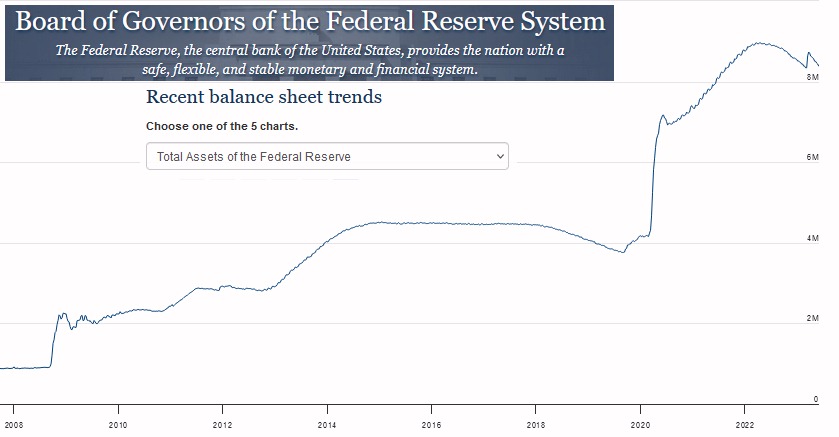
What will the Federal Reserve do? In the Spring of 2022, the Fed said they would not only stop buying Treasuries, but they would also start selling their Treasury assets. Initially, the Fed said the inflation was transitory. They were wrong. In order to fight inflation, the Fed needed to raise interest rates and reduce their assets (Treasuries). The Federal Reserve really shouldn’t be holding assets in the first place. During the financial crisis of 2007-2014, the Federal Reserve started buying trillions of dollars of assets including Treasury securities. Then during the COVID financial crisis, the Fed bought trillions more. In 2022, the Fed did stop buying Treasuries and as the securities matured, the Fed did not participate in as many Treasury rollovers. (Treasury rollover describes the process by which principal payments from maturing Treasury securities held by the SOMA are reinvested in newly auctioned securities.) However, in the graph below you see a sudden uptick in 2023.
Federal Reserve Balance Sheet Assets
The spike in assets in the Spring of 2023 was due to bank failures. The failing banks had billions of dollars in Treasuries that had lost value due to the rising interest rates. When interest rates go up, the value of existing lower yielding securities goes down. So, the Fed bought the devalued assets at full face value. The Fed may also have intervened in the markets to prop up the price of marketable securities in the open market.
What’s Next?
All of these interventions by the Fed have failed to bring inflation down to an acceptable level. Now the Treasury is going to borrow an addition 1 trillion dollars further increasing the demands on borrowing, interest rates, and the banking system. In fact, anything further the Fed does may stoke inflation. If the Fed buys more Treasuries, interest rates will be subsidized lower stimulating inflation. It will in effect be the same as printing money. Rising interest rates will increase the National Debt. Increasing the National Debt will raise interest rates. It is a vicious circle.
While our fiscal and monetary mess is unraveling, the costs of climate change are growing exponentially. Included in the debt ceiling suspension is a provision for unlimited emergency federal spending. Unfortunately this means that the government can continue to ignore the causes of climate change and instead give trillion dollar subsidies to the fossil fuel industry through emergency disaster relief. Yes, another vicious circle — more fossil fuels subsidies result in more climate catastrophes… resulting in more fossil fuel subsidies, etc. The end result will be additional trillions in government borrowing while the standard of living declines.
Recommendations
Given the above, our outlook and recommendations remain the same — persistent inflation and higher interest rates. Individual investors should max-out their annual I Bonds of up to $10k. Leftover saving should be invested in 4-week and 26-week Treasury bills. At maturity securities should be rolled over for the same length of time UNTIL interest rates peak. At that time, longer maturities should be considered.
BONUS
You can make all your transactions commission free at Treasury Direct. Marketable Treasuries are issued at a discounted rate. That means you get paid your interest in advance (giving you an even higher rate of return.)
The Economic Monsters: Inflation and Interest Rates
This article is about the economic conditions up to 2023 and a forecast for the foreseeable future. It helps to understand fiscal and monetary polices prior to reading the following.
In 2022 and 2023, the Federal Reserve raised their interest rates charged to other banks 4.75 percent in an effort to fight inflation. In the later part of 2022, inflation appeared to level-off and start to decline; however, it would be a mistake to think the war is won.
In essence, the short term rise in Fed interest rates is a fiscal facade. In the short term, the rise in Fed rates strengthens the dollar reversing the pressure on real market interest rates. The rise in rates causes inflows of foreign currency dampening the effect on the Treasury’s borrowing costs. At the same time, it makes imported consumer goods cheaper. What the Fed has done with rate hikes so far has not touched the root causes of inflation — lack of immigration/young workers, consumer spending and debt, and government spending and debt.
Unfortunately, the first one — immigration/young workers — appears to have caused a new paradigm. Instead of workers/employment/unemployment causing a wage inflation spiral, AI and robotics are replacing human labor at a rapid rate. Whereas before we thought it would be 20-50 years before impacting economic models, it appears to already be happening. We don’t know the impact yet, but likely this will be good for inflation (eg no wage inflation.) However, it will be devastating to workers’ incomes. Though income inequality will likely be justified, it won’t be a good thing since everyone will earn next to nothing. There are still a few years for this to play out, so downward pressure on wage inflation will not be felt in time for our current fiscal fiasco.
The second part — consumer spending and debt — has been increasing throughout the Fed’s rate rises fueled in part by the stronger dollar. As long as there is strong consumer demand, there are inflationary pressures. The GDP has been increasing to historic highs during the Fed rate rises. The greater the consumer debt the more severe the inevitable recession will be (multiplied by how much technology replaces workers.) In addition, climate change disasters and ill health effects are growing exponentially. Consumer spending and mass consumption through the exploitation of natural resources is the greatest long-term risk to world economics (and human life.)
The last part — government spending and debt – is the real part of the worst to come in the short term. The increase in the price of the dollar has kept marketplace interest rates artificially low. Over the last several years, the government has budgeted huge multi-trillion dollar spending packages. Most of this money has yet to be borrowed and spent (see debt limit crisis.). When the money is borrowed, the price of the dollar will get hammered, and consumers will feel a huge jump in inflation of imported goods. Long term marketplace interest rates will come under severe pressure. The Fed will be forced to buy Treasuries and print money. This is also hugely inflationary. Next, when the money is spent, hundreds of millions of dollars will be pumped into the economy causing a shift in the demand curve for many goods and services. Again, this is biggly inflationary. A microcosm of what’s to come can be seen in the stimulus checks. The 3.2k/person stimulus checks caused this first little bump in inflation we are seeing now. This is just a drop in the bucket compared to the trillions of government stimulus yet to come. There are some Republicans trying to squash the borrowing/spending, but I doubt they will be successful. Soo….
In conclusion, it will be near impossible to curb inflation through monetary policy. The greatest risk to short term world economics is US fiscal policy.
UPDATE: November 9, 2023
Attention armchair economists, investors, and homeowners:
the 30-year Treasury auction was “bad” today
… when I say bad, I mean bad for those not investing in Treasuries.
What does it mean? The government went to borrow money today, and people didn’t want to lend them money. The 30-year interest rate spiked higher. This is because the government is borrowing record amounts of money.
A Double Whammy
This has two negative feedback loops.
1) the higher interest rates mean the government has to borrow more money to make the interest payments… resulting in higher budget deficits… resulting in more borrowing… resulting in higher interest rates, etc.
2) the government is borrowing the current trillions of dollars over the next couple years… but they have yet to spend it… spending the trillions will result in inflation… which will result in higher interest rates… causing a larger deficit… requiring more borrowing, etc.
The Greatest Risks to the US Economy
Climate Change
Government Spending / Debt
Lack of Immigration
Human induced climate change is an exponential component of an unordered system (chaos theory).
The Age of Loss and Damage is a new way of thinking about economics by combining economics, climate science, statistics, and physics. Until now, economic models have been unfit to capture the full extent of climate damage. Traditionally, “integrated assessment models” (IAMs) were used to forecast “shock” events. IAMs use “quadratic function” to calculate GDP losses by squaring the temperature change, yet ignore other methods (such as the exponential function) that are better suited for rapid change. “Climate change is fundamentally different to other shocks because once it has hit, it doesn’t go away,” said Thierry Philipponnat, author of a report by Finance Watch, a Brussels-based public interest NGO on financial issues. “And if the fundamental assumption is flawed, all the rest makes little sense — if any.”
Reuters reported, “Critics say this (IAMs) choice is doomed to underplay the likely impact – particularly if the planet hits environmental tipping points in which damage is not only irreversible but happens at an ever-accelerating rate.” Thierry Philipponnat’s report, Finance in a Hot House World, concludes: “Climate risk is growing to disruptive levels throughout the financial system and the guardians of financial stability urgently need to adapt their tools to regain control.” The report calls for economic models that do not mislead, scenario analyses that prepare the market, and a new prudential tool to address the build-up of systemic climate risk.
Traditional economics is based upon the “costs and benefits” to society. Since there are no known long-term benefits of climate change to society, the Age of Loss and Damage economics focuses on the exponential costs of climate change to society.
In the spring of 2023, the USA suspended their national debt ceiling. Included in the debt ceiling suspension is a provision for unlimited emergency federal spending. The result is the government can continue to ignore the causes of climate change and instead give trillion-dollar subsidies to the fossil fuel industry through emergency disaster relief. Yes, another vicious circle — more fossil fuels subsidies result in more climate catastrophes resulting in more fossil fuel subsidies, etc. The end result will be additional trillions in government borrowing while the standard of living declines.
According to NOAA, in 2023 (as of November 8), there have been 25 confirmed weather/climate disaster events with losses exceeding $1 billion each to affect United States. These events included 1 drought event, 2 flooding events, 19 severe storm events, 1 tropical cyclone event, 1 wildfire event, and 1 winter storm event. This is the largest number of climate disasters recorded with a notable increase in extreme precipitation events (violent rain).
Meanwhile, the US politicians also fail to address the declining and aging population. By restricting immigration, the government is forcing the acceleration of AI and robotics technology. Although this is great for “productivity”, neither AI nor robots pay taxes. The US economy is based on population growth. Increased emergency spending and a declining tax base results in insolvency.
One of the best investments is Treasury Direct I Bonds. I Bonds’ interest rates are determined by the rate of inflation.
The rate of return on January 11, 2023 is 6.89%.
I Bonds can be purchased directly from the Treasury Department without a middle man, brokerage, or bank. There is no risk of losing your principle investment. They are redeemable after 12 months with three months interest penalty. No penalty after 5 years. The maturity is 30 years. Tax reporting of interest can be deferred until redemption or final maturity. If you use the money for qualified higher education expenses, you may not have to pay tax on the earnings.
An important factor in our inflation situation is immigration.
The US has stagnant population growth (as does the UK, EU, etc. Japan has a declining population.)
During the Trump administration, the US drastically curtailed immigration. The Biden administration continues to do so today.
The result has been wage inflation. The wage inflation that started in 2018 began the overall inflation spiral that continues today.
A wage inflation spiral happens when the initial wage inflation is canceled out by the price inflation requiring further wage inflation to keep up with the price inflation… the increase prices require more wage inflation for employees to keep pace with the cost of living… the subsequent rise in wages results in the need to raise prices to pay the workers… and round and round we go.
The solutions are to either increase our population (through immigration) and/or increase our productivity by eliminating the need for humans.
How the Inflation Spiral Started: Immigration
The Trump administration’s policy on immigration and building The Wall have a devastating impact on the economy. The U.S. economy is a capitalistic system based on population growth. The birth rate in America is close to zero percent. In order to maintain the standard of living, the country needs to gain millions of people through immigration. The Trump policies have attempted to eliminate immigration.
— Daniel Brouse (2020)
* “Over the course of four years, the Trump administration set an unprecedented pace for executive action on immigration, enacting 472 administrative changes that dismantled and reconstructed many elements of the U.S. immigration system. Humanitarian protections were severely diminished. The U.S.-Mexico border became more closed off. Immigration enforcement appeared more random. And legal immigration became out of reach for many. All of this was accomplished nearly exclusively by the executive branch, with sweeping presidential proclamations and executive orders, departmental policy guidance, and hundreds of small, technical adjustments.” — Migration Policy Institute’s Four Years of Profound Change (2022>
* “After years of wage stagnation, we are finally seeing rising wages,” Donald Trump (State of the Union 2018)
“The Employment Cost Index, a measure of salary and benefit costs, registered a 2.6 percent gain for the full year, tied for the best since 2007.” — CNBC (January 31, 2018)
* From December of 2020 through January of 2022, nominal wages and salaries were up 4.5 percent, the fastest increase since 1983. — Bureau of Labor Statistics (BLS)
In 2006 and 2007, we forecast the impending “great recession”. Our investment advice was to sell all your real estate. If you could not sell it, leverage it to the hilt (so you had your cash out before failure.)
Turned out to be an accurate forecast.
In 2017 and 2018, we are forecasting inflation and rising interest rates. Buy real estate now and lock-in your 30-year interest rates ASAP. [WARNING: Do not buy real estate on or near floodplain. See disclaimer below.] [WARNING: This paper was first published in 2018. Since that time the forecast has reached fruition. It is too late to beat rising interest rates.]
WHY?
* Quantitative Easing and the Troubled Asset Relief Program (TARP) was started during the height of the 2008 financial crisis. In essence, it allowed the Treasury to print money.
* In 2017 Donald Trump started enacting policies that mirrored his personal finances — borrow too much money and don’t plan on paying it back. Mr. Trump has been involved in 6 bankruptcies.
* When the government borrows lots of money without a payback plan, they compete with the private sector to borrow money resulting in a rise in interest rates. This phenomena is known as crowding out (economics). (1)
* President Trump bragged about wage inflation during his State Of The Union (SOTU) address. When wages go up without an increase in productivity, the prices of goods and services inflate.(2)
* “Make America Great Again” policies make the American dollar weak. Tariffs and trade protectionism undermine the value of the dollar and contribute to inflation. (3)
* President Trump replaced the Chairwoman of the Federal Reserve with a new chair who is not an economist. A first in U.S. history.
* Tax cuts without spending cuts result in a budget deficit. The nation’s debt is now bigger than its gross domestic product. Net interest payments on the debt are estimated to total $276.2 billion this fiscal year, or 6.8% of all federal outlays. The tax cuts are expected to make this payment explode.
* The Federal Reserves primary weapon for fighting inflation is to raise interest rates. (4)
You could say inflation and rising interest rates are a two-headed monster. When the government creates money, it is “inflationary.” The government fights inflation by raising interest rates. Rising interest rates exponentially increase the national debt. When the government borrows, it competes with consumer borrowing causing interest rates to rise.
The name given to the worst-case scenario is hyper-inflation. We don’t expect hyperinflation in the US in the near future; however, higher interest rates in the US will result in hyperinflation in other parts of the world. (See Part III below.)
WARNING: Do not buy real estate on or near floodplain.
Do not invest in real estate that is located near floodplain. Make sure your property has land ingress and egress from the closest 1,000-year-floodplain. Do not invest in any property located near a coast. Do not invest in a property that is below sea level. Do not invest in real estate located in Florida.
“Mostly stay away from the coasts because of both wind and rain issues from weather systems spinning inland. Even if you are not in a floodplain, a couple feet of rain in a day will cut off roads and overwhelm your sump pumps. Not to speak of wind taking power and telecom down.” — Sidd Mukerhjee (February 5, 2018)
NOTES
(1) “In economics, crowding out is argued by some economists to be a phenomenon that occurs when increased government involvement in a sector of the market economy substantially affects the remainder of the market, either on the supply or demand side of the market.
One type frequently discussed is when expansionary fiscal policy reduces investment spending by the private sector. The Government is “crowding out” investment because it is demanding more Loanable Funds and it is increasing interest rates from the borrowing, but that was broadened to multiple channels that might leave total output little changed or smaller.” — Olivier Jean Blanchard (2008) “crowding out,” The New Palgrave Dictionary of Economics, 2nd Edition. Abstract and Roger W. Spencer & William P. Yohe, 1970. “The ‘Crowding Out’ of Private Expenditures by Fiscal Policy Actions,” Federal Reserve Bank of St. Louis Review, October, pp. 12-24
(2) “After years of wage stagnation, we are finally seeing rising wages,” Donald Trump (State of the Union 2018)
“The Employment Cost Index, a measure of salary and benefit costs, registered a 2.6 percent gain for the full year, tied for the best since 2007.” — CNBC (January 31, 2018)
(3) “Recently, Trump levied steep tariffs on imported solar panel technology and washing machines, which immediately boosted prices for U.S. consumers.” — The Hill (February 6, 2018)
(4) “Federal Reserve officials followed through on an expected interest-rate increase and raised their forecast for economic growth in 2018, even as they stuck with a projection for three (rate) hikes in the coming year.
“This change highlights that the committee expects the labor market to remain strong, with sustained job creation, ample opportunities for workers and rising wages,” Chair Janet Yellen told reporters Wednesday in Washington following the decision. In her final scheduled press conference, Yellen noted that her nominated successor, Jerome Powell, has been part of the consensus shaping the Fed’s gradual rate-hike strategy.” — “Fed Raises Rates, Eyes Three 2018 Hikes as Yellen Era Nears End” (December 13, 2017)
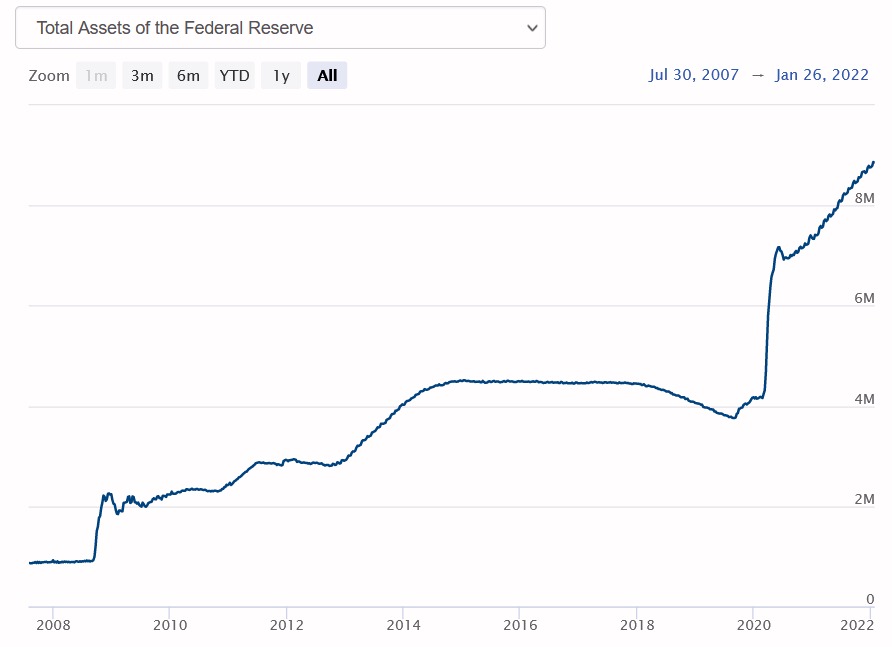
Part II: Inflation Bites
In March of 2020, the global pandemic put the Fed on hold. Then, the Fed reversed course, did not increase rates, and did substantially more (trillions) quantitative easing (see chart below.) In addition, the federal government borrowed trillions of dollars with no repayment plan. A large portion of this money was given to consumers as stimulus. The consumers shifted the demand curve causing a sharp rise in prices. “A demand curve shift refers to fundamental changes in the balance of supply and demand that alter the quantity demanded at the same price,” says The Balance Economic Theory. Consumers continued to spend beyond their means raising consumer debt. “Household debt in the third quarter of 2022, increasing by $351 billion (2.2%) to $16.51 trillion. Balances now stand $2.36 trillion higher than at the end of 2019, before the pandemic recession,” as reported by the Federal Reserve Bank of New York.
UPDATE: January 30, 2022
Inflation has hit 7% — the highest rate in 40 years.
The Fed has signaled that they are:
1) stopping quantitative easing in March
2) raising interest rates in March
Stopping quantitative easing means the Fed will no longer be supporting low Treasury yields by buying bonds. To date, they have bought over 8 trillion in Treasuries and other instruments that undercut interest rates. When the Fed stops buying Treasuries, the demand will go down and rates will go up.
Federal Reserve Balance Sheet 2022
The market has increased their forecast on the Fed raising rates to 4-5 times in 2022. When the Fed raises rates that banks charge each other, the banks charge you higher interest rates.
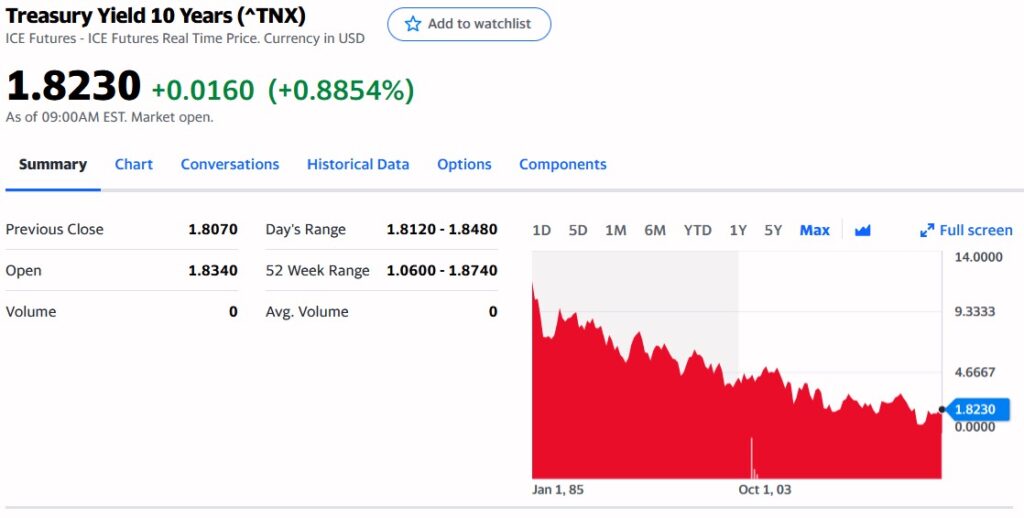
The 10 Year Treasury Note is the best indicator to watch for mortgage interest rates. It will reflect both the ending of quantitative easing and the increase in Fed funds rates. That is to say, if the Fed raises rates 1/4%, mortgage interest rates will likely rise 1/2%. That changes the forecast for mortgage rates in 2022 to rise 2 to 2.5%.
Borrow any long term money today before it is too late. [WARNING: This paper was first published in 2018. Since that time the forecast has reached fruition. It is too late to beat rising interest rates.] After rates rise for the next several years, there will be a recession. So, a long time before you may see conditions like we’ve had for the last 14 years.
10 Year Treasury Notes Interest Rates
Part III: U.S. Mass Consumption Results in Global Economic Disparity, Inequity, and Poverty
In Part I we mention the worst-case inflation scenario is hyper-inflation. We don’t expect hyperinflation in the US in the near future; however, higher interest rates in the US will result in hyperinflation in other parts of the world.
As long as the US Dollar is the world’s reserve currency, it is unlikely that the US will see hyperinflation. The US Congress defines the world’s reserve currency as, “a currency held by central banks in significant quantities. It is widely used to conduct international trade and financial transactions, eliminating the costs of settling transactions involving different currencies.”
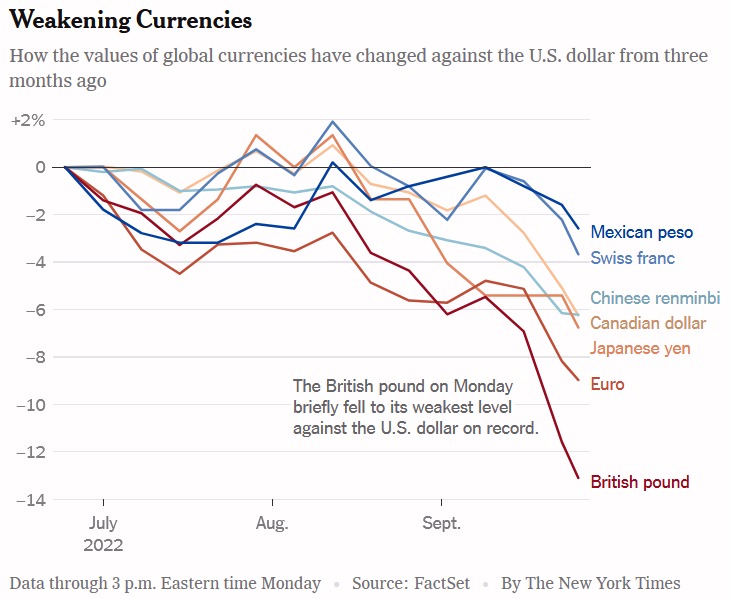
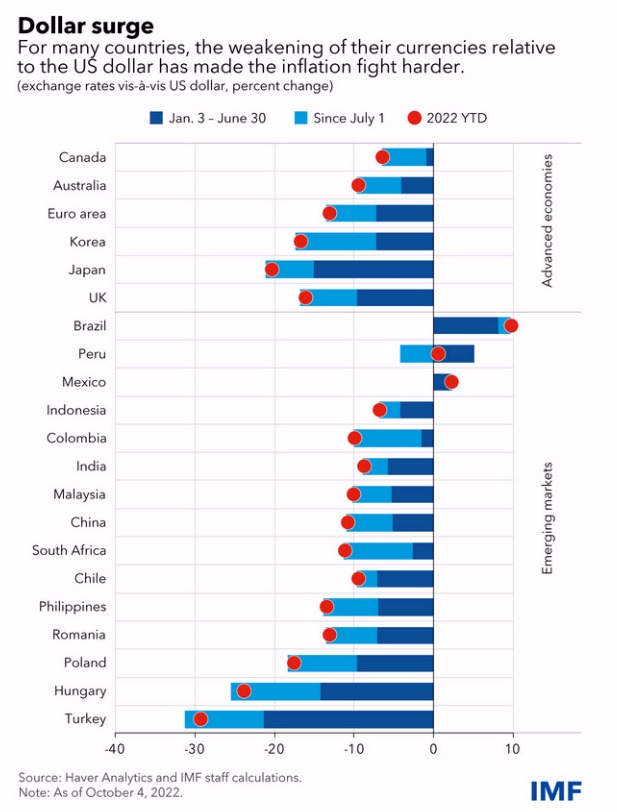
When there is inflation in the US, the US Federal Reserve Bank raises interest rates. The rise in US interest rates results in other countries’ investors putting their money in dollar denominated US interest bearing investments. That is to say, foreign investors buy dollars with their home currencies. The result is a widened disparity in the exchange rates between the currencies. The US dollar increases in value and the foreign currency depreciates in value. There is a benefit to the US consumer — imported goods and services are cheaper. The disadvantage to the foreign countries is the dollar disparity causes a much greater rise in their domestic inflation as all their imports experience both the local inflation rate as well the inflation in buying dollars. In an even worse case scenario, the foreign country has debt that has to be repaid in dollars. In essence, their debt is multiplied by a factor equal to the decline in the value of their currency.
In September of 2022, the New York Times reported, “The Federal Reserve’s determination to crush inflation at home by raising interest rates is inflicting profound pain in other countries — pushing up prices, ballooning the size of debt payments and increasing the risk of a deep recession”
“Those interest rate increases are pumping up the value of the dollar — the go-to currency for much of the world’s trade and transactions — and causing economic turmoil in both rich and poor nations. In Britain and across much of the European continent, the dollar’s acceleration is helping feed stinging inflation.”
Weakening Currencies
Also in September of 2022, the Nikkei Asia reported, “Superstrong dollar threatens debt crisis across emerging economies. Mexico pressured to follow Fed hikes, while Sri Lanka’s repayment costs soar.”
In October of 2022, the IMF reported, “The dollar is at its highest level since 2000, having appreciated 22 percent against the yen, 13 percent against the Euro and 6 percent against emerging market currencies since the start of this year. Such a sharp strengthening of the dollar in a matter of months has sizable macroeconomic implications for almost all countries, given the dominance of the dollar in international trade and finance.”
Dollar Surge
Conclusion
The United States has unsustainable mass consumption. US consumers are destroying the world’s environment and economies. The excessive demand of US consumers has resulted in the exploitation of natural resources, the largest emissions of pollution and greenhouse gases, inflation, currency disparity, and the largest redistribution of wealth in the world. Americans’ mass consumption is responsible for creating the greatest income disparity, wealth inequity, and poverty.