The U.S. economy is the worst in history. There are several measures for the health of an economy. One of the best is the “debt to GDP” ratio. National debt divided by the nation’s gross domestic product = debt to GDP ratio.
During 2019, the nation’s debt to GDP ratio reached a record high (when the Fed’s balance sheet is included.)
Calculation:
23.177 trillion $ 2019 Debt
3.8 trillion $ assets on the Federal Reserve’s balance sheet
_______________
26.977 trillion
/ divided by the GDP
21.439 trillion
_______________
125.83% debt to GDP ratio
One hundred and twenty-five percent is the highest debt to GDP ratio in the history of the United States of America.
When an individual borrows money, their debt to income ratio usually can not exceed 36%. The debt to income ratio is a reliable indicator of the ability to repay a loan. Exceptions are made for young borrowers with likely prospects of wage growth. The growth rate of the US GDP has been flat and is projected to go lower.
When a nation borrows money, the debt to GDP ratio also determines the ability to repay the debt. Therefore, it is safe to say the U.S. is in the worst economic position ever.
It’s not really a good idea to compare the debt to GDP ratio to other countries or periods in time. A better rule of thumb would be a ratio under 40% and preferably close to 0; however, for those that are curious:
Denmark — 35%
Switzerland — 33%
Australia — 47%
China — 47%
UK — 87%
Mozambique — 119%
The USA historically has had a ratio in the 30% range from 1967 through 1984. The last time the ratio came close to today’s 125% was in 1945 – 1947 when the ratio hit 119% due to the effects of WWII, the recession, and President Truman’s economic policies.
Why the Fed’s Balance Sheet is Important
It is very important to include the assets on the Federal Reserve’s balance sheet in the calculation. The reason being — the Fed should not have any assets on its balance sheet. When the Fed buys assets from the Treasury, the government is in fact borrowing the money from itself. The government is “printing” money. The government is competing with the private sector to lend the government money. Interest rates are artificially low due to the lack of competition. Borrowing more money to repay debt is unsustainable.
Worst Economy Ever
The U.S. economy is currently the worst in the nation’s history. At no time in history has our debt + Fed assets / GDP = 125%. The economy is unsustainable.
The U.N. has released a report entitled, “Extreme Weather Continues in 2018 – a Continuing Call to Climate Action”.
Addressing the dangers associated with extreme weather conditions, the Executive Secretary of the UN Climate Change Patricia Espinosa said: “We must keep an eye on the future. As the superstorms and monsoon flooding of last year and the extreme heat and extreme cold of this year show – we still have a long way to go to deliver on the promise of the Paris Climate Change Agreement”.
This year, record warmth was observed across parts of North America, Europe and Asia, as well as the Atlantic, Pacific and Indian Oceans. Record cold May temperatures were limited to northeastern Canada and the northern Atlantic Ocean, off the southern coast of Greenland.
The study published in the journal Nature showed that ice losses from Antarctica are causing sea levels to rise faster today than at any time in the past 25 years. Results of the Ice Sheet Mass Balance Inter-Comparison Exercise (IMBIE).
According to NASA, “Antarctica’s potential contribution to global sea level rise from its land-held ice is almost 7.5 times greater than all other sources of land-held ice in the world combined. The continent stores enough frozen water to raise global sea levels by 190 feet (58 meters), if it were to melt entirely. Knowing how much ice it’s losing is key to understanding the impacts of climate change now and its pace in the future.”
NOAA points to climate change as part of the problem causing the largest wildfires in California.
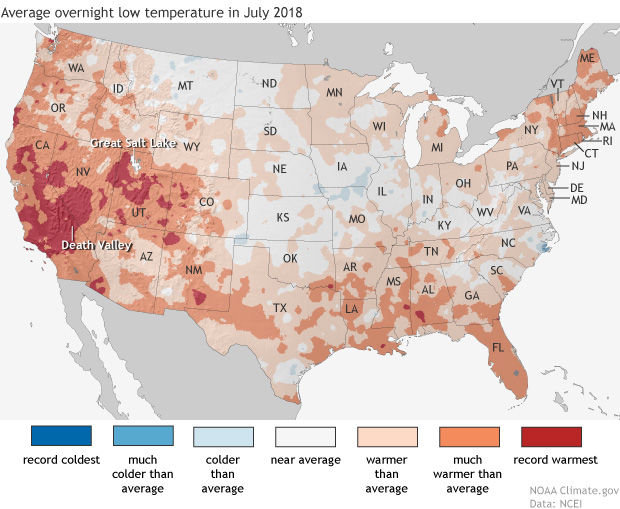
Daytime high temperatures were well above average across much of the western United States in July, but it was overnight low temperatures that were really extreme in large areas of California—where firefighters are battling multiple wildfires—and the Great Basin, and in isolated pockets of Colorado and the Southwest.
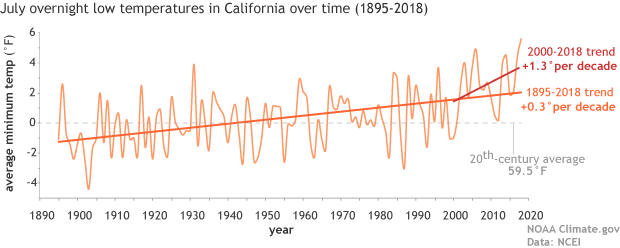
As the NCEI’s Deke Arndt has blogged about before, nighttime low temperatures are increasing faster than daytime high temperatures across most of the contiguous United States. For much of the West and Southwest, July’s record-breaking nighttime heat is a new highpoint in a long-term trend—one that has rapidly accelerated in recent decades. In California, average overnight low temperature in July rose by 0.3°F per decade over the historical record (1895-2018), but since 2000, the pace of warming has accelerated to 1.3°F per decade.
Average July minimum temperatures (overnight lows) in California (light orange line) from 1895–2018. The trend over the historical record is shown in dark orange, and the recent trend (2000-2018) is shown in red. The twentieth-century average is shown with a gray line. NOAA Climate.gov graph, based on data from NCEI’s Climate at a Glance.
According to Tim Brown, director of NOAA’s Western Region Climate Center (WRCC), it’s a pattern that has serious consequences for wildfires and those who combat them. When temperatures cool off overnight, it’s not just a physical relief for firefighters who may be working in conditions that push the limits of human endurance; fire behavior itself relaxes as temperatures drop, winds grow calmer, and relative humidity rises. He explained via email,
Moisture in dead vegetation continuously tries to reach equilibrium with atmospheric moisture. So if nighttime temperature is staying warmer, then the humidity is lower, and the fuels stay drier. A dead fuel moisture reduction of a few percent can increase flammability, flame length, and subsequent overall fire behavior.
When fires remain active at night, it can increase both the time to containment and total burned area, while also affecting public health and safety through more smoke production and lower air quality. Brown says that qualitatively, there seems to be an increase in firefighters’ reports of active nighttime fire behavior since around 2000. He and other researchers are currently investigating whether that relationship can be confirmed quantitatively.
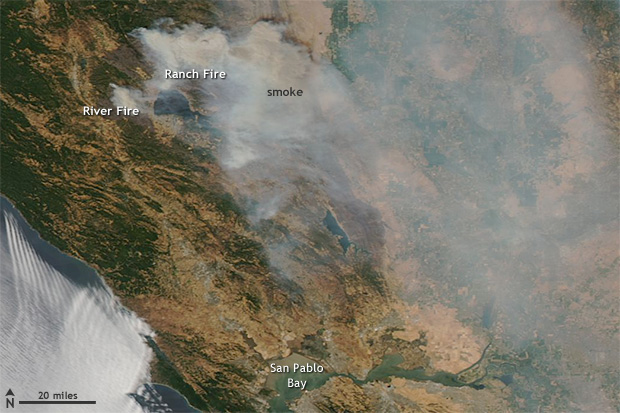
NASA Aqua satellite image of the Ranch and River Fires in Northern California on August 6, 2018, with a pall of smoke spreading to the east. These fires are part of the Mendocino Complex Fire, which has become the largest fire in California history. Extreme fire activity in the state was exacerbated by record-warm overnight low temperatures in July. Image from NASA Worldview website.
Nighttime warming has consequences for other aspects of public health. WRCC climatologist Nina Oakley pointed out via email that the South Coast region of California is experiencing the largest warming trends in nighttime temperatures, according to an environmental health hazard report from the California Environmental Protection Agency. In many communities in the region, air conditioning—rarely needed in the past—is uncommon. In addition, since 2000, heat waves in California have become more humid. In the report, experts offered a warning about the change:
People, animals, and plants that are adapted to California’s traditionally dry daytime heat and nighttime cooling are unable to recover from extreme heat, especially when humidity is high at night. The increase in nighttime heat waves presents an additional risk factor for vulnerable populations.
The rapid increase in the rate of warming in California and other parts of the U.S. West since the start of the new century is a sharp reminder that we can’t necessarily count on the future changing as slowly as the past. Asked about the July nighttime heat in California, California state climatologist Mike Anderson answered via email, “As for the past decade or two, we have noticed observations have looked different than the rest of the historical record. We are consistently sampling at the warm edge of the historical distribution now, and expectations are for that to continue, with new records being set with increasing frequency in the coming years.”
Parts of Pennsylvania recorded record rainfall during the summer of 2018 with frequent “tropical downpours” delivering thirteen or more inches of rain in a 5 day period. The Penn Environment Organization released a report entitled, “Hitting Close to Home | Global Warming is Fueling Extreme Weather Across the U.S.”
Weather-related disasters affect millions
Since September 2010, counties housing 84 percent of the total Pennsylvania population (over 10 million residents) were affected by federally-declared weather disasters.
Pennsylvania experienced five weather-related disasters, including severe storms, tornadoes, floods, and tropical storms since September 2010.
Extreme weather causes widespread destruction
In February 2015 a large winter storm and associated cold wave impacted many central, eastern and northeastern states, including Pennsylvania. The storm and cold wave caused at least 30 deaths and the total estimated costs were over $1 billion in the affected region.
In October 2012 Hurricane Sandy caused extensive damage to several states, including Pennsylvania from wind, rain, and heavy snow. Hurricane Sandy caused at least 159 deaths and the total estimated costs were $67.6 billion in the affected regions.
Since 2010, extreme weather events have caused at least 30 power outages in Pennsylvania, including one outage that lasted 10 days in 2012 during Hurricane Sandy. [3]
Weather extremes are becoming more common
Globally, 2015 was Earth’s hottest year on record, surpassing 2014. [4] Many types of extreme weather are expected to become more frequent or severe in a warming world, which could lead to more weather-related disasters.
Tropical Storms and Hurricanes: Global warming has the potential to make tropical storms more destructive. Hurricanes and other coastal storms are likely to be more powerful [5] and rainier, [6] while storm surges could be more destructive as sea levels rise. [7]
Heavy Rain and Snow: Extreme precipitation is already increasing; continued trends could increase the risk of intense downpours, heavy snowstorms and severe flooding. [8]
Droughts and Wildfires: While global warming is anticipated to bring more rain to some areas, it will also likely elevate temperatures and extend dry spells. The potential for stronger drought—and greater area burned by wildfires—will increase, particularly in the West and Southwest.
Every year the World Economic Forum publishes the Global Risks Report. This year’s report suggests that experts anticipate another year of heightened risk. From the approximately 1000 respondents of the annual Global Risks Perception Survey, 59% expect an intensified risk, compared to 7% pointing to declining risks.
Environmental risks have grown in prominence over the 13-year history of the Global Risks Report. This trend continues in the 2018 report. All five risks in the environmental category are ranked higher than average in both likelihood and impact over a 10-year horizon.
“Extreme weather events” and “Natural disasters” rank among the top three risks in terms of likelihood and impact. “Failure of climate-change mitigation and adaptation” ranks among the top five.
The information on how the Trump campaign obtained and exploited citizens’ privacy should serve as an example to your personal responsibility in maintaining internet security.
Do not use any Facebook game, IQ test, quiz or other third-party APP’s (applications). Never give permission allowing a third party access to your personal information. Shame on you if you allow your friends information to be accessed!
The BBC reported, “In 2014, Facebook invited users to find out their personality type via a quiz developed by Cambridge University researcher Dr Kogan called This is Your Digital Life.”
The personality quiz was used to exploit users personal information, as well as, all your friends’ personal information. Your (and your friends’) information was then sold through Cambridge Analytica to the Trump campaign and used to exploit you.
WHAT CAN YOU DO TO HELP PROTECT YOUR PRIVACY?
Privacy suggestions:
1) change your default Facebook settings (make sure you never share your friends info. by default)
2) clear your web browser’s cookies on a regular basis
3) install an ad blocker
For example, using FireFox web browser with the AdBlock Add-on https://addons.mozilla.org/en-US/firefox/addon/adblock-plus/
OR
1) just use TOR browser Download the Tor browser (free)
“The [Federal Open Market Committee] will continue to strike a balance between avoiding an overheating economy and bringing … price inflation to 2 percent on a sustained basis,” Chairman Jerome H. Powell said Congress as Fed chair.
The new Chairman of the Federal Reserve made his first testimony to Congress:
The Congress has assigned us the goals of promoting maximum employment and stable prices. Over the second half of 2017, the FOMC continued to gradually reduce monetary policy accommodation. Specifically, we raised the target range for the federal funds rate by 1/4 percentage point at our December meeting, bringing the target to a range of 1-1/4 to 1-1/2 percent. In addition, in October we initiated a balance sheet normalization program to gradually reduce the Federal Reserve’s securities holdings. That program has been proceeding smoothly. These interest rate and balance sheet actions reflect the Committee’s view that gradually reducing monetary policy accommodation will sustain a strong labor market while fostering a return of inflation to 2 percent.
n gauging the appropriate path for monetary policy over the next few years, the FOMC will continue to strike a balance between avoiding an overheated economy and bringing PCE price inflation to 2 percent on a sustained basis. While many factors shape the economic outlook, some of the headwinds the U.S. economy faced in previous years have turned into tailwinds: In particular, fiscal policy has become more stimulative and foreign demand for U.S. exports is on a firmer trajectory. Despite the recent volatility, financial conditions remain accommodative. At the same time, inflation remains below our 2 percent longer-run objective. In the FOMC’s view, further gradual increases in the federal funds rate will best promote attainment of both of our objectives. As always, the path of monetary policy will depend on the economic outlook as informed by incoming data.
In 2006 and 2007, we forecast the impending “great recession”. Our investment advice was to sell all your real estate. If you could not sell it, leverage it to the hilt (so you had your cash out before failure.)
Turned out to be an accurate forecast.
In 2017 and 2018, we are forecasting inflation and rising interest rates. Buy real estate now and lock-in your 30-year interest rates ASAP. [WARNING: Do not buy real estate on or near floodplain. See disclaimer below.] [WARNING: This paper was first published in 2018. Since that time the forecast has reached fruition. It is too late to beat rising interest rates.]
WHY?
* Quantitative Easing and the Troubled Asset Relief Program (TARP) was started during the height of the 2008 financial crisis. In essence, it allowed the Treasury to print money.
* In 2017 Donald Trump started enacting policies that mirrored his personal finances — borrow too much money and don’t plan on paying it back. Mr. Trump has been involved in 6 bankruptcies.
* When the government borrows lots of money without a payback plan, they compete with the private sector to borrow money resulting in a rise in interest rates. This phenomena is known as crowding out (economics). (1)
* President Trump bragged about wage inflation during his State Of The Union (SOTU) address. When wages go up without an increase in productivity, the prices of goods and services inflate.(2)
* “Make America Great Again” policies make the American dollar weak. Tariffs and trade protectionism undermine the value of the dollar and contribute to inflation. (3)
* President Trump replaced the Chairwoman of the Federal Reserve with a new chair who is not an economist. A first in U.S. history.
* Tax cuts without spending cuts result in a budget deficit. The nation’s debt is now bigger than its gross domestic product. Net interest payments on the debt are estimated to total $276.2 billion this fiscal year, or 6.8% of all federal outlays. The tax cuts are expected to make this payment explode.
* The Federal Reserves primary weapon for fighting inflation is to raise interest rates. (4)
You could say inflation and rising interest rates are a two-headed monster. When the government creates money, it is “inflationary.” The government fights inflation by raising interest rates. Rising interest rates exponentially increase the national debt. When the government borrows, it competes with consumer borrowing causing interest rates to rise.
The name given to the worst-case scenario is hyper-inflation. We don’t expect hyperinflation in the US in the near future; however, higher interest rates in the US will result in hyperinflation in other parts of the world. (See Part III below.)
WARNING: Do not buy real estate on or near floodplain.
Do not invest in real estate that is located near floodplain. Make sure your property has land ingress and egress from the closest 1,000-year-floodplain. Do not invest in any property located near a coast. Do not invest in a property that is below sea level. Do not invest in real estate located in Florida.
“Mostly stay away from the coasts because of both wind and rain issues from weather systems spinning inland. Even if you are not in a floodplain, a couple feet of rain in a day will cut off roads and overwhelm your sump pumps. Not to speak of wind taking power and telecom down.” — Sidd Mukerhjee (February 5, 2018)
NOTES
(1) “In economics, crowding out is argued by some economists to be a phenomenon that occurs when increased government involvement in a sector of the market economy substantially affects the remainder of the market, either on the supply or demand side of the market.
One type frequently discussed is when expansionary fiscal policy reduces investment spending by the private sector. The Government is “crowding out” investment because it is demanding more Loanable Funds and it is increasing interest rates from the borrowing, but that was broadened to multiple channels that might leave total output little changed or smaller.” — Olivier Jean Blanchard (2008) “crowding out,” The New Palgrave Dictionary of Economics, 2nd Edition. Abstract and Roger W. Spencer & William P. Yohe, 1970. “The ‘Crowding Out’ of Private Expenditures by Fiscal Policy Actions,” Federal Reserve Bank of St. Louis Review, October, pp. 12-24
(2) “After years of wage stagnation, we are finally seeing rising wages,” Donald Trump (State of the Union 2018)
“The Employment Cost Index, a measure of salary and benefit costs, registered a 2.6 percent gain for the full year, tied for the best since 2007.” — CNBC (January 31, 2018)
(3) “Recently, Trump levied steep tariffs on imported solar panel technology and washing machines, which immediately boosted prices for U.S. consumers.” — The Hill (February 6, 2018)
(4) “Federal Reserve officials followed through on an expected interest-rate increase and raised their forecast for economic growth in 2018, even as they stuck with a projection for three (rate) hikes in the coming year.
“This change highlights that the committee expects the labor market to remain strong, with sustained job creation, ample opportunities for workers and rising wages,” Chair Janet Yellen told reporters Wednesday in Washington following the decision. In her final scheduled press conference, Yellen noted that her nominated successor, Jerome Powell, has been part of the consensus shaping the Fed’s gradual rate-hike strategy.” — “Fed Raises Rates, Eyes Three 2018 Hikes as Yellen Era Nears End” (December 13, 2017)
Part II: Inflation Bites
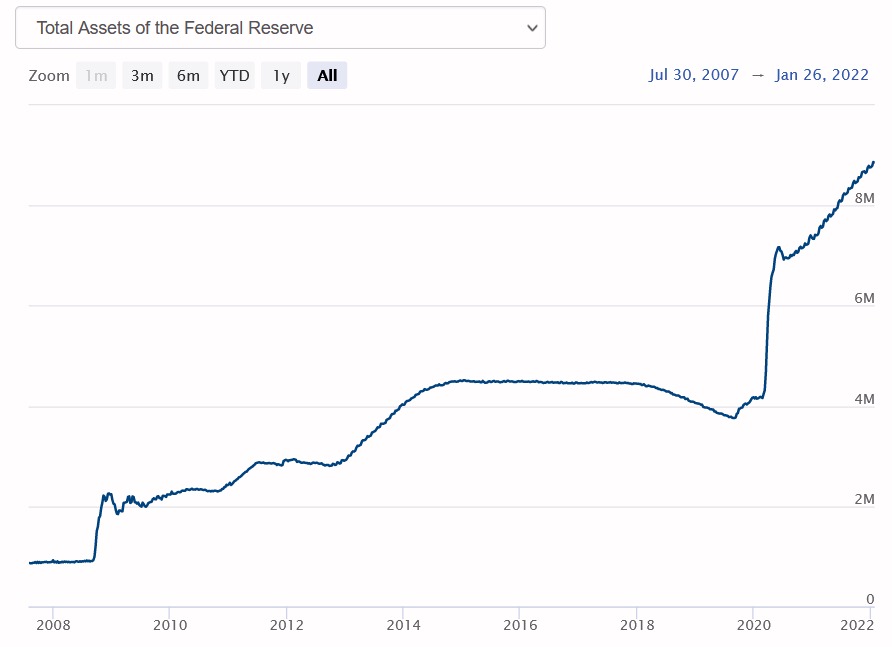
In March of 2020, the global pandemic put the Fed on hold. Then, the Fed reversed course, did not increase rates, and did substantially more (trillions) quantitative easing (see chart below.) In addition, the federal government borrowed trillions of dollars with no repayment plan. A large portion of this money was given to consumers as stimulus. The consumers shifted the demand curve causing a sharp rise in prices. “A demand curve shift refers to fundamental changes in the balance of supply and demand that alter the quantity demanded at the same price,” says The Balance Economic Theory. Consumers continued to spend beyond their means raising consumer debt. “Household debt in the third quarter of 2022, increasing by $351 billion (2.2%) to $16.51 trillion. Balances now stand $2.36 trillion higher than at the end of 2019, before the pandemic recession,” as reported by the Federal Reserve Bank of New York.
UPDATE: January 30, 2022
Inflation has hit 7% — the highest rate in 40 years.
The Fed has signaled that they are:
1) stopping quantitative easing in March
2) raising interest rates in March
Stopping quantitative easing means the Fed will no longer be supporting low Treasury yields by buying bonds. To date, they have bought over 8 trillion in Treasuries and other instruments that undercut interest rates. When the Fed stops buying Treasuries, the demand will go down and rates will go up.
Federal Reserve Balance Sheet 2022
The market has increased their forecast on the Fed raising rates to 4-5 times in 2022. When the Fed raises rates that banks charge each other, the banks charge you higher interest rates.
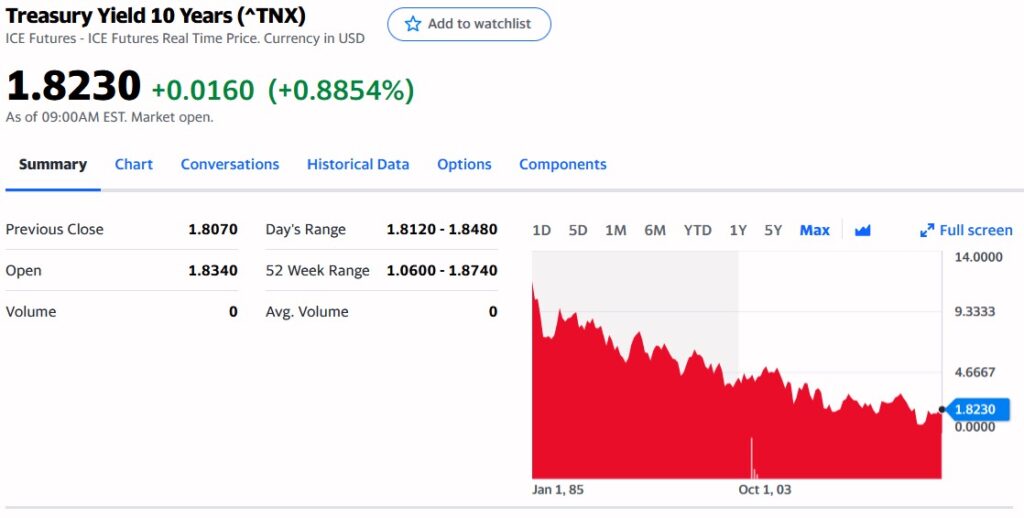
The 10 Year Treasury Note is the best indicator to watch for mortgage interest rates. It will reflect both the ending of quantitative easing and the increase in Fed funds rates. That is to say, if the Fed raises rates 1/4%, mortgage interest rates will likely rise 1/2%. That changes the forecast for mortgage rates in 2022 to rise 2 to 2.5%.
Borrow any long term money today before it is too late. [WARNING: This paper was first published in 2018. Since that time the forecast has reached fruition. It is too late to beat rising interest rates.] After rates rise for the next several years, there will be a recession. So, a long time before you may see conditions like we’ve had for the last 14 years.
10 Year Treasury Notes Interest Rates
Part III: U.S. Mass Consumption Results in Global Economic Disparity, Inequity, and Poverty
In Part I we mention the worst-case inflation scenario is hyper-inflation. We don’t expect hyperinflation in the US in the near future; however, higher interest rates in the US will result in hyperinflation in other parts of the world.
As long as the US Dollar is the world’s reserve currency, it is unlikely that the US will see hyperinflation. The US Congress defines the world’s reserve currency as, “a currency held by central banks in significant quantities. It is widely used to conduct international trade and financial transactions, eliminating the costs of settling transactions involving different currencies.”
When there is inflation in the US, the US Federal Reserve Bank raises interest rates. The rise in US interest rates results in other countries’ investors putting their money in dollar denominated US interest bearing investments. That is to say, foreign investors buy dollars with their home currencies. The result is a widened disparity in the exchange rates between the currencies. The US dollar increases in value and the foreign currency depreciates in value. There is a benefit to the US consumer — imported goods and services are cheaper. The disadvantage to the foreign countries is the dollar disparity causes a much greater rise in their domestic inflation as all their imports experience both the local inflation rate as well the inflation in buying dollars. In an even worse case scenario, the foreign country has debt that has to be repaid in dollars. In essence, their debt is multiplied by a factor equal to the decline in the value of their currency.
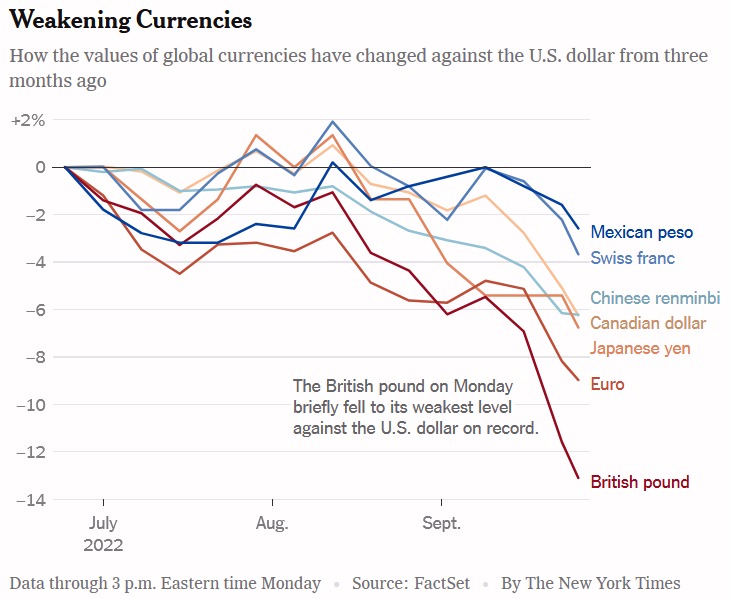
In September of 2022, the New York Times reported, “The Federal Reserve’s determination to crush inflation at home by raising interest rates is inflicting profound pain in other countries — pushing up prices, ballooning the size of debt payments and increasing the risk of a deep recession”
“Those interest rate increases are pumping up the value of the dollar — the go-to currency for much of the world’s trade and transactions — and causing economic turmoil in both rich and poor nations. In Britain and across much of the European continent, the dollar’s acceleration is helping feed stinging inflation.”
Weakening Currencies
Also in September of 2022, the Nikkei Asia reported, “Superstrong dollar threatens debt crisis across emerging economies. Mexico pressured to follow Fed hikes, while Sri Lanka’s repayment costs soar.”
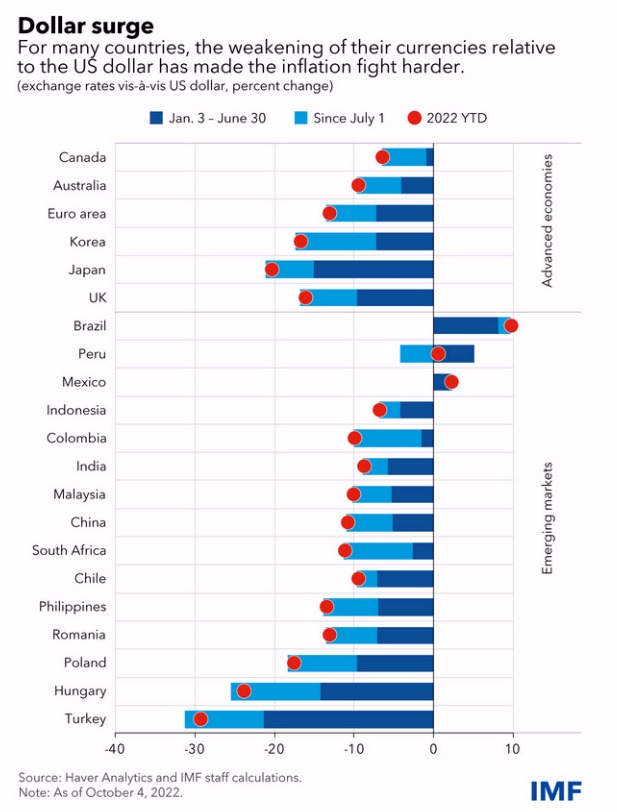
In October of 2022, the IMF reported, “The dollar is at its highest level since 2000, having appreciated 22 percent against the yen, 13 percent against the Euro and 6 percent against emerging market currencies since the start of this year. Such a sharp strengthening of the dollar in a matter of months has sizable macroeconomic implications for almost all countries, given the dominance of the dollar in international trade and finance.”
Dollar Surge
Conclusion
The United States has unsustainable mass consumption. US consumers are destroying the world’s environment and economies. The excessive demand of US consumers has resulted in the exploitation of natural resources, the largest emissions of pollution and greenhouse gases, inflation, currency disparity, and the largest redistribution of wealth in the world. Americans’ mass consumption is responsible for creating the greatest income disparity, wealth inequity, and poverty.
by the Department of Justice
Office of Public Affairs
A grand jury in the Northern District of California has indicted four defendants, including two officers of the Russian Federal Security Service (FSB), for computer hacking, economic espionage and other criminal offenses in connection with a conspiracy, beginning in January 2014, to access Yahoo’s network and the contents of webmail accounts. The defendants are Dmitry Aleksandrovich Dokuchaev, 33, a Russian national and resident; Igor Anatolyevich Sushchin, 43, a Russian national and resident; Alexsey Alexseyevich Belan, aka “Magg,” 29, a Russian national and resident; and Karim Baratov, aka “Kay,” “Karim Taloverov” and “Karim Akehmet Tokbergenov,” 22, a Canadian and Kazakh national and a resident of Canada.
The defendants used unauthorized access to Yahoo’s systems to steal information from about at least 500 million Yahoo accounts and then used some of that stolen information to obtain unauthorized access to the contents of accounts at Yahoo, Google and other webmail providers, including accounts of Russian journalists, U.S. and Russian government officials and private-sector employees of financial, transportation and other companies. One of the defendants also exploited his access to Yahoo’s network for his personal financial gain, by searching Yahoo user communications for credit card and gift card account numbers, redirecting a subset of Yahoo search engine web traffic so he could make commissions and enabling the theft of the contacts of at least 30 million Yahoo accounts to facilitate a spam campaign.
The charges were announced by Attorney General Jeff Sessions of the U.S. Department of Justice, Director James Comey of the FBI, Acting Assistant Attorney General Mary McCord of the National Security Division, U.S. Attorney Brian Stretch for the Northern District of California and Executive Assistant Director Paul Abbate of the FBI’s Criminal, Cyber, Response and Services Branch.
“Cyber crime poses a significant threat to our nation’s security and prosperity, and this is one of the largest data breaches in history,” said Attorney General Sessions. “But thanks to the tireless efforts of U.S. prosecutors and investigators, as well as our Canadian partners, today we have identified four individuals, including two Russian FSB officers, responsible for unauthorized access to millions of users’ accounts. The United States will vigorously investigate and prosecute the people behind such attacks to the fullest extent of the law.”
“Today we continue to pierce the veil of anonymity surrounding cyber crimes,” said Director Comey. “We are shrinking the world to ensure that cyber criminals think twice before targeting U.S. persons and interests.”
“ The criminal conduct at issue, carried out and otherwise facilitated by officers from an FSB unit that serves as the FBI’s point of contact in Moscow on cybercrime matters, is beyond the pale,” said Acting Assistant Attorney General McCord. “Once again, the Department and the FBI have demonstrated that hackers around the world can and will be exposed and held accountable. State actors may be using common criminals to access the data they want, but the indictment shows that our companies do not have to stand alone against this threat. We commend Yahoo and Google for their sustained and invaluable cooperation in the investigation aimed at obtaining justice for, and protecting the privacy of their users.”
“This is a highly complicated investigation of a very complex threat. It underscores the value of early, proactive engagement and cooperation between the private sector and the government,” said Executive Assistant Director Abbate. “The FBI will continue to work relentlessly with our private sector and international partners to identify those who conduct cyber-attacks against our citizens and our nation, expose them and hold them accountable under the law, no matter where they attempt to hide.”
“Silicon Valley’s computer infrastructure provides the means by which people around the world communicate with each other in their business and personal lives. The privacy and security of those communications must be governed by the rule of law, not by the whim of criminal hackers and those who employ them. People rightly expect that their communications through Silicon Valley internet providers will remain private, unless lawful authority provides otherwise. We will not tolerate unauthorized and illegal intrusions into the Silicon Valley computer infrastructure upon which both private citizens and the global economy rely,” said U.S. Attorney Stretch. “Working closely with Yahoo and Google, Department of Justice lawyers and the FBI were able to identify and expose the hackers responsible for the conduct described today, without unduly intruding into the privacy of the accounts that were stolen. We commend Yahoo and Google for providing exemplary cooperation while zealously protecting their users’ privacy.”
Summary of Allegations
According to the allegations of the Indictment:
The FSB officer defendants, Dmitry Dokuchaev and Igor Sushchin, protected, directed, facilitated and paid criminal hackers to collect information through computer intrusions in the U.S. and elsewhere. In the present case, they worked with co-defendants Alexsey Belan and Karim Baratov to obtain access to the email accounts of thousands of individuals.
Belan had been publicly indicted in September 2012 and June 2013 and was named one of FBI’s Cyber Most Wanted criminals in November 2013. An Interpol Red Notice seeking his immediate detention has been lodged (including with Russia) since July 26, 2013. Belan was arrested in a European country on a request from the U.S. in June 2013, but he was able to escape to Russia before he could be extradited.
Instead of acting on the U.S. government’s Red Notice and detaining Belan after his return, Dokuchaev and Sushchin subsequently used him to gain unauthorized access to Yahoo’s network. In or around November and December 2014, Belan stole a copy of at least a portion of Yahoo’s User Database (UDB), a Yahoo trade secret that contained, among other data, subscriber information including users’ names, recovery email accounts, phone numbers and certain information required to manually create, or “mint,” account authentication web browser “cookies” for more than 500 million Yahoo accounts.
Belan also obtained unauthorized access on behalf of the FSB conspirators to Yahoo’s Account Management Tool (AMT), which was a proprietary means by which Yahoo made and logged changes to user accounts. Belan, Dokuchaev and Sushchin then used the stolen UDB copy and AMT access to locate Yahoo email accounts of interest and to mint cookies for those accounts, enabling the co-conspirators to access at least 6,500 such accounts without authorization.
Some victim accounts were of predictable interest to the FSB, a foreign intelligence and law enforcement service, such as personal accounts belonging to Russian journalists; Russian and U.S. government officials; employees of a prominent Russian cybersecurity company; and numerous employees of other providers whose networks the conspirators sought to exploit. However, other personal accounts belonged to employees of commercial entities, such as a Russian investment banking firm, a French transportation company, U.S. financial services and private equity firms, a Swiss bitcoin wallet and banking firm and a U.S. airline.
During the conspiracy, the FSB officers facilitated Belan’s other criminal activities, by providing him with sensitive FSB law enforcement and intelligence information that would have helped him avoid detection by U.S. and other law enforcement agencies outside Russia, including information regarding FSB investigations of computer hacking and FSB techniques for identifying criminal hackers. Additionally, while working with his FSB conspirators to compromise Yahoo’s network and its users, Belan used his access to steal financial information such as gift card and credit card numbers from webmail accounts; to gain access to more than 30 million accounts whose contacts were then stolen to facilitate a spam campaign; and to earn commissions from fraudulently redirecting a subset of Yahoo’s search engine traffic.
When Dokuchaev and Sushchin learned that a target of interest had accounts at webmail providers other than Yahoo, including through information obtained as part of the Yahoo intrusion, they tasked their co-conspirator, Baratov, a resident of Canada, with obtaining unauthorized access to more than 80 accounts in exchange for commissions. On March 7, the Department of Justice submitted a provisional arrest warrant to Canadian law enforcement authorities, requesting Baratov’s arrest. On March 14, Baratov was arrested in Canada and the matter is now pending with the Canadian authorities.
An indictment is merely an accusation, and a defendant is presumed innocent unless proven guilty in a court of law.
The FBI, led by the San Francisco Field Office, conducted the investigation that resulted in the charges announced today. The case is being prosecuted by the U.S. Department of Justice National Security Division’s Counterintelligence and Export Control Section and the U.S. Attorney’s Office for the Northern District of California, with support from the Justice Department’s Office of International Affairs.
Defendants: At all times relevant to the charges, the Indictment alleges as follows:
Dmitry Aleksandrovich Dokuchaev, 33, was an officer in the FSB Center for Information Security, aka “Center 18.” Dokuchaev was a Russian national and resident.
Igor Anatolyevich Sushchin, 43, was an FSB officer, a superior to Dokuchaev within the FSB, and a Russian national and resident. Sushchin was embedded as a purported employee and Head of Information Security at a Russian investment bank.
Alexsey Alexseyevich Belan, aka “Magg,” 29, was born in Latvia and is a Russian national and resident. U.S. Federal grand juries have indicted Belan twice before, in 2012 and 2013, for computer fraud and abuse, access device fraud and aggravated identity theft involving three U.S.-based e-commerce companies and the FBI placed Belan on its “Cyber Most Wanted” list. Belan is currently the subject of a pending “Red Notice” requesting that Interpol member nations (including Russia) arrest him pending extradition. Belan was also one of two criminal hackers named by President Barack Obama on Dec. 29, 2016, pursuant to Executive Order 13694, as a Specially Designated National subject to sanctions.
Karim Baratov, aka “Kay,” “Karim Taloverov” and “Karim Akehmet Tokbergenov,” 22. He is a Canadian and Kazakh national and a resident of Canada.
Victims: Yahoo; more than 500 million Yahoo accounts for which account information about was stolen by the defendants; more than 30 million Yahoo accounts for which account contents were accessed without authorization to facilitate a spam campaign; and at least 18 additional users at other webmail providers whose accounts were accessed without authorization.
Time Period: As alleged in the Indictment, the conspiracy began at least as early as 2014 and, even though the conspirators lost their access to Yahoo’s networks in September 2016, they continued to utilize information stolen from the intrusion up to and including at least December 2016.
Crimes:
Count(s)
Defendant(s)
Charge
Statute 18 U.S.C.
Conduct
Maximum Penalty
1
All
Conspiring to commit computer fraud and abuse
§ 1030(b)
Defendants conspired to hack into the computers of Yahoo and accounts maintained by Yahoo, Google and other providers to steal information from them.
First, Belan gained access to Yahoo’s servers and stole information that allowed him, Dokuchaev, and Sushchin to gain unauthorized access to individual Yahoo user accounts.
Then, Dokuchaev and Sushchin tasked Baratov with gaining access to individual user accounts at Google and other Providers (but not Yahoo) and paid Baratov for providing them with the account passwords. In some instances, Dokuchaev and Sushchin tasked Baratov with targeting accounts that they learned of through access to Yahoo’s UDB and AMT (e.g., Gmail accounts that served as a Yahoo user’s secondary account).
10 years
2
Dokuchaev
Sushchin
Belan
Conspiring to engage in economic espionage
§ 1831(a)(5)
Starting on Nov. 4, 2014, Belan stole, and the defendants thereafter transferred, received and possessed the following Yahoo trade secrets:
the Yahoo UDB, which was proprietary and confidential Yahoo technology and information, including subscriber names, secondary accounts, phone numbers, challenge questions and answers;
the AMT, Yahoo’s interface to the UDB; and
Yahoo’s cookie “minting” source code, which enabled the defendants to manufacture account cookies to then gain access to individual Yahoo user accounts.
15 years
3
Dokuchaev
Sushchin
Belan
Conspiring to engage in theft of trade secrets
§ 1832(a)(5)
See Count 2
10 years
4-6
Dokuchaev
Sushchin
Belan
Economic espionage
§§ 1831(a)(1), (a)(4), and 2
See Count 2
15 years (each count)
7-9
Dokuchaev
Sushchin
Belan
Theft of trade secrets
§§ 1832(a)(1), and 2
See Count 2
10 years (each count)
10
Dokuchaev
Sushchin
Belan
Conspiring to commit wire fraud
§ 1349
The defendants fraudulently schemed to gain unauthorized access to Yahoo’s network through compromised Yahoo employee accounts and then used the Yahoo trade secrets to gain unauthorized access to valuable non-public information in individual Yahoo user accounts.
20 years
11-13
Dokuchaev
Sushchin
Belan
Accessing (or attempting to access) a computer without authorization to obtain information for the purpose of commercial advantage and private financial gain.
§§ 1030(a)(2)(C), 1030(c)(2)(B)(i)-(iii), and 2
The defendants gained unauthorized access to Yahoo’s corporate network and obtained information regarding Yahoo’s network architecture and the UDB.
5 years
(each count)
14-17
Dokuchaev
Sushchin
Belan
Transmitting code with the intent to cause damage to computers.
§§ 1030(a)(5)(A), 1030(c)(4)(B), and 2
During the course of their unauthorized access to Yahoo’s network, the defendants transmitted code on Yahoo’s network in order to maintain a persistent presence, to redirect Yahoo search engine users and to mint cookies for individual Yahoo accounts.
10 years (each count)
18-24
Dokuchaev
Sushchin
Belan
Accessing (or attempting to access) a computer without authorization to obtain information for the purpose of commercial advantage and private financial gain.
§§ 1030(a)(2)(C), 1030(c)(2)(B)(i)-(iii), and 2
Defendants obtained unauthorized access to individual Yahoo user accounts.
5 years
(each count)
25-36
Dokuchaev
Sushchin
Belan
Counterfeit access device fraud
§§ 1029(a)(1), 1029(b)(1), and 2
Defendants used minted cookies to gain unauthorized access to individual Yahoo user accounts.
10 years (each count)
37
Dokuchaev
Sushchin
Belan
Counterfeit access device making equipment
§§ 1029(a)(4)
Defendants used software to mint cookies for unauthorized access to individual Yahoo user accounts.
15 years
38
Dokuchaev
Sushchin
Baratov
Conspiring to commit access device fraud
§§ 1029(b)(2)
Defendants Dokuchaev and Sushchin tasked Baratov with gaining unauthorized access to individual user accounts at Google and other Providers and then paid Baratov for providing them with the account passwords. In some instances, Dokuchaev and Sushchin tasked Baratov with targeting accounts that they learned of through access to Yahoo’s UDB and AMT (e.g., Gmail accounts that served as a Yahoo user’s secondary account).
Today there are two groups of terrorists in the United States that rank far above any other groups:
1) Evangelical Christians
2) Anarchists
How do you identify members of these hate groups? Well, the Alt-right (radical and Evangelical Christians) are easy to spot. We keep that “basket of deplorables” in our Cabinet. [See Executive Branch U.S.A. 2017]
Anarchists Symbol
Q: How do you identify an anarchist?
A: Black masks, the anarchist symbol, flags, etc.
2) They like to set fires, rip things down, break windows, fences and other barriers.
3) You can not pay them; however, they will steal from you. They do not believe in ownership of property nor money. They have no boss.
“A black bloc is a tactical strategy used by anarchists, in which individuals wear black clothing, scarves, sunglasses, ski masks, motorcycle helmets with padding, or other face-concealing and face-protecting items.” — Wikipedia
WARNING: Please do not falsely accuse thy neighbor. Anarchists love to hi-jack peaceful protests and turn them violent and ugly. Do not be fooled. The hi-jackers are NOT the same group as the peaceful protesters. They are not liberal students, paid leftist protesters, black lives matter, anti-war, anti-trump supporters or supporters of any kind.
WARNING II: Do not allow the Alt-right to hi-jack the anarchists or all hell will break loose. (Thank you, The Management)
Anarchists At The Inauguration of the President of the United States
Anarchists At Berkeley University
The Anarchists Vs. The Antichrist
The Alt-right Christians and Anarchists, have the same goal — Armageddon.
The radical Christians want to bring on the Armageddon so the Rapture will occur, and they will be “saved” (aka the cleansing of the Earth.)
The anarchists goal is “abolishing all coercive structures” resulting in the cleansing of the Earth. In order for the anarchists to achieve their goal they must take-out the Alt-right government.
Will these two families fight like South Philly Mob families or Chicago gangs?
EARTH — Imagine a group of radical Christians taking over the government and trying to bring on the Rapture (aka The Apocalypse) and the Second Coming.
You no longer need to imagine. A conspiracy of Evangelical Christians are trying to facilitate The End Of Times. They want to fulfill biblical prophecies including:
The Revival of the Roman Empire
The Emergence of the Antichrist
The Covenant with Israel
Three Periods Between the Rapture and the Second Coming
The War with Russia
The Great Tribulation: Armageddon
The Radical Christian Terrorists believe they will be “saved” when these events occur.
ESCHATOLOGY
Eschatology is the part of theology concerned with death, judgment, and the final destiny of the soul and of humankind.
THE RAPTURE / ZOMBIE APOCALYPSE Daniel 12
The Time of the End
2 Many of those who are dead in the ground will awake, these to everlasting life, but the others to disgrace and everlasting contempt.
Thessalonians 4:17
17 Then we who are alive and remain will be caught up together with them in the clouds to meet the Lord in the air, and so we shall always be with the Lord.
In Christian eschatology, the Rapture refers to the prophesied event when “Christian believers who have died will be raised and believers who are still alive and remain shall be caught up together with them (the resurrected dead believers) in the clouds to meet the Lord Jesus Christ in the air.”
APOCALYPSE
The apocalypse is the complete and final destruction of the world as prophesied in the biblical books of Daniel and Revelation (the last book of the Bible.)
The Four Horsemen of the Apocalypse in the book of Revelation are horsemen on white, red, black, and pale horses. The riders are often seen as symbolizing:
Conquest, Pestilence, the Christ or the Antichrist
War
Famine
Death
“The Christian apocalyptic vision is that the four horsemen are to set a divine apocalypse upon the world as harbingers of the Last Judgment.”
Revelation 6:7-8
When the Lamb broke the fourth seal, I heard the voice of the fourth living creature saying, “Come.” I looked, and behold, an ashen (pale) horse; and he who sat on it had the name Death; and Hades was following with him. Authority was given to them over a fourth of the earth, to kill with sword and with famine and with pestilence and by the wild beasts of the earth.
The first seal is broken and the first of the four living creatures introduces a white horse whose crowned rider, equipped with a bow, goes out to conquer.
The second seal is broken and the second of the four living creatures introduces a red horse, whose rider wields a great sword.
The third seal is broken and the third of the four living creatures introduces a black horse, whose rider carries a pair of scales, goes out.
The fourth seal is broken and the fourth of the four living creatures introduces an ashen horse comes out, whose rider has the name Death and Hades follows him.
The fifth seal is broken revealing the souls of those who had been slain for the “Word of God”.
The sixth seal is broken “and there was a great earthquake; and the sun became black as sackcloth made of hair, and the whole moon became like blood; and the stars of the sky fell to the earth, The sky was split apart, every mountain and island were moved out of their places.”
Mankind hides themselves in the caves and mountains acknowledging the presence of Him who sits on the throne and the wrath of the Lamb.
Protectionism is the theory or practice of shielding a country’s domestic industries from foreign competition by restricting imports. There are no known benefits to protectionism. The costs of protectionism include being financially destructive, negatively impacting health and wellness, as well as, causing death. (also see: Trade War! What Is It Good For?)
Following are a few examples:
GOLDEN RICE AND THE TRANS PACIFIC PARTNERSHIP
Trade restrictions are often put on agricultural products in an effort for a country to protect its farmers. The result is to harm the general population. Rice is a good example of a crop that is widely protected by trade restrictions. USA Rice states, “The barriers range from ongoing phytosanitary restrictions by Colombia on imports of U.S. paddy rice; a discriminatory and very complex tariff regime in the EU; the trade distorting impact of Thailand’s rice support program; government management of rice imports in Japan and Taiwan; and Korea’s new rice import regime.”
The United States Patent and Trademark Office stated, “Despite current interventions, vitamin A deficiency is the leading killer of children globally (2-3 million annually) and also the leading cause of childhood blindness (500,000 cases annually). Most cases arise in Asia where the staple food eaten by 3.5 billion people daily, white rice, lacks vitamin A sources typically found in meat and leafy vegetables. These deaths and blindness are preventable.”
In 2015, Golden Rice won a humanitarian award. Not only is Golden Rice more nutritious than white rice, it is also less harmful to the environment (since less of it needs to be grown.) There are numerous health benefits from Golden Rice including β-Carotene that provides vitamin A to children. It is estimated that millions of children’s lives could be saved and childhood blindness could be dramatically reduced.
The Trans-Pacific Partnership Agreement (TPP) would have eliminated trade restrictions on Golden Rice by the participating countries.
1930 SMOOT-HAWLEY TARIFF ACT
The Tariff Act of 1930 was signed into law on June 17, 1930 by President Herbert Hoover. The act raised U.S. tariffs on over 20,000 imported products. The tariffs imposed an effective tax rate of 60% on many of the goods. The Act also started a trade war with America’s trading partners resulting in reduced American exports and imports by more than 50% contributing to The Great Depression.
Historians estimate at least 3 million civilians died from the Great Depression in the United States, mostly young children, the elderly and women. The main causes were:
malnutrition
infectious disease
attempted child birth
starvation
suicide
THE SHOE TAX
The shoe tax is a remnant of the Smoot–Hawley Act. United States’ shoe tariffs are 10 times higher than the average U.S. tariff rate. According to the U.S. International Trade Commission, in 2011 shoes accounted for 1 percent of merchandise imports, but provided 7.9 percent of U.S. tariff revenue.
Regressive taxes disproportionately hurt the poor. A regressive tax “imposes a greater burden (relative to resources) on the poor than on the rich.” The money paid in taxes has a larger impact on the ability of lower-income households to satisfy their basic needs, like food, clothing, healthcare and shelter.
PHARMACEUTICAL TARIFFS
In 2006 the WTO said scrapping the tariffs on medicines and drug ingredients would result in “effective action to improve access to medicines and medical devices needed to treat a wide variety of diseases effectively and ensure that these goods reach patients expeditiously at a lower cost.”
“It is ironic that many of the countries that are in urgent need of cheap medicines also have a significant tax added to drugs and medical devices they import,” said Peter Allgeier, the US ambassador to the WTO.
The National Institute of Health stated:
A group of countries, including members of the European Union, Canada, the United States, Japan, Switzerland, and Norway, agreed to eliminate import tariffs on thousands of finished drugs and intermediate ingredients in the Uruguay round trade talks between 1986 and 1994. As a result, out of an average global trade in drugs worth $145bn between 1999 and 2001, $114bn was covered by the initiative. But almost $33bn is still subject to duty, the joint proposal noted.
AL-SHIFA PHARMACEUTICAL FACTORY
Operation Infinite Reach was the codename for an American cruise missile strike on a pharmaceutical plant in Sudan. After helping Sudan build a pharmaceutical factory, the United States blew it up. Initially, the U.S. claimed the plant was making chemical weapons. Eventually, the U.S. admitted there was no evidence the plant was making chemical weapons. The side-effects to the local population included:
no supplies of chloroquine (the standard treatment for malaria)
relief workers fleeing the country resulting in starvation
fostering the attack of 9/11
The trade disruption is estimated to have killed or maimed hundreds of thousands of people many of which were children.
BABY FORMULA IN CHINA
For years China had stiff tariffs on imported baby formula. The lack of competition forced the price higher and the quality lower. In 2012, China’s consumer quality regulator found an “unusual amount” of mercury in baby formula produced by Yili Industrial Group Co. “At present, the country has no standards on mercury limits in milk powder. But to be responsible to consumers, the company decided to recall all related products,” said the company.
It is unclear how many children have been malnourished or poisoned due to China’s trade policy. Under free-trade agreements, such as the TPP, countries can not put tariffs on the product and the product must meet the health and safety standards of the USA.
International Economics 101
What do you think of when you hear the term “trade war”?
The costs and benefits to society are very similar to traditional warfare.
1) Financial Cost. A war is expensive. In a trade war, huge tariffs are placed on the purchase of imports. A tariff is a sales tax paid for by the citizen. Quite often this tax can be as high as 45% or the product even banned altogether. The tax is paid by the citizen to their government. The financial loss from the in-efficiency of paying large taxes is a tremendous burden on the country’s own citizens. In addition, there are usually large costs to the private sector. These costs can include high interest rates, inflation and loss of value to liquid assets. The standard of living declines.
2) Casualties / Loss Of Life. Millions of people are maimed or die in a trade war. The easiest examples in recent history would be the impacts on baby formula or pharmaceuticals. Hundreds-of-thousands of children, as well as, adults in need of medication died because these items were targeted in trade wars. Another example is maiming children by targeting vitamin A (causing childhood blindness.) Typically, trade wars impact the most vulnerable first — babies, the sick and the elderly.
 As the NCEI’s Deke Arndt has