WARNING: an investor should become familiar with their rights and responsibilities as an owner PRIOR to investing.
This is a beginner-intermediate level climate and investor activist portfolio. Stocks are not listed in any particular order. Some of the best performing stocks are not listed because of their questionable environmental impact, business ethics, and country of operation (in particular lithium and cobalt mining.) They are discussed in the advanced portfolio.
The stocks are an educational tool to ownership of the climate crisis. An owner has the duty to understand and implement sustainable practices, human rights, and fiscal responsibility. Investors have particular rights as activists depending on the country of incorporation and operation. In the USA, common shareholders are granted six rights: voting power, ownership, the right to transfer ownership, dividends, the right to inspect corporate documents, and the right to sue for wrongful acts.
RYCEY — Rolls Royce / advanced small modular nuclear reactors, green hydrogen and jet engines
LMT — Lockheed Martin / GridStar Flow is an innovative redox flow battery
SSUMY — Sumitomo Electric / redox flow batteries oxidation-reduction reaction of ions of vanadium
MAXN — Maxeon Solar Technologies / designs and manufactures Maxeon and SunPower brand solar panels
NEP – Nextera Energy Partners / portfolio of renewable generation assets consisting of wind and solar projects in North America
HDRO — Defiance Next Gen H2 ETF / green hydrogen
BE — Bloom Energy Corp / fuel cells, green hydrogen
BLDP — Ballard Power Systems Inc / proton exchange membrane fuel cell, green hydrogen
TOSYY — Toshiba Corp / green hydrogen, mini-nuclear plants
BP — British energy / green hydrogen, solar, wind
BAESY — BAE Systems / mini-nuclear development
SIEGY — Siemens / wind, green hydrogen
SMR — Nuscale Power / advanced small modular nuclear reactors
LGO — Largo / vanadium redox flow battery (VRFB)
GWH — ESS Tech Inc / iron flow batteries
FREY — FREYR Battery / semi-solid lithium-ion battery
QS — QuantumScape / develops solid state lithium metal batteries
Sidd said: I haven’t been following publicly traded companies. But for long term bets SSUMI,TOSYY,SIEGY, and surprisingly one that’s not on your list, AEP has some interesting prospects in renewable in spite of their history.
The reason I like Sumitomo, Toshiba, and Siemens is that they are all companies with a long history of bringing large and complicated engineering to market… successfully.
Climate change will eventually cause most American’s real estate to become worthless and uninhabitable.
“Currently, we have crossed the tipping point when human induced climate change triggers a chain reaction of feedback loops. The Earth will exceed 1.5 degrees Celsius (average global surface temperature over the surface of the earth for ten years) by the 2040’s and a societal collapse will ensue. For the most part, the Earth will be uninhabitable for humans by 2070 UNLESS immediate action is taken.” — Daniel Brouse and Sidd Mukherjee (climate scientists)
In the early 21st century, global climate change is spawning a new kind of migrant to the Upper Midwest: “Climigrants” seeking refuge from the forest fires of Western states, flooding along the saltwater coasts and ever-rising temperatures causing drought in different corners of the continent.
The reason for their arrival here is as old as time: Humans reacting to a threatening change in the environment around them and seeking a more habitable place to live.
That’s because climate forecasts are grim. A new report from the National Oceanographic and Atmospheric Administration warns that the U.S. coastline will see up to a foot of sea level rise by 2050 due to climate change.
Many climigrants to the Great Lakes region would most likely come from eastern and southern coastal areas, from the drought-stricken Southwest and West, and from wildfire-vulnerable parts of California and the Pacific Northwest.
Some will leave ahead of disaster with enough resources to resettle comfortably.
Other climigrants may be devastated financially when their homes or businesses are destroyed and they lack flood or other insurance, raising social justice questions for the communities they might move to.
Reaching “net zero” is easy, cheap, and saves you thousands of dollars, not to mention, you can help save the planet. Here are some things I’ve done to reach net zero without sacrificing my standard-of-living. In fact, I’ve gone beyond net zero in an attempt to eliminate all my pollution. The easiest way to get started is to conserve energy. Don’t use what you don’t need. Turn things off. Unplug things. Buy low energy use products.
1) Electricity and heat are the largest contributors to greenhouse gas emissions.
* choose an electric company that uses nuclear, solar, and/or wind generation
* insulate your house (Be careful not to over insulate. Indoor pollution is as large a health concern as outdoor pollution. An air-tight house needs an air exchange system with a rigorous filter maintenance program.)
* zone heat. In the winter, keep your main temperature at 50 degrees Fahrenheit and only keep the room you are occupying at a comfortable level (68 degrees). Wear warm clothes.
* an air to air heat exchanger and humidity exchanger (Note that humidity is as important as temperature.)
* plant shade trees and eliminate your need for central air
* plant windscreens, such as, evergreens
2) Food and land use is the second largest contributor to greenhouse gas emissions.
* eat less meat
* reduce transportation of food by buying local
* grow your own garden and windowsill gardens
* plant trees, and more importantly, maintain old growth
* reduce impervious surfaces
3) Transportation is the third largest contributor to greenhouse gas emissions.
* buy an EV or high MPG manual transmission (I get 50 MPG in a 4-wheel drive SUV with a 6 speed.)
* make fewer trips, take public transportation, avoid air travel
4) Invest in green technologies. Here are a few suggestions:
RYCEY — Rolls Royce / mini-nuclear plants
HDRO — Defiance Next Gen H2 ETF / green hydrogen
BE — Bloom Energy Corp / fuel cells, green hydrogen
BLDP — Ballard Power Systems Inc / proton exchange membrane fuel cell, green hydrogen
TOSYY — Toshiba Corp / mini-nuclear plants
BP — British energy / green hydrogen, solar, wind
BAESY — BAE Systems / mini-nuclear development
SIEGY — Siemens / wind, green hydrogen
An important factor in our inflation situation is immigration.
The US has stagnant population growth (as does the UK, EU, etc. Japan has a declining population.)
During the Trump administration, the US drastically curtailed immigration. The Biden administration continues to do so today.
The result has been wage inflation. The wage inflation that started in 2018 began the overall inflation spiral that continues today.
A wage inflation spiral happens when the initial wage inflation is canceled out by the price inflation requiring further wage inflation to keep up with the price inflation… the increase prices require more wage inflation for employees to keep pace with the cost of living… the subsequent rise in wages results in the need to raise prices to pay the workers… and round and round we go.
The solutions are to either increase our population (through immigration) and/or increase our productivity by eliminating the need for humans.
How the Inflation Spiral Started: Immigration
The Trump administration’s policy on immigration and building The Wall have a devastating impact on the economy. The U.S. economy is a capitalistic system based on population growth. The birth rate in America is close to zero percent. In order to maintain the standard of living, the country needs to gain millions of people through immigration. The Trump policies have attempted to eliminate immigration.
— Daniel Brouse (2020)
* “Over the course of four years, the Trump administration set an unprecedented pace for executive action on immigration, enacting 472 administrative changes that dismantled and reconstructed many elements of the U.S. immigration system. Humanitarian protections were severely diminished. The U.S.-Mexico border became more closed off. Immigration enforcement appeared more random. And legal immigration became out of reach for many. All of this was accomplished nearly exclusively by the executive branch, with sweeping presidential proclamations and executive orders, departmental policy guidance, and hundreds of small, technical adjustments.” — Migration Policy Institute’s Four Years of Profound Change (2022>
* “After years of wage stagnation, we are finally seeing rising wages,” Donald Trump (State of the Union 2018)
“The Employment Cost Index, a measure of salary and benefit costs, registered a 2.6 percent gain for the full year, tied for the best since 2007.” — CNBC (January 31, 2018)
* From December of 2020 through January of 2022, nominal wages and salaries were up 4.5 percent, the fastest increase since 1983. — Bureau of Labor Statistics (BLS)
Last week we got to watch the angry young investors invest irrationally making billions of dollars for their favorite hedge funds and the ultra-rich to the tune of 17 billion dollars! Wasn’t that fun?
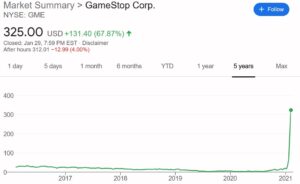
GameStop (GME) Stock Chart
“Ironically, the army of anti-establishment Reddit traders fattened the fortunes of some of the world’s ultra-rich: Chewy co-founder Ryan Cohen added $1.8 billion; Chinese billionaires Larry Chen and Wang Jianlin added $4.2 billion and $773 million, respectively; and Tootsie Roll CEO Ellen Gordon added $185 million, to name a few.—Andrew Mach”
If you thought that was exciting, stay tuned for the next two weeks as the angry young investors play “Catch the Falling Knife” with their favorite hedge funds. Risk management experts forecast the angry young investors will lose an additional $20 billion to Wall Street.
Spoiler alert: It will be a tragic ending. After the angry young investors put all their money in a bad investment, what will they do next?
You asked: Can you tell me more about the ultra-rich that made billions?
I reply: More important are the hedge funds that made $15-20 billion. You can’t find those numbers easily because they made their money from the positions they already owned (the other side of Melvin Capital’s short sales / puts). There is some reporting you can dig up on it, such as, MUST Asset Management — “GameStop Corp. GME disclosed early Thursday that one of its largest shareholders, South Korea–based MUST Asset Management Inc., no longer held any shares of the videogame and consumer electronics retailer’s shares. MUST had previously owned 3.3 million shares, or about 4.7% of all shares outstanding, which made it GameStop’s ninth largest shareholder, according to data provided by FactSet.”
You question: Are you saying the Reddit gang actually HELPED long position hedge funds as they hurt short position ones?
I respond: Exactly. In this first round 20 billion was transferred from one set of hedge funds to another set of hedge funds. Now, in the next part of the tragedy, the reddit gang will lose their GameStop investment to the same hedge funds… an additional $20 billion or so.
This is a more detailed answer to how puts work using GameStop (GME) as an example:
There are two entities. One owns 100 shares of GME. This entity believes the stock price will remain stable or go up. Lets call this entity U. Another entity thinks the price of the stock will go down. Lets call this entity Melvin.
This transaction took place when the stock price was $5/share.
Melvin comes to U and says I would like to borrow your 100 shares of GME for the next 90 days. Melvin agrees to pay U $1/share for this contract. U gets $100. U gets to keep that money no matter what and gets their 100 shares back in 90 days.
Melvin thinks the stock price is going down in the future… so, Melvin goes out and sells the 100 shares for $5/share. If the price of the stock goes down to $4/share, Melvin can buy back the 100 shares and make $100. (500-400=100). Melvin paid U $100. Melvin breaks even. The most Melvin can make on this deal is $4/share. If the price goes down to $0.01, Melvin can buy back 100/shares for a dollar. 500-100 (contract fee to U)-$1(to buy back the shares) = $399 profit.
On the other hand, if Melvin sells the 100 shares at the market rate of $5/share and the price of the stock goes up, the downside for Melvin is infinite. So, Melvin’s brokerage firm puts limits on how much Melvin can lose. As the price of the stock goes higher, the brokerage firm starts to make “margin calls”. For instance, if the price of the stock goes to $10/share, the brokerage may say Melvin needs to cover half of your shares. Instead of having 100 of U’s shares outstanding, Melvin has to go to the market and buy 50 of U’s shares back at $10/share. Then, if the stock continues to go up to say $15/share, Melvin’s brokerage makes another margin call making Melvin “cover” their outstanding shares by another 50%. Melvin then goes back to the market and buys another 25 shares at $15/share… and so on.
At the end of the 90 days, U get your 100 shares back. U can do with them as U please, and U get to keep the initial $100.
There are no good guys and bad guys. Anyone is allowed to do this. You do not have to be rich or from Wall Street. Instead of playing the side Melvin played, I recommend playing the role of U. It is a riskless way to make money. A smarter way to do this is with an option called a “covered call“.
You say: Interesting you are using “put”. I call this “Sell Short” or “Short Sale” or take a “Short Position.”
I respond: A put is the writer’s side of the short option — “A short position in a put option is called writing a put. Traders who do so are generally neutral to bullish on a particular stock in order to earn premium income. They also do so to purchase a company’s stock at a price lower than its current market price.” — Investopedia
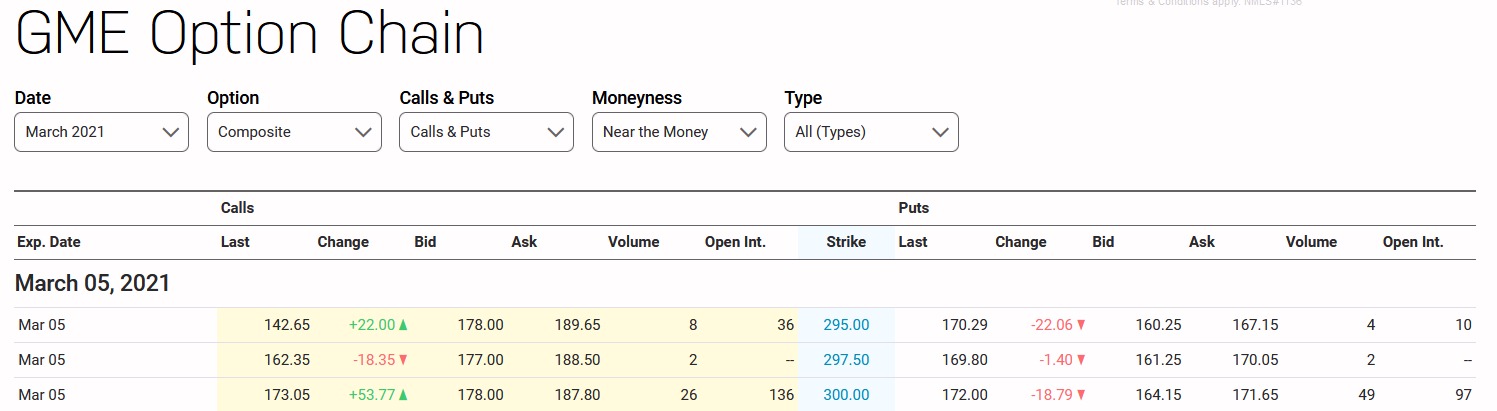
You can buy 1 put option (a contract on 100 shares) with a strike price of $300 that expires on March 5, 2021 for $172/share. If you pay $17,200, you will get an option that allows you to sell 100 shares of GME stock for $300/share between now and March 5. The last days closing price for GME was $325/share. In the event that GME falls below $300/share, you could exercise the option, buy 100 shares on the open market at the lower price and sell it for $300/share. The stock would have to fall below $128/share for you to make a profit. If you do not exercise the option, you lost your $17,200 investment.
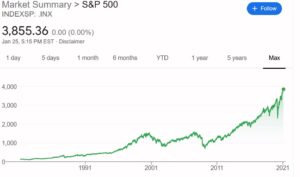
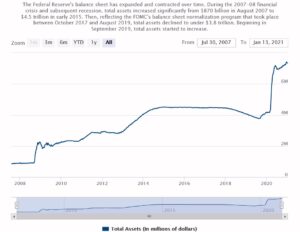
S&P 500 Rise since Fed and Treasury InterventionFederal Reserve Bank Balance Sheet 2020
We were talking about a graph of the record high stock market… and, I said:
You definitely need to keep this graph with it… the main reason the stock market is at this level is because the Federal Reserve has been buying stocks and bonds… lots of them. (That’s over 7 trillion pictured in the graph.) The old, bankers’ saying is “you can’t fight the fed”.
You asked: So, what will happen next?
I replied:
It all depends on how long the Fed can print money. A goodly portion of the bond and equity markets are owned by the Fed. (aka us / socialism / communism) . The US can do this because the dollar is the world reserve currency. Unfortunately for us, the Trump administration has put the dollar’s status in jeopardy. My guess is we have some time… until the dollar implodes. When the dollar implodes, the artificially inflated real estate, bond, and equity markets will collapse. Something like the next 10-20 years all your assets will be worthless.
You asked: do you think Janet will be Yellen and Screamin’ about this practice?
I replied:
Sad to say, no. The gov’t started propping up the private sector in 2008-2009. That was suppose to unwind. There was no unwinding under Yellen…. the real unwinding was suppose to happen under Trump. In 2017, the unwinding stopped… in 2020, the spigot was opened wide and trillions more were pumping in. Now, it is essential to keep the markets from collapsing. Thus, I expect Yellen will be forced to “Buy high and sell low”. Obviously, a failing investment practice.
ETFs are stocks as are Fannie Mae, Freddie Mac, and Ginnie Mae. Nobody knows exactly what the Fed buys, but it is widely believed the Fed started buying S&P 500 ETFs in 2020. In any event, 7 trillion in public and private debt and equities has a significant impact on artificially inflating real estate and the stock market.
You replied:
I understand it as “ETF’s” are “Exchange Traded Funds” and can be ANY investment vehicle.
To your point the Fed is documented to have made ETF Corporate Bond purchases last year …
What I could use your help on is in seeing how the (to Tom’s point) rather nominal $8 billion purchase is causing the dramatic effect seen in the graph.
I responded:
Yes. “An exchange-traded fund is a type of investment fund and exchange-traded product, i.e. they are traded on stock exchanges as stocks.” The reason(s) it bolsters the stock market include: purchases of corporate bond ETFs; purchase of equity based ETFs; purchase of specific corporate debt (eg Amazon, VISA, Kroger); most importantly the lowering of interest rates so that corporations can borrow money at near zero percent and use the money to purchase back their own stock. These are just a few ways the FED is propping up the stock market. Less direct but just as significant is the inflation of real estate (through purchase of mortgage backed securities.) The inflated value of real estate gives individuals the ability to invest (or not cashout) in the stock market. That is to say, if real estate was not inflated right now, people would be cashing out their 401k and IRAs to survive.
The Fed started doing these dirty deals in 2008. When I say dirty deals, I mean using their authority to maintain liquidity in the markets to interfere in private assets and equity. Since 2008, they have gone further and further over the line. In 2008-2009 it was focused mainly on real estate and large purchases (automobiles). In 2020, the Fed added direct and indirect ownership in corporations. For instance, airline debt… $2.2 million in Southwest Airlines debt. This allowed Southwest to borrow billions to keep afloat during the pandemic. Here is an article that explains a lot of it… “the Federal Reserve announced the deployment of additional “tools to support households, businesses, and the U.S. economy overall in this challenging time.” “Overall, $1 trillion in investment-grade bonds have been issued this year, nearly as much as all of 2019, along with tens of billions more in junk bonds from risky companies, which the Fed has also signaled that it would purchase.”
Something that is very important to consider… what is the difference between owning stock in the corporation or junk bonds issued by that corporation? That is to say, what happens to the Fed’s asset when the corporation goes bankrupt? What happens to the Fed’s good bonds when that company is taken over?
You said:
Something we should all remember … zooming back on the nation with a fresh alien perspective is a great exercise and skill …
We have a median household income barely budge since 1980 even after the majority of households went to duel income. It’s about 62,000 against 300% increases in real estate, health insurance and college costs …
Meanwhile market capitalization, cash reserves and productivity for corporations skyrocketed and the wealth gap of a tiny minority of both private individuals and elected officials skyrocketed …
To say “nothing to see here” is impossible if you look from afar …
This is one thing, the Fed, we can focus on for a better understanding. Thanks Daniel Brouse for initiating the discussion.
I add:
Agreed. The best case scenario for the USA would be to eliminate all existing Federal taxes. Establish a Federal pollution tax. Give every American 40k/year stipend.
The FED really does openly keep 2 sets of books. In general, both the Treasury and the Fed do not want to publicly disclose exactly what they are doing. 1) they don’t want to endanger private companies or industries by giving the impression that a company is in trouble 2) they don’t want the markets to undermine their efforts by trying to profit from their actions. A public example of this is in 2008-2009 when all the big banks were forced to take TARP money… whether they needed it or not. [The Fed and the Treasury have two sets of books… one for the public and one that is classified. It’s why we don’t know what stocks they are buying.)
“Making matters worse, the proportion of buybacks funded by corporate bonds reached as high as 30% in both 2016 and 2017,” according to JP Morgan Chase.
The Fed is buying stocks and bonds. And, the Fed is in cahoots with the Treasury (where do you think the Treasury borrows the money from?) The Fed has purchased trillions of dollars in direct and indirect purchase of stocks and bonds. It started in 2008 and continues to this day. US citizens have ownership in many airlines, cruise ships, real estate, General Motors, Chrysler, a multitude of banks and mortgage companies, insurance companies, and much more. That is not to mention the billions and billions lent to corporations to buy back their own stocks. This is the Fed’s money buying stocks. This is The Fed using the money multiplier to bolster the stock market since 2008.
You ask:
I tried to find data on the “stocks” you are referring to and can’t … does one of the articles you attached above have info.
This also pulls in my skepticism that the media is covering everything it should be … but I just can’t find any info so I could use sources.
I reply:
Yes. You can find out about many of the stocks owned by the government. It is a bit tangled. But, you can follow the money. Ask where the money to purchase the assets comes from? A: The Fed. Corporations and the Treasury obtain near zero interest rate money from the Fed. So, in many cases, how the Fed pays for the stocks becomes obscured. It often takes the private sector years so figure out the cash flow. We don’t know that much about 2020… except what was revealed in the CARES act, as well as, the pattern of stock buy backs (there was a big dip in buy backs in the 2nd quarter that coincides with the stock market.) You will have to dig a bit to find the names of the stocks… but they include airlines (Alaska Airlines, Allegiant Air, American Airlines, Delta Air Lines, Frontier Airlines, Hawaiian Airlines, JetBlue Airways, United Airlines, SkyWest Airlines, and Southwest Airlines), cruise ships, and supply chain companies like Amazon and Kruger. Some of the stock buybacks that lineup with the market include MGM, Best Buy, Qualcomm, Kansas City Southern, Lennar, Cummins and Xerox. The acquisition of stocks and stock options from earlier periods has been better routed out by analysts… all of the companies listed in “red” are all on the list: https://projects.propublica.org/bailout/list
You wondered: Am I missing something … these appear to be loans, not stock purchases, yes?
I explain: In 2008 the Federal Reserve and the Treasury colluded on circumventing the restriction on the both the Fed and the Treasury. Now, they are working in concert. You can no longer differentiate between the Fed and the Treasury. Quantitative Easing (QE) and the Troubled Asset Relief Program TARP) completely changed how things worked. (You can see it in the original chart above.) In most instances, the Treasury enters into stock ownership agreements and uses the Fed’s money to complete the deal. So, is it the Fed? or is it the Treasury? is the wrong the question… the right question is “Is it the Fed and treasury? The answer is yes. Now, most of the purchases/deals are under the CARES act. This is in addition to the Fed’s direct investment in public and private bonds, as well as, equities. The Fed is buy ETF’s and individual stocks, as well as… but the public can not find out exactly which ones.
It is very convoluted and in my opinion illegal. Neither the Fed nor the Treasury should be intervening / competing in the private markets. It costs the average citizen a lot of money.
The simplest way to explain is comparing it to an individual trading options with a margin account. In this scenario, the Treasury would be the account holder and the Fed would be the broker — “Buying on margin involves borrowing money from a broker to purchase stock. A margin account increases your purchasing power and allows you to use someone else’s money to increase financial leverage. Margin trading confers a higher profit potential than traditional trading but also greater risks.”
The most important part might be to start with the fact that there should be NO assets on the Fed’s balance sheet. The Fed is suppose to be the banks’ bank… regulating banks to maintain their liquidity and control inflation. Q. Is the Fed part of the government? A. No. The Federal Reserve Banks are not government agencies. The Federal Reserve is quasi-governmental. The Fed is not suppose to lend money to anyone other than member banks and only “overnight” to meet reserve requirements. (Reserve requirements are suppose to be to ensure banks remain solvent.)
Though this is not rocket science, it is convoluted high finance shell games. Very similar to investigating money laundering.
Economics and civics should be taught in every grade K-12 IMHO
A: In 1994, I started a publishing company with another scientist (low temperature physicist and co-builder of the Ohio States supercomputer). The name of the publishing company is The Philadelphia Spirit Experiment. As the name suggests, it is a scientific experiment in the publishing of arts and science. At the time, domain names were free and the world wide web was 6 months old. We wanted a name that both rhymed and made a good scientific pun — everything passes through the Membrane Domain. The KingArthur.com anti-IQ test launched in 1995.
We were the first record company, fine arts, science, technology, math, and engineering publisher on the web. As such, we were the first to analize web traffic. Our monthly audience is over 300 million. Innovations include: the clickable button on a webpage, MP3 distribution, pay-per-download, free streaming music, the web-based video… and interactive games to save the planet (including a $1,000,000 prize to solve the Anthropogenic Global Warming problem.
My areas of expertise include: musicology, geology, meteorology, anthropology, biology, health & wellness, sociology, security, climate change, physics, finance, economics, statistics, computer science, data science, chaos theory, political science, publishing, logic, and philosophy. In general, my aptitude is in science, technology, engineering, and math.
The mortality rate for COIVD is between 7-8% in PA. (* The actual mortality rate is closer to 14%) It has been since the pandemic started, and still is. An estimated additional 15% of the recovered have permanent disabilities. What is the cost of life and health on the economy? The benefit-cost analysis of a human life is generally accepted as US$10 million/dead person. [It is also referred to as the cost of life, value of preventing a fatality (VPF) and implied cost of averting a fatality (ICAF).]
But, what is the cost of lifelong disability? (COD/cost of a disability) That cost is much more difficult to calculate. How much does it cost to keep me alive? How much pain and suffering must I endure? And, how widely does the cost vary from disability to disability? If I need O2 the rest of my life… or if my leg is amputated… or neurological damage, etc.?
So, if the economy benefits by X amount by reopening early… what is the offsetting cost (X-VPF-COD)?
It seems to me this is a no-brainer. Without a doubt, it will be a negative number: X < VPF+COD
Answer: Stop the spread. Stop the dead. Make the bread.
Our Infrastructure Is Being Built for a Climate That’s Already Gone
Our drain pipes, reservoirs, power lines, roads, sewage systems, and more are all designed based on past climate data. But with the climate crisis comes the uncomfortable realization that the past can’t predict what we’ll need in the future.
by Shayla Love
Jun 2 2020, 1:05pm
In 1979, the Army Corps of Engineers predicted that by 2014, Optima Lake, in the panhandle of Oklahoma, would have 600,000 visitors a year camping, fishing, boating, and swimming. Instead, the lake sat empty, a dry expanse of land about three miles long. Today, it is still abandoned.
The Optima Lake and Dam was originally intended to control flooding from Beaver Creek and the North Canadian River. After $45 million was spent on its construction, though, the lake never filled up, and it has never reached more than 5 percent of its capacity.
Ed Rossman, a planning branch chief for the Corps of Engineers’ Tulsa District, told a local NPR station in 2013 that the project had been led astray because planners used historical climate data to pick the spot where the dam would be built. That data was wrong by the time construction was completed, and the water no longer flowed there. “We know that the historic record may not be a good snapshot for the future,” Rossman said.
In other parts of the world, the opposite problem has occurred. A flooding barrier put up in the 1990s in the Netherlands to protect Rotterdam will likely fail 25 years sooner than was predicted when it was first built in the 1990s. Replacing the barrier will cost around a billion euros, 10 million of which would be just the cost for taking it down.
The issue here, in its different guises, is one that engineers and city planners continue to face, and which reveals an inherent problem with how we’ve planned, designed, built, and made predictions around all of our infrastructure. At its core, this problem revolves around a concept called stationarity.
The tropics lost 11.9 million hectares (46,000 square miles) of tree cover, the study found, 3.8 million in older, primary forest areas – the third highest loss of primary trees since 2000 and a slight increase on 2018.
“The level of forest loss that we saw in 2019 is unacceptable,” Frances Seymour, from the World Resources Institute, said.
“And one of the reasons that it’s unacceptable is that we actually already know how to turn it around.
“If governments put into place good policies and enforce the law, forest loss goes down.
“But if governments relax restrictions on burning, or [are] signalling that they intend to open up indigenous territories for commercial exploration, forest loss goes up.”
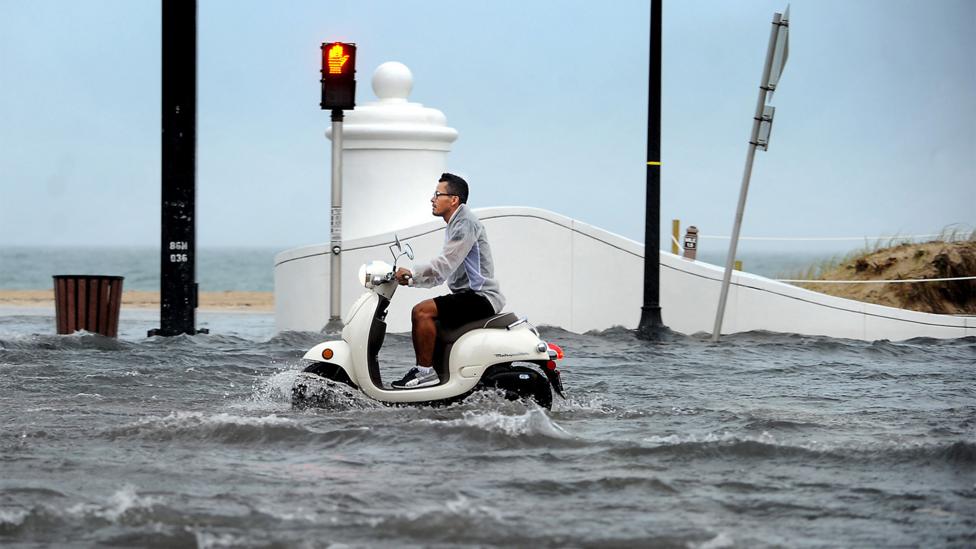
Just down the coast from Donald Trump’s weekend retreat, the residents and businesses of south Florida are experiencing regular episodes of water in the streets. In the battle against rising seas, the region – which has more to lose than almost anywhere else in the world – is becoming ground zero.
Stationarity is the idea that, statistically, the past can help you predict and plan for the future—that the variations in climate, water flow, temperature, and storm severity have remained and will remain stationary, or constant.
Nearly all the infrastructure decisions with which we live have been made with the assumption of stationarity. Engineers make choices about stormwater drainage pipes based on past data of inches of rain. Bridge engineers design foundations that can withstand a certain intensity of water flow based on the severity a certain location has experienced in the past. Reservoirs are designed to hold water based on historical information about water flow, and the historical water needs of a community.
Brazil accounted for a third of it, its worst loss in 13 years apart from huge spikes in 2016 and 2017 from fires.
However, Indonesia and the Democratic Republic of Congo both managed to reduce tree loss.
Meanwhile, Australia saw a sixfold rise in total tree loss, following dramatic wildfires late in 2019, .
As well as storing massive amounts of carbon, primary, tropical rainforests, where trees can be hundreds or even thousands of years old, are home to species such as orangutans and tigers.
The first time my father’s basement flooded, it was shortly after he moved in. The building was an ocean-front high-rise in a small city north of Miami called Sunny Isles Beach. The marble lobby had a waterfall that never stopped running; crisp-shirted valets parked your car for you. For the residents who lived in the more lavish flats, these cars were often BMWs and Mercedes. But no matter their value, the cars all wound up in the same place: the basement.
When I called, I’d ask my dad how the building was doing. “The basement flooded again a couple weeks ago,” he’d sometimes say. Or: “It’s getting worse.” It’s not only his building: he’s also driven through a foot of water on a main road a couple of towns over and is used to tiptoeing around pools in the local supermarket’s car park.
Ask nearly anyone in the Miami area about flooding and they’ll have an anecdote to share. Many will also tell you that it’s happening more and more frequently. The data backs them up.
It’s easy to think that the only communities suffering from sea level rise are far-flung and remote. And while places like the Solomon Islands and Kiribati are indeed facing particularly dramatic challenges, they aren’t the only ones being forced to grapple with the issue. Sea levels are rising around the world, and in the US, south Florida is ground zero – as much for the adaptation strategies it is attempting as for the risk that it bears.
Florida State Road A1A runs the entire length of Florida along the ocean, making it vulnerable to flooding – as shown here in Fort Lauderdale in 2013 (Credit: Alamy)
One reason is that water levels here are rising especially quickly. The most frequently-used range of estimates puts the likely range between 15-25cm (6-10in) above 1992 levels by 2030, and 79-155cm (31-61in) by 2100. With tides higher than they have been in decades – and far higher than when this swampy, tropical corner of the US began to be drained and built on a century ago – many of south Florida’s drainage systems and seawalls are no longer enough. That means not only more flooding, but challenges for the infrastructure that residents depend on every day, from septic tanks to wells. “The consequences of sea level rise are going to occur way before the high tide reaches your doorstep,” says William Sweet, an oceanographer at the National Oceanic and Atmospheric Administration (NOAA).
The flooding would be a challenge for any community, but it poses particular risks here. One recent report estimated that Miami has the most to lose in terms of financial assets of any coastal city in the world, just above Guangzhou, China and New York City. This 120-mile (193km) corridor running up the coast from Homestead to Jupiter – taking in major cities like Miami, Fort Lauderdale and West Palm Beach – is the eighth most populous metropolitan area in the US. It’s also booming. In 2015, the US Census Bureau found that the population of all three counties here was growing – along with the rest of Florida – at around 8%, roughly twice the pace of the US average. Recent studies have shown that Florida has more residents at risk from climate change than any other US state.