bookmark_borderTipped Tipping Points, Feedback Loops, and the Domino Effect

By Daniel Brouse and Sidd Mukherjee
September 29, 2023

A look at three (3) of the multiple tipping points we appear to have breached and The Domino Effect:

  • Mountain Glacier Loss
  • Collapse of AMOC (Atlantic Meridional Overturning Circulation)
  • Amazon Rainforest Dieback

Crossing one tipping point would be alarming. For instance, crossing the tipping point for ‘mountain glacier loss‘ has immediate consequences: millions of people in Europe will be impacted by the lack of fresh water. Billions of people that live along coasts will be impacted by the saline infiltration and eventually by the submerging of their property. In September of 2022, UNESCO reported accelerated melting of glaciers in World Heritage sites, with glaciers in a third of sites set to disappear by 2050. In September of 2023, the GLAMOS glacier monitoring center found 10% of Swiss glaciers had disappeared in the last 2 years. They do not expect any Swiss glaciers will be left by 2050 no matter what actions are taken. If extreme measures are taken, they anticipate we may be able to save some polar glaciers.

This in and of itself should be alarming; however, it gets worse. Tipping points are parts of feedback loop systems. The ice–albedo feedback loop is an expression of the ability of surfaces to reflect sunlight (heat from the sun). Any loss of ice over a darker surface means the surface will absorb more heat and reflect less heat. This process makes the Earth warmer causing more loss of ice… which in turn causes more warming of the Earth. So, yes, the mountain ice tipping point is quite alarming for both its immediate impact as well as its self-sustaining growth to global warming; but wait, it gets more alarming. The increasing temperatures due to crossing a tipping point cause other tipping points to be toppled (The Domino Effect).

The tipping point for the collapse of AMOC (Atlantic Meridional Overturning Circulation) was thought to be centuries away, at the earliest. In July of 2023, the study Warning of a forthcoming collapse of the Atlantic meridional overturning circulation was published in the journal Nature Communications. “Here we provide statistical significance and data-driven estimators for the time of tipping. We estimate a collapse of the AMOC to occur around mid-century (2025-2095) under the current scenario of future emissions.” The collapse is likely to cause faster sea level rise on the east coast of the US, more severe storms in Europe, and increasing drought in the Sahel in Africa. “From the study of past climate, we know changes in the AMOC have been some of the most abrupt and impactful events in the history of climate,” said Prof. Stefan Rahmstorf, at the Potsdam Institute for Climate Impact Research in Germany and world leading oceanographer. During the last Ice Age, winter temperatures changed by up to 10C within three years in some places. “We are dealing with a system that in some aspects is highly non-linear, so fiddling with it is very dangerous, because you may well trigger some surprises,” he said. “I wish I knew where this critical tipping point is, but that is unfortunately just what we don’t know. We should avoid disrupting the AMOC at all costs. It is one more reason why we should stop global warming as soon as possible.” A feedback loop created by the AMOC tipping point is disruption in weather systems and circulation that cause loss of naturally occurring carbon sinks. One scenario is desertification of the Amazon rainforest.

The tipping point / feedback loop problem is very complex (chaos theory) and exponentially alarming. A third tipping point appears to have been triggered by the summer of 2023 — Amazon Rainforest Dieback. The Amazon is often referred to as ‘the lungs of our planet.’ Not only does the Amazon suck in huge quantities of CO2 and breath out O2, but the Amazon soils also store huge amounts of CO2.  The desertification of the Amazon would result in a release of the carbon as the soils disappeared.

1) much of July was spent at record temperatures +3C
2) the collapse of the Amazon rainforest is likely to happen between +2 – 4C. The collapse of the Amazon is expected to occur because of changing weather patterns and circulation that result in drought.
3) Brazil set up a task force for “unprecedented drought in the Amazon”

Low river levels and hotter waters have killed masses of fish seen floating on river surfaces, contaminating the drinking water, Environment Minister Marina Silva said. “We have a very worrying situation. This record drought has disrupted river transport routes (dropping 30 cm / day) threatening food and water shortages, and a large fish mortality is already beginning.” This was the effect of a periodic El Niño mixing with changes in weather patterns brought by global warming. “We are seeing a collision of two phenomena, one natural which is El Niño and the other a phenomenon produced by humans, which is the change in the Earth’s temperature.” Worsened by climate change, this combination has caused drought not seen before in the Amazon and “is incomparably stronger and could happen more frequently.”

Feedback loops and tipping points are parts of an equation that determine the rate of acceleration in climate change.. Triggering these tipping points results in the CO2 stored in nature to be released. Though we do not know how much carbon is stored in nature, it would be reasonable to assume that the temperature could be pushed from 3 degrees to 6 degrees above pre-industrial levels. Humans cannot thrive above a rise of 1.5 degrees. Humans cannot survive if the temperature rises 6 degrees.

Climate Change Tipping Points

What you can do today. How to save the planet.

Climate Change: The End of Times

The Human Induced Climate Change Experiment

bookmark_borderCalifornia Homeowners Insurance Consider Climate Change Prices

California use to only allow a max of 7% increase a year on homeowners insurance… and only base premiums on past payouts on a property. Not anymore.

“California will let insurance companies consider climate change when setting their prices, the state’s chief regulator announced Thursday, a move aimed at preventing insurers from fleeing the state over fears of massive losses from wildfires and other natural disasters. The rule change could mean higher rates for homeowners who are already seeing dramatic increases. Eight insurance companies doing business in California have requested rate increases of at least 20% or higher this year, according to the California Department of Insurance,” AP news reported.

“Modernizing our insurance market is not going to be easy or happen overnight. We are in really unchartered territory and we must make difficult choices when the world is changing rapidly.” California Insurance Commissioner Ricardo Lara said.

“Insurers have advanced a very powerful argument that the past is not as good a predictor of the future as it used to be,” said Amy Bach, executive director of United Policyholders. “I think the (Insurance) department did what it needed to do to try to restore a viable market. We don’t have a viable market right now in this state in a lot of areas.”

Florida and Louisiana already have a homeowners insurance crisis with companies fleeing the states. The 9th National Risk Assessment for Homeowners Insurance found 1/4 of all homes in the nation are underpriced for climate risk insurance.

More articles on Flood Insurance, Rising Sea Levels and Global Warming.

bookmark_borderClimate Change: Insurance Risk

The 9th National Risk Assessment for Homeowners Insurance found climate risks place 39 million U.S. homes at risk of losing their insurance. “Sound pricing is going to make it unaffordable to live in certain places as climate impacts emerge.”

“There’s this climate insurance bubble out there,” said Jeremy Porter, the head of climate implications at First Street and a contributor to the report. “And you can quantify it.”

“There’s no education to the public of what’s going on and where the risk is,” said Porter, explaining that most insurance models are proprietary. Even the Federal Emergency Management Agency (FEMA) doesn’t make flood insurance pricing available to the public. Homeowners must obtain coverage through a private insurance broker for a quote.

Wildfires are the fastest growing natural disaster risk. According to the report, “It’s not just wildfires – pressure on flood and wind insurance is increasing, too.”

Porter went on to say, “You don’t want someone to live in a place that always burns. They don”t belong there. We’re subsidizing people to live in harm’s way. Large numbers of people will need to be relocated away from areas that will be uninsurable. There is a reckoning on the horizon and it’s not pretty.”

Flow Speeds

The burning of fossil fuels and other human released emissions have impacted momentum’s impact. A warmer atmosphere can hold more moisture. Warmer air allows for the creation of more massive raindrops. Warmer ocean temperatures create stronger hurricanes. Hail and tornadoes form in strong thunderstorm clouds with intense updrafts, high liquid-water content, and large water droplets.

Sidd added: It’s worse than that. Wind and water flow forces scale as the square of velocity, so as flow speeds increase (say due to more intense heating or heavier rain) the damage scales as the square of the velocity.

So a twenty mile an hour wind exerts four times as much force as a ten mile an hour wind. And a forty mile an hour wind exerts sixteen times as much force as a ten mile an hour wind. A wind of fifty miles an hour exerts twenty five times and a wind of sixty miles an hour exerts thirty six times as much force as one of ten miles an hour. Then you have the density term. Water is about eight hundred times denser than air, So the force exerted by a ten mile an hour flow of water is eight hundred times that of a ten mile an hour wind. So as flow velocities go up due to climate change, force and damage scale as square of the velocities. What is not clear is how much these velocities increase with climate change. But in a sense we are seeing this already as, for example, flood and sewage systems succumb and hillsides fall down, and so on.

Climate change’s influence on wind and water flow forces caused more severe damage and deaths. The Maui wildfire of August 2023 is an example. What would have been a fairly routine wildfire was fanned out-of-control by hurricane force winds. One headline read, “Maui fires: Hawaii blazes fanned by Hurricane Dora”. Another headline read, “Hawaii wildfires kill as ‘apocalypse’ hits Maui island”. The New York Times reported, “Gov. Josh Green of Hawaii said on Thursday that the devastating wildfires that swept through western Maui and killed at least 55 people, and possibly many more, were ‘likely the largest natural disaster in Hawaii state history.'”

Both wind and water flow forces contributed to the devastation. Hurricane Dora was at least 500 miles from Hawaii yet the wind forces impacted the fire in Maui. The winds were so strong that before the fire reached Lahaina extremely hot air blew over the town. The streets were so hot they burnt people’s feet trying to flee. The surface of everything became hot. Even after people jumped into the ocean, they said the debris in the water was too hot to float on. Almost all the boats in the harbor burned.

The blast of hot air over Lahaina created the conditions for a flashpoint. A flashpoint is the temperature at which a particular organic compound gives off sufficient vapor to ignite in air. The entire town ignited so quickly that warning sirens could not be activated and people did not have time to escape.

In an unexpected twist, water flow forces also contributed to the chaos. How could water flow add to the fire emergency conditions? When people fled the heat and fire, they jumped into the sea. ABC news reported: Shawn Dougherty, of Lahaina, was among the hundreds of residents forced to flee the resort city when the wildfire began engulfing their homes.

Like others, Dougherty said his only means of survival was to jump into the ocean with his girlfriend, but while some found safety in nearby jetties, the rocks and coral tore up Dougherty’s body.

“At one point, it seemed like I might drown,” he told ABC News. “{I’m a good swimmer, but the water was just really rough because of the wind and the turbulence.”

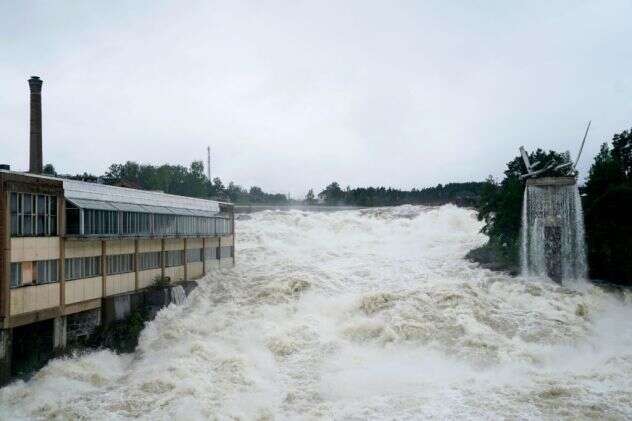
Norway Floods 2023

Also in August of 2023, climate change’s influence on water flow forces caused more severe damage and deaths. AccuWeather reported, “Dam bursts open as deadly flooding washes away homes in Norway. Torrents of water gushed through multiple towns across Norway and landslides cascaded down mountainsides after a deluge drenched Norway.”

Summary

By increasing the energy in the system, humans have increased flow volumes, masses and velocities leading to increased damage (and deaths.)

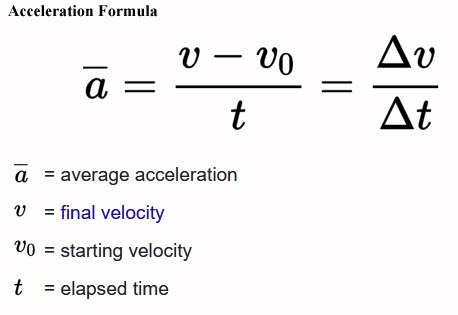
Newton’s second law: F = m * a
F = force
m = mass of an object
a = acceleration

Acceleration Formula

ALSO SEE
Climate Change: Rate of Acceleration
By 2020, there was enough data to see the “doubling period” of some anthropogenic climate affects had gone from 100 years to 10 years. For instance the rate of sea level rise has gone from about 1.5 millimeters per year to over 3 millimeters. We expect to see the doubling period to continue to shrink raising the possibility of sea levels rising a foot/year by 2050.

Tipping points and feedback loops are parts of an equation that determine the rate of acceleration in climate change.

Climate Change: The End of Times

More articles on Flood Insurance, Rising Sea Levels and Global Warming.

bookmark_borderInsurance, and the Lack Thereof

The Washington Post reported, “Home insurers cut natural disasters from policies as climate risks grow“.

“Allstate, American Family, Nationwide, Erie Insurance Group and Berkshire Hathaway — have told regulators that extreme weather patterns caused by climate change have led them to stop writing coverages in some regions, exclude protections from various weather events and raise monthly premiums and deductibles.”

“they will cut out damage caused by hurricanes, wind and hail from policies underwriting property along coastlines and in wildfire country”

“places once considered safe from natural catastrophes could lose crucial insurance protections while their natural disaster exposure expands or intensifies ”

“Allstate said its climate risk mitigation strategy would include “limiting new [auto and property] business … in areas most exposed to hurricanes” and “implementing tropical cyclone and/or wind/hail deductibles or exclusions where appropriate.””

“Nationwide said it no longer underwrites coverage for “properties within a certain distance to the coastline” because of hurricane potential.”

“There’s no place to hide from these severe natural disasters”

“a policy in a region afflicted by hurricanes may exclude coverage for wind or hail damage, or in wildfire country, a policy without fire and smoke protection.”

“Activity has been observed in recent years that has differed from historical norms or modeled expectations.”

More articles on Flood Insurance, Rising Sea Levels and Global Warming.

bookmark_borderClimate Change: The End of Times

by Daniel Brouse
July 21, 2023

What will the “End of Times” look like?

In the 1990’s, we wrote a paper on the worst-case scenario entitled, “The Impact of Governance & Globalization on Forecasting (The Tunnel Under Thesis).” The theory predicted that forecasting would become increasing difficult. “The result — a figurative, as well as, literal tunneling underground.”

Since that time, forecasting has become increasing more difficult. “In general, as energy is added to a system, the fluctuations in the system increase. So, we expect more storms, more droughts, more wildfires, more floods, more fluctuations of all kinds. What we are saying is that weather conditions will become more volatile due to the impact of humans,” said Mukherjee and Brouse. (2004)

In a report published in Nature entitled Over half of known human pathogenic diseases can be aggravated by climate change, data analyst and associate professor in the Department of Geography and Environment at the University of Hawaii Manoa, Camilo Mora, said climate hazards aggravated 58% of all known human pathogens. That is over half of infectious diseases discovered since the end of the Roman Empire. 58% of an authoritative list of infectious diseases documented to have impacted humanity have already been shown to be aggravated by climatic hazards — a finding the researchers found “shocking,” Mora said.

Movement of people and animals caused by climate is one factor. Warming at higher latitudes allowed vectors and pathogens to survive winter is another factor. The report goes on to say, “The human pathogenic diseases and transmission pathways aggravated by climatic hazards are too numerous for comprehensive societal adaptations, highlighting the urgent need to work at the source of the problem: reducing GHG (Greenhouse Gas) emissions.”

This research reveals more evidence that humans will have difficulty adapting to climate change, especially those in developing countries, Mora said. “The magnitude of the vulnerability when you think about one or two diseases — okay, sure, we can deal with that,” he said. “But when you’re talking about 58% of the diseases, and 58% of those diseases can be affected or triggered in 1,000 different ways. So that, to me, was also revealing of the fact that we’re not going to be able to adapt to climate change.”

In 2023, I wrote the paper, “Climate Change: How Long Is ‘Ever’?“. When we wrote the Tunnel Under Thesis, we forecast these events would not happen for centuries. We underestimated Man’s ignorance and arrogance. Fossil fuel consumption and greenhouse gas emissions have continued to set record highs. Humans have caused chain-reactions resulting in domino-effects, snowball effects, and feedback loops.

Events we thought would not happen in our lifetimes are happening now. My last resort emergency plan was to escape to Canada. (I am a dual citizen.) This summer that plan literally went up in smoke. “Beginning in March 2023, and with increased intensity starting in June, Canada has been affected by an ongoing, record-setting series of wildfires.” — Wikipedia

All of my life I have located my office and bedrooms in the uppermost southern exposure (preferably in the tree canopy.) I love sunlight, elevation, trees, fresh air, and wildlife. It is becoming ever more obvious my dreamlife is coming to an end, and I will be forced to tunnel under. For those forward thinkers, think about your poop. Pumping sewage above ground level will be a major problem at all times. In addition, the inability to pump flood water will become deadly during extreme weather events. In July of 2020 NPR reported, “The remnants of Hurricane Ida dropped unprecedented rainfall on several eastern states, killing dozens of people. Eleven of them were Queens residents who died when their basement apartments flooded.” In August of 2022 CNN reported, “Seoul has vowed to move some of the city’s poorest families out of underground and semi-subterranean homes after 13 people were killed in flooding caused by record rainfall this week, sparking public horror and calls for government accountability.” Drowning in your own poop may result for those unprepared.

Fresh air, water, food, and light will also be problematic; however, your most severe concern will likely be security. Those with supplies will be at high risk of being raped and looted. Good luck!

More From the Human Induced Climate Change Experiment

bookmark_borderYour National Debt

by Daniel Brouse
June 8, 2023

The Economic Monsters: Inflation and Interest Rates
I Economic Forecast = Inflation (2018)
II Inflation Bites (2022)
III U.S. Mass Consumption Results in Global Economic Disparity, Inequity, and Poverty (2023)
IV Investment Recommendation: Savings Bonds / I Bonds (2023)

Part V: Your National Debt

The federal government currently has $31.83 trillion in federal debt. So, what does that mean to you?

Some economists say it doesn’t mean anything. As long as the U.S. dollar remains the world’s reserve currency, the federal government can spend without limit. Other economists disagree.

Here is what to watch for:
1. a declining influence of the dollar as the world reserve currency
The dollar has been falling out of favor with many world economies. The dollar has also been sanctioned to be used by many countries and companies. Though efforts by groups like BRICS (Brazil, Russia, India, China, and South Africa) to form their own reserve currency will likely fail, the overall dependency on the dollar is weakening. The dollar will not be able to go on with “business as usual”.

2. the amount of debt (bills, notes, bonds) being sold by the Treasury
In 2023, Congress suspended the debt ceiling. During the April – June 2023 quarter and the Treasury said, “Treasury expects to borrow $726 billion in privately-held net marketable debt, assuming an end-of-June cash balance of $550 billion. The borrowing estimate is $449 billion higher than announced in January 2023.” Now that the debt ceiling has been suspended the Treasury is staring a $1tn borrowing drive. The trillion-dollar borrowing spree will have many impacts. For instance The Financial Times reports, “analysts fear scale of new issuance following debt ceiling fight will push up yields and suck cash out of deposits.” As investors pull their savings out of bank accounts and put it into high yielding Treasuries, this will put an added burden on the already struggling banking sector and further put into play the role of the Federal Reserve.

3. the amount of national debt being bought by the Federal Reserve
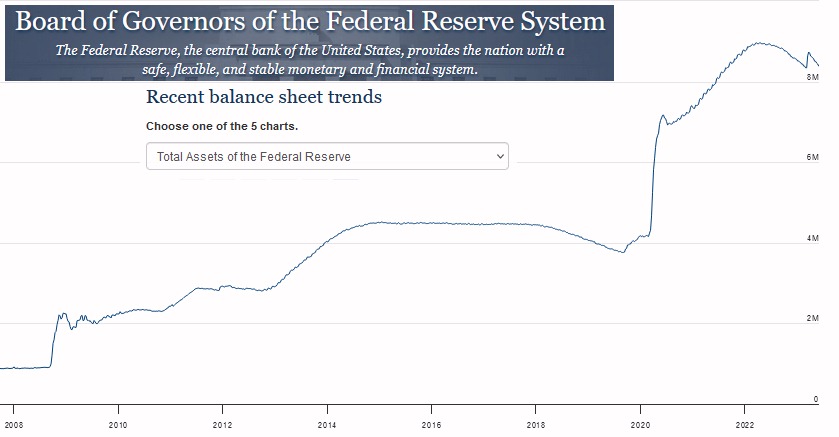
What will the Federal Reserve do? In the Spring of 2022, the Fed said they would not only stop buying Treasuries, but they would also start selling their Treasury assets. Initially, the Fed said the inflation was transitory. They were wrong. In order to fight inflation, the Fed needed to raise interest rates and reduce their assets (Treasuries). The Federal Reserve really shouldn’t be holding assets in the first place. During the financial crisis of 2007-2014, the Federal Reserve started buying trillions of dollars of assets including Treasury securities. Then during the COVID financial crisis, the Fed bought trillions more. In 2022, the Fed did stop buying Treasuries and as the securities matured, the Fed did not participate in as many Treasury rollovers. (Treasury rollover describes the process by which principal payments from maturing Treasury securities held by the SOMA are reinvested in newly auctioned securities.) However, in the graph below you see a sudden uptick in 2023.

Federal Reserve Balance Sheet Assets

The spike in assets in the Spring of 2023 was due to bank failures. The failing banks had billions of dollars in Treasuries that had lost value due to the rising interest rates. When interest rates go up, the value of existing lower yielding securities goes down. So, the Fed bought the devalued assets at full face value. The Fed may also have intervened in the markets to prop up the price of marketable securities in the open market.

What’s Next?
All of these interventions by the Fed have failed to bring inflation down to an acceptable level. Now the Treasury is going to borrow an addition 1 trillion dollars further increasing the demands on borrowing, interest rates, and the banking system. In fact, anything further the Fed does may stoke inflation. If the Fed buys more Treasuries, interest rates will be subsidized lower stimulating inflation. It will in effect be the same as printing money. Rising interest rates will increase the National Debt. Increasing the National Debt will raise interest rates. It is a vicious circle.

While our fiscal and monetary mess is unraveling, the costs of climate change are growing exponentially. Included in the debt ceiling suspension is a provision for unlimited emergency federal spending. Unfortunately this means that the government can continue to ignore the causes of climate change and instead give trillion dollar subsidies to the fossil fuel industry through emergency disaster relief. Yes, another vicious circle — more fossil fuels subsidies result in more climate catastrophes… resulting in more fossil fuel subsidies, etc. The end result will be additional trillions in government borrowing while the standard of living declines.

Recommendations
Given the above, our outlook and recommendations remain the same — persistent inflation and higher interest rates. Individual investors should max-out their annual I Bonds of up to $10k. Leftover saving should be invested in 4-week and 26-week Treasury bills. At maturity securities should be rolled over for the same length of time UNTIL interest rates peak. At that time, longer maturities should be considered.

BONUS
You can make all your transactions commission free at Treasury Direct. Marketable Treasuries are issued at a discounted rate. That means you get paid your interest in advance (giving you an even higher rate of return.)

The Economic Monsters: Inflation and Interest Rates

  1. Economic Forecast = Inflation (2018)
  2. Inflation Bites (2022)
  3. U.S. Mass Consumption Results in Global Economic Disparity, Inequity, and Poverty (2023)
  4. Investment Recommendation: Savings Bonds / I Bonds
  5. Your National Debt

Business & Economics

bookmark_borderClimate Change Impacts on Flood Risks and Real Estate Values

by Daniel Brouse and Sidd Mukherjee
February 26, 2023

Climate change poses many risks to real estate values. In general, as energy is added to a system, the fluctuations in the system increase. So, we expect more storms, more droughts, more wildfires, more floods, more fluctuations of all kinds. What we are saying is that weather conditions will become more volatile due to the impact of humans. For the most part, weather events will become more extreme. Even the momentum of rain will cause a harder rain to fall damaging roofs, sidewalks, and driveways.

Some of the most vulnerable real estate is along coastlines and near floodplains. The study published in the Journal Nature Unpriced climate risk and the potential consequences of overvaluation in US housing markets found:

Climate change impacts threaten the stability of the US housing market. In response to growing concerns that increasing costs of flooding are not fully captured in property values, we quantify the magnitude of unpriced flood risk in the housing market by comparing the empirical and economically efficient prices for properties at risk. We find that residential properties exposed to flood risk are overvalued by US$121–US$237 billion, depending on the discount rate. In general, highly overvalued properties are concentrated in counties along the coast with no flood risk disclosure laws and where there is less concern about climate change. Low-income households are at greater risk of losing home equity from price deflation, and municipalities that are heavily reliant on property taxes for revenue are vulnerable to budgetary shortfalls.

Sidd Mukherjee said, “Pay close attention to Figure 4 in the main paper (top left map, zoom in to max.) The red boundaries are where properties are seriously overvalued and where tax revenues will collapse after flooding.

High Flood Risk Real Estate (The darker the color the higher the risk)

Sidd goes on to say, “Don’t miss the supplementaries.”
Flood Risk to Real Estate Supplementaries

More articles on Flood Insurance, Rising Sea Levels and Global Warming.

bookmark_borderReal Estate Underwater: Displacement and Climate Refugees

by Daniel Brouse
February 22, 2023

For years climate scientists have been trying to develop models for the real estate market impacted by rising sea levels. Florida is proving to be a microcosm of coastal real estate.

“Everybody thinks this is a God-given sea level,” Harold Wanless, who heads the University of Miami’s geology department told the Miami Herald. “There’s nothing special about where the sea level is right now.”

In fact, almost all scientists agree there is going to be significant sea level rise within the next century. Miami-Dade County has developed extremely detailed elevation maps because the county is only about 6 feet above sea level with the highest elevations under 25 feet. So far, sea levels have risen about 6 inches in Miami-Dade. The rate of rise is increasing at an exponential rate.  The Southeast Florida Regional Climate Compact expects sea levels to rise 3 to 8 feet over the next century. NOAA’s extreme worst-case climate projections show sea levels rising by 14 feet in Southern Florida. Leading climate scientists expect sea levels to rise even higher and faster. “Once we have destabilized these ice sheets, there will be no stable coastline for centuries. I repeat: There will be no stable coastline for centuries. I apologize to the children,” said Sidd Mukherjee in his paper Longthaw.

It is certain that much of the coastline will not have to wait decades to see extreme sea level rise. In 2022, the West Coast of Florida saw a sudden sea level rise of up to 20 feet that destroyed 5,000 houses and damaged 35,000 additional homes. Insured damages were between $50 billion and 65 billion after Hurricane Ian made landfall with extreme winds, torrential rain, and storm surge. Uninsured damages were estimated at an additional $50 billion.

As sea levels rise, it is unclear if real estate built on higher ground will be able to retain any value. Florida real estate located at the higher elevations is still dependent on low-lying infrastructure. “You’re not going to have roads to get around on. You’re not going to have sewage treatment facilities. You won’t have garbage pickup. You won’t have a source of fresh water,” said Wanless. “All those things are the unfortunate reality of the future, and it won’t wait until sea levels have risen 20 feet.”

The inability to obtain flood insurance will likely be a leading driver in climate displacement out of Florida. If residents wait too long, they will likely become indigent climate refugees fleeing after letting their property values plunge to zero. Standard flood insurance only covers up to $250,000 of property damage, nothing below the first floor, and cumulative to the life of the property. (That is to say, if a previous homeowner made a claim of $100,000, the new homeowner is only covered for $150,000.) In the event a homeowner is able to obtain a flood insurance policy, the cost of the insurance has been increasing yearly. In 2022, FEMA announced its new pricing policy: “FEMA is updating the National Flood Insurance Program’s (NFIP) risk rating methodology through the implementation of a new pricing methodology called Risk Rating 2.0. The methodology leverages industry best practices and cutting-edge technology to enable FEMA to deliver rates that are actuarily sound, equitable, easier to understand and better reflect a property’s flood risk.” Flood insurance rates have quadrupled in Miami-Dade County.

FEMA also has the 50% rule — the 50% Rule is a regulation of the National Flood Insurance Program (NFIP) that prohibits improvements to a structure exceeding 50% of its market value unless the entire structure is brought into full compliance with current flood regulations. Many existing structures cannot be rebuilt to their previous size, or for structures like trailers they cannot be rebuilt at all.

Quite a few private insurance companies have pulled out of Florida altogether. Five Florida insurance companies have already pulled out of the state. In addition, these private insurers are in liquidation:
AMERICAN CAPITAL ASSURANCE CORPORATION
AVATAR PROPERTY AND CASUALTY INSURANCE COMPANY
FEDNAT INSURANCE COMPANY
FLORIDA SPECIALTY INSURANCE COMPANY
GUARANTEE INSURANCE COMPANY
GULFSTREAM PROPERTY AND CASUALTY INSURANCE COMPANY
PHYSICIANS UNITED PLAN, INC.
SOUTHERN FIDELITY INSURANCE COMPANY
ST. JOHNS INSURANCE COMPANY, INC.
SUNSHINE STATE INSURANCE COMPANY
UNIVERSAL HEALTH CARE INSURANCE COMPANY, INC.
UNIVERSAL HEALTH CARE, INC.
WESTON PROPERTY & CASUALTY INSURANCE COMPANY
WINDHAVEN INSURANCE COMPANY

The Florida Office of Insurance Regulation has had to step in and provide state assistance for reinsurance coverage through state-run Citizens Property Insurance. The St. Lucie News Tribune reports, “The dramatic decision to assume financial responsibility for a raft of struggling insurers underscores the dire circumstances Florida is facing as a large portion of its homeowners insurance market teeters on the brink of collapse.”

Most mortgages require homeowner’s insurance in addition to flood insurance for properties located in a flood zone. Washington, D.C. is finally addressing the concept of some areas being too vulnerable to insure and addressing a
“Managed Retreat”.

Some Florida residents have already glimpsed the future and are moving out now. The Insider reports:

The Faasts had lived the kind of life you can only live in the Keys: Connie worked on commercial fishing boats and in a local aquarium, while Glenn owned a boat maintenance company and raced Jet Skis in his spare time. They had stuck it out in the Keys through several major storms, including 2005’s Hurricane Wilma, which brought five feet of water to their little island and totaled three of their cars; Connie still shudders when she remembers the image of her husband wading through the water around their house with snakes climbing all over him, clinging to him for shelter from the flood. The Faasts had second thoughts after that storm, but the Keys were paradise, and besides, they didn’t know where else they would go.

When Irma came 12 years later, though, the choice was much easier. During the evacuation, it took the Faasts a week to find a decaying hotel in Orlando where they could wait out the storm. As the hurricane passed over the center of the state, it knocked out their power, leaving them and their pets to spend the night in 100-degree heat without air conditioning. “That was it for us,” she said. They had to get out — not just out of the Keys, but out of Florida altogether.

In conclusion:
Do not buy real estate on or near floodplain. You can avoid being a climate refuge due to economic climate displacement. Make sure your property has land ingress and egress from the closest 1,000-year-floodplain. Do not invest in any property located near a coast. Do not invest in a property that is below sea level. Do not invest in real estate located in Florida.

“Mostly stay away from the coasts because of both wind and rain issues from weather systems spinning inland. Even if you are not in a floodplain, a couple feet of rain in a day will cut off roads and overwhelm your sump pumps. Not to speak of wind taking power and telecom down.” — Sidd Mukerhjee (February 5, 2018)

More articles on Flood Insurance, Rising Sea Levels and Global Warming.

bookmark_borderEconomic Update: Inflation, Interest Rates, AI, Consumer Spending, Climate Change, and Fiscal Policy

by Daniel Brouse
February 3, 2023

This article is about the economic conditions up to 2023 and a forecast for the foreseeable future. It helps to understand fiscal and monetary polices prior to reading the following.

In 2022 and 2023, the Federal Reserve raised their interest rates charged to other banks 4.75 percent in an effort to fight inflation. In the later part of 2022, inflation appeared to level-off and start to decline; however, it would be a mistake to think the war is won.

In essence, the short term rise in Fed interest rates is a fiscal facade. In the short term, the rise in Fed rates strengthens the dollar reversing the pressure on real market interest rates. The rise in rates causes inflows of foreign currency dampening the effect on the Treasury’s borrowing costs. At the same time, it makes imported consumer goods cheaper. What the Fed has done with rate hikes so far has not touched the root causes of inflation — lack of immigration/young workers, consumer spending and debt, and government spending and debt.

Unfortunately, the first one — immigration/young workers — appears to have caused a new paradigm. Instead of workers/employment/unemployment causing a wage inflation spiral, AI and robotics are replacing human labor at a rapid rate. Whereas before we thought it would be 20-50 years before impacting economic models, it appears to already be happening. We don’t know the impact yet, but likely this will be good for inflation (eg no wage inflation.) However, it will be devastating to workers’ incomes. Though income inequality will likely be justified, it won’t be a good thing since everyone will earn next to nothing. There are still a few years for this to play out, so downward pressure on wage inflation will not be felt in time for our current fiscal fiasco.

The second part — consumer spending and debt — has been increasing throughout the Fed’s rate rises fueled in part by the stronger dollar. As long as there is strong consumer demand, there are inflationary pressures. The GDP has been increasing to historic highs during the Fed rate rises. The greater the consumer debt the more severe the inevitable recession will be (multiplied by how much technology replaces workers.) In addition, climate change disasters and ill health effects are growing exponentially. Consumer spending and mass consumption through the exploitation of natural resources is the greatest long-term risk to world economics (and human life.)

The last part — government spending and debt – is the real part of the worst to come in the short term. The increase in the price of the dollar has kept marketplace interest rates artificially low. Over the last several years, the government has budgeted huge multi-trillion dollar spending packages. Most of this money has yet to be borrowed and spent (see debt limit crisis.). When the money is borrowed, the price of the dollar will get hammered, and consumers will feel a huge jump in inflation of imported goods. Long term marketplace interest rates will come under severe pressure. The Fed will be forced to buy Treasuries and print money. This is also hugely inflationary. Next, when the money is spent, hundreds of millions of dollars will be pumped into the economy causing a shift in the demand curve for many goods and services. Again, this is biggly inflationary. A microcosm of what’s to come can be seen in the stimulus checks. The 3.2k/person stimulus checks caused this first little bump in inflation we are seeing now. This is just a drop in the bucket compared to the trillions of government stimulus yet to come. There are some Republicans trying to squash the borrowing/spending, but I doubt they will be successful. Soo….

In conclusion, it will be near impossible to curb inflation through monetary policy. The greatest risk to short term world economics is US fiscal policy.

UPDATE: November 9, 2023

Attention armchair economists, investors, and homeowners:
the 30-year Treasury auction was “bad” today
… when I say bad, I mean bad for those not investing in Treasuries.

What does it mean? The government went to borrow money today, and people didn’t want to lend them money. The 30-year interest rate spiked higher. This is because the government is borrowing record amounts of money.

A Double Whammy
This has two negative feedback loops.
1) the higher interest rates mean the government has to borrow more money to make the interest payments… resulting in higher budget deficits… resulting in more borrowing… resulting in higher interest rates, etc.
2) the government is borrowing the current trillions of dollars over the next couple years… but they have yet to spend it… spending the trillions will result in inflation… which will result in higher interest rates… causing a larger deficit… requiring more borrowing, etc.

The Greatest Risks to the US Economy

  1. Climate Change
  2. Government Spending / Debt
  3. Lack of Immigration

Human induced climate change is an exponential component of an unordered system (chaos theory).

The Age of Loss and Damage is a new way of thinking about economics by combining economics, climate science, statistics, and physics. Until now, economic models have been unfit to capture the full extent of climate damage. Traditionally, “integrated assessment models” (IAMs) were used to forecast “shock” events. IAMs use “quadratic function” to calculate GDP losses by squaring the temperature change, yet ignore other methods (such as the exponential function) that are better suited for rapid change. “Climate change is fundamentally different to other shocks because once it has hit, it doesn’t go away,” said Thierry Philipponnat, author of a report by Finance Watch, a Brussels-based public interest NGO on financial issues. “And if the fundamental assumption is flawed, all the rest makes little sense — if any.”

Reuters reported, “Critics say this (IAMs) choice is doomed to underplay the likely impact – particularly if the planet hits environmental tipping points in which damage is not only irreversible but happens at an ever-accelerating rate.” Thierry Philipponnat’s report, Finance in a Hot House World, concludes: “Climate risk is growing to disruptive levels throughout the financial system and the guardians of financial stability urgently need to adapt their tools to regain control.” The report calls for economic models that do not mislead, scenario analyses that prepare the market, and a new prudential tool to address the build-up of systemic climate risk.

Traditional economics is based upon the “costs and benefits” to society. Since there are no known long-term benefits of climate change to society, the Age of Loss and Damage economics focuses on the exponential costs of climate change to society.

Loss and damage litigation against oil companies and governments will change world economics.

In the spring of 2023, the USA suspended their national debt ceiling. Included in the debt ceiling suspension is a provision for unlimited emergency federal spending. The result is the government can continue to ignore the causes of climate change and instead give trillion-dollar subsidies to the fossil fuel industry through emergency disaster relief. Yes, another vicious circle — more fossil fuels subsidies result in more climate catastrophes resulting in more fossil fuel subsidies, etc. The end result will be additional trillions in government borrowing while the standard of living declines.

According to NOAA, in 2023 (as of November 8), there have been 25 confirmed weather/climate disaster events with losses exceeding $1 billion each to affect United States. These events included 1 drought event, 2 flooding events, 19 severe storm events, 1 tropical cyclone event, 1 wildfire event, and 1 winter storm event. This is the largest number of climate disasters recorded with a notable increase in extreme precipitation events (violent rain).

Meanwhile, the US politicians also fail to address the declining and aging population. By restricting immigration, the government is forcing the acceleration of AI and robotics technology. Although this is great for “productivity”, neither AI nor robots pay taxes. The US economy is based on population growth. Increased emergency spending and a declining tax base results in insolvency.

ALSO SEE: The Economic Monsters: Inflation and Interest Rates

UPDATE 2024: Economic Facts on Immigration, Budget Deficits and Inflation

Business, Finance, and Economics

bookmark_borderInvestment Recommendation: Savings Bonds / I Bonds

January 11, 2023

One of the best investments is Treasury Direct I Bonds. I Bonds’ interest rates are determined by the rate of inflation.

The rate of return on January 11, 2023 is 6.89%.

I Bonds can be purchased directly from the Treasury Department without a middle man, brokerage, or bank. There is no risk of losing your principle investment. They are redeemable after 12 months with three months interest penalty. No penalty after 5 years. The maturity is 30 years. Tax reporting of interest can be deferred until redemption or final maturity. If you use the money for qualified higher education expenses, you may not have to pay tax on the earnings.

About Inflation and Interest Rates

Business, Finance, and Economics