bookmark_borderAtlantic City Going Under

by Daniel Brouse

Atlantic City, NJ / Sea Level Rising

For decades businesses located on the island of Atlantic City have been scenario planning for climate change and rising sea levels. At the turn of the century, the casinos devised a plan to float their businesses and ferry gamblers in. Now, the rising waters are no longer a scenario.

So-called “nuisance flooding” — which causes public inconveniences such as frequent road closures, overwhelmed storm drains, and compromised infrastructure — has increased on all three U.S. coasts, between 300 and 925 percent since the 1960s, according to a 2014 NOAA report

“As relative sea level increases, it no longer takes a strong storm or a hurricane to cause flooding,” said William Sweet, Ph.D., oceanographer at NOAA’s Center for Operational Oceanographic Products and Services (CO-OPS) and the report’s lead author. “Flooding now occurs with high tides in many locations due to climate-related sea level rise, land subsidence and the loss of natural barriers. The effects of rising sea levels along most of the continental U.S. coastline are only going to become more noticeable and much more severe in the coming decades, probably more so than any other climate-change related factor.”

Atlantic City, N.J. ranked third in the top ten U.S. areas that experience nuisance flooding with a 682% surge since 1957.

“It started with a thunderstorm — high tide, heavy rain — and suddenly we had 6 inches of water in the entire office,” said Yellow Cab owner Paul Rosenberg. “We thought it was a freak thing and we had to submit insurance claims for drywall.” But, it keeps happening.

“It’s these smaller events where the accumulated toll begins chipping away at infrastructure,” says William Sweet, a NOAA oceanographer who has studied nuisance flooding. “The way the public will notice the impacts of sea level rise will be through nuisance tidal flooding. What this sea level rise does is it increases everything: the mean (sea level), the height of high tides and the water levels during severe events.”

“Sandy, as devastating as it was, isn’t the greatest barometer because we have flash floods,” said Cathy Burke, who has run the Irish Pub since 1973. We can have floods at the drop of a hat. Without even realizing we’re going to have them. It’ll be raining and within seconds you’ll see flooding in the street. You don’t read about it in the paper. You don’t hear about it on the radio or television. You just have water that just comes up and if you don’t have warning and move your car, you have water in the car.”

“There is no central place that makes all the decisions, so you get one town building a pump station to push water out and another town pumping the water back to the same place,” said Rouzbeh Nazari, an environmental engineering expert at Rowan University. “It kind of feels like we’ve just given up, that we can’t do anything about it. I’m less worried about a Sandy-like event than nuisance flooding. They are losing 20 cars a month to nuisance flooding on Absecon Island. We need a regional solution but New Jersey has no specific plan to deal with it

“The Native Americans were a lot smarter than the European settlers,” said James Whalen, a former Atlantic City mayor and now state senator. “The barrier islands up and down the coast really should not have been built on, but here we are.”

A spokesman for Chris Christie said: “I don’t know what you want me to do, you want me to go down there with a mop?”

Sources: NOAA, The Guardian, The Press of Atlantic City
Climate Change

Rising Sea Level

Flood Insurance

Extreme Weather Events

bookmark_borderAir Pollution: Getting All Choked Up

By Daniel Brouse

Air pollution may be the largest problem facing the world. Emissions of CO2, methane and other greenhouse gases are causing irreversible climate change. Since the effects of global warming take years to become apparent, many people don’t even notice the change; however, air pollution is already the leading cause of death worldwide. Again, since the pollution can’t be seen with the naked eye, many people are in denial of the dire consequences. 92% of the world’s population lives where outdoor air quality fails to meet the World Health Organization (WHO) guidelines.

In March of 2017, Dr. Margaret Chan, director general of the World Health Organization, said air pollution is “one of the most pernicious threats” facing global public health today and is on a much bigger scale than HIV or Ebola. Dr. Chan attributed the deaths of 600,000 children per year to indoor and outdoor air pollution.

UNICEF Executive Director Anthony Lake said, “Pollutants don’t only harm children’s developing lungs, they can actually cross the blood-brain barrier and permanently damage their developing brains, and, thus, their futures. No society can afford to ignore air pollution.”

“Protecting children from air pollution is not only in their best interests; it is also in the best interests of their societies — a benefit realized in reduced health costs, in increased productivity, in a cleaner, safer environment, and thus, in more sustainable development,” Lake said.

It is estimated that 5-7 million people are dying prematurely every year as a result of air pollution.

The American Lung Association says, “Two types of air pollution dominate in the U.S.: ozone and particle pollution. These two pollutants threaten the health and the lives of millions of Americans. Thanks to the Clean Air Act, the U.S. has far less of both pollutants now than in the past. Ozone pollution is the most widespread pollutant in the U.S. and is also one of the most dangerous.”

Ozone Action Alert Days are a frequent occurrence throughout the United States. During an Ozone Alert, you should not breath outside. During any days near metropolitan areas, you should limit outdoor physical activities as deep breathing causes more severe damage. The young and old are at greater risk at all times.

Particle pollution comes from small particles in exhaust and increase the risk of heart disease, lung cancer and asthma attacks. Particulates can interfere with the growth and work of the lungs.

The Environ Health Perspect Study states, “First and foremost, short-term exposure to particle pollution can kill. Peaks or spikes in particle pollution can last for hours to days. Deaths can occur on the very day that particle levels are high, or within one to two months afterward. Particle pollution does not just make people die a few days earlier than they might otherwise—these are deaths that would not have occurred if the air were cleaner.”

In February of 2017, the EPA released an update on air quality in the U.S.:

Today, pollution levels in many areas of the United States exceed national air quality standards for at least one of the six common pollutants:

  • Although levels of particle pollution and ground-level ozone pollution are substantially lower than in the past, levels are unhealthy in numerous areas of the country. Both pollutants are the result of emissions from diverse sources, and travel long distances and across state lines.

    An extensive body of scientific evidence shows that long- and short-term exposures to fine particle pollution, also known as fine particulate matter (PM2.5), can cause premature death and harmful effects on the cardiovascular system, including increased hospital admissions and emergency department visits for heart attacks and strokes. Scientific evidence also links PM to harmful respiratory effects, including asthma attacks.

    Ozone can increase the frequency of asthma attacks, cause shortness of breath, aggravate lung diseases, and cause permanent damage to lungs through long-term exposure. Elevated ozone levels are linked to increases in hospitalizations, emergency room visits and premature death.

    Both pollutants cause environmental damage, and fine particles impair visibility.

    Fine particles can be emitted directly or formed from gaseous emissions including sulfur dioxide or nitrogen oxides. Ozone, a colorless gas, is created when emissions of nitrogen oxides and volatile organic compounds react.

  • For unhealthy peak levels of sulfur dioxide and nitrogen dioxide, EPA is working with states and others on ways to determine where and how often unhealthy peaks occur. Both pollutants cause multiple adverse respiratory effects including increased asthma symptoms, and are associated with increased emergency department visits and hospital admissions for respiratory illness. Both pollutants cause environmental damage, and are byproducts of fossil fuel combustion.
  • Airborne lead pollution, a nationwide health concern before EPA phased out lead in motor vehicle gasoline under Clean Air Act authority, now meets national air quality standards except in areas near certain large lead-emitting industrial facilities. Lead is associated with neurological effects in children, such as behavioral problems, learning deficits and lowered IQ, and high blood pressure and heart disease in adults.
  • The entire nation meets the carbon monoxide air quality standards, largely because of emissions standards for new motor vehicles under the Clean Air Act.

MORE REFERENCES
Health And Air Quality
Air Pollution Deaths
Air Pollution Killing Millions
Largest Health Risk

bookmark_borderAntarctica And Rising Sea Level

by Daniel Brouse and Sidd Mukherjee

The U.N. weather agency said the Antarctic peninsula has set a heat record of 63.5° Fahrenheit (17.5 degrees Celsius) on March 24, 2015. In March of 2017, there is about 10% less sea ice in Antarctica than the previous record minimum. “One would probably say that the old record was obliterated,” said Jan Lieser, a sea ice scientist at the Hobart-based Antarctic Climate and Ecosystems Co-operative Research Centre.

Antarctica contains 90% of the world’s fresh water as ice. If all the ice melts, sea levels will rise by 60 meters (200 feet). The sea ice melting doesn’t raise the sea level as the ice is already floating. The ice that is above land is a different story.

The problem with the ice in Antarctica is that much of the ice is on land. As the land ice melts or falls into the ocean the sea level rises. Compounding the problem is the elevation of the land. Over the centuries the weight of the ice has caused the land to sink. As the ocean temperature warms, water is starting to seep in under the ice. The warm water under the ice sheet is accelerating the destabilization of the sheet.

“There was a physicist called John Mercer at the Byrd polar research center here at Ohio State, who was warning of WAIS collapse as early as 1968,” said Sidd Mukherjee research physicist at Ohio State University.

Then in 1978 Mercer wrote:
“One warning sign that a dangerous warming is beginning in Antarctica, will be a breakup of ice shelves in the Antarctic Peninsula just south of the recent January 0C isotherm; the ice shelf in the Prince Gustav Channel on the east side of the peninsula, and the Wordie Ice Shelf; the ice shelf in George VI Sound, and the ice shelf in Wilkins Sound on the west side. ”

Each of these shelves is in retreat or gone. Mercer was more correct than he knew. Recent work by Bassis et al. shows that ice shelves collapse shortly after the temperature of the top surface exceeds the 0C melting point through a process called hydrofracture, where water filled crevasses penetrate all the way to the bottom of the shelf. Bassis et al. also pointed out that a cliff of ice higher than 100m (300 ft) is unstable against collapse. These cliff heights are attained where the bedrock is more than 1Km below sea level, as in large parts of WAIS. When the shelves melt leaving cliffs behind which directly face the ocean they will collapse along large sections of WAIS. The more frightening estimates for WAIS deglaciation are on the order of centuries, rather than millennia, indeed decadal time scales cannot be entirely ruled out. We know from past records that sea level can rise as fast as a foot a decade and maintain that rate for five hundred years. Such rates of sea level rise will destroy most coastal cities of the world, since coastal infrastructure cannot be moved inland or protected by seawalls quickly enough.

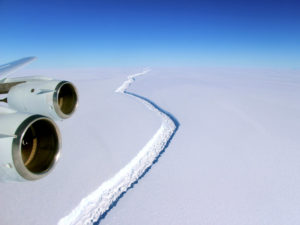
Antarctica Larsen C Ice Crack

In January of 2017, a UK research team discovered a huge increase in a massive 90-mile crack running through the Larsen C shelf (pictured to the right). The crack might soon split off a chunk of ice the size of Delaware. Larson C is part of Eastern Antarctic. Larson A and Larson B have already collapsed.

The Western Antarctic Ice Sheet (WAIS) is the segment of the continental ice sheet that covers West Antarctica. The melting of the West Antarctic ice sheet alone would raise global sea levels by more than 20 feet, according to researchers from the British Antarctic Survey. Over the last several years, WAIS has become unstable. A 2016 study by Khazendar, Rignot, and others adds to the mounting evidence that the threshold for an irreversible disintegration has begun.

“It’s generally accepted that it’s no longer a question of whether the West Antarctic Ice Sheet will melt, it’s a question of when,” said leader Ian Howat, associate professor of earth sciences at Ohio State in a 2016 study published in the journal Geophysical Research Letters. “This kind of rifting behavior provides another mechanism for rapid retreat of these glaciers, adding to the probability that we may see significant collapse of West Antarctica in our lifetimes.”

Ice calving is the breaking of ice chunks from the edge of a glacier. Calving causes mini-tsunamis daily in Antarctica.

The Thwaites Glacier is of great concern. Thwaites Glacier is an unusually broad and fast Antarctic glacier flowing into Pine Island Bay. As the warming temperature of sea water melts the bottom of the glacier, it allows water to enter underneath the ice. A University of Washington study determined that the Thwaites Glacier will gradually melt, leading to an irreversible collapse over the next 200 to 1000 years.

bookmark_borderFlood Insurance and Rising Sea Levels

by Daniel Brouse

Q: Who pays for flood insurance?
A: The United States government, FEMA, covers losses for people that pay flood insurance premiums.

Q: Does your homeowners insurance policy cover you in the event of flooding?
A: No.

Flood insurance coverage is very limited. For instance, basements and belonging in a basement are not covered. Life-time coverage is also limited. If a property has a pay-out in the past, it will be applied to the maximum coverage of the life-time coverage.

As climate change causes extreme weather events and the sea level to rise, houses that are prone to flooding will find it harder and harder to get flood insurance. Without flood insurance, properties located in a flood plain become almost impossible to sell.

For years, the casinos in Atlantic City, NJ have had a plan to float the casinos and move them westward as the sea level rises. Shipping ports face a similar problem, but how can you move a port inland? Coastal areas will need to start a constant and progressive movement to higher ground.

Freddie Mac mortgage says, “Insurance is an essential component of real estate transactions, and flood insurance currently makes it possible to obtain loans for homes in areas of identified flood risk. However, some of the varied impacts of climate change—rising sea levels, changing rainfall and flooding patterns, increasing temperatures—may not be insurable. As a result, some important features of housing finance may have to change. The potential impact of these systemic changes on the financial system is difficult to visualize today.” (More from this article.)

Flood Insurance Index
Global Warming Index

bookmark_borderBottom Of The Ocean Trashed

by Daniel Brouse

EARTH — How much of the Earth have humans polluted? Scientists sent robots to the bottom of the ocean… deeper than man has ever explored. The findings are disturbing.

“We often think deep-sea trenches are remote and pristine, untouched by humans,” says Alan Jamieson, a deep-ocean researcher at the University of Aberdeen, UK. “It’s even higher than in the estuaries of two of the most polluted rivers — the Pearl River and the Liao River — in China.”

“Crustaceans at depths of 10,000 metres contain higher concentrations of chemicals than do some animals in coastal waters.”

The small animals retrieved from the ocean’s bottom contained PCB’s (polychlorinated biphenyls used to make plastics and as anti-fouling agents to stop barnacles from growing on ships’ hulls), as well as, flame retardants (polybrominated diphenyl ethers, PBDEs).

“It’s really surprising to find pollutants so deep in the ocean at such high concentrations,” said Jeffrey Drazen, a marine ecologist at the University of Hawaii.

The findings raise concern about how microbial activities are adversely affected, the impact on the carbon cycle and climate change.

bookmark_borderProtectionism: The Costs and Benefits of Trade Wars

by Daniel Brouse

Protectionism is the theory or practice of shielding a country’s domestic industries from foreign competition by restricting imports. There are no known benefits to protectionism. The costs of protectionism include being financially destructive, negatively impacting health and wellness, as well as, causing death. (also see: )

Following are a few examples:

GOLDEN RICE AND THE TRANS PACIFIC PARTNERSHIP
Trade restrictions are often put on agricultural products in an effort for a country to protect its farmers. The result is to harm the general population. Rice is a good example of a crop that is widely protected by trade restrictions. USA Rice states, “The barriers range from ongoing phytosanitary restrictions by Colombia on imports of U.S. paddy rice; a discriminatory and very complex tariff regime in the EU; the trade distorting impact of Thailand’s rice support program; government management of rice imports in Japan and Taiwan; and Korea’s new rice import regime.”

The United States Patent and Trademark Office stated, “Despite current interventions, vitamin A deficiency is the leading killer of children globally (2-3 million annually) and also the leading cause of childhood blindness (500,000 cases annually). Most cases arise in Asia where the staple food eaten by 3.5 billion people daily, white rice, lacks vitamin A sources typically found in meat and leafy vegetables. These deaths and blindness are preventable.”

In 2015, Golden Rice won a humanitarian award. Not only is Golden Rice more nutritious than white rice, it is also less harmful to the environment (since less of it needs to be grown.) There are numerous health benefits from Golden Rice including β-Carotene that provides vitamin A to children. It is estimated that millions of children’s lives could be saved and childhood blindness could be dramatically reduced.

The Trans-Pacific Partnership Agreement (TPP) would have eliminated trade restrictions on Golden Rice by the participating countries.

1930 SMOOT-HAWLEY TARIFF ACT
The Tariff Act of 1930 was signed into law on June 17, 1930 by President Herbert Hoover. The act raised U.S. tariffs on over 20,000 imported products. The tariffs imposed an effective tax rate of 60% on many of the goods. The Act also started a trade war with America’s trading partners resulting in reduced American exports and imports by more than 50% contributing to The Great Depression.

Historians estimate at least 3 million civilians died from the Great Depression in the United States, mostly young children, the elderly and women. The main causes were:

  1. malnutrition
  2. infectious disease
  3. attempted child birth
  4. starvation
  5. suicide

THE SHOE TAX
The shoe tax is a remnant of the Smoot–Hawley Act. United States’ shoe tariffs are 10 times higher than the average U.S. tariff rate. According to the U.S. International Trade Commission, in 2011 shoes accounted for 1 percent of merchandise imports, but  provided 7.9 percent of U.S. tariff revenue.

Regressive taxes disproportionately hurt the poor. A regressive tax “imposes a greater burden (relative to resources) on the poor than on the rich.” The money paid in taxes has a larger impact on the ability of lower-income households to satisfy their basic needs, like food, clothing, healthcare and shelter.

PHARMACEUTICAL TARIFFS
In 2006 the WTO said scrapping the tariffs on medicines and drug ingredients would result in “effective action to improve access to medicines and medical devices needed to treat a wide variety of diseases effectively and ensure that these goods reach patients expeditiously at a lower cost.”

“It is ironic that many of the countries that are in urgent need of cheap medicines also have a significant tax added to drugs and medical devices they import,” said Peter Allgeier, the US ambassador to the WTO.

The National Institute of Health stated:
A group of countries, including members of the European Union, Canada, the United States, Japan, Switzerland, and Norway, agreed to eliminate import tariffs on thousands of finished drugs and intermediate ingredients in the Uruguay round trade talks between 1986 and 1994. As a result, out of an average global trade in drugs worth $145bn between 1999 and 2001, $114bn was covered by the initiative. But almost $33bn is still subject to duty, the joint proposal noted.

AL-SHIFA PHARMACEUTICAL FACTORY
Operation Infinite Reach was the codename for an American cruise missile strike on a pharmaceutical plant in Sudan. After helping Sudan build a pharmaceutical factory, the United States blew it up. Initially, the U.S. claimed the plant was making chemical weapons. Eventually, the U.S. admitted there was no evidence the plant was making chemical weapons. The side-effects to the local population included:

  • no supplies of chloroquine (the standard treatment for malaria)
  • relief workers fleeing the country resulting in starvation
  • fostering the attack of 9/11

The trade disruption is estimated to have killed or maimed hundreds of thousands of people many of which were children.

BABY FORMULA IN CHINA
For years China had stiff tariffs on imported baby formula. The lack of competition forced the price higher and the quality lower. In 2012, China’s consumer quality regulator found an “unusual amount” of mercury in baby formula produced by Yili Industrial Group Co. “At present, the country has no standards on mercury limits in milk powder. But to be responsible to consumers, the company decided to recall all related products,” said the company.

It is unclear how many children have been malnourished or poisoned due to China’s trade policy. Under free-trade agreements, such as the TPP, countries can not put tariffs on the product and the product must meet the health and safety standards of the USA.

bookmark_borderTrade War! What Is It Good For?

By Daniel Brouse

International Economics 101
What do you think of when you hear the term “trade war”?
The costs and benefits to society are very similar to traditional warfare.
1) Financial Cost. A war is expensive. In a trade war, huge tariffs are placed on the purchase of imports. A tariff is a sales tax paid for by the citizen. Quite often this tax can be as high as 45% or the product even banned altogether. The tax is paid by the citizen to their government. The financial loss from the in-efficiency of paying large taxes is a tremendous burden on the country’s own citizens. In addition, there are usually large costs to the private sector. These costs can include high interest rates, inflation and loss of value to liquid assets. The standard of living declines.
2) Casualties / Loss Of Life. Millions of people are maimed or die in a trade war. The easiest examples in recent history would be the impacts on baby formula or pharmaceuticals. Hundreds-of-thousands of children, as well as, adults in need of medication died because these items were targeted in trade wars. Another example is maiming children by targeting vitamin A (causing childhood blindness.) Typically, trade wars impact the most vulnerable first — babies, the sick and the elderly.

bookmark_borderThe Demise Of The USA: Will China Takeover?

By Daniel Brouse

UNITED STATES — President Trump has done more to damage the environment in his first days of office than any President in history. He has pledged to withdraw from the Paris treaty. The Paris Treaty was the most extensive agreement to address climate change and the first time China and India joined-in. Also, in the first hour of his administration all references to global warming and climate change were removed from WhiteHouse.gov. In addition, the website promoted the increased use of fossil fuels. Then on his first full day in office, Trump signed an executive order to withdraw from the The Trans-Pacific Partnership Agreement (TPP).

The TPP was a trade agreement negotiated by twelve countries: Australia, Canada, Japan, Malaysia, Mexico, Peru, United States, Vietnam, Chile, Brunei, Singapore, and New Zealand.

One of the largest benefits of the TPP would have been protecting the environment. Participating countries will need to adopt tougher pollution standards similar to the USA. “TPP includes the most robust enforceable environment commitments of any trade agreement in history,” according the United States. “TPP requires countries to play by fair environmental rules if they want to send their goods to the United States, and upgrades NAFTA by putting fully enforceable environment obligations at the core of the agreement.” In addition, TPP helps improve conditions on the ground in TPP countries by requiring them to:
* Fulfill their obligations under the Convention on International Trade in Endangered Species of Wild Fauna and Flora (CITES) to protect and conserve iconic species, such as rhinos and elephants.
* For the first time in any trade agreement, prohibit harmful fisheries subsidies, including those that contribute to overfishing, and work to restrain new subsidy programs or enhancements to existing subsidy programs.
* Combat illegal fishing, promote sustainable fisheries management practices, and protect wetlands and important natural areas.
* Promote the long-term conservation of whales, dolphins, sharks, sea turtles, and other marine species at risk.
* Combat wildlife trafficking, illegal logging, and illegal fishing through enhanced national and regional actions.
* Protect the marine environment from ship pollution, including by implementing their obligations under MARPOL (an international agreement to prevent marine pollution).

Now that the USA is pulling out, world leaders are considering China to replace the USA — a move that would backfire in Trump’s face.

bookmark_borderHottest Year

By Daniel Brouse
For The Human Induced Climate Change Experiment

2016 was Earth’s warmest year in at least the last 125,000 years. It marks the third record year in a row.

NOAA reported, “The globally averaged temperature over land and ocean surfaces for 2016 was the highest among all years since record keeping began in 1880. During the final month, the December combined global land and ocean average surface temperature was the third highest for December in the 137-year record . During 2016, the globally-averaged land surface temperature was 2.57°F (1.43°C) above the 20th century average. This was the highest among all years in the 1880–2016 record, surpassing the previous record of 2015 by 0.18°F (0.10°C).”

Experts believe that a 1.5°C to 2°C increase is a tipping point that could make global warming irreversible. The 1.43°C increase is of grave concern.

Arctic ice also reached a record low. “Recent trends in the decline of Arctic polar sea ice extent continued in 2016.” The estimated average annual sea ice extent in the Arctic was approximately 3.92 million square miles. The smallest annual average on record.

bookmark_borderLosing 10 Billion Trees Per Year

Part of the study Foliage Spoilage & the Trees’ Canopy Collapse

Thomas Crowther is a Yale Climate & Energy Institute postdoctoral fellow at the Yale School of Forestry & Environmental Studies (F&ES) and led a study and census of the world’s trees (2015). The study determined there are 3 trillion trees on Earth; however, the study also estimates we are losing 10 billion trees per year.