bookmark_borderFlorida Insurance Regulators Taking an “unprecedented” and “extraordinary” Step

The St. Lucie News Tribune reports:

Florida insurance regulators are taking an “unprecedented” and “extraordinary” step to try and prevent tens of thousands of homeowners from being forced to look for new property insurance coverage if rating agency Demotech follows through on plans to downgrade many Florida carriers.

The Florida Office of Insurance Regulation announced a plan Wednesday to provide companies that are downgraded with reinsurance coverage through state-run Citizens Property Insurance.

The dramatic decision to assume financial responsibility for a raft of struggling insurers underscores the dire circumstances Florida is facing as a large portion of its homeowners insurance market teeters on the brink of collapse.

Downgrading so many companies could wreak havoc in the state, causing big problems for homeowners and the real estate industry.

Mortgage giants Fannie Mae and Freddie Mac require borrowers to have a home insurance policy from a highly-rated company. Florida’s home insurance market is dominated by smaller companies that only get ratings from Demotech, giving the company significant sway in the industry.

“Fannie Mae and Freddie Mac each offer an exception to the financial rating requirements for an insurer that is covered by a reinsurer who assumes, by endorsement, 100 percent of the insurer’s liability for any covered loss payable, but unpaid by the insurer, by reason of insolvency,” the release states.

Gov. Ron DeSantis said Wednesday that it makes sense to use Citizens as a financial backstop for insurers, because if the companies are downgraded many of their policies would ultimately flow into Citizens – the state’s insurer of last resort.

“If the companies get downgraded and they have to shed policies those will end up going on Citizens anyway, so the exposure to Citizens is more to take on the policies than it will be to act as a reinsurer of last resort,” DeSantis said during a press conference in Tampa.

Reinsurance is insurance for insurance companies. By providing such coverage, Citizens would be on the hook to pay the claims if the downgraded insurers aren’t able to meet their financial obligations. Spiking reinsurance costs have contributed to the home insurance industry’s problems in Florida, which is heavily reliant on such coverage.

The additional reinsurance coverage comes on top of a $2 billion rescue fund approved by state lawmakers during a special session earlier this year. That fund provides reinsurance at no cost to Florida insurers. It was part of a package of reforms intended to stabilize the insurance industry.

Demotech had planned to release its ratings revisions on Tuesday, but said in a statement provided to USA TODAY Network – Florida that it is taking more time to update the ratings.

“As the current regulatory climate has become hostile and negative and we have and will expend a significant effort creating responses to third party letters, we will be taking additional time to review information and consider the issues affecting the companies operating in Florida,” the statement reads.

More articles on Flood Insurance, Rising Sea Levels and Global Warming.

bookmark_borderImmigration and the Wage Inflation Spiral

An important factor in our inflation situation is immigration.

The US has stagnant population growth (as does the UK, EU, etc. Japan has a declining population.)

During the Trump administration, the US drastically curtailed immigration. The Biden administration continues to do so today.

The result has been wage inflation. The wage inflation that started in 2018 began the overall inflation spiral that continues today.

A wage inflation spiral happens when the initial wage inflation is canceled out by the price inflation requiring further wage inflation to keep up with the price inflation… the increase prices require more wage inflation for employees to keep pace with the cost of living… the subsequent rise in wages results in the need to raise prices to pay the workers… and round and round we go.

The solutions are to either increase our population (through immigration) and/or increase our productivity by eliminating the need for humans.

How the Inflation Spiral Started: Immigration
The Trump administration’s policy on immigration and building The Wall have a devastating impact on the economy. The U.S. economy is a capitalistic system based on population growth. The birth rate in America is close to zero percent. In order to maintain the standard of living, the country needs to gain millions of people through immigration. The Trump policies have attempted to eliminate immigration.
— Daniel Brouse (2020)

* “Over the course of four years, the Trump administration set an unprecedented pace for executive action on immigration, enacting 472 administrative changes that dismantled and reconstructed many elements of the U.S. immigration system. Humanitarian protections were severely diminished. The U.S.-Mexico border became more closed off. Immigration enforcement appeared more random. And legal immigration became out of reach for many. All of this was accomplished nearly exclusively by the executive branch, with sweeping presidential proclamations and executive orders, departmental policy guidance, and hundreds of small, technical adjustments.” — Migration Policy Institute’s Four Years of Profound Change (2022>

* “After years of wage stagnation, we are finally seeing rising wages,” Donald Trump (State of the Union 2018)
“The Employment Cost Index, a measure of salary and benefit costs, registered a 2.6 percent gain for the full year, tied for the best since 2007.” — CNBC (January 31, 2018)

* From December of 2020 through January of 2022, nominal wages and salaries were up 4.5 percent, the fastest increase since 1983. — Bureau of Labor Statistics (BLS)

ALSO SEE:
The True Costs (and Benefitlessness) of a Trump Economy
The Economic Monsters: Inflation and Interest Rates

bookmark_borderCost of Property Insurance in Florida

Florida Politics reports in their article, As climate in Florida sets ‘new normal,’ cost of property insurance will separate haves, have-nots:

“Insurers believe that due to climate change, this is the new normal. They’re finding that catastrophic and non-catastrophic weather events are increasing in severity every year,” said Paul Handerhan, president of the Federal Association for Insurance Reform, a national nonprofit advocacy organization based in Fort Lauderdale.

The consequences of climate change not only include catastrophic — and increasingly expensive — weather such as hurricanes and wildfires, but also more everyday events such as storms that pelt residential and commercial properties with straight-line wind and hail.

The actuarially sound way to respond to the new normal is to raise rates, reduce coverage, or throw in the towel, as eight property insurance companies in Florida have done since 2018. Just this week, three others asked state insurance regulators to approve hefty rate increases — as high as 49 percent on policyholders not among the tens of thousands who recently lost coverage altogether due to non-renewals.

Over time, Handerhan said, property insurance coverage will become so expensive that only the wealthiest of the wealthy can “afford to live in paradise.”

“This market is completely,100% out of control,” said Barry Gilway, president, CEO, and executive director of Citizens, during the board of governors meeting. “It all has to do with the total collapse of the overall Florida marketplace, and that collapse continues.”

More articles on Flood Insurance, Rising Sea Levels and Global Warming.

bookmark_borderHomeowners Insurance and Extreme Weather Events

Homeonwers insurance is becoming more expensive or even unavailable due to the increase frequency and intensity of extreme weather events caused by climate change.

NOLA newspapers reports:
Louisiana’s homeowners insurance market straining under weight of 600,000 claims
Two active Atlantic hurricane seasons in a row have made some insurers insolvent.

It’s the latest sign of a deepening crisis taking shape once again in Louisiana, where the legacy of Hurricane Katrina and other storms still looms large. As big national insurers pulled out of coastal areas in the southeast, homeowners increasingly relied on less-regulated regional insurance providers to make them whole in case of catastrophe. Now, even some of those companies — once willing to make a risky bet — are leaving.

In Calcasieu Parish, nearly three out of every four occupied homes filed an insurance claim after Hurricane Laura, according to a Times-Picayune analysis of state and census data. One in four filed claims again less than two months later after Delta made landfall about 10 miles west of where Laura came ashore.

Failures not ‘anomalies’
The flurry of storms was too much for some insurance companies to bear. The Department of Insurance has already seized control of three firms because they could not afford to pay claims.

“I wish I could say I thought they were anomalies, but I don’t,” said Insurance Commissioner Jim Donelon. He said a fourth insurer that’s in dire financial straits will likely be placed under the care of the Louisiana Insurance Guaranty Association.

“I would say our property insurance market is in crisis,” said Jeff Albright, CEO of the Independent Insurance Agents and Brokers of Louisiana. “The sad part of it is we’re reliant on these small, thinly capitalized companies instead of having large national carriers that have lots of assets and can weather the big storms.”

Donelon said five companies have withdrawn entirely from the state and another five or six have stopped writing policies. As a result, Donelon said he expects the number of policies under Louisiana Citizens to double this year as the state launches headlong into another hurricane season.

More articles on Flood Insurance, Extreme Weather Events and Global Warming.

bookmark_borderClimate Change: Adapt or Die

United Nations Press Release — UN scientists on Monday delivered a stark warning about the impact of climate change on people and the planet, saying that ecosystem collapse, species extinction, deadly heatwaves and floods are among the “unavoidable multiple climate hazards” the world will face over the next two decades due to global warming.

UN-IPCC-Climate-Change-March-2022 PDF

Climate change: a threat to human wellbeing and health of the planet. Taking action now can secure our future

BERLIN, Feb 28 – Human-induced climate change is causing dangerous and widespread disruption in nature and affecting the lives of billions of people around the world, despite efforts to reduce the risks. People and ecosystems least able to cope are being hardest hit, said scientists in the latest Intergovernmental Panel on Climate Change (IPCC) report, released today.

“This report is a dire warning about the consequences of inaction,” said Hoesung Lee, Chair of the IPCC. “It shows that climate change is a grave and mounting threat to our wellbeing and a healthy planet. Our actions today will shape how people adapt and nature responds to increasing climate risks.”

The world faces unavoidable multiple climate hazards over the next two decades with global warming of 1.5°C (2.7°F). Even temporarily exceeding this warming level will result in additional severe impacts, some of which will be irreversible. Risks for society will increase, including to infrastructure and low-lying coastal settlements.

The Summary for Policymakers of the IPCC Working Group II report, Climate Change 2022: Impacts, Adaptation and Vulnerability was approved on Sunday, February 27 2022, by 195 member governments of the IPCC, through a virtual approval session that was held over two weeks starting on February 14.

Urgent action required to deal with increasing risks

Increased heatwaves, droughts and floods are already exceeding plants’ and animals’ tolerance thresholds, driving mass mortalities in species such as trees and corals. These weather extremes are occurring simultaneously, causing cascading impacts that are increasingly difficult to manage. They have exposed millions of people to acute food and water insecurity, especially in Africa, Asia, Central and South America, on Small Islands and in the Arctic.

To avoid mounting loss of life, biodiversity and infrastructure, ambitious, accelerated action is required to adapt to climate change, at the same time as making rapid, deep cuts in greenhouse gas emissions. So far, progress on adaptation is uneven and there are increasing gaps between action taken and what is needed to deal with the increasing risks, the new report finds. These gaps are largest among lower-income populations.

The Working Group II report is the second instalment of the IPCC’s Sixth Assessment Report (AR6), which will be completed this year.

“This report recognizes the interdependence of climate, biodiversity and people and integrates natural, social and economic sciences more strongly than earlier IPCC assessments,” said Hoesung Lee. “It emphasizes the urgency of immediate and more ambitious action to address climate risks. Half measures are no longer an option.”

Safeguarding and strengthening nature is key to securing a liveable future

There are options to adapt to a changing climate. This report provides new insights into nature’s potential not only to reduce climate risks but also to improve people’s lives.

“Healthy ecosystems are more resilient to climate change and provide life-critical services such as food and clean water”, said IPCC Working Group II Co-Chair Hans-Otto Pörtner. “By restoring degraded ecosystems and effectively and equitably conserving 30 to 50 per cent of Earth’s land, freshwater and ocean habitats, society can benefit from nature’s capacity to absorb and store carbon, and we can accelerate progress towards sustainable development, but adequate finance and political support are essential.”

Scientists point out that climate change interacts with global trends such as unsustainable use of natural resources, growing urbanization, social inequalities, losses and damages from extreme events and a pandemic, jeopardizing future development.

“Our assessment clearly shows that tackling all these different challenges involves everyone – governments, the private sector, civil society – working together to prioritize risk reduction, as well as equity and justice, in decision-making and investment,” said IPCC Working Group II Co-Chair Debra Roberts.

“In this way, different interests, values and world views can be reconciled. By bringing together scientific and technological know-how as well as Indigenous and local knowledge, solutions will be more effective. Failure to achieve climate resilient and sustainable development will result in a sub-optimal future for people and nature.”

Cities: Hotspots of impacts and risks, but also a crucial part of the solution

This report provides a detailed assessment of climate change impacts, risks and adaptation in cities, where more than half the world’s population lives. People’s health, lives and livelihoods, as well as property and critical infrastructure, including energy and transportation systems, are being increasingly adversely affected by hazards from heatwaves, storms, drought and flooding as well as slow-onset changes, including sea level rise.

“Together, growing urbanization and climate change create complex risks, especially for those cities that already experience poorly planned urban growth, high levels of poverty and unemployment, and a lack of basic services,” Debra Roberts said.

“But cities also provide opportunities for climate action – green buildings, reliable supplies of clean water and renewable energy, and sustainable transport systems that connect urban and rural areas can all lead to a more inclusive, fairer society.”

There is increasing evidence of adaptation that has caused unintended consequences, for example destroying nature, putting peoples’ lives at risk or increasing greenhouse gas emissions. This can be avoided by involving everyone in planning, attention to equity and justice, and drawing on Indigenous and local knowledge.

A narrowing window for action

Climate change is a global challenge that requires local solutions and that’s why the Working Group II contribution to the IPCC’s Sixth Assessment Report (AR6) provides extensive regional information to enable Climate Resilient Development.

The report clearly states Climate Resilient Development is already challenging at current warming levels. It will become more limited if global warming exceeds 1.5°C (2.7°F). In some regions it will be impossible if global warming exceeds 2°C (3.6°F). This key finding underlines the urgency for climate action, focusing on equity and justice. Adequate funding, technology transfer, political commitment and partnership lead to more effective climate change adaptation and emissions reductions.

“The scientific evidence is unequivocal: climate change is a threat to human wellbeing and the health of the planet. Any further delay in concerted global action will miss a brief and rapidly closing window to secure a liveable future,” said Hans-Otto Pörtner.
bookmark_borderThe Cost of Flood Insurance

An article in the New York Times entitled The Cost of Insuring Expensive Waterfront Homes Is About to Skyrocket states, “Federal officials say the goal is fairness — and also getting homeowners to understand the extent of the risk they face, and perhaps move to safer ground, reducing the human and financial toll of disasters.”

“Subsidized insurance has been critical for supporting coastal real estate markets,” said Benjamin Keys, a professor at the University of Pennsylvania’s Wharton School. Removing that subsidy, he said, is likely to affect where Americans build houses and how much people will pay for them. “It’s going to require a major rethink about coastal living.”

In 2019, FEMA said it would instead price flood insurance based on the particular risks facing each individual property, a change the agency called “Risk Rating 2.0.”

“With a rapidly escalating threat of natural disasters, Risk Rating 2.0 is a much needed and timely change,” said Laura Lightbody of Pew Charitable Trusts, which has pushed governments to better respond to climate threats. Higher insurance costs, she said, were “a reflection of our new, wet reality.”

“For the first time, our policyholder premiums will be based on their individual risk,” said David Maurstad, who runs the flood insurance program at FEMA. “We pledge to continue to evaluate and make adjustments where and when it’s warranted.”

But the growing threat of climate change may make that kind of intervention less successful, said Roy Wright, who ran the flood insurance program until 2018 and now runs the Insurance Institute for Business & Home Safety.

“We cannot hide the truth of this increasing risk,” Mr. Wright said. “We shouldn’t hide it. Tell people the truth.”

More articles on Flood Insurance, Rising Sea Levels and Global Warming.

bookmark_borderNational Flood Insurance Program Increasing Rates

FEMA is updating the National Flood Insurance Program’s (NFIP) risk rating methodology through the implementation of a new pricing methodology called Risk Rating 2.0. The methodology leverages industry best practices and cutting-edge technology to enable FEMA to deliver rates that are actuarily sound, equitable, easier to understand and better reflect a property’s flood risk.

The Bradenton Herald reports, “More than a million Floridians will see their flood insurance premium rise next year, FEMA said Thursday.

The good news is, most will see increases of less than $120 a year. The bad news is that homeowners will likely see annual rate hikes like that for the foreseeable future.

The new strategy is meant to help pull the program out of its $20 billion debt and encourage people to live in safer, less flood-prone homes.

The new program will stop charging flood insurance premiums based solely on whether a home is within or outside of a flood zone and instead consider a range of factors like distance from the ocean, rainfall flooding and the cost to rebuild a home.

Starting April 2022, this pricing revamp will lead to higher prices for a majority of Florida’s 1.7 million policyholders — the most of any state — as well as a decrease for about 20% of policies, more than 340,000 policyholders.

“It allows us to set accurately sound rates and communicate flood risk better than we ever have before,” David Maurstad, senior executive of FEMA’s National Flood Insurance Program.

More articles on Flood Insurance, Rising Sea Levels and Global Warming.

bookmark_borderThe Federal Reserve, the Treasury, and You

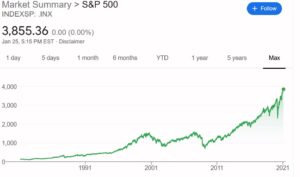
S&P 500 Rise since Fed and Treasury Intervention
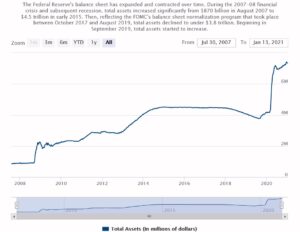
Federal Reserve Bank Balance Sheet 2020

We were talking about a graph of the record high stock market… and, I said:
You definitely need to keep this graph with it… the main reason the stock market is at this level is because the Federal Reserve has been buying stocks and bonds… lots of them. (That’s over 7 trillion pictured in the graph.) The old, bankers’ saying is “you can’t fight the fed”.

You asked: So, what will happen next?

I replied:
It all depends on how long the Fed can print money. A goodly portion of the bond and equity markets are owned by the Fed. (aka us / socialism / communism) . The US can do this because the dollar is the world reserve currency. Unfortunately for us, the Trump administration has put the dollar’s status in jeopardy. My guess is we have some time… until the dollar implodes. When the dollar implodes, the artificially inflated real estate, bond, and equity markets will collapse. Something like the next 10-20 years all your assets will be worthless.

You asked: do you think Janet will be Yellen and Screamin’ about this practice?

I replied:
Sad to say, no. The gov’t started propping up the private sector in 2008-2009. That was suppose to unwind. There was no unwinding under Yellen…. the real unwinding was suppose to happen under Trump. In 2017, the unwinding stopped… in 2020, the spigot was opened wide and trillions more were pumping in. Now, it is essential to keep the markets from collapsing. Thus, I expect Yellen will be forced to “Buy high and sell low”. Obviously, a failing investment practice.

ETFs are stocks as are Fannie Mae, Freddie Mac, and Ginnie Mae. Nobody knows exactly what the Fed buys, but it is widely believed the Fed started buying S&P 500 ETFs in 2020. In any event, 7 trillion in public and private debt and equities has a significant impact on artificially inflating real estate and the stock market.

You replied:
I understand it as “ETF’s” are “Exchange Traded Funds” and can be ANY investment vehicle.
To your point the Fed is documented to have made ETF Corporate Bond purchases last year …
What I could use your help on is in seeing how the (to Tom’s point) rather nominal $8 billion purchase is causing the dramatic effect seen in the graph.

I responded:
Yes. “An exchange-traded fund is a type of investment fund and exchange-traded product, i.e. they are traded on stock exchanges as stocks.” The reason(s) it bolsters the stock market include: purchases of corporate bond ETFs; purchase of equity based ETFs; purchase of specific corporate debt (eg Amazon, VISA, Kroger); most importantly the lowering of interest rates so that corporations can borrow money at near zero percent and use the money to purchase back their own stock. These are just a few ways the FED is propping up the stock market. Less direct but just as significant is the inflation of real estate (through purchase of mortgage backed securities.) The inflated value of real estate gives individuals the ability to invest (or not cashout) in the stock market. That is to say, if real estate was not inflated right now, people would be cashing out their 401k and IRAs to survive.

The Fed started doing these dirty deals in 2008. When I say dirty deals, I mean using their authority to maintain liquidity in the markets to interfere in private assets and equity. Since 2008, they have gone further and further over the line. In 2008-2009 it was focused mainly on real estate and large purchases (automobiles). In 2020, the Fed added direct and indirect ownership in corporations. For instance, airline debt… $2.2 million in Southwest Airlines debt. This allowed Southwest to borrow billions to keep afloat during the pandemic. Here is an article that explains a lot of it… “the Federal Reserve announced the deployment of additional “tools to support households, businesses, and the U.S. economy overall in this challenging time.” “Overall, $1 trillion in investment-grade bonds have been issued this year, nearly as much as all of 2019, along with tens of billions more in junk bonds from risky companies, which the Fed has also signaled that it would purchase.”

Something that is very important to consider… what is the difference between owning stock in the corporation or junk bonds issued by that corporation? That is to say, what happens to the Fed’s asset when the corporation goes bankrupt? What happens to the Fed’s good bonds when that company is taken over?

You said:
Something we should all remember … zooming back on the nation with a fresh alien perspective is a great exercise and skill …
We have a median household income barely budge since 1980 even after the majority of households went to duel income. It’s about 62,000 against 300% increases in real estate, health insurance and college costs …
Meanwhile market capitalization, cash reserves and productivity for corporations skyrocketed and the wealth gap of a tiny minority of both private individuals and elected officials skyrocketed …
To say “nothing to see here” is impossible if you look from afar …
This is one thing, the Fed, we can focus on for a better understanding. Thanks Daniel Brouse for initiating the discussion.

I add:
Agreed. The best case scenario for the USA would be to eliminate all existing Federal taxes. Establish a Federal pollution tax. Give every American 40k/year stipend.

The FED really does openly keep 2 sets of books. In general, both the Treasury and the Fed do not want to publicly disclose exactly what they are doing. 1) they don’t want to endanger private companies or industries by giving the impression that a company is in trouble 2) they don’t want the markets to undermine their efforts by trying to profit from their actions. A public example of this is in 2008-2009 when all the big banks were forced to take TARP money… whether they needed it or not. [The Fed and the Treasury have two sets of books… one for the public and one that is classified. It’s why we don’t know what stocks they are buying.)

“Making matters worse, the proportion of buybacks funded by corporate bonds reached as high as 30% in both 2016 and 2017,” according to JP Morgan Chase.

The Fed is buying stocks and bonds. And, the Fed is in cahoots with the Treasury (where do you think the Treasury borrows the money from?) The Fed has purchased trillions of dollars in direct and indirect purchase of stocks and bonds. It started in 2008 and continues to this day. US citizens have ownership in many airlines, cruise ships, real estate, General Motors, Chrysler, a multitude of banks and mortgage companies, insurance companies, and much more. That is not to mention the billions and billions lent to corporations to buy back their own stocks. This is the Fed’s money buying stocks. This is The Fed using the money multiplier to bolster the stock market since 2008.

You ask:
I tried to find data on the “stocks” you are referring to and can’t … does one of the articles you attached above have info.

This also pulls in my skepticism that the media is covering everything it should be … but I just can’t find any info so I could use sources.

I reply:

Yes. You can find out about many of the stocks owned by the government. It is a bit tangled. But, you can follow the money. Ask where the money to purchase the assets comes from? A: The Fed. Corporations and the Treasury obtain near zero interest rate money from the Fed. So, in many cases, how the Fed pays for the stocks becomes obscured. It often takes the private sector years so figure out the cash flow. We don’t know that much about 2020… except what was revealed in the CARES act, as well as, the pattern of stock buy backs (there was a big dip in buy backs in the 2nd quarter that coincides with the stock market.) You will have to dig a bit to find the names of the stocks… but they include airlines (Alaska Airlines, Allegiant Air, American Airlines, Delta Air Lines, Frontier Airlines, Hawaiian Airlines, JetBlue Airways, United Airlines, SkyWest Airlines, and Southwest Airlines), cruise ships, and supply chain companies like Amazon and Kruger. Some of the stock buybacks that lineup with the market include MGM, Best Buy, Qualcomm, Kansas City Southern, Lennar, Cummins and Xerox. The acquisition of stocks and stock options from earlier periods has been better routed out by analysts… all of the companies listed in “red” are all on the list: https://projects.propublica.org/bailout/list

You wondered: Am I missing something … these appear to be loans, not stock purchases, yes?

I explain: In 2008 the Federal Reserve and the Treasury colluded on circumventing the restriction on the both the Fed and the Treasury. Now, they are working in concert. You can no longer differentiate between the Fed and the Treasury. Quantitative Easing (QE) and the Troubled Asset Relief Program TARP) completely changed how things worked. (You can see it in the original chart above.) In most instances, the Treasury enters into stock ownership agreements and uses the Fed’s money to complete the deal. So, is it the Fed? or is it the Treasury? is the wrong the question… the right question is “Is it the Fed and treasury? The answer is yes. Now, most of the purchases/deals are under the CARES act. This is in addition to the Fed’s direct investment in public and private bonds, as well as, equities. The Fed is buy ETF’s and individual stocks, as well as… but the public can not find out exactly which ones.

It is very convoluted and in my opinion illegal. Neither the Fed nor the Treasury should be intervening / competing in the private markets. It costs the average citizen a lot of money.

The simplest way to explain is comparing it to an individual trading options with a margin account. In this scenario, the Treasury would be the account holder and the Fed would be the broker — “Buying on margin involves borrowing money from a broker to purchase stock. A margin account increases your purchasing power and allows you to use someone else’s money to increase financial leverage. Margin trading confers a higher profit potential than traditional trading but also greater risks.”

The most important part might be to start with the fact that there should be NO assets on the Fed’s balance sheet. The Fed is suppose to be the banks’ bank… regulating banks to maintain their liquidity and control inflation. Q. Is the Fed part of the government? A. No. The Federal Reserve Banks are not government agencies. The Federal Reserve is quasi-governmental. The Fed is not suppose to lend money to anyone other than member banks and only “overnight” to meet reserve requirements. (Reserve requirements are suppose to be to ensure banks remain solvent.)

Though this is not rocket science, it is convoluted high finance shell games. Very similar to investigating money laundering.

Economics and civics should be taught in every grade K-12 IMHO

bookmark_borderDaniel Brouse: About the Author

Q: Any background on membrane .com?

A: In 1994, I started a publishing company with another scientist (low temperature physicist and co-builder of the Ohio States supercomputer). The name of the publishing company is The Philadelphia Spirit Experiment. As the name suggests, it is a scientific experiment in the publishing of arts and science. At the time, domain names were free and the world wide web was 6 months old. We wanted a name that both rhymed and made a good scientific pun — everything passes through the Membrane Domain. The KingArthur.com anti-IQ test launched in 1995.

We were the first record company, fine arts, science, technology, math, and engineering publisher on the web. As such, we were the first to analize web traffic. Our monthly audience is over 300 million. Innovations include: the clickable button on a webpage, MP3 distribution, pay-per-download, free streaming music, the web-based video… and interactive games to save the planet (including a $1,000,000 prize to solve the Anthropogenic Global Warming problem.

My areas of expertise include: musicology, geology, meteorology, anthropology, biology, health & wellness, sociology, security, climate change, physics, finance, economics, statistics, computer science, data science, chaos theory, political science, publishing, logic, and philosophy. In general, my aptitude is in science, technology, engineering, and math.

— Daniel Brouse

bookmark_borderAssessing Climate Risk

The LA Times reports,”The municipal bond market looks to satellites to help assess climate risk”

The $3.8-trillion municipal-bond market has found a new tool in its effort to understand the effects of climate change: satellites orbiting Earth.

Assessing climate risks is a particularly vexing problem given that U.S. state and local governments tend to give investors information that’s too little or just too late. But the use of geospatial data and information from sources such as Google Earth could help municipal bond investors evaluate and price the risks posed from a warming climate, rising sea levels and natural disasters.

“Largely, finance lives in columns and rows in Excel spreadsheets — climate change is not a row-and-column exercise,” said Chris Goolgasian, director of climate research at Wellington Management, a Boston asset manager that uses mapping technology to consider the effects of climate change on investments including municipal bonds. “It’s much more powerful to see it visualized.”