bookmark_borderHow to Make Gold & Platinum

by Daniel Brouse

Q: How do you make gold and platinum?
A: Collide two neutron stars

“It’s so beautiful. It’s so beautiful it makes me want to cry. It’s the fulfillment of dozens, hundreds, thousands of people’s efforts, but it’s also the fulfillment of an idea suddenly becoming real,” said Peter Saulson of Syracuse University.

Not only does a collision of neutron stars create heavy metals, it also causes a wrinkle in space-time. Gravitational waves had been an Albert Einstein theory until 2015. Since then, there have been three recordings of gravitational waves; however, they were all colliding black holes. This was the first recording of gravitational waves in light.

The observation was made by LIGO:
Laser Interferometer Gravitational-Wave Observatory
Supported by the National Science Foundation
Operated by Caltech and MIT

Gravitational waves are ripples in the curvature of spacetime that are generated in certain gravitational interactions and propagate as waves outward from their source at the speed of light. The possibility of gravitational waves was discussed in 1893 by Oliver Heaviside using the analogy between the inverse-square law in gravitation and electricity. In 1905 Henri Poincaré first proposed gravitational waves (ondes gravifiques) emanating from a body and propagating at the speed of light as being required by the Lorentz transformations. Predicted in 1916 by Albert Einstein on the basis of his theory of general relativity, gravitational waves transport energy as gravitational radiation, a form of radiant energy similar to electromagnetic radiation. Newton’s law of universal gravitation, part of classical mechanics, does not provide for the existence of gravitational waves, since that law is predicated on the assumption that physical interactions propagate at infinite speed—showing one of the ways that the methods of classical physics is unable to explain phenomena associated with relativity.

GW170817 Press Release

LIGO and Virgo make first detection of gravitational waves produced by colliding neutron stars

Discovery marks first cosmic event observed in both gravitational waves and light.

Watch the recording of a press conference announcing the discovery, at the National Press Club in Washington, DC:

Watch the recording of a seminar at Caltech titled “Seeing and Hearing the Cataclysmic Universe” following the announcement:


For the first time, scientists have directly detected gravitational waves — ripples in space-time — in addition to light from the spectacular collision of two neutron stars. This marks the first time that a cosmic event has been viewed in both gravitational waves and light.

The discovery was made using the U.S.-based Laser Interferometer Gravitational-Wave Observatory (LIGO); the Europe-based Virgo detector; and some 70 ground- and space-based observatories.

Neutron stars are the smallest, densest stars known to exist and are formed when massive stars explode in supernovas. As these neutron stars spiraled together, they emitted gravitational waves that were detectable for about 100 seconds; when they collided, a flash of light in the form of gamma rays was emitted and seen on Earth about two seconds after the gravitational waves. In the days and weeks following the smashup, other forms of light, or electromagnetic radiation — including X-ray, ultraviolet, optical, infrared, and radio waves — were detected.
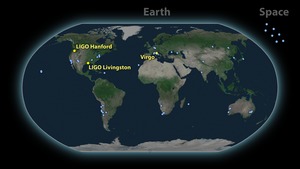
GW+EM Observatories Map

GW170817: A Global Astronomy Event

The observations have given astronomers an unprecedented opportunity to probe a collision of two neutron stars. For example, observations made by the U.S. Gemini Observatory, the European Very Large Telescope, and the Hubble Space Telescope reveal signatures of recently synthesized material, including gold and platinum, solving a decades-long mystery of where about half of all elements heavier than iron are produced.

The LIGO-Virgo results are published today in the journal Physical Review Letters; additional papers from the LIGO and Virgo collaborations and the astronomical community have been either submitted or accepted for publication in various journals.

“It is tremendously exciting to experience a rare event that transforms our understanding of the workings of the universe,” says France A. Córdova, director of the National Science Foundation (NSF), which funds LIGO. “This discovery realizes a long-standing goal many of us have had, that is, to simultaneously observe rare cosmic events using both traditional as well as gravitational-wave observatories. Only through NSF’s four-decade investment in gravitational-wave observatories, coupled with telescopes that observe from radio to gamma-ray wavelengths, are we able to expand our opportunities to detect new cosmic phenomena and piece together a fresh narrative of the physics of stars in their death throes.”


A stellar sign

The gravitational signal, named GW170817, was first detected on Aug. 17 at 8:41 a.m. Eastern Daylight Time; the detection was made by the two identical LIGO detectors, located in Hanford, Washington, and Livingston, Louisiana. The information provided by the third detector, Virgo, situated near Pisa, Italy, enabled an improvement in localizing the cosmic event. At the time, LIGO was nearing the end of its second observing run since being upgraded in a program called Advanced LIGO, while Virgo had begun its first run after recently completing an upgrade known as Advanced Virgo.

Gravitational-Wave Observatories Across the Globe

Current operating facilities in the global network include the twin LIGO detectors—in Hanford, Washington, and Livingston, Louisiana— Virgo in Italy and GEO600 in Germany.

The NSF-funded LIGO observatories were conceived, constructed, and operated by Caltech and MIT. Virgo is funded by the Istituto Nazionale di Fisica Nucleare (INFN) in Italy and the Centre National de la Recherche Scientifique (CNRS) in France, and operated by the European Gravitational Observatory. Some 1,500 scientists in the LIGO Scientific Collaboration and the Virgo Collaboration work together to operate the detectors and to process and understand the gravitational-wave data they capture.

Each observatory consists of two long tunnels arranged in an L shape, at the joint of which a laser beam is split in two. Light is sent down the length of each tunnel, then reflected back in the direction it came from by a suspended mirror. In the absence of gravitational waves, the laser light in each tunnel should return to the location where the beams were split at precisely the same time. If a gravitational wave passes through the observatory, it will alter each laser beam’s arrival time, creating an almost imperceptible change in the observatory’s output signal.

On Aug. 17, LIGO’s real-time data analysis software caught a strong signal of gravitational waves from space in one of the two LIGO detectors. At nearly the same time, the Gamma-ray Burst Monitor on NASA’s Fermi space telescope had detected a burst of gamma rays. LIGO-Virgo analysis software put the two signals together and saw it was highly unlikely to be a chance coincidence, and another automated LIGO analysis indicated that there was a coincident gravitational wave signal in the other LIGO detector. Rapid gravitational-wave detection by the LIGO-Virgo team, coupled with Fermi’s gamma-ray detection, enabled the launch of follow-up by telescopes around the world.

The LIGO data indicated that two astrophysical objects located at the relatively close distance of about 130 million light-years from Earth had been spiraling in toward each other. It appeared that the objects were not as massive as binary black holes — objects that LIGO and Virgo have previously detected. Instead, the inspiraling objects were estimated to be in a range from around 1.1 to 1.6 times the mass of the sun, in the mass range of neutron stars. A neutron star is about 20 kilometers, or 12 miles, in diameter and is so dense that a teaspoon of neutron star material has a mass of about a billion tons.

While binary black holes produce “chirps” lasting a fraction of a second in the LIGO detector’s sensitive band, the Aug. 17 chirp lasted approximately 100 seconds and was seen through the entire frequency range of LIGO — about the same range as common musical instruments. Scientists could identify the chirp source as objects that were much less massive than the black holes seen to date.

Gravitational Wave Chirp Spectrogram

LIGO’s data shows the “chirp” sound produced as the two neutron stars inspiral.

“It immediately appeared to us the source was likely to be neutron stars, the other coveted source we were hoping to see — and promising the world we would see,” says David Shoemaker, spokesperson for the LIGO Scientific Collaboration and senior research scientist in MIT’s Kavli Institute for Astrophysics and Space Research. “From informing detailed models of the inner workings of neutron stars and the emissions they produce, to more fundamental physics such as general relativity, this event is just so rich. It is a gift that will keep on giving.”

“Our background analysis showed an event of this strength happens less than once in 80,000 years by random coincidence, so we recognized this right away as a very confident detection and a remarkably nearby source,” adds Laura Cadonati, professor of physics at Georgia Tech and deputy spokesperson for the LIGO Scientific Collaboration. “This detection has genuinely opened the doors to a new way of doing astrophysics. I expect it will be remembered as one of the most studied astrophysical events in history.”

Theorists have predicted that when neutron stars collide, they should give off gravitational waves and gamma rays, along with powerful jets that emit light across the electromagnetic spectrum. The gamma-ray burst detected by Fermi, and soon thereafter confirmed by the European Space Agency’s gamma-ray observatory INTEGRAL, is what’s called a short gamma-ray burst; the new observations confirm that at least some short gamma-ray bursts are generated by the merging of neutron stars — something that was only theorized before.

“For decades we’ve suspected short gamma-ray bursts were powered by neutron star mergers,” says Fermi Project Scientist Julie McEnery of NASA’s Goddard Space Flight Center. “Now, with the incredible data from LIGO and Virgo for this event, we have the answer. The gravitational waves tell us that the merging objects had masses consistent with neutron stars, and the flash of gamma rays tells us that the objects are unlikely to be black holes, since a collision of black holes is not expected to give off light.”

But while one mystery appears to be solved, new mysteries have emerged. The observed short gamma-ray burst was one of the closest to Earth seen so far, yet it was surprisingly weak for its distance. Scientists are beginning to propose models for why this might be, McEnery says, adding that new insights are likely to arise for years to come.


A patch in the sky

Though the LIGO detectors first picked up the gravitational wave in the United States, Virgo, in Italy, played a key role in the story. Due to its orientation with respect to the source at the time of detection, Virgo recovered a small signal; combined with the signal sizes and timing in the LIGO detectors, this allowed scientists to precisely triangulate the position in the sky. After performing a thorough vetting to make sure the signals were not an artifact of instrumentation, scientists concluded that a gravitational wave came from a relatively small patch in the southern sky.
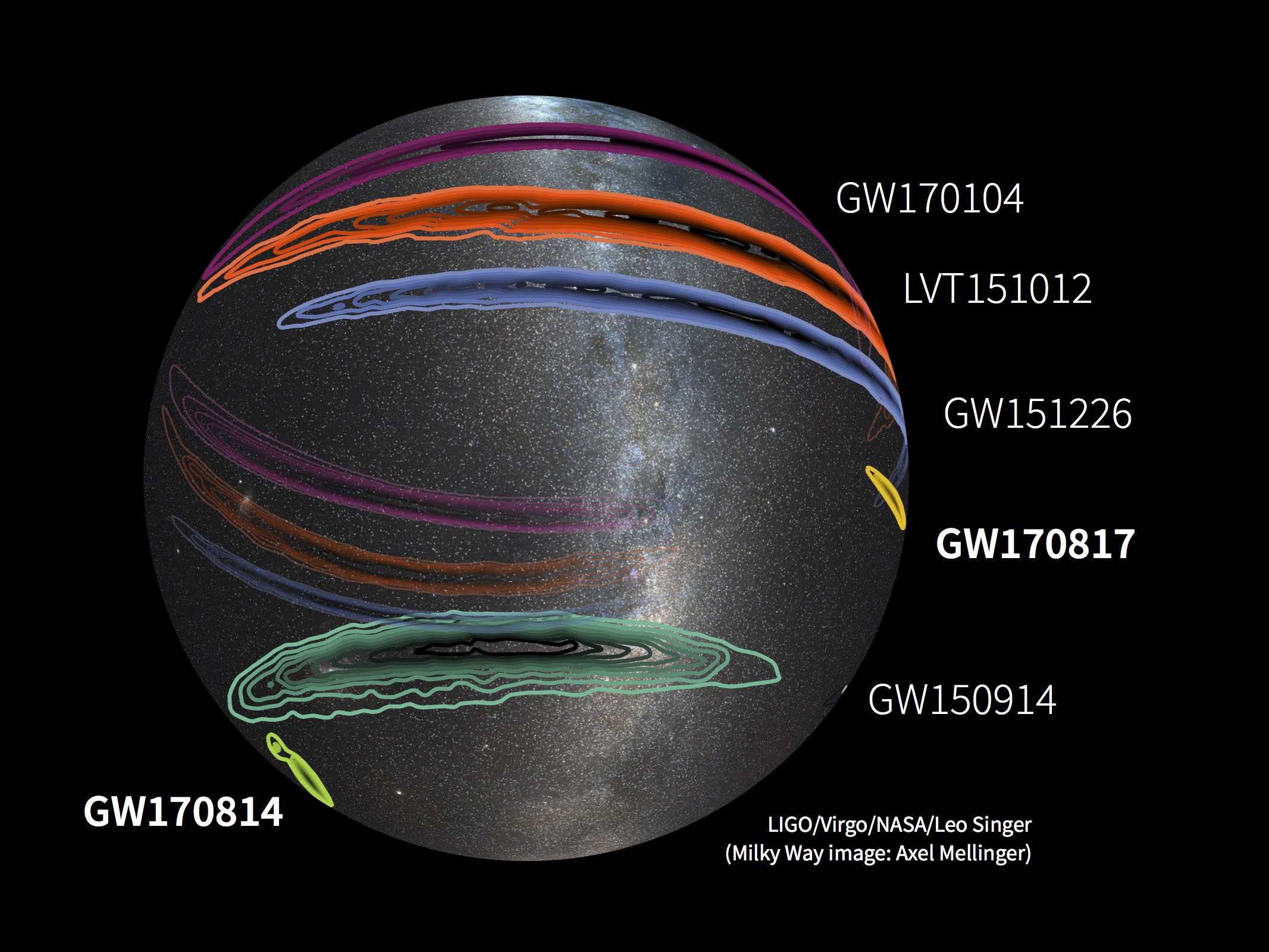
SkyMap

Virgo Helps Localize Gravitational-Wave Signals

“This event has the most precise sky localization of all detected gravitational waves so far,” says Jo van den Brand of Nikhef (the Dutch National Institute for Subatomic Physics) and VU University Amsterdam, who is the spokesperson for the Virgo collaboration. “This record precision enabled astronomers to perform follow-up observations that led to a plethora of breathtaking results.”

“This result is a great example of the effectiveness of teamwork, of the importance of coordinating, and of the value of scientific collaboration,” adds EGO Director Federico Ferrini. “We are delighted to have played our relevant part in this extraordinary scientific challenge: Without Virgo, it would have been very difficult to locate the source of the gravitational wave.

Fermi was able to provide a localization that was later confirmed and greatly refined with the coordinates provided by the combined LIGO-Virgo detection. With these coordinates, a handful of observatories around the world were able, hours later, to start searching the region of the sky where the signal was thought to originate. A new point of light, resembling a new star, was first found by optical telescopes. Ultimately, about 70 observatories on the ground and in space observed the event at their representative wavelengths.

“This detection opens the window of a long-awaited ‘multi-messenger’ astronomy,” says Caltech’s David H. Reitze, executive director of the LIGO Laboratory. “It’s the first time that we’ve observed a cataclysmic astrophysical event in both gravitational waves and electromagnetic waves — our cosmic messengers. Gravitational-wave astronomy offers new opportunities to understand the properties of neutron stars in ways that just can’t be achieved with electromagnetic astronomy alone.”

A fireball and an afterglow

Each electromagnetic observatory will be releasing its own detailed observations of the astrophysical event. In the meantime, a general picture is emerging among all observatories involved that further confirms that the initial gravitational-wave signal indeed came from a pair of inspiraling neutron stars.

Approximately 130 million years ago, the two neutron stars were in their final moments of orbiting each other, separated only by about 300 kilometers, or 200 miles, and gathering speed while closing the distance between them. As the stars spiraled faster and closer together, they stretched and distorted the surrounding space-time, giving off energy in the form of powerful gravitational waves, before smashing into each other.

Filename: GW Versus Matter STILL

Neutron Star Merger Seen in Gravity and Matter

At the moment of collision, the bulk of the two neutron stars merged into one ultradense object, emitting a “fireball” of gamma rays. The initial gamma-ray measurements, combined with the gravitational-wave detection, also provide confirmation for Einstein’s general theory of relativity, which predicts that gravitational waves should travel at the speed of light.

Theorists have predicted that what follows the initial fireball is a “kilonova” — a phenomenon by which the material that is left over from the neutron star collision, which glows with light, is blown out of the immediate region and far out into space. The new light-based observations show that heavy elements, such as lead and gold, are created in these collisions and subsequently distributed throughout the universe.

In the weeks and months ahead, telescopes around the world will continue to observe the afterglow of the neutron star merger and gather further evidence about various stages of the merger, its interaction with its surroundings, and the processes that produce the heaviest elements in the universe.

“When we were first planning LIGO back in the late 1980s, we knew that we would ultimately need an international network of gravitational-wave observatories, including Europe, to help localize the gravitational-wave sources so that light-based telescopes can follow up and study the glow of events like this neutron star merger,” says Caltech’s Fred Raab, LIGO associate director for observatory operations. “Today we can say that our gravitational-wave network is working together brilliantly with the light-based observatories to usher in a new era in astronomy, and will improve with the planned addition of observatories in Japan and India.”

LIGO is funded by the NSF, and operated by Caltech and MIT, which conceived of LIGO and led the Initial and Advanced LIGO projects. Financial support for the Advanced LIGO project was led by the NSF with Germany (Max Planck Society), the U.K. (Science and Technology Facilities Council) and Australia (Australian Research Council) making significant commitments and contributions to the project.

More than 1,200 scientists and some 100 institutions from around the world participate in the effort through the LIGO Scientific Collaboration, which includes the GEO Collaboration and the Australian collaboration OzGrav. Additional partners are listed at http://ligo.org/partners.php

The Virgo collaboration consists of more than 280 physicists and engineers belonging to 20 different European research groups: six from Centre National de la Recherche Scientifique (CNRS) in France; eight from the Istituto Nazionale di Fisica Nucleare (INFN) in Italy; two in the Netherlands with Nikhef; the MTA Wigner RCP in Hungary; the POLGRAW group in Poland; Spain with the University of Valencia; and the European Gravitational Observatory, EGO, the laboratory hosting the Virgo detector near Pisa in Italy, funded by CNRS, INFN, and Nikhef.


Written by Jennifer Chu, MIT News Office


RELATED LINKS

Additional resources from the LIGO Scientific Collaboration:  http://ligo.org/detections/GW170817.php

Additional Media Assets: http://mediaassets.caltech.edu/nsm

Caltech Story: https://www.caltech.edu/news/caltech-led-teams-strike-cosmic-gold-80074

Related Papers & Data: https://www.ligo.caltech.edu/page/detection-companion-papers


Images

High Res. versions of these graphics can be found in our gallery.

GW170817 FactSheet
GW170817’s numbers


BH and NS Mass Chart
Masses of Neutron Stars and Black Holes


Gravitational-Wave Observatories Across the Globe
Current operating facilities in the global network include the twin LIGO detectors—in Hanford, Washington, and Livingston, Louisiana – Virgo in Italy, and GEO600 in Germany.


Filename: GW Versus Matter STILL
Neutron Star Merger Seen in Gravity and Matter


SkyMap
Virgo Helps Localize Gravitational-Wave Signals


GW+EM Observatories Map
GW170817: A Global Astronomy Event


Cataclysmic Collision
Artist’s illustration of two merging neutron stars.


Gravitational Wave Chirp Spectrogram
LIGO’s data shows the “chirp” sound produced as the two neutron stars inspiral.


Videos

Neutron star merger (Credit: Christopher W. Evans/Georgia Tech)

Jets and Debris from Neutron Star Collision (Credit: NASA/Goddard Space Flight Center/CI Lab)

Last Dance of Neutron Star Pair (Credit: W. Kastaun/T. Kawamura/B. Giacomazzo/R. Ciolfi/A. Endrizzi)

Ripples of Gravity, Flashes of Light (Credit: LIGO/Virgo)

Zooming in on the Source of Gravitational Waves (Credit: LIGO-Virgo)

Final Flight of Neutron Star Pair (Credit: LIGO-Virgo/Aaron Geller/Northwestern University)

Hearing the Wave (Credit: Alex Nitz/Max Planck Institute for Gravitational Physics/LIGO)

bookmark_borderAir Quality and Climate Change

Current models indicate an increase in air quality alerts. The increase risk is not necessarily from an increase in pollution. An on-going research study conducted by InternetU.org suggests a warming climate is likely contributing to reduction in air quality.

The frequency of air quality alerts is on the rise in the United States and many other parts of the world. The Philadelphia Area is a prime example. Philly and suburbs have had multiple days in a row when it was unhealthy to breath. The Action Alert days are also starting earlier in the season and lasting longer into the summer. In fact, a recent string of days with temperatures above 90 have resulted in an Action Alert on September 25, 2017.

Ozone Action Alert for September 25, 2017

When the Earth’s surface temperature is hot enough and sunlight provides enough ultraviolet light, Nitrogen Oxides (NOx) and Volatile Organic Compounds (VOCs) in the air create a chemical reaction. The result is ozone. Tropospheric ozone is very destructive to plants and animals. Tropospheric ozone is killing an unprecedented number of trees. Unfortunately, it is also causing a massive amount of respiratory and immune system problems in humans, such as, asthma.

Check the current Air Quality Index

More About Ozone

bookmark_borderHuge Credit Agency Data Breach

by Daniel Brouse and Sidd Mukherjee for Membrane Domain Security

Equifax is one of the largest credit reporting agencies in the world. Ironically, Equifax provides “identity protection tools with daily monitoring and alerts today!”

From May to July, 2017, Equifax allowed a cybersecurity breach to steal 143 million people’s identity. The stolen information includes social security numbers, birthdays, addresses and driver’s license numbers.

On September 7, Equifax released a statement via Twitter: “We recently discovered a cybersecurity incident involving consumer information. Once discovered, we acted immediately to stop the intrusion. We apologize to our consumers and business customers for the concern and frustration this causes. Learn more: .”

The data breach compromised about half the population of the United States.

Cyber security specialist Sidd Mukherjee said, “The main issue not addressed is the collection of the data in the first place. There would be no target if there were no centralized database. If the data were maintained in a distributed mechanism, with strict privacy guarantees and guaranteed update (such as blockchain/bittorent/tor allows) we would not be in this situation.

‘But that’s so hard and we need to make money this quarter’

OK, that is actually quite a cruel summary, so let me expand. Back in the day, centralized was the only way to go. The Internet made a lot of things possible and mathematics did as much. Companies like Equifax began in response to a need. They
glommed on to a need twenty years before the Internet and made big databases because they watched ATT and SABRE and railroads, and such. The Internet came along and they lumbered over. And now, they find they are in a strange and terrible land beset with pitfall and with snare.

Equifax makes money through collection and controlled distribution of data. Both those avenues and control are threatened in this brave new world, as Mr. Assange pointed out some time ago.

Don’t get me wrong. I actually think assaults on privacy have done the evolution thing, selected for those schemes which resist assault. And as such, the centralized databases will get selected out of the game. It will take a while, though.”

In other news, until you had many to many communication with latency lower than human attention span, which seems to be about 20 seconds, you can’t really do hive intelligence like the kids are doing with the cell phones. Watch the kids. Demographic is destiny, as someone said.”

bookmark_borderWhy “Fresh Air and Sunshine” is Dangerous

By Daniel Brouse

Q: Do you know what are two of the most dangerous exposures for children and the elderly?
A: Fresh air and sunshine. Either may be hazardous; however, when fresh air and sunshine are combined, the result can be extreme.

On days like today, do not go out and play.

The sun can damage your skin and cause cancer. Air pollution causes many health risks, too.


Fresh Air + Sunshine = Dangerous

Sunshine is also part of a deadly reaction. When combined with heat and volatile gases in the air, ultraviolet light causes a deadly reaction. The result is tropospheric ozone.

The dangerous ozone (O3) is created when vehicle (and other) exhaust is not completely combusted. Nitrogen Oxides (NOx) and Volatile Organic Compounds (VOCs) in the exhaust react to temperature and sunlight creating tropospheric ozone (O3).

The ozone in the air can cause permanent damage to your respiratory and immune systems. Millions of micro-explosions enter through your mouth and nose (and to some extent eyes, ears and skin)… then, if lucky, complete their short lives in your lungs. (NOTE: Lucky, for the length of their life. Unlucky, for the length of yours.)

bookmark_borderThe Universal Theorem

The Cron Vortex
by Daniel Brouse

The Universal Theorem contains elements from: Einstein’s Theory of Relativity / Space-time Continuum, Vortex Physics, Chaos Theory and The Laws of Thermodynamics. The combination of these elements form a system. The interaction between the system and matter is commonly called time.

Imagine Earth as it starts on the edge of the vortex and slowly gets pulled toward the center and bottom… spiraling faster and faster.

Spiral Galaxy
Spiral Galaxy

NASA states, “Messier 74, also called NGC 628, is a stunning example of a grand-design spiral galaxy that is viewed by Earth observers nearly face-on. Its perfectly symmetrical spiral arms emanate from the central nucleus and are dotted with clusters of young blue stars and glowing pink regions of ionized hydrogen (hydrogen atoms that have lost their electrons). These regions of star formation show an excess of light at ultraviolet wavelengths.”

Toilet Flushing (MP4 Video)

More about Cron Vortex

bookmark_borderIs Oxygen A Carcinogen?

There are some people that believe in a fluoride conspiracy. They take out all the minerals (elements) in their drinking water because they have a fluoride-phobia.

Fluoride is naturally present in the food and drink we consume and is considered a normal constituent of the human body. The fluoride concentration in bones and teeth is about 10,000 times that in body fluids and soft tissues. Fluoride is ingested from several sources including foods, fluoridated and unfluoridated water, fluoridated toothpastes and some dietary supplements. (NIH 2017)

Recommended fluoride intake.

Moderation is the key. Not enough fluoride and you’ll have weak teeth and bones. Too much fluoride can kill you. Did you know that too much oxygen can kill you, too?

NIH
Med Hypotheses. 1983 Sep;12(1):55-60.
Oxygen: our major carcinogen?
Evidence has accumulated implicating that atmospheric oxygen can be considered as an important environmental mutagen, whose action can be potentiated by a variety of environmental factors. Under normal conditions oxygen genotoxicity is largely prevented by a cellular antioxygenic defense system, which must be extremely efficient, but might not be entirely safe. A better understanding of this defense system may help to suggest how the incidence of carcinogenesis can be minimized.

Science News
from research organizations
Can inhaled oxygen cause cancer?
Date: January 13, 2015
Source: PeerJ
Summary:
The ancient physician/alchemist, Paracelsus, said: ‘The dose makes the poison.’ According to a new study, even oxygen may fall prey to the above adage. While essential to human life, aspects of oxygen metabolism may promote cancer. Capitalizing on the inverse relationship of oxygen concentration with elevation, researchers found lower rates of lung cancer at higher elevations, a trend that did not extend to non-respiratory cancers, suggesting that carcinogen exposure occurs via inhalation.

Oxygen toxicity
From Wikipedia, the free encyclopedia Oxygen toxicity is a condition resulting from the harmful effects of breathing molecular oxygen (O2) at increased partial pressures. It is also known as oxygen toxicity syndrome, oxygen intoxication, and oxygen poisoning. Historically, the central nervous system condition was called the Paul Bert effect, and the pulmonary condition the Lorrain Smith effect, after the researchers who pioneered its discovery and description in the late 19th century. Severe cases can result in cell damage and death, with effects most often seen in the central nervous system, lungs and eyes. Oxygen toxicity is a concern for underwater divers, those on high concentrations of supplemental oxygen (particularly premature babies), and those undergoing hyperbaric oxygen therapy.

You can also consume too much water — drowning. Listen to your body for the happy medium.

bookmark_borderAir Pollution: Getting All Choked Up

By Daniel Brouse

Air pollution may be the largest problem facing the world. Emissions of CO2, methane and other greenhouse gases are causing irreversible climate change. Since the effects of global warming take years to become apparent, many people don’t even notice the change; however, air pollution is already the leading cause of death worldwide. Again, since the pollution can’t be seen with the naked eye, many people are in denial of the dire consequences. 92% of the world’s population lives where outdoor air quality fails to meet the World Health Organization (WHO) guidelines.

In March of 2017, Dr. Margaret Chan, director general of the World Health Organization, said air pollution is “one of the most pernicious threats” facing global public health today and is on a much bigger scale than HIV or Ebola. Dr. Chan attributed the deaths of 600,000 children per year to indoor and outdoor air pollution.

UNICEF Executive Director Anthony Lake said, “Pollutants don’t only harm children’s developing lungs, they can actually cross the blood-brain barrier and permanently damage their developing brains, and, thus, their futures. No society can afford to ignore air pollution.”

“Protecting children from air pollution is not only in their best interests; it is also in the best interests of their societies — a benefit realized in reduced health costs, in increased productivity, in a cleaner, safer environment, and thus, in more sustainable development,” Lake said.

It is estimated that 5-7 million people are dying prematurely every year as a result of air pollution.

The American Lung Association says, “Two types of air pollution dominate in the U.S.: ozone and particle pollution. These two pollutants threaten the health and the lives of millions of Americans. Thanks to the Clean Air Act, the U.S. has far less of both pollutants now than in the past. Ozone pollution is the most widespread pollutant in the U.S. and is also one of the most dangerous.”

Ozone Action Alert Days are a frequent occurrence throughout the United States. During an Ozone Alert, you should not breath outside. During any days near metropolitan areas, you should limit outdoor physical activities as deep breathing causes more severe damage. The young and old are at greater risk at all times.

Particle pollution comes from small particles in exhaust and increase the risk of heart disease, lung cancer and asthma attacks. Particulates can interfere with the growth and work of the lungs.

The Environ Health Perspect Study states, “First and foremost, short-term exposure to particle pollution can kill. Peaks or spikes in particle pollution can last for hours to days. Deaths can occur on the very day that particle levels are high, or within one to two months afterward. Particle pollution does not just make people die a few days earlier than they might otherwise—these are deaths that would not have occurred if the air were cleaner.”

In February of 2017, the EPA released an update on air quality in the U.S.:

Today, pollution levels in many areas of the United States exceed national air quality standards for at least one of the six common pollutants:

  • Although levels of particle pollution and ground-level ozone pollution are substantially lower than in the past, levels are unhealthy in numerous areas of the country. Both pollutants are the result of emissions from diverse sources, and travel long distances and across state lines.

    An extensive body of scientific evidence shows that long- and short-term exposures to fine particle pollution, also known as fine particulate matter (PM2.5), can cause premature death and harmful effects on the cardiovascular system, including increased hospital admissions and emergency department visits for heart attacks and strokes. Scientific evidence also links PM to harmful respiratory effects, including asthma attacks.

    Ozone can increase the frequency of asthma attacks, cause shortness of breath, aggravate lung diseases, and cause permanent damage to lungs through long-term exposure. Elevated ozone levels are linked to increases in hospitalizations, emergency room visits and premature death.

    Both pollutants cause environmental damage, and fine particles impair visibility.

    Fine particles can be emitted directly or formed from gaseous emissions including sulfur dioxide or nitrogen oxides. Ozone, a colorless gas, is created when emissions of nitrogen oxides and volatile organic compounds react.

  • For unhealthy peak levels of sulfur dioxide and nitrogen dioxide, EPA is working with states and others on ways to determine where and how often unhealthy peaks occur. Both pollutants cause multiple adverse respiratory effects including increased asthma symptoms, and are associated with increased emergency department visits and hospital admissions for respiratory illness. Both pollutants cause environmental damage, and are byproducts of fossil fuel combustion.
  • Airborne lead pollution, a nationwide health concern before EPA phased out lead in motor vehicle gasoline under Clean Air Act authority, now meets national air quality standards except in areas near certain large lead-emitting industrial facilities. Lead is associated with neurological effects in children, such as behavioral problems, learning deficits and lowered IQ, and high blood pressure and heart disease in adults.
  • The entire nation meets the carbon monoxide air quality standards, largely because of emissions standards for new motor vehicles under the Clean Air Act.

MORE REFERENCES
Health And Air Quality
Air Pollution Deaths
Air Pollution Killing Millions
Largest Health Risk

bookmark_borderWooten Words Of Wisdom

On March 4, 2017, Victor Wooten gave a “free to the public” seminar in King Of Prussia, Pennsylvania.


Feel

Like a child speaking… learning to communicate in English… how many hours a day did you practice?

If you are playing bass, you are the rhythm. You need time. Listening to timing is more important than techniques, notes and scales. There is no such thing as a wrong note.

Victor was born the youngest of five brothers. The brothers already had a band — guitar, sax, drums and keys — but, they needed a bass player. Victor first learned to play. His brothers encouraged him to just play. Later, he taught himself how to play bass on a four-string guitar.

A question was asked, “I teach music to K-5… how can I teach the children to improvise?”
A: Have them try to play the wrong notes.

Karl McWherter and Victor Wooten

Brad Rau:
What an amazing gift the universe gave me for my birthday. I got the Jason Vieaux a few weeks ago and now Victor Wooten. At one point Victor without looking asked someone to turn any string they wanted out of tune. The he jumped right into playing (be myself by sly) quickly realized the G was tuned down a whole step and starting playing the line up two frets so he ended up playing in tune. They tuned back to normal without missing a beat. You had to be there.


Karl McWherter Photography at The Ardmore Music Hall


bookmark_borderAntarctica And Rising Sea Level

by Daniel Brouse and Sidd Mukherjee

The U.N. weather agency said the Antarctic peninsula has set a heat record of 63.5° Fahrenheit (17.5 degrees Celsius) on March 24, 2015. In March of 2017, there is about 10% less sea ice in Antarctica than the previous record minimum. “One would probably say that the old record was obliterated,” said Jan Lieser, a sea ice scientist at the Hobart-based Antarctic Climate and Ecosystems Co-operative Research Centre.

Antarctica contains 90% of the world’s fresh water as ice. If all the ice melts, sea levels will rise by 60 meters (200 feet). The sea ice melting doesn’t raise the sea level as the ice is already floating. The ice that is above land is a different story.

The problem with the ice in Antarctica is that much of the ice is on land. As the land ice melts or falls into the ocean the sea level rises. Compounding the problem is the elevation of the land. Over the centuries the weight of the ice has caused the land to sink. As the ocean temperature warms, water is starting to seep in under the ice. The warm water under the ice sheet is accelerating the destabilization of the sheet.

“There was a physicist called John Mercer at the Byrd polar research center here at Ohio State, who was warning of WAIS collapse as early as 1968,” said Sidd Mukherjee research physicist at Ohio State University.

Then in 1978 Mercer wrote:
“One warning sign that a dangerous warming is beginning in Antarctica, will be a breakup of ice shelves in the Antarctic Peninsula just south of the recent January 0C isotherm; the ice shelf in the Prince Gustav Channel on the east side of the peninsula, and the Wordie Ice Shelf; the ice shelf in George VI Sound, and the ice shelf in Wilkins Sound on the west side. ”

Each of these shelves is in retreat or gone. Mercer was more correct than he knew. Recent work by Bassis et al. shows that ice shelves collapse shortly after the temperature of the top surface exceeds the 0C melting point through a process called hydrofracture, where water filled crevasses penetrate all the way to the bottom of the shelf. Bassis et al. also pointed out that a cliff of ice higher than 100m (300 ft) is unstable against collapse. These cliff heights are attained where the bedrock is more than 1Km below sea level, as in large parts of WAIS. When the shelves melt leaving cliffs behind which directly face the ocean they will collapse along large sections of WAIS. The more frightening estimates for WAIS deglaciation are on the order of centuries, rather than millennia, indeed decadal time scales cannot be entirely ruled out. We know from past records that sea level can rise as fast as a foot a decade and maintain that rate for five hundred years. Such rates of sea level rise will destroy most coastal cities of the world, since coastal infrastructure cannot be moved inland or protected by seawalls quickly enough.

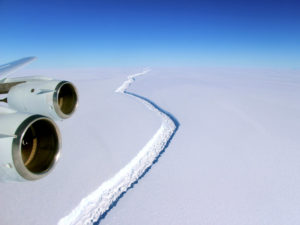
Antarctica Larsen C Ice Crack

In January of 2017, a UK research team discovered a huge increase in a massive 90-mile crack running through the Larsen C shelf (pictured to the right). The crack might soon split off a chunk of ice the size of Delaware. Larson C is part of Eastern Antarctic. Larson A and Larson B have already collapsed.

The Western Antarctic Ice Sheet (WAIS) is the segment of the continental ice sheet that covers West Antarctica. The melting of the West Antarctic ice sheet alone would raise global sea levels by more than 20 feet, according to researchers from the British Antarctic Survey. Over the last several years, WAIS has become unstable. A 2016 study by Khazendar, Rignot, and others adds to the mounting evidence that the threshold for an irreversible disintegration has begun.

“It’s generally accepted that it’s no longer a question of whether the West Antarctic Ice Sheet will melt, it’s a question of when,” said leader Ian Howat, associate professor of earth sciences at Ohio State in a 2016 study published in the journal Geophysical Research Letters. “This kind of rifting behavior provides another mechanism for rapid retreat of these glaciers, adding to the probability that we may see significant collapse of West Antarctica in our lifetimes.”

Ice calving is the breaking of ice chunks from the edge of a glacier. Calving causes mini-tsunamis daily in Antarctica.

The Thwaites Glacier is of great concern. Thwaites Glacier is an unusually broad and fast Antarctic glacier flowing into Pine Island Bay. As the warming temperature of sea water melts the bottom of the glacier, it allows water to enter underneath the ice. A University of Washington study determined that the Thwaites Glacier will gradually melt, leading to an irreversible collapse over the next 200 to 1000 years.

bookmark_borderBottom Of The Ocean Trashed

by Daniel Brouse

EARTH — How much of the Earth have humans polluted? Scientists sent robots to the bottom of the ocean… deeper than man has ever explored. The findings are disturbing.

“We often think deep-sea trenches are remote and pristine, untouched by humans,” says Alan Jamieson, a deep-ocean researcher at the University of Aberdeen, UK. “It’s even higher than in the estuaries of two of the most polluted rivers — the Pearl River and the Liao River — in China.”

“Crustaceans at depths of 10,000 metres contain higher concentrations of chemicals than do some animals in coastal waters.”

The small animals retrieved from the ocean’s bottom contained PCB’s (polychlorinated biphenyls used to make plastics and as anti-fouling agents to stop barnacles from growing on ships’ hulls), as well as, flame retardants (polybrominated diphenyl ethers, PBDEs).

“It’s really surprising to find pollutants so deep in the ocean at such high concentrations,” said Jeffrey Drazen, a marine ecologist at the University of Hawaii.

The findings raise concern about how microbial activities are adversely affected, the impact on the carbon cycle and climate change.