bookmark_borderClimate Change: The End of Times

by Daniel Brouse
July 21, 2023

What will the “End of Times” look like?

In the 1990’s, we wrote a paper on the worst-case scenario entitled, “The Impact of Governance & Globalization on Forecasting (The Tunnel Under Thesis).” The theory predicted that forecasting would become increasing difficult. “The result — a figurative, as well as, literal tunneling underground.”

Since that time, forecasting has become increasing more difficult. “In general, as energy is added to a system, the fluctuations in the system increase. So, we expect more storms, more droughts, more wildfires, more floods, more fluctuations of all kinds. What we are saying is that weather conditions will become more volatile due to the impact of humans,” said Mukherjee and Brouse. (2004)

In a report published in Nature entitled Over half of known human pathogenic diseases can be aggravated by climate change, data analyst and associate professor in the Department of Geography and Environment at the University of Hawaii Manoa, Camilo Mora, said climate hazards aggravated 58% of all known human pathogens. That is over half of infectious diseases discovered since the end of the Roman Empire. 58% of an authoritative list of infectious diseases documented to have impacted humanity have already been shown to be aggravated by climatic hazards — a finding the researchers found “shocking,” Mora said.

Movement of people and animals caused by climate is one factor. Warming at higher latitudes allowed vectors and pathogens to survive winter is another factor. The report goes on to say, “The human pathogenic diseases and transmission pathways aggravated by climatic hazards are too numerous for comprehensive societal adaptations, highlighting the urgent need to work at the source of the problem: reducing GHG (Greenhouse Gas) emissions.”

This research reveals more evidence that humans will have difficulty adapting to climate change, especially those in developing countries, Mora said. “The magnitude of the vulnerability when you think about one or two diseases — okay, sure, we can deal with that,” he said. “But when you’re talking about 58% of the diseases, and 58% of those diseases can be affected or triggered in 1,000 different ways. So that, to me, was also revealing of the fact that we’re not going to be able to adapt to climate change.”

In 2023, I wrote the paper, “Climate Change: How Long Is ‘Ever’?“. When we wrote the Tunnel Under Thesis, we forecast these events would not happen for centuries. We underestimated Man’s ignorance and arrogance. Fossil fuel consumption and greenhouse gas emissions have continued to set record highs. Humans have caused chain-reactions resulting in domino-effects, snowball effects, and feedback loops.

Events we thought would not happen in our lifetimes are happening now. My last resort emergency plan was to escape to Canada. (I am a dual citizen.) This summer that plan literally went up in smoke. “Beginning in March 2023, and with increased intensity starting in June, Canada has been affected by an ongoing, record-setting series of wildfires.” — Wikipedia

All of my life I have located my office and bedrooms in the uppermost southern exposure (preferably in the tree canopy.) I love sunlight, elevation, trees, fresh air, and wildlife. It is becoming ever more obvious my dreamlife is coming to an end, and I will be forced to tunnel under. For those forward thinkers, think about your poop. Pumping sewage above ground level will be a major problem at all times. In addition, the inability to pump flood water will become deadly during extreme weather events. In July of 2020 NPR reported, “The remnants of Hurricane Ida dropped unprecedented rainfall on several eastern states, killing dozens of people. Eleven of them were Queens residents who died when their basement apartments flooded.” In August of 2022 CNN reported, “Seoul has vowed to move some of the city’s poorest families out of underground and semi-subterranean homes after 13 people were killed in flooding caused by record rainfall this week, sparking public horror and calls for government accountability.” Drowning in your own poop may result for those unprepared.

Fresh air, water, food, and light will also be problematic; however, your most severe concern will likely be security. Those with supplies will be at high risk of being raped and looted. Good luck!

More From the Human Induced Climate Change Experiment

bookmark_borderClimate Change: How Long Is “Ever”?

By Daniel Brouse
July 8, 2023

How long is “ever”… as in “the hottest it’s ever been in recorded history”?

During the first week of July 2023, the Earth had the hottest days ever.

Humans are about 200,000 years old with our closest variety being dated to about 140,000 years ago. The earliest “recording of history” is approximately 100,000 years old. It is the story of The Seven Sisters of The Pleiades. The Seven Sister are a cluster of stars in the Taurus constellation. There are six stars visible to the naked eye. The story is about seven stars. The seventh star has not been visible to the naked eye for over 100,000 years.

The 20th-century surface temperature average for Earth was 13.9 °C.
In July of 2023 we are seeing average temperatures of 17°C.

Q: Is it possible for humans to push the temperature 3 °C above pre-industrial levels?
A: Yes. Humans have pushed global temperatures up more than 3 °C.

Q: Is it possible for humans to survive at temperatures greater than 3 °C?
A: Probably not long. Humans have never done it before.

Extreme weather will become more frequent and intense. Sea levels will rapidly rise as the coasts disappear. However, the most concerning development will be feedback loops. Plants will become extinct and many carbon sinks will vanish. The Earth’s temperature will continue to accelerate at an exponential rate no matter what humans do. Food, fresh water, and breathable air will cease to exist. Humans will likely follow in short order.

“The increasing heating of our planet caused by fossil fuel use is not unexpected, it was predicted already in the 19th century after all,” said climate scientist Stefan Rahmstorf at the Potsdam Institute for Climate Research in Germany. “But it is dangerous for us humans and for the ecosystems we depend on. We need to stop it fast.”

This is our current situation. Not “years away”. Not tomorrow. Today.

Stop burning fossil fuels today, stop exploiting hydrocarbons today, or else….

You replied, “I don’t see anything I can do…!”

I responded, “Here’s what I have done. (Not only have I saved many thousands of dollars, I am also carbon negative.)” — How to go net zero now. Free and easy. Save the planet.

The Human Induced Climate Change Experiment

bookmark_borderHealth Impacts of Air Pollution

By Daniel Brouse
June 30, 2023

The health impacts of air pollution are both cumulative and irreversible. The more polluted the air, the more severe the effects. The more polluted air you breathe over time, the more severe the effects. That is to say breathing “Moderate” quality air for 3 days might be similar to breathing “Unhealthy for Sensitive Group” quality air for 1 day. In both cases, your respiratory, circulatory, neurological, and immune systems have been damaged. A partial list of ailments include:
Alzheimer’s Disease, asthma, bronchitis, cancer, cataracts, chronic obstructive pulmonary disease (COPD), dementia, developmental damage, emphysema, gastrointestinal disorders, heart ailments, heart attacks, immune system dysfunction (including susceptibility to infections), ischaemic heart disease, impaired brain development in children, kidney disease, liver disease, lung disease, premature death, pneumonia, nasal and upper respiratory tract health problems, neurological disorders, respiratory system failure, skin diseases, strokes

You can (and should) check your local air quality several times a day at AirNow.gov. The air quality index (AQI) goes from 0 to 500. An AQI value of 50 or below represents good air quality, while an AQI value over 300 represents hazardous air quality.

EPA establishes an AQI for five major air pollutants regulated by the Clean Air Act. Each of these pollutants has a national air quality standard set by EPA to protect public health:

  • ground-level ozone
  • particle pollution (also known as particulate matter, including PM2.5 and PM10)
  • carbon monoxide
  • sulfur dioxide
  • nitrogen dioxide

Following is an explanation of two of these pollutants — particle pollution and ground-level ozone.

Particulate Matter (PM)

The EPA defines particulate matter (also called particle pollution): the term for a mixture of solid particles and liquid droplets found in the air. Some particles, such as dust, dirt, soot, or smoke, are large or dark enough to be seen with the naked eye. Others are so small they can only be detected using an electron microscope.

Particle pollution is similar to smoking cigarettes. The more you inhale, the worse it is for you. Also, the more particles in the air you breath, the worse it is for you. Breathing air on a day with an AQI that is unhealthy is similar to smoking a half-pack of cigarettes. If you go running instead of walking, it might be equivalent to smoking 2 packs of cigarettes.

The more particulate matter you breathe in over time, the greater the cumulative effect. The impact on your health will depend on your predisposition. In all cases your risk increases for nasal and upper respiratory tract health problems, heart attacks, strokes, asthma, and bronchitis, as well as premature death from heart ailments, lung disease, and cancer. Studies show that exposure can impair brain development in children and are significantly associated with the development of dementia and Alzheimer’s disease.

Some of the impacts of particle pollution may be reversed overtime if further exposure to particle pollution is eliminated. After five years of quitting smoking, the risk of developing complications decreases by up to 50%.

The best lifestyle is to avoid particulate matter. Exercise outside only on days with a “Good” AQI under 50. If you must go out on days with an AQI over 50, wear an N95 mask. Indoors build and run a Corsi-Rosenthal Box filter.

Ground-level Ozone

Tropospheric ozone is low level ozone caused by humans. Tropospheric ozone is “bad ozone” that causes health problems in humans, plants to die and other destructive results. (Stratospheric ozone, the good ozone, is the ozone layer in the stratosphere that keeps 95-99% of the suns ultraviolet radiation from striking the earth.)

“Tropospheric ozone is formed by the interaction of sunlight, particularly ultraviolet light, with hydrocarbons and nitrogen oxides, which are emitted by automobiles, gasoline vapors, fossil fuel power plants, refineries, and certain other industries.” — National Center for Atmospheric Research

Ozone primarily affects the respiratory and immune systems. The damage is permanent, untreatable and often results in death. The Santa Barbara County Air Pollution Control District reports, “Roughly one out of three people in the U.S. is at risk of experiencing ozone-related health effects.”

The best lifestyle is to avoid ozone exposure. Since heat and ultraviolet light are needed to create ozone, staying indoors offers the best protection. Neither masks nor air purifiers protect from ozone exposure. (Ozone is O3 and almost the same size as Oxygen O2)

REFERENCES
Death by Ozone
COVID-19 and Air Pollution
Ozone Know Zone
Air Pollution Kills
Indoor Air Pollution: How to Purify the Air, Aromatic Plants, and Phytoncides
Corsi-Rosenthal Box filter
The Human Induced Climate Change Experiment

bookmark_borderCarbon Offsets: Planting Trees is Greenwashing

By Daniel Brouse
June 28, 2023

This article is in response to “Animal Agriculture is the Leading Cause of Climate Change“.

I said, “About the paper, it is not a good paper… flawed in several ways. The main problem with the paper is it depends on “the potential to sequester over 2000 Giga tons.” No amount of sequestering will solve our problem. Sequestration is only a temporary solution. The most important thing for people to do is stop the use of hydrocarbon based products today… followed by everything else. Minimize consumption of everything.

Plant vegetation sequestration only lasts for several years (with old growth hardwood some sequestration may last up to 100 years.) We wrote a paper on it a few years ago. Though the paper focuses on hemp, it covers all vegetation (The Hemp Myth, Carbon Sinks and the Environment).

Some people argue that we can not abruptly stop the use of fossil fuels or it will cause social unrest. The total collapse of society is inevitable. Even if we stopped using fossil fuels today, we have already baked in a rise of 2 degrees Celsius. “The Earth will exceed 1.5℃ (average global surface temperature over the surface of the earth for ten years) by the 2040’s and a societal collapse will ensue. For the most part, the Earth will be uninhabitable for humans by 2070 UNLESS immediate action is taken.” — Brouse and Mukherjee

The average life of a tree planted for carbon credit sequestration is 7 years. (In addition, “Tree Extinction Due to Human Induced Environmental Stress” is already lowering the life expectancy of all trees.) Climate scientists, such as myself, are against the use of sequestering for carbon credits. Giving carbon offsets for planting trees and allowing for the continued use of fossil fuels is greenwashing and accelerates the pace of climate change.

The Human Induced Climate Change Experiment

bookmark_borderCorsi-Rosenthal Box: The Best Air Purifier

What is a Corsi-Rosenthal Box and how do you build one? The Corsi-Rosenthal Box is a simple DIY air filter and purifier that outperforms and can be more effective than expensive HEPA purifiers.

Corsi-Rosenthal Boxes are made from cardboard, tape, furnace air filters, and a box fan.

Corsi-Rosenthal Box
Corsi-Rosenthal Box

The Corsi-Rosenthal Box was invented by Richard Corsi, PhD, of the University of California-Davis and Jim Rosenthal, CEO of Tex-Air Filters.

“One night, I just scribbled out this idea on a piece of paper,” said Corsi. “It wasn’t an original idea – people had put a single filter on a box fan before. But not with MERV 13 filters.” (MERV — minimum efficiency reporting values — is the measure of how well a filter captures particles. The higher the MERV, the more effective the filter.)

“The Corsi-Rosenthal box outperformed the HEPA filter on every sized particle,” Rosenthal said. “You have such high flow from these fans, way more flow than you get out of a commercial HEPA filter. The air goes through the filter more than once in the same period of time. It may only get 50% of the particles at first. But the second time through, it’s getting much more.”

Corsi-Rosenthal Box Test

Smoke from wildfires in Canada brought record-breaking air pollution to the United States this spring, creating dangerous air quality from Bismarck, N.D., to Denver and Detroit to New York City and Washington. According to a Washington Post analysis of smoke data through June 7 (2023) from Stanford University, 197 air quality monitoring stations have reported all-time high pollution from wildfires.

During the Air Quality Crisis of 2023 the plant-based long-term breathing experiment failed the test. After 4 days in a row of Unhealthy (151 to 200 AQI) to Hazardous (301 and higher AQI) outdoor air quality, the the plant-filtered indoor air quality was unhealthy.

Even with spider plant filled windows and dozens of other plants, humans still suffered from itchy eyes, scratchy throats, and headaches.

Christopher suggested, “You should look into Corsi-Rosenthal… they consistently outperform high-end air filtration systems and it’s a simple DIY project.”

Sidd independently advised, “We are way beyond that (plant filtration). Put in something about Corsi-Rosenthal filters and CO2 monitors to judge ventilation.

Sooo… luckily I had a couple furnace filters, a box fan, and a case of beer. After constructing a crude Corsi-Rosenthal Box, the entire first floor was cleared of noticeable pollutants within 15 minutes. The itchy eyes, scratchy throat, and headache dissipated.

Makeshift / Emergency Corsi-Rosenthal Box

To confirm our results, we brought in the hound dog. Dogs are even more sensitive to air quality. After days of suffering in unhealthy air quality, the hound immediately laid down with his nose in the flow of the circulating Corsi-Rosenthal filtered air.

Conclusion
Air quality is already considered the number one contributing factor to death worldwide. Climate change is making poor air quality even more extreme. A combination of plant and Corsi-Rosenthal filtered air is recommended on a daily basis.

Our experiment was conducted in Southeastern Pennsylvania during an extreme air quality event; however, to our east is Philadelphia. The immediate Philadelphia area rarely has a day of Good air quality. Most summer days are Moderate to Very Unhealthy. To our west is Morgantown and Lancaster County. Even though Lancaster is a much more rural area, it continuously has some of the worst air quality in the world. So it doesn’t really matter where you live, implementing plant and Corsi-Rosenthal filtered air to the daily routine will likely improve your quality and quantity of life.

More on Clean Water, Air, and Healthy Plants
More Things You Can Do to Help the Environment and Your Health


bookmark_borderYour National Debt

by Daniel Brouse
June 8, 2023

The Economic Monsters: Inflation and Interest Rates
I Economic Forecast = Inflation (2018)
II Inflation Bites (2022)
III U.S. Mass Consumption Results in Global Economic Disparity, Inequity, and Poverty (2023)
IV Investment Recommendation: Savings Bonds / I Bonds (2023)

Part V: Your National Debt

The federal government currently has $31.83 trillion in federal debt. So, what does that mean to you?

Some economists say it doesn’t mean anything. As long as the U.S. dollar remains the world’s reserve currency, the federal government can spend without limit. Other economists disagree.

Here is what to watch for:
1. a declining influence of the dollar as the world reserve currency
The dollar has been falling out of favor with many world economies. The dollar has also been sanctioned to be used by many countries and companies. Though efforts by groups like BRICS (Brazil, Russia, India, China, and South Africa) to form their own reserve currency will likely fail, the overall dependency on the dollar is weakening. The dollar will not be able to go on with “business as usual”.

2. the amount of debt (bills, notes, bonds) being sold by the Treasury
In 2023, Congress suspended the debt ceiling. During the April – June 2023 quarter and the Treasury said, “Treasury expects to borrow $726 billion in privately-held net marketable debt, assuming an end-of-June cash balance of $550 billion. The borrowing estimate is $449 billion higher than announced in January 2023.” Now that the debt ceiling has been suspended the Treasury is staring a $1tn borrowing drive. The trillion-dollar borrowing spree will have many impacts. For instance The Financial Times reports, “analysts fear scale of new issuance following debt ceiling fight will push up yields and suck cash out of deposits.” As investors pull their savings out of bank accounts and put it into high yielding Treasuries, this will put an added burden on the already struggling banking sector and further put into play the role of the Federal Reserve.

3. the amount of national debt being bought by the Federal Reserve
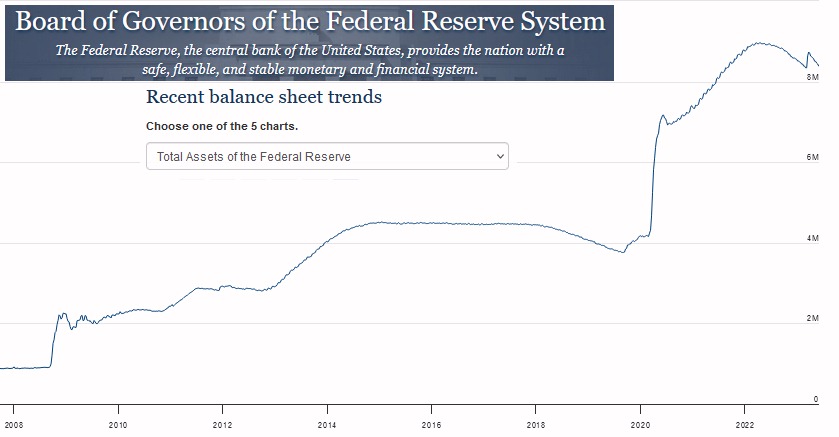
What will the Federal Reserve do? In the Spring of 2022, the Fed said they would not only stop buying Treasuries, but they would also start selling their Treasury assets. Initially, the Fed said the inflation was transitory. They were wrong. In order to fight inflation, the Fed needed to raise interest rates and reduce their assets (Treasuries). The Federal Reserve really shouldn’t be holding assets in the first place. During the financial crisis of 2007-2014, the Federal Reserve started buying trillions of dollars of assets including Treasury securities. Then during the COVID financial crisis, the Fed bought trillions more. In 2022, the Fed did stop buying Treasuries and as the securities matured, the Fed did not participate in as many Treasury rollovers. (Treasury rollover describes the process by which principal payments from maturing Treasury securities held by the SOMA are reinvested in newly auctioned securities.) However, in the graph below you see a sudden uptick in 2023.

Federal Reserve Balance Sheet Assets

The spike in assets in the Spring of 2023 was due to bank failures. The failing banks had billions of dollars in Treasuries that had lost value due to the rising interest rates. When interest rates go up, the value of existing lower yielding securities goes down. So, the Fed bought the devalued assets at full face value. The Fed may also have intervened in the markets to prop up the price of marketable securities in the open market.

What’s Next?
All of these interventions by the Fed have failed to bring inflation down to an acceptable level. Now the Treasury is going to borrow an addition 1 trillion dollars further increasing the demands on borrowing, interest rates, and the banking system. In fact, anything further the Fed does may stoke inflation. If the Fed buys more Treasuries, interest rates will be subsidized lower stimulating inflation. It will in effect be the same as printing money. Rising interest rates will increase the National Debt. Increasing the National Debt will raise interest rates. It is a vicious circle.

While our fiscal and monetary mess is unraveling, the costs of climate change are growing exponentially. Included in the debt ceiling suspension is a provision for unlimited emergency federal spending. Unfortunately this means that the government can continue to ignore the causes of climate change and instead give trillion dollar subsidies to the fossil fuel industry through emergency disaster relief. Yes, another vicious circle — more fossil fuels subsidies result in more climate catastrophes… resulting in more fossil fuel subsidies, etc. The end result will be additional trillions in government borrowing while the standard of living declines.

Recommendations
Given the above, our outlook and recommendations remain the same — persistent inflation and higher interest rates. Individual investors should max-out their annual I Bonds of up to $10k. Leftover saving should be invested in 4-week and 26-week Treasury bills. At maturity securities should be rolled over for the same length of time UNTIL interest rates peak. At that time, longer maturities should be considered.

BONUS
You can make all your transactions commission free at Treasury Direct. Marketable Treasuries are issued at a discounted rate. That means you get paid your interest in advance (giving you an even higher rate of return.)

The Economic Monsters: Inflation and Interest Rates

  1. Economic Forecast = Inflation (2018)
  2. Inflation Bites (2022)
  3. U.S. Mass Consumption Results in Global Economic Disparity, Inequity, and Poverty (2023)
  4. Investment Recommendation: Savings Bonds / I Bonds
  5. Your National Debt

Business & Economics

bookmark_borderClimate Change: Stranded on an Island

by Daniel Brouse

Climate change brings with it the inevitability of rising sea levels. Even if green house gas emissions were stopped completely, the sea will continue to rise for hundreds or thousands of years.

Not only will the submerged properties be affected by the rising tides, so will all the new island properties. Initially, some properties will just be temporarily cut-off from civilization. Eventually, those temporary islands will become permanent.

An initial reaction may be “Oh, I’ve always wanted to live on island;” however, being stranded on a deserted island is not fun. It is important to look forward and evaluate the risk in value to real estate. Much of the newly isolated land will become worthless.

ARS Technica reports, “having a property above water won’t be much good if flooding nearby means you can’t get to a hospital or grocery store when you need to or lose access to electricity or other services. It’s entirely possible for rising seas to leave a property high, dry, but uninhabitable as rising seas cut connections to essential services. A group of researchers has analyzed the risk of isolation driven by sea level rise, and shows it’s a major contributor to the future risks the US faces.”

If you’re interested in comparing the risk of isolation to that of inundation, the researchers built a website that lets you explore the risks under different sea level rise scenarios.

The Journal Nature published “Risk of isolation increases the expected burden from sea-level rise”:

The typical displacement metric for sea-level rise adaptation planning is property inundation. However, this metric may underestimate risk as it does not fully capture the wider cascading or indirect effects of sea-level rise. To address this, we propose complementing it by considering the risk of population isolation: those who may be cut off from essential services. We investigate the importance of this metric by comparing the number of people at risk from inundation to the number of people at risk from isolation. Considering inundated roadways during mean higher high water tides in the coastal United States shows, although highly spatially variable, that the increase across the United States varies between 30% and 90% and is several times higher in some states. We find that risk of isolation may occur decades sooner than risk of inundation. Both risk metrics provide critical information for evaluating adaptation options and giving priority to support for at-risk communities.

More articles on Flood Insurance, Rising Sea Levels and Global Warming.

bookmark_borderAntarctic Ice Sheet Is Melting at Accelerated Rate

The Word Economic Forum published the report The Antarctic ice sheet is melting. And this is bad news for humanity.

* The Antarctic ice sheet has been strongly decreasing since 2016.
* If left unchecked, the complete melting of the West Antarctic ice sheet would cause a global sea level increase of 3.3 metres in the future, says an expert.
* At present, the world is heading towards a warming of 2.8C by the end of this century.
* The Antarctic ice sheet will therefore continue to melt and contribute to sea level rise, which will test the adaptive capacity of humanity.

The consequences of the collapsing ice sheet
The sustained melting of the West Antarctic ice sheet could indicate that an unstable retreat (which reinforces itself) is underway or imminent. However, there is high uncertainty about this phenomenon.

The mechanism that would explain this unstable retreat is known as Marine Ice Sheet Instability.

If the bed, where the ice sheet lies, slopes down towards the interior, it destabilizes the position of the grounding line — zone where this ice sheet starts to float. The thinning of the ice shelf causes this grounding line to retreat, which leads to an influx of ice from the ice sheet to the sea. This, subsequently, causes the thinning of the ice shelf and so on and so forth.

The bottom line is that the melting of the Antarctic ice sheet contributes to and will continue to contribute to sea level rise for a long time, which will test the adaptive capacity of humanity.

The sea level increase by 2100 will particularly affect the tropical countries. And so, what happens in the Antarctic will definitely not stay in the Antarctic.

In February of 2023. the Copernicus Programme issued the repot Copernicus: Antarctic sea ice extent reaches all-time minimum in February – Second warmest winter on record in Europe.

February 2023 – temperature highlights:
* February 2023 was the fifth warmest globally
* Most of Europe had above-average air temperatures, particularly northern Norway and Sweden, and the Svalbard region
* Above-average temperatures occurred in the eastern United States, northern Russia, and in Pakistan and India
* Below-average temperatures were experienced across the Iberian Peninsula, Türkiye, the western United States, * Canada, northeast Russia, and northern Australia

February 2023 – Sea ice highlights:
* Antarctic sea ice reached its lowest monthly extent in the satellite data record, at 34% below the average for February, breaking the previous record of February 2017.
* Antarctic daily sea ice extent also reached an all-time minimum, surpassing the previous record set in February 2022.
* Sea ice concentrations were much below-average in all sectors of the Southern Ocean.
* Arctic sea ice extent was 4% below average, ranking 2nd lowest for February in the satellite data record, jointly with February 2016 and 2017.
* Arctic sea ice concentrations were most below-average in the Barents Sea and Svalbard region.

Sea-level Rise: Greenland and the Collapse of the Antarctic Ice Sheet

More articles on Flood Insurance, Extreme Weather Events, Rising Sea Levels and Global Warming

bookmark_borderClimate Change Impacts on Flood Risks and Real Estate Values

by Daniel Brouse and Sidd Mukherjee
February 26, 2023

Climate change poses many risks to real estate values. In general, as energy is added to a system, the fluctuations in the system increase. So, we expect more storms, more droughts, more wildfires, more floods, more fluctuations of all kinds. What we are saying is that weather conditions will become more volatile due to the impact of humans. For the most part, weather events will become more extreme. Even the momentum of rain will cause a harder rain to fall damaging roofs, sidewalks, and driveways.

Some of the most vulnerable real estate is along coastlines and near floodplains. The study published in the Journal Nature Unpriced climate risk and the potential consequences of overvaluation in US housing markets found:

Climate change impacts threaten the stability of the US housing market. In response to growing concerns that increasing costs of flooding are not fully captured in property values, we quantify the magnitude of unpriced flood risk in the housing market by comparing the empirical and economically efficient prices for properties at risk. We find that residential properties exposed to flood risk are overvalued by US$121–US$237 billion, depending on the discount rate. In general, highly overvalued properties are concentrated in counties along the coast with no flood risk disclosure laws and where there is less concern about climate change. Low-income households are at greater risk of losing home equity from price deflation, and municipalities that are heavily reliant on property taxes for revenue are vulnerable to budgetary shortfalls.

Sidd Mukherjee said, “Pay close attention to Figure 4 in the main paper (top left map, zoom in to max.) The red boundaries are where properties are seriously overvalued and where tax revenues will collapse after flooding.

High Flood Risk Real Estate (The darker the color the higher the risk)

Sidd goes on to say, “Don’t miss the supplementaries.”
Flood Risk to Real Estate Supplementaries

More articles on Flood Insurance, Rising Sea Levels and Global Warming.

bookmark_borderEarliest Spring on Record: Climate Change in Real Time

by Daniel Brouse
February 24, 2023

Parts of Texas, Arkansas, Ohio, Maryland, and New York are all experiencing the earliest spring conditions on record. The National Phenology Network has published a study on February 21, 2023 that found:
Spring leaf out continues to spread north, arriving several days to weeks earlier than average (the period of 1991-2020) in much of the Southeast, lower Midwest, and mid-Atlantic. New York City is 32 days early, Baltimore, MD is 20 days early, and Louisville, KY is 16 days early. Much of southern California and Arizona are days to over a week late, while the coastal Northwest is days to weeks early. Phoenix, AZ is a week late. Seattle, WA is a week early.

“It’s a little unsettling, it’s certainly something that is out of the bounds of when we’d normally expect spring,” said Teresa Crimmins, director of the National Phenology Network and an environmental scientist at the University of Arizona. “It perhaps isn’t surprising, given the trajectory our planet is on, but it is surprising when you live through it.”

Parts of the Southeast, lower Midwest, and mid-Atlantic are seeing either the earliest spring on record or a spring that only occurs once every 40 years

The Human Induced Climate Change Experiment