bookmark_borderAir Pollution Deaths

A report from the World Bank found: Air pollution has emerged as the deadliest form of pollution and the fourth leading risk factor for premature deaths worldwide. Those deaths cost the global economy about US$225 billion in lost labor income in 2013, a new study finds, pointing toward the economic burden of air pollution.

The Cost of Air Pollution: Strengthening the economic case for action, a joint study of the World Bank and the Institute for Health Metrics and Evaluation (IHME), seeks to estimate the costs of premature deaths related to air pollution, to strengthen the case for action and facilitate decision making in the context of scarce resources. An estimated 5.5 million lives were lost in 2013 to diseases associated with outdoor and household air pollution, causing human suffering and reducing economic development.

While pollution-related deaths strike mainly young children and the elderly, premature deaths also result in lost labor income for working-age men and women. The report finds that annual labor income losses cost the equivalent of almost 1 percent – 0.83 percent — of Gross Domestic Product (GDP) in South Asia. In East Asia and the Pacific, where the population is ageing, labor income losses represent 0.25 percent of GDP, while in Sub-Saharan Africa, where air pollution impairs the earning potential of younger populations, annual labor income losses represent the equivalent of 0.61 percent of GDP.

When looking at fatalities across all age groups through the lens of “welfare losses”, an approach commonly used to evaluate the costs and benefits of environmental regulations in a given country context, the aggregate cost of premature deaths was more than US$5 trillion worldwide in 2013. In East and South Asia, welfare losses related to air pollution were the equivalent of about 7.5 percent of GDP.

“Air pollution is a challenge that threatens basic human welfare, damages natural and physical capital, and constrains economic growth. We hope this study will translate the cost of premature deaths into an economic language that resonates with policy makers so that more resources will be devoted to improving air quality. By supporting healthier cities and investments in cleaner sources of energy, we can reduce dangerous emissions, slow climate change, and most importantly save lives,” said Laura Tuck, Vice President for Sustainable Development at the World Bank.

Deaths related to ambient air pollution have risen in heavily populated, fast-urbanizing regions, while deaths related to cooking and heating homes with solid fuels have remained constant despite development gains and improvements in health services. Diseases attributed to both types of air pollution caused 1 in 10 deaths in 2013, or more than six times the number of deaths caused by malaria.

“This report and the burden of disease associated with air pollution are an urgent call to action,” said Dr. Chris Murray, Director of IHME. “Of all the different risk factors for premature deaths, this is one area, the air we breathe, over which individuals have little control. Policy makers in health and environment agencies, as well as leaders in various industries, are facing growing demands – and expectations – to address this problem.”

About 90 percent of the population in low and middle income countries are exposed to dangerous levels of ambient air pollution. The World Bank works with developing countries and development partners to reduce pollution by supporting monitoring and analysis, regulatory reforms, and investments. In 2016 for example, the Bank committed US$1 billion to help China improve air quality by reducing emissions of specific air pollutants from industrial, transport and rural sources in the province of Hebei, and by increasing energy efficiency and clean energy through innovative financing in the Beijing-Tianjin-Hebei region (also known as Jing-Jin-Ji region) that covers the capital area and neighboring provinces.

bookmark_borderClimate Change, Extreme Weather and Toxic Crops

by Daniel Brouse

The United Nations Environment Programme (UNEP) has released a report that examines how climate change is increasing the toxicity of crops.

Crop Toxicity
Extreme weather events, such as “drought and high temperatures, can trigger the accumulation in crops of chemical compounds that are toxic to animals and humans.”

The report goes on to say: Wheat, barley, maize (corn) and millet are among the crops most susceptible to nitrate accumulation, which is caused by prolonged drought. Acute nitrate poisoning in animals can lead to miscarriage, asphyxiation and death, ruining the lives of smallholder farmers and herders.

Heavy rains that break prolonged drought can also result in the dangerous accumulation of another toxic compound called hydrogen cyanide or prussic acid in crops like flax, maize, sorghum, arrow grass, cherries and apples.

Aflatoxins, which are fungal toxins that can cause cancer and stunt foetal growth, are another emerging problem in crops. The risk of aflatoxin contamination, especially in maize, is expected to increase in higher latitudes due to rising temperatures. A recent study predicts that this toxin will become a food safety issue for Europe, especially in the most likely scenario of a 2oC rise in global temperatures.

The report highlights two critical issues associated with climate change – loss and damage. Given the delays in the last 25 years in mitigating and adapting to climate change, scientific evidence suggests that losses and damages from climate change are inevitable, with profound consequences for ecosystems, people, assets and economies. This is already happening. The heat waves of 2003 are a good example of what happens when efforts to mitigate and adapt to changes in the climate fail: 30,000 people died, glaciers decreased, permafrost thawed and the European Union’s agricultural sector lost $14.7 billion.

bookmark_borderAntarctica: Melting Glacier Could See Sea Levels to Rise by 6 Feet

In a new study by Imperial College of London, “current rates of climate change could trigger instability in a major Antarctic glacier, ultimately leading to more than 2m of sea-level rise.”

“The evidence coming together is painting a picture of East Antarctica being much more vulnerable to a warming environment than we thought,” said Professor Martin Siegert, Co-Director of the Grantham Institute at Imperial College London. “This is something we should worry about. Totten Glacier is losing ice now, and the warm ocean water that is causing this loss has the potential to also push the glacier back to an unstable place.”

“Totten Glacier is only one outlet for the ice of the East Antarctic Ice Sheet, but it could have a huge impact. The East Antarctic Ice Sheet is by far the largest mass of ice on Earth, so any small changes have a big influence globally.”

bookmark_borderUS Corporate Taxes

By Daniel Brouse

The United States is the only country that taxes domestic corporations on their worldwide income at the federal and state levels. “The IRS reminds you to report your worldwide income on your U.S. tax returns.”

The United States has the highest corporate tax rate in the world. Federal tax rates on corporate taxable income vary from 15% to 39%.

The United States imposes double taxation on corporate dividends. The IRS says, “The profit of a corporation is taxed to the corporation when earned, and then is taxed to the shareholders when distributed as dividends. This creates a double tax.”

The non-competitive corporate tax rate inhibits businesses from starting in the USA, as well, as encourages business to move out of the USA.

An analysis by the Center for Data Analysis (CDA) of a reduction in the corporate income tax rate to 25 percent shows substantial growth for the U.S. economy:

  • The number of jobs in the U.S. would grow
  • U.S. real gross domestic product would rise
  • A typical family of four’s after-tax income would rise on average by $2,484 per year
  • U.S. capital stock would grow; and Gross private domestic investment would increase

bookmark_borderThe Panama Papers

By Daniel Brouse

The Panama Papers is the name being attached to the world’s largest data breach. A Panama law firm known for offshore business structures had 11,000,000 files stolen. Most of the activities did not take place in Panama, so the name is a bit misleading. Most of the transactions took place in territories, such as, the British Virgin Islands.

An anonymous “whistle blower” gave the data to a German newspaper. The German newspaper is sharing the data with the ICIJ. The International Consortium of Investigative Journalists has hundreds of journalist from around the world working on analyzing the data.

Not About Taxes. About Corruption.
Contrary to common conspiracy theorists, most of the findings do not have to do with tax evasion. Almost all of the named parties are using the shell companies to hide money for other reasons. So far, all of the Americans mentioned are already known criminals.

The names taking the international headlines are mostly political leaders that have been hiding money from their own governments (because they are corrupt and need to hide their ill-gotten gains.) These officials would gladly pay taxes on the money, but they can’t explain how the money was earned. This isn’t about the taxes. This is about laundering money.

The Prime Minister of Iceland stepped down when it was revealed he had hid millions of dollars during his disclosure to Parliament. Vladimir Putin is said to be hiding money from his government in an account set-up under his cellist. The Chinese leaders are accused of the same behavior.

The others being named are individuals placed on sanctions, convicted criminals, and shell companies for the proceeds from Ponzi schemes. In addition to personal corruption, there is also evidence of sanctioned States committing violations. The law firm, Mossack Fonseca, “helped firms subject to sanctions”, such as, links to North Korea’s nuclear weapons program. Another rogue State utilizing the black market is Syria. Mossack Fonseca serviced Assad cousin’s firms despite Syria being on the world watch list.

The current count is:
World Leaders 12
Sanctioned individuals or companies 33

bookmark_borderContrails Versus Chemtrails

by Daniel Brouse

When jet engines fly across the sky, there are two different things that happen. Both are likely causing harm to the environment. Neither are being done on purpose. That is to say — there is no conspiracy to spray chemicals. There is no such thing as intentional “chemtrails”.

What is really happening?

#1 — Jet fuel combustion. The jet fuel exhaust that you can’t see is CO2, particulates and gases which contribute to human induced climate change. They are a major cause of global warming and ocean acidification. The European Union states, “Aviation is one of the fastest-growing sources of greenhouse gas emissions. Someone flying from London to New York and back generates roughly the same level of emissions as the average person in the EU does by heating their home for a whole year.”

In 2013, aircraft accounted for nearly 11 percent of carbon dioxide emissions from the U.S. transportation sector, making them responsible for about 3 percent of total U.S. carbon dioxide emissions. (Center for Climate and Energy Solutions)

#2 — Water vapor. Jet engines at high altitude, under certain atmospheric conditions, condense water into droplets to form Condensation trails (contrails). These contrails are the clouds that you can see with the naked eye. Dr. Sidd Mukherjee of the Membrane Domain says, “It is clear that contrails contribute to warming (form high level cirrus that blocks more outgoing radiation than incoming solar) and this effect was seen when air traffic was suspended in 2001.”

Another effect recently studied is caused by jet exhausts generating a layer of ice crystals, ice haze, that promotes a more diffuse type of light. Chuck Long, from the US National Oceanic and Atmospheric Administration (NOAA), said what was occurring is an example of “accidental geoengineering”. He said, “If you look up the definition of geoengineering, it includes large-scale manipulation of parts of the climate system or the environment, and I believe this ice haze from jet traffic does satisfy that requirement.”

The ice haze is scattering the light as it falls on the Earth. The researchers do not think the “sub-visual contrail-generated ice haze” has a major effect on global warming; however, it may have some significant effects on biology, says Prof. Martin Wild of the Swiss Federal Institute of Technology. Plants prefer diffuse light. Mr. Wild explained, “If you have a canopy structure, the direct light is absorbed by the uppermost leaves. Everything below is shaded and so misses out on that energy. But diffuse light can travel deeper into the canopy and can be absorbed by the plants lower down. So in that sense, if you have more diffuse light those lower plants will profit.” What is good for low level plants may be bad for solar panels: “If you’re decreasing the direct light, then you’re decreasing the energy available for those concentrator systems.”

bookmark_borderSignificant Climate Events

National Oceanic and Atmospheric Administration (NOAA)

> November 2015 was the warmest November on record for the globe.
> January-November 2015 (YTD) was the warmest such period on record for the globe.
> September-November (N. Hemisphere fall) was the warmest such period on record for the globe.
> The November 2015 average global sea surface temperature was also the highest on record.

Records date back 136 years.

Climate Events 2015
Climate Events 2015

bookmark_borderClimate Change Immigrants and Refugees

By Daniel Brouse

EARTH — As human induced climate change is realized, mammals have started showing patterns of migration. Some conditions are driving animals south due to the loss of their habitat (mostly animals living on ice, such as, seals and polar bears.) Some conditions are allowing animals to migrate further north (like humpback whales.) Some conditions are forcing animals to seek higher ground, as well as, escape salt water intrusion. (eg humans that live on islands)

* NOAA recently concluded that mammals are migrating due to global warming. “Humpback and fin whales are now able to go farther north in most winters, competing with beluga whales for resources,” a scientist for the National Oceanic and Atmospheric Administration said.

* The government of the Marshall Islands has requested climate change refugee status from the United States for former Bikini island residents. “The people of Bikini came back to us and asked us to take this proposal to the US, to request the resettlement trust fund be used to settle people in the US not just the Marshall Islands,” said Tony de Brum, Foreign Minister of the Marshall Islands. “We have not seen the final text of the legislation but the request that went in was on the basis of Kili being uninhabitable because of climate change.”

* In Paris almost 200 countries have ratified a new agreement in an attempt to help mitigate climate change. Included in the deal is $100bn fund to help developing and island countries adapt to global warming.

* Long ago in the United States, FEMA started a forced plan of relocation for homes located in areas prone to flooding.

Chances are large that if you are a mammal you will become a climate change refugee.

More on the Human Induced Climate Change Experiment

bookmark_borderChina: Air Quality *Red Alert*

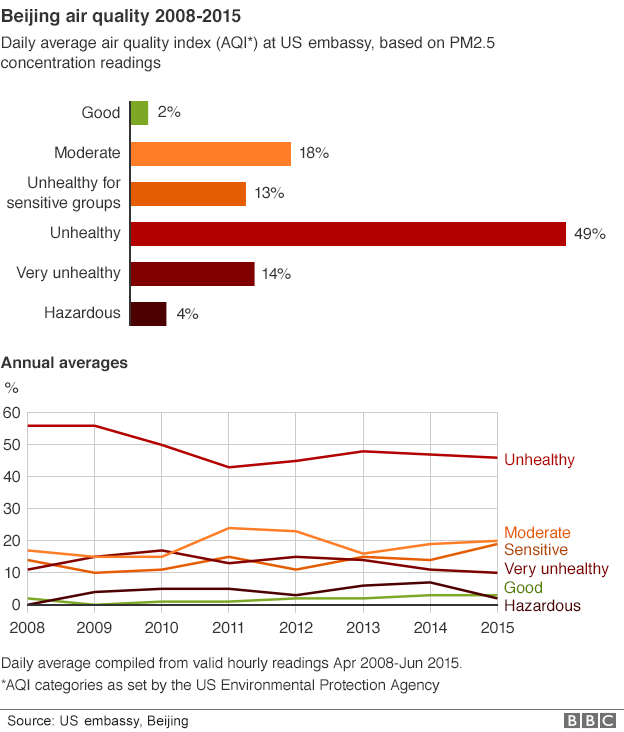
The air pollution in China has become so bad the government has issued their first ever Red Alert. Schools in Beijing are closing and outdoor construction is to cease. The state-run Xinhua news agency says the red alert is the highest possible, and has not been used in the city before.

The air quality is so bad that it is unhealthy to breath. The very young, old and physically active are the most prone to ill-effects. Breathing the air could result in respiratory disease or even death.

Beijing Air Quality
Beijing Air Quality

More on the health risks of air pollution.

More on global warming and climate change.

bookmark_borderDisappearing Islands (Climate Change Refugees)

By Daniel Brouse

THE MARSHALL ISLANDS — If your home is going underwater, you have no doubt about human induced climate change. This is the case for Bikini islanders. In the 1940’s, Bikini island was used for atomic bomb tests. The United States conducted at least 23 nuclear tests including the Bravo hydrogen bomb (the largest weapon of mass destruction at that time.) In 1946, the US relocated residents of Bikini island to another of the Marshall Islands and set up a trust fund. However, by 2011 floods, high tides and encroaching salt water began threatening their existence.

“The people of Bikini came back to us and asked us to take this proposal to the US, to request the resettlement trust fund be used to settle people in the US not just the Marshall Islands,” said Tony de Brum, Foreign Minister of the Marshall Islands. “We have not seen the final text of the legislation but the request that went in was on the basis of Kili being uninhabitable because of climate change.”

This could be the first wave of climate change refugees. It is possible that coastal cities worldwide will need to relocate during this century.

Atomic Bomb Test at Bikini Island