bookmark_borderIs Opposition To GMO Crops Irrational?

By Daniel Brouse

There is evidence of genetically modified crops for over 8,000 years. There is no evidence of harm from eating GM foods. The Bible compares the grafting of an olive branch to a human being grafted to God. Romans 11:17 — “But some of these branches from Abraham’s tree — some of the people of Israel — have been broken off. And you Gentiles, who were branches from a wild olive tree, have been grafted in. So now you also receive the blessing God has promised Abraham and his children, sharing in the rich nourishment from the root of God’s special olive tree.”

The BBC program “The Inquiry” asks:

“Ask a scientist, and they will almost certainly tell you genetically modified food is safe to eat. Yet an awful lot of consumers disagree. Is their fear of GM food irrational? Earlier this year the Pew Foundation released a US poll which suggested 88% of scientists think GM food is generally safe to eat, while only 37% of the public agree. It is the issue on which American scientists and the general public are most divided, more so than climate change or vaccines. If the scientific consensus says it is safe, should we embrace a technology that could help solve hunger and feed the world? Or is GM food a lightning rod for justified concerns about the impact of global agribusiness and industrial food production?”

Listen to the report.

The BBC report mentions flood-tolerant rice. The Ronald Laboratories of UC Davis state:

“Each year millions of small farmers in the poorest areas of the world lose their entire crops to flooding. Although 24% of the global rice crop is grown in paddies, most rice varieties will die if fully submerged for more than three days. In India and Bangladesh alone, submergence destroys 4 million tons of rice each year, enough to feed 30 million people.

About 50 years ago, breeders discovered an unusual and ancient variety of rice that could withstand 2 weeks of complete submergence. Using conventional approaches, breeders tried to introduce this submergence tolerance trait into rice varieties favored by farmers in India and Bangladesh. However, because the breeding was imprecise, the resulting varieties were rejected by farmers. In the 1990s, rice breeder David Mackill (University of California, Davis) and graduate student Kenong Xu (University of California, Davis) demonstrated that tolerance to complete submergence mapped to the Submergence tolerance 1 (Sub1) Quantitative trait locus (QTL)

In 1996, Ronald began a project with Mackill and Xu, funded by the USDA, to isolate the genes at the Sub1 locus. Over a period of 10 years, Dr. Xu carried out fine mapping and physical isolation of the Sub1 gene in the Mackill and Ronald laboratories at the University of California, Davis (Xu. et. al., 2000). While working as a postdoctoral fellow in Ronald’s laboratory, Xu identified and sequenced the Sub1 QTL genomic region, revealed that it carried three ethylene response transcription factors (ERF) and demonstrated that one of the ERFs, designated Sub1A, was up-regulated rapidly in response to submergence. Xu and Ronald further demonstrated that overexpression of Sub1A conferred robust tolerance to submergence in genetically engineered plants ( Xu. et. al., 2006). This work revealed an important mechanism with which plants control tolerance to environmental stress and set the stage for in-depth molecular-genetic analyses of Sub1A-mediated processes”
Also see: GMO Rice Wins Humanitarian Award

bookmark_borderCarbon Dioxide Breaks 800,000 Year Record

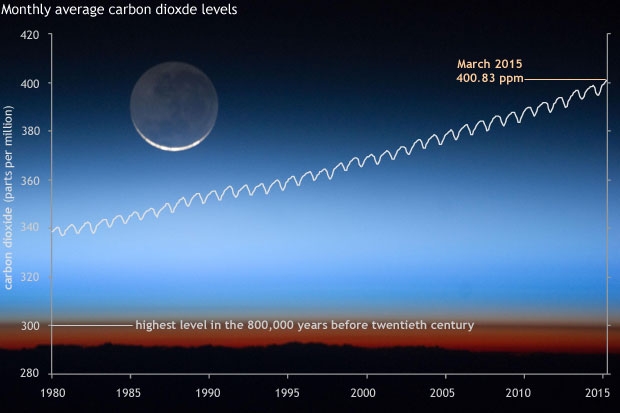
NOAA — For 800,000 years before the twentieth century, carbon dioxide levels in Earth’s atmosphere never exceeded 300 parts per million. Then the Industrial Revolution began, and modern human civilization started burning through millions of years of fossilized carbon in the geological blink of an eye.

NOAA scientists reported that in March 2015 the monthly average global carbon dioxide level went above 400 parts per million for the first time. The graph below puts this value into historical context, showing modern observations since 1980. The seasonal cycle of plant growth and decay in the Northern Hemisphere causes the dips and peaks in the line.

The graph is overlaid on an astronaut photograph of the Earth’s atmospheric limb—the narrow halo of air that appears as a layered cake when viewed from the side and far away. Heat from the sun-warmed surface of the Earth must travel that distance and pass back out to space for Earth’s surface temperature to remain in balance.

But within those layers of atmosphere, carbon dioxide molecules absorb heat, just like the bricks in your chimney absorb heat from a fire. The more carbon dioxide, the more heating, and the longer it takes the atmosphere to cool off. Every night, the solar heating stops, and everything begins to cool off, but every day the Sun comes up and restarts the heating. Because the day’s heat takes longer on average to pass through all those layers than it did when there was less carbon dioxide, Earth’s average temperature has gone up. The more carbon dioxide (and other greenhouse gases) we add, the more it will continue to go up.

In addition to the cascade of climate impacts from this global warming—rising sea level, more extreme rain events, insect pest population explosions, increasing coral bleaching—the extra carbon dioxide is also changing the pH of the ocean. Carbon dioxide is mildly acidic when it dissolves in water (think of your favorite carbonated beverage). The ocean’s rising acidity has harmed oysters and other marine creatures by weakening their shells.

When commenting on the milestone, NOAA scientists pointed out that carbon dioxide is a long-lived greenhouse gas, so stopping the further increase in emissions will not immediately return the Earth’s temperature to it’s pre-industrial state. Once we stop adding more than the Earth’s natural systems can remove in any given year, we will still have to wait thousands of years for the Earth to completely remove the excess amount we have already emitted.

Image by NOAA Climate.gov, based on monthly global carbon dioxide data from Mauna Loa Observatory, provided by NOAA ESRL. Astronaut photograph courtesy NASA Earth Observatory.

Record CO2 Level
Record CO2 Level

bookmark_borderGMO Rice Wins Humanitarian Award

by Daniel Brouse

WASHINGTON, DC — Although social media is full of unsubstantiated claims about GMO’s, the truth is: there is no evidence that GMO’s are harmful. In fact, quite the contrary. For instance, there are specific breeds of tomatoes, potatoes and carrots being grown for their additional health benefits.

Such a beneficial crop, Golden Rice, has just won a humanitarian award. Not only is Golden Rice more nutritious, it is also less harmful to the environment. There are numerous health benefits including β-Carotene providing vitamin A to children. The environment would also see a positive impact in many parts of the world from Golden Rice. Because the rice is more nutritious, less of it needs to be consumed. In addition, a healthy population is much less taxing on the natural resources.

The United States Patent and Trademark Office stated, “Despite current interventions, vitamin A deficiency is the leading killer of children globally (2-3 million annually) and also the leading cause of childhood blindness (500,000 cases annually). Most cases arise in Asia where the staple food eaten by 3.5 billion people daily, white rice, lacks vitamin A sources typically found in meat and leafy vegetables. These deaths and blindness are preventable.

Golden Rice was genetically enhanced to provide a source of vitamin A for people subsisting mainly on rice. Professors Potrykus and Beyer invented the technology after a decade of research, and have worked with Dr. Dubock since 2000 to donate it to the resource poor in developing countries. Patenting the technology allowed the inventors to partner with Syngenta on commercial projects in return for support of their humanitarian objectives to make Golden Rice available free of charge to those in need. Local Golden Rice varieties are currently being developed by public sector institutions in Bangladesh, China, India, Indonesia, Philippines, and Vietnam, with a target cost no more than white rice.”

In a statement, Golden Rice said, “The White House Office of Science and Technology Policy and the U.S. Patent and Trademark Office (USPTO) have announced the winners of the 2015 recipients of the Patents for Humanity Award, among them the Golden Rice Project.

Patents for Humanity is a USPTO program that recognizes patent owners and licensees working to improve global health and living standards for underserved populations. The program advances the President’s global development agenda by recognizing private sector leaders who bring life-saving technologies to those in need, while showing how patents are an integral part of tackling the world’s challenges.

The award has been bestowed upon the Golden Rice Project, in particular to Prof Ingo Potrykus, Prof Peter Beyer, and Dr Adrian Dubock. Dr Dubock will attend the official award ceremony on 20 April 2015, accompanied by the Golden Rice Humanitarian.”

Unfortunately, many of the countries most in need of Golden Rice have laws against importing rice; however, the Pacific Trade Partnership could help save millions of kids… annually.

bookmark_borderThe Problem with Roundup Weed Killer

IARC, the France-based cancer research arm of the World Health Organization, has issued a report finding that Roundup is a probable carcinogen. Though, Monsanto continues to defend the chemical.

“We question the quality of the assessment,” Philip Miller, Monsanto vice president of global regulatory affairs, said. “The WHO has something to explain.”

Glyphosate is the main ingredient in Roundup.

bookmark_borderWhy Do Vegaterians Seem Brain Damaged?

By Daniel Brouse

“Vegans eat only food of plant origin. Because animal products are the only food sources of vitamin B12, vegans must supplement their diets with a source of this vitamin.” — USDA

Lack of B12 and amino acids results in neurological disorders. (eg Brain Damage)

“Also, the vegan diet is a poor choice for growing children. The process of neurodevelopment requires many things. One of those things is cholesterol. It is involved in the myelin sheath. As adults, we make as much, or even more than we need. As children are actively growing myelin, they need more than they can produce. For those infants still nursing, they get it from Mom. Once weened, they need a source for cholesterol. There is no vegetable source of cholesterol. Denying animal-based foods will have a significantly detrimental impact on a growing child’s neurodevelopment,” added Seth Glass.

More from Humans Are Omnivores

bookmark_borderArrests for 90-Year-Old Man Who Feeds Homeless Myth

By Daniel Brouse

There have been many false posts about the arrests of a “90-Year-Old Man Who Feeds Homeless” in Ft. Lauderdale, Florida. For the most part, everything in the posts is not true.

1. The man has not been arrested
2. It is not against the law to feed the homeless in Fort Lauderdale

Screen Shot of a False and Misleading Post

The Sun Sentinel:

“Most people think we’ve banned feeding and we haven’t,” Mayor Seiler of Ft. Lauderdale said. “We’ve set up clear rules and regulations, and they’re reasonable and consistent. We got a lot of input on this from the social service community.”

The New York Times reports:

“This year, Fort Lauderdale, despite a reputation for being more progressive than most Florida cities on homelessness, passed a series of measures that surprised and drew the ire of homeless activists. The latest one, passed last month, made food distribution in public places difficult by requiring toilets, written consent from property owners and feeding sites located 500 feet away from each other.

But the law also relaxed the rules on feeding the homeless in houses of worship and on private property, an attempt to steer food distribution away from parks. On Wednesday, a police officer recommended two nearby sites to Mr. Abbott, an offer the mayor said Mr. Abbott had refused earlier in the day.”

The Mayor released a statement regarding the issue:

On Nov. 5, Fort Lauderdale Mayor Jack Seiler issued a statement in which he said he wanted to “set the record straight” about the city’s services for homeless. He said that the media had misrepresented the facts.

“Contrary to reports,” Seiler wrote, “the City of Fort Lauderdale is not banning groups from feeding the homeless.”

“At two recent outdoor food distributions, citations were rightly issued for non-compliance with the process enacted to ensure public health and safety. Contrary to what was reported in the media, no one was taken into custody. …”

Many cities in the United States have laws against serving prepared food without Health Department certifications, proper garbage disposal, sanitary hand washing and other safety measures that apply to serving any body.

Other problems we found at Occupy Philly while feeding 500 people on a regular basis:
1) Excrement. It is a cruel and unusual punishment to bring homeless people together, feed them and then not let them go to the bathroom. In fact, taking a shower and going to the bathroom are much greater concerns than getting fed. Fortunately, there are many places to get three meals a day. Unfortunately, there are few places for basic human hygiene.
2) Med’s go with feeding. People needing medications for mental illness went untreated. After the first week or two, things got ugly. I was assaulted on more than one occasion by the people we were helping. Also, issues like seizure medication. While embedded as a journalist, I started an Occupy Philly houseband. It was made-up of great musicians. Many were homeless. One (nicknamed “Church”) ended up not getting his seizure med’s. He had a seizure, fell down the concrete steps and had all his front teeth knocked out. If you’re going to feed people, you need to make sure they get their medications.
3) Safety. Once we established a regular feeding, the element of society that preys on the vulnerable arrived. The homeless were robbed, cheated, raped and victimized in almost anyway imaginable.
4) Estate plan. There needs to be a plan for when you can not feed them any longer. We created a large group of people that became dependent on our three meals a day. When the plug was pulled, it was very unfair to the homeless.

Sources:
Tampa Bay Times / Miami Herald “Jack Seiler says Arnold Abbott, 90-year-old, wasn’t taken into custody for feeding homeless”
The New York Times “Florida Finds Tricky Balance Over Feeding of the Homeless”

bookmark_borderLife Lesson

There’s a lesson that I need to remember
When everything is falling apart
In life, just like in loving
There’s such a thing as trying to hard

You’ve gotta sing
Like you don’t need the money
Love like you’ll never get hurt
You’ve gotta dance
Like nobody’s watching
It’s gotta come from the heart
If you want it to work.
— Kathy Mattea

bookmark_borderClimate-related Health Risks

The World Health Organization calls for stronger action on climate-related health risks:

“The evidence is overwhelming: climate change endangers human health,” says Dr Margaret Chan, WHO Director-General. “Solutions exist and we need to act decisively to change this trajectory.”

Previously unrecognized health benefits could be realized from fast action to reduce climate change and its consequences. For example, changes in energy and transport policies could save millions of lives annually from diseases caused by high levels of air pollution. The right energy and transport policies could also reduce the burden of disease associated with physical inactivity and traffic injury.

Measures to adapt to climate change could also save lives around the world by ensuring that communities are better prepared to deal with the impact of heat, extreme weather, infectious disease and food insecurity.

Cholera, malaria and dengue highly sensitive to weather and climate

WHO and its partners highlight the importance of acting now to help protect health in the present as well as the future. The health community is working hard to improve its capacity for surveillance and control of infectious diseases such as cholera, malaria and dengue, which are highly sensitive to weather and climate.

Climate change is already causing tens of thousands of deaths every year from shifting patterns of disease, from extreme weather events, such as heat-waves and floods, and from the degradation of water supplies, sanitation, and impacts on agriculture, according to the most recent WHO data.

“Vulnerable populations, the poor, the disadvantaged and children are among those suffering the greatest burden of climate-related impacts and consequent diseases, such as malaria, diarrhoea and malnutrition, which already kill millions every year”, notes Dr Flavia Bustreo, WHO Assistant Director-General, Family, Women’s and Children’s Health. “Without effective action to mitigate and adapt to the adverse effects of climate change on health, society will face one of its most serious health challenges,” she says.

“But the good news is that reducing climate change can yield substantial and immediate health benefits” says Dr Maria Neira, WHO Director, Department of Public Health, Environmental and Social Determinants of Health. “The most powerful example is air pollution, which in 2012 was responsible for 7 million deaths – one in eight of all deaths worldwide. There is now solid evidence that mitigating climate change can greatly reduce this toll,” she adds.

bookmark_borderEbola Virus Disease

The World Health Organization (WHO) believes the ebola outbreak is more severe than first thought. Because of fear and lack of education, many cases are going unreported. Ebola has a high instance of death due to bleeding from orifices.

“Ebola virus disease is a severe, often fatal illness and one of the world’s most virulent diseases. The infection is transmitted by direct contact with the blood, body fluids and tissues of infected animals or people. During an outbreak, people at higher risk of infection are health workers, family members and others in close contact with sick people and anyone who has died from Ebola. People who are ill with the disease need to receive expert care in appropriate facilities. Ebola outbreaks can devastate families and communities, but the infection can be controlled through the use of recommended protective measures. WHO is coordinating a global response to the latest outbreaks in Africa.”

  • Ebola virus disease (EVD), formerly known as Ebola haemorrhagic fever, is a severe, often fatal illness in humans.
  • EVD outbreaks have a case fatality rate of up to 90%.
  • EVD outbreaks occur primarily in remote villages in Central and West Africa, near tropical rainforests.
  • The virus is transmitted to people from wild animals and spreads in the human population through human-to-human transmission.
  • Fruit bats of the Pteropodidae family are considered to be the natural host of the Ebola virus.
  • Severely ill patients require intensive supportive care. No licensed specific treatment or vaccine is available for use in people or animals.

bookmark_borderClimate Disruption

The United States of America released a report on global warming and has named the problem climate disruption.


The report +confirms that climate change is not a distant threat — it’s affecting us now.” Climate disruption is “expected to become increasingly disruptive across the nation throughout this century and beyond,” the National Climate Assessment concluded.

“President Obama has announced a series of executive actions to reduce carbon pollution, prepare the U.S. for the impacts of climate change, and lead international efforts to address global climate change.”

Due to climate change, the weather is getting more extreme Temperatures are rising across the U.S. Temperatures from 2001 to 2012 were warmer than any previous decade in every region of the United States. Explore this interactive map from the National Climate Assessment to learn more.

EXTREME WEATHER EVENTS
Droughts, Wildfires, and Floods are all more frequent and intense. Precipitation was 2.57 inches below the 20th Century Average. Wildfires burned more than 9.3 million U.S. acres.

Extreme weather comes at a cost

Climate and weather disasters in 2012 alone cost the American economy more than $100 billion

$30 Billion U.S. drought/heatwave

$65 Billion Superstorm Sandy

$11.1 Billion Combined severe weather

$1 Billion Western wildfires

$2.3 Billion Hurricane Isaac

There are also public health threats associated with extreme weather

Children, the elderly, and the poor are most vulnerable to a range of climate-related health effects, including those related to heat stress, air pollution, extreme weather events, and diseases carried by food, water, and insects.


We can choose to believe that Superstorm Sandy, and the most severe drought in decades, and the worst wildfires some states have ever seen were all just a freak coincidence. Or we can choose to believe in the overwhelming judgement of science — and act before it’s too late.
– President Obama