The most likely force to cause a change in climate change is money. New York City is filing a law suit against five major oil companies (BP, Chevron, ConocoPhillips, Exxon Mobil and Royal Dutch Shell), claiming they have contributed to global warming. Mayor Bill de Blasio said the city will seek billions of dollars in the lawsuit to recoup money spent by the city for resiliency efforts related to global warming.
Tag: greenhouse gas emissions
bookmark_borderCarbon Dioxide Breaks 800,000 Year Record
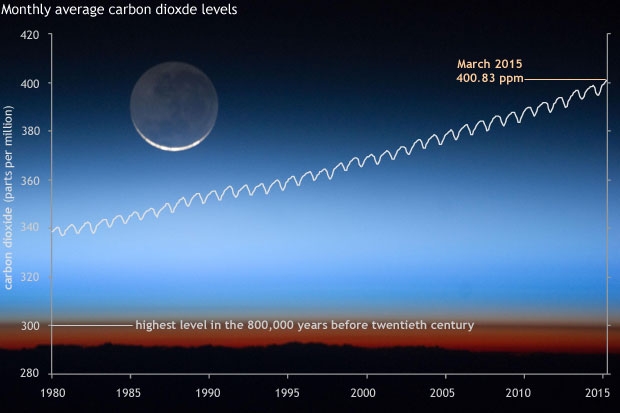
NOAA — For 800,000 years before the twentieth century, carbon dioxide levels in Earth’s atmosphere never exceeded 300 parts per million. Then the Industrial Revolution began, and modern human civilization started burning through millions of years of fossilized carbon in the geological blink of an eye.
NOAA scientists reported that in March 2015 the monthly average global carbon dioxide level went above 400 parts per million for the first time. The graph below puts this value into historical context, showing modern observations since 1980. The seasonal cycle of plant growth and decay in the Northern Hemisphere causes the dips and peaks in the line.
The graph is overlaid on an astronaut photograph of the Earth’s atmospheric limb—the narrow halo of air that appears as a layered cake when viewed from the side and far away. Heat from the sun-warmed surface of the Earth must travel that distance and pass back out to space for Earth’s surface temperature to remain in balance.
But within those layers of atmosphere, carbon dioxide molecules absorb heat, just like the bricks in your chimney absorb heat from a fire. The more carbon dioxide, the more heating, and the longer it takes the atmosphere to cool off. Every night, the solar heating stops, and everything begins to cool off, but every day the Sun comes up and restarts the heating. Because the day’s heat takes longer on average to pass through all those layers than it did when there was less carbon dioxide, Earth’s average temperature has gone up. The more carbon dioxide (and other greenhouse gases) we add, the more it will continue to go up.
In addition to the cascade of climate impacts from this global warming—rising sea level, more extreme rain events, insect pest population explosions, increasing coral bleaching—the extra carbon dioxide is also changing the pH of the ocean. Carbon dioxide is mildly acidic when it dissolves in water (think of your favorite carbonated beverage). The ocean’s rising acidity has harmed oysters and other marine creatures by weakening their shells.
When commenting on the milestone, NOAA scientists pointed out that carbon dioxide is a long-lived greenhouse gas, so stopping the further increase in emissions will not immediately return the Earth’s temperature to it’s pre-industrial state. Once we stop adding more than the Earth’s natural systems can remove in any given year, we will still have to wait thousands of years for the Earth to completely remove the excess amount we have already emitted.
Image by NOAA Climate.gov, based on monthly global carbon dioxide data from Mauna Loa Observatory, provided by NOAA ESRL. Astronaut photograph courtesy NASA Earth Observatory.
bookmark_borderClimate Change and the Presidental Action Plan
The President’s Plan to Cut Carbon Pollution in America
Reducing Carbon Pollution from Power Plants

Power plants are the largest major source of emissions in the U.S., together accounting for roughly one-third of all domestic greenhouse gas pollution.
PROGRESS:
In September 2013, the Environmental Protection Agency (EPA) announced proposed carbon pollution standards for new power plants.
PROGRESS:
The EPA has met with more than 300 stakeholder groups from across the country to gather information on standards for existing power plants. In June 2014, the EPA issued proposed carbon pollution standards for existing power plants.
Continuing the momentum for the future:
Accelerating Clean Energy Leadership

During the President’s first term, the United States more than doubled generation of electricity from wind and solar energy.
PROGRESS:
Since President Obama took office, the U.S. increased solar generation by more than ten-fold and tripled electricity production from wind power.
PROGRESS:
The Department of the Interior (DOI) announced permitting the 50th utility-scale renewable energy project on public lands. The projects could support more than 20,000 jobs and generate enough electricity to power 4.8 million homes.
PROGRESS:
In May 2014, the DOE’s Solar Instructor Training Network announced it will support training programs at community colleges across the country that will assist 50,000 workers to enter the solar industry by 2020.
PROGRESS:
In May 2014, President Obama announced more than 300 commitments private and public sector commitments to create jobs and cut carbon pollution by advancing solar deployment and energy efficiency — representing enough energy to power nearly 130,000 homes.
Continuing the momentum for the future:
Building a 21st Century Clean Energy Infrastructure

Heavy-duty vehicles (commercial trucks, vans, and buses) are currently the second largest source of greenhouse gas pollution within the transportation sector.
PROGRESS:
In January 2014, President Obama signed a Presidential Memorandum establishing the federal government’s first Quadrennial Energy Review (QER) process, with an initial focus on our nation’s energy infrastructure.
PROGRESS:
In February 2014, President Obama directed EPA and DOT to develop and issue the next phase of heavy-duty vehicle fuel efficiency and greenhouse gas standards by March 2016.
PROGRESS:
In 2011, the Administration finalized fuel economy standards for Model Year 2014-2018 for heavy-duty trucks, buses, and vans. This will reduce greenhouse gas emissions by about 270 million metric tons and save 530 million barrels of oil.
PROGRESS:
The Administration has already established the toughest fuel economy standards for passenger vehicles in U.S. history. These standards require an average performance equivalent of 54.5 miles per gallon by 2025.
Continuing the momentum for the future:
Cutting energy waste in homes, businesses, and factories

Energy efficiency is one of the clearest and most cost-effective opportunities to save families money, make our businesses more competitive, and reduce greenhouse gas pollution.
PROGRESS:
Since June, 75 new partners have joined the President’s Better Buildings Challenge. More than 190 organizations, together representing over 3 billion square feet of building space, have now committed to energy savings.
PROGRESS:
In President Obama’s first term, DOE and HUD completed efficiency upgrades in nearly two million homes, saving many families more than $400 on their heating and cooling bills in the first year alone.
PROGRESS:
In December 2013, the Department of Agriculture announced it will provide up to $250 million to help businesses and residential customers in rural areas cut their energy bills through energy efficiency and renewable energy use.
PROGRESS:
Since June, DOE has issued nine proposed and seven final energy conservation standards for appliances and equipment. If finalized and combined with rules already issued, the energy savings will help cut consumers’ electricity bills by hundreds of billions of dollars.
Continuing the momentum for the future:
Reducing other greenhouse gas emissions

Emissions of hydrofluorocarbons (HFCs) — which are potent greehouse gases — are expected to double by 2020 and nearly triple by 2030 in the U.S.
PROGRESS:
Since 1990, methane emissions have decreased by 11% in part through partnerships with industry.
PROGRESS:
In March 2014, the Administration released a Strategy to Reduce Methane Emissions from landfills, coal mining, agriculture, and oil and gas systems through voluntary actions and common-sense standards.
Continuing the momentum for the future:
Federal leadership

Since 2008, federal agencies have reduced greenhouse gas pollution by more than 17 percent — the equivalent of permanently taking 1.8 million cars off the road.
PROGRESS:
Expanded energy performance contracts from $2 billion to $4 billion to provide energy efficiency upgrades for Federal buildings, at no net cost to the taxpayer.
PROGRESS:
On December 5, President Obama signed a Presidential Memorandum directing the federal government to buy at least 20% of its electricity from renewable sources by 2020.