bookmark_borderEnergy, Heat and Global Warming

By Daniel Brouse and Sidd Mukherjee for Sidd’s Science Center

I ask:
Is there anything humans do with energy that results in less heat?

For example, furnaces generate heat, refrigerators generate heat, light bulbs generate heat, computers, cars, fans and even air conditioners create more heat.

Is there anything that we do that has a net loss of thermal energy or does the use of energy (period. both fossil fuel and renewable energy) by humans add to global warming?

Sidd replies:
Not just humans. Anytime energy is converted from one form to another and work is extracted by any agency, not just humans, some is lost as heat energy. That’s the second law of thermodynamics.

But to put it in perspective, lets say you burn a pound of coal, and take all the chemical energy out as heat. The amount of heat you directly obtain is several hundred times smaller than the heat trapped by the carbon dioxide generated over the next many thousand years that it remains in the atmosphere… so, don’t burn coal, oil or any fossil carbon.

Thus, for example conversion of AC to DC electricity can be very close to 100% efficient… but if you take out some of the energy and do work with it, you will lose some energy as heat.

The second law of thermodynamics states that the total entropy of an isolated system always increases over time, or remains constant in ideal cases where the system is in a steady state or undergoing a reversible process. The increase in entropy accounts for the irreversibility of natural processes, and the asymmetry between future and past.

The second law has been expressed in many ways. Its first formulation is credited to the French scientist Sadi Carnot in 1824, who showed that there is an upper limit to the efficiency of conversion of heat to work in a heat engine.

bookmark_borderHumans Set World Pollution Record

by Daniel Brouse

Scientists wrote in the journal Nature Geoscience, “Given currently available records, the present anthropogenic carbon release rate is unprecedented during the past 66 million years.”

The largest known natural surge is believed to have happened 56 million years ago and was likely caused by a release of frozen methane beneath the seabed.

“Our results suggest that future ocean acidification and possible effects on marine calcifying organisms will be more severe than during the PETM (Paleoeocene-Eocene Thermal Maximum),” said lead author Richard Zeebe of the University of Hawaii. “Future ecosystem disruptions are likely to exceed the relatively limited extinctions observed at the PETM.” It is believed in previous warming animals had more time to adapt. In the current warming trend, creatures (such as humans) will unlikely be able to adapt. The warming rate is too fast.

Article from Nature Geoscience:
Anthropogenic carbon release rate unprecedented during the past 66 million years
by Richard E. Zeebe, Andy Ridgwell & James C. Zachos

Abstract
Carbon release rates from anthropogenic sources reached a record high of ~10 Pg C yr−1 in 2014. Geologic analogues from past transient climate changes could provide invaluable constraints on the response of the climate system to such perturbations, but only if the associated carbon release rates can be reliably reconstructed. The Palaeocene–Eocene Thermal Maximum (PETM) is known at present to have the highest carbon release rates of the past 66 million years, but robust estimates of the initial rate and onset duration are hindered by uncertainties in age models. Here we introduce a new method to extract rates of change from a sedimentary record based on the relative timing of climate and carbon cycle changes, without the need for an age model. We apply this method to stable carbon and oxygen isotope records from the New Jersey shelf using time-series analysis and carbon cycle–climate modelling. We calculate that the initial carbon release during the onset of the PETM occurred over at least 4,000 years. This constrains the maximum sustained PETM carbon release rate to less than 1.1 Pg C yr−1. We conclude that, given currently available records, the present anthropogenic carbon release rate is unprecedented during the past 66 million years. We suggest that such a ‘no-analogue’ state represents a fundamental challenge in constraining future climate projections. Also, future ecosystem disruptions are likely to exceed the relatively limited extinctions observed at the PETM.

More Human Induced Climate Change Experiments

bookmark_borderCarbon Dioxide Breaks 800,000 Year Record

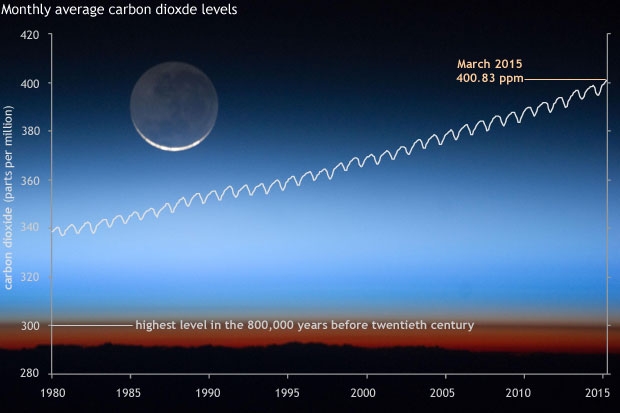
NOAA — For 800,000 years before the twentieth century, carbon dioxide levels in Earth’s atmosphere never exceeded 300 parts per million. Then the Industrial Revolution began, and modern human civilization started burning through millions of years of fossilized carbon in the geological blink of an eye.

NOAA scientists reported that in March 2015 the monthly average global carbon dioxide level went above 400 parts per million for the first time. The graph below puts this value into historical context, showing modern observations since 1980. The seasonal cycle of plant growth and decay in the Northern Hemisphere causes the dips and peaks in the line.

The graph is overlaid on an astronaut photograph of the Earth’s atmospheric limb—the narrow halo of air that appears as a layered cake when viewed from the side and far away. Heat from the sun-warmed surface of the Earth must travel that distance and pass back out to space for Earth’s surface temperature to remain in balance.

But within those layers of atmosphere, carbon dioxide molecules absorb heat, just like the bricks in your chimney absorb heat from a fire. The more carbon dioxide, the more heating, and the longer it takes the atmosphere to cool off. Every night, the solar heating stops, and everything begins to cool off, but every day the Sun comes up and restarts the heating. Because the day’s heat takes longer on average to pass through all those layers than it did when there was less carbon dioxide, Earth’s average temperature has gone up. The more carbon dioxide (and other greenhouse gases) we add, the more it will continue to go up.

In addition to the cascade of climate impacts from this global warming—rising sea level, more extreme rain events, insect pest population explosions, increasing coral bleaching—the extra carbon dioxide is also changing the pH of the ocean. Carbon dioxide is mildly acidic when it dissolves in water (think of your favorite carbonated beverage). The ocean’s rising acidity has harmed oysters and other marine creatures by weakening their shells.

When commenting on the milestone, NOAA scientists pointed out that carbon dioxide is a long-lived greenhouse gas, so stopping the further increase in emissions will not immediately return the Earth’s temperature to it’s pre-industrial state. Once we stop adding more than the Earth’s natural systems can remove in any given year, we will still have to wait thousands of years for the Earth to completely remove the excess amount we have already emitted.

Image by NOAA Climate.gov, based on monthly global carbon dioxide data from Mauna Loa Observatory, provided by NOAA ESRL. Astronaut photograph courtesy NASA Earth Observatory.

Record CO2 Level
Record CO2 Level

bookmark_borderClimate Change Pearls of Wisdom

Learn more about global warming.

World Oceans Month Brings Mixed News for Oysters
by the National Science Foundation

Ocean acidification inhibits shell formation, but interventions at hatcheries may offset some effects, scientists find

In World Oceans Month, there’s mixed news for the Pacific Northwest oyster industry.

For the past several years, it has struggled with significant losses due to ocean acidification. Oyster larvae have had mortality rates high enough to render production no longer economically feasible.

Now a new study documents why oysters appear so sensitive to increasing acidity, but also offers some hope for the future.

It isn’t necessarily a case of acidic water dissolving the oysters’ shells, scientists say. It’s water high in carbon dioxide altering shell formation rates, energy usage and, ultimately, the growth and survival of young oysters.

“The failure of oyster seed production in Northwest Pacific coastal waters is one of the most graphic examples of ocean acidification effects on important commercial shellfish,” said Dave Garrison, program director in the National Science Foundation’s (NSF) Division of Ocean Sciences.

NSF funded the study through its Ocean Acidification Program, part of NSF’s Science, Engineering and Education for Sustainability programs.

“This research is among the first to identify the links among organism physiology, ocean carbonate chemistry and oyster seed mortality,” said Garrison.

Results of the study are online in the journal Geophysical Research Letters, published by the American Geophysical Union.

“From the time eggs are fertilized, Pacific oyster larvae precipitate roughly 90 percent of their body weight as a calcium carbonate shell within 48 hours,” said George Waldbusser, an Oregon State University marine ecologist and lead author of the paper.

“Young oysters rely solely on the energy they derive from the egg because they have not yet developed feeding organs.”

During exposure to increasing carbon dioxide in acidified water, however, it becomes more energetically expensive for organisms like oysters to build shells.

Adult oysters and other bivalves may grow more slowly when exposed to rising carbon dioxide levels. But larvae in the first two days of life do not have the luxury of delayed growth.

“They must build their first shell quickly on a limited amount of energy–and along with the shell comes the organ to capture external food,” said Waldbusser.

“It becomes a death race of sorts. Can the oyster build its shell quickly enough to allow its feeding mechanism to develop before it runs out of energy from the egg?”

The results are important, marine scientists say, because they document for the first time the links among shell formation rate, available energy, and sensitivity to acidification.

The researchers say that the faster the rate of shell formation, the more energy is needed. Oyster embryos building their first shells need “to make a lot of shell on short order,” said Waldbusser.

“As the carbon dioxide in seawater increases, but before waters become corrosive, calcium carbonate precipitation requires more energy to maintain higher rates of shell formation during this early stage.”

The researchers worked with Whiskey Creek Shellfish Hatchery in Netarts Bay, Ore. They found that on the second day of life, 100 percent of the larval tissue growth was from egg-derived carbon.

“The oyster larvae were still relying on egg-derived energy until they were 11 days old,” said Elizabeth Brunner of Oregon State University and a co-author of the paper.

The earliest shell material in the larvae contained the greatest amount of carbon from the surrounding waters.

Increasing amounts of carbon from respiration were incorporated into shells after the first 48 hours, indicating an ability to isolate and control the shell surfaces where calcium carbonate is being deposited.

Waldbusser notes that adult bivalves are well-adapted to growing shell in conditions that are more acidified, and have evolved several mechanisms to do so.

These include use of organic molecules to organize and facilitate the formation of calcium carbonate, pumps that remove acid from the calcifying fluids, and outer shell coatings that protect minerals to some degree from surrounding waters.

Waldbusser said that the results help explain previous findings at the Whiskey Creek Hatchery of larval sensitivity to waters that are high in carbon dioxide but not corrosive to calcium carbonate.

They also explain carryover effects later in larval life of exposure to high carbon dioxide, similar to human neonatal nutrition effects.

The discovery may be good news, scientists say, because there are interventions that can be done at hatcheries that may offset some of the effects of ocean acidification.

Some hatcheries have begun “buffering” water for larvae–essentially adding antacids to incoming waters–including the Whiskey Creek Hatchery and the Taylor Shellfish Farms in Washington.

The study provides a scientific foundation for the target level of buffering.

“You can make sure that eggs have more energy before they enter the larval stage,” said Waldbusser, “so a well-balanced adult diet may help larval oysters cope better with the stress of acidified water.”

-NSF-