bookmark_borderChina: Air Quality *Red Alert*

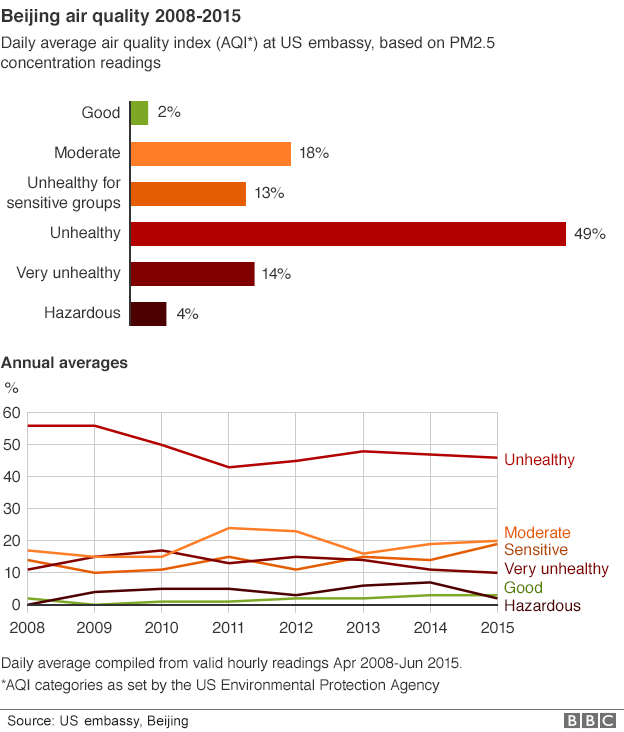
The air pollution in China has become so bad the government has issued their first ever Red Alert. Schools in Beijing are closing and outdoor construction is to cease. The state-run Xinhua news agency says the red alert is the highest possible, and has not been used in the city before.

The air quality is so bad that it is unhealthy to breath. The very young, old and physically active are the most prone to ill-effects. Breathing the air could result in respiratory disease or even death.

Beijing Air Quality
Beijing Air Quality

More on the health risks of air pollution.

More on global warming and climate change.

bookmark_borderLargest Health Risk

The largest unnatural risk to your health is air pollution.

Air pollution is responsible for 1 in 8 deaths.

WHO reports:
In new estimates released today, WHO reports that in 2012 around 7 million people died – one in eight of total global deaths – as a result of air pollution exposure. This finding more than doubles previous estimates and confirms that air pollution is now the world’s largest single environmental health risk. Reducing air pollution could save millions of lives.
New estimates

In particular, the new data reveal a stronger link between both indoor and outdoor air pollution exposure and cardiovascular diseases, such as strokes and ischaemic heart disease, as well as between air pollution and cancer. This is in addition to air pollution’s role in the development of respiratory diseases, including acute respiratory infections and chronic obstructive pulmonary diseases.

The new estimates are not only based on more knowledge about the diseases caused by air pollution, but also upon better assessment of human exposure to air pollutants through the use of improved measurements and technology. This has enabled scientists to make a more detailed analysis of health risks from a wider demographic spread that now includes rural as well as urban areas.

Regionally, low- and middle-income countries in the WHO South-East Asia and Western Pacific Regions had the largest air pollution-related burden in 2012, with a total of 3.3 million deaths linked to indoor air pollution and 2.6 million deaths related to outdoor air pollution.

“Cleaning up the air we breathe prevents non-communicable diseases as well as reduces disease risks among women and vulnerable groups, including children and the elderly…”

Dr Flavia Bustreo, WHO Assistant Director-General Family, Women and Children’s Health

“Cleaning up the air we breathe prevents noncommunicable diseases as well as reduces disease risks among women and vulnerable groups, including children and the elderly,” says Dr Flavia Bustreo, WHO Assistant Director-General Family, Women and Children’s Health. “Poor women and children pay a heavy price from indoor air pollution since they spend more time at home breathing in smoke and soot from leaky coal and wood cook stoves.”

Included in the assessment is a breakdown of deaths attributed to specific diseases, underlining that the vast majority of air pollution deaths are due to cardiovascular diseases as follows:
Outdoor air pollution-caused deaths – breakdown by disease:

40% – ischaemic heart disease;
40% – stroke;
11% – chronic obstructive pulmonary disease (COPD);
6% – lung cancer; and
3% – acute lower respiratory infections in children.

Indoor air pollution-caused deaths – breakdown by disease:

34% – stroke;
26% – ischaemic heart disease;
22% – COPD;
12% – acute lower respiratory infections in children; and
6% – lung cancer.

The new estimates are based on the latest WHO mortality data from 2012 as well as evidence of health risks from air pollution exposures. Estimates of people’s exposure to outdoor air pollution in different parts of the world were formulated through a new global data mapping. This incorporated satellite data, ground-level monitoring measurements and data on pollution emissions from key sources, as well as modelling of how pollution drifts in the air.
Risks factors are greater than expected

“The risks from air pollution are now far greater than previously thought or understood, particularly for heart disease and strokes,” says Dr Maria Neira, Director of WHO’s Department for Public Health, Environmental and Social Determinants of Health. “Few risks have a greater impact on global health today than air pollution; the evidence signals the need for concerted action to clean up the air we all breathe.”

After analysing the risk factors and taking into account revisions in methodology, WHO estimates indoor air pollution was linked to 4.3 million deaths in 2012 in households cooking over coal, wood and biomass stoves. The new estimate is explained by better information about pollution exposures among the estimated 2.9 billion people living in homes using wood, coal or dung as their primary cooking fuel, as well as evidence about air pollution’s role in the development of cardiovascular and respiratory diseases, and cancers.

In the case of outdoor air pollution, WHO estimates there were 3.7 million deaths in 2012 from urban and rural sources worldwide.

Many people are exposed to both indoor and outdoor air pollution. Due to this overlap, mortality attributed to the two sources cannot simply be added together, hence the total estimate of around 7 million deaths in 2012.

“Excessive air pollution is often a by-product of unsustainable policies in sectors such as transport, energy, waste management and industry. In most cases, healthier strategies will also be more economical in the long term due to health-care cost savings as well as climate gains,” says Dr Carlos Dora, WHO Coordinator for Public Health, Environmental and Social Determinants of Health. “WHO and health sectors have a unique role in translating scientific evidence on air pollution into policies that can deliver impact and improvements that will save lives.”

The release of today’s data is a significant step in advancing a WHO roadmap for preventing diseases related to air pollution. This involves the development of a WHO-hosted global platform on air quality and health to generate better data on air pollution-related diseases and strengthened support to countries and cities through guidance, information and evidence about health gains from key interventions.

Later this year, WHO will release indoor air quality guidelines on household fuel combustion, as well as country data on outdoor and indoor air pollution exposures and related mortality, plus an update of air quality measurements in 1600 cities from all regions of the world.
bookmark_borderClimate Change Health Hazard

Physicians For Social Responsibility report:

High in the Earth’s atmosphere, naturally occurring ozone is essential to protecting life on Earth from the harmful ultraviolet rays of the sun. However, here on Earth’s surface, ground-level ozone is a harmful pollutant.

Source of Ozone: Ground-level ozone is formed when two major classes of air pollutants — nitrogen oxides and volatile organic compounds (VOCs) — combine with oxygen in the presence of sunlight. VOCs are emitted naturally by plant life, and also by human industrial activity: from coal combustion in power plants, from chemical plants, gasoline, oil-based paints, and auto body and print shops. Nitrogen oxides result primarily from fossil fuel combustion in power plants, industrial furnaces and boilers, and motor vehicles.

Ozone and Climate Change: Scientists have found that higher temperatures accelerate the reaction between nitrogen oxides and VOCs, creating more ozone. By 2050, climate change alone is projected to increase summertime ozone concentrations by 2 to 8 parts per billion from today’s concentrations.

Health Impacts: Ground-level ozone is associated with many respiratory and cardiovascular ailments and is harmful even to healthy people. Breathing in high ozone levels causes an effect that has been likened to “sunburn of the lungs.” It can create difficulty breathing, aggravation of asthma, development of new cases of asthma, emphysema, chronic bronchitis, and pneumonia.

Ozone can also affect the heart, leading to cardiac arrhythmia and heart attacks. It can also increase the number of low birth-weight babies in mothers exposed to high levels during pregnancy.

Health-related costs of climate change effects on ozone air pollution have been estimated at $6.5 billion annually, nationwide.

Ozone can also impact human health by inhibiting photosynthesis and plant growth, thus reducing yields from food crops.

Health Advice for Bad Air Days: The U.S. Environmental Protection Agency uses an air quality index to rank the day’s ozone levels from good to very unhealthy. Levels are highest on hot, sunny days and are exacerbated by traffic and nearby industry. People with lung disease, including asthma, children, and the elderly are advised to limit outdoor activity when levels reach a ranking over 100.

More About Death By Ozone

bookmark_borderBackground Ozone

Low level ozone (Tropospheric Ozone) is deadly to plants and animals. The huge increase in human respiratory problems and asthma is largely attributed to ozone.

NASA has released a new study on ozone pollution:

Levels of “background ozone” — ozone pollution present in a region but not originating from local, human-produced sources — are high enough in Northern California and Nevada that they leave little room for local ozone production under proposed stricter U.S. ground-level ozone standards, finds a new NASA-led study.

The researchers, led by Min Huang of George Mason University, Fairfax, Virginia, used a novel technique that combined data acquired from two instruments on NASA’s Aura spacecraft in the summer of 2008. The technique more accurately determines levels of background ozone and their relative contribution to total surface ozone levels. Integrating Aura satellite data into the study increased the estimates of background ozone by an average of 2.4 parts per billion (ppb) over previous estimates, an amount that varied by 4 to 11 ppb over the two states. Huang conducted the study while a postdoctoral scholar at NASA’s Jet Propulsion Laboratory, Pasadena, California.

The new method of integrating satellite data may help provide states with a scientific basis to request exemptions to the federal air quality standards for ground-level ozone proposed by the U.S. Environmental Protection Agency. EPA proposed lowering the standard from the current 75 ppb set in 2008 to between 65 and 70 ppb, following a review of public data on the negative health effects of ozone pollution. EPA is required to announce a final decision by Oct. 1.

Background ozone can be produced from natural local sources such as wildfires, and transported via winds from distant sources, such as the stratosphere or another region or country.

Monthly-mean maximum daily 8-hour average background ozone concentration in parts per billion in California and Nevada
Monthly-mean maximum daily 8-hour average background ozone concentration in parts per billion in California and Nevada, estimated by integrating data from NASA’s Aura spacecraft. Credit: NASA/JPL-Caltech/George Mason University

The NASA study found that, on average, background ozone sources generated about 48.3 ppb, or 77 percent, of the total ozone in the study region of California and Nevada. The findings are particularly important in Northern California and Nevada, where wildfires and ozone transported to the region from abroad can cause background ozone to exceed 60 ppb. The lowest background ozone levels were seen in Southern California, where topography helps trap local emissions.

“Our study shows background ozone plays a significant role in Western U.S. ozone levels under high-ozone conditions, and varies considerably by region, with higher values in many rural regions,” said Kevin Bowman, study co-author and principal investigator of Aura’s Tropospheric Emission Spectrometer (TES) instrument at JPL. “Some regions in the West have high background ozone levels that leave less than 10 parts per billion for local ozone production under the EPA’s most aggressive proposed ground-level ozone standards.”

To more accurately determine which sources are contributing the ozone, the team developed a multi-scale pollution assimilation system that ingests global ozone data from Aura’s TES instrument with nitrogen dioxide data from Aura’s Ozone Monitoring Instrument (OMI). Data from independent aircraft, ozonesondes (balloon-borne instruments that measure the concentration of ozone at various altitudes) and surface monitoring sites tested the system’s predictions. The team estimated the contribution of local and background ozone at surface monitoring sites when ozone levels exceeded EPA thresholds.

Ninety percent of ozone is found in Earth’s stratosphere, where it protects us from harmful ultraviolet radiation. The rest is found in Earth’s lower atmosphere, the troposphere, where it acts as a greenhouse gas. At ground level, however, ozone is a key component of smog, produced when nitrogen oxides photochemically react with sunlight in the presence of volatile organic compounds. Ground-level ozone also affects human and ecosystem health. Nitrogen dioxide, the most important ingredient in the production of ozone, comes primarily from cars and industrial emissions, as well as natural sources, such as wildfires.

Critics of EPA’s proposed new standard argue it would throw many areas out of compliance, resulting in economic burdens, and that much of the ozone in their regions comes from non-local pollution. When a county or area is found to be out of compliance, it must act to reduce its ozone emissions. Proponents of the new standard argue the reductions are essential to protect public health. EPA is not allowed to consider economic costs in its decision.

Contributions of background ozone and local, human-produced emissions to ozone levels greater than 65 parts per billion at surface sites in various regions.
Contributions of background ozone (green bars) and local, human-produced emissions to ozone levels greater than 65 parts per billion (horizontal red dash line) at surface sites in various regions. Credit: NASA/JPL-Caltech/George Mason University

The Clean Air Act allows states to request an exemption to the ozone standard if they can show that the cause of an air-quality violation is due to ozone from outside the country or from natural causes. To date, only Wyoming has been granted an exceptional event clearance by EPA due to high background ozone levels.

“By assimilating NASA satellite data on ozone and nitrogen dioxide, our study improves calculations of total and background ozone levels from both non-local ozone and wildfires, data that may prove useful to policymakers,” said Huang. “Our method can potentially be applied broadly to predict air quality in other time periods and locations. We plan to conduct follow-up studies over longer time periods, especially during higher wildfire periods.”

Bowman points to a recent NASA study that showed pollution entering the western United States from Asia has offset expected reductions in mid-tropospheric ozone from local sources. “The partitioning between background and local human sources will likely change in the future, as emissions from outside the United States continue to increase, and contributions from drought-related wildfires grow due to climate change. These changes will require additional reductions in local human-produced emissions to meet EPA standards.”

Bowman said the results highlight the importance of a new international constellation of low-Earth orbiting and geostationary satellites that will continuously observe pollution over Asia, Europe and North America, including NASA’s planned Tropospheric Emissions: Monitoring of Pollution (TEMPO) mission. “This constellation will be a game changer in quantifying global sources of local pollution,” he said.

Study results were published recently in the Journal of Geophysical Research: Atmospheres. Other participating institutions include the University of Iowa, Iowa City; NOAA, College Park, Maryland; University of Colorado, Boulder; and NASA’s Goddard Space Flight Center, Greenbelt, Maryland. JPL is managed for NASA by the California Institute of Technology in Pasadena.

bookmark_borderHealth And Air Quality

by Daniel Brouse

Q: What causes the most illness in the United States?
A: Bad air quality

The leading causes of bad air quality are Particulate Matter, Ground Level Ozone, Sulfur Dioxide (SO2) and Nitrogen Oxide (NOx).

Asthma is a chronic lung disease that affects an estimated 16.4 million adults and 7.0 million children in the United States, regardless of age, sex, race, or ethnicity.(1) Although the exact cause of asthma is unknown and it
cannot be cured, bad air quality is believed to be the main cause. In particular, low level ozone is causing an increase in asthma-like symptoms.(2) What many people believe are food allergies are just symptoms of respiratory and immune system damage caused by ozone.

Low level ozone (tropospheric ozone) is highly volatile and is created in large part due to vehicle emissions. “Ground level ozone is a serious problem in cities with lots of traffic, such as Los Angeles, Philadelphia, Houston and New York City. In 2013, according to the American Lung Association, nearly four in 10 people in the United States (38 percent) lived in areas with unhealthful levels of ozone.” (3) The use of ethanol in gasoline is causing a dramatic increase in low level ozone.(4)

The EPA monitors ozone levels and issues action alert days. “Action days are usually called when the AQI gets into the unhealthy ranges. Different air pollution control agencies call them at different levels. In some places, action days are called when the AQI is forecast to be Unhealthy for Sensitive Groups, or Code Orange. In this case, the groups that are sensitive to the pollutant should reduce exposure by reducing prolonged or heavy exertion outdoors. For ozone this includes: children and adults who are active outdoors, and people with lung disease, such as asthma. For particle pollution this includes: people with heart or lung disease, older adults and children.”(5)

“When ozone levels are very high, everyone should be concerned about ozone exposure.”(6)

1. Centers for Disease Control and Prevention (2008)
2. “Although the data are inconsistent, some epidemiological studies suggest that long-term exposure to ozone could play a role in the development of asthma.” — EPA (2015)
3. National Resources Defense Counsel (2014)
4. Gasoline Plus Ethanol Equals Bad Ozone — The Membrane Domain (2009)
5. AirNow — EPA (2015)
6. Are you at risk from ground-level ozone? — EPA (2009)

bookmark_borderMusic Can Ease the Pain

ENGLAND — The BBC reports: Researchers at Queen Mary University of London said the patients who had listened to music had been less anxious after their surgery and had needed less pain relief.

The Department of Health said doctors should consider the findings. The scientists want hospitals to suggest in NHS information leaflets that patients bring music devices and playlists into hospital with them.

The team reviewed 70 trials, involving about 7,000 patients around the time of surgery, comparing a wide variety of mostly “soothing” music with:

* undisturbed bed rest
* headphones with no music
* white noise
* routine care

The lead author, Dr Catherine Meads, said Pink Floyd’s Dark Side of the Moon album had helped soothe her pain three hours after hip surgery in April.

Music was a safe, cheap and non-invasive option that should “be available to everyone having surgery”, she said.

“Currently music is not used routinely during surgery to help patients in their post-operative recovery.

“The lack of uptake is often down to the scepticism of professionals as to whether it genuinely works, and of course issues of budget and the integration into daily practice.”

Dr Meads added “it was quite a surprise” music had worked under general anaesthetic.

In another study, Prof. Levitin said, “We’ve found compelling evidence that musical interventions can play a health care role in settings ranging from operating rooms to family clinics. But even more importantly, we were able to document the neurochemical mechanisms by which music has an effect in four domains: management of mood, stress, immunity and as an aid to social bonding.”

Playing a musical instrument, singing and dancing provide even greater health benefits.

bookmark_borderSea Level Warning

A new study, written by James Hansen (NASA’s former lead climate scientist) and 16 co-authors, concludes that glaciers in Greenland and Antarctica will melt 10 times faster than previous estimates. The result could be a sea level rise of at least 10 feet in the next 50 years. Hanson said the new findings would be “substantially more persuasive than anything previously published.”

“We conclude that continued high emissions will make multi-meter sea level rise practically unavoidable and likely to occur this century. Social disruption and economic consequences of such large sea level rise could be devastating. It is not difficult to imagine that conflicts arising from forced migrations and economic collapse might make the planet ungovernable, threatening the fabric of civilization.”

bookmark_borderEPA: Climate Change Report

WASHINGTON –The U.S. Environmental Protection Agency (EPA) today released one of the most comprehensive analyses to date on the economic, health and environmental benefits to the United States of global climate action. The peer-reviewed report, “Climate Change in the United States: Benefits of Global Action,” examines how future impacts and damages of climate change across a number of sectors in the United States can be avoided or reduced with global action. The report compares two future scenarios: a future with significant global action on climate change, where global warming has been limited to 2 degrees Celsius (3.6 degrees Fahrenheit), and a future with no action on climate change (where global temperatures rise 9 degrees Fahrenheit). The report then quantifies the differences in health, infrastructure and ecosystem impacts under the two scenarios, producing estimates of the costs of inaction and the benefits of reducing global GHG emissions.

“Will the United States benefit from climate action? Absolutely. This report shows us how costly inaction will be to Americans’ health, our environment and our society. But more importantly, it helps us understand the magnitude of benefits to a number of sectors of the U.S. with global climate action,” said EPA Administrator Gina McCarthy. “We can save tens of thousands of American lives, and hundreds of billions of dollars, annually in the United States by the end of this century, but the sooner we act, the better off America and future generations of Americans will be.”

The report examines how the impacts and damages of climate change across a number of sectors in the United States can be avoided with global action. The findings include:

• Global action on climate change reduces the frequency of extreme weather events and associated impacts. For example, by 2100 global action on climate change is projected to avoid an estimated 12,000 deaths annually associated with extreme temperatures in 49 U.S. cities, compared to a future with no reductions in greenhouse gas emissions. This is more than a 90 percent reduction from what we would expect with no action.

• Global action now leads to greater benefits over time. The decisions we make today will have long-term effects, and future generations will either benefit from, or be burdened by, our current actions. Compared to a future with unchecked climate change, climate action is projected to avoid approximately 13,000 deaths in 2050 and 57,000 deaths annually in 2100 from poor air quality. Delaying action on emissions reductions will likely reduce these and other benefits.

• Global action on climate change avoids costly damages in the United States. For nearly all of the 20 sectors studied, global action on climate change significantly reduces the economic damages of climate change. For example, without climate action, we estimated up to $10 billion in increased road maintenance costs each year by the end of the century. With action, we can avoid up to $7 billion of these damages.

• Climate change impacts are not equally distributed. Some regions of the United States are more vulnerable than others and will bear greater impacts. For example, without action on climate change, California is projected to face increasing risk of drought, the Rocky Mountain region will see significant increases in wildfires, and the mid-Atlantic and Southeast are projected to experience infrastructure damage from extreme temperatures, heavy rainfall, sea level rise, and storm surge.

• Adaptation can reduce damages and costs. For some sectors, adaptation can substantially reduce the impacts of climate change. For example, in a future without greenhouse gas reductions, estimated damages from sea-level rise and storm surge to coastal property in the lower 48 states are $5.0 trillion dollars through 2100. With adaptation along the coast, the estimated damages and adaptation costs are reduced to $810 billion.

The report is a product of the Climate Change Impacts and Risks Analysis (CIRA) project, led by EPA in collaboration with the Massachusetts Institute of Technology, the Pacific Northwest National Lab, the National Renewable Energy Laboratory, and other partners. The CIRA project is one of the first efforts to quantify the benefits of global action on climate change across a large number of U.S. sectors using a common analytic framework and consistent underlying data inputs. The project spans 20 U.S. sectors related to health, infrastructure, electricity, water resources, agriculture and forestry, and ecosystems.

bookmark_borderCatastrophic Impacts of Climate Change

A study by University College London (UCL) concludes we heave severely underestimated the health impacts of global warming. “The frequency and intensity of extreme weather events will dramatically increase.”

“In essence, whether we respond to “the biggest global health threat of the 21st century” is no longer a technical or economic question — it is political. An effective international agreement will be one that supports stronger efforts everywhere and at every level,” the report says.

The Business Insider reports, “The direct health impacts will come from heat waves, floods, droughts and storms, but the indirect impacts, such as changes in infectious disease patterns, pollution, malnutrition, mass migrations, and conflicts will be just as impactful.”

“Our analysis clearly shows that by tackling climate change, we can also benefit health, and tackling climate change in fact represents one of the greatest opportunities to benefit human health for generations to come,” Commission co-Chair Professor Anthony Costello, Director of the UCL Institute for Global Health told UCL News.

“The difficulty, essentially, is ourselves: the tendency of humans to ignore or discount unpleasant facts or difficult choices, the nature of companies and countries to defend their own rather than collective interests and the narrow, short term horizons of most human institutions, which feed into the difficulties of global negotiations,” the report concludes.

bookmark_borderThe Sixth Mass Extinction Is Here

Researchers from several universities have released a study that concludes the Earth has entered into its sixth mass extinction. Rob Jordan author of the Stanford Woods Institute for the Environment states, “There is no longer any doubt: We are entering a mass extinction that threatens humanity’s existence.”

The onset of the extinction is due to human activity. Paul Ehrlich, the Bing Professor of Population Studies in biology and a senior fellow at the Stanford Woods Institute for the Environment, calls for “fast action to conserve threatened species, populations and habitat, but warn that the window of opportunity is rapidly closing.”

“The study shows without any significant doubt that we are now entering the sixth great mass extinction event,” Ehrlich said. “There are examples of species all over the world that are essentially the walking dead. We are sawing off the limb that we are sitting on.”

The study shows that “even with extremely conservative estimates, species are disappearing up to about 100 times faster than the normal rate between mass extinctions.”

“If it is allowed to continue, life would take many millions of years to recover, and our species itself would likely disappear early on,” said lead author Gerardo Ceballos of the Universidad Autónoma de México.

“We are now entering the sixth great mass extinction event,” one of the authors of the paper told the BBC.

Gerardo Ceballos, lead author of the research, added: “If it is allowed to continue, life would take many millions of years to recover and our species itself would likely disappear early on”.

The main causes of the mass extinction are:


  • Land clearing for farming, logging and settlement
  • Introduction of invasive species
  • Carbon emissions that drive climate change and ocean acidification
  • Toxins that alter and poison ecosystems


Extinction Chart
Extinction Chart