Every day I walk a hundred years to the hill where my great, great granddaughter sits. I carry words of blessing and reach to touch her back.
But feeling me near she turns, sad-eyed and heavy with grief.
“What was it like?” she asks, “when the great whales swam, when the birds sang you awake, when the rains came soft, and the soil smelled sweet underfoot?”
And the blessings catch in my throat.
On darker days she turns, her famished face charred, and eyes sunk in their bony orbits, burn with curses.
And the blessings froth at my mouth with the poisonous spume of betrayal.
On the darkest of all days I walk the hundred years and find no one there.
Let today be the bright day. Let today be the bright day I lay my hand upon her back.
And, feeling me near, she turns and blesses me, saying,
“Your love was fierce enough, sweet ancestor, your love was fierce enough.”
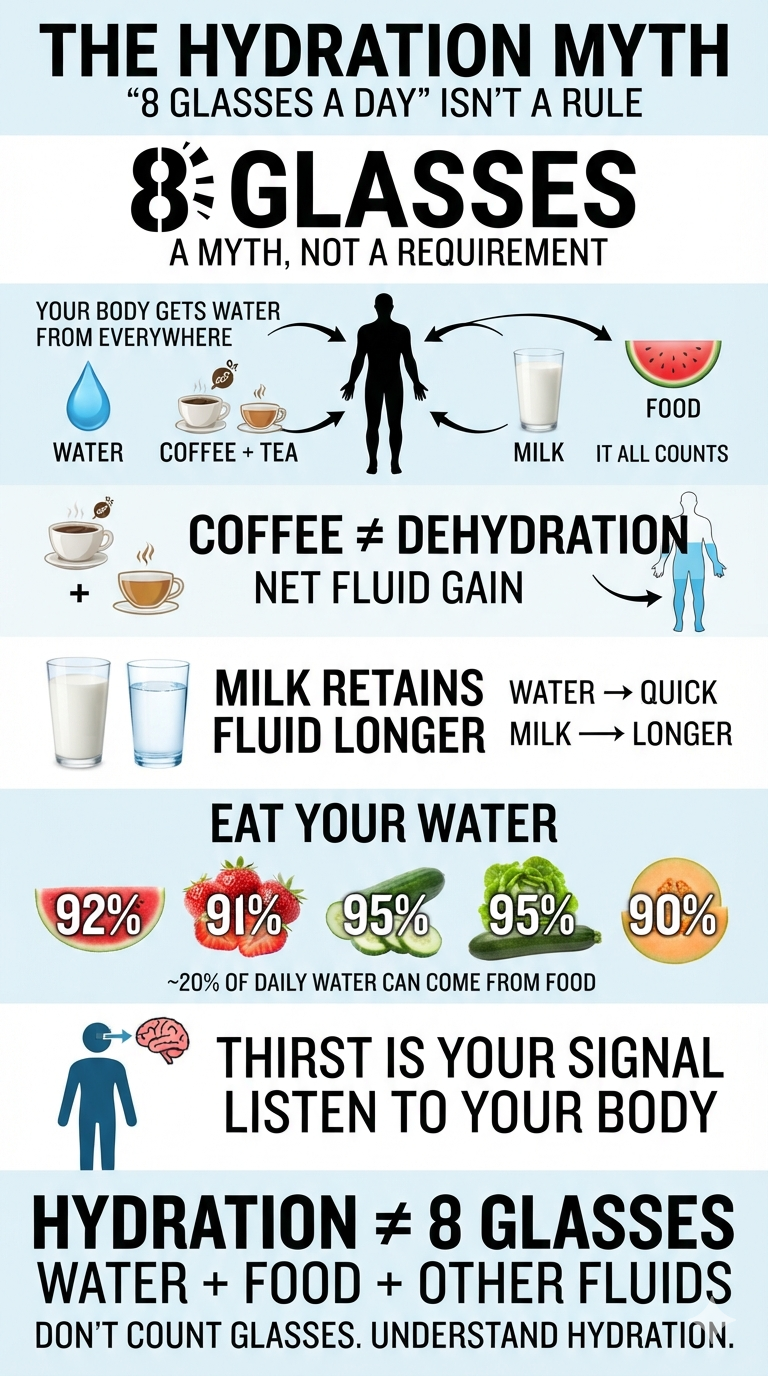
The rule to drink six to eight glasses of water a day is a myth.
The standard recommendation to drink six to eight glasses of water every day is a popular health myth that is not supported by scientific evidence. While it may serve as a convenient baseline, there is no universal requirement for everyone to drink a fixed number of glasses of water each day.
Your actual hydration needs depend heavily on your body size, health, activity level, diet, and local weather conditions.
Why the “Eight Glasses” Rule Is Flawed
It Omits Food Sources
You get roughly 20% of your daily water from food. Fruits and vegetables can contain extraordinarily high amounts of water, meaning hydration doesn’t come exclusively from what you drink.
It Counts Only Water
Coffee, tea, milk, juice, and other beverages all contribute directly to your daily fluid intake. Your body doesn’t somehow exclude the water in those beverages simply because it isn’t plain water.
Another persistent hydration myth is that coffee and tea are so diuretic that drinking them causes you to lose more fluid than you consume.
That’s not true.
It Ignores Your Body
For most healthy adults, your natural thirst mechanism is an incredibly precise indicator of when you need to drink. When you’re thirsty, drink. When you’re not thirsty, there is no scientific reason to force yourself to consume an arbitrary number of glasses simply because a popular rule says you should.
Milk Is More Hydrating Than Plain Water
Milk is actually more hydrating than plain water and keeps you hydrated for a longer period of time.
Plain water is excellent for rapid hydration, but it moves through the digestive system quickly and can result in faster fluid loss through urination. Milk contains water along with electrolytes, carbohydrates, protein, and other nutrients that slow fluid movement and help the body retain the water longer. Studies have found that milk produces less fluid loss than plain water.
This makes milk an especially effective hydrating beverage when longer-lasting fluid retention matters.
Eat Your Water
Some of the most hydrating foods on the planet are also among the most nutritious.
Melons and Berries
Watermelon: Composed of 92% water and packed with the antioxidant lycopene and potassium.
Strawberries: Contain 91% water alongside high amounts of vitamin C and inflammation-fighting fiber.
Cantaloupe: Made of 90% water and provides more than half your daily vitamin A needs per cup.
Crunchy and Leafy Vegetables
Cucumbers: Boast the highest water content of any solid food at 95% water, plus vitamin K.
Celery: Contains 95% water and provides a natural source of hydrating potassium and sodium.
Zucchini: Made of 94% water and delivers gut-friendly fiber that slows nutrient absorption.
Lettuce: Iceberg and romaine are approximately 95% water, providing an easy, volume-based hydration boost.
Liquids and Soups
Plain Yogurt or Kefir: Approximately 85% water while also providing calcium, protein, and gut-healthy probiotics.
Broths and Bouillons: Provide a high-moisture base loaded with electrolytes such as sodium, which helps the body retain fluids and prevents rapid fluid loss.
The Bottom Line
Hydration is not about hitting an arbitrary number of glasses.
Your body gets water from food and beverages—not just from plain water. Your hydration needs change with your size, activity, health, diet, temperature, and humidity.
So forget the eight-glass rule.
Drink when you’re thirsty. Eat water-rich foods. Drink more when you’re sweating or exposed to heat. And stop treating plain water as the only source of hydration.
Your body already has a sophisticated hydration system.
I use phasing out in a way that means completely ending the use and production of fossil fuels down to zero. Phasing down means a gradual reduction or scaling back in FF use over time without specifying a complete stop. Would add or alter that in any way?
How would you define differntiate ‘transition away’?
Reply:
I would slightly modify your definition of “phasing down” to: “a gradual reduction or scaling back in fossil-fuel use over time without specifying a date for complete cessation.”
There are really two separate issues for me:
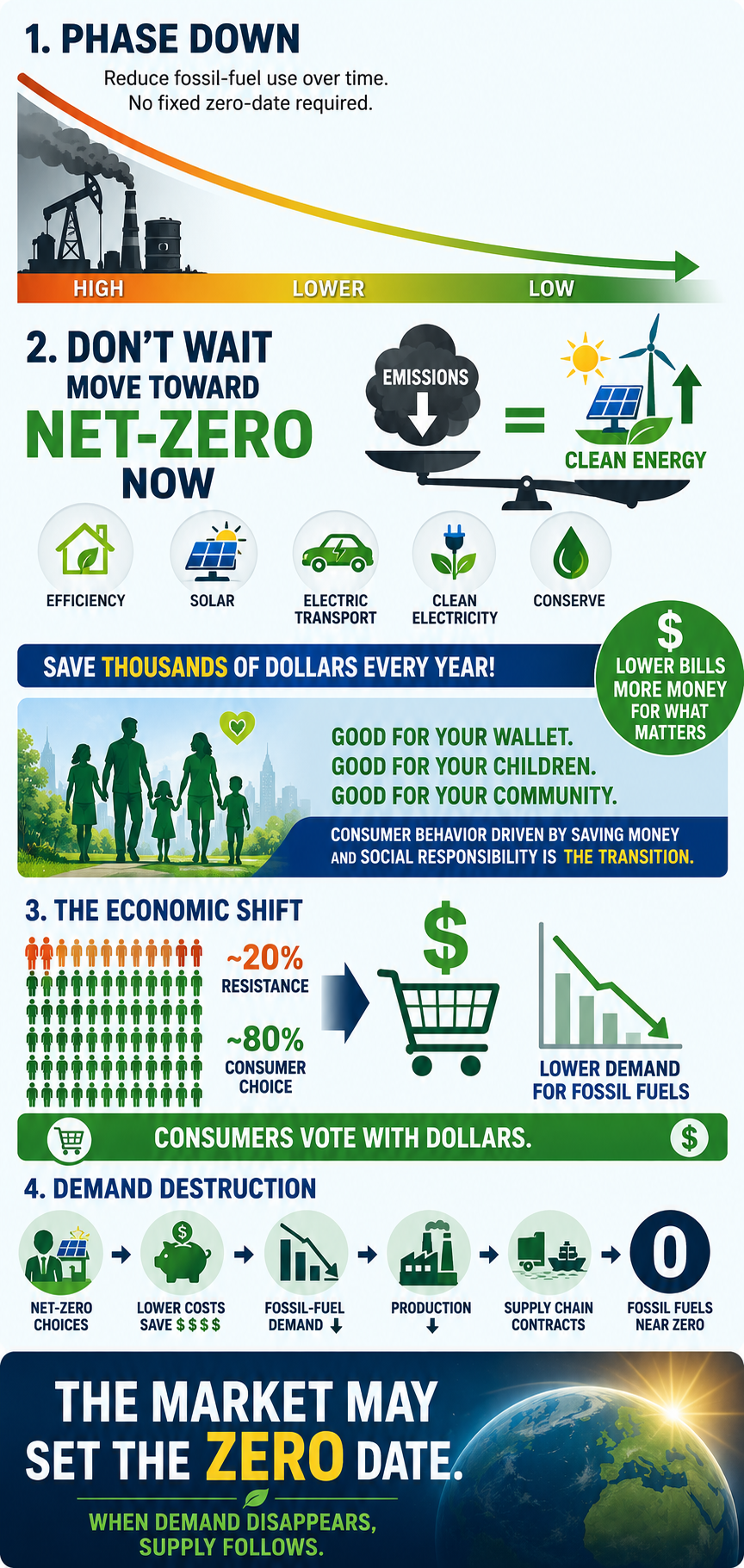
1. For this generation, I prefer net-zero carbon emissions as the immediate goal. If someone isn’t already moving toward net-zero, I think they should start now. We don’t need to wait for a theoretical future phase-out date to begin reducing emissions.
2. As both a climatologist and an economist, I’m not convinced that setting a specific date for the complete elimination of fossil fuels is ultimately what matters. In the U.S., roughly 20% of the population appears ideologically committed to policies that would accelerate climate change. Nothing I say or do is likely to change that.
But that still leaves roughly 80% of the population—and I think economics is going to do much of the work.
Right now, perhaps only ~0.5% of Americans are seriously attempting a structured net-zero lifestyle through continuous behavioral reductions and intentional balancing. As more people discover that net-zero can actually save them thousands of dollars a year while also leaving a better environment for their children and grandchildren, I expect consumer behavior to change.
When the remaining ~79.5% begin voting with their dollars, fossil-fuel demand will fall. That creates demand destruction, which ultimately means suppliers will have less and less reason to produce fossil fuels.
So, ironically, I don’t think we necessarily need to establish the exact date when fossil fuels reach zero. The market may establish that date for us. The “complete stop” happens when there is no longer sufficient demand to sustain the fossil-fuel supply chain.
Question:
When you use the term net zero is it with the understanding that the “net” component allows continuous greenhouse gas emissions under the assumption that unproven removal technologies or flawed offsets will balance them out later, delaying necessary fossil fuel phaseouts?
Net zero is a contentious term within my community and I want to be clear that I understand how you see and apply it.
Reply:
That’s an important distinction. When I use the term net-zero, I’m talking about it at the personal/lifestyle level, and I am not using “net” to justify continuing to emit greenhouse gases while assuming that unproven technologies or questionable offsets will clean up the problem later.
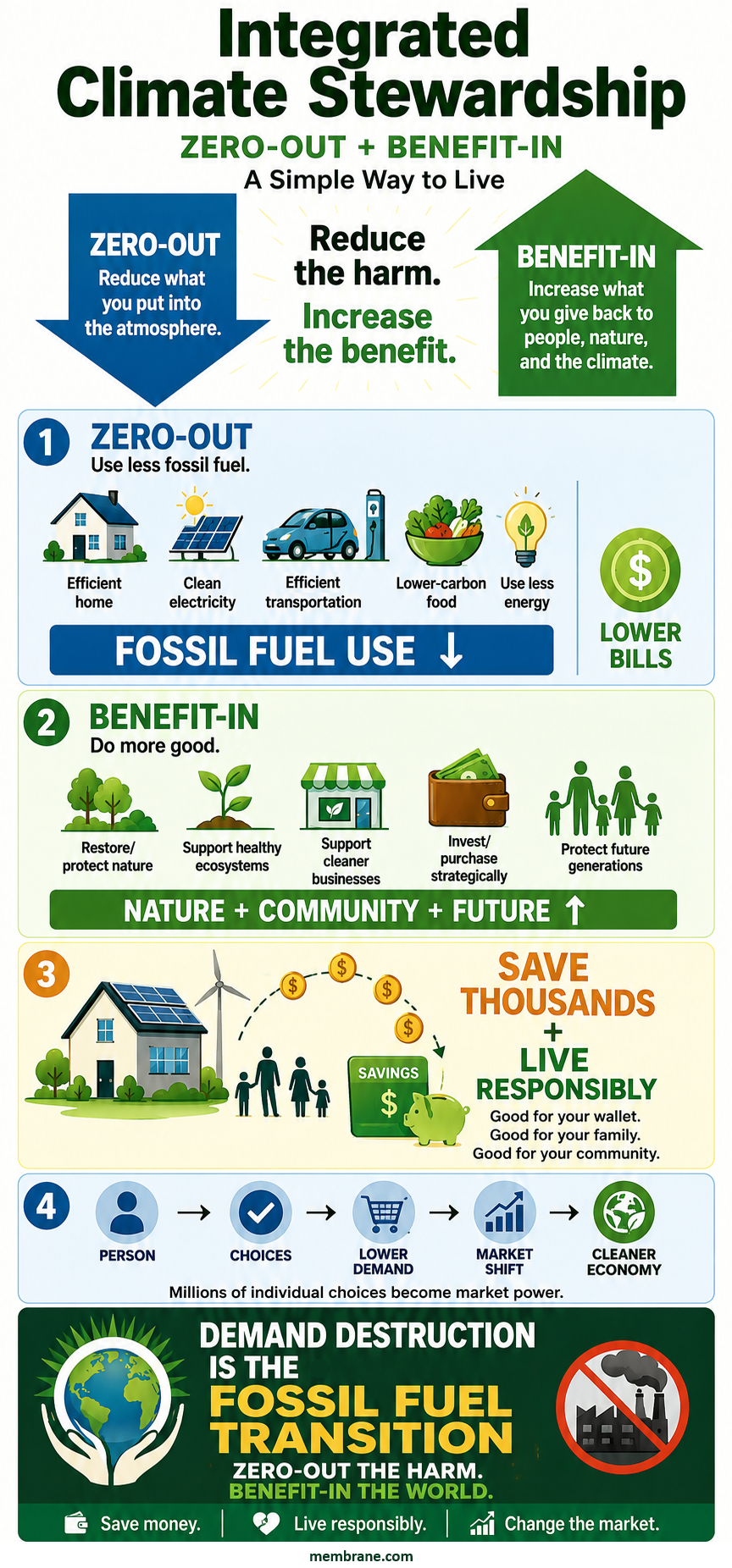
What I mean is closer to “Holistic Net-Zero Living” or “Integrated Climate Stewardship”: reducing and, wherever realistically possible, zeroing out the emissions associated with my own lifestyle first, while also taking responsibility for the impacts I can’t immediately eliminate.
For me, that means a 360-degree carbon strategy:
ZEROING OUT / STRUCTURAL DECARBONIZATION
Electrifying transportation and home energy
Increasing energy efficiency
Using clean electricity
Reducing fossil-fuel consumption as close to zero as practical
Reducing high-carbon consumption, including dietary choices
BEYOND MY DIRECT FOOTPRINT
Supporting ecosystem restoration and conservation
Protecting forests and biodiversity
Supporting businesses and technologies that accelerate decarbonization
Using my purchasing and investment decisions to create economic demand for cleaner alternatives
So I’m not saying, “Keep emitting and someone will remove it later.” Quite the opposite. The first priority is eliminating the emissions themselves.
I think of the “net” component as recognizing that an individual cannot instantly eliminate every indirect emission associated with modern life. Rather than pretending those emissions don’t exist, I try to compensate through additional positive actions while continuously working to reduce the underlying footprint.
Ultimately, my goal isn’t simply to achieve a favorable carbon-accounting number. It’s to change the way I live so that my actual fossil-fuel demand approaches zero—and to use my economic choices to help make that transition happen systemically.
That’s why I sometimes think “holistic net-zero living” or “integrated climate stewardship” communicates what I mean better than simply saying “net-zero.”
Question:
Why continue using the language of ‘net zero’? What economic model do you see best aligns w/ what you have outlined?
Reply:
Haaha… good questions.
A: I’m actually in the process of writing the paper that officially changes my language from “net-zero” to “Integrated Climate Stewardship.” So thank you for pushing me on that. I think the new terminology better captures what I’ve been trying to describe.
B: I’m also working on the economic model, and that one is considerably trickier—not because of the terminology, but because AI is changing the underlying economics so rapidly.
I see AI as a double-edged sword. On one edge, as AI replaces more human labor and productivity, the human contribution to economic production could eventually become a much smaller share of GDP. AI may also be capable of producing enormous amounts of economic value with far less energy per unit of output than traditional human labor and many existing production systems.
But the other edge of that sword is wealth distribution.
If the ownership of AI, capital, and productive capacity becomes increasingly concentrated, we could see extraordinary productivity growth occurring alongside increasingly unjust wealth inequality. We could potentially solve one problem—resource and energy efficiency—while creating another: who actually owns and benefits from the productivity?
That’s the economic model I’m wrestling with now: how do we build an economy where AI-driven productivity, decarbonization, consumer savings, and environmental stewardship reinforce each other while the resulting wealth is broadly distributed?
That may ultimately be a much bigger economic question than the climate transition itself.
Question:
Have you been sitting with the economic of degrowth in all of this then? Sounds like there is that tension in what is being considered.
Reply:
Yes. I’ve been sitting with the economics of degrowth quite a bit. And I think there’s an interesting tension here.
Traditional capitalism is fundamentally tied to population growth, human labor, productivity, and consumption. But AI potentially breaks that relationship. If technology increasingly replaces human labor, then economic growth can continue—even accelerate—while the economic value of human labor declines, perhaps dramatically.
So I’m not sure the future necessarily looks like “degrowth.” It may be something stranger: exponential technological growth occurring alongside declining human labor demand, an aging population in the developed regions of the world, and potentially declining population worldwide.
That raises a much bigger question: if human labor is no longer the primary engine of economic value, what exactly are we trying to maximize—and how should the economy distribute the benefits of that productivity?
That’s the economic model I’m wrestling with right now.
Question:
What about lands and waters in these considerations?
Can we agree that what we need must be either mined or grown?
Raw materials come from somewhere with significant externalities — often left out of economic theory.
My other issue is the assumptive ghost of interest-bearing-debt as a driver of unnecessary growth.
Reply:
Yes—and I think land, water, and raw materials have to be part of the model. My initial modeling, however, is pointing toward a very different problem than the one we traditionally assume.
If AI continues improving itself, productivity could eventually become extraordinarily resource-efficient. Very little additional human labor—and potentially much less land, water, or energy per unit of economic output—may be required for productivity and growth. At the same time, consumers could be forced to consume much less because their income from labor is declining. And as solar and other clean-energy technologies continue becoming cheaper, the pressure for some forms of mining and extraction could decline as well.
That brings me back to your point about interest-bearing debt. I think sovereign debt may become the critical part of the equation.
Productivity gains and abundant cheap clean energy are profoundly deflationary. Deflation sounds wonderful for consumers in theory—but not if it is accompanied by collapsing labor income. You could have falling costs and prices while households simultaneously lose the purchasing power needed to buy anything.
Now add governments facing enormous debt obligations while their traditional tax base is shrinking because human labor is becoming less economically valuable. Governments could increasingly rely on interest-bearing debt to finance poverty reduction, redistribution, and some form of basic income.
And that creates a potentially nasty feedback loop: AI-driven productivity → declining labor income → shrinking tax base → rising sovereign debt → greater reliance on monetary expansion → inflationary pressure.
Historically, severe sovereign debt problems have sometimes been resolved through substantial currency devaluation and inflation. I’m not saying hyperinflation is inevitable—but it is one of the risks I’m now modeling.
The really strange possibility is that we could simultaneously have exponential productivity, increasingly abundant cheap energy, falling costs of production—and increasing economic hardship for ordinary people.
In other words, the problem may not ultimately be whether the planet can produce enough. It may be whether humans can maintain enough income, purchasing power, and economic agency to participate in the abundance that AI creates.
That, to me, is where the economic model gets really interesting.
By Daniel Brouse Economist & Climatologist Membrane Domain USA August 10, 2026
Our system gives no value to global commons such as the atmosphere or the oceans, because they are not seen as “scarce commodities”. One oak tree does not matter, because there are vast numbers of oak trees.
Pumping sewage into the sea doesn’t matter, because the sea is too big for it to matter.
Pumping CO2 into the air doesn’t matter, because the air is limitless.*
This is a mythological view of the world, and generally people prefer myths to facts, because facts don’t obey wishes.
*In fact if there was a lift that could travel vertically at the speed of a fast car, within minutes you’d need breathing equipment.
— Rocky Rex
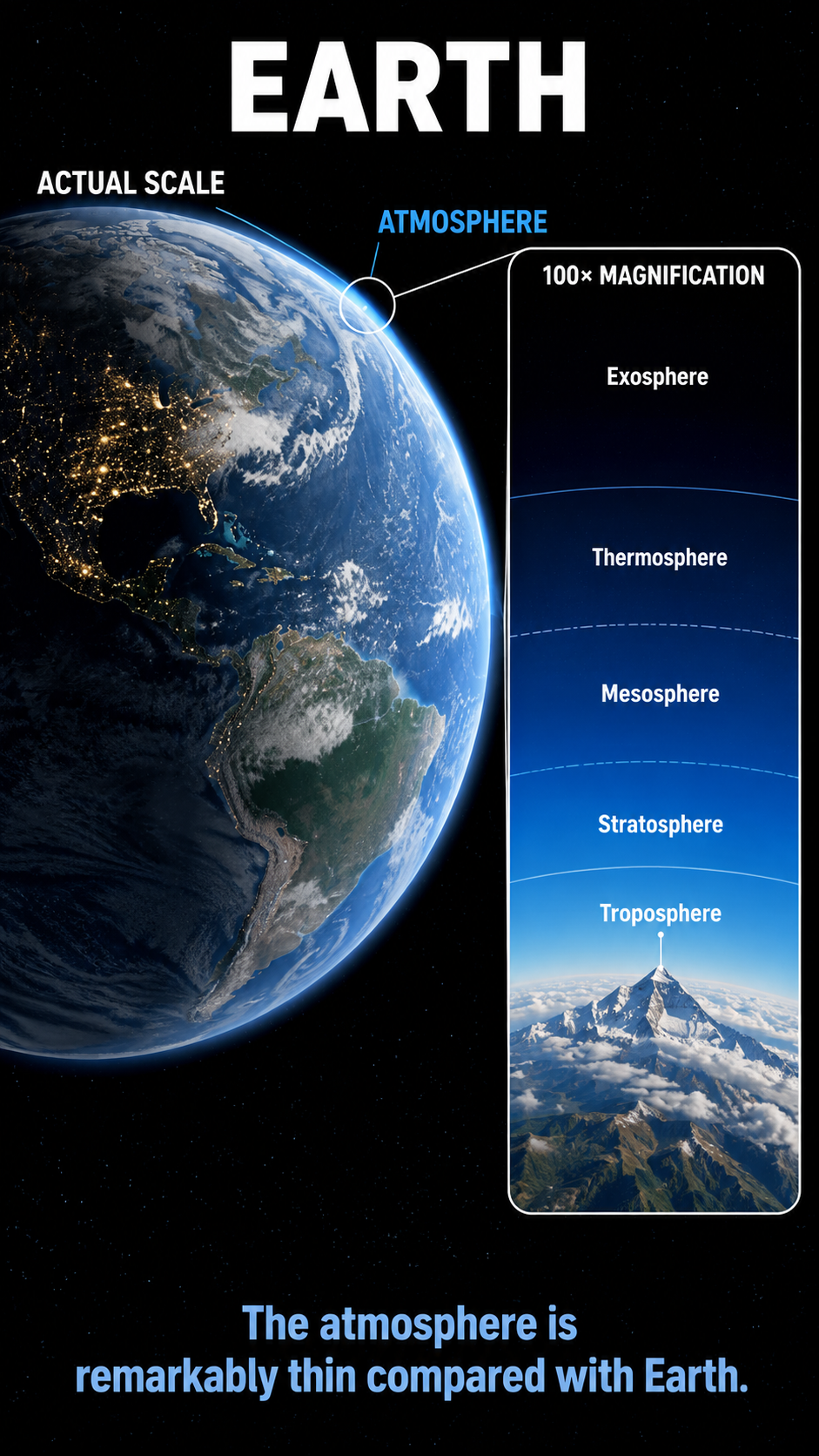
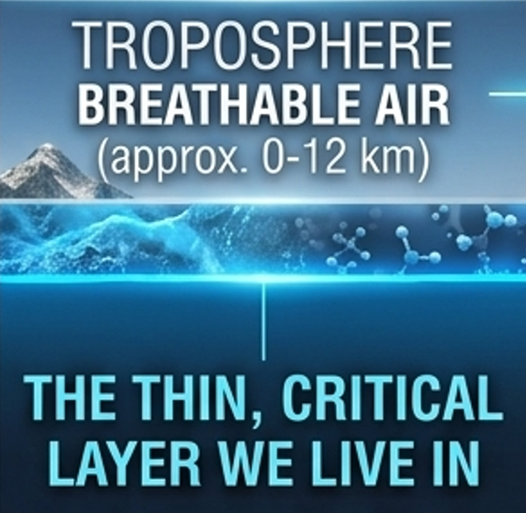
Earth’s Thin, Changing Atmosphere: How Human Climate Change Is Reshaping the Troposphere
Human-driven climate change is profoundly altering the thin atmospheric layer in which we live—the troposphere. Greenhouse-gas accumulation is changing its temperature, vertical structure, moisture content, and relationship with the layers above it.
The atmosphere may look enormous in many illustrations, but relative to the size of Earth, the layer where virtually all human life and weather occur is remarkably thin. Climate change is not simply warming this layer; it is changing the structure and dynamics of the atmosphere itself.
1. The Troposphere Is Expanding
As rising greenhouse-gas concentrations warm the troposphere, the atmosphere responds dynamically by expanding. One measurable consequence is a rising tropopause—the boundary between the troposphere and stratosphere.
Observations from radiosondes and satellite GPS-radio-occultation measurements show that the tropopause has risen substantially in recent decades. In the Northern Hemisphere, studies find an average rise of roughly 50–60 meters per decade since 2000, with tropospheric warming identified as the primary driver.
This does not mean that the entire atmosphere is simply being pushed upward like a solid layer. Rather, warming changes the temperature structure and density of the atmosphere, causing the troposphere to occupy a greater vertical extent.
The result: Earth’s already-thin weather layer is expanding upward.
2. Warming Below, Cooling Above
One of the clearest fingerprints of increasing greenhouse gases is a vertical temperature contrast: the troposphere warms while much of the stratosphere cools.
This occurs for different physical reasons in the two layers. In the troposphere, increasing greenhouse gases reduce the rate at which infrared energy escapes directly to space, contributing to warming near the surface and throughout much of the lower atmosphere. In the stratosphere, increasing CO₂ enhances radiative emission to space, producing cooling.
The observed long-term cooling is strongest in the middle and upper stratosphere, where NOAA assessments attribute much of the trend to increasing CO₂ and other greenhouse gases. The lower stratosphere is more complicated: its temperature has shown little long-term global trend since the late 1990s because multiple influences—including ozone changes and natural variability—act simultaneously.
This creates a changing thermal structure across the tropopause.
That matters because temperature gradients help organize winds, atmospheric circulation, jet streams, and the movement of weather systems. Changes in the troposphere–stratosphere system can therefore propagate downward into the weather patterns experienced at Earth’s surface.
3. A Warmer Atmosphere Carries More Water
A warmer atmosphere can contain substantially more water vapor. The Clausius–Clapeyron relationship implies approximately 7% more water-holding capacity per 1°C of warming near typical atmospheric temperatures.
This does not mean that every location becomes 7% wetter. Actual atmospheric moisture depends on evaporation, circulation, precipitation, and regional conditions.
But where additional moisture is available, a warmer atmosphere can support larger amounts of water vapor and heavier precipitation.
Water vapor is itself a powerful greenhouse gas, creating an important positive feedback:
The same additional moisture can also increase the potential intensity of extreme precipitation because storms have access to larger quantities of atmospheric water.
In other words, climate change is altering not only the temperature of the atmosphere but also the amount of energy and water circulating through our thin atmospheric habitat.
4. The Ozone Layer Is Being Affected—But Not Simply “Compressed”
The expanding troposphere interacts with the upper troposphere–lower stratosphere (UTLS), a region where chemistry, radiation, and atmospheric circulation are tightly coupled.
Climate change can alter stratospheric temperatures, circulation, water vapor, and ozone distribution. Increasing greenhouse gases cool the stratosphere and modify atmospheric circulation, while ozone changes themselves affect stratospheric temperature and circulation.
However, it is misleading to say that the expanding troposphere simply “compresses” or “thins” the ozone layer. The ozone layer is not a rigid physical shell. Its distribution changes through interacting chemical and dynamical processes.
Importantly, the global ozone layer is currently recovering from the effects of ozone-depleting substances because of the Montreal Protocol. Climate change nevertheless continues to interact with ozone chemistry and stratospheric circulation, making the relationship between the two systems increasingly important.
5. The Bigger Picture: A Thin Layer Undergoing Structural Change
The most important point is not that climate change is merely making the atmosphere warmer.
It is reorganizing the atmosphere vertically and dynamically.
The troposphere is expanding. The tropopause is rising. The troposphere is warming. Much of the stratosphere is cooling. Atmospheric moisture is increasing as temperatures rise. Circulation patterns are changing. And the interaction between the troposphere, stratosphere, water vapor, and ozone is becoming increasingly important.
All of this is occurring within a layer that is astonishingly thin compared with the size of Earth.
That is perhaps the most important perspective:
We do not live on Earth beneath an enormous atmosphere. We live inside an extraordinarily thin atmospheric layer wrapped around a planet.
Human activity is now changing the physical and chemical properties of that layer on a global scale.
By Daniel Brouse Economist & Climatologist Membrane Domain USA August 10, 2026
I’m not certain what the future holds. I don’t think anyone can be.
But I’m also not convinced that the future of fossil fuels can be projected simply by looking at today’s production levels and assuming they will continue indefinitely.
There is a very real possibility that economics, energy security, technological substitution, and even economic disruption could phase out fossil fuels much faster than most people expect.
In fact, some of the data already point in that direction.
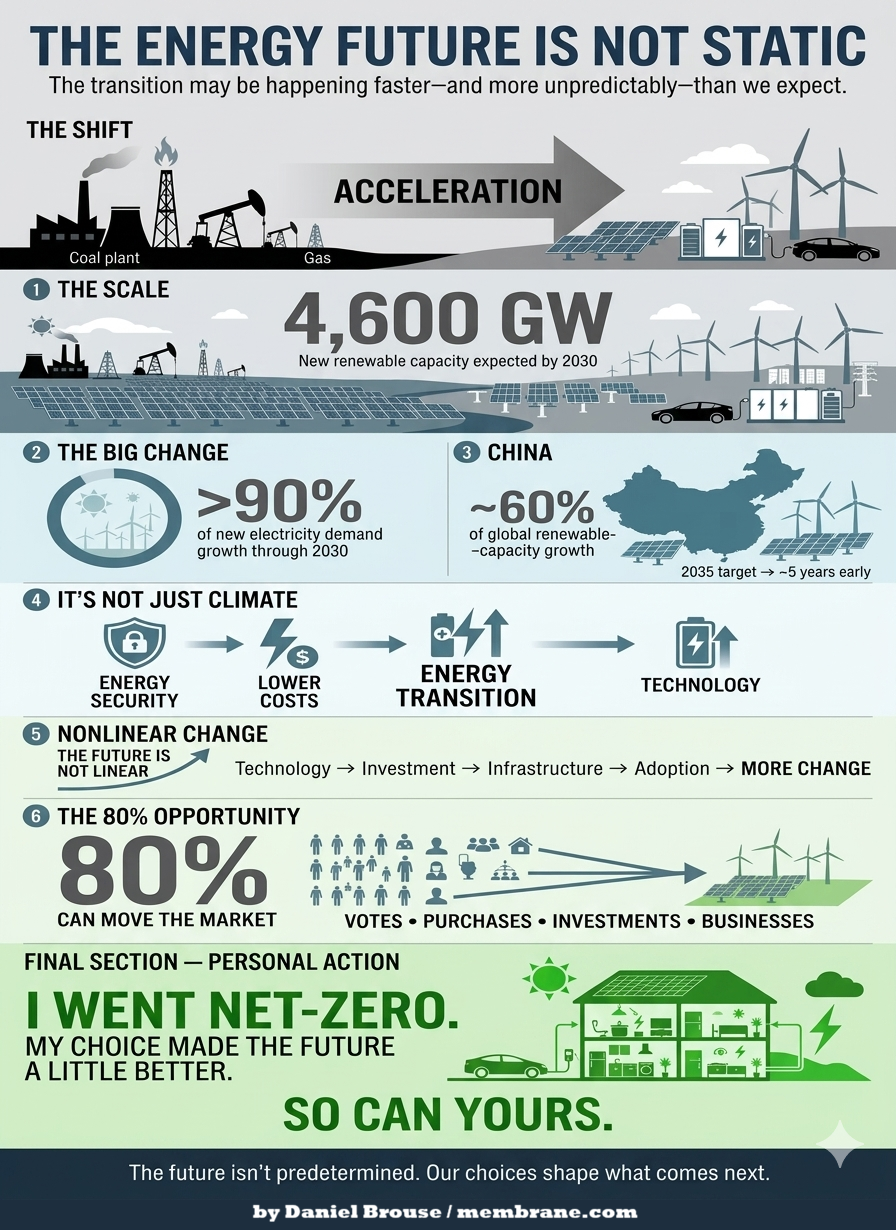
The Energy Transition Is Already Moving
The International Energy Agency estimates that global renewable capacity will increase by roughly 4,600 GW between 2025 and 2030—an extraordinary expansion roughly equivalent to the combined current power capacity of China, the European Union, and Japan.
Solar PV is expected to account for almost 80% of that expansion.
Even more significant is what this means for the growth of electricity demand. Renewables are expected to provide more than 90% of the increase in global electricity generation through 2030.
This is not simply a distant prediction about some hypothetical future energy system. It represents an enormous investment already underway.
And the transition is happening particularly rapidly in China.
China is now responsible for nearly 60% of global renewable-capacity growth. In 2025 alone, it added roughly 314 GW of solar capacity and is on track to reach its 2035 wind-and-solar target approximately five years early.
Whatever one’s views on climate policy, these numbers are difficult to dismiss.
The global energy system is changing.
And it is changing rapidly.
This Isn’t Just About Climate Policy
There is another factor that deserves considerably more attention: energy security.
The transition away from fossil fuels is not being driven exclusively by environmental concerns. Increasingly, it is also becoming an economic and strategic imperative.
The disruption of oil and gas flows through critical transportation routes such as the Strait of Hormuz demonstrates the vulnerability inherent in an energy system dependent upon globally traded fossil fuels.
For Europe and Asia in particular, domestic renewable generation, energy storage, electrification, and efficiency increasingly represent something more than climate policy.
They are energy-security assets.
A solar panel or wind turbine doesn’t need to be transported through a geopolitical chokepoint every time it generates electricity. Once installed, domestic renewable resources can reduce exposure to international fuel-price shocks, supply disruptions, and geopolitical conflicts.
That changes the economic calculation.
And it is one reason I believe the energy transition may prove considerably more nonlinear than many conventional forecasts assume.
The Future May Be Nonlinear
I agree that we shouldn’t pretend we know exactly what the future holds.
My point is almost the opposite.
The future may be much more nonlinear than either of us can confidently predict.
Technologies don’t necessarily replace one another gradually. Once a technology becomes sufficiently cheap, reliable, scalable, and convenient, adoption can accelerate rapidly.
The same thing can happen with infrastructure.
Battery storage becomes cheaper. Electric vehicles become more capable. Solar becomes less expensive. Transmission improves. Heat pumps become more efficient. Businesses discover that electrification can reduce operating costs. Consumers begin choosing technologies that save them money.
Each development can reinforce the others.
And once enough pieces of the system change, the economics of the entire energy system can change with them.
This is why simply extrapolating today’s fossil-fuel production into the future can be misleading.
Could “Drill, Baby, Drill” Backfire?
There is an irony here.
Policies intended to expand U.S. fossil-fuel production could potentially accelerate the transition they are intended to slow if they contribute to greater volatility, geopolitical exposure, or investment in alternatives.
Consider what could happen during a serious economic downturn.
A major recession could cause substantial demand destruction. Businesses would consume less energy. Consumers would drive less and purchase fewer goods. Industrial production would decline.
Fossil-fuel consumption could fall sharply.
That would potentially undermine the very industry that policies designed around expanding fossil-fuel production are intended to strengthen.
There is no guarantee this will happen. But that’s precisely the point.
The future contains feedback loops.
Economic conditions affect energy demand. Energy prices affect technology adoption. Technology affects investment. Investment affects infrastructure. Infrastructure affects energy prices and security. Geopolitical events affect all of them.
The result is a system capable of changing much faster than a simple linear projection would suggest.
This Isn’t an All-or-Nothing Choice
I’m not trying to create another online debate.
I’m simply pointing out that the data show a transition already underway—and its speed is anything but static.
And perhaps the most important point is that this isn’t an all-or-nothing proposition.
Every increment of transition matters.
Every electric vehicle displaces some gasoline consumption. Every solar panel replaces some electricity that otherwise might have come from fossil fuels. Every efficiency improvement reduces energy demand. Every battery installation makes intermittent renewable energy more useful. Every business that electrifies reduces some exposure to fossil-fuel prices.
The more we transition, the more reasonable—and manageable—the future becomes.
We don’t need to transform the entire energy system overnight.
We need to keep moving.
Technology Is Changing More Than Energy
There is another reason I remain optimistic.
Ironically, AI and rapidly advancing technology are accelerating climate science at a pace that may eventually rival the acceleration of climate change itself.
Research that once took years can increasingly be explored in hours.
Large datasets can be analyzed in ways that weren’t previously practical. Relationships between variables can be identified more quickly. Models can be tested, refined, and compared at extraordinary speed.
I’ve been able to identify hundreds of interacting feedbacks and relationships that weren’t even being seriously considered just a few years ago.
That doesn’t mean every hypothesis will be correct.
It means our ability to investigate complex systems is expanding extraordinarily quickly.
And that gives me reason for optimism.
Humans have an extraordinary capacity to adapt, innovate, and solve difficult problems—especially when we are sufficiently motivated to do so.
The future is not predetermined.
What we do now can still make an enormous difference in what comes next.
The 80% Question
A final thought concerns something that initially struck me as particularly concerning.
Roughly 20% of Americans appear to be actively fighting the energy transition.
At first, I found that almost dumbfounding. I expected the number to be closer to less than 2%.
But there is another way to look at it.
That still leaves roughly 80% of the population.
And if that 80% chooses to act—through voting, investment, purchasing decisions, business decisions, and simply choosing where to spend their dollars—the market can move remarkably quickly.
We don’t necessarily have to fight the remaining 20%.
We can vote with our dollars.
Markets respond to demand.
If enough consumers and businesses choose alternatives, capital will follow. Manufacturers will respond. Infrastructure will change. Companies will adapt.
And eventually, the fossil-fuel industry will have to adapt as well—or gradually lose market share.
That is the power of an energy transition driven not only by government policy, but by millions of individual economic decisions.
My Choice. Your Choice. Our Future.
I went net-zero years ago.
If I can do it, anybody can.
I don’t claim that my individual decision changed the world.
But my choice made the future a little better than it otherwise would have been.
And so can yours.
The future of energy isn’t predetermined by today’s production numbers, today’s political battles, or today’s assumptions.
It will be shaped by billions of decisions made by consumers, businesses, investors, engineers, scientists, and governments.
Some of those decisions will be political.
Many will be economic.
Some will be technological.
And countless others will be personal.
That’s why I don’t think the question is whether we can predict exactly what the energy system will look like in 10, 20, or 30 years.
We can’t.
The more important question is:
What direction are we moving—and how much can our choices influence where we ultimately arrive?
About Denialism and Ecofascism: Science Is Science
The Observation Glad to know you’re watching out! At the same time, this divisiveness—when we desperately need everyone to pull together because it’s a CRISIS, right?—makes me somehow deeply sad.
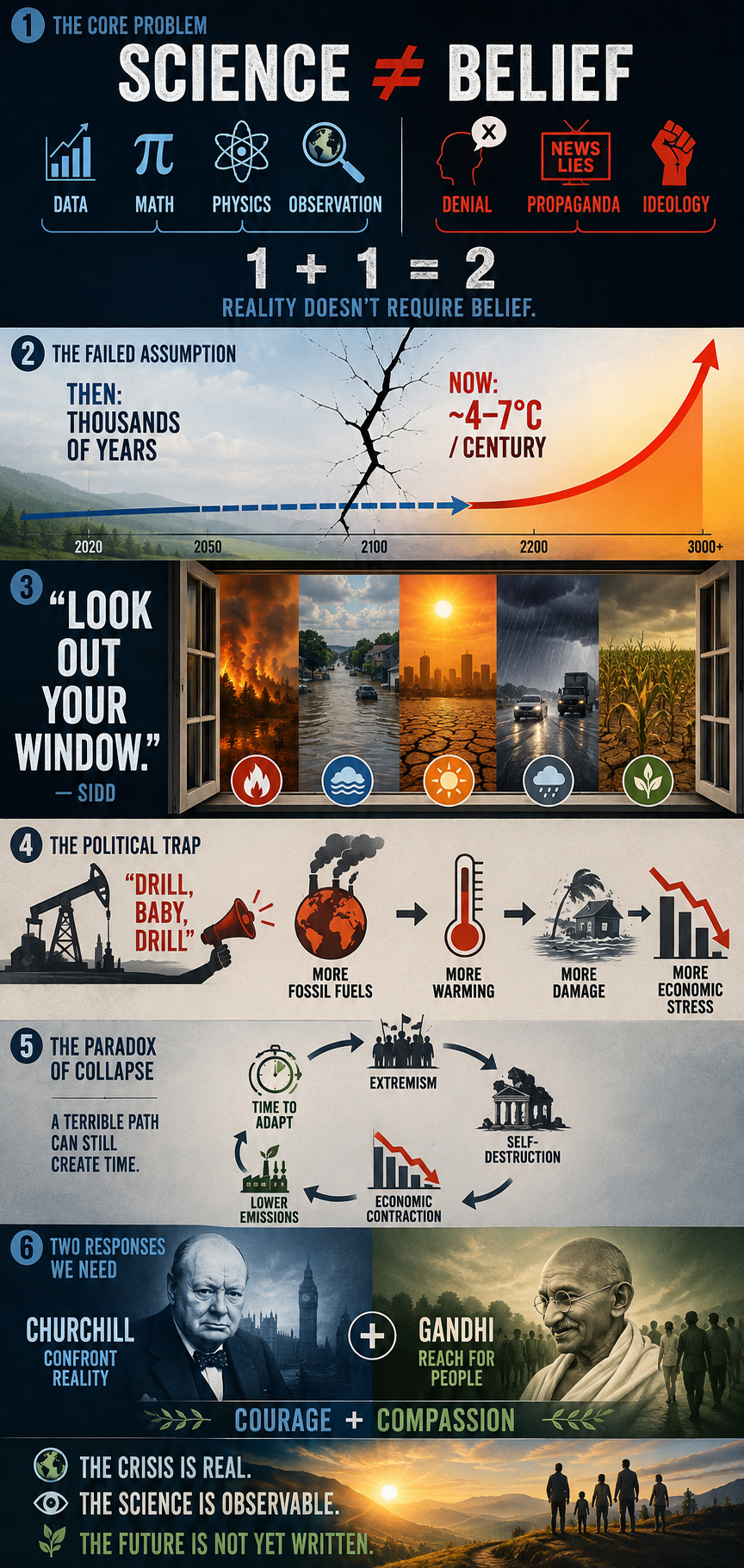
That’s a big job right there… How do we reach those who seem furthest away from any kind of understanding? We need both a Winston Churchill and a Mahatma Gandhi in this endeavor…
The Response Agreed. Both denialism and ecofascism are ideologies that ultimately defy logic. In very different ways, they can become a kind of combination of self-destruction and destruction of others.
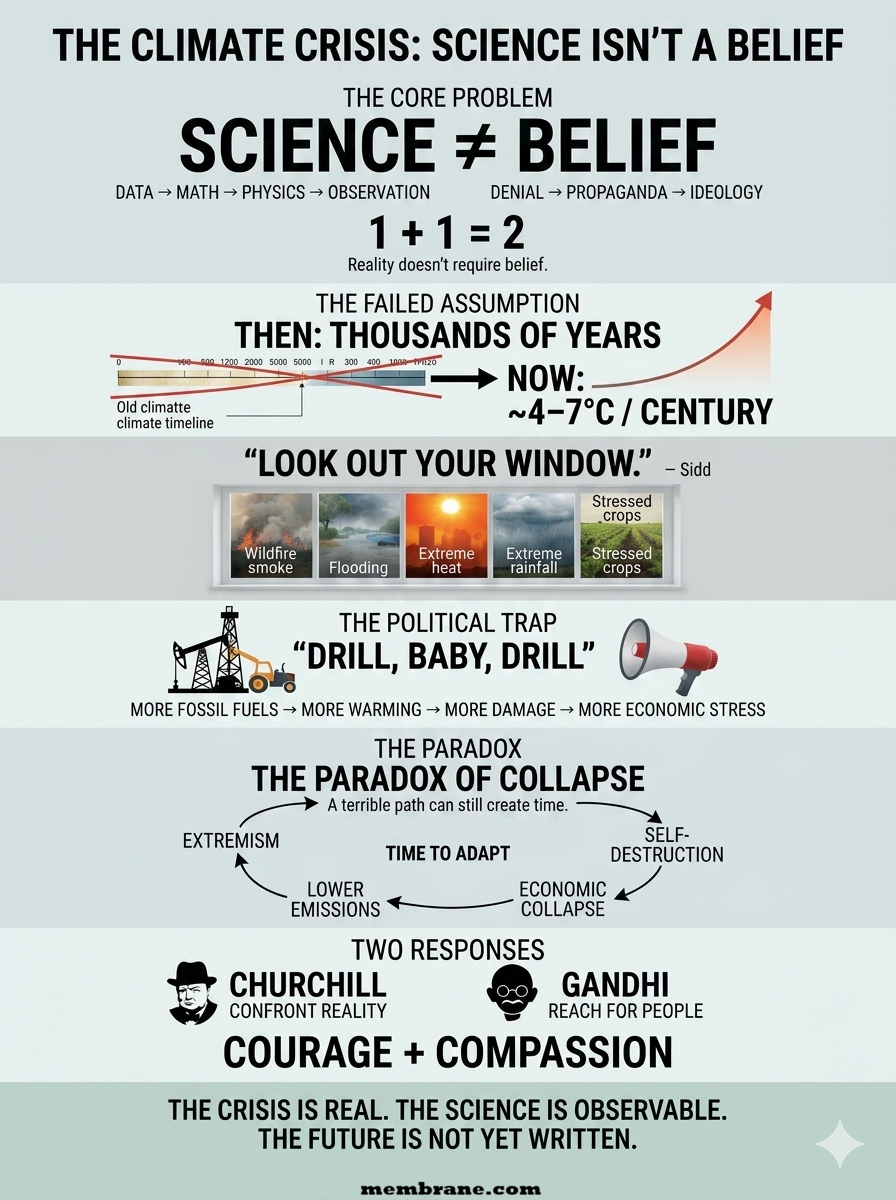
I’ve spent years battling misinformation, propaganda, and rhetoric. To the best of my knowledge, neither Sidd nor I have successfully converted—or even educated—a single committed denier. Climate science has somehow been transformed into a “belief” system. But science has nothing to do with belief. 1 + 1 = 2. If someone refuses to “believe” that, what exactly can you do?
From the beginning, our work has been based on observations, data, mathematics, and the laws of physics. So yes, I think this is at the heart of the crisis. When we started this work, we genuinely believed humanity would eventually take action. We thought we had thousands, if not tens of thousands, of years to adapt. That was the one thing we got wrong.
A couple of years ago, after explaining my continuing attempts to reach climate deniers, I asked Sidd what we could possibly do. His response was essentially, “Dude, just tell them to look out their window.” It sounds simplistic, but there is profound truth in it. The consequences are becoming increasingly difficult to deny.
Since then, we’ve had to rebuild much of our modeling. A +4°C world within thousands of years is no longer the worst-case scenario we worry about. The possibility of 4–7°C of warming within a century has become a much more serious concern in our work.
And then there is the political dimension. The rise of white-nationalist and authoritarian governments in the U.S. and elsewhere has made an already difficult problem considerably harder. Paradoxically, though, history offers one small reason for hope: fascism ultimately fails. It is inherently self-destructive.
The “drill, baby, drill” mentality is economically and environmentally self-defeating. A severe economic contraction could, ironically, buy humanity some time for adaptation while drastically reducing emissions. That is hardly the future anyone should want, but history has repeatedly demonstrated that systems built on extremism and authoritarianism eventually consume themselves.
So yes—we desperately need both the Churchill and Gandhi dimensions: the willingness to confront reality without flinching, and the willingness to keep reaching for people rather than giving up on them. I’m just not sure humanity has ever faced a crisis where we needed both quite this badly.
An AP-NORC poll reveals a deeply troubling contradiction in the American public’s understanding of climate change: Americans are increasingly experiencing the effects of extreme heat, yet fewer now believe climate change is actually happening.
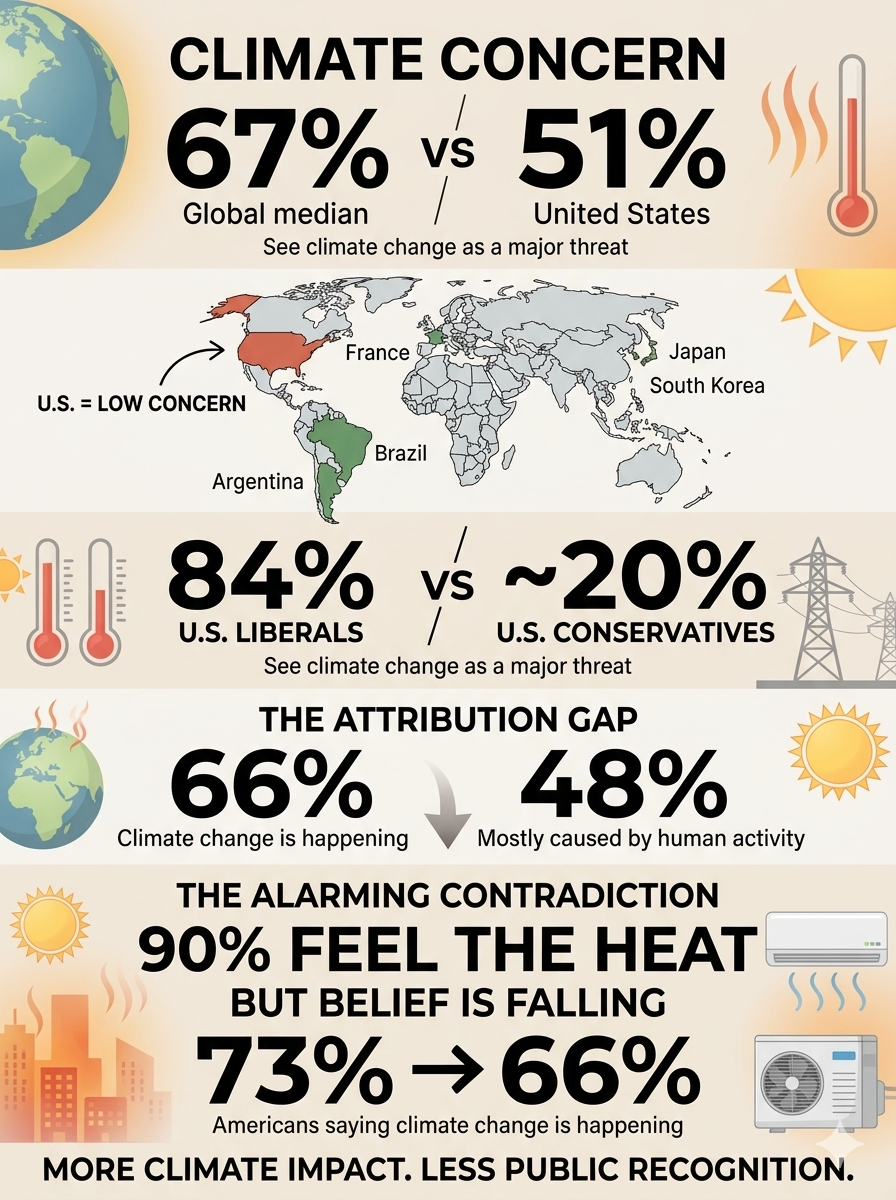
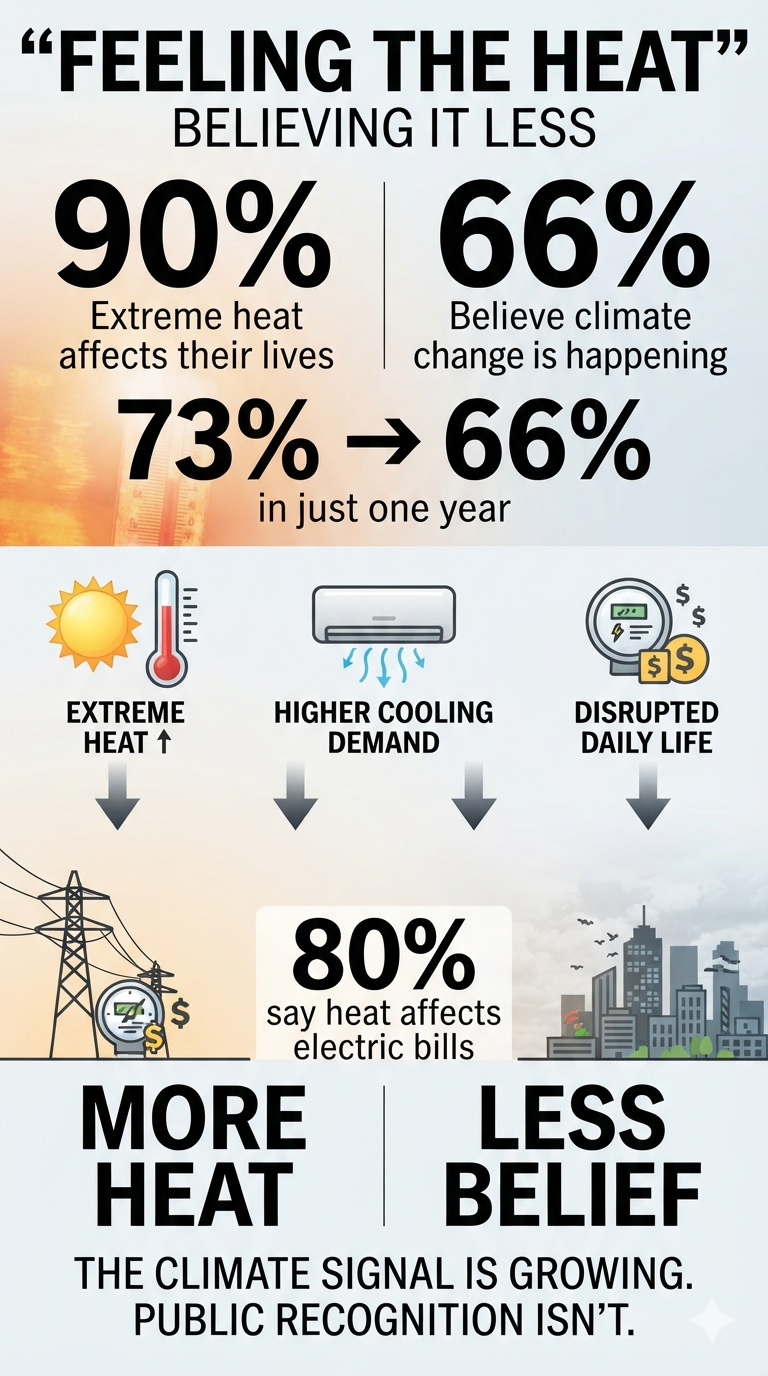
According to the poll, just 66% of Americans say climate change is happening, down sharply from 73% a year ago. That seven-percentage-point decline is particularly alarming because it comes at a time when Americans are reporting increasingly direct and disruptive experiences with extreme heat.
The disconnect raises an important question: How can people increasingly experience the consequences of a changing climate while becoming less likely to recognize climate change as the cause?
Extreme Heat Is Becoming Personal
The same poll found that 90% of Americans say extreme heat has affected their lives in some way, up from 83% in July 2024.
The impacts aren’t confined to abstract concerns about the environment. Americans report that extreme heat is affecting everyday life, including:
Electricity bills
Outdoor activities
Sleep
Travel and vacations
Daily routines
Perhaps most significantly, about 80% say extreme heat has affected their electricity bills, up from 69% in 2024.
In the Midwest, the increase is even more striking: 44% now say extreme heat has had a major impact on their electricity bills, compared with 29% two years ago.
That is climate change translated into something tangible: a higher household expense.
The Perception–Attribution Gap
The most important finding may not be the increase in heat-related disruption. It may be the growing gap between what Americans experience and what they believe is causing it.
The survey presents two seemingly contradictory trends:
90% say extreme heat has affected their lives.
Yet only 66% say climate change is happening.
And that 66% figure is down from 73% just one year ago.
This is a remarkable perception–attribution gap.
Americans can recognize that summers are becoming more difficult, electricity costs are rising, outdoor activities are being disrupted and extreme heat is affecting sleep—without necessarily connecting those experiences to a changing climate.
The result is a potentially dangerous disconnect between physical reality and public understanding.
Political Division Is Part of the Explanation
Political ideology continues to play an enormous role in how Americans interpret climate-related experiences.
Democrats are substantially more likely than Republicans to describe extreme heat as having a major impact on their lives. But that doesn’t mean Republicans aren’t experiencing the same heat.
The distinction is increasingly about interpretation and attribution.
People across the political spectrum can experience the same 100-degree day. They can experience the same oppressive humidity, pay the same higher electricity bill and face the same restrictions on outdoor activity.
But they may reach very different conclusions about why it is happening.
That distinction matters because climate change doesn’t require public agreement in order to produce physical consequences.
Climate Change Is Becoming an Economic Issue
The AP-NORC findings also demonstrate why climate change should not be viewed exclusively as an environmental issue.
Extreme heat can also affect worker productivity, agriculture, infrastructure, public health, insurance losses and energy-grid reliability.
The household electricity bill may therefore be only the first visible economic manifestation of a much larger systemic problem.
The public doesn’t need to understand atmospheric physics to experience these consequences.
They simply need to notice that something is different.
The Most Alarming Finding Isn’t the Heat
The increase in extreme-heat impacts is concerning, but the seven-point decline in belief that climate change is happening may be even more alarming.
The country is experiencing a growing number of climate-related disruptions while simultaneously becoming less certain—or less willing—to identify climate change as the underlying cause.
That creates a dangerous situation for public policy.
Democratic societies depend upon the public recognizing problems before governments can effectively address them. If the physical impacts become increasingly severe while public recognition of their underlying causes declines, political pressure for adaptation and mitigation can weaken precisely when the need for action is growing.
This creates a potential feedback loop:
More climate disruption → greater personal impacts → greater economic costs → political polarization → weaker recognition of climate change → less public support for climate action → greater future vulnerability
That is not merely a communications problem.
It is a systemic risk.
Experience Is Increasing Faster Than Understanding
The AP-NORC poll doesn’t measure the physical climate system. It measures what Americans are experiencing and what they believe.
Those are different things.
The survey cannot establish how much of an individual’s electricity bill, sleep disruption or outdoor inconvenience is attributable specifically to climate change. Establishing those causal relationships requires observational climate data and scientific attribution studies.
But the poll does reveal something extremely important about the human response to climate change.
The consequences are becoming increasingly personal while public recognition of climate change is moving in the opposite direction.
That should concern everyone, regardless of political affiliation.
The challenge is no longer simply convincing people that the climate is changing.
It is explaining why their increasingly familiar experiences—extreme heat, higher cooling demand, disrupted outdoor activities, poor sleep and growing economic costs—are connected to a much larger physical system.
Americans may not agree about climate change.
But increasingly, they are living with its consequences.
And the most alarming finding from this poll is that as those consequences become harder to escape, fewer Americans say climate change is actually happening: 66% today, compared with 73% a year ago.
America Is an International Outlier on Climate Change
The decline in American belief becomes even more concerning when viewed against the rest of the world.
A 2025 Pew Research Center international survey of 25 countries found that a global median of 67% of respondents considered climate change a major threat to their country. In the United States, however, only 51% said the same—a gap of 16 percentage points.
The U.S. was among the least concerned countries surveyed. Americans were less likely than respondents in 13 of the 16 high-income countries included in the survey to view climate change as a major threat. In countries such as Argentina, Brazil, France, Japan and South Korea, roughly 80% of respondents regarded climate change as a major threat.
The difference is particularly striking because the United States is not insulated from climate impacts. Americans are experiencing extreme heat, rising cooling demand, disrupted outdoor activities and other consequences of a warming climate, yet concern about climate change remains comparatively low.
The American Divide Is Also Unusually Political
The international comparison becomes even more revealing when political ideology is considered.
Pew found that approximately 84% of U.S. liberals regarded climate change as a major threat, compared with only about 20% of U.S. conservatives. That enormous gap makes the United States an international outlier in the degree to which climate change has become politically polarized.
The result is a remarkable paradox.
Americans across the political spectrum can experience the same heat wave, pay the same electricity bill and endure the same disruption to their daily lives. Yet they may reach dramatically different conclusions about what those experiences mean.
The disagreement therefore isn’t simply about the physical environment. It is increasingly about how Americans interpret the physical environment.
Believing the Climate Is Changing Is Not the Same as Accepting Why
Another Pew measure illustrates the problem even more clearly.
In 2026, only 48% of Americans said the Earth is warming mostly because of human activity. That is substantially lower than the 66% who currently say climate change is happening in the AP-NORC poll.
The difference is crucial.
A person can acknowledge that the climate is changing without accepting that human activity is primarily responsible for that change. Others may accept human-caused warming but disagree about its severity, consequences or appropriate policy response.
This creates several layers of public perception:
Is the climate changing?
↓
Is human activity causing it?
↓
Is it becoming dangerous?
↓
Should government and society act?
Americans can answer those questions very differently.
An Alarming Combination
Taken together, the international and domestic polling reveals a troubling pattern:
90% — say extreme heat has affected their lives
80% — say heat has affected their electricity bills
73% → 66% — Americans saying climate change is happening
51% — Americans calling climate change a major national threat
48% — Americans saying warming is mostly caused by human activity
The numbers measure different things and should not be treated as interchangeable. But together they reveal a striking disconnect between experience, attribution and concern.
The United States is already an international outlier in climate skepticism and political polarization. Now, at a time when Americans report increasingly personal impacts from extreme heat, the share saying climate change is happening has fallen seven percentage points in only one year.
That may be the most troubling finding of all.
The physical climate signal is becoming harder to escape, while public recognition of that signal is moving in the opposite direction.
How Lapse-Rate and Ice–Albedo Feedbacks Couple to Create a Powerful Self-Reinforcing Warming Loop
The Two Dominant Drivers of Arctic Amplification
Arctic amplification is not produced by a single climate feedback. It emerges from the interaction of several processes that redistribute, trap, and amplify energy within the Arctic climate system.
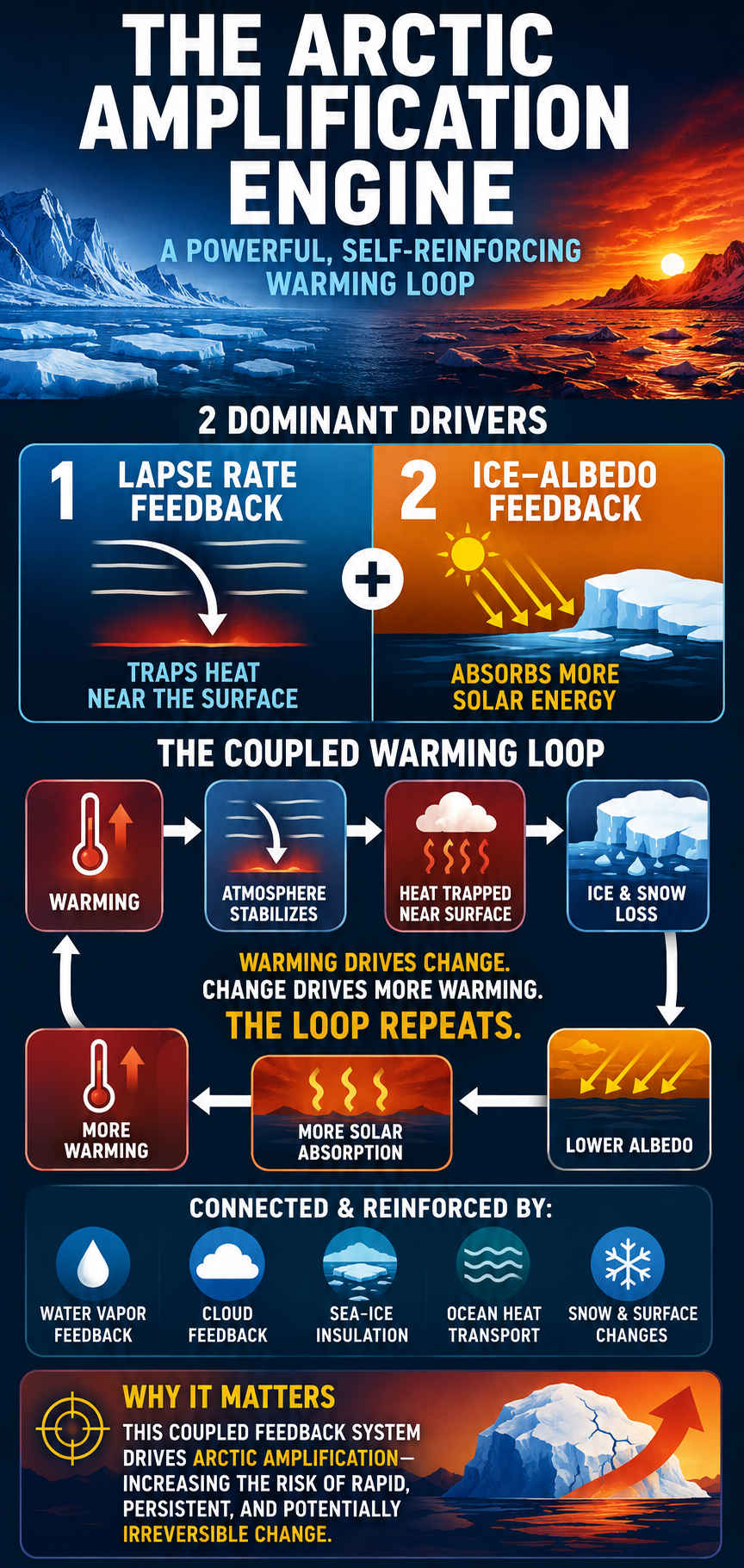
Two of the most important are the lapse-rate feedback and the ice–albedo feedback. They operate through different physical mechanisms, but they are tightly coupled:
Lapse-Rate Feedback → Traps Heat Near the Surface
Ice–Albedo Feedback → Converts More Sunlight Into Heat
Together, they create a reinforcing loop:
Warming → Atmospheric Stabilization → Surface Heat Retention → Ice and Snow Loss → Lower Albedo → Greater Solar Absorption → More Warming
This coupling helps explain why the Arctic can warm substantially faster than the global average.
1. Lapse-Rate Feedback: The Primary Atmospheric Amplifier
The Arctic atmosphere behaves very differently from the atmosphere of the tropics.
In the warm tropics, intense solar heating produces strong convection. Warm air rises, expands, mixes vertically, and transports energy high into the atmosphere. This vertical mixing helps distribute surface heating through a deep atmospheric column, where energy can ultimately be radiated to space.
The Arctic atmosphere is often much more stable.
During periods of strong surface cooling—especially over snow- and ice-covered surfaces—cold, dense air can accumulate near the ground while warmer air remains above it. This creates a temperature inversion, in which temperature increases with height rather than decreasing.
The result is a strongly stratified atmosphere with limited vertical mixing.
When greenhouse gases and other processes add energy to the Arctic system, that energy is therefore more readily retained near the surface rather than rapidly redistributed upward by convection.
This produces a critical asymmetry:
Tropical warming → strong vertical mixing
Arctic warming → weak vertical mixing and enhanced near-surface warming
The lapse-rate feedback therefore changes how efficiently the Arctic atmosphere can respond to additional radiative energy.
As the Arctic warms, the vertical temperature structure changes. The characteristic lapse rate—the rate at which temperature changes with altitude—affects the amount of infrared radiation escaping to space. Because the Arctic surface and lower atmosphere can warm disproportionately, the region’s radiative response differs substantially from that of warmer, more convective regions.
The result is an atmospheric environment particularly favorable to near-surface warming and Arctic amplification.
2. Ice–Albedo Feedback: The Solar Amplifier
The lapse-rate feedback is only part of the story.
The Arctic is covered by highly reflective surfaces—especially snow and sea ice—that normally reflect a substantial fraction of incoming sunlight back toward space.
Ice and snow therefore act as a planetary-scale solar shield.
But warming begins to remove that shield.
As snow and ice melt, they expose darker surfaces:
Bright snow and ice → dark ocean and land
Dark surfaces absorb much more solar radiation than bright, reflective surfaces.
That additional absorbed energy warms the surface and surrounding environment, which promotes additional melting.
The loop becomes:
Warming → Ice/Snow Loss → Lower Albedo → More Solar Absorption → More Warming
This is the classic ice–albedo feedback.
Unlike the lapse-rate mechanism, which primarily alters the vertical distribution and radiative behavior of atmospheric energy, the ice–albedo feedback changes the amount of incoming solar energy absorbed by the surface.
The two mechanisms therefore attack the climate system from different directions.
3. The Coupling: When Two Feedbacks Reinforce Each Other
The real significance emerges when the feedbacks are considered together.
The lapse-rate feedback helps concentrate warming near the Arctic surface.
The ice–albedo feedback increases the amount of solar energy absorbed by that same surface.
That creates a powerful coupling:
Greenhouse Forcing
↓
Atmospheric Stability / Lapse-Rate Effects
↓
More Near-Surface Heat Retention
↓
Warmer Surface
↓
Snow and Ice Loss
↓
Lower Surface Albedo
↓
More Solar Energy Absorbed
↓
Additional Surface Warming
↓
Further Snow and Ice Loss
The result is not simply two independent feedbacks operating side by side.
It is a coupled amplification system.
4. Why the Coupling Matters
The most important feature of this system is that each feedback can strengthen the conditions that make the other more effective.
A warmer Arctic atmosphere can accelerate snow and ice loss.
Less snow and ice exposes darker surfaces and increases solar absorption.
Greater surface absorption increases warming.
Meanwhile, changes in snow and ice cover, surface temperature, moisture, clouds, and atmospheric structure can alter the Arctic’s vertical temperature profile and stability.
This creates a network of interacting processes rather than a single linear chain.
The Arctic climate system can therefore be represented conceptually as:
External Warming
→ Lapse-Rate / Atmospheric Stability Effects
→ Enhanced Near-Surface Warming
→ Snow & Ice Loss
→ Lower Albedo
→ Greater Solar Absorption
→ More Surface Warming
→ Further Atmospheric and Cryospheric Change
→ Feedback Intensification
This is why Arctic amplification is best understood as an interconnected feedback network.
5. The Feedbacks Do Not Operate in Isolation
The lapse-rate and ice–albedo feedbacks also interact with other major Arctic processes.
Water-Vapor Feedback
A warmer atmosphere can contain more water vapor. Because water vapor is itself a greenhouse gas, increased atmospheric moisture can enhance infrared heat retention.
Warming → More Water Vapor → Greater Greenhouse Effect → More Warming
Cloud Feedbacks
Changes in Arctic clouds can alter both incoming solar radiation and outgoing infrared radiation. Their net effect varies with season, surface conditions, cloud properties, and atmospheric structure, making clouds an important but complex component of Arctic amplification.
Sea-Ice Insulation Feedback
Sea ice acts as an insulating barrier between the relatively warm ocean and the cold atmosphere.
When thick sea ice is replaced by thinner ice or open water, the ocean can release substantially more heat into the atmosphere during the cold season.
Ice Loss → Greater Ocean–Atmosphere Heat Transfer → Atmospheric Warming
Ocean Heat Transport
Warm water entering the Arctic from lower latitudes can contribute to sea-ice loss and influence the timing and magnitude of Arctic warming. Oceanic heat transport therefore connects Arctic amplification to the broader global climate system.
Snow and Surface Feedbacks
Snow cover is especially important because snow has a very high albedo. Losing snow exposes darker ground, vegetation, or ice and can rapidly change the surface energy balance.
These mechanisms can interact with the two dominant feedbacks, increasing the complexity—and potentially the strength—of the overall amplification.
The Arctic as a Coupled Amplification System
The critical insight is that Arctic amplification is not caused by one feedback acting alone.
It is generated by the coupling of atmospheric, cryospheric, oceanic, and radiative processes.
Among these, the lapse-rate feedback and ice–albedo feedback form a particularly important coupled pair:
Lapse Rate
Keeps more warming concentrated near the surface
↓
Ice–Albedo
Turns more incoming sunlight into absorbed energy
↓
Surface Warming
↓
Snow & Ice Loss
↓
Even Greater Solar Absorption
↓
Additional Warming
The system is further reinforced by water vapor, clouds, sea-ice insulation, ocean heat transport, and other cryospheric processes.
The result is a climate system in which warming changes the physical conditions that determine how readily additional warming occurs.
That is the essence of a positive climate feedback.
From Feedback to Tipping Dynamics
The most consequential question is not whether these processes amplify warming—they do—but how strongly they interact and whether their combined effects can push portions of the Arctic system toward thresholds or tipping behavior.
A feedback does not automatically constitute a tipping point.
A tipping point occurs when a system crosses a threshold after which a change becomes difficult to reverse or continues because internal feedbacks sustain it.
This distinction is crucial.
The coupled Arctic feedback system can progressively reduce the resilience of snow, sea ice, permafrost, and ice-sheet systems. Once substantial cryospheric changes occur, recovery can become increasingly difficult because the climate state that originally maintained the ice has itself been altered.
The broader chain can therefore be viewed as:
Global Warming
→ Arctic Amplification
→ Coupled Atmospheric + Cryospheric Feedbacks
→ Accelerated Snow and Ice Loss
→ Reduced Reflectivity + Greater Heat Retention
→ Further Warming
→ Increasing Cryospheric Instability
→ Potential Threshold Crossing
This does not mean that the Arctic is inevitably headed toward runaway warming or irreversible collapse.
It means that the feedback structure itself can increase the rate and persistence of change, making the Arctic one of the most important regions for understanding nonlinear climate dynamics.
The Central Insight
The Arctic is not simply warming faster because it receives more heat.
It is warming faster because the Arctic climate system can transform an initial radiative disturbance into a series of reinforcing physical responses.
The lapse-rate feedback helps determine how efficiently heat is retained and redistributed within the lower atmosphere.
The ice–albedo feedback determines how much incoming sunlight is absorbed by the surface.
Water vapor, clouds, sea-ice insulation, ocean heat transport, snow cover, and other feedbacks connect these mechanisms into a larger network.
The resulting system can be summarized in one sentence:
The Arctic amplification engine is powered by greenhouse forcing, intensified by atmospheric heat retention, accelerated by the loss of reflective ice and snow, and reinforced by the increasingly dark, warm surface that replaces them.
That coupling—not any single feedback alone—is what makes Arctic amplification such a powerful expression of nonlinear climate change.
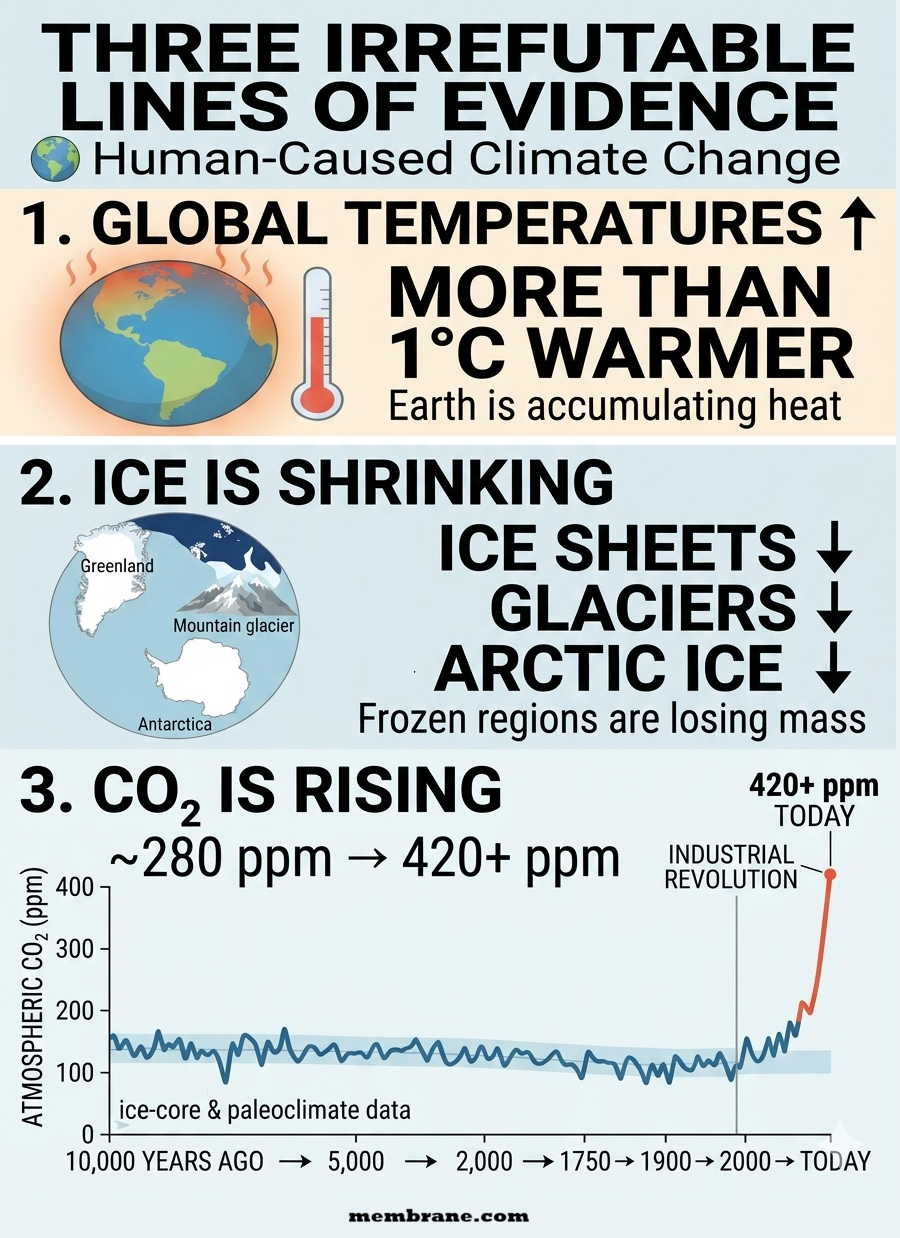
The evidence for human-caused climate change does not rest on a single temperature record, computer model, or scientific study. It comes from multiple independent lines of evidence that converge on the same conclusion.
Three of the clearest are rising global temperatures, shrinking ice sheets and glaciers, and rapidly increasing atmospheric carbon dioxide (CO₂) with a chemical fingerprint linked to fossil fuels.
Each observation is significant on its own. Together, they provide an exceptionally strong scientific case that human activities—especially the burning of coal, oil, and natural gas—are driving the modern warming of Earth’s climate.
1. Rising Global Temperatures
Earth’s average surface temperature has increased by more than 1°C since the late 19th century, with the great majority of that warming occurring since the mid-20th century.
The warming is occurring across the planet and is not limited to the atmosphere. The oceans are absorbing most of the excess heat accumulating in Earth’s climate system, resulting in rising ocean heat content and increasing sea-surface temperatures.
This broad pattern is exactly what scientists expect from an atmosphere increasingly enriched with heat-trapping greenhouse gases.
The evidence also extends beyond simple surface-temperature measurements. Changes in ocean heat, atmospheric temperatures, nighttime temperatures, seasonal patterns, and other components of the climate system independently demonstrate that Earth is undergoing sustained warming.
The planet is not merely experiencing a few unusually hot years. The entire climate system is accumulating heat.
2. Shrinking Ice Sheets, Glaciers, and Arctic Sea Ice
Earth’s frozen regions provide another powerful and highly visible record of climate change.
Greenland and Antarctica are losing ice mass. Glaciers are retreating in nearly every major mountain region, including the Alps, Himalayas, Rockies, Andes, and Alaska. Meanwhile, Arctic sea ice has declined substantially in both extent and thickness.
These changes matter because ice responds directly to changes in the climate system.
When temperatures rise persistently, glaciers retreat and ice sheets lose mass. As snow and ice disappear, darker land and ocean surfaces are exposed, allowing them to absorb more solar energy rather than reflecting it back into space. This creates an important ice-albedo feedback that can amplify warming.
The geographical reach of the changes is particularly important. Ice loss is not occurring at one isolated location. Multiple independent ice systems around the world are responding to a warming planet.
The retreat of glaciers, loss of polar ice, declining Arctic sea ice, and shrinking seasonal snow cover all point in the same direction.
3. Rising Atmospheric CO₂ and the Fossil-Fuel Fingerprint
Perhaps the most direct evidence of human influence comes from the atmosphere itself.
Before industrialization, atmospheric carbon dioxide concentrations were approximately 280 parts per million (ppm). Today, concentrations have risen to more than 420 ppm—an enormous increase occurring over a period far shorter than the natural changes that produced comparable atmospheric concentrations in the distant past.
But the evidence goes beyond simply measuring more CO₂.
Scientists can identify where the additional carbon is coming from.
The carbon added to the atmosphere has an isotopic signature consistent with carbon released from ancient organic material, including coal, oil, and natural gas. Atmospheric oxygen measurements and other observations provide additional evidence that fossil-fuel combustion is responsible for a substantial portion of the increase.
Human activities are therefore not merely occurring at the same time as rising CO₂. We can trace the additional carbon to its source.
And CO₂ has a well-established physical mechanism for affecting climate: it absorbs outgoing infrared radiation, reducing the amount of heat that escapes to space. Increasing its concentration strengthens the atmosphere’s greenhouse effect and produces warming.
Three Independent Signals—One Consistent Explanation
The strength of the evidence comes from the fact that these observations are connected but independently measurable:
Temperatures are rising. Ice is shrinking. CO₂ is increasing—and its chemical fingerprint identifies a major human source.
The observations also extend beyond these three indicators. Rising ocean heat, changing atmospheric circulation, shifting precipitation patterns, increasing ocean acidity, and numerous other changes are consistent with a planet responding to increased greenhouse-gas concentrations.
The critical point is that no single observation has to carry the entire argument.
If global temperatures were rising without increasing greenhouse gases, the explanation would be incomplete.
If atmospheric CO₂ were increasing without a corresponding physical mechanism for warming, the explanation would be incomplete.
If temperatures were rising while glaciers, ice sheets, and Arctic sea ice showed no response, the explanation would be incomplete.
Instead, the evidence converges.
The Climate Fingerprint
The modern climate system displays a coherent pattern:
Human activity increases greenhouse gases → greenhouse gases trap additional heat → Earth’s climate system accumulates energy → global temperatures rise → ice melts and glaciers retreat → oceans warm and expand → additional climate feedbacks amplify the changes.
This is not evidence based on one measurement or one institution. It is a conclusion supported by physics, atmospheric chemistry, temperature records, ocean measurements, satellite observations, glacier surveys, ice-sheet measurements, and paleoclimate evidence.
The overwhelming convergence of these independent observations makes the central conclusion extraordinarily robust:
Earth is warming, the warming is occurring across the climate system, atmospheric greenhouse gases are rising because of human activity, and the resulting enhanced greenhouse effect is driving the modern warming.
The evidence is not merely suggestive.
It is convergent, measurable, physically explainable, and unmistakably human-driven.
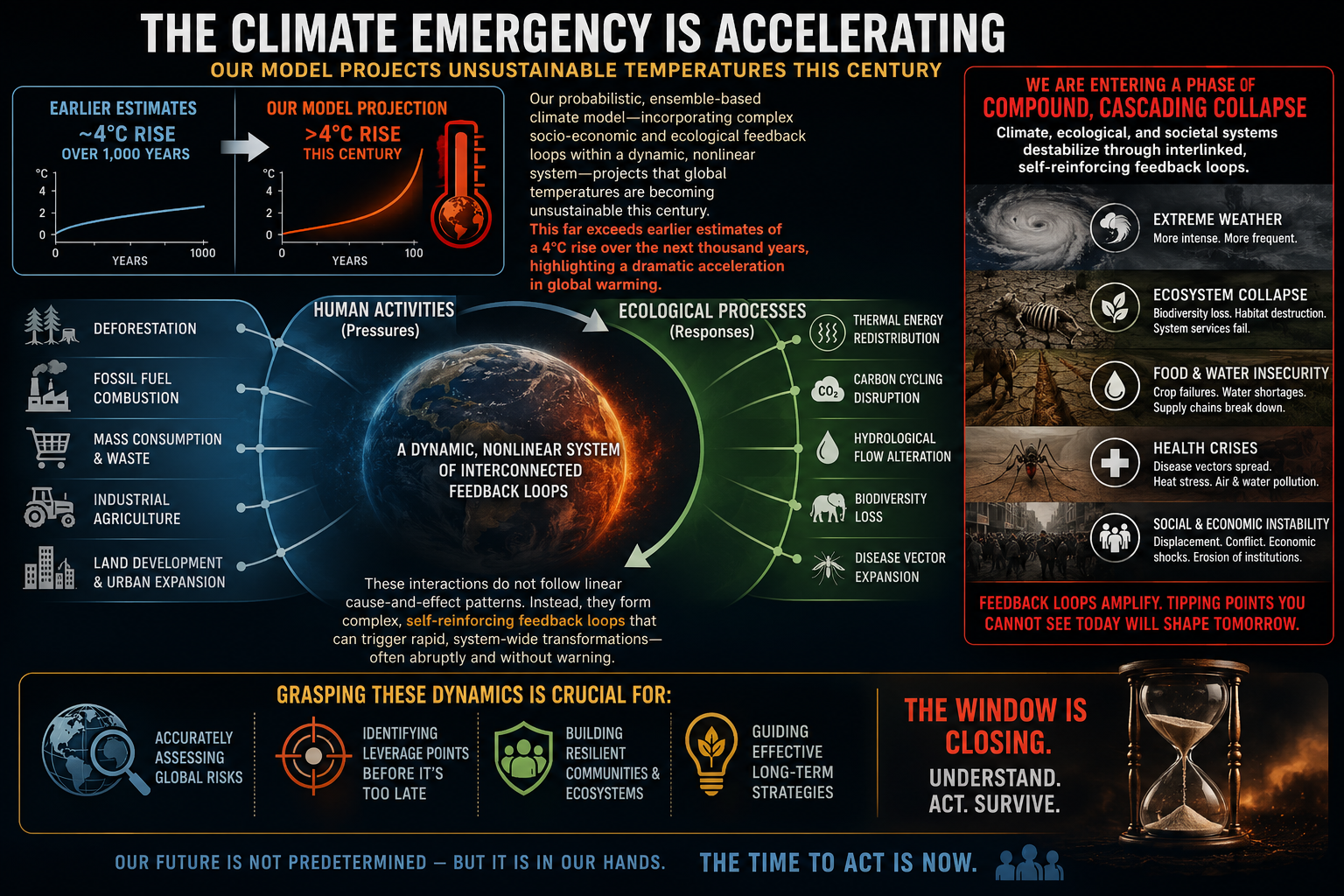
We examine how human activities — such as deforestation, fossil fuel combustion, mass consumption, industrial agriculture, and land development — interact with ecological processes like thermal energy redistribution, carbon cycling, hydrological flow, biodiversity loss, and the spread of disease vectors. These interactions do not follow linear cause-and-effect patterns. Instead, they form complex, self-reinforcing feedback loops that can trigger rapid, system-wide transformations — often abruptly and without warning. Grasping these dynamics is crucial for accurately assessing global risks and developing effective strategies for long-term survival.
Feedback loops amplify climate change and can push interconnected Earth systems past critical tipping points. As tipping points are crossed, they can trigger additional feedback loops and destabilize other climate systems. This cascading “Domino Effect” compresses timescales, accelerates change, and increases the risk of rapid, nonlinear climate transformations.
Bottom line:The question is no longer how warm the planet becomes, but how life on Earth can endure when change outpaces our ability to adapt. We cannot control the laws of physics, but we can control our pollution. The most effective action is to stop burning fossil fuels.
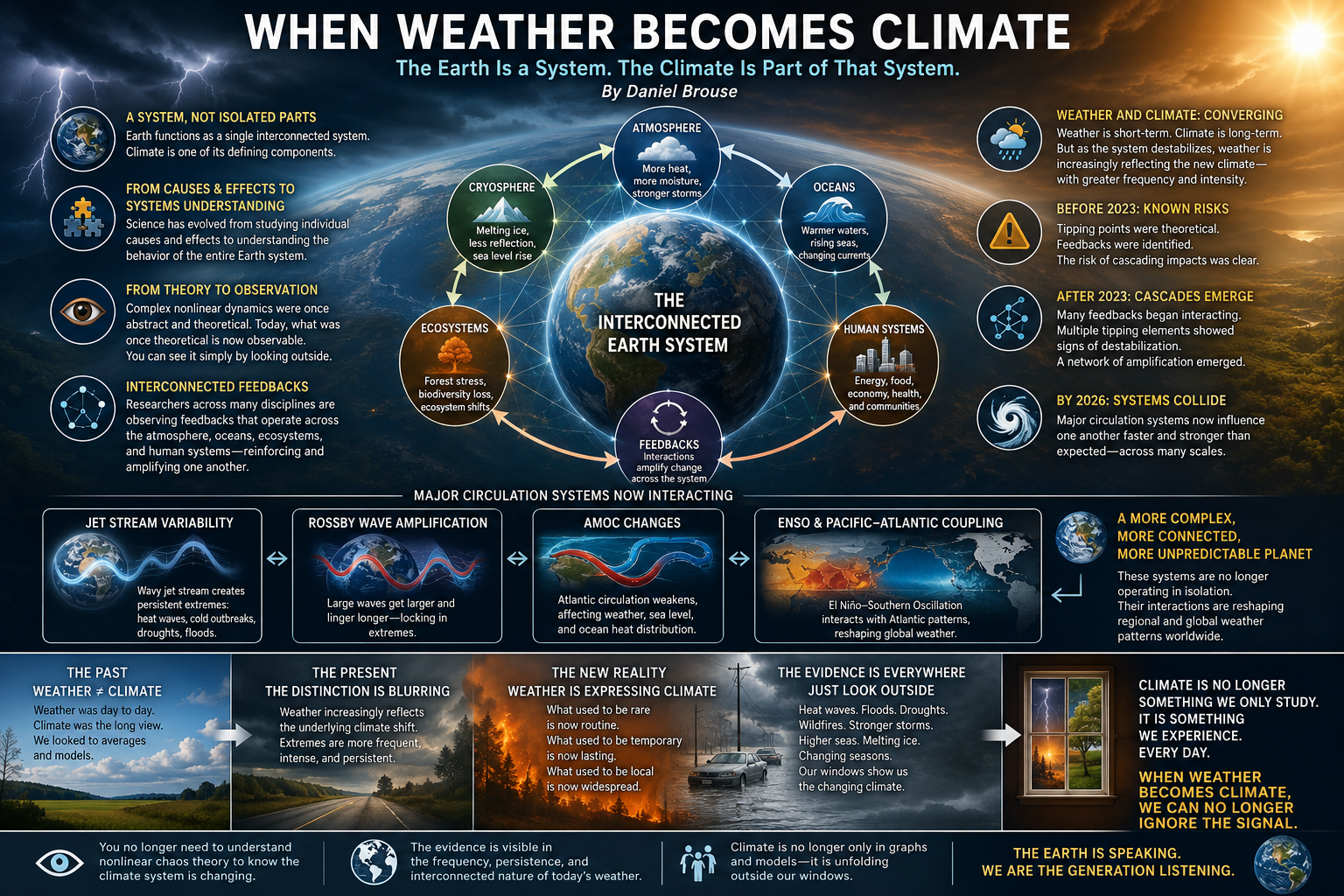
Earth functions as a single interconnected system, and climate is one of its defining components. For much of modern science, climatology focused primarily on identifying individual causes and effects. Today, that focus has expanded toward understanding the behavior of the entire Earth system.
The dynamics of complex nonlinear systems were once considered highly abstract, requiring sophisticated mathematical models to visualize their behavior. That is no longer the case. What was once theoretical has become increasingly observable. In many respects, the behavior of the climate system can now be seen simply by looking outside.
Climatologists, economists, ecologists, and other researchers are increasingly observing climate feedbacks operating across the entire Earth system. Rather than isolated events or independent variables, we are witnessing interconnected processes that reinforce one another across atmospheric, oceanic, ecological, and human systems.
Historically, weather and climate were treated as distinct concepts. Weather described short-term atmospheric conditions, while climate represented long-term statistical patterns. As the climate system becomes increasingly unstable, however, weather is reflecting those long-term changes with growing frequency and intensity. The distinction remains scientifically valid, but climate change is becoming visible through the character of everyday weather.
Before 2023, scientists understood that climate tipping points were possible, and numerous positive feedback mechanisms had already been identified. After 2023, evidence increasingly suggested that many of these feedbacks were interacting simultaneously, with multiple tipping elements showing signs of destabilization. Instead of isolated feedback loops, researchers began observing a network of interconnected processes capable of amplifying one another.
By 2026, many of Earth’s major circulation systems appear to be influencing one another in ways that are faster, stronger, and more interconnected than previously anticipated. These interactions are occurring across multiple scales, increasing the complexity of the global climate response.
Examples include the interaction between jet stream variability, Rossby wave amplification, and changes in the Atlantic Meridional Overturning Circulation (AMOC). Likewise, large-scale ocean-atmosphere interactions involving ENSO and Pacific–Atlantic climate coupling continue to reshape regional weather patterns around the globe.
Understanding the mathematics of nonlinear dynamics and chaos theory remains valuable, but it is no longer necessary to appreciate that the climate system is behaving differently. The evidence is increasingly visible in the frequency, persistence, and interconnected nature of the weather people experience.
In that sense, one of the defining characteristics of our time is that climate is no longer perceived only through long-term averages and scientific graphs. It is increasingly recognized through the weather unfolding outside our windows.
Why Weather Is Becoming Climate
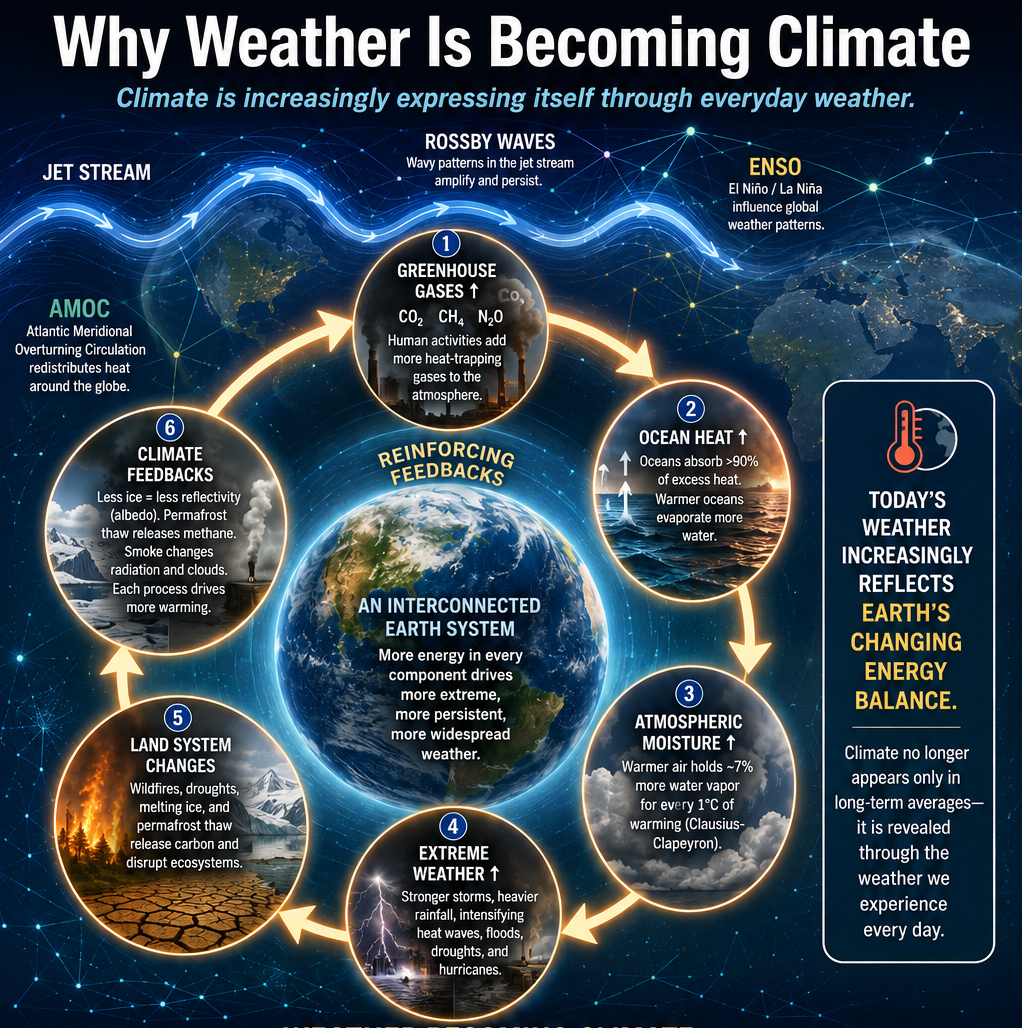
The distinction between weather and climate has not disappeared. Weather remains the day-to-day state of the atmosphere, while climate describes long-term averages and the underlying behavior of the Earth system. What has changed is the degree to which climate is now shaping weather in real time.
As greenhouse gases accumulate and the planet stores more heat, every component of the climate system contains more energy. Warmer oceans evaporate more water, the atmosphere holds more moisture, and circulation patterns are increasingly disrupted by changes in temperature gradients between the tropics and the poles. These changes alter not only the intensity of individual weather events but also the persistence and interaction of entire weather patterns.
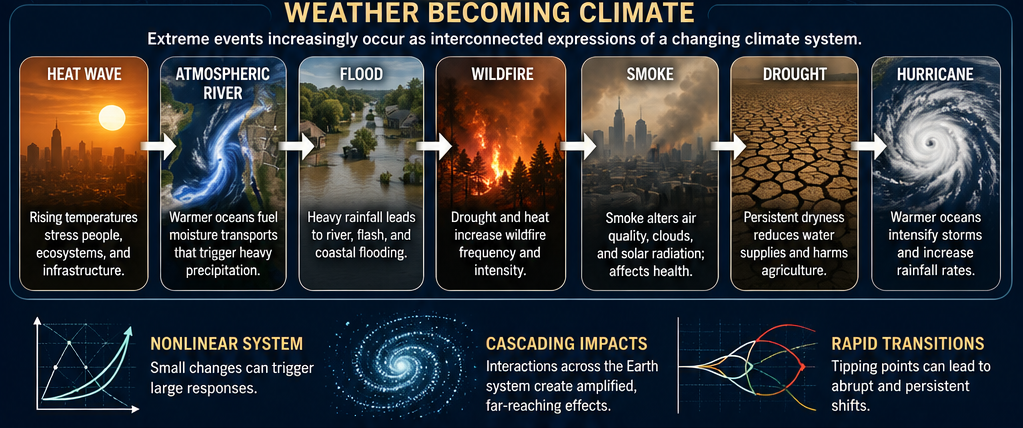
The result is a network of reinforcing feedbacks. A warming ocean fuels stronger atmospheric rivers and hurricanes. Droughts increase wildfire activity, while wildfire smoke alters atmospheric chemistry and solar radiation. Reduced snow and ice decrease Earth’s reflectivity, allowing additional warming. Permafrost thaw releases greenhouse gases that contribute to further warming. Each process influences others, producing cascading effects across the Earth system.
These interactions also affect the planet’s major circulation systems. Changes in the jet stream, Rossby wave amplification, ENSO, the Atlantic Meridional Overturning Circulation (AMOC), and other large-scale patterns increasingly influence one another. Rather than operating as largely independent phenomena, they are becoming components of an interconnected global system whose behavior is nonlinear and capable of rapid transitions.
This systems perspective helps explain why extreme weather events are becoming more persistent, widespread, and synchronized. Heat waves, floods, droughts, wildfires, and severe storms are no longer viewed simply as isolated disasters. They are increasingly understood as different expressions of the same underlying climate dynamics.
In this sense, weather has become one of the most visible indicators of climate change. The climate system is no longer revealing itself only through decades of averaged temperature records or scientific models. It is increasingly expressing itself through the weather that people experience every day. As nonlinear feedbacks continue to strengthen, weather is becoming the language through which climate communicates its changing state and at what rate.
What Fascinates You?
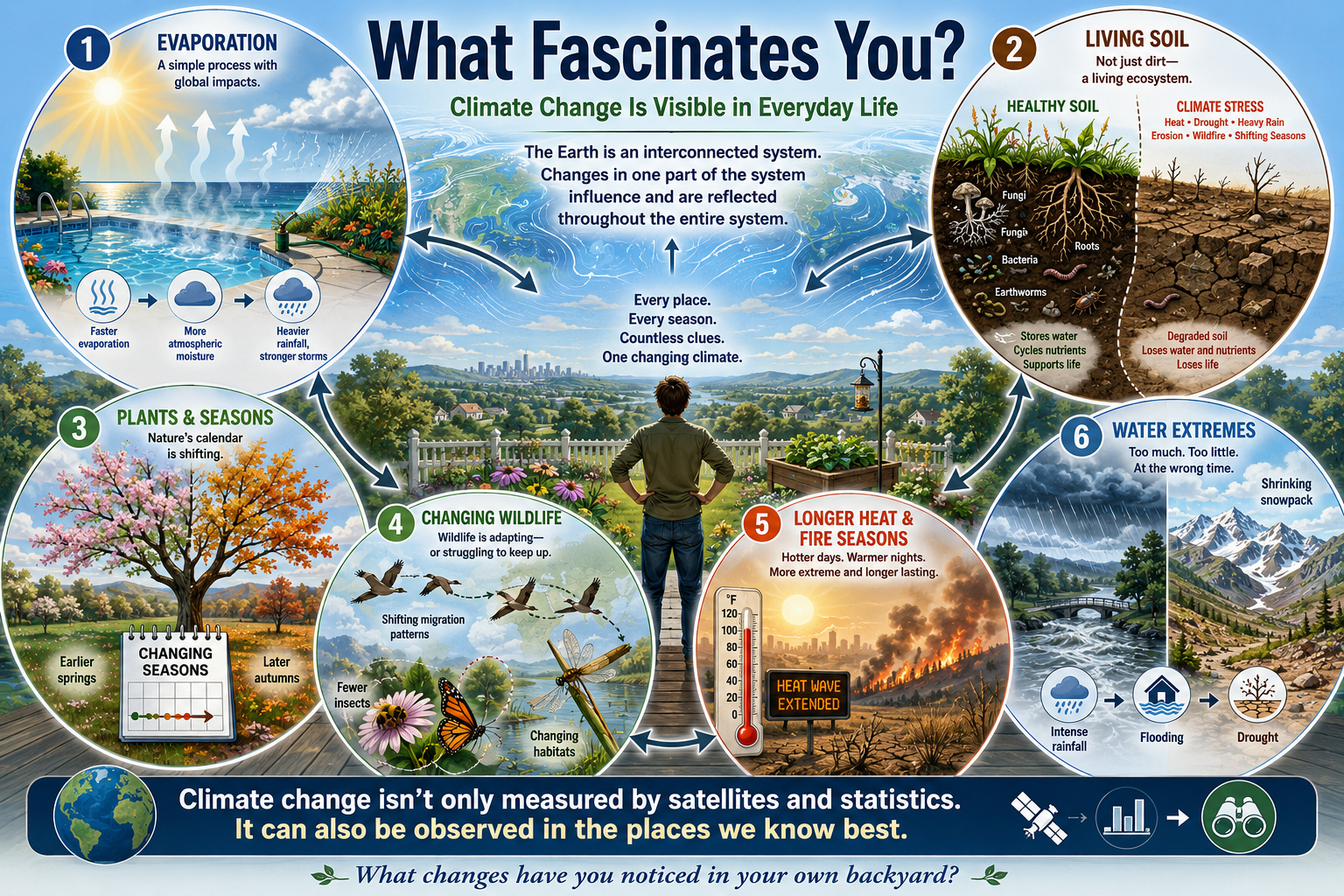
One of the remarkable aspects of climate change is that it no longer exists only in scientific journals or satellite imagery. It can be observed in countless ways during everyday life. Once you begin looking at the Earth as an interconnected system, signs of change seem to appear everywhere.
I find evaporation especially fascinating. It is one of the simplest processes to observe, yet it connects directly to the global climate system. I notice how quickly water disappears from a swimming pool after a hot, humid day. I see gardens requiring more frequent watering. At the global scale, the same process is evident in warmer oceans that transfer more water vapor into the atmosphere, fueling heavier downpours, stronger storms, and atmospheric rivers that are becoming increasingly familiar in regions where they were once uncommon.
I am equally fascinated by soil. Healthy soil is not simply dirt—it is a living ecosystem filled with fungi, bacteria, earthworms, insects, roots, and organic matter. It stores water, cycles nutrients, and supports nearly all terrestrial life. Yet I also see soil under stress. Extended heat, drought, intense rainfall, erosion, wildfire, and changing seasons are degrading soils in many places. The ground beneath our feet is quietly telling the story of a changing climate.
Others may notice different changes. Some watch the timing of blossoms in the spring or leaves in the autumn. Others observe declining insect populations, shifting bird migrations, warmer nights, disappearing snow cover, longer wildfire seasons, or increasingly persistent heat waves. Farmers may recognize changing growing seasons, while anglers notice warmer streams and changing fish populations. Every landscape offers its own clues.
Climate change is often discussed in terms of global averages and long-term statistics, but it is also a collection of countless local observations. The Earth system expresses itself through the places we know best.
So, what fascinates you?
What changes have you noticed in your own backyard, neighborhood, or community? The answers to that question may be among the most compelling evidence that weather is increasingly revealing the changing character of our climate.