bookmark_borderClimate Change and a Backyard Produce Experiment

by Daniel Brouse

Climate Change and a Backyard Produce Experiment: Results Through July 2026

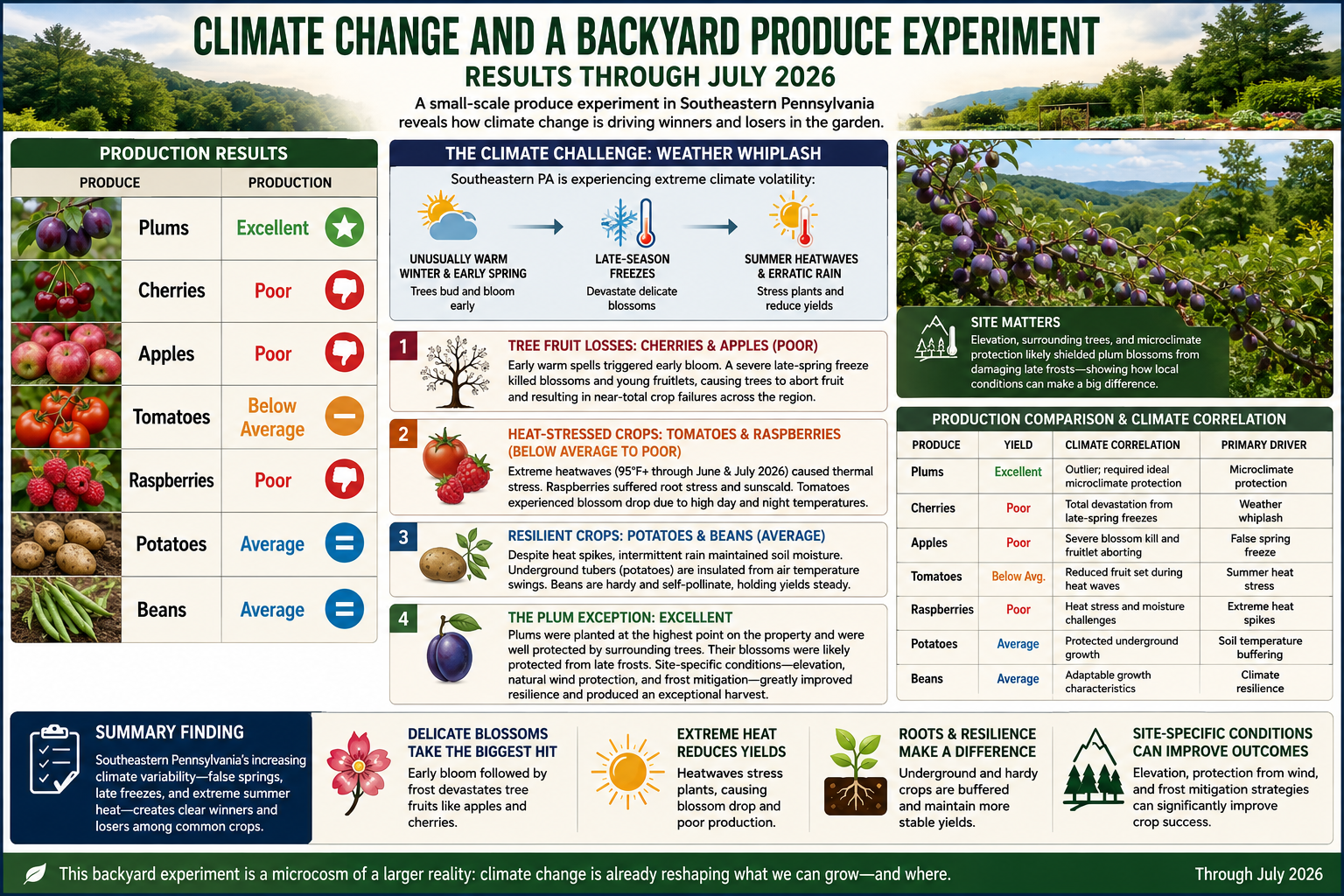
Production Results

ProduceProduction
PlumsExcellent
CherriesPoor
ApplesPoor
TomatoesBelow Average
RaspberriesPoor
PotatoesAverage
BeansAverage

Introduction

The results of this backyard produce experiment closely reflect the climate-related agricultural challenges affecting Southeastern Pennsylvania through July 2026. The region has experienced increasing climate volatility, often described as “weather whiplash”—a pattern characterized by unusually warm winter and early spring conditions followed by damaging late-season freezes, summer heat waves, and increasingly erratic precipitation.

The observed performance of each crop corresponds closely with the climatic stresses documented throughout the region.

Analysis by Crop Type

1. Tree Fruit Losses: Cherries and Apples

Both cherries and apples produced poor yields, mirroring the severe losses reported by many Pennsylvania fruit growers.

Climate Driver:
Warmer winters and early springs are causing fruit trees to break dormancy and bloom earlier than historical averages.

The False Spring Effect:
Following an unusually warm early spring, a significant late-season freeze struck Pennsylvania. Because many cherry and apple trees had already reached vulnerable flowering stages, blossoms were damaged or destroyed. Trees subsequently aborted damaged fruitlets, resulting in dramatically reduced harvests.

Observed Result: Poor production.


2. Heat-Stressed Crops: Tomatoes and Raspberries

Tomatoes and raspberries showed substantial sensitivity to elevated summer temperatures.

Climate Driver:
Repeated heat waves during June and July 2026 produced prolonged periods with temperatures exceeding 95°F (35°C).

Botanical Impacts:

  • Raspberries possess shallow root systems that are highly vulnerable to heat stress and soil moisture fluctuations. Prolonged high temperatures can reduce berry size, quality, and overall production.
  • Tomatoes often experience blossom drop when both daytime and nighttime temperatures remain elevated. Flowers fail to pollinate successfully, reducing fruit set and overall yield.

Observed Results:

  • Raspberries: Poor
  • Tomatoes: Below Average

3. Resilient Crops: Potatoes and Beans

Potatoes and beans demonstrated greater resilience despite challenging weather conditions.

Climate Driver:
Although extreme heat occurred, the season also included intermittent rainfall events that helped maintain soil moisture.

Botanical Impacts:

  • Potatoes benefit from underground tubers that remain insulated from extreme air temperatures.
  • Beans are generally adaptable and capable of maintaining stable production across a wider range of environmental conditions.

Observed Results:

  • Potatoes: Average
  • Beans: Average

4. The Plum Exception

Plums were the clear standout of the experiment, producing an excellent harvest despite widespread challenges affecting other fruit crops.

Climate Driver:
Most stone fruit in the region faced significant frost damage. However, localized factors can substantially alter outcomes.

Possible Explanations:

  • Favorable microclimate conditions
  • Higher-elevation planting sites where cold air drains away
  • Natural frost protection from surrounding terrain
  • Orchard management practices that reduced freeze damage

The plums were planted at the highest point on the property and were well protected by surrounding trees. Their elevated location likely reduced frost exposure, while the surrounding trees helped moderate temperature fluctuations and wind. Together, these conditions likely protected the blossoms from the damaging late-spring frosts that devastated many other fruit trees. The exceptional performance of the plum crop suggests that site-specific conditions—including elevation, natural wind protection, and frost mitigation—can significantly improve a crop’s resilience to climate-related stresses.

Observed Result: Excellent production.


Production Comparison and Climate Correlation

ProduceYieldClimate CorrelationPrimary Driver
PlumsExcellentLocalized success despite regional stressMicroclimate protection
CherriesPoorSevere blossom losses from spring freezeWeather whiplash
ApplesPoorFrost-damaged blossoms and fruitletsFalse spring freeze
TomatoesBelow AverageReduced fruit set during heat wavesSummer heat stress
RaspberriesPoorHeat stress and moisture challengesExtreme temperatures
PotatoesAverageProtected underground growthSoil temperature buffering
BeansAverageAdaptable growth characteristicsClimate resilience

Conclusions

This small-scale produce experiment provides a useful illustration of how climate change is increasingly influencing agricultural outcomes in Southeastern Pennsylvania.

The results reflect a broader regional pattern:

  • Early warming followed by hard freezes disproportionately impacts tree fruits such as apples and cherries.
  • Extreme summer heat reduces yields of temperature-sensitive crops such as tomatoes and raspberries.
  • Root crops and legumes generally demonstrate greater resilience to short-term temperature extremes.
  • Microclimate advantages can sometimes offset regional climate pressures, as demonstrated by the exceptional plum harvest.

Key Finding

The experiment suggests that Southeastern Pennsylvania’s increasing climate variability—particularly the combination of false springs, late freezes, and extreme summer heat—is creating clear winners and losers among common food crops. Delicate flowering fruit trees experienced the greatest losses, while more resilient crops maintained average production levels despite challenging conditions.

bookmark_borderFrom Linear Warming to Cascading Climate Dynamics: The Evolution Toward a Nonlinear Earth System Framework

By Daniel Brouse and Sidd Mukherjee

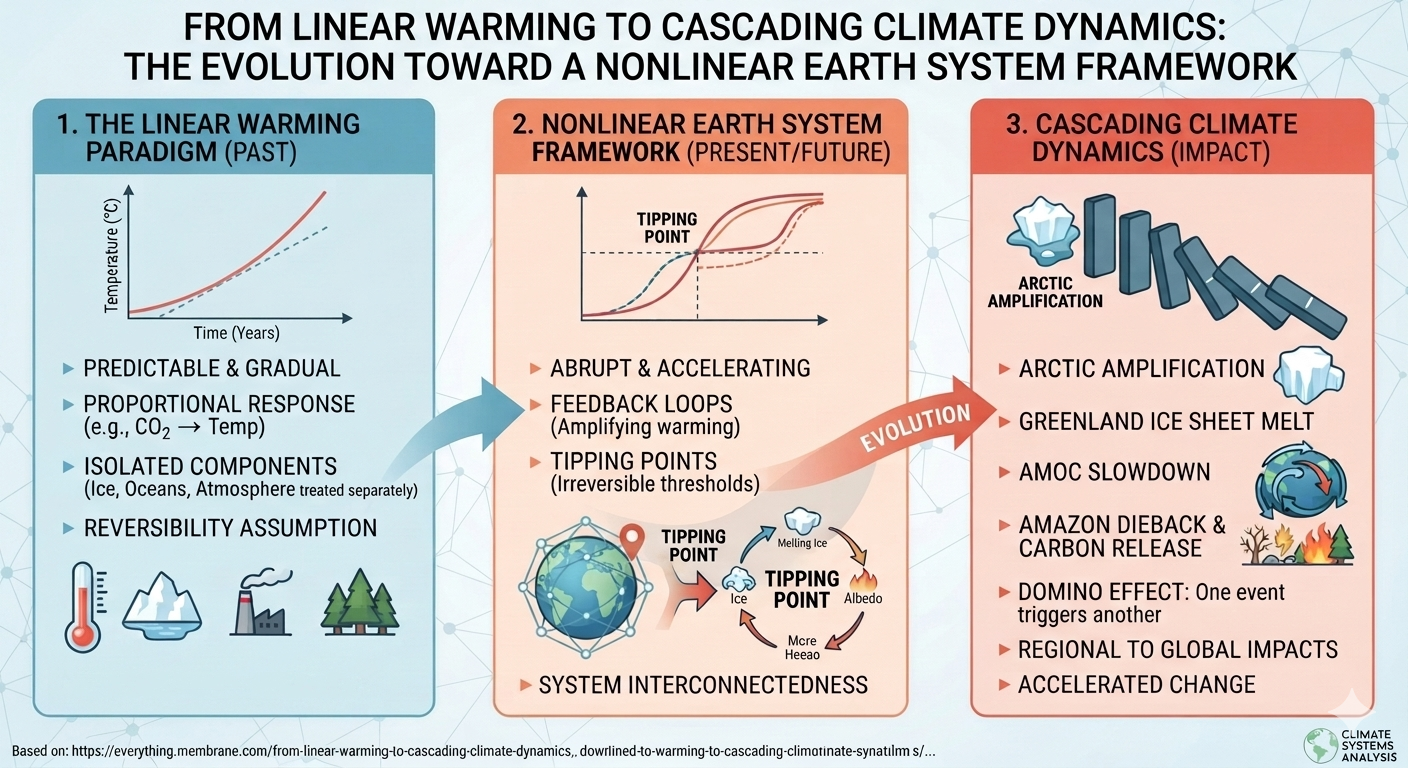
For decades, climate change has been communicated primarily through a relatively simple causal framework: increasing greenhouse gas concentrations drive global warming, which then increases the frequency, intensity, and duration of climate impacts. This linear model has been extraordinarily successful in explaining the fundamental physics of anthropogenic climate change.

However, Earth’s climate system is not a simple linear machine. It is a complex adaptive system composed of interacting components—including the atmosphere, oceans, cryosphere, biosphere, and human systems—that continuously exchange energy, matter, and information. As these interactions strengthen, the climate system can exhibit behaviors that cannot be fully explained by examining individual components in isolation.

In the 1990s, together with laboratory partner Sidd Mukherjee, we began developing the Nonlinear Acceleration Hypothesis (NAH), a framework proposing that climate change evolves through increasingly interconnected feedback networks. The hypothesis suggests that as climate subsystems become more tightly coupled, disturbances can propagate across multiple pathways, accelerating the rate of environmental change and increasing the probability of compound and cascading climate events.

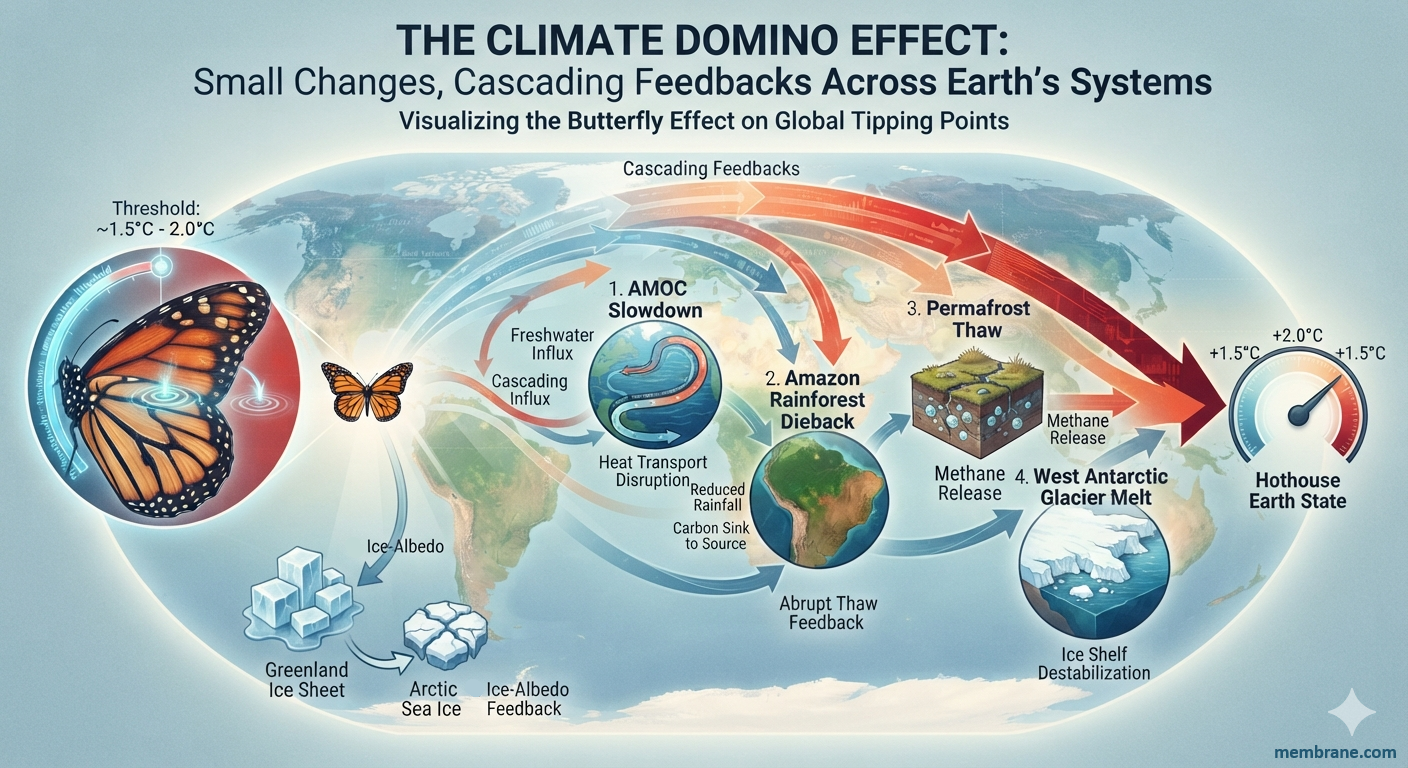
At the center of this framework is the concept of the Domino Effect, or Cascading Climate Dynamics. In this view, climate-driven events are not isolated occurrences but interacting processes in which one disturbance alters the conditions that influence subsequent events.

For example:

Rising temperatures → increased atmospheric moisture → stronger precipitation extremes → flooding → ecosystem disruption → economic impacts → societal stress

Similarly:

Arctic warming → permafrost thaw → greenhouse gas release → additional warming → further ice loss

These cascading interactions create reinforcing feedback loops that can reshape the trajectory of the entire Earth system.

Climate State-Space: Mapping Earth’s Changing Trajectory

The concept of climate state-space modeling provides a mathematical framework for understanding these complex transitions. Rather than describing climate change through a single variable such as global average temperature, state-space analysis represents the Earth system as a multidimensional landscape containing interacting variables such as:

  • Ocean heat content
  • Sea level rise
  • Atmospheric water vapor
  • Marine heatwaves
  • Ice-sheet stability
  • Ecosystem resilience
  • Extreme weather frequency

Each combination of these variables represents a possible climate state. As greenhouse forcing increases and feedback mechanisms intensify, Earth does not simply become warmer—it migrates through climate state-space toward increasingly unfamiliar regions characterized by new combinations of environmental conditions.

This perspective explains why modern climate extremes are increasingly difficult to categorize using historical experience alone. The challenge is not only that individual variables are changing, but that the relationships among variables are also evolving.

Extreme Event Attribution: The Missing Link Supporting a Nonlinear Climate Framework

For many years, climate science was able to establish the broad relationship between rising greenhouse gas concentrations and a warming planet, but scientists faced a significant challenge: determining the extent to which human-caused climate change contributed to specific individual extreme events.

That limitation has now been substantially reduced. Recent advances in extreme event attribution science, including the landmark work summarized by the National Academies of Sciences, Engineering, and Medicine (NASEM), have demonstrated that researchers can rigorously evaluate the human contribution to individual climate extremes, including heatwaves, heavy precipitation events, droughts, and other high-impact phenomena.

This scientific advancement represents more than an improvement in attribution methods—it provides critical observational support for the transition from a linear climate model toward a nonlinear Earth system framework.

The ability to attribute individual events to anthropogenic forcing confirms that climate change is not merely a gradual shift in global averages. Human influence is now detectable within specific components of the climate system and within the extreme events that emerge from their interactions.

This directly aligns with the central premise of the Nonlinear Acceleration Hypothesis (NAH): that climate change increasingly operates through interconnected feedback networks where individual disturbances can amplify, propagate, and interact across multiple Earth system components.

The scientific question is therefore evolving from:

“Is human activity causing climate change and increasing extreme events?”

to:

“How do human-driven changes alter the probability, intensity, timing, and interaction of cascading climate events across the Earth system?”

NASEM’s validation of extreme event attribution establishes an important foundation for this next phase of climate science. If human influence can now be detected within individual extreme events, then the logical next step is understanding how these events connect through feedback loops and contribute to broader system-level transitions.

The emerging scientific picture is of a coupled planetary system in which the atmosphere, oceans, cryosphere, biosphere, and human societies are not independent components but interacting elements of a dynamic network.

The future of climate research must therefore expand beyond measuring warming alone and toward understanding climate system acceleration, state-space migration, and cascading dynamics.

Climate change is not simply a rise in temperature.

It is an accelerating transformation of the Earth system driven by increasingly interconnected feedbacks.

Understanding this transformation requires new mathematical frameworks, new modeling approaches, and a deeper understanding of the nonlinear interactions that determine planetary stability.

bookmark_borderThe Collapse of Climate Predictability

by Daniel Brouse

How Coupled Climate Feedbacks Are Changing Earth’s Behavior

Abstract

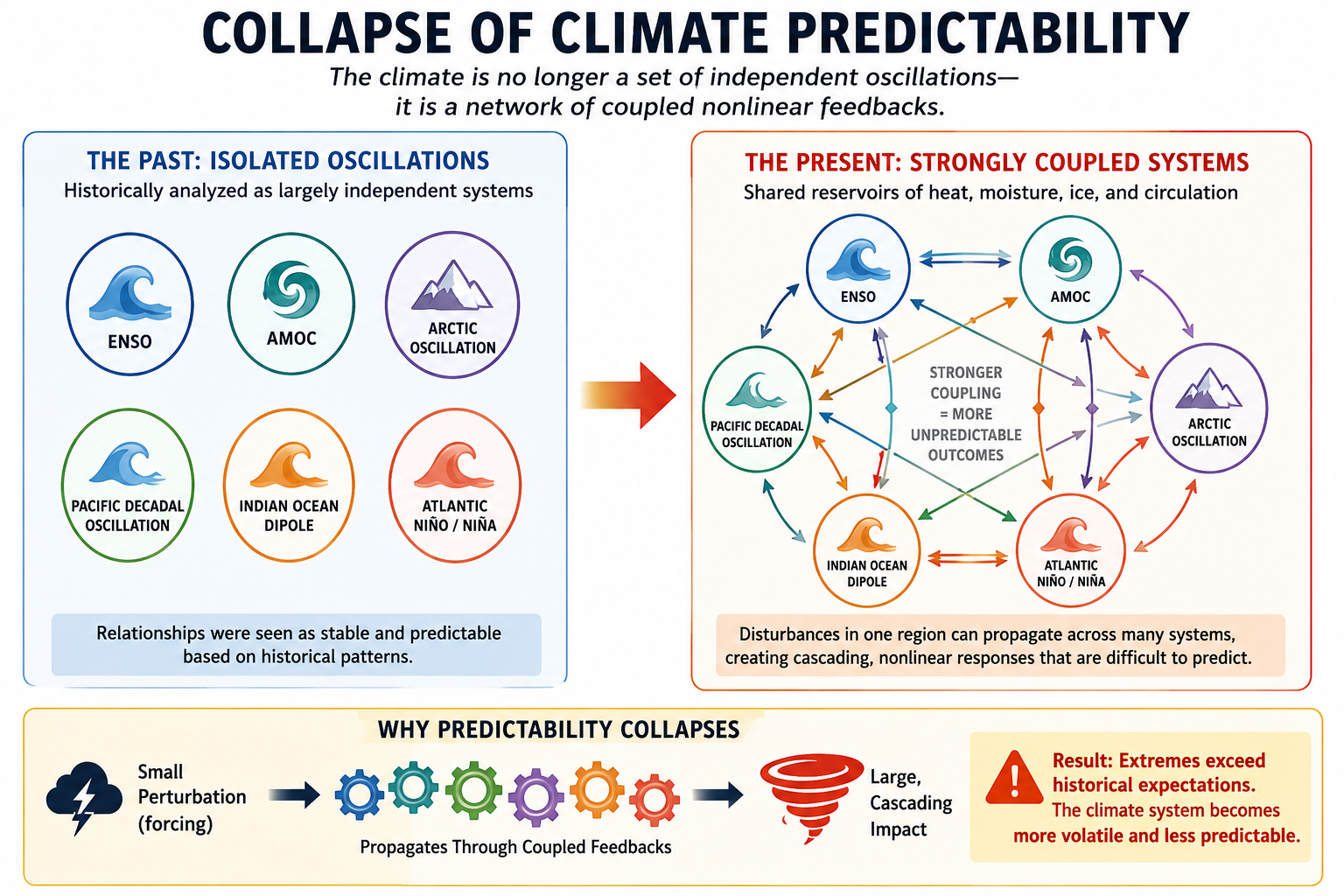
For much of the modern scientific era, Earth’s major climate oscillations were studied as largely independent systems. Phenomena such as the El Niño–Southern Oscillation (ENSO), the Atlantic Meridional Overturning Circulation (AMOC), the Arctic Oscillation (AO), the Pacific Decadal Oscillation (PDO), the Indian Ocean Dipole (IOD), and the Atlantic Niño/Niña each possessed recognizable patterns, historical relationships, and reasonably predictable behavior.

Today, however, a growing body of observations suggests these systems are becoming increasingly interconnected through shared reservoirs of heat, moisture, ice, and atmospheric circulation. Rather than behaving as isolated oscillators, they are evolving into a tightly coupled network in which disturbances propagate across multiple components of the Earth system. This increasing connectivity reduces the reliability of historical climate relationships and contributes to what can be described as the collapse of climate predictability.


From Independent Oscillators to a Coupled System

Classical climatology often treated Earth’s major modes of variability as separate oscillations whose interactions were relatively weak and occurred over well-defined time scales.

Examples include:

  • El Niño–Southern Oscillation (ENSO)
  • Atlantic Meridional Overturning Circulation (AMOC)
  • Arctic Oscillation (AO)
  • Pacific Decadal Oscillation (PDO)
  • Indian Ocean Dipole (IOD)
  • Atlantic Niño/Niña

These oscillations remain useful conceptual tools, but they no longer appear to behave as isolated components. Instead, they increasingly exchange energy through atmospheric circulation, ocean heat transport, cryospheric change, and hydrologic feedbacks.

The climate system is transitioning from a collection of loosely connected oscillators to a highly interconnected nonlinear network.


The Common Driver: Earth’s Growing Energy Imbalance

The increasing coupling among climate systems is not random.

It is driven by a steadily increasing accumulation of heat within the Earth system.

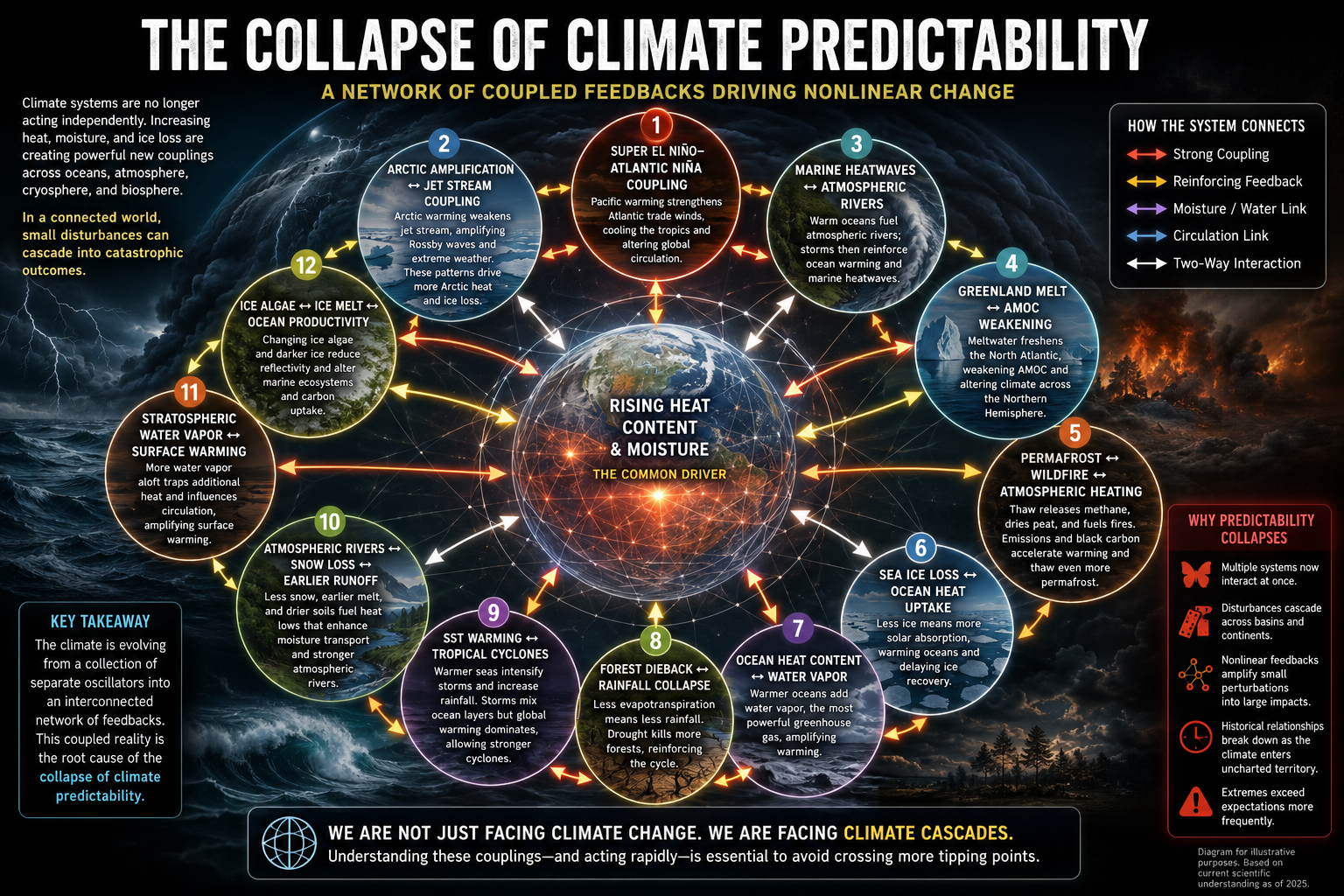
More than 90 percent of the excess energy trapped by greenhouse gases is absorbed by the oceans. Rising ocean heat content increases evaporation, atmospheric water vapor, sea surface temperatures, and latent heat available to storms. At the same time, declining sea ice reduces Earth’s reflectivity, allowing additional solar energy to be absorbed. Melting glaciers introduce freshwater into the oceans, altering circulation patterns, while warming soils and thawing permafrost release additional greenhouse gases.

These processes all originate from the same growing energy imbalance, linking climate systems that historically behaved more independently.


Emerging Climate Couplings

Numerous examples illustrate this increasing interconnectedness.

Super El Niño–Atlantic Niña

Exceptional Pacific warming modifies atmospheric circulation, strengthening Atlantic trade winds and promoting cooling in portions of the tropical Atlantic. The altered Atlantic circulation then feeds back into global atmospheric patterns, influencing hurricane development, African rainfall, and Amazon precipitation.


Arctic Amplification–Jet Stream Coupling

Rapid Arctic warming weakens the north-south temperature gradient that maintains the polar jet stream. The resulting slower, more meandering jet stream favors persistent blocking patterns, prolonged heat domes, stalled storms, and extended droughts. Those weather extremes further accelerate Arctic warming through enhanced ice loss and wildfire activity.


Greenland Melt–AMOC Coupling

Accelerated melting of the Greenland Ice Sheet introduces freshwater into the North Atlantic, reducing salinity and slowing deep-water formation. A weaker AMOC alters weather patterns across the Northern Hemisphere, changing precipitation and temperature patterns that can further influence Greenland’s mass balance.


Marine Heatwaves–Atmospheric Rivers

Warmer oceans increase evaporation and atmospheric moisture. Enhanced water vapor intensifies atmospheric rivers, producing heavier precipitation while simultaneously reinforcing marine heatwaves through changes in ocean mixing and heat distribution.


Permafrost–Wildfire–Atmosphere Coupling

Permafrost thaw releases methane and dries peatlands, increasing wildfire activity. Wildfires emit greenhouse gases and black carbon, which darkens snow and ice surfaces, accelerating melting and further warming high-latitude regions.


Forest Dieback–Rainfall Coupling

Forests recycle enormous quantities of moisture through evapotranspiration. As forests decline from heat, drought, or wildfire, atmospheric moisture recycling weakens, reducing rainfall and increasing drought severity, which in turn accelerates additional forest loss.


Why Predictability Is Declining

Historically, climate forecasting relied heavily on recurring relationships.

Meteorologists and climatologists could often estimate future conditions because the underlying oscillations behaved within relatively stable statistical boundaries.

As coupling strengthens, those assumptions become increasingly unreliable.

A disturbance originating in one ocean basin can now propagate through atmospheric circulation into multiple ocean basins, alter sea surface temperatures elsewhere, modify jet stream behavior, influence storm tracks, and feed back into the original disturbance.

Small changes no longer remain local.

Instead, they cascade through interconnected systems.

The result is increasing uncertainty, even while the underlying driver—Earth’s growing energy imbalance—continues to strengthen.


A Network of Nonlinear Feedbacks

This transition is fundamentally a problem of nonlinear dynamics.

In linear systems:

  • responses are generally proportional to the forcing;
  • disturbances remain localized; and
  • historical relationships remain relatively stable.

In nonlinear systems:

  • small perturbations can produce disproportionately large responses;
  • interactions among multiple feedback loops amplify disturbances; and
  • outcomes become increasingly sensitive to initial conditions.

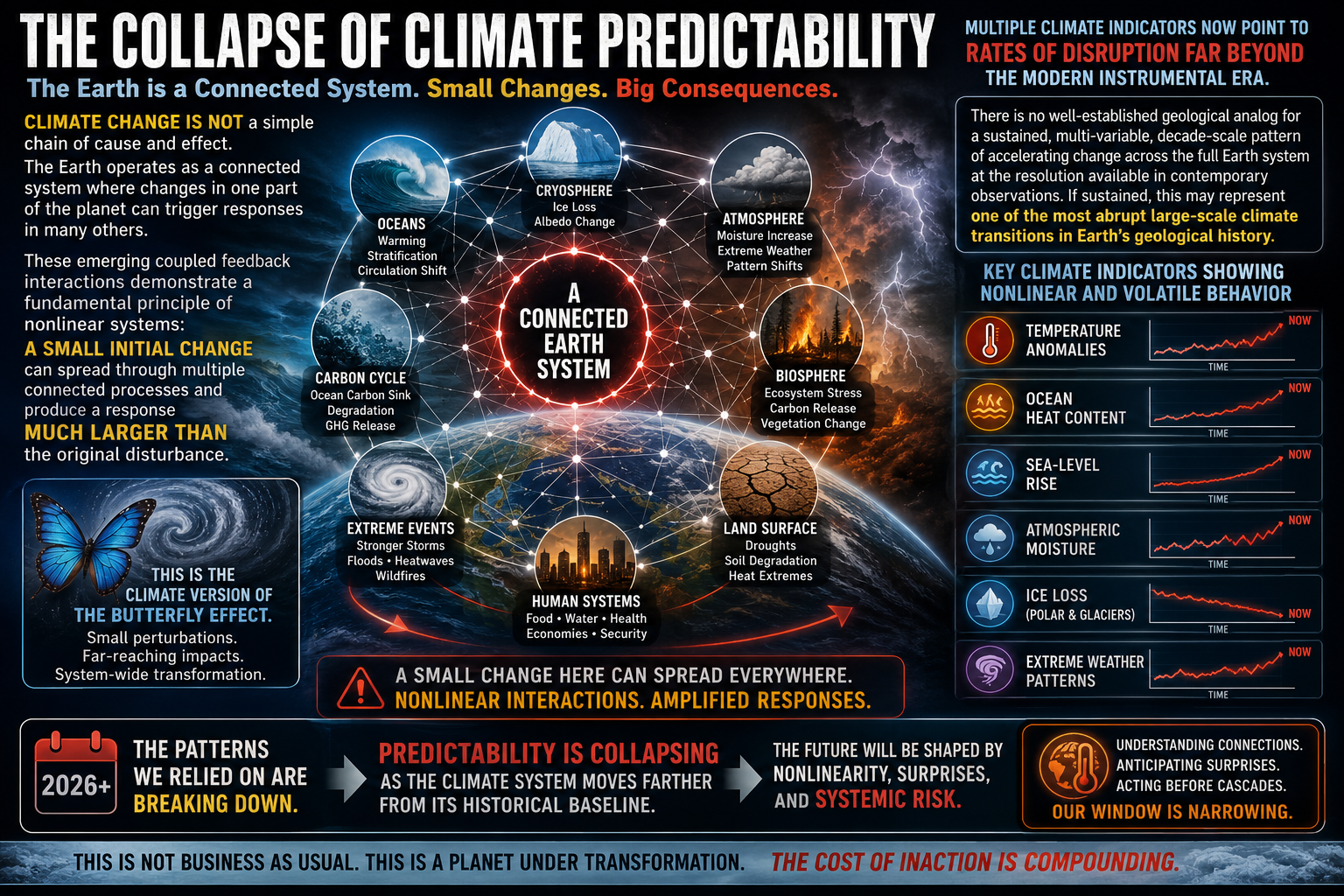
As climate systems become more strongly coupled, Earth’s behavior increasingly resembles a nonlinear network rather than a collection of independent oscillators.

This is the climate-scale manifestation of the Butterfly Effect.


Cascading Climate Responses

Once coupling strengthens sufficiently, climate events begin propagating across multiple systems.

For example:

Ocean Warming → Marine Heatwaves → Increased Evaporation → Higher Atmospheric Water Vapor → Stronger Atmospheric Rivers → Extreme Flooding → Reduced Snowpack → Earlier Runoff → Hotter Soils → Stronger Heat Domes → Additional Ocean Warming

Each step reinforces subsequent processes, creating cascading responses that are considerably larger than the original perturbation.


Beyond Traditional Climate Variability

Many recent extreme events have exceeded expectations based on historical climate statistics.

Persistent heat domes, multi-day atmospheric rivers, marine heatwaves, rapid intensification of tropical cyclones, widespread wildfire outbreaks, and simultaneous extremes occurring across multiple continents increasingly reflect the behavior of an interconnected system rather than isolated weather anomalies.

The climate is no longer responding solely through individual oscillations.

It is responding through interactions among oscillations.


A New Framework for Climate Science

Understanding future climate risk increasingly requires moving beyond analyses that focus on individual climate modes in isolation.

Future prediction will depend on understanding:

  • cross-basin ocean interactions;
  • atmospheric teleconnections;
  • cryosphere–ocean coupling;
  • biosphere–atmosphere feedbacks;
  • hydrologic amplification; and
  • nonlinear propagation through coupled climate networks.

The central scientific challenge is no longer identifying individual feedbacks, but understanding how those feedbacks interact simultaneously.


Conclusion

The growing accumulation of heat within Earth’s climate system is strengthening connections among atmospheric, oceanic, cryospheric, and biological processes. These interactions are transforming once largely independent climate oscillations into a coupled network of nonlinear feedbacks.

As coupling intensifies, disturbances spread more efficiently across the Earth system, historical relationships become less reliable, and extreme events increasingly exceed expectations derived from the past. The resulting decline in predictability is not evidence that the climate has become random. Rather, it reflects the behavior of a highly interconnected nonlinear system whose responses are increasingly governed by cascading interactions instead of isolated processes.

The collapse of climate predictability is therefore best understood not as the failure of climate science, but as the emergence of a new climatic regime—one in which understanding the connections between Earth’s major systems becomes as important as understanding the systems themselves.

bookmark_borderClimate Dominoes: How Small Changes Trigger Cascading Feedbacks Across Earth’s Systems

by Daniel Brouse

Introduction: The Hidden Connections Driving Climate Change

Climate change is not a simple chain of cause and effect. The Earth operates as a connected system where changes in one part of the planet can trigger responses in many others. These emerging coupled feedback interactions demonstrate a fundamental principle of nonlinear systems: a small initial change can spread through multiple connected processes and produce a response much larger than the original disturbance. This is the climate version of the Butterfly Effect.

Climate feedbacks do not operate independently. Instead, they interact as a vast network linking the atmosphere, oceans, ice sheets, forests, soils, and ecosystems. When one feedback strengthens another, the combined effect can become greater than the sum of the individual parts. This is why climate change can sometimes accelerate faster than expected and why predicting future changes is so challenging.

From Individual Feedbacks to Climate Cascades

A traditional climate feedback is often described as a single process:

  • warming melts ice,
  • melting ice reduces reflectivity,
  • reduced reflectivity causes more warming.

However, the real climate system is more complex. One feedback can activate several others, creating a chain reaction across different parts of the planet.

These connected processes are called coupled feedback interactions. They occur when multiple feedbacks reinforce one another, creating cascading effects that cannot be understood by studying each process separately.

Wildfires: From Local Fires to Global Feedbacks

A powerful example begins with heat and drought.

As temperatures rise and soils dry, forests become more vulnerable to large wildfires. These fires release carbon dioxide stored in trees and soils, adding more greenhouse gases to the atmosphere. They also produce black carbon, or soot, which can travel long distances and settle on snow, glaciers, and Arctic sea ice.

Darkened ice and snow absorb more sunlight than clean, reflective surfaces. This increases melting, exposes darker land and ocean surfaces, and allows even more solar energy to be absorbed.

At the same time, burned forests lose their ability to remove carbon dioxide from the atmosphere. A regional drought can therefore trigger a chain of connected responses involving the atmosphere, forests, ice, and oceans.

A single wildfire can become part of a much larger climate feedback network.

Arctic Permafrost: The Sleeping Carbon Reservoir

The Arctic contains enormous amounts of carbon stored in frozen soils known as permafrost. As the Arctic warms, this frozen ground begins to thaw.

When permafrost melts:

  • microorganisms break down ancient organic material,
  • carbon dioxide and methane are released,
  • additional greenhouse gases enter the atmosphere,
  • warming increases further.

Thawing permafrost can also create thermokarst lakes—collapsed areas filled with water. These lakes absorb heat more efficiently than frozen ground, accelerating nearby thaw.

Another unusual example is the rise of zombie fires. These underground fires can continue burning beneath snow throughout the winter, then reappear during warmer seasons. They release carbon, damage vegetation, and accelerate the loss of the insulating layers that protect permafrost.

Together, permafrost thaw, methane release, thermokarst lakes, and zombie fires form a connected Arctic amplification system.

Greenland Ice Algae: When Life Darkens Ice

Greenland provides one of the most surprising examples of a biological climate feedback.

As temperatures rise, more snow and ice melt during summer. This exposes surfaces where microscopic algae can grow. These algae contain dark pigments that reduce the brightness of the ice.

Normally, bright ice reflects sunlight back into space. Darker ice absorbs more solar energy.

The result:

melting ice → more algae growth → darker ice → more solar absorption → faster melting

As melting increases, more liquid water becomes available, creating conditions that can support additional algal growth. A biological process becomes directly connected to the physical loss of an ice sheet.

Oceans and the Atmosphere: A Heat and Moisture Engine

The oceans absorb most of the excess heat trapped by greenhouse gases. As ocean temperatures rise, evaporation increases, adding more water vapor to the atmosphere.

Water vapor is itself a greenhouse gas, creating additional warming.

A warmer ocean and atmosphere can contribute to:

  • stronger atmospheric rivers,
  • heavier rainfall events,
  • more intense tropical storms,
  • longer-lasting marine heatwaves.

At the same time, warmer oceans can become less effective at absorbing carbon dioxide. Marine heatwaves can also damage ecosystems such as kelp forests and phytoplankton communities that help remove carbon from the atmosphere.

The ocean, atmosphere, and biosphere therefore form a tightly connected climate system.

Vegetation Changes: The Arctic Landscape Transforms

Climate change can also reshape ecosystems in ways that amplify warming.

As Arctic temperatures increase, shrubs expand into areas that were previously dominated by low vegetation. These darker shrubs absorb more sunlight than snow-covered tundra.

Shrubs also trap more snow during winter. Deeper snow acts like a blanket, keeping the ground warmer and accelerating permafrost thaw.

A similar process occurs in forests. Warmer winters allow pests such as bark beetles to survive in greater numbers. Large areas of weakened forest can then become vulnerable to wildfire, releasing more carbon and reducing future carbon storage.

The Bigger Picture: Earth as a Connected System

These examples reveal an important shift in how we understand climate change.

The Earth system is not simply a collection of separate feedback loops. It is a network of interacting systems where changes in one area can activate responses elsewhere.

A warming ocean can influence the atmosphere.
A wildfire can influence ice melt.
Melting ice can influence ecosystems.
Changing ecosystems can influence greenhouse gases.

These connections create climate cascades—chains of interacting processes that can amplify change throughout the planet.

The future of climate change will depend not only on the amount of greenhouse gases added to the atmosphere, but also on how these interconnected feedbacks evolve, interact, and influence one another.

Understanding these hidden connections is essential for understanding why climate change is not just warming—it is a rapidly evolving Earth system response.

bookmark_borderThe Acceleration of Acceleration

Coupled Climate Feedbacks, Nonlinear Amplification, and the Physical Limits of Earth’s Warming

by Daniel Brouse

Introduction

Emerging coupled feedback interactions exemplify nonlinear amplification: a modest initial perturbation can propagate through multiple coupled systems, producing a response much larger than the original forcing—a climate-scale manifestation of the Butterfly Effect. Rather than operating independently, feedbacks interact as an interconnected network in which biological, atmospheric, oceanic, cryospheric, and ecological processes reinforce one another. This networked behavior is one reason Earth-system responses become increasingly difficult to predict using traditional linear cause-and-effect thinking.

Unlike traditional climate feedbacks, which are often described individually, coupled feedback interactions arise when one feedback activates, strengthens, or synchronizes with others, producing cascading amplification throughout the Earth system. These interactions create emergent behavior that cannot be understood by examining any single process in isolation.

For example, prolonged heat and drought increase the likelihood of large wildfires. Those fires release massive quantities of carbon dioxide while depositing black carbon (soot) onto glaciers, Arctic sea ice, and seasonal snowpack. The resulting darkened surfaces absorb more solar radiation, accelerating melt and exposing darker land and ocean surfaces that absorb even more heat. At the same time, burned forests lose their capacity to sequester carbon, allowing atmospheric greenhouse gas concentrations to rise further. What begins as a regional drought evolves into an interconnected atmospheric, cryospheric, and ecological feedback network.

A second example occurs across the Arctic. Rising temperatures thaw permafrost, releasing carbon dioxide and methane from previously frozen organic material. Ground collapse forms thermokarst lakes that transfer heat more efficiently into surrounding permafrost, accelerating additional thaw. In Canada and Siberia, “zombie fires” can continue smoldering beneath snow throughout the winter, reigniting during spring while further degrading permafrost and releasing additional greenhouse gases. Together, these processes couple biological decomposition, wildfire dynamics, methane emissions, and cryospheric change into a self-reinforcing amplification cycle.

Greenland provides another striking example. As snow and ice melt, microscopic ice algae colonize newly exposed surfaces. Their dark pigments reduce the ice sheet’s reflectivity (albedo), allowing greater solar absorption and accelerating surface melt. Increased meltwater creates a more favorable habitat for additional algal growth while exposing larger areas of bare ice. This biological feedback couples directly with cryospheric processes, amplifying mass loss from the Greenland Ice Sheet.

Ocean-atmosphere interactions also demonstrate powerful coupling. Increasing ocean heat content enhances evaporation, raising atmospheric water vapor—the atmosphere’s most abundant greenhouse gas. Higher moisture levels increase latent heat transport and intensify extreme precipitation, atmospheric rivers, and tropical cyclones. Warmer oceans simultaneously reduce their capacity to absorb additional carbon dioxide, while marine heatwaves weaken phytoplankton and kelp ecosystems that normally remove carbon from the atmosphere. These coupled oceanic, atmospheric, and biological feedbacks amplify both the hydrologic cycle and the planetary energy imbalance.

Even ecological changes can initiate broad climate responses. Warming allows shrubs to expand across Arctic tundra, replacing highly reflective snow-covered landscapes with darker vegetation that absorbs more solar energy. Shrubs also trap deeper snow during winter, insulating the ground and increasing soil temperatures, which accelerates permafrost thaw and greenhouse gas release. Similarly, warmer winters enable bark beetles to survive in greater numbers, killing vast boreal forests that become increasingly susceptible to catastrophic wildfire, further strengthening carbon and albedo feedbacks.

These examples illustrate a fundamental shift in climate dynamics. The Earth system is no longer adequately described as a collection of isolated feedback loops. Instead, it behaves as a network of interacting feedback networks, in which newly activated processes strengthen existing feedbacks while increasing the probability that additional feedbacks will emerge. This progressive coupling is a defining characteristic of nonlinear systems and suggests that future climate evolution may depend as much on the interactions among feedbacks as on the magnitude of the initial radiative forcing itself.

Accelerating Acceleration

Recent observations suggest that climate change is unfolding more rapidly than many earlier projections anticipated, with multiple indicators—including ocean heat content, sea-level rise, atmospheric water vapor, and the frequency of extreme events—showing evidence of accelerating change. As additional feedback mechanisms emerge and become more strongly coupled, the amplification itself may accelerate. In other words, the rate of climate change is not only increasing, but evidence from multiple climate indicators suggests that the rate of acceleration is also increasing as reinforcing feedbacks become more tightly coupled across the Earth system. This raises a new scientific challenge: not simply determining how fast the climate is changing, but quantifying how rapidly the acceleration itself is evolving, how long this phase of increasing acceleration will persist, and what physical limits will ultimately constrain it. As coupling among feedbacks strengthens, the system may experience increasingly rapid changes in growth rates before approaching the thermodynamic and radiative equilibrium imposed by the laws of physics.

One of the greatest scientific uncertainties is determining the ultimate upper bound of this amplification. While the physics governing Earth’s energy balance impose finite constraints, the magnitude and timing of future radiative forcing remain uncertain because they depend on the strength, interaction, and persistence of coupled feedbacks that are still being discovered and quantified. Likewise, the eventual upper limit of ocean heat content—the largest reservoir of excess thermal energy in the climate system—will depend on how efficiently the oceans continue to absorb, redistribute, and eventually release heat under increasingly nonlinear conditions.

Fundamental thermodynamics indicate that runaway warming is not unbounded. Current physical understanding suggests that the Earth system likely possesses an upper equilibrium limit well below a true Venus-like runaway greenhouse state. Some theoretical analyses place this upper bound near 9°C of global mean warming above preindustrial temperatures, although the precise value remains uncertain and depends on long-term feedbacks, cloud dynamics, atmospheric composition, and ocean-atmosphere interactions. The critical scientific question is therefore not whether warming is infinite, but how rapidly the climate system approaches its physical limits, and how many ecological, societal, and economic thresholds are crossed long before equilibrium is reached.

Understanding these nonlinear interactions is therefore essential. The Earth’s climate is not merely responding to increasing greenhouse gas concentrations; it is evolving as a complex adaptive system in which newly activated feedbacks can amplify one another, creating cascading responses that challenge conventional linear forecasting methods and underscore the importance of incorporating chaos theory into future climate modeling.


1. From Linear Warming to Network Dynamics

Traditional descriptions of climate change often portray global warming as a relatively straightforward response to increasing greenhouse gas concentrations. In reality, greenhouse gases provide the initial radiative forcing, while the Earth system determines how that energy is redistributed. As warming progresses, the atmosphere, oceans, cryosphere, biosphere, and lithosphere become increasingly coupled through exchanges of heat, moisture, carbon, momentum, and radiation.

These exchanges create a network of positive and negative feedbacks whose combined behavior cannot be understood by studying any single process in isolation. Instead, climate evolves as a nonlinear system in which interactions among feedbacks generate new system-wide responses. The collective behavior of the network becomes more important than the behavior of its individual components.


2. Feedback Networks and Emergent Amplification

Positive feedbacks rarely occur independently. A single warming event may simultaneously trigger increased atmospheric water vapor, accelerated glacier melt, reduced surface albedo, greater wildfire activity, enhanced methane emissions from thawing permafrost, and changes in ocean circulation. Each process contributes additional energy or greenhouse gases to the climate system while also increasing the likelihood that other feedbacks will intensify.

Examples include:

  • Zombie fires that continue burning beneath snow, releasing carbon while removing insulating vegetation and accelerating permafrost thaw.
  • Greenland ice algae that darken ice surfaces, reducing albedo and increasing solar absorption.
  • Thermokarst lakes that expand methane emissions while increasing heat transfer into permafrost.
  • Marine heatwaves that weaken biological carbon uptake while strengthening ocean stratification.
  • Wildfire soot that darkens glaciers and seasonal snowpack, increasing melt rates.

Viewed individually, each represents an important feedback. Viewed collectively, they form an interconnected amplification network capable of producing emergent behavior.


3. The Acceleration of Acceleration

One consequence of increasing feedback connectivity is that acceleration itself may evolve.

In a linear system, acceleration remains approximately constant. In a nonlinear network, every newly activated feedback can increase both the rate of warming and the effectiveness of existing feedbacks. As coupling strengthens, the overall amplification of the climate system may itself increase.

Conceptually, this progression can be viewed as:

Radiative Forcing → Initial Warming → Positive Feedback Activation → Coupled Feedback Interactions → Nonlinear System Amplification → Emergent Climate Feedback Networks → Increasing Rate of Acceleration → Further Coupling and Amplification

This hypothesis does not imply unlimited growth. Rather, it suggests that the climate system may pass through successive stages in which feedback interactions become progressively more efficient before approaching physical constraints.


4. Ocean Heat Content as the Integrator of Climate Change

More than 90 percent of Earth’s excess heat is stored in the oceans, making ocean heat content one of the most comprehensive indicators of planetary energy imbalance. Unlike surface air temperature, which fluctuates over relatively short timescales, ocean heat content integrates decades of accumulated warming.

Increasing ocean heat influences nearly every component of the climate system by increasing evaporation, strengthening atmospheric moisture transport, intensifying tropical cyclones, raising sea level through thermal expansion, reducing sea-ice formation, and altering global ocean circulation.

As long as Earth’s energy imbalance remains positive, ocean heat content will continue to increase. Understanding its long-term evolution therefore becomes central to understanding the future trajectory of climate change.


5. Radiative Forcing and Thermodynamic Constraints

Although positive feedbacks amplify warming, they operate within the constraints imposed by fundamental physics. As Earth’s temperature increases, outgoing longwave radiation also increases according to the Stefan-Boltzmann relationship. These radiative responses act as stabilizing mechanisms that eventually balance incoming solar energy.

Current theoretical studies suggest that Earth’s equilibrium climate remains well below the conditions required for a classical runaway greenhouse effect. Some analyses estimate an upper equilibrium near approximately 9°C above preindustrial temperatures, although this value remains uncertain because it depends upon cloud feedbacks, atmospheric composition, aerosol loading, ocean circulation, and long-term cryospheric evolution.

Consequently, the principal scientific challenge is not determining whether warming is limitless, but understanding how rapidly Earth approaches its physical equilibrium and what irreversible changes occur before that equilibrium is reached.


6. Scientific Uncertainties

Several major questions remain unresolved.

  • How many significant feedback mechanisms have yet to be identified?
  • At what point do independent feedbacks begin behaving as an integrated network?
  • Does amplification increase gradually, or does it occur through abrupt transitions?
  • How will evolving cloud dynamics modify future radiative forcing?
  • What are the practical upper limits of ocean heat storage before large-scale circulation patterns fundamentally change?
  • Can currently weak feedbacks become dominant as environmental thresholds are crossed?

These uncertainties represent some of the most important frontiers in Earth-system science.


7. Toward a Chaos-Theory Framework

Chaos theory provides a framework for understanding why increasingly connected feedback networks may generate behavior that appears abrupt, disproportionate, or unexpected. Small perturbations need not remain small when repeatedly amplified through nonlinear interactions.

Rather than viewing climate change as a sequence of independent cause-and-effect relationships, the Earth system can be understood as a continuously evolving adaptive network. Feedbacks alter one another’s strength, timing, and spatial extent, producing emergent behavior that cannot always be inferred from the properties of individual processes alone.

This perspective complements traditional climate modeling by emphasizing the importance of network interactions, threshold behavior, and nonlinear amplification.


Conclusion

Climate change is more than a gradual increase in global temperature. It is the evolution of an increasingly interconnected Earth system whose components continuously exchange thermal energy, moisture, carbon, and momentum through a growing network of coupled feedbacks.

The possibility that the acceleration of climate change may itself accelerate represents one of the most consequential hypotheses in modern climate science. If correct, future climate change will depend not only on greenhouse gas emissions but also on how rapidly feedbacks become interconnected and how efficiently they amplify one another.

Determining the limits of this amplification—including the upper bounds of radiative forcing, ocean heat content, and equilibrium warming—will require integrating chaos theory, nonlinear dynamics, thermodynamics, and Earth-system science into the next generation of climate models. Understanding these interactions may prove essential for anticipating future climate trajectories and the societal, ecological, and economic thresholds they may cross.
bookmark_borderWhy Climate Change Will Continue to Evolve for Decades: The Case for Long-Term Financial and Real Estate Planning

“The greater risk is a gradual degradation of living standards if adaptation is delayed.“

by Daniel Brouse

Introduction

Climate change is often discussed as if it will either produce an imminent societal collapse or, conversely, have little economic consequence. Neither view is supported by the physical science.

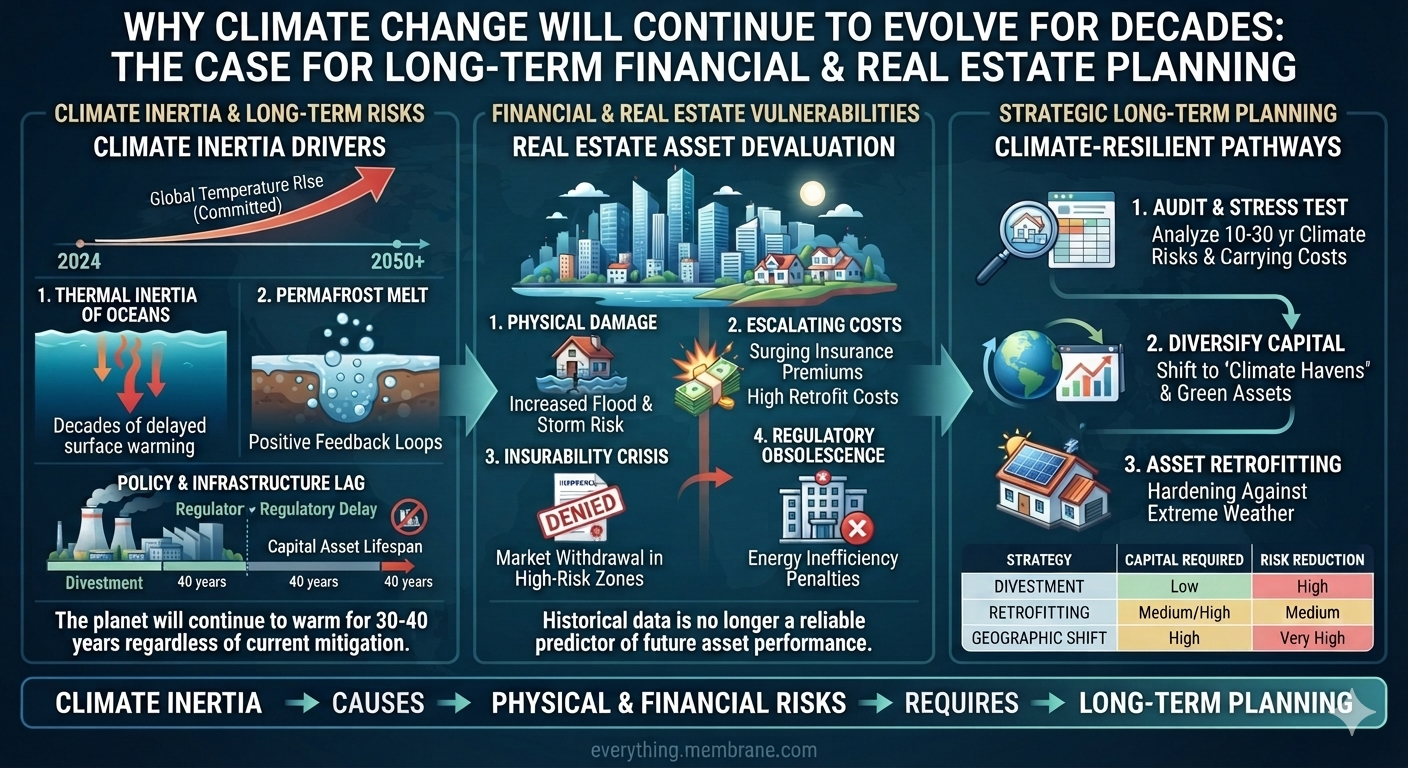
The Earth’s climate system responds over multiple timescales. While the atmosphere reacts relatively quickly to changes in greenhouse gas concentrations, the oceans—the planet’s largest heat reservoir—respond much more slowly. This difference, known as thermal inertia, means that many of the economic consequences of climate change will continue to unfold over decades, regardless of whether emissions peak today or several years from now.

For investors, homeowners, businesses, insurers, lenders, and governments, this distinction is critical. The evidence points not toward an immediate collapse of the global economy, but toward a long period of increasing environmental risks that will progressively reshape financial markets and real estate values.


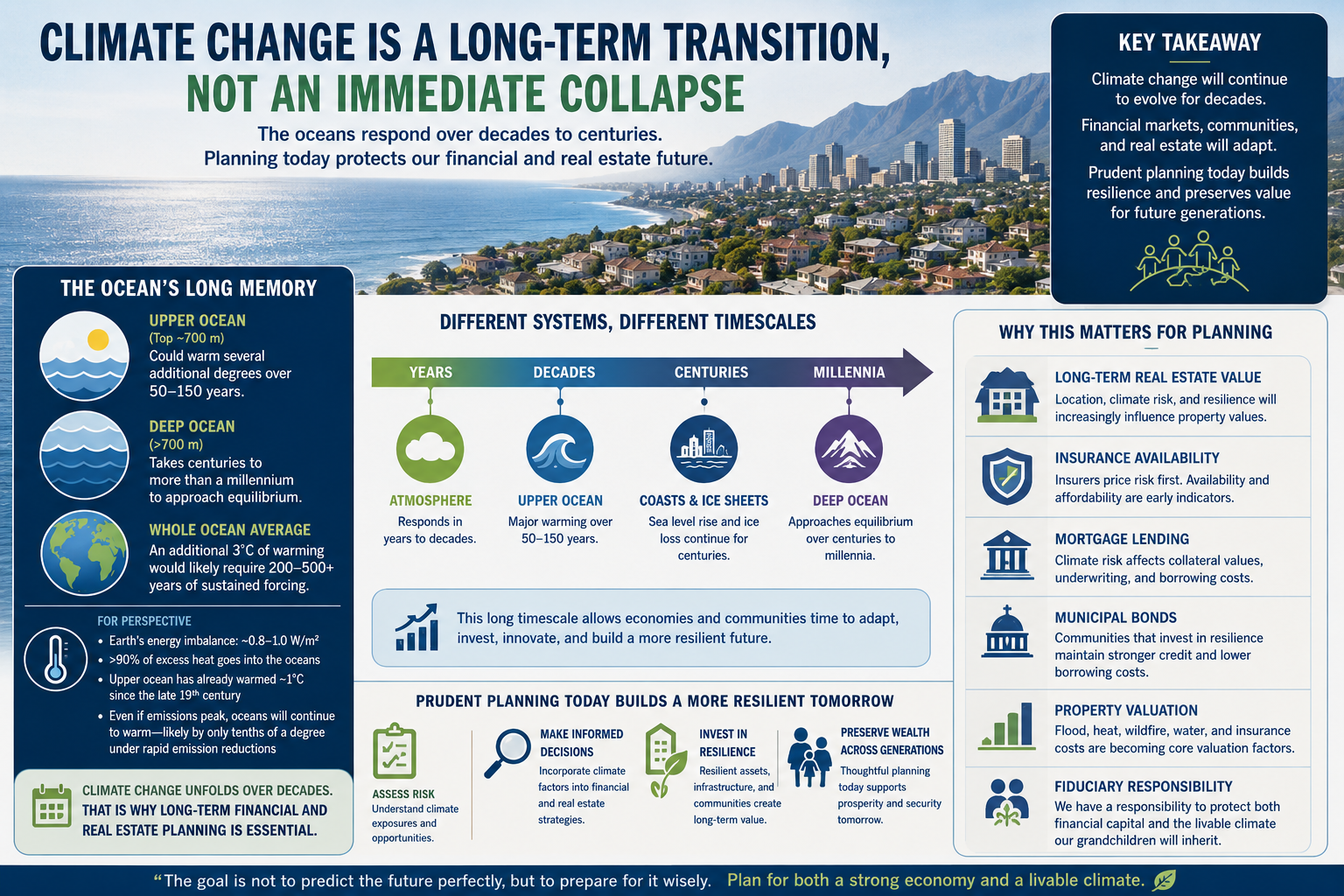
The Ocean’s Long Memory

If greenhouse gas concentrations remained near current levels long enough to maintain today’s radiative forcing, it would likely take many decades to centuries for the global ocean to warm by an additional 3°C.

Current scientific understanding suggests:

  • The upper ocean (roughly the top 700 meters) could warm several additional degrees over approximately 50–150 years.
  • The deep ocean requires centuries to more than a millennium to approach equilibrium.
  • The global ocean average would likely require several centuries of sustained forcing to warm another 3°C.

More than 90% of Earth’s excess heat enters the oceans, giving the climate system enormous momentum.

Even if atmospheric temperatures stabilize, sea level rise, marine heat waves, glacier retreat, and many coastal impacts continue because the oceans continue redistributing heat.

Climate change therefore behaves less like flipping a switch and more like steering an aircraft carrier. Once underway, changes continue for decades.


Why This Does Not Mean Immediate Economic Collapse

The nonlinear acceleration of climate change does not imply that modern economies disappear within a few years.

Economic systems continually adapt.

History demonstrates remarkable resilience through world wars, financial crises, pandemics, technological revolutions, and natural disasters. Markets evolve. Capital reallocates. Infrastructure is rebuilt. New technologies emerge.

Climate change represents another major structural transformation—not an instantaneous end to economic activity.

The greater risk is a gradual degradation of living standards if adaptation is delayed.


Financial Markets Price Risk—They Do Not Ignore It

Financial markets constantly evaluate future expectations.

Investors already incorporate:

  • Inflation
  • Interest rates
  • Technological disruption
  • Demographics
  • Political risk
  • Corporate earnings

Climate risk is becoming another measurable input.

Rather than causing markets to cease functioning, climate change increasingly changes how capital is allocated.

Investment flows are likely to favor:

  • Resilient infrastructure
  • Water management
  • Energy efficiency
  • Distributed power systems
  • Climate-resilient agriculture
  • Advanced building technologies
  • Adaptation engineering

Markets rarely stop functioning.

They reprice risk.


Mortgage Lending in a Changing Climate

Mortgage lending has always depended upon one fundamental assumption:

The collateral will retain value over the life of the loan.

Most residential mortgages extend 15 to 30 years.

Commercial financing often spans decades.

Those time horizons now overlap directly with accelerating climate risks.

Lenders are increasingly evaluating:

  • Flood exposure
  • Wildfire probability
  • Coastal erosion
  • Extreme heat
  • Water availability
  • Infrastructure resilience
  • Local adaptation policies

Climate risk is becoming credit risk.

Properties with increasing exposure may experience:

  • Higher insurance costs
  • Larger reserve requirements
  • Lower loan-to-value ratios
  • Increased underwriting scrutiny
  • Higher borrowing costs

Conversely, resilient communities with strong infrastructure may receive more favorable financing because they present lower long-term risk.

Climate-informed lending is simply modern risk management.


Insurance Availability May Become the First Market Signal

Insurance companies often detect climate risk before property markets do.

Unlike homeowners, insurers continuously update catastrophe models using the latest observations and loss data.

When risks increase, insurers respond by:

  • Raising premiums
  • Increasing deductibles
  • Restricting coverage
  • Reducing policy limits
  • Withdrawing from selected markets

Recent developments in wildfire-prone states, hurricane-exposed coastlines, and hail-prone regions illustrate this trend.

In many communities, insurance affordability—not property damage itself—may become the first significant economic consequence of climate change.

Without affordable insurance:

  • Mortgage financing becomes more difficult.
  • Homeownership becomes more expensive.
  • Property values may weaken.
  • Municipal tax bases can come under pressure.

Insurance increasingly serves as an early warning system for long-term climate risk.


Municipal Bonds and Local Government Finance

Climate resilience is increasingly becoming a municipal finance issue.

Cities and counties finance much of their infrastructure through municipal bonds.

Those bonds ultimately depend upon:

  • Stable tax revenues
  • Economic growth
  • Reliable infrastructure
  • Sustainable operating costs

As climate risks increase, municipalities may require additional investments in:

  • Flood control
  • Stormwater systems
  • Water supply
  • Cooling infrastructure
  • Grid modernization
  • Emergency services
  • Road and bridge resilience

Communities that invest proactively may maintain stronger credit quality over time.

Communities that defer adaptation could face rising maintenance costs, increasing insurance expenses, and pressure on their fiscal health.

For municipal investors, climate resilience increasingly becomes part of long-term credit analysis.


Property Valuation Is Becoming Dynamic

Historically, property valuation focused on:

  • Location
  • Schools
  • Transportation
  • Employment
  • Neighborhood quality

Climate is becoming another location characteristic.

Future valuation models will likely incorporate increasing amounts of climate-related information, including:

  • FEMA flood maps
  • Local flood history
  • Heat exposure
  • Wind risk
  • Wildfire potential
  • Water reliability
  • Insurance costs
  • Building resilience
  • Community adaptation investments

Properties will not simply gain or lose value because of climate change.

Rather, markets will increasingly differentiate between properties based on their long-term resilience.

The result is likely to be greater divergence between communities that prepare and those that do not.


Investment Implications

Because climate impacts unfold over decades, financial planning becomes more—not less—important.

Assuming there will be “no economy” several years from now is neither supported by economic history nor by climate science.

Instead, investors should recognize that long-term wealth preservation increasingly depends upon understanding long-term environmental risk.

That includes:

  • Diversified investment portfolios.
  • Climate-informed real estate decisions.
  • Appropriate insurance coverage.
  • Infrastructure resilience.
  • Geographic diversification.
  • Long-term retirement planning.

Planning remains one of the strongest tools available for reducing future financial risk.


Fiduciary Responsibility Across Generations

Every generation inherits assets built by those before it.

Likewise, every generation passes assets forward.

That fiduciary responsibility extends beyond investment portfolios.

It includes:

  • Homes.
  • Communities.
  • Infrastructure.
  • Businesses.
  • Natural resources.
  • Financial systems.

Protecting both environmental and financial capital is not a contradiction.

It is prudent stewardship.

Planning for climate risk is no different than planning for inflation, demographic change, technological disruption, or changing interest rates.

Responsible investors prepare for foreseeable risks rather than assuming those risks either do not exist or will immediately end the economic system.


Conclusion

Climate science indicates that many impacts will continue evolving over decades because Earth’s oceans absorb and release heat slowly.

That long timescale does not support predictions of imminent economic collapse.

Instead, it points toward an extended period during which markets continuously adapt by repricing risk, directing capital toward resilience, and rewarding long-term planning.

For homeowners, investors, lenders, insurers, businesses, and governments, the challenge is not deciding whether there will be an economy.

The challenge is helping shape an economy that is both financially resilient and environmentally sustainable.

The goal is not simply to leave future generations a larger investment portfolio.

It is to leave them both a livable climate and an economy capable of supporting opportunity for decades to come.

bookmark_borderMicrobursts, Extreme Energy Events, and a Warming Climate

by Daniel Brouse

When the Sky Suddenly Explodes

On July 11, 2026, four distinct microbursts struck the Philadelphia region simultaneously. Wind gusts approaching 70 mph and torrential downpours ripped roofs from buildings, caused structural collapses, toppled trees, and brought down power lines across the area.

Microbursts develop rapidly and are notoriously difficult to predict. Because they can strike with little or no warning, meteorologists stress that a Severe Thunderstorm Warning should be treated with the same urgency as a Tornado Warning.


What Is a Microburst?

A microburst is a sudden, intense downdraft of air within a thunderstorm that plunges toward the ground and then spreads outward violently in all directions.

Although these events typically last only 5 to 15 minutes and usually affect an area less than 2.5 miles (4 km) wide, they can produce straight-line winds exceeding 100 mph (160 km/h)—strong enough to cause damage comparable to an EF-1 tornado.


How a Microburst Forms

1. Suspension

A powerful thunderstorm updraft lifts and suspends a massive core of rain and hail high within the storm.

2. Evaporative Cooling

Dry air enters the storm, causing raindrops to evaporate. Evaporation rapidly cools the surrounding air, making it denser and heavier.

3. Collapse

The storm’s updraft weakens and can no longer support the heavy precipitation core and the increasingly dense, chilled air.

4. Impact

The entire mass plunges toward Earth like an atmospheric water balloon. Upon reaching the ground, the air has nowhere to go except outward, exploding horizontally and generating destructive straight-line winds.

       [ Thunderstorm Cloud ]
          /      |      \
         /   DOWNDRAFT   \
        v       |        v
                |
================|================
<-- WIND   IMPACT   WIND -->
      Explodes outward

Types of Microbursts

Wet Microbursts

Wet microbursts are accompanied by blinding rainfall, torrential downpours, and flash flooding. They are particularly common during hot, humid summer conditions.

Dry Microbursts

Dry microbursts occur when precipitation evaporates before reaching the ground. Little or no rain is observed, leaving behind what can seem like an invisible explosion of wind.


Microburst vs. Tornado

FeatureMicroburstTornado
Wind MovementStraight-line winds spreading outwardRotational winds spiraling inward and upward
Damage PatternDebris falls in one direction or fans outwardDebris is twisted, swirled, and chaotic
Size & DurationUsually under 2.5 miles wide and lasts 5–15 minutesVarying widths; can track for miles and last over an hour

Climate Change and Microbursts

Climate change is expected to increase both the frequency and intensity of microbursts by altering the amount of energy and moisture available in the atmosphere.

Because microbursts are highly localized events, they are difficult to isolate within traditional global climate models. However, advances in atmospheric physics, high-resolution modeling, and machine-learning analyses increasingly indicate that a warming climate is creating environments more favorable for severe thunderstorm downbursts.

1. The 7% Moisture Rule: More Fuel for Storms

For every 1°C (1.8°F) of warming, the atmosphere can hold approximately 7% more water vapor.

The Impact:
This additional moisture acts as high-octane fuel for thunderstorms, allowing larger precipitation cores to develop. When these heavier cores collapse, they can generate faster and more powerful downdrafts.

2. Rising DCAPE: More Kinetic Energy

Meteorologists use Downdraft Convective Available Potential Energy (DCAPE) to estimate the potential strength of descending air within a storm.

The Impact:
Climate simulations project increases in average DCAPE across many regions under continued greenhouse warming. Higher DCAPE generally translates into stronger descending air and potentially higher straight-line wind speeds.

3. Enhanced Evaporative Cooling

In many regions, warming temperatures create hotter and sometimes drier layers of air beneath thunderstorms.

The Impact:
As rain falls into these dry layers, evaporation accelerates. The resulting rapid cooling creates exceptionally dense air that sinks at high speed, intensifying both wet and dry microbursts.

4. Seasonal and Geographic Shifts

The atmospheric ingredients that favor severe thunderstorm winds are changing geographically and seasonally.

The Impact:
Research suggests that environments conducive to severe downbursts are shifting poleward, exposing regions farther north to increased risks during seasons when microbursts were historically less common.


Microbursts as Extreme Energy Events

At their core, microbursts are extreme energy events.

Climate change represents an imbalance in Earth’s energy system. As the atmosphere and oceans accumulate additional heat, more energy becomes available to power thunderstorms and other forms of extreme weather.

The destructive potential of wind is highly nonlinear. Kinetic energy increases with the square of wind speed, meaning relatively small increases in velocity can produce disproportionately larger impacts. Consequently, modest increases in storm intensity can translate into dramatically greater damage to homes, infrastructure, forests, and electrical systems.

Microbursts are one example of how additional energy in the climate system can manifest as sudden, localized, and highly destructive weather extremes.


Growing Risks to Aviation and Infrastructure

Microbursts remain among the most dangerous weather phenomena for aviation. A sudden downburst can rapidly alter an aircraft’s airspeed and lift during takeoff or landing, creating life-threatening conditions within seconds.

At the same time, stronger straight-line winds pose increasing challenges for power grids, transportation networks, communication systems, and urban infrastructure.

As the climate system continues to warm, understanding and preparing for these rapidly developing extreme energy events will become increasingly important for both public safety and infrastructure resilience.

Conclusion: More Energy, More Extreme Outcomes

Microbursts illustrate a fundamental principle of climate physics: a warmer world is a more energetic world. As greenhouse gases trap additional heat, the atmosphere holds more moisture, stores more potential energy, and increasingly creates conditions favorable for powerful convective storms.

Not every thunderstorm will produce a microburst, and climate change does not cause any single event in isolation. However, the underlying environmental ingredients that fuel severe downbursts—greater atmospheric moisture, enhanced instability, stronger evaporative cooling, and shifting storm environments—are becoming more favorable in many regions.

Because the relationship between energy and damage is nonlinear, relatively modest increases in storm intensity can lead to disproportionately larger consequences. A short-lived microburst can transform an ordinary summer storm into a destructive event capable of flattening trees, crippling power infrastructure, and threatening lives within minutes.

Microbursts therefore serve as a reminder that climate change is not simply a story of gradually rising temperatures. It is also a story of how additional energy in Earth’s system increasingly manifests through sudden, concentrated, and extreme weather events. Understanding these processes is essential for improving forecasting, strengthening infrastructure resilience, and adapting to a climate system that is becoming progressively more volatile and energetic.

bookmark_borderDenialism and Ecofascism

Complex social-ecological feedback loops arise when human systems and natural systems react to climate change in ways that amplify one another. Because Earth’s climate operates as a nonlinear system, these interactions do not unfold gradually — they can accelerate suddenly, compound unpredictably, and push the system toward irreversible shifts.

This nonlinear, cross-regional feedback behavior is something we have been modeling for decades — where climate physics couples directly with economic networks.

In the 1990s we underestimated one variable: human delay. We assumed mitigation would begin in earnest. It did not.

Now we observe potential doubling in the intensity or frequency of certain climate impacts on timescales of 2–10 years rather than centuries. The apparent acceleration has compressed from millennial-scale shifts to multi-decade nonlinear surges.

Denialism and Ecofascism

One factor we drastically underestimated was the influence of organized denialism and emerging ecofascist ideology.

Initially the investigation focused on a straightforward institutional question:

Were challenges to the EPA’s Endangerment Finding and coordinated regulatory rollbacks primarily driven by economic motives — specifically the fossil-fuel industry’s long-documented strategy of financing climate denial narratives?

Organizations such as the CO₂ Coalition and the Department of Energy’s Climate Working Group were key nodes of analysis. The economic motive was clear and well documented: protect fossil capital, delay regulation, and manufacture doubt.

But as correspondence, affiliations, and rhetoric were analyzed, a second pattern emerged.

This was not simply economic denialism. It was the normalization of ecofascist ideology.

Ecofascism reframes environmental collapse as beneficial — even desirable — if it reduces populations deemed inferior, excessive, or expendable. It merges environmental crisis with authoritarian hierarchy, racialized survival logic, and elite domination theory.

This is not speculation. It is visible in the language used by some elite circles revealed through the Epstein files.

Examples include statements attributed to Jeffrey Epstein such as:

  • “I liked the argument that more CO₂ is good for plants.”
  • “Maybe climate change is a good way of dealing with overpopulation — the Earth’s forest fire. Potentially a good thing for the species.”

Combined with statements reflecting explicit eugenic ideology:

  • “Executions of the elderly and infirm make sense.”
  • “African music has lots of beats and little development — no accident. It mirrors their learning process.”

This is not conventional policy disagreement. This is eliminationist logic.

Where traditional denial protects capital investment, ecofascism rationalizes unequal human survival.

bookmark_borderClimate Change: Emergency PSA

For the basics: Climate Change Simplified

* Our probabilistic, ensemble-based climate model — which incorporates complex socio-economic and ecological feedback loops within a dynamic, nonlinear system — projects that global temperatures are becoming unsustainable this century. This far exceeds earlier estimates of a 4°C rise over the next thousand years, highlighting a dramatic acceleration in global warming. We are now entering a phase of compound, cascading collapse, where climate, ecological, and societal systems destabilize through interlinked, self-reinforcing feedback loops.

We examine how human activities — such as deforestation, fossil fuel combustion, mass consumption, industrial agriculture, and land development — interact with ecological processes like thermal energy redistribution, carbon cycling, hydrological flow, biodiversity loss, and the spread of disease vectors. These interactions do not follow linear cause-and-effect patterns. Instead, they form complex, self-reinforcing feedback loops that can trigger rapid, system-wide transformations — often abruptly and without warning. Grasping these dynamics is crucial for accurately assessing global risks and developing effective strategies for long-term survival.

bookmark_borderClimate Change, Circadian Disruption, REM Sleep, and the Gut Microbiome

Climate Change Is Disrupting the Biology of Life

Climate change is not just changing the planet—it is changing us.

Extreme heat, shifting seasons, storms, and pollution are disrupting our circadian rhythms, damaging sleep, altering the gut microbiome, and destabilizing the gut-brain axis.

Protecting the climate means protecting the systems that keep us alive.

by Daniel Brouse

A Nonlinear Acceleration Pathway in Human Health

Introduction: Climate Change as a Biological Disruptor

One of the most significant and underappreciated health consequences of climate change is the disruption of human circadian rhythms through heat stress, seasonal disruption, and extreme weather events, triggering cascading feedback interactions among sleep, the gut microbiome, the gut-brain axis, immune function, and neurological health.

Climate change is not merely an increase in average temperature. It represents a system-wide environmental destabilization that alters the timing, intensity, and predictability of the natural signals that regulate human biology. The human circadian system evolved under relatively stable patterns of light, temperature, seasons, and environmental cycles. Rapid climate change is now disrupting these biological cues faster than human physiology can adapt.

The Nonlinear Climate Acceleration Hypothesis proposes that climate impacts increasingly emerge through interacting feedback loops rather than simple linear progression. Within the human body, climate-driven stressors can create similar accelerating feedback systems. Rising temperatures, shifting seasons, extreme weather events, and increasing environmental instability disrupt sleep and circadian regulation. Sleep disruption then damages metabolic, immune, and neurological systems, creating additional physiological stress that further reduces resilience.

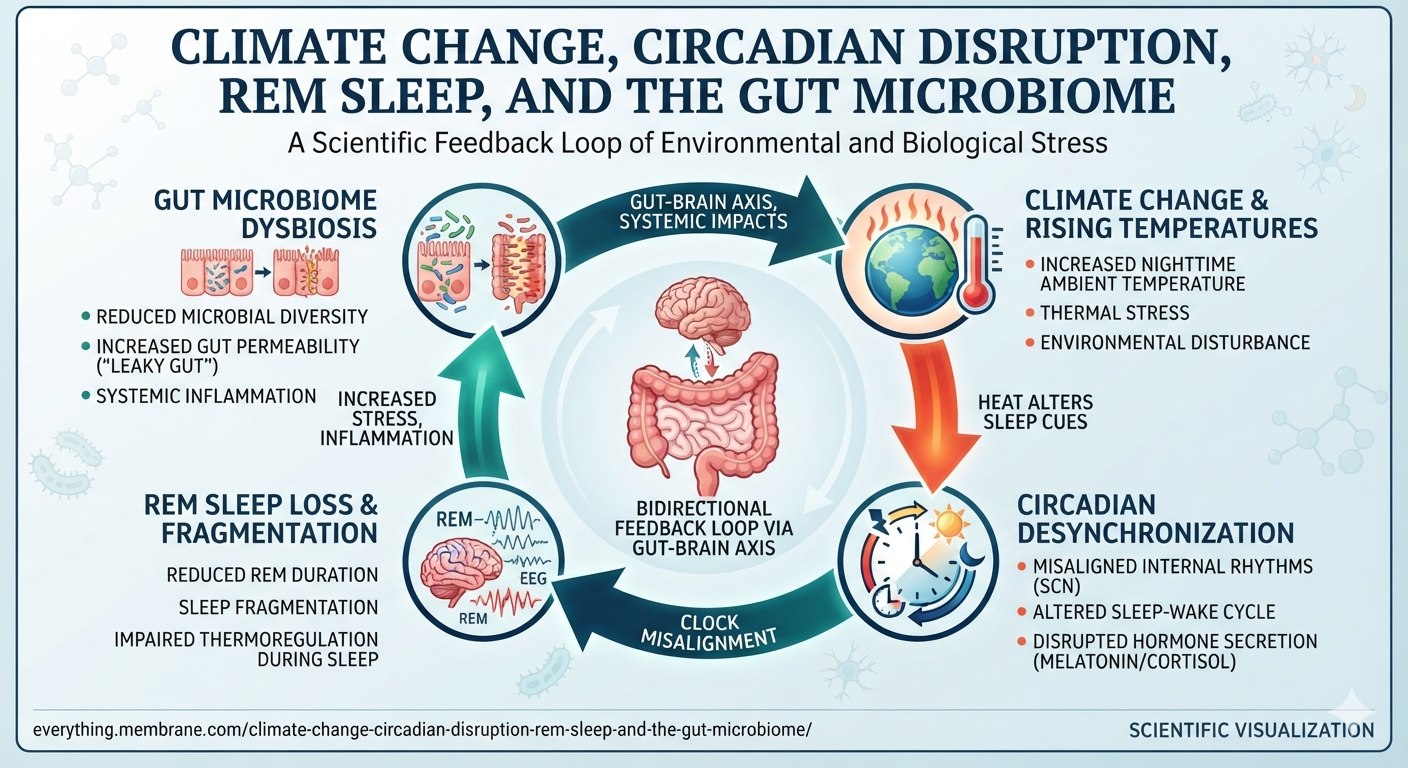
The result is a climate-driven biological feedback loop:

Climate Stress → Circadian Disruption → Sleep Loss → Gut Dysbiosis → Inflammation → Reduced Adaptation Capacity → Greater Vulnerability to Climate Stress


1. Climate Change Is Disrupting the Environmental Clock

Human biology is synchronized by environmental timing signals known as zeitgebers. The strongest of these are sunlight exposure, temperature cycles, seasonal changes, and predictable daily patterns. Climate change is altering each of these signals.

Rising Nighttime Temperatures and Sleep Loss

One of the most important climate-related sleep disruptions is the rapid increase in nighttime temperatures. Nighttime temperatures are rising faster than daytime temperatures in many regions, reducing the natural cooling period required for restorative sleep.

Human sleep initiation depends on a decline in core body temperature. During heatwaves, elevated nighttime temperatures prevent this cooling process, increasing nighttime awakenings and reducing both deep N3 slow-wave sleep and rapid eye movement (REM) sleep.

Even modest increases in nighttime temperature can produce measurable sleep losses, particularly among older adults, people without climate-controlled environments, and vulnerable populations.


2. Seasonal Disruption: The Loss of the Natural Biological Calendar

While increasing temperatures receive significant attention, the disruption of seasonal cycles represents another major but less recognized climate threat.

For thousands of years, human physiology adapted to predictable seasonal patterns:

  • Spring warming signaled increasing daylight and biological activation.
  • Summer conditions established metabolic and reproductive rhythms.
  • Autumn cooling prepared the body for seasonal transitions.
  • Winter conditions reinforced changes in sleep duration, hormones, and energy regulation.

Climate change is now altering this biological calendar.

Expanding Warm Seasons

Warmer conditions are extending the length of spring and delaying the onset of autumn. In many regions, growing seasons have expanded by weeks on both ends, creating longer periods of heat exposure and reduced seasonal cooling.

This seasonal compression disrupts:

  • Melatonin timing
  • Hormonal cycles
  • Immune seasonality
  • Metabolic regulation
  • Sleep duration patterns

The circadian system does not only operate on a 24-hour cycle. Humans also possess annual biological rhythms that respond to seasonal changes in temperature and daylight. Rapid seasonal shifts create a form of biological “seasonal jet lag,” where internal timing becomes increasingly misaligned with environmental conditions.


3. Extreme Weather Events as Sleep Disruptors

Climate change is also increasing the frequency and intensity of extreme weather events that directly interfere with human sleep.

Severe Storms and Atmospheric Disturbances

More intense storms create multiple pathways for sleep disruption:

  • Increased nighttime noise from wind, rain, and flooding
  • Power outages that eliminate cooling systems
  • Emergency alerts and disaster preparation
  • Displacement from damaged homes
  • Chronic stress after repeated extreme events

Floods, hurricanes, tornadoes, and severe thunderstorms can create prolonged periods of psychological stress that activate the sympathetic nervous system and disrupt normal sleep architecture.

Wildfire Smoke and Air Quality

Increasing wildfire activity introduces another sleep-related climate stressor.

Smoke exposure can:

  • Irritate airways
  • Increase nighttime coughing
  • Reduce oxygen exchange efficiency
  • Increase systemic inflammation

Poor air quality often forces people indoors with reduced ventilation, altered routines, and additional psychological stress.

Drought and Heat Stress

Drought increases heat exposure, reduces nighttime cooling through vegetation loss, and contributes to prolonged periods of environmental stress. Agricultural and economic impacts also increase anxiety and chronic stress, further impairing sleep.


4. The Climate-Sleep-Gut Feedback Loop

Climate-driven environmental instability disrupts the microbiota-gut-brain axis, creating a self-amplifying biological cascade.

Climate-Induced Heat Stress + Seasonal Disruption + Extreme Weather Stress
→ Circadian Disruption
→ REM & Deep Sleep Depletion
→ Elevated Cortisol & HPA Activation
→ Intestinal Permeability ("Leaky Gut")
→ Gut Microbiome Dysbiosis
→ Reduced Neurotransmitter Production (Serotonin, GABA, SCFAs)
→ Further Circadian Disruption
→ ... Amplify and Repeat...

This represents a biological example of nonlinear acceleration: multiple stressors interact and amplify each other rather than producing independent effects.


5. Sleep Loss Accelerates Gut Microbiome Breakdown

Thermal stress, storm-related anxiety, and circadian disruption reduce restorative sleep. Loss of REM and deep sleep activates the hypothalamic-pituitary-adrenal (HPA) axis, increasing cortisol levels.

Chronic cortisol elevation:

  • Increases systemic inflammation
  • Alters intestinal microbial diversity
  • Reduces beneficial bacterial populations
  • Weakens intestinal barrier function

Because gut bacteria themselves follow circadian rhythms, disrupted sleep directly alters microbial activity and metabolism.


6. Heat Stress and Intestinal Permeability

During extreme heat, the body redirects blood flow toward the skin to support cooling. This reduces blood flow available to internal organs, including the gastrointestinal tract.

Reduced intestinal circulation can weaken the epithelial barrier, increasing intestinal permeability.

The result is:

Heat Stress → Reduced Gut Barrier Integrity → Increased Inflammatory Molecules in Bloodstream → Systemic Inflammation

This inflammatory state further damages sleep quality and neurological regulation.


7. Gut Dysbiosis Disrupts Sleep Chemistry

A healthy microbiome produces compounds essential for neurological balance and sleep regulation.

Short-Chain Fatty Acids (SCFAs)

Beneficial bacteria produce SCFAs such as butyrate, which support:

  • Intestinal integrity
  • Reduced inflammation
  • Brain health
  • Sleep regulation

Serotonin and GABA

Microbes including Lactobacillus and Bifidobacterium contribute to pathways involved in producing:

  • Gamma-aminobutyric acid (GABA), which promotes relaxation and sleep initiation
  • Serotonin, much of which is produced in the gut and serves as a precursor to melatonin

Tryptophan Pathway Disruption

Gut dysbiosis alters tryptophan metabolism, reducing the availability of compounds needed for serotonin and melatonin production.

The result is another reinforcing cycle:

Climate Stress → Poor Sleep → Gut Dysfunction → Reduced Sleep Chemistry → Worse Sleep


8. Compounding Health Consequences

Health SystemClimate-Sleep-Gut MechanismPotential Outcomes
MetabolicLoss of microbial rhythms and impaired glucose regulationObesity, insulin resistance, Type 2 diabetes
ImmuneIncreased gut permeability and chronic inflammationAutoimmune dysfunction, inflammatory disease
NeurologicalReduced REM sleep and neurotransmitter disruptionAnxiety, depression, cognitive decline
CardiovascularElevated cortisol and chronic stress responseHypertension, cardiovascular disease
PsychologicalRepeated disasters and climate anxietyChronic stress, reduced resilience

9. Mitigating the Climate-Circadian Threat

Maintain Thermal Sleep Conditions

During heat events, maintain cooler sleeping environments using:

  • Air conditioning
  • Fans
  • Cooling mattresses
  • Improved ventilation

A cooler bedroom supports natural nighttime temperature decline.

Restore Circadian Anchors

Strengthen biological timing through:

  • Morning sunlight exposure
  • Consistent sleep schedules
  • Reduced nighttime artificial light exposure

Support the Microbiome

Promote microbial diversity through:

  • High-fiber diets
  • Diverse plant foods
  • Fermented foods
  • Adequate hydration

Stabilize Meal Timing

Time-restricted eating can reinforce peripheral circadian clocks in the liver and gut, helping compensate for environmental disruption.


Conclusion: Climate Change as a Nonlinear Biological Accelerator

Climate change is increasingly affecting human health through pathways that extend far beyond direct heat exposure. By altering temperatures, seasonal cycles, storm patterns, air quality, and environmental predictability, climate instability is disrupting the biological timing systems that regulate human physiology. These disruptions affect not only sleep and circadian rhythms, but also the interconnected networks linking the brain, immune system, metabolism, and the gut microbiome.

The interaction between circadian disruption, REM sleep loss, microbiome deterioration, and impairment of the gut-brain axis represents a self-reinforcing biological feedback system consistent with the principles of the Nonlinear Climate Acceleration Hypothesis. Disrupted sleep can alter microbial diversity and intestinal permeability, while changes in the gut microbiome can influence inflammation, stress regulation, cognition, and neurological function through the gut-brain axis. Together, these processes create cascading effects that may amplify the physiological burden of climate stress.

As climate instability increases, these biological disruptions may not progress in a simple linear manner. Instead, interacting stressors—including extreme heat, seasonal disruption, severe storms, air pollution, and chronic environmental uncertainty—may accelerate one another, progressively reducing human resilience and increasing vulnerability to chronic disease.

A critical concern is the emergence of a biological tipping cascade, in which multiple interconnected systems begin to amplify one another beyond their ability to self-correct. Persistent climate-driven circadian disruption can impair sleep quality, weaken immune regulation, alter the gut microbiome, and destabilize the gut-brain axis. These changes can increase inflammation, stress hormone activation, and neurological vulnerability, creating feedback loops that further reduce the capacity of the human body to adapt. Much like tipping dynamics observed in Earth systems, biological systems may not fail through a single catastrophic event but through the accumulation and interaction of multiple smaller disruptions that collectively push the system toward a less resilient state.

Climate change is therefore not only an environmental crisis or a climate system disruption—it is increasingly becoming a biological timing crisis. By interfering with the rhythms that synchronize human physiology with the natural world, climate change threatens the delicate regulatory systems that allow humans to sleep, heal, adapt, and maintain health. Understanding these nonlinear interactions is essential because protecting climate stability is also a means of protecting the biological systems that sustain human resilience.