by Daniel Brouse
Introduction: The Hidden Connections Driving Climate Change
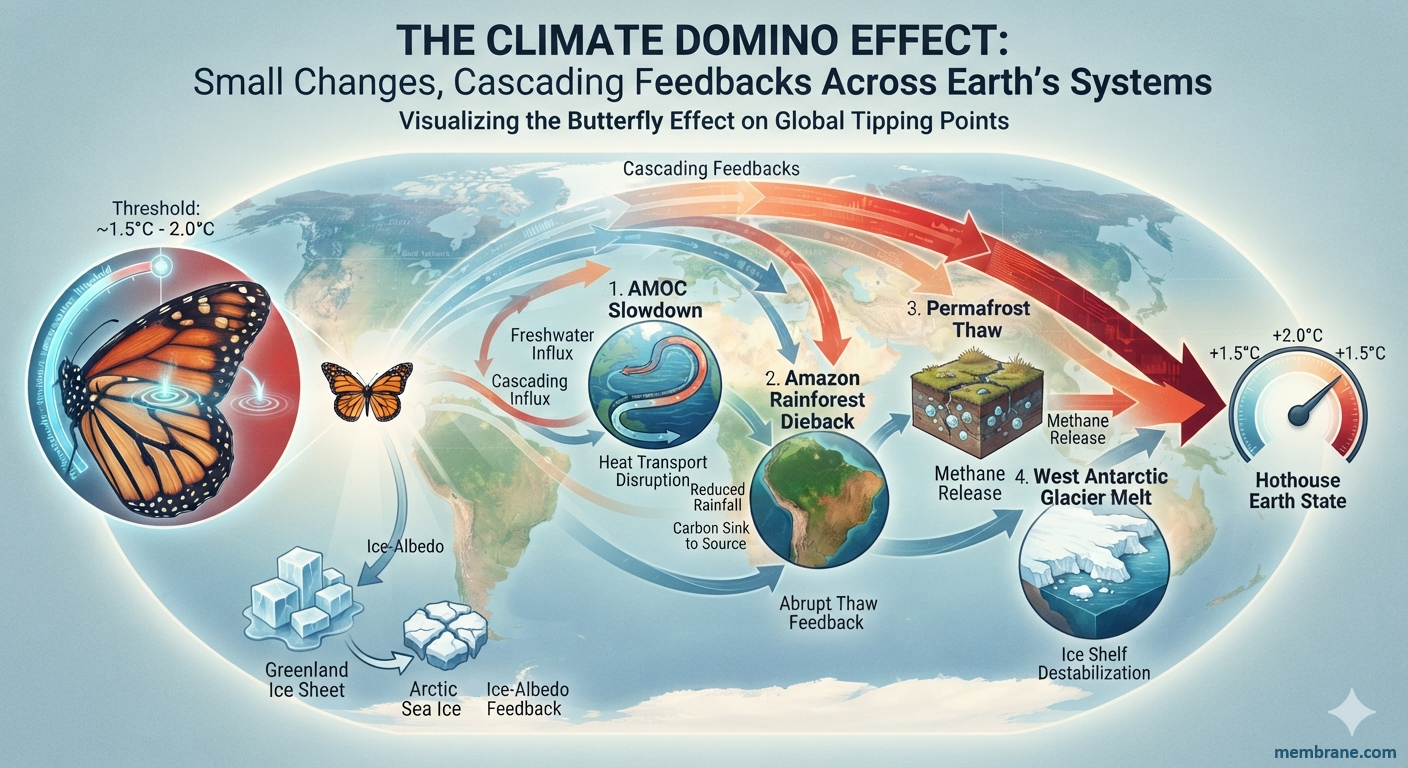
Climate change is not a simple chain of cause and effect. The Earth operates as a connected system where changes in one part of the planet can trigger responses in many others. These emerging coupled feedback interactions demonstrate a fundamental principle of nonlinear systems: a small initial change can spread through multiple connected processes and produce a response much larger than the original disturbance. This is the climate version of the Butterfly Effect.
Climate feedbacks do not operate independently. Instead, they interact as a vast network linking the atmosphere, oceans, ice sheets, forests, soils, and ecosystems. When one feedback strengthens another, the combined effect can become greater than the sum of the individual parts. This is why climate change can sometimes accelerate faster than expected and why predicting future changes is so challenging.
From Individual Feedbacks to Climate Cascades
A traditional climate feedback is often described as a single process:
- warming melts ice,
- melting ice reduces reflectivity,
- reduced reflectivity causes more warming.
However, the real climate system is more complex. One feedback can activate several others, creating a chain reaction across different parts of the planet.
These connected processes are called coupled feedback interactions. They occur when multiple feedbacks reinforce one another, creating cascading effects that cannot be understood by studying each process separately.
Wildfires: From Local Fires to Global Feedbacks
A powerful example begins with heat and drought.
As temperatures rise and soils dry, forests become more vulnerable to large wildfires. These fires release carbon dioxide stored in trees and soils, adding more greenhouse gases to the atmosphere. They also produce black carbon, or soot, which can travel long distances and settle on snow, glaciers, and Arctic sea ice.
Darkened ice and snow absorb more sunlight than clean, reflective surfaces. This increases melting, exposes darker land and ocean surfaces, and allows even more solar energy to be absorbed.
At the same time, burned forests lose their ability to remove carbon dioxide from the atmosphere. A regional drought can therefore trigger a chain of connected responses involving the atmosphere, forests, ice, and oceans.
A single wildfire can become part of a much larger climate feedback network.
Arctic Permafrost: The Sleeping Carbon Reservoir
The Arctic contains enormous amounts of carbon stored in frozen soils known as permafrost. As the Arctic warms, this frozen ground begins to thaw.
When permafrost melts:
- microorganisms break down ancient organic material,
- carbon dioxide and methane are released,
- additional greenhouse gases enter the atmosphere,
- warming increases further.
Thawing permafrost can also create thermokarst lakes—collapsed areas filled with water. These lakes absorb heat more efficiently than frozen ground, accelerating nearby thaw.
Another unusual example is the rise of zombie fires. These underground fires can continue burning beneath snow throughout the winter, then reappear during warmer seasons. They release carbon, damage vegetation, and accelerate the loss of the insulating layers that protect permafrost.
Together, permafrost thaw, methane release, thermokarst lakes, and zombie fires form a connected Arctic amplification system.
Greenland Ice Algae: When Life Darkens Ice
Greenland provides one of the most surprising examples of a biological climate feedback.
As temperatures rise, more snow and ice melt during summer. This exposes surfaces where microscopic algae can grow. These algae contain dark pigments that reduce the brightness of the ice.
Normally, bright ice reflects sunlight back into space. Darker ice absorbs more solar energy.
The result:
melting ice → more algae growth → darker ice → more solar absorption → faster melting
As melting increases, more liquid water becomes available, creating conditions that can support additional algal growth. A biological process becomes directly connected to the physical loss of an ice sheet.
Oceans and the Atmosphere: A Heat and Moisture Engine
The oceans absorb most of the excess heat trapped by greenhouse gases. As ocean temperatures rise, evaporation increases, adding more water vapor to the atmosphere.
Water vapor is itself a greenhouse gas, creating additional warming.
A warmer ocean and atmosphere can contribute to:
- stronger atmospheric rivers,
- heavier rainfall events,
- more intense tropical storms,
- longer-lasting marine heatwaves.
At the same time, warmer oceans can become less effective at absorbing carbon dioxide. Marine heatwaves can also damage ecosystems such as kelp forests and phytoplankton communities that help remove carbon from the atmosphere.
The ocean, atmosphere, and biosphere therefore form a tightly connected climate system.
Vegetation Changes: The Arctic Landscape Transforms
Climate change can also reshape ecosystems in ways that amplify warming.
As Arctic temperatures increase, shrubs expand into areas that were previously dominated by low vegetation. These darker shrubs absorb more sunlight than snow-covered tundra.
Shrubs also trap more snow during winter. Deeper snow acts like a blanket, keeping the ground warmer and accelerating permafrost thaw.
A similar process occurs in forests. Warmer winters allow pests such as bark beetles to survive in greater numbers. Large areas of weakened forest can then become vulnerable to wildfire, releasing more carbon and reducing future carbon storage.
The Bigger Picture: Earth as a Connected System
These examples reveal an important shift in how we understand climate change.
The Earth system is not simply a collection of separate feedback loops. It is a network of interacting systems where changes in one area can activate responses elsewhere.
A warming ocean can influence the atmosphere.
A wildfire can influence ice melt.
Melting ice can influence ecosystems.
Changing ecosystems can influence greenhouse gases.
These connections create climate cascades—chains of interacting processes that can amplify change throughout the planet.
The future of climate change will depend not only on the amount of greenhouse gases added to the atmosphere, but also on how these interconnected feedbacks evolve, interact, and influence one another.
Understanding these hidden connections is essential for understanding why climate change is not just warming—it is a rapidly evolving Earth system response.