by Daniel Brouse
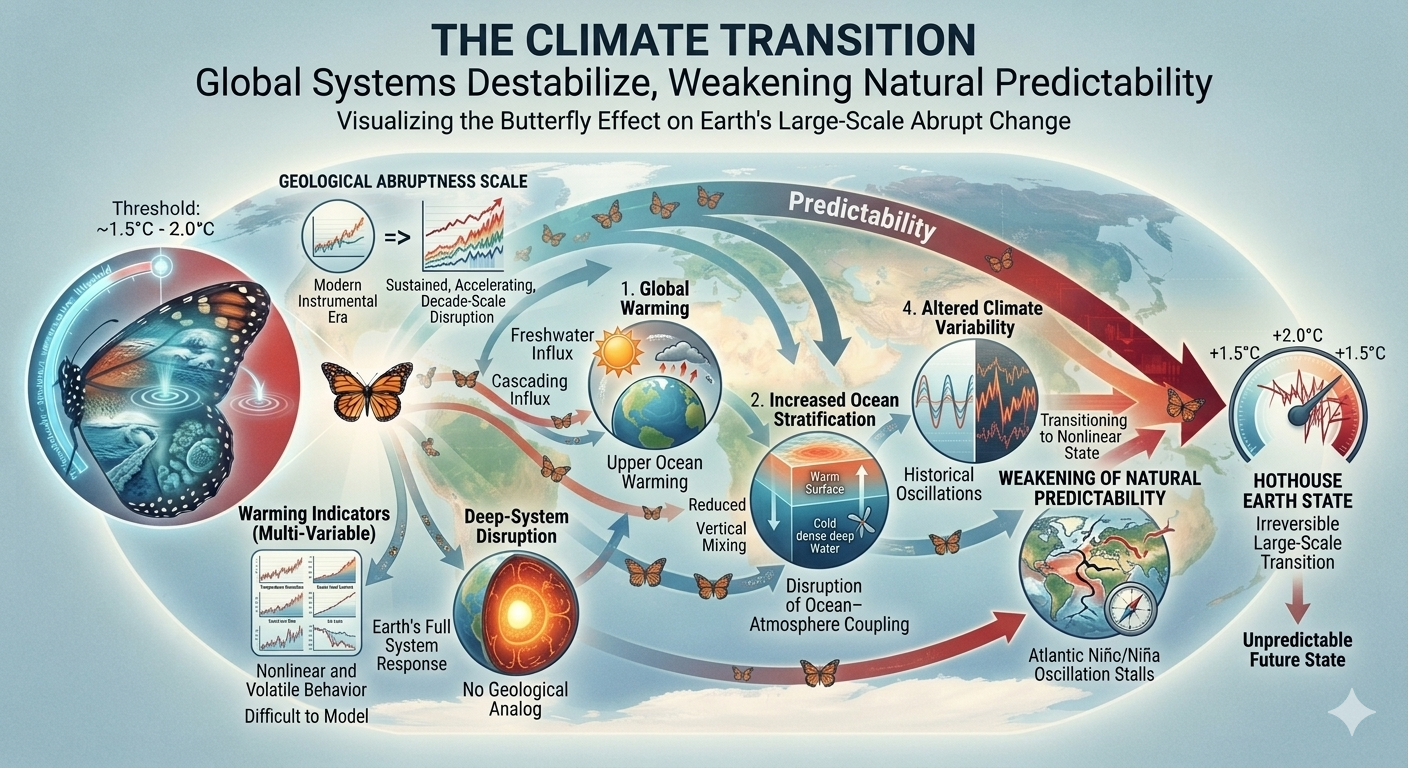
Multiple climate indicators now point to rates of warming-related disruption far beyond those observed during the modern instrumental era. There is no well-established geological analog for a sustained, multi-variable, decade-scale pattern of accelerating change across the full Earth system at the resolution available in contemporary observations. If sustained, this may represent one of the most abrupt large-scale climate transitions in Earth’s geological history.
Many of the climate indicators traditionally used for forecasting are exhibiting increasingly nonlinear and volatile behavior. Temperature anomalies, ocean heat content, sea-level rise, atmospheric moisture, ice loss, and extreme weather patterns are showing changes that are becoming more difficult to model using assumptions based primarily on historical variability.
Abstract
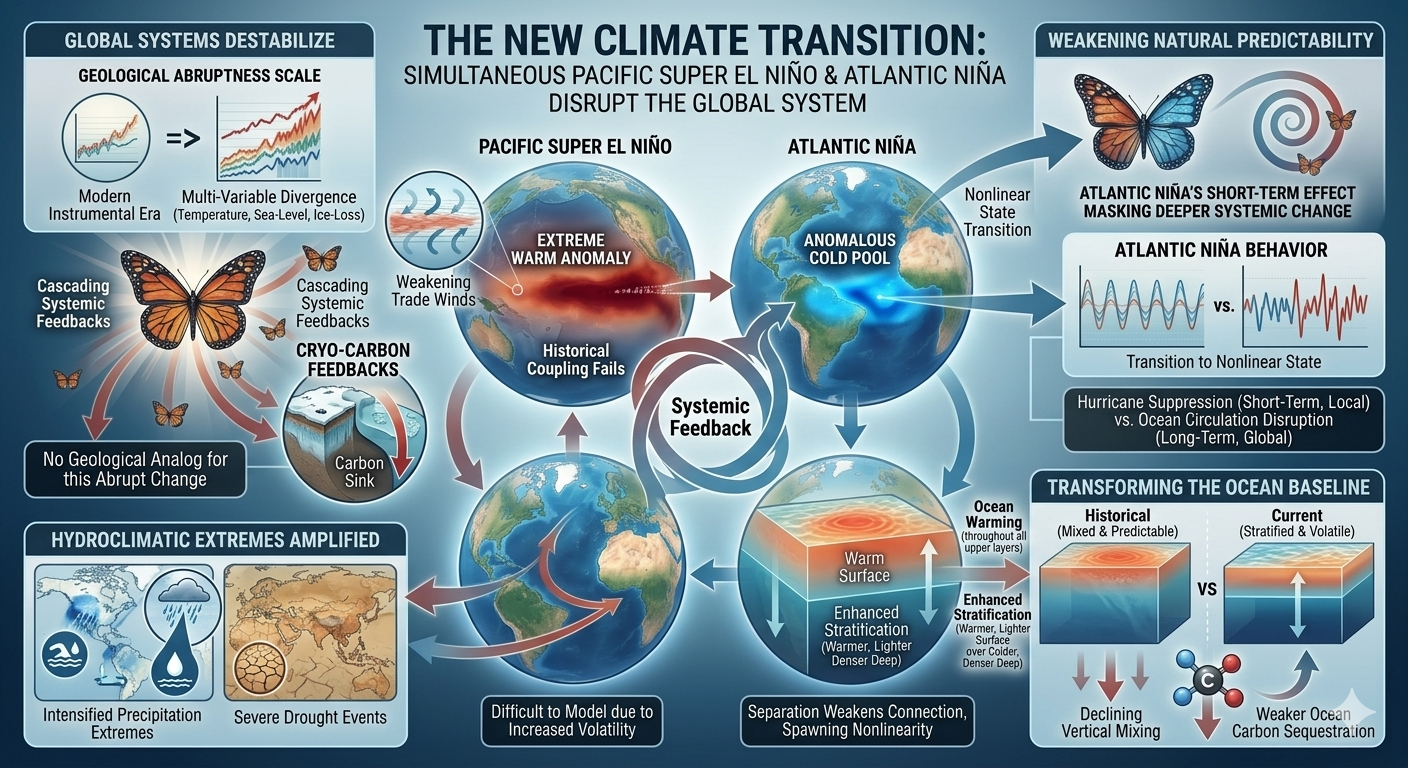
The simultaneous occurrence of an extreme Pacific Super El Niño and an anomalous Atlantic Niña represents a significant disruption of historically observed ocean–atmosphere interactions. These coupled climate anomalies illustrate how anthropogenic warming is altering the baseline state of Earth’s climate system, reducing predictability, amplifying hydroclimatic extremes, and accelerating interconnected feedback mechanisms. While an Atlantic Niña pattern may temporarily suppress Atlantic hurricane activity through increased atmospheric stability and wind shear, this short-term effect masks deeper systemic changes occurring within global ocean circulation, carbon cycling, and energy redistribution.
Climate change is increasingly modifying the physical conditions under which natural climate oscillations such as El Niño–Southern Oscillation (ENSO) and Atlantic Niño variability operate. Warmer ocean surfaces, enhanced stratification, declining vertical mixing, and changing circulation patterns are transforming previously stable climate relationships into increasingly nonlinear and difficult-to-predict interactions. These changes threaten to intensify global precipitation extremes, weaken ocean carbon sequestration, and accelerate reinforcing feedback loops involving greenhouse gas emissions, ocean warming, and cryosphere loss.
1. Introduction: A Changing Climate Baseline
Earth’s climate system is governed by complex interactions between the atmosphere, oceans, cryosphere, and biosphere. Natural climate oscillations, including Pacific El Niño events and Atlantic Niño/Niña variability, have historically provided a degree of predictability by influencing global temperature patterns, rainfall distributions, and storm activity.
However, climate change is altering the fundamental conditions under which these oscillations occur. The emergence of an extreme Pacific Super El Niño coinciding with an Atlantic Niña demonstrates a growing departure from historical climate behavior. Rather than acting as isolated events, these anomalies increasingly interact within a warmer planetary system, producing nonlinear responses that amplify regional and global impacts.
The key concern is not the individual climate pattern itself, but the changing background state in which these patterns develop.
2. Weakening of Natural Climate Predictability
2.1 Disruption of Ocean–Atmosphere Coupling
The Atlantic Niño/Niña cycle depends on interactions between surface ocean temperatures, subsurface heat content, atmospheric circulation, and equatorial wind patterns. Under historical conditions, these interactions produced recognizable oscillations that contributed to seasonal climate predictability.
Global warming is now modifying this relationship.
As greenhouse gas accumulation increases ocean heat content, warming is occurring throughout the upper ocean layers. This enhanced surface warming increases ocean stratification—the separation between warmer, lighter surface water and colder, denser deep water.
The result is a reduction in vertical ocean mixing:Ocean Warming→Increased Stratification→Reduced Vertical Mixing→Altered Climate Variability
This separation weakens the connection between surface conditions and deeper ocean processes, making climate oscillations more irregular and reducing the reliability of historical forecasting models.
The Atlantic Niño/Niña system is therefore transitioning from a relatively predictable oscillatory behavior toward a more complex, nonlinear state influenced by persistent anthropogenic forcing.
3. Global Redistribution of Rainfall Extremes
The interaction between a Pacific Super El Niño and Atlantic Niña creates a highly disrupted global precipitation pattern.
3.1 Extreme Flooding in West Africa
An intensified Atlantic Niña can strengthen atmospheric circulation patterns associated with the West African monsoon.
Enhanced ocean–atmosphere energy exchange increases moisture transport into the Gulf of Guinea region, potentially producing:
- Extreme rainfall events
- River flooding
- Agricultural disruption
- Infrastructure damage
- Increased risks to vulnerable populations
Rather than representing a simple regional anomaly, these changes demonstrate how altered ocean temperatures can reorganize atmospheric circulation thousands of kilometers away.
3.2 Intensified Drought in Northeastern South America
At the same time, Atlantic Niña conditions can reduce moisture transport into northeastern South America.
When combined with Pacific El Niño influences, this can amplify drought conditions through:
- Reduced atmospheric moisture availability
- Persistent high-pressure systems
- Increased evaporation from warming land surfaces
- Reduced soil moisture retention
The result is a climate paradox: one region experiences catastrophic flooding while another experiences severe drought, both driven by the same reorganizing global climate system.
4. Amplification of Climate Feedback Loops
The 2026 ocean–atmosphere configuration illustrates how climate variability can interact with long-term warming trends to activate reinforcing feedback mechanisms.
A simplified representation is:Ocean Warming→Stronger Stratification→Reduced Mixing↓Increased Greenhouse Gas Release→Accelerated Warming→Further Ocean Warming
These feedbacks transform climate change from a linear response into a nonlinear system where small perturbations can trigger increasingly larger consequences.
5. The Marine Methane Feedback Loop
5.1 Stratification and Ocean Biological Disruption
The ocean plays a critical role in regulating atmospheric greenhouse gases. However, warming-driven stratification threatens this regulatory function.
Normally, ocean circulation transports nutrients such as phosphate and nitrogen from deep waters toward the surface, supporting marine ecosystems and biological carbon uptake.
As stratification increases:Surface Warming→Reduced Nutrient Mixing→Altered Marine Ecosystems
Nutrient limitation changes microbial communities and can increase conditions favorable for methane-producing organisms.
5.2 Methane Amplification
Methane (CH4) is a highly effective greenhouse gas, particularly over shorter atmospheric timescales.
Over a 20-year period, methane has a substantially greater warming influence than carbon dioxide (CO2).
A potential reinforcing cycle emerges:Ocean Warming→Increased Methane Production→Atmospheric Warming→Additional Ocean Warming
This represents a positive feedback loop in which warming creates conditions that generate additional warming.
6. Degradation of the Ocean Carbon Sink
6.1 The Ocean as a Global Carbon Reservoir
The ocean currently absorbs approximately one-quarter of anthropogenic carbon dioxide emissions, functioning as one of Earth’s most important climate stabilizing mechanisms.
This process depends heavily on ocean circulation systems, including the Atlantic Meridional Overturning Circulation (AMOC).
The AMOC transports warm surface water northward, where cooling increases density and allows carbon-rich water to sink into the deep ocean.
6.2 Weakening Carbon Removal Capacity
Climate change threatens this process through:
- Rising ocean temperatures
- Increased freshwater input from melting ice sheets
- Reduced deep-water formation
- Increased ocean stratification
Warmer water absorbs less dissolved gas, while weaker circulation reduces the transport of carbon into the deep ocean.
The resulting feedback is:Ocean Warming→Reduced Carbon Storage→More Atmospheric CO2→Further Warming
A weakened ocean carbon sink represents a fundamental shift from a stabilizing Earth system component toward a potential climate amplifier.
7. The Ice–Albedo Feedback Loop
Super El Niño events often produce temporary increases in global temperatures by redistributing stored ocean heat into the atmosphere.
During these periods, extreme heat accelerates melting of:
- Arctic sea ice
- Mountain glaciers
- Polar ice sheets
The loss of reflective ice surfaces activates the ice–albedo feedback:Ice Loss→Reduced Solar Reflection→Increased Ocean Heat Absorption→Accelerated Ice Loss
Bright ice reflects incoming solar radiation back into space. Dark ocean water absorbs much more solar energy, increasing local warming and accelerating further melting.
This creates a self-reinforcing cycle affecting polar regions and global temperature patterns.
8. Conclusion: From Climate Variability to Climate System Transformation
The interaction between a Pacific Super El Niño and an Atlantic Niña provides a window into a rapidly changing climate system. While individual climate anomalies may temporarily produce localized benefits, such as reduced Atlantic hurricane activity, these short-term effects do not indicate increased climate stability.
Instead, the emergence of unusual ocean–atmosphere configurations reflects deeper structural changes:
- Reduced predictability of natural climate oscillations
- Increasing precipitation extremes
- Weakening ocean carbon storage
- Intensifying greenhouse gas feedback loops
- Accelerating cryosphere loss
Climate change is not simply increasing average global temperatures; it is reorganizing the interactions between Earth’s major systems. The greatest risk arises from the increasing coupling of multiple feedback processes, where changes in one component of the climate system amplify changes elsewhere.
The future trajectory of climate stability will depend not only on reducing greenhouse gas emissions but also on understanding and monitoring these increasingly interconnected nonlinear responses within the Earth system.