By Daniel Brouse and Sidd Mukherjee
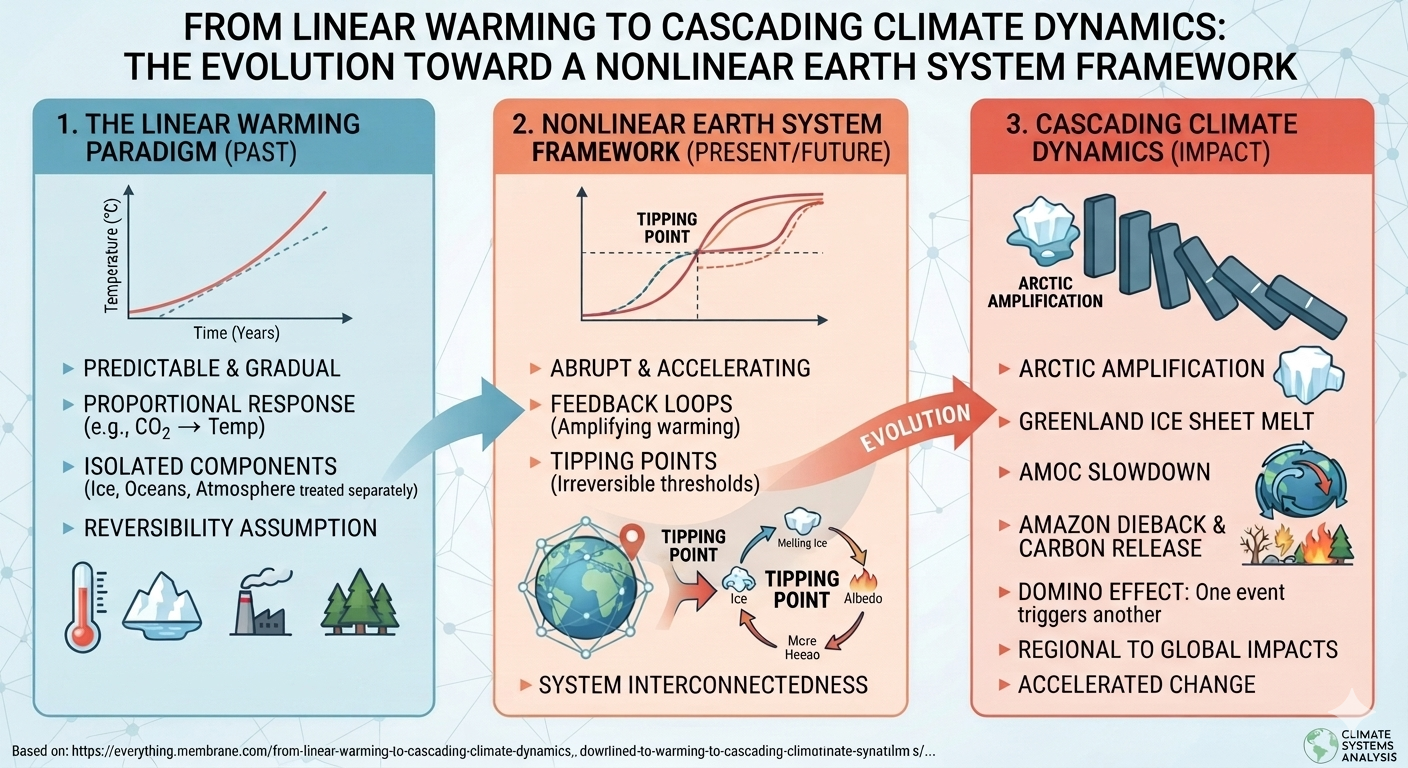
For decades, climate change has been communicated primarily through a relatively simple causal framework: increasing greenhouse gas concentrations drive global warming, which then increases the frequency, intensity, and duration of climate impacts. This linear model has been extraordinarily successful in explaining the fundamental physics of anthropogenic climate change.
However, Earth’s climate system is not a simple linear machine. It is a complex adaptive system composed of interacting components—including the atmosphere, oceans, cryosphere, biosphere, and human systems—that continuously exchange energy, matter, and information. As these interactions strengthen, the climate system can exhibit behaviors that cannot be fully explained by examining individual components in isolation.
In the 1990s, together with laboratory partner Sidd Mukherjee, we began developing the Nonlinear Acceleration Hypothesis (NAH), a framework proposing that climate change evolves through increasingly interconnected feedback networks. The hypothesis suggests that as climate subsystems become more tightly coupled, disturbances can propagate across multiple pathways, accelerating the rate of environmental change and increasing the probability of compound and cascading climate events.
At the center of this framework is the concept of the Domino Effect, or Cascading Climate Dynamics. In this view, climate-driven events are not isolated occurrences but interacting processes in which one disturbance alters the conditions that influence subsequent events.
For example:
Rising temperatures → increased atmospheric moisture → stronger precipitation extremes → flooding → ecosystem disruption → economic impacts → societal stress
Similarly:
Arctic warming → permafrost thaw → greenhouse gas release → additional warming → further ice loss
These cascading interactions create reinforcing feedback loops that can reshape the trajectory of the entire Earth system.
Climate State-Space: Mapping Earth’s Changing Trajectory
The concept of climate state-space modeling provides a mathematical framework for understanding these complex transitions. Rather than describing climate change through a single variable such as global average temperature, state-space analysis represents the Earth system as a multidimensional landscape containing interacting variables such as:
- Ocean heat content
- Sea level rise
- Atmospheric water vapor
- Marine heatwaves
- Ice-sheet stability
- Ecosystem resilience
- Extreme weather frequency
Each combination of these variables represents a possible climate state. As greenhouse forcing increases and feedback mechanisms intensify, Earth does not simply become warmer—it migrates through climate state-space toward increasingly unfamiliar regions characterized by new combinations of environmental conditions.
This perspective explains why modern climate extremes are increasingly difficult to categorize using historical experience alone. The challenge is not only that individual variables are changing, but that the relationships among variables are also evolving.
Extreme Event Attribution: The Missing Link Supporting a Nonlinear Climate Framework
For many years, climate science was able to establish the broad relationship between rising greenhouse gas concentrations and a warming planet, but scientists faced a significant challenge: determining the extent to which human-caused climate change contributed to specific individual extreme events.
That limitation has now been substantially reduced. Recent advances in extreme event attribution science, including the landmark work summarized by the National Academies of Sciences, Engineering, and Medicine (NASEM), have demonstrated that researchers can rigorously evaluate the human contribution to individual climate extremes, including heatwaves, heavy precipitation events, droughts, and other high-impact phenomena.
This scientific advancement represents more than an improvement in attribution methods—it provides critical observational support for the transition from a linear climate model toward a nonlinear Earth system framework.
The ability to attribute individual events to anthropogenic forcing confirms that climate change is not merely a gradual shift in global averages. Human influence is now detectable within specific components of the climate system and within the extreme events that emerge from their interactions.
This directly aligns with the central premise of the Nonlinear Acceleration Hypothesis (NAH): that climate change increasingly operates through interconnected feedback networks where individual disturbances can amplify, propagate, and interact across multiple Earth system components.
The scientific question is therefore evolving from:
“Is human activity causing climate change and increasing extreme events?”
to:
“How do human-driven changes alter the probability, intensity, timing, and interaction of cascading climate events across the Earth system?”
NASEM’s validation of extreme event attribution establishes an important foundation for this next phase of climate science. If human influence can now be detected within individual extreme events, then the logical next step is understanding how these events connect through feedback loops and contribute to broader system-level transitions.
The emerging scientific picture is of a coupled planetary system in which the atmosphere, oceans, cryosphere, biosphere, and human societies are not independent components but interacting elements of a dynamic network.
The future of climate research must therefore expand beyond measuring warming alone and toward understanding climate system acceleration, state-space migration, and cascading dynamics.
Climate change is not simply a rise in temperature.
It is an accelerating transformation of the Earth system driven by increasingly interconnected feedbacks.
Understanding this transformation requires new mathematical frameworks, new modeling approaches, and a deeper understanding of the nonlinear interactions that determine planetary stability.