by Daniel Brouse
A Global Climate System Under Increasing Stress
The most destructive climate disasters of 2026 reveal a rapidly changing pattern: extreme events are becoming more intense, more widespread, and increasingly interconnected.
From deadly heatwaves across Europe and South Asia to catastrophic flooding and severe storms across the United States, this year’s disasters demonstrate how human-caused warming is amplifying natural climate variability.
Scientific attribution studies from organizations such as World Weather Attribution (WWA) have repeatedly shown that greenhouse gas emissions are increasing the severity, duration, and likelihood of many modern climate extremes. Climate change is not replacing natural weather patterns—it is shifting the baseline conditions in which those patterns occur, turning historically rare events into recurring hazards.
1. Global Heatwaves and Heat Domes — The Deadliest Climate Hazard of 2026
Extreme heat has emerged as the defining climate disaster of the year, affecting billions of people across South Asia, Europe, the Middle East, and North America.
South Asia: Record-Breaking Pre-Monsoon Heat
India and Pakistan experienced a prolonged pre-monsoon heatwave, with temperatures repeatedly exceeding 46°C (115°F) in multiple cities.
The extreme heat disrupted agriculture, increased energy demand, threatened outdoor workers, and placed millions of vulnerable people at risk.
Climate Connection:
World Weather Attribution researchers concluded that human-caused warming significantly intensified the event, making such prolonged extreme heat far more likely than under historical climate conditions.
Europe: Over 10,000 Excess Deaths from Extreme Heat
Europe experienced one of the most severe heat disasters in modern history as persistent heatwaves pushed temperatures 5–12°C above average in some regions.
France, Spain, the United Kingdom, and other European nations experienced record-breaking temperatures, widespread drought stress, increased wildfire danger, and severe impacts on public health.
The heat contributed to more than 10,000 excess deaths, with older adults and people with underlying health vulnerabilities experiencing the greatest risks.
These deaths highlight the growing recognition that extreme heat is one of the deadliest consequences of climate change, often exceeding the immediate fatalities associated with storms and floods.
Climate Connection:
Attribution studies have concluded that human-caused climate change substantially increased the intensity and probability of these European heat extremes by raising the global temperature baseline.
The Hajj Heat Disaster: Climate Risks in a Warmer World
In Mecca, Saudi Arabia, extreme heat during the Hajj pilgrimage created dangerous conditions for millions of participants.
The combination of intense solar exposure, high humidity, and prolonged outdoor activity pushed temperatures beyond historically safe thresholds, producing hundreds of heat-related illnesses and significant loss of life.
Climate Connection:
Fossil fuel emissions have expanded the duration and severity of dangerous heat conditions in the region, increasing risks for large outdoor gatherings.
2. The Emerging Super El Niño: A Climate Amplifier
The extreme weather of 2026 is occurring alongside a strengthening El Niño event in the tropical Pacific.
El Niño is a natural climate cycle that periodically transfers large amounts of ocean heat into the atmosphere. However, it is now occurring on top of record global ocean temperatures driven by greenhouse gas emissions.
This creates a climate multiplier effect, increasing the likelihood of:
- Record-breaking temperatures
- Extreme rainfall events
- Flash flooding
- Agricultural disruption
- Expanding drought conditions
The interaction between natural variability and human-caused warming is producing a more unstable and energetic climate system.
Major U.S. Climate Disasters of 2026
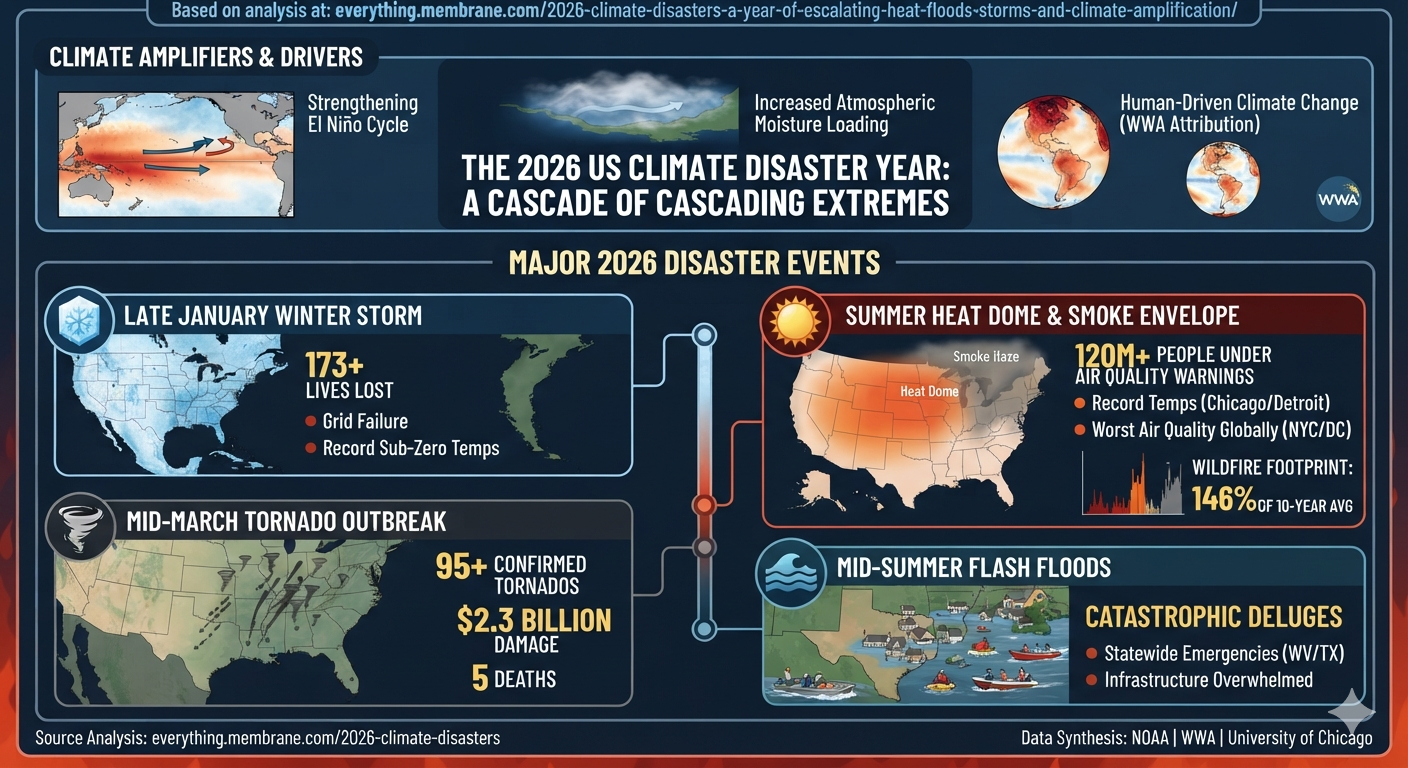
1. Summer Heat Dome and Wildfire Smoke Envelope — Largest Human Exposure
The most widespread U.S. climate disaster of the year was a massive heat dome combined with wildfire smoke spreading across the continent.
More than 120 million Americans from Minnesota to Massachusetts experienced heat alerts and hazardous air quality conditions.
Major metropolitan areas including Chicago, Detroit, New York, and Washington, D.C., experienced some of the worst air quality conditions in the world as smoke from Canadian wildfires moved southward.
Climate Connection:
Hotter and drier conditions have expanded wildfire activity, with North American wildfire acreage reaching approximately 146% of the 10-year average. Climate change is increasing the likelihood of persistent heat domes, drought conditions, and larger wildfire seasons.
2. January North American Winter Storm — Highest Early-Year Death Toll
A massive winter storm swept across the United States and Atlantic Canada, producing extreme cold, freezing temperatures, ice accumulation, and infrastructure failures.
The storm caused more than 173 deaths, making it one of the deadliest weather events of the year.
Climate Connection:
Although winter storms remain natural phenomena, warmer oceans and a warmer atmosphere allow storms to carry more moisture, increasing the potential for heavier precipitation, extreme snowfall, and more damaging freeze events.
3. Central and Southeastern Tornado Outbreak — Largest Severe Storm Damage
A three-day severe weather outbreak in March produced more than 95 confirmed tornadoes, causing approximately $2.3 billion in damage.
The storms moved from Illinois into Mississippi, Alabama, and Georgia, producing destructive tornadoes, damaging winds, and widespread infrastructure impacts.
Climate Connection:
A warmer atmosphere contains more heat and moisture, increasing atmospheric instability and creating conditions favorable for more intense severe thunderstorms.
4. Mid-Summer Flash Flood Disasters — The Fastest Escalating Threat
Extreme rainfall events produced catastrophic flash flooding across parts of Texas Hill Country, West Virginia, and the Ohio Valley.
Communities experienced emergency declarations, water rescues, landslides, infrastructure failures, and overwhelmed emergency systems.
Climate Connection:
Because the atmosphere holds approximately 7% more moisture for every 1°C of warming, climate change is increasing the potential for sudden, extreme rainfall events that overwhelm drainage systems and communities.
2026 Climate Disaster Overview
| Disaster Category | Key 2026 Indicator | Major Impact Areas |
|---|---|---|
| Extreme Heat | Record-breaking heatwaves and >10,000 European excess deaths | Europe, South Asia, Middle East, North America |
| Wildfires | 146% of 10-year average acreage burned | Western U.S., Canada, Northeast smoke corridor |
| Severe Storms | $2.3 billion tornado outbreak | Illinois, Mississippi, Alabama, Georgia |
| Flash Flooding | Multiple emergency declarations | Texas Hill Country, West Virginia, Ohio Valley |
| Winter Storms | 173+ fatalities | United States and Atlantic Canada |
A New Era of Compound Climate Disasters
The defining feature of 2026 is not simply that individual disasters are becoming stronger—it is that climate extremes are increasingly interacting.
Heat intensifies drought.
Drought fuels wildfires.
Wildfires spread smoke across continents.
Warmer oceans energize storms.
A warmer atmosphere produces heavier rainfall.
These cascading interactions represent a transition from isolated weather events to a more interconnected climate risk system.
The challenge of the coming decades will not only be adapting to a warmer planet, but managing a climate system where multiple extreme events increasingly occur together, amplify one another, and create cascading impacts across societies and ecosystems.