by Daniel Brouse
The evidence for human-caused climate change does not rest on a single temperature record, computer model, or scientific study. It comes from multiple independent lines of evidence that converge on the same conclusion.
Three of the clearest are rising global temperatures, shrinking ice sheets and glaciers, and rapidly increasing atmospheric carbon dioxide (CO₂) with a chemical fingerprint linked to fossil fuels.
Each observation is significant on its own. Together, they provide an exceptionally strong scientific case that human activities—especially the burning of coal, oil, and natural gas—are driving the modern warming of Earth’s climate.
1. Rising Global Temperatures
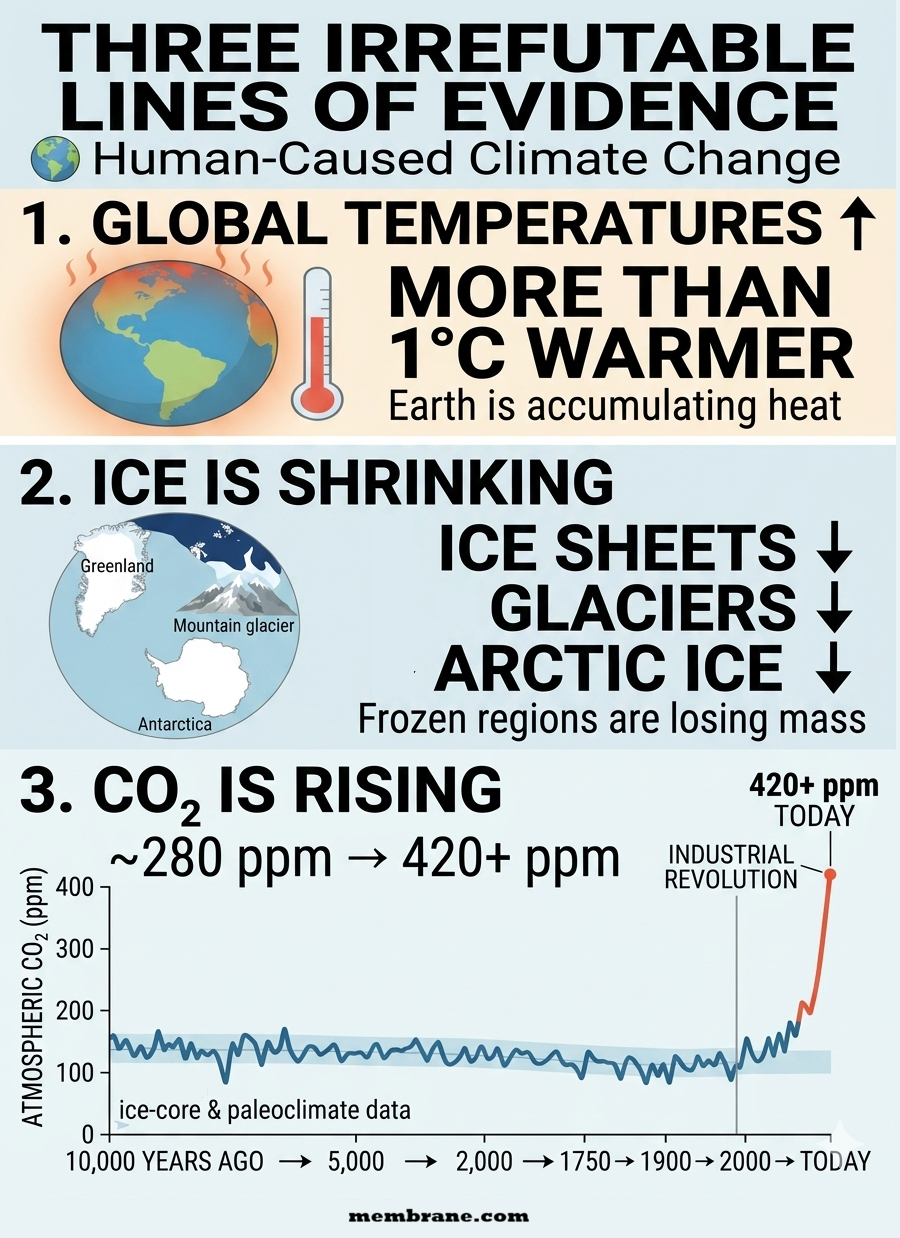
Earth’s average surface temperature has increased by more than 1°C since the late 19th century, with the great majority of that warming occurring since the mid-20th century.
The warming is occurring across the planet and is not limited to the atmosphere. The oceans are absorbing most of the excess heat accumulating in Earth’s climate system, resulting in rising ocean heat content and increasing sea-surface temperatures.
This broad pattern is exactly what scientists expect from an atmosphere increasingly enriched with heat-trapping greenhouse gases.
The evidence also extends beyond simple surface-temperature measurements. Changes in ocean heat, atmospheric temperatures, nighttime temperatures, seasonal patterns, and other components of the climate system independently demonstrate that Earth is undergoing sustained warming.
The planet is not merely experiencing a few unusually hot years. The entire climate system is accumulating heat.
2. Shrinking Ice Sheets, Glaciers, and Arctic Sea Ice
Earth’s frozen regions provide another powerful and highly visible record of climate change.
Greenland and Antarctica are losing ice mass. Glaciers are retreating in nearly every major mountain region, including the Alps, Himalayas, Rockies, Andes, and Alaska. Meanwhile, Arctic sea ice has declined substantially in both extent and thickness.
These changes matter because ice responds directly to changes in the climate system.
When temperatures rise persistently, glaciers retreat and ice sheets lose mass. As snow and ice disappear, darker land and ocean surfaces are exposed, allowing them to absorb more solar energy rather than reflecting it back into space. This creates an important ice-albedo feedback that can amplify warming.
The geographical reach of the changes is particularly important. Ice loss is not occurring at one isolated location. Multiple independent ice systems around the world are responding to a warming planet.
The retreat of glaciers, loss of polar ice, declining Arctic sea ice, and shrinking seasonal snow cover all point in the same direction.
3. Rising Atmospheric CO₂ and the Fossil-Fuel Fingerprint
Perhaps the most direct evidence of human influence comes from the atmosphere itself.
Before industrialization, atmospheric carbon dioxide concentrations were approximately 280 parts per million (ppm). Today, concentrations have risen to more than 420 ppm—an enormous increase occurring over a period far shorter than the natural changes that produced comparable atmospheric concentrations in the distant past.
But the evidence goes beyond simply measuring more CO₂.
Scientists can identify where the additional carbon is coming from.
The carbon added to the atmosphere has an isotopic signature consistent with carbon released from ancient organic material, including coal, oil, and natural gas. Atmospheric oxygen measurements and other observations provide additional evidence that fossil-fuel combustion is responsible for a substantial portion of the increase.
Human activities are therefore not merely occurring at the same time as rising CO₂. We can trace the additional carbon to its source.
And CO₂ has a well-established physical mechanism for affecting climate: it absorbs outgoing infrared radiation, reducing the amount of heat that escapes to space. Increasing its concentration strengthens the atmosphere’s greenhouse effect and produces warming.
Three Independent Signals—One Consistent Explanation
The strength of the evidence comes from the fact that these observations are connected but independently measurable:
Temperatures are rising.
Ice is shrinking.
CO₂ is increasing—and its chemical fingerprint identifies a major human source.
The observations also extend beyond these three indicators. Rising ocean heat, changing atmospheric circulation, shifting precipitation patterns, increasing ocean acidity, and numerous other changes are consistent with a planet responding to increased greenhouse-gas concentrations.
The critical point is that no single observation has to carry the entire argument.
If global temperatures were rising without increasing greenhouse gases, the explanation would be incomplete.
If atmospheric CO₂ were increasing without a corresponding physical mechanism for warming, the explanation would be incomplete.
If temperatures were rising while glaciers, ice sheets, and Arctic sea ice showed no response, the explanation would be incomplete.
Instead, the evidence converges.
The Climate Fingerprint
The modern climate system displays a coherent pattern:
Human activity increases greenhouse gases → greenhouse gases trap additional heat → Earth’s climate system accumulates energy → global temperatures rise → ice melts and glaciers retreat → oceans warm and expand → additional climate feedbacks amplify the changes.
This is not evidence based on one measurement or one institution. It is a conclusion supported by physics, atmospheric chemistry, temperature records, ocean measurements, satellite observations, glacier surveys, ice-sheet measurements, and paleoclimate evidence.
The overwhelming convergence of these independent observations makes the central conclusion extraordinarily robust:
Earth is warming, the warming is occurring across the climate system, atmospheric greenhouse gases are rising because of human activity, and the resulting enhanced greenhouse effect is driving the modern warming.
The evidence is not merely suggestive.
It is convergent, measurable, physically explainable, and unmistakably human-driven.
The Climate Crisis
Extreme Impacts:Extreme Weather Events | Violent Rain | Deadly Humid Heat | Sea Level Rise | Insurance
Ecosystems & Feedbacks:Ecosystem Collapse & Extinction Risks | Soil–Insect Climate Feedback Collapse | Insect Collapse | Soil | Trees & Deforestation
Human Health & Society:Climate Change Business & Economics | DIY Climate Control | Climate & Human Health | Climate Tax | Limits of Human Adaptability | Climate-Driven Health Collapse | Food & Water Security | Civilization Collapse
* Our probabilistic, ensemble-based climate model — which incorporates complex socio-economic and ecological feedback loops within a dynamic, nonlinear system — projects that global temperatures are becoming unsustainable this century. This far exceeds earlier estimates of a 4°C rise over the next thousand years, highlighting a dramatic acceleration in global warming. We are now entering a phase of compound, cascading collapse, where climate, ecological, and societal systems destabilize through interlinked, self-reinforcing feedback loops.
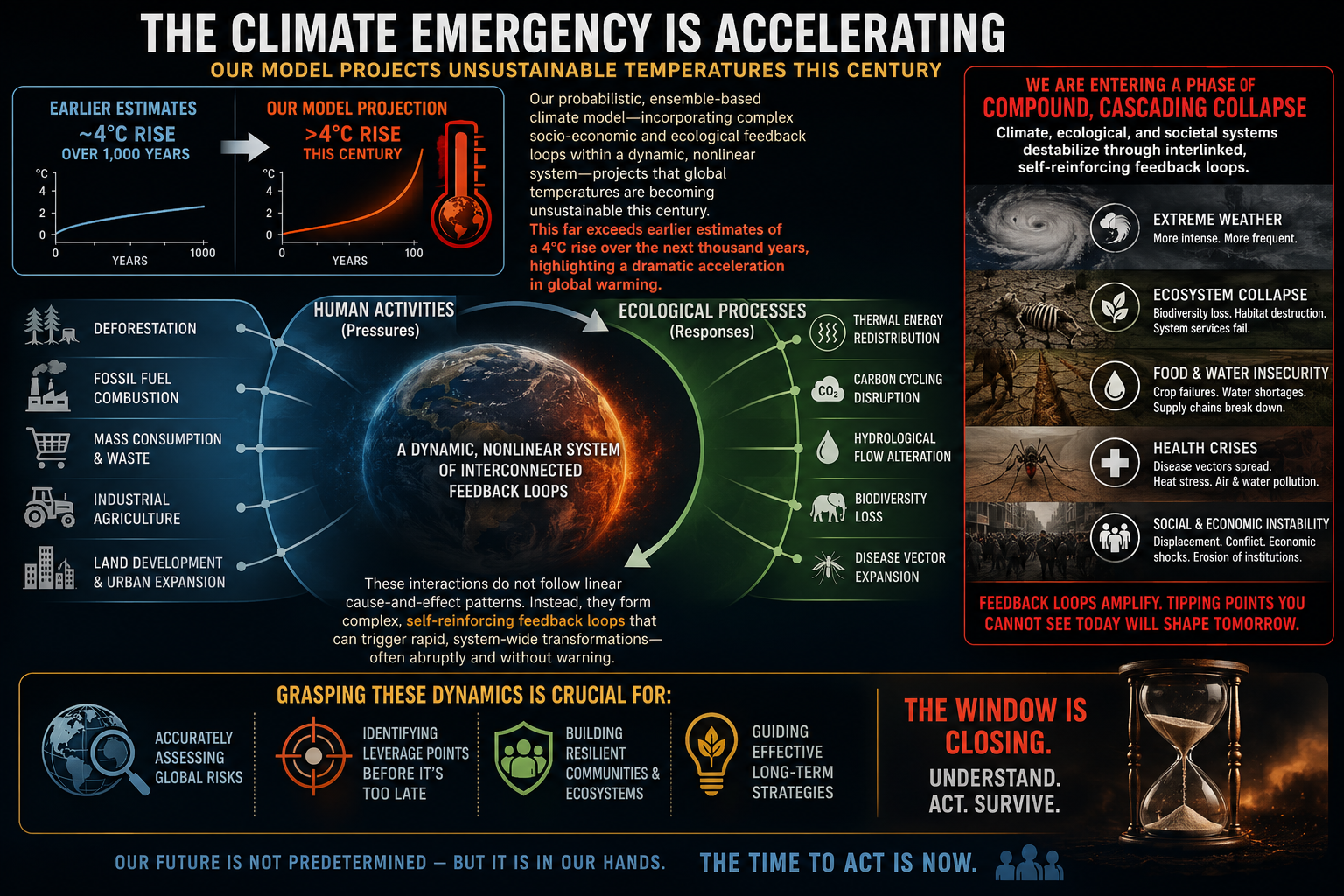
We examine how human activities — such as deforestation, fossil fuel combustion, mass consumption, industrial agriculture, and land development — interact with ecological processes like thermal energy redistribution, carbon cycling, hydrological flow, biodiversity loss, and the spread of disease vectors. These interactions do not follow linear cause-and-effect patterns. Instead, they form complex, self-reinforcing feedback loops that can trigger rapid, system-wide transformations — often abruptly and without warning. Grasping these dynamics is crucial for accurately assessing global risks and developing effective strategies for long-term survival.
Feedback Loops → Acceleration → Tipping Points → Acceleration → Domino Effect
Feedback loops amplify climate change and can push interconnected Earth systems past critical tipping points. As tipping points are crossed, they can trigger additional feedback loops and destabilize other climate systems. This cascading “Domino Effect” compresses timescales, accelerates change, and increases the risk of rapid, nonlinear climate transformations.
Bottom line:The question is no longer how warm the planet becomes, but how life on Earth can endure when change outpaces our ability to adapt.
We cannot control the laws of physics, but we can control our pollution. The most effective action is to stop burning fossil fuels.