By Daniel Brouse
Economist & Climatologist
Membrane Domain USA
August 10, 2026
Our system gives no value to global commons such as the atmosphere or the oceans, because they are not seen as “scarce commodities”. One oak tree does not matter, because there are vast numbers of oak trees.
Pumping sewage into the sea doesn’t matter, because the sea is too big for it to matter.
Pumping CO2 into the air doesn’t matter, because the air is limitless.*
This is a mythological view of the world, and generally people prefer myths to facts, because facts don’t obey wishes.
*In fact if there was a lift that could travel vertically at the speed of a fast car, within minutes you’d need breathing equipment.
— Rocky Rex
Earth’s Thin, Changing Atmosphere: How Human Climate Change Is Reshaping the Troposphere
Human-driven climate change is profoundly altering the thin atmospheric layer in which we live—the troposphere. Greenhouse-gas accumulation is changing its temperature, vertical structure, moisture content, and relationship with the layers above it.
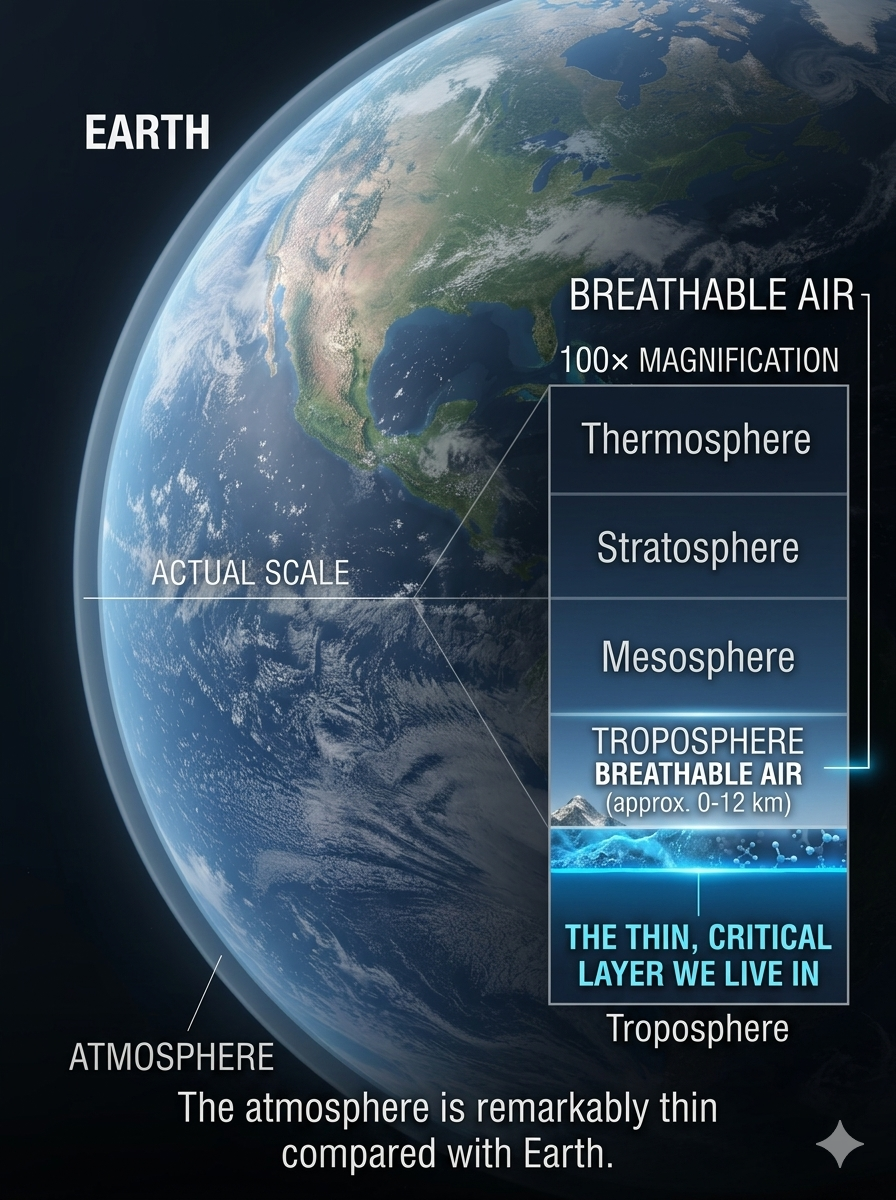
The atmosphere may look enormous in many illustrations, but relative to the size of Earth, the layer where virtually all human life and weather occur is remarkably thin. Climate change is not simply warming this layer; it is changing the structure and dynamics of the atmosphere itself.
1. The Troposphere Is Expanding
As rising greenhouse-gas concentrations warm the troposphere, the atmosphere responds dynamically by expanding. One measurable consequence is a rising tropopause—the boundary between the troposphere and stratosphere.
Observations from radiosondes and satellite GPS-radio-occultation measurements show that the tropopause has risen substantially in recent decades. In the Northern Hemisphere, studies find an average rise of roughly 50–60 meters per decade since 2000, with tropospheric warming identified as the primary driver.
This does not mean that the entire atmosphere is simply being pushed upward like a solid layer. Rather, warming changes the temperature structure and density of the atmosphere, causing the troposphere to occupy a greater vertical extent.
The result: Earth’s already-thin weather layer is expanding upward.
2. Warming Below, Cooling Above
One of the clearest fingerprints of increasing greenhouse gases is a vertical temperature contrast: the troposphere warms while much of the stratosphere cools.
This occurs for different physical reasons in the two layers. In the troposphere, increasing greenhouse gases reduce the rate at which infrared energy escapes directly to space, contributing to warming near the surface and throughout much of the lower atmosphere. In the stratosphere, increasing CO₂ enhances radiative emission to space, producing cooling.
The observed long-term cooling is strongest in the middle and upper stratosphere, where NOAA assessments attribute much of the trend to increasing CO₂ and other greenhouse gases. The lower stratosphere is more complicated: its temperature has shown little long-term global trend since the late 1990s because multiple influences—including ozone changes and natural variability—act simultaneously.
This creates a changing thermal structure across the tropopause.
That matters because temperature gradients help organize winds, atmospheric circulation, jet streams, and the movement of weather systems. Changes in the troposphere–stratosphere system can therefore propagate downward into the weather patterns experienced at Earth’s surface.
3. A Warmer Atmosphere Carries More Water
A warmer atmosphere can contain substantially more water vapor. The Clausius–Clapeyron relationship implies approximately 7% more water-holding capacity per 1°C of warming near typical atmospheric temperatures.
This does not mean that every location becomes 7% wetter. Actual atmospheric moisture depends on evaporation, circulation, precipitation, and regional conditions.
But where additional moisture is available, a warmer atmosphere can support larger amounts of water vapor and heavier precipitation.
Water vapor is itself a powerful greenhouse gas, creating an important positive feedback:
Warming → more atmospheric moisture → stronger greenhouse effect → additional warming
The same additional moisture can also increase the potential intensity of extreme precipitation because storms have access to larger quantities of atmospheric water.
In other words, climate change is altering not only the temperature of the atmosphere but also the amount of energy and water circulating through our thin atmospheric habitat.
4. The Ozone Layer Is Being Affected—But Not Simply “Compressed”
The expanding troposphere interacts with the upper troposphere–lower stratosphere (UTLS), a region where chemistry, radiation, and atmospheric circulation are tightly coupled.
Climate change can alter stratospheric temperatures, circulation, water vapor, and ozone distribution. Increasing greenhouse gases cool the stratosphere and modify atmospheric circulation, while ozone changes themselves affect stratospheric temperature and circulation.
However, it is misleading to say that the expanding troposphere simply “compresses” or “thins” the ozone layer. The ozone layer is not a rigid physical shell. Its distribution changes through interacting chemical and dynamical processes.
Importantly, the global ozone layer is currently recovering from the effects of ozone-depleting substances because of the Montreal Protocol. Climate change nevertheless continues to interact with ozone chemistry and stratospheric circulation, making the relationship between the two systems increasingly important.
5. The Bigger Picture: A Thin Layer Undergoing Structural Change
The most important point is not that climate change is merely making the atmosphere warmer.
It is reorganizing the atmosphere vertically and dynamically.
The troposphere is expanding.
The tropopause is rising.
The troposphere is warming.
Much of the stratosphere is cooling.
Atmospheric moisture is increasing as temperatures rise.
Circulation patterns are changing.
And the interaction between the troposphere, stratosphere, water vapor, and ozone is becoming increasingly important.
All of this is occurring within a layer that is astonishingly thin compared with the size of Earth.
That is perhaps the most important perspective:
We do not live on Earth beneath an enormous atmosphere. We live inside an extraordinarily thin atmospheric layer wrapped around a planet.
Human activity is now changing the physical and chemical properties of that layer on a global scale.
The atmosphere is thin.
The changes are not.